




There comes a point in every publication's life where conventional dispute resolution has run its course. In Critic Te Ārohi’s case, it happened one hundred and one years in.
You can write a letter to the editor. You can request a correction. You can complain privately in the office. Hell, if you’re feeling particularly mature, you can accept that sometimes journalists make mistakes and simply move on.
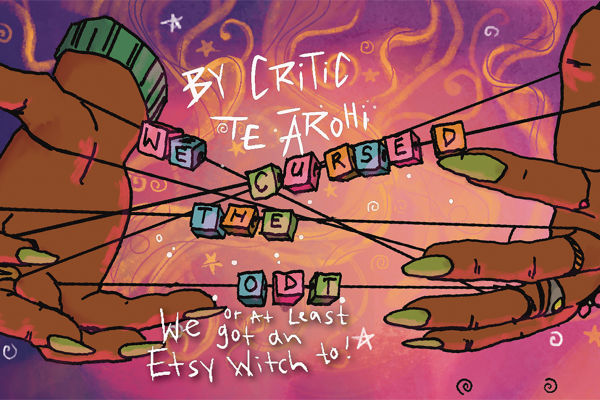
But that’s boring. After years of the media compressing the student body into a caricature of couch-burning, roof-climbing, duck-leg biting morons, we decided to take action. With a bit of spare change in our pocket, we decided to spend $28 to commission an international Etsy witch to place a curse on our biggest rival: the Otago Daily Times.
It’s arguable if the ODT would even consider themselves to be in the same ball-game as us, let alone rivals. For instance, they employ real journalists, and we publish obnoxious sex stories, rules for drinking games, and articles about people making milk out of potatoes. To that, we say “fair enough” – but also “fuck you”.
For the record, Critic is not anti-journalism. We love journalism. We are journalism – just look at this article! Unfortunately, journalism occasionally requires difficult decisions. That’s the real world for you – it’s a cut throat industry. After years of conflict, tensions, and occasionally pulling the finger as we drove past our friends at New Zealand's second most trusted news outlet, we decided that diplomacy had failed.
The next reasonable step was, obviously, supernatural intervention.
The Curse
The process was surprisingly professional, and we got it done sitting at a laptop in the Critic office. It involved a lot more tapping on a keyboard than conjuring, crystals or suspicious chanting echoing. We love technology.
Instead, getting someone to perform a curse for us was just some light online shopping. We browsed, comparing various practitioners and spells. We read reviews. We asked ourselves some very important questions about whether we needed a 5-star witch, or if we could settle for a 4-star. We debated whether we needed to pay an extra fee for a stronger spell (we didn’t do this – we’re saving that for Salient).
Ultimately, we found our practitioner, a witch by the name of Mia. Mia described herself as an “Intuitive Witch” and “Karmic Justice Practitioner” whose work is rooted in “real ritual, real intention, [and] real spiritual presence”. She offered four tiers of magical intervention, the pinnacle of which was the “Permanent Cast/Eternal Seal” – a lifetime karmic binding for those particularly committed to reserve.
While that all sounded super exciting and utterly ghastly for whoever was on the receiving end, we opted for the standard package. Student media budgets only stretch so far. For $28 NZD, we received a personalised curse designed specifically for our situation within 48 hours. Frankly, that’s faster customer service than StudyLink provides, and gave us absolutely no time to consider if firing off curses was good or bad energy.
The Findings
A few days later, our lovely consultant returned her findings. We were expecting a photo of a candle and a vaguely threatening message about Mercury being in retrograde to copy, paste and send straight to Matthew Littlewood’s inbox. Instead, we received a 20-page report written in a similar tone to a Deloitte audit.
According to Mia, the Otago Daily Times is held together by an intricate network of energetic systems. Some were healthy. Some were compromised. Some required immediate intervention.
The first casualty was what Mia coined the “Editorial Accountability Layer”. According to the report, years of accumulated imbalance had disrupted the paper’s ability to properly recognise truth and responsibility (yeah, tell us something we don’t know). Through an elaborate ritual of candles, herbs, and mirror work, Mia was able to identify, isolate, and correct this energetic block. Now we feel way less bad for cursing these guys because realistically we were actually giving them an energy colonoscopy.
The next discovery concerned the “Student Reputation Layer”. This apparently governs the energetic relationship between student media and institutional journalism. The report concluded that this layer had become contaminated through repeated narrative distortion and required immediate purification. Frankly, it was reassuring to have our suspicions confirmed by an internationally accredited Etsy witch. For years, student culture has been reduced to Castle Street, Saint Patrick’s Day and whatever shit related incident has happened that week. These reductions are, admittedly, not always entirely inaccurate. But students also volunteer, research, create art, organise protests, pass exams and occasionally attend lectures. Apparently, the universe agreed that our collective public image needed a little magical assistance.
However, Mia told us that the condition of the “Authorship Truth Layer” was the most concerning. The report suggested that proper recognition of original work had become spiritually obstructed, and required careful separation from competing narrative before truth could once again circulate freely. We can only assume Mia must have been talking about the occasional time where Critic has managed to get to a story before the ODT, which has then resulted in the poor sods scrambling to get an article together and not be shown up by weekly-printing hippies. Luckily, Mia ensured that this layer would not be built on urgency or fear, and instead everyone should enjoy ODT articles that attribute any and all Critic inspo.
The Results
It’s difficult to say if the curse has worked, per se. The ODT continues to publish. The presses continue to roll. The website remains online. Staff continue to arrive at work apparently unburdened by ancient forces. In many ways, it appears nothing has changed. But magic, much like journalism, works on longer deadlines.
At the time of writing, the curse remains active. Mia advises that energetic restructuring can take up to one lunar cycle to fully manifest. Which we totally #respect.
In the meantime, we will continue monitoring the situation with professionalism and the complete absence of confirmation bias that has long defined our fine publication. If, over the coming weeks, the ODT experiences an unusual run of typographical errors, mysteriously flat microphones, or an overwhelming desire to give Critic a shout out, we will simply report the facts.
The ODT has been notified of our actions (via this article).
Conclusions
What have we learned from this exercise? Firstly, the Internet has successfully commodified every conceivable human activity. Secondly, for less than the price of a KFC family bucket, it is possible to outsource your petty grievances to an international spiritual contractor. Thirdly, if journalism as a career ever collapses in its entirety, creative writing appears to be a significant skill used in producing twenty-page mystical reports. After this article, we wouldn’t be surprised if all Critic staff end up on some ‘Do Not Hire’ list within the industry, so it’s nice to know we have options.
Most importantly, this experience reminded us that all media organisations ultimately run on belief. Readers believe stories. Journalists believe they are making a difference. Communication teams believe we are a serious publication. And Etsy witches believe they can energetically restructure an entire newspaper from the other side of the planet for the cost of a box.
For legal reasons, Critic would like to clarify that we have absolutely no evidence that curses are real. We can, however, confirm that Mia delivered her report on time and communicated professionally throughout the process. 10/10.
Should the curse fail, we will accept the outcome with grace, maturity, and dignity. Should the curse succeed, we’d like it noted that Critic has achieved a historic breakthrough in applied occultism and we will begin targeting other publications.
Either way, it was the best $28 we have ever spent.
