



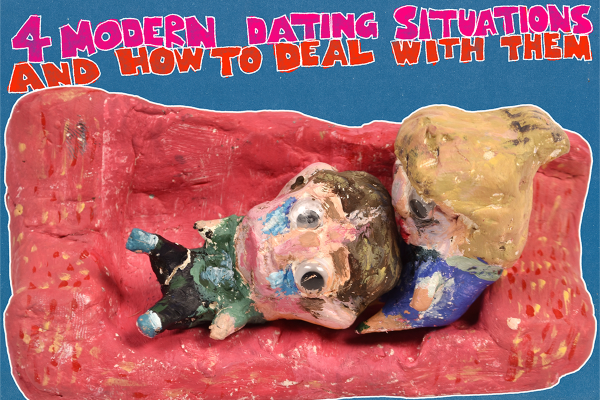

Dating isn’t easy, especially at university. Everything’s changed since our parents were courting each other via carrier pigeon, so we’ve put together some advice applicable to today’s dating scene. This isn’t one-size-fits-all, but it’s a starting point. After all, what is Critic Te Ārohi here for if not to offer completely unsolicited advice?
I feel like ever since coming to university, I’ve outgrown my relationship with my partner. What should I do?
Being in a relationship is often a hefty emotional investment, and it can be stressful if you’re beginning to feel distant. If that’s the case, it’s totally okay (and actually necessary) to take some time to reflect and sit with your thoughts. The decision to end a romantic connection is a meaningful one, and one that sometimes does need to be made.
Growing pains can look like conversations feeling forced or less genuine or having few things in common. You might struggle to relate to them or notice that you don’t feel emotionally or intellectually challenged. You might pick fights over small things or become more easily frustrated at little quirks that they can’t help.
Once you've had a good ponder, try to talk to your partner in an open and constructive manner. They only know what you share with them, and keeping them in the dark doesn’t benefit either of you. Also – do it in person. Phone calls and texts are notoriously difficult forms of emotive communication to rely on when the going gets tough, so maybe don’t go there.
The good news and bad news is that human nature is fluid and dynamic. Our perspectives, interests, and values shift and transform over time, so of course our relationships are inevitably going to change as well. Your top three best mates from primary school probably aren’t still your top three buddies. That doesn’t mean you fell out with anyone; it just shows that we change.
This change is not something to beat yourself up over or blame your partner for. One person may be prioritising self-improvement and exploring different aspects of their identity, while the other partner may feel left behind or content with what they have. Neither is in the wrong.
Just because a relationship ends does not mean it was insincere, wasteful or wrong. If something ends, it doesn’t mean you failed at it, or that you made a mistake and wasted the time spent together. Loss is the proof of love, and outgrowing a relationship isn’t anyone’s fault – it just happens sometimes.
Having that tough conversation will help you both gain a clearer understanding of where your relationship is at.
My partner is upset that I don’t post them on social media. While I maintain a decent online presence, I’m pretty private about my relationships and don’t really want to post my partner. What should I do?
For some, posting their partner all over the place is an effortless display of admiration. For others, relationships are a part of life that warrants more privacy. We all have different approaches to how we personalise our social media presence, and there’s no right answer (despite what that guy who rates Instagram accounts may say). Social media throws us right off the deep end of being perceived, and it can be scary dealing with that while striving to feel accepted and appreciated by our peers – and partners.
If you’re someone who doesn’t really vibe with posting your partner, that’s chill. Hopefully it’s because of your own reasons, and isn’t a reflection of them, your relationship, or an extensive roster you’re trying to keep on the DL. Assuming your reasons are deeper than that, once again, open and honest communication is always the way to go.
It’s important to explain that your partner’s absence on your social media is not a reflection of their worth, or of how much you value your relationship. We all show how we value our relationships differently, but explaining your own thoughts with transparency and care will set your partner’s mind at ease.
You could try some other ways of showing that you value them – buy a bottle of wine worth $20 instead of the usual $11 for your next date night, wash up the pile of dishes that has been causing tension in their flat, or even offer some purely selfless lovemaking.
There is no rulebook for relationships, and how you run the ‘gram is entirely up to you. If you’re feeling pressured by your partner to change your behaviour, talk about it! Maybe even find a nonsensical BuzzFeed quiz on what each of your love languages are (is BuzzFeed still a thing?). It’s a starting point to working out what's important to each of you in your relationship and knowing that sometimes these things can change over time.
Understanding what your partner values in relationships is huge, and while it’s important to stay true to yourself, compromise is also a cornerstone of any strong relationship – potentially a cheeky soft launch might be the best of both worlds.
With all the discourse online around looksmaxxing, incels, and being an “alpha male”, I feel super self-conscious about the way I talk to women. Any advice?
The media we consume undoubtedly can have some pretty pervasive effects. If we are constantly exposed to handpicked highlights of the most attractive, smart and successful people on social media, we are absolutely going to start subconsciously comparing ourselves to these famous models, influencers, and celebrities.
Even looking at our friends and peers online, we often end up comparing the parts we see of their lives – their best moments from a semester – with the (often monotonous) reality of our own.
First and foremost, it’s important to remember that line that has been repeated to us over and over: social media isn’t real. Comparing ourselves to others only heightens our awareness of how we ourselves are perceived – something that we can’t exactly control.
It is often both liberating and difficult to learn that lesson, but once you do, you can reality check your attitudes around relationships as well. Believe it or not, you don’t need impossibly perfect physical features to have a conversation with a girl. Sure, physical attraction is a factor, but there’s no objective standard measurable by metrics.
Your personality, behaviour, and general vibe are going to make a more lasting and valuable impression than a perfect jawline. You’re more likely to be remembered for how you’ve made someone feel, rather than what you look like, so it may be more helpful to think about some promising topics of conversation, rather than obsessing over trying to achieve an eight-pack. Even if you’ve got biceps the size of tree trunks, chances are you’ll still be reasonably nervous when taking a chance on someone you’re interested in.
There’s nothing wrong with material self-improvement, but it's more beneficial long-term when you’re striving to achieve it for the right reasons. Reframe your thinking about feeling nervous, too. View nerves as a chance to facilitate improvement, not debilitate you. Nerves often signify a course of action worth pursuing, so take that leap of faith and give it your best shot! You miss all the shots you don’t take, so trust that the right person will love you for who you are, and what you look like. Realistically, if you’re being a dick and going on about yourself, they’ll see right through you anyway.
My partner changes when they get drunk. They suggest that I don’t love them, or that we should break up. When they’re sober, they apologise. Do I say something?
As hard as it can be to say something, the answer to almost all of these relationship problems is open communication – and this is no exception. However, this can be a delicate situation, and a super tough one to be in, so take the time to think through what you’re actually trying to get across.
First of all, if you’re genuinely worried about your partner’s drinking habits and their wellbeing on a more serious level, there are resources available through Student Support and Student Health, and more information about these can be found on the University website.
Putting that aside, try and unpack your partner’s reasoning behind these comments. Don’t take the whole ‘drunk words are sober thoughts’ thing and run with it – alcohol isn’t a truth potion.
See if you can manage a productive (sober) conversation to see what the actual root of the problem is. Whether it’s anxiety, or insecurity or something else that’s bugging them, it’s important to try and understand where they’re coming from.
At the same time, remember that it’s okay to take a step back. This situation is a lot to deal with, and using guilt in this way is hugely detrimental to any relationship, and completely unfair on you. Take time for yourself and make sure you have a support system outside of your partner – your friends, family, or Student Support.
