



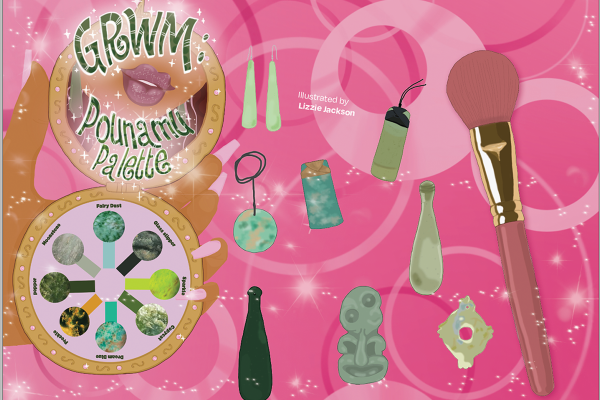

Imagine the South Island launching its own eyeshadow palette. Crack open the compact, and you’ll find smoky forest greens, creamy blue sheens, leafy olives, and icy shimmers that easily double as highlight. Except this collection isn’t sitting beneath the fluorescent lights at Mecca; it has been forming beneath Te Waipounamu for millions of years.
But before we swatch, let’s get the formula straight. Pounamu is not simply greenstone, nor is it just jade. Most pounamu is nephrite, a tough metamorphic rock formed deep underground under intense heat and pressure. So yes – the glow-up takes millions of years. The result is a stone that is exclusively sourced in Te Waipounamu (it’s in the name, duh), with major source pockets around Te Tai Poutini, South Westland and Wakatipu, while bowenite occurs at Piopiotahi. Limited edition is an understatement.
But pounamu is more than a pretty colour story. It has been fashioned into tools, ornaments and weapons, traded between communities and gifted to strengthen relationships. In 1997, the Ngāi Tahu (Pounamu Vesting) Act returned Crown-held pounamu to Te Rūnanga o Ngāi Tahu. Yet illegal extraction and trade continue, while markets can obscure the provenance. After all, a convincing swatch doesn’t make the formula authentic, and “greenstone” is not one pigment. Jade, on the other hand, is a global category referring to two different minerals: jadeite and nephrite. Jadeite does not occur naturally in Aotearoa, while most pounamu is nephrite; bowenite and serpentine also make the legal cut. Think of jade as the beauty aisle, not the brand. Now, let’s swatch.
Kahurangi (Shade: Sparkle)
Did somebody say flawless? Kahurangi is a vividly green, highly prized variety of nephrite, with a clarity that gives it an almost luminous quality. If you’re reaching for a sparkly shade that catches the light first, this is your match.
Kawakawa (Shade: Pepper)
Named after the kawakawa leaf, this medium-to-dark green nephrite is usually opaque and the most common variety. Consider it the everyday shade of the palette: rich pigment, low shine, and flattering on anyone. She may be a classic, but she never misses.
Īnanga (Shade: Moonstone)
Named after the native whitebait, the cool-toned pearl of the palette ranges from milky white to mottled grey-green and misted blue-grey. Some pieces are incredibly translucent, giving them the soft silvery glow of a moonlit stone.
Kōkopu (Shade: Freckle)
Kōkopu doesn’t draw her freckles on – they’re natural, darling. Named after the native freshwater fish, this variety blends olive and green with natural speckles of cream, brown, white, red and blue. Like Fenty, kōkopu’s shade range is unmatched.
Tangiwai (Shade: Glass Slipper)
Glossy and luminous, tangiwai shifts flawlessly from olive to blue-green when held to the light. Considered the earliest form of pounamu used by Māori, it is also the palette’s formula outlier: unlike most pounamu, tangiwai is not nephrite, but bowenite, a translucent form of serpentine. No filter required. She is sheer brilliance.
Tahutahi (Shade: Fairy Dust)
Located on the Cascade Plateau south of Haast, tahutahi is the rarest pounamu in Aotearoa and the shimmeriest shade in the palette. Its vibrant green is pressed with glittery white flecks scattered throughout the stone. Talk about a natural highlight, nē?
Aotea (Shade: Blue Dream)
Soft, cloudy blue takes shape in this rare South Westland stone, where blue kyanite, green fuchsite and white quartz blend in a cool, silvery mix. Softer than nephrite, when it comes to formula this one is playing by different rules: its mineral make-up means it falls outside the three stone types legally defined as pounamu. Still, it’s proof that greenstone doesn’t always mean green.
Serpentine (Shade: Copycat)
Serpentine brings a misunderstood matte finish to our palette. Sometimes called the “fool’s gold” of pounamu, she’s often dismissed as a cheap dupe. Māori made reels, pendants and taonga from serpentine long before Europeans' arrival, and the 1997 Act includes qualifying serpentine within its definition of pounamu. Respect the shade.
GRWM: Final Look
So, what’s the final look? The swatch might be flawless, the pigment may have serious payoff, but what’s actually in the formula? With pounamu, geology tells us what’s in the formula, provenance is the receipt, and whakapapa and law are its authenticity sticker. Together, they tell you what the stone is, where it came from, and how it belongs to Te Waipounamu. Just like any good product, what’s behind the packaging matters. Pounamu worked by local carvers deserve more love than faceless, mass-produced greenstone churned out for the souvenir shelf. Go ahead and obsess over the rare shades, but don’t just stop at the swatch. Read the label, check the receipt, and know your formula.
After all, trends get discontinued, but taonga are forever diamonds.
