




Relationships are not a concrete concept, but rather something much more fluid. This may very well be one of the biggest lessons I have learnt since moving out of home and going to university. ‘Boyfriend and girlfriend’ is not a rigid term, it turns out. The more people you meet and form bonds with, the clearer it is that what constitutes an ‘adult relationship’ can be just as messy as the world of young love and friendships.
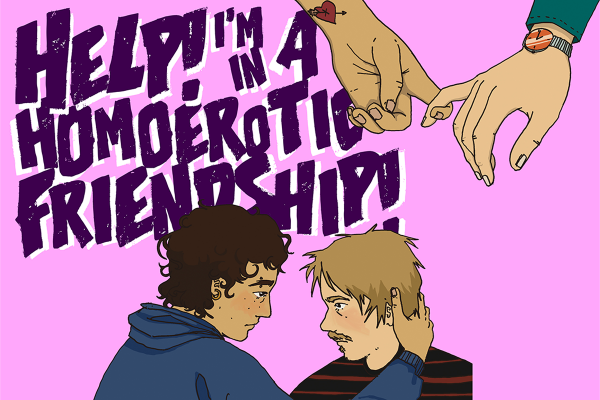
Whether it’s easy for you to admit or not, homoerotic friendships are inherent to the queer experience. Western society has laid out the ground rules for friendships for centuries: female friendships share deep emotional bonds, while male friendships are guarded with banter to prevent any semblance of a feeling from crashing through. But with growing up queer, many of these friendships don’t fit the script, providing a source of ‘in-between friendships’. There’s never enough there to afford a label, but there’s room where many lessons about love end up laying. I think that’s where the term ‘homoerotic friendship’ begins to look handy: an intimate, same-gender bond without necessarily involving any sexual or romantic activity, existing in the in-between.
Growing up, I have a distinct memory of my mother sitting me down in year one and telling me I needed to be friends with more boys. This wasn’t a thought that had ever crossed my mind before but was one of the first moments where I learnt how society wanted my friendships to be. I wasn’t a sporty kid, preferring reading and gossiping, which found me among girls, and I didn’t notice a single thing about it. Luckily for my mother, a Pokémon phase found me a pack of dweeby boys to ride through primary school with, as if being able to name the original 151 together was what my friendships were destined to be.
Years later, high school rolled around, conveniently as we trawled through the depths of puberty. The gender of who you were friends with suddenly made a lot more sense to me. Our balls were dropping – it was game time. Suddenly, my Pokémon crew were off to the all-boys high school, and at my co-ed, I found myself back in a healthy rotation of female friendships. Again, I didn't see the appeal in playing football every lunch, but lying on the field and gossiping took my heart.
Unfortunately for me, a three letter g word became a regular in people's vocabulary. Suddenly, who I was friends with became pretty good evidence to be called that. As did my voice, which was somehow deep thanks to my fresh Adam’s apple, but had a touch of femininity to it that people liked to point out. And after those came the little things. The way I walked, my hobbies and anything that didn’t fit the conveniently set-out standards for masculinity made it easy bait for any observers. It wasn’t just from peers either. One time a friend had told me their mum had described me as quite an “effeminate” male friend, as if that invalidated the bond we had. Ouch.
If you couldn’t tell by my lack of close male friendships growing up, this was a glaring sign I would turn out to be queer when I got older. I may have missed the signs (some people know before they even understand what sexuality is, I was more the type who realised one random night at seventeen years old). By the time I arrived at university, I had a lot of soul searching and thinking to do about how I would conduct my relationships, and dealing with the fallouts of being a square peg in the circular hole of masculinity.
From the first day of uni, I hit it off with this guy. Our friend groups didn’t particularly cross over, but we both always took the chance to get to know each other.
Even the phrase ‘homoerotic’ doesn’t feel quite right. The word ‘erotic’ carries a connotation of something provocative, daring and controversial. In the moment, what feels normal to you is almost never seen as erotic in your mind. When the conversations reach vulnerability and connection so strong you cannot speak it, perhaps that is too daring for society to see as coming from just a friendship.
Then there’s the co-dependency. Showing up to a host without him by my side didn’t feel right, and his flat would instinctively invite me to pre’s before the rest of the friend group. It began to feel like domestic clockwork. Heck, we even shared the same part-time job at one point during the summer break. In the moment it just felt like two friends by each other's side no matter what, but the more I understood our friendship, the more I understood the power he held. It’s from these moments that other emotions develop, such as jealousy from not spending every waking second together. I began to wonder if he approached all of his friendships like this, if I was just another in a long line of friendships where we never talked about what happened.
But when nobody was around, you couldn’t ignore it. Electric tension. Brushes of the pinky that always lasted half a second too long to be accidental. Fingers curling around each other at gigs and finding secluded places to chat on drunk walks home for hours at a time. Most of the time, nothing happened. But it always felt like something would. And sometimes it did. The most important rule is that if it did, we told none of our friends. We never even acknowledged it to each other. At the best of times, it was thrilling. At the worst, I felt like a secret experiment that nobody thought about. When you never talk about these moments, the space feels like too much of a vacuum to ever broach the topic of sexuality, or the dreaded “what are we”?
Looking back, the moments feel so high-schoolesque and cringe, but maybe that was the point. A lot of that stuff doesn’t happen between two people of the same sex in high school, maybe a homoerotic friendship was trying to speed up your social development by advancing friendship and love at the same time. Lots of emotions are advanced in the absence of sincere communication, because what a homoerotic friendship is seems to disappear from the world the second you try to quantify or describe it.
When writing it all on paper, it doesn’t seem all that different from your normal run-of-the-mill relationship. Meeting for coffee on the reg may as well have been a date, same for those hour- long drives. So when did the separation become apparent? Perhaps only at the end. ‘Cause when it ends, there’s no messy break-up or devolution of it all. It all just silently fizzles out. There was no big talk about feelings or the future. We were just something one day and not the next. Normal break-ups happen, and society doesn’t bat an eye when you grieve and feel the emotions of a relationship that doesn’t exist anymore. But without a label, it may as well just be another day in the office. Nobody past primary school seems to care if a friendship has broken off, particularly when you’re a guy. You both move on with life, and months later it probably hits you what it all was. In my case, this happened as they began to date regularly and get into their first serious university relationship – pretty much as soon as our very close friendship had ended. Friendships are transient, you see. Relationships are meant to be something special that lasts longer. If your bond doesn’t fit the relationship mould when it ends, the ending will not fit that mould either.
The funny thing is that through the peak of my most intense homoerotic friendship, I would have never thought I was living it. Sure, we were friends with a couple of sworn secrets, but apart from that we looked like a normal set of best friends. By the time I ended up describing this experience to other people, I was shocked by the amount of people who had experienced a similar thing.
Nobody wants to talk about homoerotic friendships, but we can acknowledge the lessons you learn from one. As a queer man, the types of relationships and friendships that are modelled and put on pedestals are often not what you experience growing up. This instead results in an awkward bottleneck in your early adulthood where a tsunami of repressed feelings can explode at any second, on to any friendship. In some ways, I feel that it’s bound to happen. Adult relationships are complicated on a good day, and even more so if you never had the tailored tools or role modelling available to decode them.
That doesn’t mean I’m hateful or resentful of my homoerotic friendship. I have learnt so much about myself, how I treat others and even how I love just from these friendships. At the end of the day, that’s just young adulthood. It’s these relationships that shape you as to who you are, and as long as you are safe and loved in the moment, maybe it will be alright after all.
