



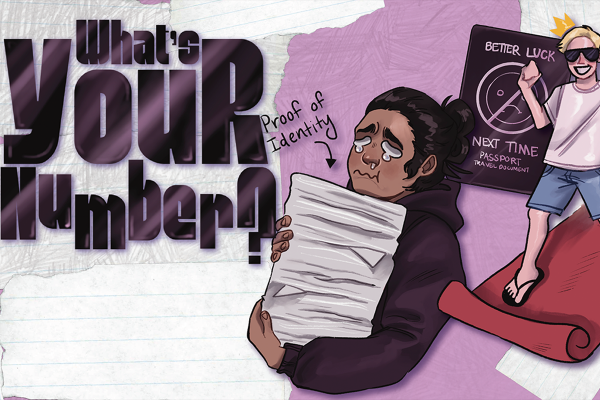

Hector* clocks in at 7, Tonya* at 10, Dominica* at 16 and Augusto*? A solid 41. Get your mind out of the gutter, folks – I’m not talking about that number.
I’m talking about a number that – through no fault of your own – can change your life, make or break your dream and dictate how much of the world you get to see and how easily. Drum roll, please: the global passport index.
Passports have a complex and surprisingly long history, with early versions appearing in ancient China and classical Rome. But the modern passport – in the shape and form we recognise today – was introduced as a “temporary” wartime security measure during World War I. Through the series of events that followed, a handful of rich and powerful nations, especially the erstwhile colonisers, ended up becoming the gatekeepers of global mobility. The imperialist and fascist politics of the era were also clearly reflected in the system.
After WWI ended, 42 nations, mostly the victorious Western Allied powers – convened at the Paris Conference on Passports in 1920, where the standardisation of modern passports took place. The British passport was treated as the “gold standard,” true to imperialist traditions. Fascist regimes of the 1920s and 1930s later perfected the passport as a tool of population surveillance, control and racial sorting. The irony? The Paris conference was convened partly to consider the total abolition of the passport system.
So, back to those numbers. The global passport index indicates the strength of a country’s passport, based on how many countries its holder can enter visa-free or with a visa on arrival. There isn’t a single passport index, but the most popular one is the Henley Passport Index (HPI). According to HPI, Hector’s Canadian passport ranks 7 globally, granting him visa-free access to 183 countries. Kiana’s* Iranian passport, on the other hand, ranks 97, allowing her to travel to only 37 countries hassle-free. The lower your passport sits in this hierarchy, the more complex, expensive and uncertain international travel becomes. For some additional context, a New Zealand passport is a 7.
TWO CLUBS, ONE GAMBLE
My number is 82, and my visa journey sucked! It gave me sleepless nights, probably a few extra frown lines and kept my therapist in business. With the stress of that, I wanted to know if I was alone in this – and I’m definitely not.
The University of Otago actually boasts an international student population of 14%, so I conducted a small survey among 20 international students from different parts of the world across five continents (though I didn’t manage to track down any Europeans). The survey had 21 questions about different aspects of the visa process. The responses were grouped based on the HPI scores of the participants’ passports and analysed.
The most telling signs of inequality appeared in three categories: visa processing times, overall visa expenses and the number of documents submitted. For the sake of keeping it simple, let’s call the strong-HPI countries Club North and the weak-HPI countries Club South. That’s a tribute to my exorbitantly expensive master’s degree in international development here at Otago, referring to the concept of the Global North and South. The Global North are wealthier, industrialised countries with more economic and political power, and the South tend to be countries with lower income levels and histories of colonial exploitation.
Now, bear with me while I throw a few more numbers at you.
I found that participants from countries with lower HPI scores typically had longer visa processing windows, and more than 50% of them waited over four weeks. From my personal experience, those four weeks feel like four decades. Every email notification is terrifying because a visa rejection means more than a ‘no’ – it means starting from zero again. I would liken it to psychological warfare. One in four respondents from Club South reported previous visa rejections from different countries, whereas none from Club North had faced any.
The same pattern showed up in processing fees: most from Club North spent only between 100 and 1,000 dollars, while the pattern for Club South was far heavier – around 45% paid between 1,000 and 2,000 NZD, and about 12% were pushed beyond 2,000. And that’s before counting the hidden costs – travelling for government clearances, expensive medical exams, bank charges, exchange‑rate fluctuations and the hours and pay lost due to taking leave from work. Club South is also shackled by weak currencies, leaving them to deal with a brutal double whammy.
The next disparity was documentation. Three‑quarters of Club North had to submit only between 1 and 15 documents – the basic essentials like passports, university offer letters and bank statements. In contrast, nearly half of respondents from Club South, especially those who travelled with family, had to produce around 30 to 50 documents – sometimes even more. These included social media records, personal photographs, family history, travel history, chats and call‑logs, legal affidavits and property deeds, on top of the key documents. Many of these are difficult to access because of bureaucratic delays or unfavourable political scenarios and respondents reported that the paperwork hunt took just as long as – if not longer than – the actual application process.
The visa game is a high‑stakes gamble, and the toll it takes on mental health is often overlooked. About half of all respondents reported moderate to high stress levels during the process. Another 15% described the experience as “painful,” and 10% said “I wouldn’t wish this process on my worst enemies” – all of whom were from Club South.
Not all metrics were bleak, though. A vast majority of the international cohort reported being well travelled. In this context, I use “well travelled” to mean that they have visited at least two countries outside their home country and Aotearoa New Zealand.
But remember – these experiences still only capture those who ‘made the crossing’. For thousands more, the finish line keeps moving. According to official data from New Zealand Immigration, 6,487 student visas were rejected in the calendar year 2025 alone. About 98% of all rejected student visas were from Club South.
At the beginning of this year, the UK government announced a temporary “visa brake”, halting new study visa applications for four countries: Afghanistan, Cameroon, Myanmar and Sudan. Students who had secured prestigious scholarships like Chevening were left with just 19 days to find a way out – which they ultimately couldn’t – resulting in their visas and scholarships being terminated. All because they were born on the wrong side of imaginary lines on a make‑believe globe.
PUNISHING DIGITS
International students in Aotearoa (including myself) are not here just because we are smart. We are here because we have been bestowed with social and cultural capital – because we had the privilege of being in the right place at the right time.
For some, the stamps on their passports are souvenirs of adventure, freedom, and wanderlust. For others, they’re what Dimitry Kochenov calls a “punishing legal liability” , they’re people who end up as “victims of their citizenships.” Put simply, Amila* (HPI 98) or Lionel* (HPI 88) can’t just join their mate Hazel* (HPI 7) if she wakes up one morning and decides to backpack across Europe – simply because she can.
We are all born with some numbers predetermined for us. What’s yours?
Some Visa Anecdotes
Pepper
The hardest part of the visa process for Pepper* from China was getting a letter of proof from her local government to confirm that her father was her father! She eventually sorted it out with the help of a kind police officer who took pity on her.
Anika
Anika*, who came here with her partner, had to prove their relationship was ‘stable and genuine’. That meant a never-ending list of documents: joint financial records, mail addressed to their shared residence, public photographs, affidavits from friends and family confirming their relationship and so on. In a frustration-induced moment of rebellion, they included an Amazon invoice for a pack of condoms they had ordered – because according to them, if that doesn’t prove a genuine relationship, then honestly, what does?
Vanessa
Vanessa* is here on a prestigious scholarship and was required to arrive before a stipulated deadline. But the scholarship team at Otago advised her to arrive later, citing financial difficulties in supporting her earlier. She listened and upon arriving
from Samoa was pulled aside by immigration officers for violating visa conditions. After explaining her situation, she was granted a one-month interim visa to sort things out. To quote her: “It was scary and it hasn’t reached the time for it to be funny yet. Lol.”
*(names changed to protect privacy)
