


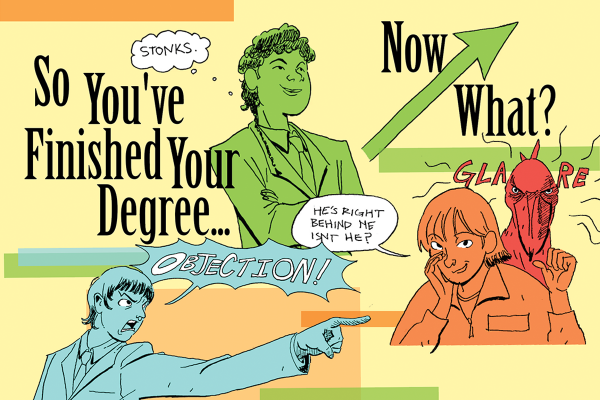

At some point – tragically – university ends. Your student email is deactivated, the midweek hangovers become less defensible, and people start expecting you to exchange roughly eight hours of your day for money. Boo.
If you’re currently staring down graduation and assuming everyone with professional LinkedIn headshots knows something you don't, we’ve got good news: they don’t. Critic Te Ārohi hunted down grads working across healthcare, journalism, science, consulting, policy and other professions Otago churns graduates towards en masse, and asked what they wish they’d known before starting out. Don’t ever say we don’t feed you.
Your first job does not need to be “the one”
MP Francisco Hernandez’s first lesson is probably worth tattooing onto the forehead of anyone stuck trawling Seek until 2am: your first job might not be particularly fun or interesting. Sometimes, he says, “you just gotta take a grind job to get your foot in the door.”
Liam, an associate policy advisor, agreed. His biggest misconception was that you need to land the perfect job in your field immediately – but you don’t. Get in, learn stuff, meet people, then move.
The same applies if your first post-uni move looks sideways, backwards, or a lot like the hospo job you thought your degree was the key to the getaway car from. Journalist and former Critic Editor Nina briefly returned to waitressing before her big break with Paddy Gower. Though, careers unfortunately are not usually a single escalator from Graduate Nobody to Chief Important Person.
Sometimes the first job's main contribution to your career is teaching you exactly what you never want to do again.
Networking is real (unfortunately)
Bad news for those hoping LinkedIn was an elaborate collective prank. Suckers.
Franciso recommends networking “as much as you can while at uni”. Nina says established people in journalism (and most other industries) genuinely want to help the next generation – so send that cold email, ask for the coffee date, and pick their brain. Jodie, an Interpretation Coordinator at Auckland Zoo, goes one better: find a mentor who is both successful and, more importantly, kind.
Try go for less of a ‘corner the CEO beside the cheese platter and recite your CV’ vibe and more ‘let people know you're interested, be pleasant, and stay in touch’. Jodie says all of her contract work has come through word of mouth. Annoying and time consuming? Yes. Useful? Also yes.
You are allowed to have absolutely no clue
Amber, a central-government policy advisor, wishes she had remembered what Cabinet was before starting work. Her solution? “Google is your mate.” That may be the most comforting professional advice you will ever receive.
Healthcare worker Sienna says that when you start somewhere new, you may feel “out of place, terrified, or utterly clueless.” Keep turning up. Hours become weeks, weeks become months, and eventually you stop feeling like someone who snuck in and actually like you. Mia, a health economist, agrees, saying it can take six to nine months – or longer – to properly learn your job.
Lucy, a budding teacher, expected her degree to prepare her to teach. It did. What it did not prepare her for was having to persuade thirty pre-teens to stop talking long enough to actually get some teaching done. Her advice: don’t interpret every chaotic class or situation as evidence that you're bad at your job. Managing other people – especially the youth – is a skill you develop by actually doing the job.
The lesson? Your qualification is what gets you through the door. Nobody expects you to emerge from graduation perfectly cooked and ready to go.
Ask the stupid question
University trains some of us to struggle alone for a whole evening rather than sending a three sentence email to a lecturer. Work is not the place for this.
Mia’s biggest advice is to ask for help. A five-minute conversation with someone senior can save you hours of quiet suffering. Francesca, a consultant, makes the same point: “Corporate uncs are fascinated by our generation and genuinely want to help us succeed. Ask questions!”
Tom, a junior solicitor, quickly discovered that being good at law school and knowing how to be a lawyer are not the same thing. His early mistake was wasting far too long trying to solve things alone because he didn’t want to look incompetent. Meanwhile, a senior lawyer sitting ten metres away could have solved the issue in under a minute.
Being new is the one period of your career where nobody can be shocked that you don’t know something. Use this to help you build your toolkit of skills.
Your degree is not the be-all and end-all
Francesca did an Arts degree and now works as a consultant. She did not, as it turns out, need a Bachelor of Buzzwords, or even of Consulting.
Her advice is to stop only applying for jobs that explicitly name your degree. Group projects become ‘teamwork’. Essays become written communication. Feedback from your supervisor becomes ‘taking direction’. That average assignment submission time of 11:58pm becomes… actually probably best to leave that one out of the CV.
Jodie also warns against assuming grades are everything. Extracurriculars, internships, contacts, and evidence you can work productively in a range of settings can matter just as much. Your degree does matter. It is not, however, a legally binding prediction of the next 45 years of your life.
People skills are important, no matter the job
You can know every bond in the human body and still discover that explaining something to another human is a separate skill. New grad physio Sophie thought starting work would mean the hard bit was knowing what was wrong with a patient and how to fix it. Then she actually started work. Her biggest lesson was that the perfect rehab plan is useless if you can’t explain why it matters, make someone feel comfortable, or convince them to actually do it.
The same rule travels across industries. Clients want lawyers who can explain things without sounding like they were made from a textbook. Students want teachers who can have a yarn. Journalists need sources to trust them. Scientists still have to explain their work to someone who hasn’t spent four years staring down a microscope.
Basically, technical competence gets you a long way – but so does not being unbearable.
Your manager matters – a lot!
Two of the alumni we spoke to came back with the same warning: a good manager can make or break the beginning of your career.
Workforce management graduate Amy recommends talking about working styles early on. Ask whether your manager wants questions as they come up or save for one meeting. Work out how they communicate. Set boundaries before accidentally establishing that you're available until 11pm forever.
Andrew, who works across carbon forestry and online safety, similarly recommends researching who is good to work for and finding someone you can learn from. The shiny company name matters a whole lot less if the person directly above you makes every Tuesday feel like you're crawling over landmines.
Be a person from the jump
Amber sees grads make the mistake of presenting themselves as a “perfect worker robot” in applications. Employers are hiring a colleague as well as a CV. Show some personality and explain not just what you did, but why and how you did it well.
Theo, who works at the Ministry of Social Development, was surprised to discover office workers are not “boring squares”. They are – at the end of the day – just normal people. He had expected full-time work to be miserable. Instead, he likes it. “It’s nice to have money,” he admitted. That’s potentially the strongest graduate recruitment slogan of all time.
Uni rules don't apply here
Andrew offers probably the harshest advice of all: the workplace does not have extensions because you had a big Wednesday. You have to own your work and deliver.
This doesn't mean that your boss or manager won't be flexible with what is going on in your life, but it does mean that reliability and understanding you are part of a chain of workflow is important. Oftentimes other people are waiting on your bit before they can do theirs.
Fransciso had some similar advice: work hard, don’t burn bridges, and join your union.
The grand finale: back yourself
Jodie’s biggest early mistake was letting being the “new grad" or “young one in the office” eat into her confidence. Some workplaces will be brilliant at supporting you. Some will not. Neither is a definitive assessment of whether you belong in the field.
Sienna’s advice was similar: be patient and kind to yourself. The hard days affect everyone. So do the good ones.
Your first job will probably involve confusion, awkward interactions, deeply unnatural email tone and at least one moment where you wonder if in year 13 you made the right decision to study the degree that you did. But nobody starts as the finished product. You learn by doing the job.
So: apply for the thing you're not quite sure you're qualified for. Ask your questions. Take that coffee meeting. Make a friend. And remember that everyone around you once stood in the office kitchen pretending they knew which cupboard the mugs lived in – and soon you actually will.
