



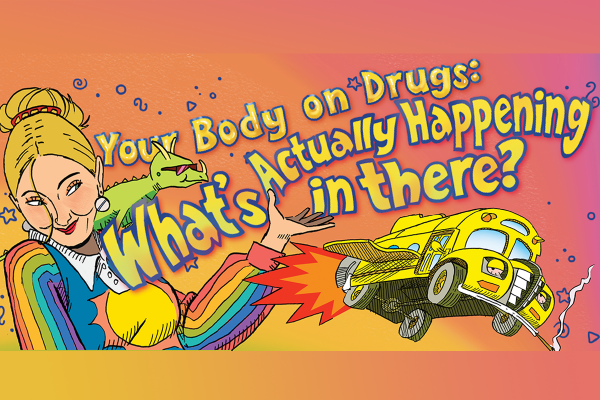

Today is a very special day. Today, we are riding the Magic School Bus into our friend Sally.
Sally is having a very normal night for an Otago student. There’s alcohol in her stomach, caffeine keeping her eyes open and nicotine being passed around. As the evening progresses, things are becoming increasingly pharmacologically complicated. From the outside, Sally is just standing in the kitchen pre-ing for a 21st, having a deep conversation with a girl she met 20 minutes ago. Inside, billions of neurons are firing, her heart is changing pace, her kidneys are fucking around with fluids, her liver is attempting to process the evening, and a whole lot of receptors are being fungled with.
Thankfully, we’ve brought an adult along our ride inside. Professor Bruce Russell is the Dean of the University of Otago’s School of Pharmacy and researches psychopharmacology. For today, he is essentially our Ms Frizzle, except instead of learning about the water cycle we are watching Sally’s nervous system get progressively more scrambled.
Seatbelts on. We’re going in.
First Stop: How Did All This Shit Get In Here?
How drugs get in your body actually makes a big difference to its onset. When you swallow something, it has to work through the digestive system before reaching your bloodstream. If you smoke or vape something, it can reach the brain within seconds – our lungs are very good at moving things into the bloodstream. Unfortunately, this system was designed with oxygen in mind – not a Rothman Red.
Before Sally will feel anything, whatever she’s taken needs to reach the part of her body where it does something. That speed matters too; a faster arrival can create a sharper dopamine response, making the connection between “I did this” and “that felt good” much clearer. Your brain loves learning shortcuts, even shit ones. It’s basically behavioural conditioning, except Pavlov’s dog has a vape.
Alcohol: Someone Has Hit The Brakes
First proper stop: North Dunedin’s favourite drug — and the one people usually forget even is a drug. Alcohol is a central nervous system depressant. That doesn’t mean one vodka lemonade automatically makes Sally sad; it means alcohol slows down activity in parts of her nervous system.
One of the big players is GABA, an inhibitory neurotransmitter. Neurotransmitters are basically chemicals brain cells use to talk to each other, and while some messages say “go”, GABA is more of a “slow down, horsey”.
Alcohol strengthens this signalling, which can initially have the opposite effect to what ‘inhibition’ might intuitively suggest. Sally gets louder, more confident, and significantly less bothered about whether she is embarrassing herself. Her judgement and inhibition are being affected, and so the little voice asking “Should I maybe not do that?” has lost some of its volume.
If Sally keeps drinking, her coordination gets worse, reactions slow, and memory formation can become patchy. At high enough levels, Sally can be awake and talking, but not properly storing parts of the night as memories. This is usually called being ‘blackout drunk’.
Then there's that person who proudly tells you that they can “handle their drink”. Professor Bruce says regular drinkers do not necessarily become much faster at metabolising alcohol – they can just get better at functioning while intoxicated. Your blood alcohol is still your blood alcohol. You’ve just got more experience driving the meat suit while the warning lights are flashing.
Stimulants: Wakey, Wakey!
Time for a complete U-turn! Stimulants include amphetamine-type drugs (like Adderall), methylphenidate (Ritalin), and caffeine. These all work differently, and while prescribed stimulant use is obviously not the same thing as recreational use, all stimulates tend to increase activity in systems linked to alertness and arousal.
Two names worth remembering are dopamine and noradrenaline. Dopamine gets called the “pleasure chemical”, which is a bit like calling the Octagon “a roundabout with traffic lights”. Not technically incorrect, but missing quite a lot. It is involved in reward, motivation, learning and reinforcement.
Noradrenaline is more directly involved in alertness and fight-or-flight. Turn that system up, and Sally’s heart beats faster, blood pressure rises, pupils might dilate, and appetite may disappear. Meanwhile, Sally has suddenly remembered 14 stories that simply must be told right this second.
Caffeine mainly blocks adenosine receptors. Adenosine helps build up feelings of tiredness, so caffeine has not actually removed Sally’s need for sleep. It has just stopped some of those messages getting through — a blockade that has carried generations of students through 8am lectures.
Nicotine: Can I Have A Hoon?
Before leaving stimulant land, we have a quick stop for nicotine – because there is no way Sally has made it this far without asking someone for a cheeky vape or puff of a dart.
Inhale nicotine and it can reach the brain very quickly, feeding into reward pathways involving dopamine. Sally takes a puff, and the brain gets a small reward. Then she can repeat the process almost immediately. Vape equals thing brain likes. Nice and simple.
Nicotine can also raise heart rate and blood pressure and constrict blood vessels. It might feel calming, particularly for someone who uses it regularly, even though it still acts as a stimulant in the body.
MDMA: Best Friends Forever
Now things are getting emotional.
Bruce describes MDMA as sitting somewhere between dopamine-heavy stimulants and drugs whose effects lean more strongly on serotonin. It affects both systems, helping explain the combination of stimulation, altered perception, and an overwhelming desire to tell everyone how much you love them.
Sally has known the girl next to her for 9 minutes and would now take a bullet for her.
Serotonin is also simply known as the “happiness chemical”, but it is involved in heaps of other processes, including mood, perception, temperature regulation, and fluid balance.
MDMA can also cause the body to retain water. Someone dancing in a hot room still needs fluids, but if the body is holding onto water and someone absolutely hoses themselves, sodium in the blood can become dangerously diluted. At the extreme end, this can lead to brain swelling and seizures.
Then comes the post-MDMA slump. Changes in available serotonin and dopamine can contribute to feeling flat afterwards, but despite what someone’s older brother told you in the smokers at a festival, Sally has not literally “used up all her serotonin”. The factory has not shut down; it's just not that well stocked.
Acid: Why Are We Looking At The Wall?
LSD, or acid, is a classic hallucinogen whose major effects are tied much more strongly to serotonin systems than the dopamine-heavy effects associated with stimulants.
Rather than simply making Sally more alert, LSD changes the way her brain processes sensory information. Colours can look different, patterns can shift, sounds may feel strange, and time can stop being like a useful concept. The wall remains a wall – Sally’s brain has just decided to see it in a new light.
Bruce notes that LSD does not appear to drive addiction in the same way as drugs producing strong, rapid dopamine rewards. That doesn’t mean acid is harmless – the risks are just different.
Weed: Green In The Machine
Next stop is the endocannabinoid system, which existed long before anyone discovered you could even smoke weed.
Our bodies naturally produce chemical messengers that interact with cannabinoid receptors involved in things like pain, memory, movement, appetite and perception. THC can act on those same receptors, which helps explain why cannabis can fuck with such a random collection of bodily systems at once.
When she puffs and passes, Sally’s short-term memory becomes less reliable. Time gets weird. Food becomes the only thing she can think about – after all, a packet of chips is definitely the best invention ever. THC is also particularly fond of fatty tissue, meaning it can stick around in the body for longer than the basic feeling of being high lasts.
Synthetic cannabinoids are another thing entirely. Despite names like “synthetic weed”, some can act much more strongly at cannabinoid receptors and be considerably more toxic.
Ketamine: Connection Lost
Our final stop is ketamine, a dissociative drug with anaesthetic properties. One of its major actions is interfering with glutamate signalling through NMDA receptors, disrupting communication between different parts of the brain. The result can be dissociation: feeling detached from your body, surroundings or usual sense of reality. The control room is still open, but no one is answering the phone.
This matters more when we remember Sally has already been drinking. Alcohol and ketamine can have synergistic depressant effects, meaning the combination can cause more impairment than simply adding Drug A to Drug B in your head. Sedation, memory problems and unconsciousness can become more likely.
Everybody Off: Sally Has Mixed Everything
Bruce’s main advice for students is simple: don’t mix drugs.
Once you start combining substances, things become harder to predict. One drug might amplify another, or change how intoxicated Sally feels without undoing what is happening inside her body. A stimulant making her feel awake does not mean the alcohol has magically left her bloodstream. Feeling fine is, unfortunately, not the same as being sober.
There is also the issue that illicit drugs are not always what someone thinks they are – something sold as one drug might contain another, or a mix that produces vaguely similar effects.
Which brings us back to the point of this deeply invasive field trip. From Sally’s perspective, none of this feels like pharmacology. It feels like being drunk, wired, hungry, paranoid, sleepy, affectionate, nauseous or convinced you are having the greatest conversation anyone has ever had.
But inside Sally are receptors, neurotransmitters, organs, blood vessels and electrical signals responding to chemicals interfering with systems that were already there. Drugs do not create a new Sally. They just muck around with the machinery Sally already came with.
Our Magic School Bus is now leaving through whichever exit requires the least explanation.
Someone, anyone – please get Sally home.
If you’re going to take something, get it checked first — KnowYourStuffNZ offers free, legal and confidential drug checking around Aotearoa. And before mixing anything (yes, alcohol counts), check a drug-interaction chart first. Charts aren’t a guarantee that a combo is safe, but they’re a much better starting point than just winging it.
