



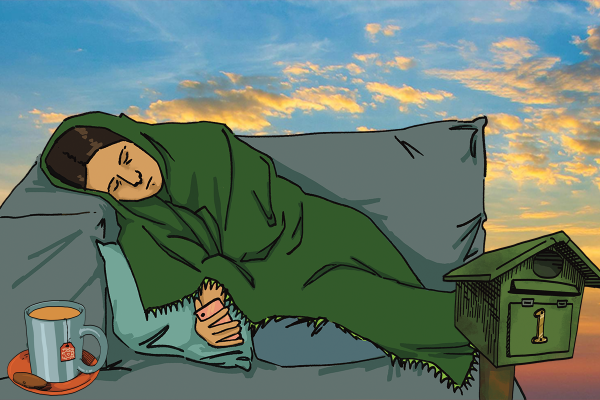

I have spent five years ruminating on the idea of home. On where it is, what it is, and what it means to me, and to those around me.
I was lucky. I grew up in a happy family who lived in the same house from when I was six months old until I left for uni, so I had never really needed to question what home meant to me. This was home, where my Dad would set up a fake Christmas tree every year because I had bad hayfever, where the door frame was covered in Sharpie markings noting me and my siblings’ growth spurts sat, where I knew which cupboard had the good snacks, which doors creaked, and where everything lived without ever really having to think about it.
Home was a fixed point. You left it, but you always came back.
I think that kind of certainty and stability made me a little naive. When you’ve only ever had one home, you only think of it as an address. Something permanent that waits patiently for you while you go off and do other things.
Coming to uni was strange. First year felt like a movie set in the ‘big city’, where I got to do dorm-style living with my best friends nearby and only had to worry about changing my own sheets. For the first time, I was away from home without really being away from home. I had a new bed, new friends, a new city and a new life, but my parents’ house was still there. It was still the address on my bank statements. It was where I spent the holidays. It was still the place I called home.
Halls make this whole transition deceptively easy. You get all the independence of moving out while dinner still magically appears every night. There are hundreds of people around you also pretending they know how to be adults, but someone else is making sure none of you starve.
Somewhere in that first year, Dunedin started to feel like mine. I knew which streets got me home fastest, which supermarket I liked, which shortcuts were actually shortcuts and which ones just involved walking up a hill for no reason. Suddenly, my life was happening here.
I remember my Dad’s reaction the first time I referred to Dunedin as my ‘home’, and the look of horror and sadness in his eyes. ‘Home’ was now somewhere he didn’t even know. Maybe I was even replacing the home he had made for me. But I was just trying to describe where my life was happening. At the time, I felt like one of us had to be right: either my parents’ house was home, or Dunedin was. It took me a while to realise that home can be more than a house.
About a year into uni, my sister moved into my old bedroom. There was no shrine left behind in my honour, no untouched childhood bedroom waiting for my triumphant return. I was replaced. Fair enough, really – my room was always better.
Then my parents moved out of that house I grew up in altogether, and whatever physical claim I had to that version of home disappeared with it. None of my stuff lives at their new house. I don’t have a drawer, a shelf, or even a pile of clothes I forgot to take with me. It is my parents’ house. It is my sister’s house. I am obviously welcome there, but I am essentially just a very loved guest.
And it’s the mundane stuff that gets me. I don’t know where the towels live. That sounds stupid, but there is something devastating about not knowing where your own parents keep their towels. Home is supposed to be the place you can navigate in the dark. The place where you know which cupboard has the mugs, which drawer has the batteries and which door needs a little kick before it will close. Now, I stand in my parents’ kitchen opening cupboards like I’m staying in an Airbnb.
I don’t even know their address off by heart. Every time I need it, I quietly pull up Google Maps because asking would feel worse.
I think this is one of the stranger parts of getting older. Nobody actually kicks you out of home. You just slowly lose your admin privileges. First your sister takes your bedroom. Then your stuff disappears. Then one day you are standing in the bathroom after a shower wondering where the fuck the towels are.
Meanwhile, the flatting years had made ‘home’ more transient. I didn’t particularly want to call a place where it was sometimes too cold for my phone to charge ‘home’, and student flats are not exactly renowned for inspiring permanence. The carpet is questionable, the shower pressure is a gamble, and there is almost certainly mould growing in corners that everyone has collectively agreed not to investigate.
But I loved those flats, and eventually I realised I wasn’t attached to the houses. I was attached to the people inside them.
There's something comforting about knowing someone would always be in the kitchen when you came home. Someone to tell you about the weird thing they did in their tutorial. Someone to sit on the couch while you complain about your day. Someone who’d ask if anyone needed anything from the supermarket and suddenly four of you were all piling into the car to buy one bottle of milk. Someone to wander into your room without knocking because the piece of gossip they had just couldn’t wait.
Home became the place where I could walk through the front door after a horrible day and be understood. It became the place where I could be annoying, grumpy, ugly, silent, loud or completely ridiculous without worrying that the people around me would suddenly decide they hated me.
Then they all graduated. One by one, my flatmates moved into careers, further study, different cities and different lives. It is a strange part of university that everyone counts down to, but nobody really prepares for. You spend years building a life with people and then suddenly everyone starts leaving it. There isn’t always some dramatic goodbye. Sometimes someone just moves their boxes out, you hug in the driveway, and a few weeks later they are sending photos from a new flat hundreds of kilometres away.
So home moved again, into a flat formed through a Facebook Marketplace listing, and it felt different. Moving into an established flat is weird. Everyone else already knows whose shelf in the fridge is whose, where people sit on the couch, and what the unspoken rules are. You arrive with your boxes and your bond, and still feel like you are staying in someone else’s house.
It’s even worse when you are literally moving into someone else’s old room. Their Blu Tack is still on the walls. Their name still gets mentioned in stories. Everyone else has months of shared jokes and flat lore that you weren’t there for.
Shitty flatmates make that feeling even more complicated. A bad flat doesn’t necessarily mean screaming matches and slammed doors. Sometimes it’s just that you don’t really want to be in the common spaces. You hear someone in the kitchen and decide you’re actually not that hungry. You sit in your room for hours, because walking into the lounge feels like gate crashing. The hallway is somewhere to pass through, not to linger. It is strange to feel like a guest in a house with your name on the tenancy agreement.
Eventually, the entire ‘home’ you pay hundreds of dollars a week to live in is really just one bedroom and a shelf in the fridge. It was my room. My bed. My books. My clothes piled directly beside the wardrobe they were theoretically supposed to live inside. The little collection of things that had followed me from flat to flat.
Strangely, it taught me something. For the first time, home wasn’t something somebody else had made for me. My parents weren’t there. My best friends weren’t there. If I wanted somewhere to feel familiar and safe, I had to create that feeling myself.
Hindsight is a beautiful thing, because now I can see that all along ‘home’ hasn’t just been a house, or even the people inside that house. It’s a feeling. Belonging. Safety. Familiarity. Loving and being loved. Sometimes that feeling lives in your childhood bedroom. Sometimes it lives in a freezing flat with six people shouting to each other from opposite ends of the house. Sometimes it's a person who lives in another city. Sometimes it’s just the relief of shutting your bedroom door at the end of the day. Home isn’t one fixed point. It can stretch. It can disappear for a while and come back looking different. It can be something you inherit, something you build, something you share, or something you have to create for yourself.
For you freshers desperately searching for ‘home’, you might not find it right away, and that's okay. Your hall might not feel like home. Your first flat might be a damp shitbox populated by people you never speak to again. None of that means you are doing university wrong.
You might only realise somewhere was home once you have already left it. That is the annoying thing about home: the harder you try to pin it down, the more it moves.
I still call my parents’ place home, even though I need Google Maps to find it. I call Dunedin home too. Neither feels like a betrayal of the other anymore.
