



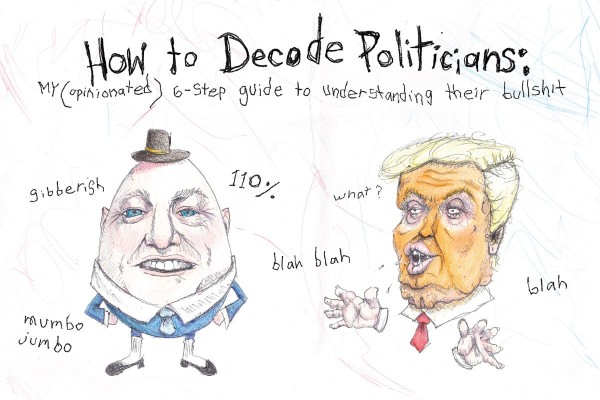

"Speech is power: speech is to persuade, to convert, to compel." — Ralph Waldo Emerson
The Merriam Webster dictionary defines a politician as “a person experienced in the art or science of government. Especially: one actively engaged in conducting the business of a government.”
I think that definition is almost as ideologically vague as the politicians it describes. Art? Conducting business? It makes politics sound neutral – like it's just management or admin. Like politics is something quiet, or happening in the background.
If I had it my way, I’d redefine it as:
“A spokesperson to slyly persuade you on an agenda that a group of incredibly rich and powerful people have unilaterally decided upon. Especially: one taught the art of rhetoric and branding.”
Rhetoric, for reference, is the ancient Greek idea of persuasion through speech. Politicians have that down to a T – they love to talk. Duh. Press conferences, long speeches, interviews and social media posts. There is constant output of speech. And, in today’s politically chaotic world, it's becoming more important than ever to actually listen. Political literacy is hot. But understanding what they’re actually saying? That's where it gets tricky.
Take President Donald Trump, for example:
“We’ve got the best tanks, the best ships, the best missiles and rockets – we have the best of everything.”
On the surface, it sounds almost hilariously vague. Students don’t get away with making statements without references in assignments, but it would be unsurprising to hear a claim made by a politician without citing a source. How do you define “the best”?
That’s where sharp-eared audiences need to figure out what’s BS and what’s not.
#1 Saying Nothing (Very Confidently)
One of the most common techniques is called pivoting. This is often used when a politician is asked a hard question. It may sound like they are answering the question, but they’re not. They’ve pivoted: trained to always bring it back to well practiced and media-trained lines.
Then there’s the bridge: “I understand your question, but what really matters is…”
This acknowledges the question just enough to seem respectful, before immediately abandoning it. It leaves you feeling like something was said, but when you try to recall it, there's no concrete details to fall back on.
Even worse, this ambiguity forces you to fill in the gaps yourself. You start interpreting their meaning, connecting dots, doing the mental labour for them. All the while exhausting your mental power – making it harder to become politically invested.
A disengaged public is a complacent one.
Decoding tip: Stay focused on the original question. Don’t exhaust yourself trying to figure out what they mean with their fluffy practiced lines. If they don’t answer, then that's your answer.
Watch for phrases like:
- “What I can say is…”
- “The reality is…”
- “People expect…”
#2 Keywords Are Never Accidental
Politicians rely heavily on filler words. They sound positive, but are deliberately vague. These totemic words trigger an emotional response in us, and allow for our own assumptions to fill in the meaning.
When Chrispoher Luxon says "We are operationalising our government”, it sounds impressive. Technical, even. Great! But what does it actually mean?
They are always improving something, reforming, investing in something – yet the public sees no tangible evidence or change.
Decoding tip: Ask yourself: “what does this actually change?” If you can’t picture a real-world impact, it’s probably just branding.
Words like:
- “Reform”
- “Progress”
- “Resilience”
#3 No One’s To Blame
No one did the thing, it just… happened.
Most likely, no one faced any consequences either. We’re just supposed to accept it as the state of affairs. I believe that politicians are sometimes akin to weasels, always wanting to take the easy way out and run away. By taking the subject out of a statement, they take the blame out of situations. This means they’ve gotten away from any consequences.
The vaguer the better. Unnamed, untalked about things are forgettable.
Decoding tip: Always ask: “who?" and “what?” Because if something isn’t named, it disappears from accountability.
Phrases like:
- “Mistakes were made.”
- “Processes weren’t followed.”
#4 The Relatability Performance
They’re just like you. Apparently.
When it goes right, we forget all their false promises. When it goes wrong, it’s kinda like your grandparents trying to say “yass queen” and you just cringe. This isn’t accidental, it’s branding. The goal is to feel familiar enough that you stop questioning. Politicians are not just selling their flashy policies, but their personal brand – hoping to snag your vote based either on a hope for a better future, or you reckoning this person would be a pretty mean PM.
They’ll complain about parking, joke about technology, or act casually to seem approachable.
There's also paralipsis: “I won’t even mention…”
Which, of course, means they’re about to mention it. It creates the illusion they’re letting us in on something, while avoiding responsibility for saying it directly.
Decoding tip: Separate the persona from the policy. Liking how someone sounds is not the same as agreeing with what they’re doing.
Watch out for:
- Bemoaning an everyday problem
- Staged visits
- That feeling when you actually start to like your politicians
#5 Numbers, Numbers, Numbers
Numbers and stats can be manipulated while still being technically true – and in speeches there are no citations.
That leaves us doing the unpaid labour of fact-checking.
For example, former UK deputy prime minister Nick Clegg claimed 27 million people were £825 better off due to tax cuts – using data from before he introduced those policies.
Decoding tip: Always ask: “When were these statistics taken?” and “Compared to what?” Numbers without context is just a story with graphs and statistics, moving the agenda forward.
Watch for unbacked numbers like:
- “We’ve increased funding by 20%.” (From what?)
- “Crime is up 10%.” (Compared to when?)
#6 Fire Hosing
This is where it gets fucking shit.
Politicians will flood the space with so many claims – often false or exaggerated – that it becomes impossible to keep up. This is most popular among Russian and American politicians.
From Trump: “Our country was being invaded by an army of 25 million people”. See also: “The price of eggs is down 82% since March, and everything else is falling rapidly.”
Constant scepticism is exhausting. Eventually, people stop engaging altogether.
At that point, politics becomes evil. It's no longer about persuasion or representation – it’s about sides. National versus Labour, left versus right. Actually, we’re all stuck in the middle of it.
This creates a mob mentality centred around what they want us to believe. If you have ever considered storming the capital just because your side lost, I’m afraid you have fallen victim to this technique.
You are losing if you take a side, but cannot win on either. This forces you to put your vote in hopes for the ‘less bad option’.
Decoding tip: Don’t exhaust yourself reacting to everything. Step back and look at the patterns.
Watch out for:
- Repeated, obvious lies
- Constant denial of facts
My Final Thoughts
You should never ‘ride or die’ with your politicians.
They’re not neutral actors, and you can never assume their media-rehearsed version of the truth. It may be hard to muddle through the nonsense they say, but isn’t it much scarier to think you’re the bottom in the relationship just taking their load, accepting it.
Right now, I'm not sure politics is just about policy. It’s about persuasion and marketing.
And if you don’t know how the language works, it works on you.
