



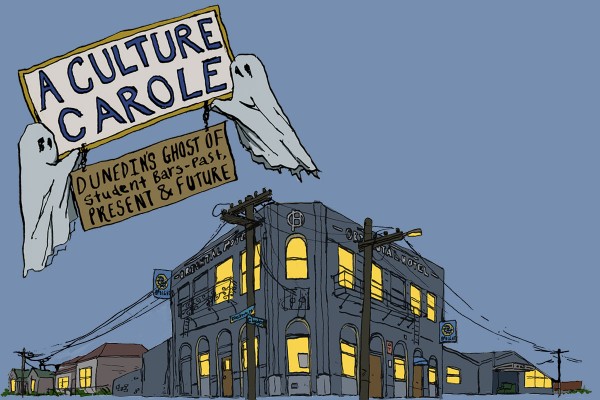

Dick is a Castle Street man, through and through.
Everyone knows a Dick. If you've spent longer than ten minutes North of the campus, you’ve probably met one. Dick lives in a mouldy flat halfway down Castle, swears flat parties are the pinnacle of student culture, and believes that smashing a bottle in the street is the ultimate form of self expression.
Bars? Dick isn’t having a bar of it. Too many rules. Too many bouncers. Too many people telling you that maybe you shouldn’t climb behind the DJ booth if you have 3 drinks in one hand. No, Dick prefers the freedom of the flat party: the sticky kitchen floor, the Bluetooth speaker that cuts out at every beat drop, the bathroom door that hasn't locked since Ori. This, Dick insists loudly and often, is the real Otago culture.
But Dick is wrong.
On one particularly mystical Saturday night, as bass rattled the windows and a lone Campus Watch car idled patiently on the end of Castle, Dick was about to receive a visit. Not from the cops. From the Ghosts of Student Bars Past, Present, and Future.
With music blaring over the beginning weeks of the semester, and partying at an all time high, the veil of Dunedin’s student culture is at its thinnest. The Ghosts have appeared to show Dick what he’s missing: actual establishments with a roof, a door, and a duty manager to cut you off if you get too rowdy. It was a place to drink, dance, flirt, and make questionable life decisions before going home at a semi-reasonable hour. At least that's what the Ghosts said. Now we’re left with Castle Street, and people like Dick.
So tonight, in the spirit of Dickens and social commentary, the Ghosts are here to show Dick what Dunedin night life was, is, and what it might be again.
Dick cracks a fullcream Speights. And the Ghost begins.
The Ghost of Student Bars Past:
The Ghost takes Dick to a conversation he’s heard a hundred times before: an Otago alumni reminiscing about their glory days. John, who graduated in 1969, kept it simple. “A typical weekend night always started at the pub,” John says to anyone who will listen, as they attempt to feign mild interest. During the late 60s, John had a plethora of places to choose from. Whether he was in for a long night at the Gardies or getting in the mosh with all of the other munters at the Cook, there was a pub to host any occasion.
It was a time where having a few drinks almost always meant leaving the flat. “People didn’t preload at home in those days. You’d go to the pub first, have a few drinks there and then on the way to the party you might stop at the bottle shop to buy a beer to take along.” Dick raises an eyebrow at that. The pub was never an afterthought, or somewhere you only go when Mum and Dad's credit card was around, the Ghost explains, looking nostalgic. It was the centre of gravity that the student’s night out revolved around. The Ghost leads Dick out of the living room.
Stepping out of the door leads Dick to a wet street, lined by rows of flats. He can hear laughter and voices nearby. By the 90’s, the night out rituals had evolved slightly. The Ghost takes him to meet Andrea, who graduated from Otago in 1993. Her typical Saturday night piss up started with drinks at her flat or a friend’s place. After a few and feeling good, you could wander into town and pick whatever bar you felt like that night. “One of the best things about going out in Dunedin back then was simply how social it was. You could walk into almost any bar or club and see heaps of people you knew, have a few drinks, dance, and catch up. It was pretty easy-going and a lot of fun,” Andrea says. Dick listens. Properly listens.
As the Ghost guides him through the past, the buildings rise again. Dick can see it all.
The Cook, which is rumoured to boast the busiest ATM in New Zealand, with hoards of students lining up to shell out for another pint. The Gardies pulses with life before its eventual closure and renovation. The Oriental – later known as The Ori and then Starters – filled with generations of students. Then, just as quickly as it appeared, it's gone. Brick by brick, Starters is demolished. A car park takes its place. Even Dick looks a little emotional watching on.
Dunedin's drinking culture was renowned back then. Students have always known how to have a good time, but the chaos had to go and had to find a new home, the Ghost tells Dick. The Ghost urges Dick forward, and we arrive in 2026.
The Ghost of Student Bars Present:
Dick finds his voice. “See? This is what I’m talking about.” The Ghost of Student Bar Present says nothing. Instead, the Ghost shows us an average Saturday night.
It no longer begins in a warm pub surrounded by your friends. Instead, it unfolds across the suburb of North Dunedin, where students huddle in damp courtyards around shitty speakers. The DJ is someone’s friend's flatmate who bought decks off of Facebook Marketplace two weeks ago. The bathroom is nonfunctional and people have taken to pissing in the corner of the garden. Unfortunately, that is where the Ghost and Dick are watching, so they shuffle slightly out of the way. The walls are sweating too, which can't be good, because even Dick looks a little grossed out. Eventually, the whole function spills onto the street – it’s a disaster waiting to happen.
Students have noticed this. The Ghost tells Dick that some have been outspoken about the issue, like Hold On To Your Friends (HOTYF), a student-led organisation focused on improving Dunedin’s drinking culture in line with the Sophia Charter. The charter was created after the tragic death of Sophia Crestani at a flat party, striving to improve safety, encourage students to look out for each other and create safer spaces to socialise. The Ghost brings us to meet HOTYF executive member, Maddy Barnes, who tells us that HOTYF is an “incredibly pro student bar” organisation, working closely in line with the Sophia Charter. The Ghost nods wisely.
“The lack of student bars is seriously concerning,” Maddy continues. “It breeds a really dangerous flat culture, especially on Castle Street, with people rushing to one host to the point where it gets really dangerous and overwhelming.”
We’ve all been there – losing your mates at some random house party, or stuck in the mosh at Castle Street. It’s fun till it’s not. Going out should be fun and chaotic, but not unsafe. There should be protections in place, the Ghost suggests. HOTYF actually runs street clean ups, bar takeovers (involving local DJ’s performing in safe environments) and flat chats, during which second and third years are given the opportunity to speak up about their experiences with flat culture.
“Dunedin gets a bad rep,” Maddy says, as we begin to feel the pull of the Ghost of Student Bar Future. “But really, its issues lie at the core.”
As she speaks, the Ghost begins to pull Dick forward again. Dick starts to finally understand what has been happening all along – what the core of student culture Dunedin is. When you remove the bar, the party and culture doesn’t disappear. It just moves somewhere that is less equipped to deal with it.
The Ghost of Student Bars Future:
The air shifts as the future unfolds before Dick and the Ghost of Student Bars Future. Dick begins to feel slightly motion sick.
In 2025, the Otago University Students’ Association president Daniel Leamy ran a successful campaign partly built on the promise to bring back a student bar. It struck a chord with students who have grown increasingly aware that something has been lost from Dunedin’s social landscape.
Daniel, compelled to appear before Dick by the Ghost, tells us that a student bar remains an important focus for him and OUSA. “It wasn’t just to make noise, it’s a personal issue for me,” he explains. “I’ve seen firsthand how unsafe many flat parties can be.”
For him, the goal isn't just to provide students with a place to have a good time. Without centralised, monitored spaces for students to gather, the risks associated with large flat parties continue to escalate. Harm reduction, the Ghost mouths to Dick.
“We've seen the damage and loss of life which has occurred, and very little being done to responsibly improve the situation.” The Ghost nudges Dick, telling him to ask the question he’s starting to wonder. Dick wants to know what stops a student bar resurgence in the future.
As with most things, the answer is money. Running a genuine student bar means doing it properly: ensuring drinks are affordable, staff are well-trained, and safety measures are in place. That level of infrastructure requires funding, which could potentially come from an increase in the student services fee (the Ghost shakes its head vigorously), or greater financial support from the University itself (the Ghost cheers). “It needs to be up there on the Uni’s priority list,” Daniel says.
Student culture doesn't exist in a vacuum, the Ghost explains. It’s shaped by the spaces that exist – or don’t – for students to gather. If those spaces disappear, the culture will adapt, often in ways that are less safe, less inclusive, and far less resilient to change.
The question isn't whether students will drink, because they will – they always have. That’s the lesson the Ghost has imparted. The question is where they will drink. The Ghost shows us two futures: in one, students drinking in overcrowded flats, surrounded by broken furniture and unpredictable crowds. In the other, we can see them in spaces built for exactly that purpose.
Right now, the future leans largely toward the first option. But it doesn't have to stay that way.
Dick’s Return
Dick is quiet when the Ghost returns him to his Castle Street flat. His flatmates are waiting for him as he walks through the door. For the first time in a long time, he has nothing to say. He has seen the past, felt the present and stared into the future of student bars. The Ghost turns to him. Dick looks down, somber. He thought chaos was the culture. That louder meant better. That more people meant more fun. But now he is starting to see the difference. The way a place for it all to happen could help.
The two possible futures flicker in front of him, and as Dick stares at them he realises one feels familiar, but the other feels… better. He turns to his flatmates. “Reckon we head into town?”, he whispers.
It's quiet, small and barely a decision at all. But a couple of his mates glance up. Someone shrugs and says “Yeah, could be the move.” It's a start.
If Dunedin's past proved anything, it's that the student bars once worked. While they weren't perfect, still sticky, still chaotic, they provided a safe space for the culture. Maybe we will find something like the stories the Ghost showed us.
Somewhere, not too far away, Dick stands at a bar – not smashing bottles, but waiting for a pint. The Ghost lingering in the corner. Watching. Just in case he forgets the lessons he learnt on this Saturday night.
