



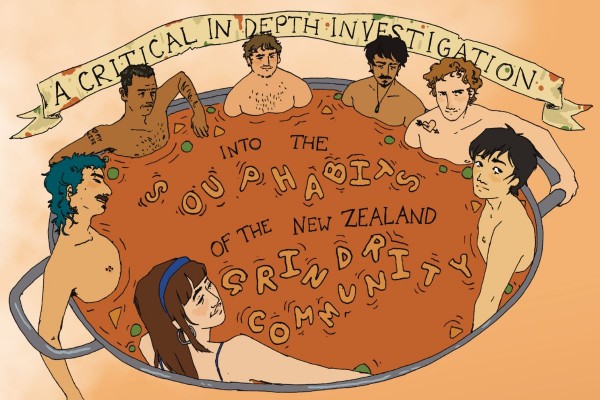

I set out to answer the question plaguing the minds of touch-starved homosexuals everywhere: what is the ideal soup to make for a Grindr hook-up?
You may ask: why Grindr specifically? And after you ask that, you may then ask: why are you finding out soup popularities from Grindr users?
Well, preliminary testing (with ‘Soup-Hinge’ and ‘Soup-Tinder’) revealed some key advantages to Soup Grindr. Grindr doesn’t require a face picture – which is perfect so as not to accidentally catfish anyone. Its user base also leans towards casual encounters, which lowers the barrier to weird niche conversations. And crucially, you don't even need to match – anyone can message you. The main draw is, of course, that Grindr is full of gay people, and gay people fucking love soup!
Over several months, I was – allegedly – more successful than those using the app for its intended purpose. I received nearly 300 responses, 32 unsolicited dick pictures and got involved in at least one debilitating lesbian situationship. Consider this a warning – the gays really love soup.
Methodology
My method was simple: download Grindr, create an account, and optimise for soup.
The goal was to maximise the chances of soup-based interactions whilst minimising the amount of people who actually wanted to hook up with me. Grindr lets you tag identities and preferences (bear, twink, dl, poly, T4T, etc). I listed the one that felt most appropriate (‘cooking’) and made a bio that would be sure to attract Grindr’s most soup-opinionated gays. I said that I was a lesbian, but happy to chat soup with anyone (soup love knows no boundaries). I encouraged everyone to tell me their soup opinions, and that I was genuinely interested in only that, not hook ups or dates. DNI only if you don’t like soup.
While gathering data, I recorded responses verbatim, then sorted them into broader categories based on similarity and frequency. In cases where people listed more than one favourite soup, I asked them to narrow it to two options – and both soups would score one half mark from myself.
I treated “soup” as a broad umbrella category, including stews and such. My results were gathered from across the country, thanks to Grindr’s absurd 900+ km matching radius, though it skews South Island-heavy as I was in Dunedin for a large chunk of this time period.
My Findings
Demographics
Most respondents were older men (30-50 years old), which tracks with Grindr’s general userbase. There were also younger users, and a small handful of women (largely transgender). Most identified as gay or bisexual, but there was a surprisingly large contingent of professed heterosexuals. These were either chasers or, in a few cases, genuinely lost.
More concerning were the few individuals who claimed not to like soup enough to have a preference. Deeply troubling. One user with the display name ‘I h8 soup’, is now my arch-nemesis. I sent him a recipe for a delicious lentil, kūmara and kale soup. No response. Fuckwit.
Anyways, on to the soup popularity tier lists.
Tier 1 Soups - Classic Staples
Pumpkin dominated (21.8%), emerging as the gay’s clear favourite – comforting, sweet, and aggressively inoffensive. Taken collectively, “Chicken soups” do end up coming close (18.8%), but fail, even collectively, to get ahead.
Tomato (10.4%) came in next – notably seasonal, with a spike as summer rolled in. This was followed by plain Chicken soup (9.2%), Chicken Noodle (7.4%) and finally Miscellaneous Vegetable (6.6%).
These are what I’d call “base soups” – the kind you could find in packets, tins, or Andy Warhol paintings (though of course, best made from whole ingredients). That’s not meant to be disparaging. These soups, when done well, are the best of crowd-pleasers and have lots of room for you to iterate on and develop into your own home soups.
If you’re trying to impress a Grindr hook-up without scaring them off, this is your lane. Roast your veggies, sprinkle chilli flakes, and add some secondary ingredients (kūmara, roast capsicum, onion and garlic). You’ll be sure to make a soup to please anyone.
Tier 2 Soups - #Notlikeothersoups
Tier 2 soups are more specific, but still very popular in their own right: Leek and Potato (4.8%), French Onion (4.0%), Minestrone/Pasta soups (3.5%) and Mushroom (3.2%).
These are “classy soups.” If they’re your favourite soup, you are certifiably “not basic”, and statistically more likely to know how to caramelise onions without Googling it.
They’re also more divisive. Mushroom, in particular, produced strong reactions – people either loved it or absolutely did not want a bar of it. French onion carries risk: done well, it’s life changing. Done badly, it's just wet onions and wasted time.
These soups suggest dedication, intention, and a willingness to put more effort in than Jamie Oliver did with those school lunches. Proceed carefully if making them for a first date, these soups are more 3rd date material.
Tier 3 Soups - Underrated Icons
Tier 3 soups are more niche still, but popular enough to have at least a handful (4-8) people mention them specifically. I like to call these cult favourites. We have Pork/Ham/Bacon (2.6%), Chicken and Corn (2.2%), Laksa (2.0%), and Mulligatawny (1.7%), which was seemingly exclusively popular among 40+ year olds. Finally, we have Lentil (1.7%) which, in my opinion, is criminally low.
These soups aren’t dominant in the soup-sphere by any means, but they’re pretty memorable. They tend to be richer, more flavour-forward, and often tied to specific cultural or personal preferences. These are the kind of soups that you bring out once the relationship has settled a little, potentially post meeting-the-parents.
Tier 4 Soups - Bottom of the Bowl
Here we get to the deeply underrated, the highly specific and the downright bizarre. I won’t list all of them here, but I do have some I’d like to highlight.
We start with Broccoli (1.2%), followed by Beef (1.1%), both of which are about where I would expect them to be. Broccoli and Cheese and Borscht (both 1.0%) deserve much more aroha, whereas Leek (1.0%), and Leek and Bacon (1.0%), were victims of my categorisation system. I couldn’t quite justify merging these two since they’re still kind of distinct.
Miso was a standout for being much, much lower than I would have expected it to be (0.7%). Pear and Walnut (0.3%), Orange and Cumin (0.3%) and Wild Nettle and Garlic (0.2%) were all such fascinating combinations that I have made it a goal to make them all by the end of this year. Even a seasoned soup expert like myself can expand their horizons.
Incredibly low were any fish soups. For example, Seafood Noodle (0.3%) and Chowder (0.7%). This wasn’t necessarily surprising, but I imagined there would be at least a few more people into them. Fair enough – seafood prices are out the gate. I’m quite disappointed in the lack of kūmara soup (0%) as it’s one of my personal favourites. I did also have one guy respond with “one day blinding soup” (0.3%) and then refused to elaborate beyond telling me that it’s soup that makes you go blind for one day, which was great.
Soup Lessons & Closing Thoughts
This experiment changed me. I would like to acknowledge the following participants:
To the beautiful Wellingtonian woman who suggested adding miso paste to my soups: thank you. It worked really well in a tomato soup I made recently. To the people who recommended mixing coconut cream into my soups: genuinely transformative. To the man who blended an entire Big Mac combo (soda included) into soup: what the fuck. To those who sent me recipes and soup pics: appreciate it. To the five people who diagnosed me with autism because of this study: unsure what to say to that.
My next steps are to actually go and make all of the soups I haven’t yet tried so I can definitively determine my favourite.
As my findings have shown, there is a huge variety of soups out there – meat soups, veggie soups, noodle soups, and many more. This is one of my favourite things about soups. Although the form is generally similar, the ingredients, spices, flavour and texture profiles are incredibly diverse, and even the most obscure soups have their own ardent supporters.
So get out there. Experiment. Do something strange.
And most importantly, go forth and make soups!
