



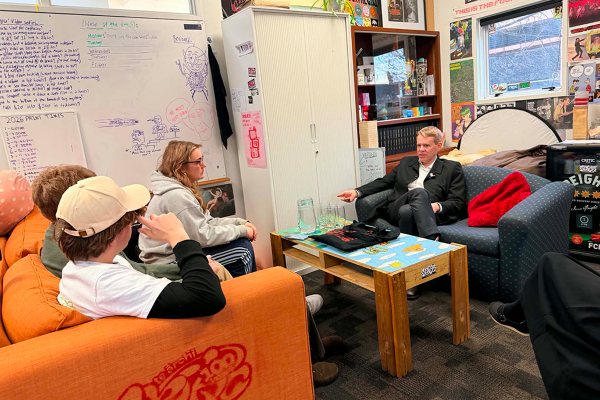

Labour Leader Chris Hipkins (the Chris nicknamed Chippy, not the other one), braved a Dunedin winter's day to come down to campus for Re:Ori’s Clubs Day. Critic Te Ārohi managed to snag a spot in the former Prime Minister’s packed schedule to talk about some of the key issues that are facing students. Here are some of Labour’s plans as campaigning gears up for the November 7th election.
Not letting Chris get too comfortable on the Critic couch, the interview kicked off by addressing the rise of the minor parties. Seen locally, as well as in Australia and the UK, many voters are getting fed up with the major establishment parties – increasingly putting their votes towards the smaller players. In Aotearoa, we’ve seen a rise in support of the Green Party, ACT, NZ First and The Opportunities Party in the polls. With all of those options, what is the real benefit in saving your party vote for a large party like Labour? “When you vote for one of the bigger parties, you know what you're voting for,” Chris explained. Big parties have been around the block, but Chris reckoned that smaller players can “often change their positions”, and that it’s not always “clear what they’re going to achieve in government.”
Speaking to what he thinks the reasoning behind betting on the political underdogs is, Chris put it down to a sense of frustration with the system and disillusionment with politics that voters are feeling. “The economy's not working for a large number of people, and therefore they're feeling disillusioned with politics. They're feeling disillusioned with anything that's established, and so they're looking at more anti-establishment options. I hope as we get towards the election and as people start to think seriously about how they're gonna vote, that we can win many of those voters back.”
Moving to the issues that will help you make your decision in the voting booth, it wouldn't be an interview with a politician without mentioning the brain drain to Australia. Chris mentioned that in his uni days, people who went overseas always had plans to return to New Zealand after a few years. However, the shift towards record numbers of migration to Australia over the past few years has been something that has been stressing our former PM out. “That's something that we should all be worried about,” he emphasises. To Chris, it’s a departure of our next generation of workers, ideas and talent that will be lost unless we create “more reasons to keep them here in New Zealand.”
Heading into the election, Labour has adopted the slogan “Jobs, Health, Homes” to clearly lay out their priorities. “Those are the foundations for people to be able to have a good life,” Chris explained. Acknowledging that many people (often students) are renting, he wants tenants to know that their rental is “secure, that it's affordable, and that it's actually a quality rental”. This includes insulation, heating and being “properly looked after by your landlord”. Chippy also took the chance to plug Labour’s past track record in Government, citing the increased standards that Labour imposed on landlords in terms of insulation. “Thinking about students here in Dunedin, we know that the houses that students were renting are some of the worst insulated, worst maintained houses in the country.” Otago on top?
Aside from renters, it is keen to increase the amount of available housing to meet demand and hopefully decrease prices. “We do need more houses, so we need to build more houses to cope with the fact that our population has increased significantly in recent times.” For Labour, this means changing the way we think about housing development – such as going “up, rather than out”. That’s something that will grow alongside the “added advantage” of scaled public transport.
Speaking of buying houses, we were keen to chat KiwiSaver with the potential Kiwi Saviour (LOL). Chippy was quick to voice his disagreement with the National Party’s recently-announced campaign policy – increasing the minimum contribution rate from 3 to 6% and making the scheme mandatory if re-elected. Chris said that for a lot of Kiwis, it's not that they don't want to be in KiwiSaver. “They just can't afford it,” he says. For a lot of young people that will benefit the most from saving early, 3% of their wages each week is something they’d rather take now to deal with the costs of living than save it for later. “Making it compulsory doesn't make it any more affordable to be part of KiwiSaver,” Chris argued. Instead, Chris seems keen to look at other options to increase KiwiSaver participation. Our friends over in Australia have recently increased their Superannuation Guarantee rate to 12%, meaning employers must contribute a minimum of 12% of an employee's Qualifying Earnings to their super. In Aotearoa, the compulsory employer’s contribution to an employee's KiwiSaver is 3.5%.
Next, Chris touched on a few recent controversial legislation changes from the current National-led Government. The NZ-First backed Legislation (Definitions of Woman and Man) Bill was labelled “horrific” by Chippy. “I see no value in that whatsoever. It's just designed to provoke a very divisive debate.” Additionally, he didn’t seem to have much time for the Conservation Amendment Bill, a proposed law change that would open up conservation land for sale and commercial use. The Bill has since been scrapped after fierce opposition. “We've been really clear that's just not gonna happen,” Chris said. “And, you know, had they gone ahead with that law change, we would've repealed it.” He emphasised the importance of conservation to New Zealand, and that putting a commercial imperative into anything the Department of Conservation does would be “totally and utterly the wrong way” of approaching conservation land management. When asked about the Fast-Track Approvals Act, one of the most controversial laws passed by the current Government, Chris said Labour was prepared to look at fast tracked projects on a “case-by-case basis.” He pointed to “controversial” mining applications as an example of things that should be excluded from fast-track approval and undergo a full consent process, namely for their “significant environmental impacts.”
Critic also asked about the rise of big tech, something that has begun to be felt in Aotearoa with the recent proposal of Datagrid setting up shop in Invercargill. How can New Zealand balance staying ahead of the tech trends while making sure international tech firms benefit us locally? “The idea that the big tech companies are redirecting all of their New Zealand based revenue through offshore tax havens in order to not pay tax on it is something that we should be concerned about,” Chris admitted. He did mention it wasn’t just big tech companies doing this though – stressing the need for a “multinational conversation” about tax laws. According to Chris, one of the more pressing issues in this area is that some countries “really reward” that cheeky tax behaviour, which “undermines the work of the countries who are trying to clamp down on it.” To make sure that we’re a part of that multi-national conversation regarding tech and local benefits, it’ll be a matter of working with “like-minded” countries.
To round off the interview, Critic asked about how to keep a bit of hope and optimism going in the current political climate. “If I could go back and speak to myself as a university student, my main message would be just chill out a little bit,” he said. Being involved in politics since he was a student (he was President of the Victoria University Students Association for a couple of years in the 2000s), he knows there’s a lot to worry about. In saying that, “you've always gotta remember there's only so much of the world that you actually have an influence over.” Acknowledging that the world can be a “pretty grim place”, Chris assures that “obsessing about it's not gonna change that”, no matter how hard you try. “So focus on the bit that you can change.” For Chris, this hope comes from grassroots and community level initiatives. Reflecting on years of campaigning for Labour all around the motu, one of his favourite things is seeing people at that level doing “amazing things and changing lives”.
As the interview drew to a close, Chris had settled comfortably into the Critic couch, and was sent on his way with a Critic and Radio One #swag bag (a bit of self-promo never hurts). With politicians like Chris criss-crossing the country to give their pitch to voters, it’s time to start thinking about who will get your two votes on the 7th of November.
