


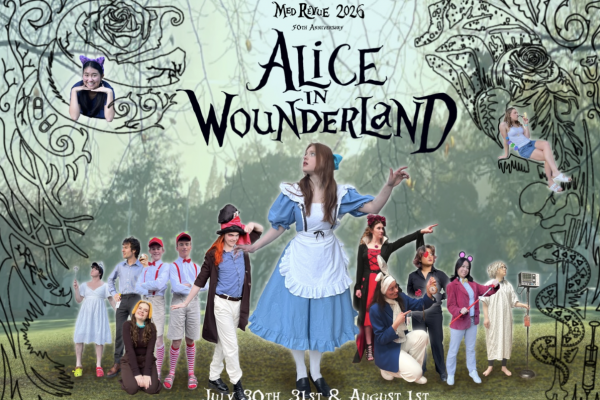

To celebrate its 50th anniversary, Med Revue had audiences tumbling down the rabbit hole to see its latest production, Alice in Wounderland. Critic Te Ārohi dived in too, braving the risk of getting lost in a warren of medical jokes that fly over our heads. Spoilers: only 4.
Someone had to come out and explain what a revue is, so we'll take it as a hint we should too. A revue is a noble tradition which combines music, dance, a main sketch separated by unrelated side sketches, and washes it all down with sex jokes. Revue is also French for review, and so the Capping Show, Law Revue and Med Revue will all often "review" current events. In English though – not French.
The main sketch, Alice in Wounderland, follows Alice, your average med aspirant (someone who wears a long Victorian-style blue dress). Everything changes after one fateful email sucks Alice into the bizarro world of med school. Running from July 30th to August 1, all show proceeds were donated to the Mount Cargill Trust, which provides intellectual disability care around Ōtepoti.
The main sketch theme was well chosen to convey the story — that med school is a trippy experience! Alice staggers from bewildering professors (Matt Hatter), to bewildering classmates (they killed Tweedle-dee! Or was it Tweedle-dum?). Main sketches in student revue shows can sometimes be an unfunny drag on the rest of the show, and while Wounderland bombed as much as it had its hits, it wasn't actually trying to be funny at every junction. As a satirical review of the med school experience, it did pretty well. In Wounderland we see the professor retiring, and Alice becomes a doctor after a timeskip — a sweet ending instead of the common rushed one.
Med Revue has gone from success to success in the props and costumes department. There was, we kid you not: a comically sized fish, a giant moth costume, a gigantic phone, a caterpillar costume, a monumental chainsaw, a two-person cow costume, and much more! Every costume was killer. As was also the case with last year's similarly prop-tastic Med Revue, pun-tastic times came from these items. The cow had Mad Cow Disease (it's really angry), and was our second-favourite returning gag.
Not only could those med zombies make props, they can be occasionally funny too. The side sketches had some gems. Jetstar's "terminal" velocity thanks to the fuel crisis was gas (haha). There was some serious dedication to working Med-stuff into sketches, mostly through death, like when the Wiggles musically fumble a heart attack. A caterpillar "eating out" an egg was peak quick slap-you-in-the-face student sex comedy (would it be a student revue show without a skit like that?). Critic’s all-time favourite skit had to be "Heated Rivalry", a two-sketch homoerotic dalliance between a Highlander and a Crusader.
But nothing – no, not even the tasteful placement of an issue from the award-winning student magazine Critic Te Ārohi – could stop us from being critical. Last year's largest problem was audience fatigue, with play times going over three hours. With a runtime of two hours and fourty five minutes, it’s a touch shorter than the past few years. This year, the microphones on the actors were the issue — at various points they played up and made the dialogue hard, if not uncomfortable to listen to. Our unsolicited advice: teach the actors to project.
Overall, there were some uneven bits. Capping Show and Med Revue share the same performance space, University College of Education auditorium, which gives them access to ugly, but reliable, tables and chairs. Oftentimes, those chairs and tables really jarred with other glammed-up set pieces. Literally putting a cloth over it in one scene solved the problem. The acting was a bit wooden in spots, and there was some energy lost by slow transitions and the occasional fumble. Here and there, it needed more time in the microwave to keep cooking.
Some uneven acting is to be expected — med students are not (get this) trained actors. The directors knew this, and chose their entire main cast well. Alice's floaty physical performance made the most mundane action interesting, the Tweedle brothers had jester-licious energy, and Matt Hatter was wonderfully weird without indulging in overperformance. We loved the deliciously evil Red Queen, whose tyrannical cuts had students dissecting each other, and thought their take on Donald Trump was hysterical (watch out, Capping Show).
All in all, Alice in Wounderland was a community theatre fairy-tale play, with its charms and fumbles, warts and all. Kudos as always to these glorified mouth chiropractors for the months of mahi they put into Med Revue. Good shit. There's always acting if you flunk out of med school!
