



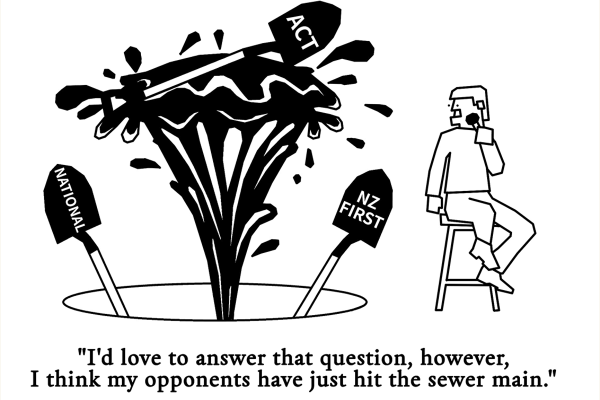

The OUSA Leaders Debate took place in Union Hall last Tuesday, and boy, was it a wild one. With twice as many audience members than seats, the student community showed up (some quite loudly), to watch the debate. OUSA sent invitations to eight party leaders on the 3rd of February, giving them seven months to make the effort or at least send their deputy leaders.
In the end, only two party leaders showed up: Green Party co-leader Chlöe Swarbrick and Alliance Party leader Victor Billot, alongside Opportunity Party deputy leader Daniel Eb. The remaining parties did not send their leaders, but did send representatives. National sent Invercargill MP and Minister for Tertiary, Science, Innovation, and Technology, Penny Simmonds; Labour sent Northcote MP and tertiary and Whānau Ora spokesperson, Shanan Halbert; NZ First sent former Wellington Mayor, Tertiary Spokesperson and list MP, Andy Foster; ACT sent former National MP, Parmjeet Parmar; and Te Pāti Māori was represented by Te Tai Tonga candidate, Lisa Marie Murch. Some credit is due to those parties who didn’t send their leaders, but did send their Tertiary Spokespersons instead.
The event was hosted by Critic Te Ārohi and Radio One’s very own Maddy Barnes and Sam Smith-Soppet, who were given the near-impossible task of asking controversial questions while keeping the representatives on topic and stopping them from bickering like a group of siblings. Students particularly enjoyed the soundboard, which added emphasis, humour, and a much-needed Gen Z twist to the traditional political debate. The discussion ranged from housing and affordability, to sustainability, infrastructure, and education.
One topic that quickly got students’ attention was artificial intelligence. During a yes-or-no question, students learned that some of the politicians use generative AI in their jobs, which did not exactly receive a standing ovation. Thankfully, NZ First representative Andy Foster clarified that he does not use generative AI, just ChatGPT. Yes – he was quickly corrected. Things got more interesting when Invercargill MP Penny Simmonds was asked about the resource consent granted for New Zealand’s first AI data centre in Makarewa, amid concerns about its environmental impact and whether it will deliver much in the way of economic growth. Simmonds pointed to the amount of data we generate online, arguing that “this data has to be processed somewhere”, and said the Government has an AI strategy and is “looking at a data centre strategy”. She then identified what appeared to be her greater concern: “I would be worried about data sovereignty [...] I don’t want our data being processed in the Middle East.” This earned a few audible “woahs” from the crowd.
The data centre debate was particularly relevant to the crowd, given the proposed facility is just a couple hours away in Southland. One student Critic Te Ārohi spoke to after the debate said there had been a lot of “dancing around” the questions about AI data centres, particularly when it came to their environmental impact. “I’m from Southland, and it’s a bit daunting, the idea of having this,” they said.
Environmental concerns did not stay confined to the discussion, however. The debate had a couple of unexpected visitors: climate activists wearing shirts emblazoned with “IT’S A CLIMATE EMERGENCY”. Two walked onto the stage and stood on either side of National’s Penny Simmonds as she introduced herself, prompting a wave of cheers from the crowd. A few more seemingly attempted to follow, but were politely stopped by co-host Sam Smith-Soppet. One of the activists was heard saying, “I think we made our point,” before heading back into the audience.
This audience disruption marked the beginning of the clashes between the representatives. Party representatives whose leaders are currently in Government faced plenty of criticism from Labour and the left-wing minor parties, with Labour tertiary spokesperson Shanan Halbert repeatedly labelling National’s Penny Simmonds a “cooker” and claiming the current Government has been “the most anti-Māori government we have seen, ever”.
Simmonds pushed back by pointing to the Government’s vaccination rates for two-year-old Māori children, saying they had increased from below 50% to 70%. Halbert was quick to interrupt: “Come on Penny, you’ve shafted Māori time and time again.” Simmonds fired back that if Halbert believed the Government was worse for Māori, then improving immunisation rates was hardly a bad thing, referring to “little Māori babies” not being immunised as “a terrible thing for Māori”. The National representative appeared to be reaching for the heartstrings, although whether vaccination rates were quite the same issue as the broader criticism of the Government’s Māori policy was another question. Halbert’s response was that the Government had “taken race relations in this country back 20 years”. Quite the exchange.
The argument over Māori issues continued when NZ First’s Andy Foster was asked what structural barrier he would remove for tauira Māori at Otago, and what he would replace it with. Foster focused on the disproportionate number of Māori students who do not attend school prior to reaching tertiary education. Shanan was quick to challenge him, saying, “Andy, you don’t even recognise Māori in the education system... you want to remove Te Tiriti from every legislation!” Foster, seemingly desperate to respond, snapped “can I please have the mic for a second?” “No,” Shanan replied. “I’m holding you accountable for taking Māori backwards.” At this point, the debate was beginning to resemble less of a political discussion and more of a particularly chaotic family dinner when somebody decides to bring up politics at the table.
The hosts were not about to let the non-leader representatives use their second-string status to dodge difficult questions either. Following a heated discussion about passing laws under urgency, the representatives were asked whether they would commit to a cross-party agreement limiting the use of urgency to situations supported by two-thirds of Parliament, genuine emergencies, or genuinely time-sensitive issues. Foster argued that this was not a reasonable yes-or-no question, agreeing that urgency should be used “a lot less”, but suggesting that if the party leaders had been present, the hosts might have got a straight answer. “So why is your leader not here then, sorry?” Maddy shot back, prompting cheers from the crowd. “We told you in February this was happening. You’ve had seven months to prepare.” Foster responded that his leader, the Minister for Foreign Affairs, was overseas. Perhaps seven months’ notice was not enough to clear the calendar, or the leaders just weren’t keen on facing the Dunedin winter, or the Dunedin students.
ACT’s Parmjeet Parmar also found herself facing a less-than-enthusiastic audience when she talked about the recently-announced policy wanting to make student service fees voluntary. “Just because you’re enrolled doesn't mean you should be forced to pay for union activities” or for “services you may not use”, she said. The announcement was met with a few pointed responses from the audience, including “you cost us all our money!” and “stop taking away fees-free then!”, followed by a few whoops.
Chlöe Swarbrick challenged Parmar’s position, arguing that student services would not survive without the funding provided through student fees. Parmar responded that “all these organisations will have to prove their worth”, prompting Swarbrick to fire back: “The ACT Party would get rid of public hospitals, guys, because basically what they are saying is if you do not use things then you should not pay for them... we believe, in the Green Party, that we have this thing called society!”
For all the policy clashes, the question of whether students actually left knowing what the parties stood for remained. Talking to students after the debate, Critic found mixed reviews. “With all due respect to OUSA, babes, I have no idea what anyone was campaigning on. They were just yelling,” said fourth-year student Izzy. She said she thought the event was perhaps not the best organised and left her even more confused about who to vote for in the upcoming election.
OUSA President Daniel Leamy hopes students did take at least one thing away from the event: a reminder to enrol to vote. “I hope they get their flatmates enrolled to vote and their friends,” he said. He also pointed to another upcoming debate hosted by OUSA for Dunedin MP candidates, which will be held on 11 September, with all local candidates invited.
All together, while the debate was perhaps not the most enlightening, it was entertaining. Every representative contributed something, whether it was their party’s stance on a particular policy, a heated exchange with another representative, Chlöe Swarbrick fact-checking others on her phone, or Alliance leader Victor Billot repeatedly launching himself out of his chair whenever it was his turn to speak – bellowing loudly enough to make sure students on the other side of campus knew Alliance had arrived.
For an event intended to help students decide who deserves their vote, it may not have provided all the answers, but it certainly gave them plenty to talk about. With under three months until the election, for many students it's going to be a tough decision of who to give your two ticks to.
