



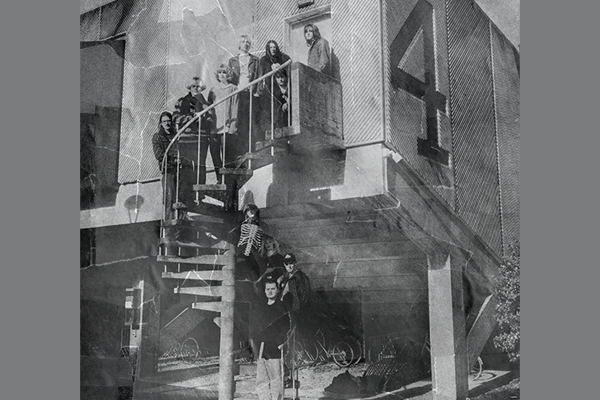

A couple of weeks ago, Taylor Swift, Justin Bieber, and Sabrina Carpenter had a bad day in Aotearoa. That’s because 4EPs, a recent release featuring four EPs by local Dunedin bands Sogg, U-No Juno, Vagina Dry and Sivle Talk, debuted at the number one spot on the Official Aotearea Music Charts’ Top 20 Aotearoa Albums. If that wasn’t enough of a flex on the pop icons, 4EPs also snagged the tenth spot on the Official Top 40 Albums.
Probably the most unique things about 4EPs is that it’s only out on vinyl and CD. According to Natasha Griffiths, founder of Dun Records and known to some in the Dunedin Sound as the “mum of the alternative music scene”, the choice was a call back to the “infamous” Dunedin Double. 2 years ago, the Dunedin Double was one of Flying Nun’s first records, featuring iconic bands The Chills, Sneaky Feelings, The Stones and The Verlaines. “[4EPs came about] when I was kind of sitting around thinking ‘the world sucks, what can I do?’”, Natasha explained. Surrounded by “amazingly talented” young musicians, she had the idea to do a modern day Dunedin Double. Natasha “instantly” knew the four bands that she wanted to make the project happen – and they were just as keen.
“It goes against the grain of everything you’re supposed to do,” Natasha admitted, referencing the fact that none of the bands are on Spotify, and sticking to physical sales had been a pretty bold thing to do. “But it worked.” Natasha originally came up with the idea in November, and gave the bands until the end of March to finish recording. By mid-July, 4EPs was out, topping the charts.
4EPs was a labour of love from all corners of the Dunedin community. Even recording didn’t take place in one spot, instead shared between the likes of Nicholas Rowan from South Link Productions, and over at War Possum Studios. The Student Radio Network (including our very own Radio One) have also been major supporters in promoting the release. Getting 4EPs to vinyl was no easy task either, with Natasha tweaking with the record design to bring costs down, making videos explaining things to the bands as she went along. “As we went on, it became more and more of a family, more community kind of. Everyone knew one another… it just became a really beautiful project.”
That community was what convinced Murray from Stebbing Records to get on board with the project, and he helped manage some of the costs required to get 4EPs pressed into vinyl. “He loved hearing about the community, and I truly believe it’s been saving lives [...] He’s just been incredible to work with.” When Natasha first went into the project, it was looking like things would have a very thin margin, and she’d sorted out a long-term payment plan. However, thanks to strong interest in helping the project succeed, the 4EPs community has already pretty much managed to pay off the CDs and vinyls already. “Things happened,” Natasha shared – and that they did. Martin Phillip’s sisters donated the money for mastering, and JB Hi-Fi and Relics bought a bunch in advance. The rest of the account has been getting paid off with physical sales. “We’ve done four hundred records, and we’re gonna do a repress. Because we have to,” Natasha laughed. “Isn’t that insane?”
4EPs isn’t the only thing that makes Dun Records a bit of an unconventional player in the music industry. Circling back to Taylor Swift, Natasha gives her kudos for buying back her masters, in fact, Dun Records retain none of the rights in their artists’ music. “People have learned what masters are, and ownership of records [...] All the original Dunedin musicians have not owned the rights to their music, or lost them quite early on.” Natasha recalled the recent loss of Brent McLachlan, the drummer for Bailter Space and previously The Gordons. “The last time I spoke to him, he said ‘Natasha: please teach these young people to hold on to their music. I haven’t had any payouts from any record label, for any release.’” It’s something that Natasha has committed to: “there’s no reason why I should own it. I kind of stepped in to make sure someone else didn’t own it. That was one of my motivations [behind Dun Records].”
Natasha doesn’t expect any of the musicians that work with Dun Records to stay with her. She considers herself the “inbetween” – some will stay, and others will explore different opportunities. But if there’s one thing that she does know for sure, it’s that the young musicians she works with know what owning their music means. “I imagine that all of these musicians will end up owning their music, because they’ve been told about it. Hopefully in a few years time, there’s going to be more independent labels they’re all running, and just releasing their own music [...] It’s really, really important to me.”
If you go back far enough in the Critic Te Ārohi archives, you can find music articles written by Natasha – that’s how much she lives and breathes the local sound. At age 17, on her first day of university, she’d bounded up the stairs to Critic and Radio One to ask the then Editor if she could give writing a crack. “He said, ‘Okay, tell you what. We’ve been trying to get Straitjacket Fits for a week to get an interview. If you can get an interview, you can write for Critic.’” Unbeknownst to the Editor, the band’s vocalist Shayne Carter was Natasha’s brother. She told the Editor she’d give it a go, who laughed at her. “Three days later, I came back with a Shayne Carter interview [...] It was so funny.”
If you’re keen to give 4EPs a listen, you can pick up a copy at Relics Music Dunedin or JB Hi-Fi.
