



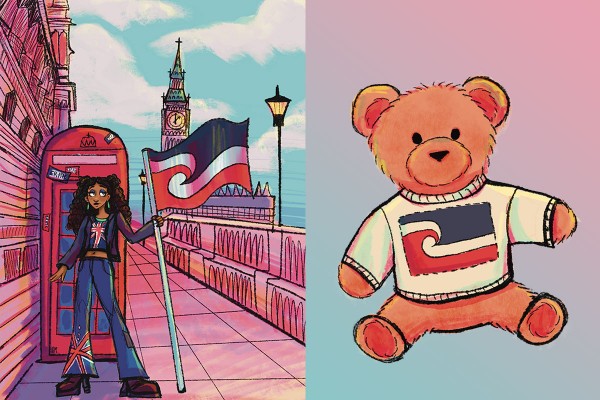

I went to London to see what all the fuss was about. After all, it has a long history of looking in our direction first.
It’s the third week of uni, which means I should be pretty locked in: highlighting readings, colour-coding my calendar, and convincing myself this is the semester I finally become the hyper-organised academic weapon I keep promising myself I’ll be. Instead, I’m knee-deep in Skyscanner deals, again, romanticising departure gates while deadlines start to accumulate. If nineteenth-century explorers had access to flight alerts and a half-decent search engine, history may have unfolded very differently.
Right now, like most of us, my world stretches from my flat to campus to the Octagon and back again. The outer limits of my weekly orbit are defined by $7 matchas at Auahi Ora, tutorial attendance requirements, and whether I can be bothered climbing to the third floor of Central Library for a window seat. My geography is small, contained, and responsibly budgeted. But between Aoroa notifications and eReserve tabs multiplying like kutus, I keep ending up on Google Maps, dragging myself out of Dunedin one scroll at a time.
The problem with leaving a place is that you return with altered proportions. After a summer on the other side of the world, the Octagon no longer feels like the centre of everything so much as a very well-lit loop. Over the break, I travelled through Europe on what my mates confidently labelled a “once in a lifetime” trip, a phrase intended to discourage repetition and manage expectations. Personally, I consider it an opening chapter. It was expansive in the literal sense: space widened, history thickened, and my sense of scale permanently shifted. There were cathedrals, overnight buses (cheap but grim, BTW), and languages I did not speak but attempted anyway. Moving constantly, adjusting quickly, and getting used to not quite knowing where I was.
But before Budapest and Paris entered the frame, my summer break began in autumnal London. Unlike other cities that exist in my memory as aesthetic backdrops, London is the belly of the beast – the one that looms in footnotes, lingers in Treaty clauses, and operates as the headquarters of an empire that insisted Māori would be British subjects. If you’re wondering why I’m taking this seriously, I’m a Ngāpuhi, born on Waitangi Day, and I study politics. Of course I wasn’t going to let that slide. To put it simply, I’ve got beef with this place. Longstanding, in fact.
If Britain “discovered” the world through the simple act of naming it, then I saw no reason not to return the gesture, and in true Valley Gewl fashion, discover London. In the spirit of reciprocity, of course. Anā.
The Centre of the World (According to Itself)
There is something quietly embarrassing about standing in the so-called heart of imperial power and realising that it now competes with brunch culture and Premier League fixtures for national attention. Sure, the city still carries itself with importance, but it no longer monopolises it. Global finance runs through New York and Shanghai, and cultural trends erupt from Seoul and Lagos. Political power is multipolar – London remains influential, but it is far from singular.
For those of us raised under the long shadow of “the Crown”, this matters. When you grow up hearing that your tūpuna became British subjects, the word Britain acquires a kind of gravitational pull. It sounds central, authoritative and defining. But when you are physically there, watching tourists queue for photos while MPs argue inside Parliament about entirely domestic issues, the myth thins slightly. The sky does not bend toward Westminster, and the world does not pause at the chime of Big Ben. The centre, it turns out, is a matter of perspective. And perspective, it turns out, travels.
London still knows how to market itself as the main character. It has centuries of practice. But walking its streets made one thing abundantly clear: the empire may have once narrated the story, but it no longer controls the script.
The Colonial Catalogue
If London once styled itself as the centre of the world, the British Museum reads like the ledger. This is the belly: where the empire keeps what it swallowed. Its galleries unfold with composed authority: monumental stone guardians from Assyria, Egyptian sarcophagi, classical marble torsos, temple façades transported and reconstructed as though geography were merely an utter inconvenience. Objects that once anchored specific cosmologies now sit within a universal narrative of “world civilisation,” gently unified by lighting design and institutional confidence.
The Shrine of Taharqa from Sudan stands with architectural certainty. A Moai, the cuzzy, from Rapa Nui occupies space with a kind of displaced stillness. The Rosetta Stone draws a crowd that photographs it as though language itself originated in Bloomsbury. Across storerooms and displays, more than 3,000 taonga Māori are catalogued into this global inventory, separated from the whenua that shaped them and the communities that continue to carry their meaning.
Though, for a Māori visitor – and I’m certainly not the first – it lands in the body before it lands in the brain. You grow up understanding taonga not as objects but as ancestors, as vessels of whakapapa, and as things that breathe alongside the people who carry them. Here, they are itemised like entries in a colonial catalogue. They are trophies collecting dust on a cabinet, positioned beneath plaques written in immaculate passive voice: collected, origin unknown, acquired, transferred. Very clean language for very paru work.
There is also, of course, the well-worn joke that very little in the British Museum is actually British. The institution holds millions of objects – entire histories have been reorganised into gallery wings. But knowing that thousands of taonga Māori sit within that archive, stored or displayed according to curatorial priorities, shifts the tone. The joke begins to feel less subversive and more descriptive.
Eventually, the architectural choreography guides you toward the exit, and, as with all major cultural institutions, the path concludes in retail – the transition is almost seamless. After rooms dense with global antiquity, you find yourself in a space where Britishness is condensed into something portable and pleasant. Shelves offer confectionery wrapped in Union Jack packaging, porcelain printed with Beatrix Potter illustrations, commemorative stamp collections bearing a familiar monarch’s profile, and entire sections devoted to wizardry merchandised through nostalgia. All that’s missing is a Union Jack doormat. Give it time.
The atmosphere is tidy, whimsical, and reassuringly endearing, but the contrast is anything except subtle. Upstairs, the material record of imperial reach; downstairs, a version of national identity rendered both charming and consumable. One can move, within minutes, from contemplating the displacement of sacred objects to purchasing a tea towel that implies it was all rather tasteful – in the name of conquest.
Standing there, thousands of kilometres from home, I found the audacity almost impressive. Empire no longer claims to rule the plot, but it continues to curate the set with remarkable confidence. That sense of curated control is not isolated to the museum; it bleeds outward into the city – its institutions, its symbols, its assumptions about what it is and what it represents. Once you start seeing it, it becomes difficult to ignore.
Terms & Conditions Apply
That realisation does not stay neatly inside the museum. It follows you out, past the gift shop, and straight into the everyday mechanics of the state. It is one thing to see an empire behind glass; another to queue up and pay to enter it.
There is something deeply ironic about arriving in the so-called motherland and discovering that the “rights and privileges of British subjects” come with a cover charge. Te Tiriti assures us that, “in consideration thereof Her Majesty the Queen of England extends to the Natives of New Zealand her royal protection and imparts to them all the Rights and Privileges of British Subjects.” Generous, in theory. Slightly less convincing when you are $50 lighter at the border with no British passport, no fast-track lane, and no visible sign that this arrangement was ever designed to work both ways.
If I am, as promised, a British subject, then I would love to know where exactly those privileges are hiding. They were not stamped into my passport, they were not recognised on arrival, and they certainly were not covering my entry fee. “Rights and privileges” sounds decent until you try to use them. It starts to feel a bit like being handed a gift card and then realising it expired sometime in the nineteenth century. Mean gesture, though.
Of course, the legal position has shifted since those words were written. New Zealand moved away from British subjecthood decades ago, and our constitutional arrangements have changed along the way. Fair enough. But Te Tiriti is still invoked when we talk about the relationship between the Crown and Māori, and the promise itself remains there in plain language. The wording has not disappeared. The relationship certainly has not.
And that raises a quieter question. If the meaning of that promise has changed over time, when exactly was it revisited with the people it was originally made to? For more than a century – roughly 146 years between the signing of Te Tiriti and the constitutional shift of the 1980s – that language sat there intact. Plenty of time, you would think, to clarify what it meant in practice. Instead, the wording remains. The promise is still printed, but the application feels… interpretive. Conveniently so.
You do start to wonder what, exactly, is taught there. Do children grow up learning about Te Tiriti o Waitangi in the same way we do? About the agreements made, the guarantees offered, the obligations implied? Or does empire, like everything else, sit neatly arranged – acknowledged, preserved, but not particularly interrogated?
Long Live the Brand
And then there is the monarchy itself, which London treats less like a governing structure and more like a heritage franchise that refuses to go out of business. It is everywhere, printed, minted, commemorated, and quietly insisted upon, from tea tins and biscuit boxes to souvenir stands stacked with carefully curated reverence. The Crown, which exists at home as an abstract authority invoked in policy and Treaty interpretation, becomes something far more tangible here: a logo, a face, a constant presence that is endlessly reproduced and, more importantly, endlessly sold.
I visited Buckingham Palace, where access is carefully managed, and tickets are very much part of the experience. I found myself in conversation with someone who explained, quite earnestly, that it must be difficult for the royal family. The reasoning was that opening the palace to the public helps “close the gap” between the royals and their subjects, a gesture framed as both generous and necessary. It was delivered with such sincerity that I almost admired it. Yeah, nah. Because standing there, in a space that quite literally monetises proximity to inherited power, the idea that this arrangement should inspire sympathy felt less convincing and more theatrical. A difficult life, clearly. I’ll light a candle. Kia kaha.
If anything, the entire experience sharpened the opposite impression. The distance is not disappearing; it is being managed, packaged, and sold back as access. You are not closing the gap; instead, you are queuing through it. And at a certain point, it becomes difficult to tell whether the monarchy is maintaining relevance or simply running one of the most successful long-term branding exercises in modern history with exceptional returns.
A National Delicacy, Apparently
At some point, between museums, monarchy, and mild disillusionment, I found myself being introduced to what was described – with full confidence – as British delicacies. The word itself felt ambitious. Delicacy suggests intention, balance, or something worth seeking out. Think: escargot in Paris, schnitzel in Vienna, chimney cakes in Budapest. I even came face-to-face with a Reindeer hotdog in Tromso, Norway. Hard pass. But what I encountered in the L-town felt more like a long-standing agreement not to ask too many questions and simply keep eating.
There is something fascinating about the way British food is presented, as though enthusiasm alone might compensate for what is happening on the plate. Though not a foreign concept in Aotearoa, the full English breakfast, for example, operates on a principle of inclusion rather than cohesion: beans, toast, sausage, eggs, mushrooms, tomato, all assembled with the quiet confidence that proximity will do the work of flavour. It is less a meal and more a group project where no one communicated, but everyone still showed up. Mushy peas, I was told, are essential. Both non-negotiable and a cornerstone of the experience. What arrived was a shade of green that felt more theoretical than edible, somewhere between paste and memory, sitting comfortably on the plate as though it had tenure. One word – auē! You don’t eat it because it improves anything; you eat it because it has been there for so long that removing it would feel politically controversial. Moumou, yes. My problem, no.
The flat whites were decent, yes, which in London feels like a win and at home feels like the bare minimum. The Sunday roast, I will admit, was a vibe – heavy, committed, aggressively beige, but at least internally consistent. It knew what it was doing, even if that thing was mostly butter and momentum. Elsewhere, food becomes less about eating and more about navigating: $11 steamed buns in Chinatown (unheard of), the quiet reliability of a Tesco meal deal, and the ever-present chicken tikka masala, widely referred to as Britain’s national delicacy. I avoided it, partly out of principle, but also out of fatigue. The idea of eating a dish so globally entangled in a place that insists on presenting itself as the origin point of everything felt like eating empire in reverse, and I was not sure I had the appetite for it.
Seen, But Not Known
What I will give London is its ability to make you feel completely insignificant. No one is looking at you unless you are directly in their way, and even then, it is less curiosity and more a quiet expectation that you will move. The city runs on a kind of silent agreement: keep walking, keep left, and definitely do not hesitate. At best, you are an “excuse me.” At worst, you are a delay.
The commitment to presentation is undeniable. Almost everyone is dressed like they have somewhere important to be, even if that place is just the next Pret. No Uggs in sight; coats, layers, actual shoes – every day felt like walking through my Pinterest board, except everyone in it had somewhere to be and no time to acknowledge you. It is impressive, if slightly intimidating. You are not being watched, but you are definitely being outdressed. Once you realise that, the city becomes unexpectedly permissive – you can do almost anything. Personally, I chose to bawl my eyes out three times at the Phantom of the Opera, and then once more upon leaving the theatre. No one so much as glanced in my direction. People stepped around me with the same efficiency they applied to everything else, as though public displays of distress were just another obstacle to navigate. Tragic? Also yes. But feeling te ihi me te wana on that scale would do that to any haka fanatic.
At one point, I even did a full outfit change on Westminster Bridge in front of Big Ben – shoes, makeup, the whole get-up – using the city as a changing room it had not agreed to be and showing off my Hunaarn gears, as always. Anywhere else, it would have been a spectacle. But in London, it barely registered. Not even a double-take. People passed, adjusted their path slightly, and continued on, leaving me to it without interruption or acknowledgement. You are completely visible, but functionally unnoticed – seen only to the extent that you need to be avoided.
Not the Centre, After All
After a few days, it became clear that the “beast” is not quite as fearsome as it once made itself out to be. For something that built its authority on taking, naming, and claiming, the empire now relies mostly on the suggestion that it can still bite. The teeth are still on display, of course – polished, preserved, occasionally invoked – but they do not quite sink in the way they once did.
London works very hard to remind you that it matters. The buildings are large, the history is everywhere, and the symbols are repeated often enough that you start to recognise them before you understand them. Flags, guards, plaques, entire streets arranged like they have something to prove – it is all very convincing for about five minutes. Maybe less.
Perhaps that is why so much of the world is still sitting here, carefully catalogued and preserved. When control slips, possession can start to look a lot like memory. Whole histories arranged neatly behind glass as proof that the centre once mattered. The city does not display its importance; it collects it from everywhere else and calls it its own with impressive consistency.
After all, a beast is nothing without its teeth. Anā.
