



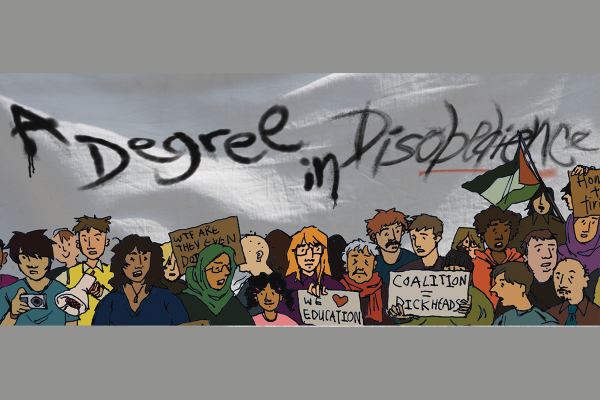

It’s been almost one hundred years since students first got fucked off at the University of Otago and decided to protest. Over the decades, Otago students have occupied the Registry building, marched down George Street, and transformed lecture buildings into bases for fiery protests. Students have fought tertiary and governmental decisions – from tuition fees and educational policies, to foreign wars in Vietnam and Gaza. Students have been denied a voice time and again, even occasionally arrested. Despite the risk, they continue to march through the streets of campus.
Ōtākou Whakaihu Waka was founded in 1869, making it the oldest university in Aotearoa New Zealand. It opened in 1871 with a modest number of staff (three people). There was one professor to teach classics, English language, and literature, one to teach mathematics and natural philosophy, and the third in charge of mental and moral philosophy and political economy. 81 students were enrolled in the university’s opening year, growing to around 3000 in 1961. As of 2025, there are 21,295 students enrolled.
Clearly, much has changed over the years, and protest at Otago has rarely been about just one issue. Instead, the objections and outrage reflect the problems of the day. The 1930s and 40s were characterised by religious and social issues, seeing The Great Depression and second World War sweep the globe. In the post-war era, Baby Boomers fought for a nuclear free New Zealand, and against the ban on mixed-gender flatting – in that order. The mid 1960s to 70s was a defining period for student protests. Incensed by New Zealand’s continued involvement in the Vietnam War, students continued to rally for change until 1975 when the war finally ended.
Protests were no longer limited to issues that would directly affect students. Rather, they reflect the zeitgeist of the time – the ‘spirit of the age’. Protesting became a way of inciting change in the way that students are best at: making lots of noise and pushing the boundaries of authority.
A 1992 government decision to introduce annual tertiary fees caused an explosion in the sheer size and scale of student protests, and this flood of outrage only grew the following year when these fees increased almost tenfold.
However, the mass occupations and confrontations that for a time became synonymous with the university, have seen a significant drop in their size and influence since the turn of the century. The Registry building still stands, the Clocktower still looms over campus. It could be that students are finally content, but a brief scroll on Castle2026 (RIP Castle26) proves that this is far from the case.
Throughout the University’s history, students have had a lot to protest about. Some demonstrations were small and largely forgotten, while others drew hundreds onto the streets and left a lasting mark on our campus. Let’s take a closer look.
20 September 1932: Closure of Dunedin Training College
Student protests had relatively humble beginnings at the University of Otago. A trawl through the archives provides one of the earliest examples of demonstration reported by the Otago Daily Times, instigated by Parliament’s proposal to close down the Dunedin Training College in 1932.
The Dunedin Training College (eventually becoming the Dunedin College of Education, and then absorbed by the University to become TCol) opened in 1876 to train primary school teachers. It served the community well for several decades, facilitating the gradual shift away from ‘on-the-job’ training to professionally educated teachers. All was well until 1932, when the college was marked for closure during the Great Depression.
For the students, this closure was about more than just another institution being lost. The college had trained teachers for decades, and students saw the loss as a significant blow to the University’s educational resources. The proposal also raised questions about accessibility to education and the future of teacher training in Dunedin. Students decided to do what they do best: make noise.
However, the word “protest” might be a little deceptive here. Rather than taking to the streets with megaphones and witty signs, a committee of student representatives used the most terrifying form of protest imaginable – a petition to Parliament. The petition gathered signatures in school districts around Otago and Southland, with strong levels of support. However, no number of signatures could dissuade the University. The college was still closed later that year, alongside similar institutions in Christchurch and Wellington.
Despite this initial defeat, changing economic conditions after the Great Depression eventually saw the training colleges reinstated in 1936 (yay!), with an impressive uptake in enrolments over the coming decades (woo!). While the campaign might have lacked the spectacle of the protests that followed, it was an impressive early example of Otago students using their collective voice to challenge decisions being made even beyond the University’s authority.
9 May 1947: Compulsory Chapel Attendance at Arana
In 1947, the then-warden of Arana, Reverend H. W. Turner, announced that compulsory chapel attendance would be introduced for all residents the following semester. It was perhaps one of the earliest recorded instances of Otago students discovering they weren’t particularly fond of authority. Before long, the Arana Students’ Association approached the university to challenge the decision.
A petition calling to scrap compulsory worship garnered the support of nearly all Arana residents, which at the time was a male-only hall. By today’s standards, this protest might seem pretty mundane, but it was another powerful example of students pushing back against attempts to control their education and everyday lives.
The scheme was ultimately overturned. The protest was not necessarily a fight over morality or religion, but rather a challenge to the university’s authority over what students did in their own time.
14 August 1958: Dunedin Anti-Nuclear Protest
By the end of the 1950s, Otago students were beginning to take their demands off campus and into the streets of Dunedin. In 1958, around 200 students were involved in Dunedin’s first ever anti-nuclear protest that marched from the University campus all the way to the Octagon, joining a growing movement against the spread and testing of nuclear weapons. Despite this issue seeming far removed from the day-to-day concerns of university life, it showed that students were willing to use their collective voice to address issues beyond their direct self-interest.
A big portion of the anti-nuclear protestors came from the Otago branch of the Students’ Christian Movement. Formed in 1896 and established at the University of Otago the next year, the SCM comprised 47% of all Otago students at its peak in 1915. While they initially began as a support group, raising funds for charities and disaster relief, they gradually shifted toward political activism. Its influence would be felt across student protests for many decades to come.
1960s: The Vietnam War
When you think of the word “protest”, you might well think of the stereotypical scenes of the ‘60s: peace signs, raised fists, placards, and long-haired students chanting and singing their way to social justice. That actually wasn’t too far from the truth at Otago. As students became increasingly aware of geopolitical affairs, few issues would define the decade quite like Vietnam.
The Wellington Committee on Vietnam (C.O.V.) organised a handful of public meetings at the Dunedin Town Hall between 1965 and 1975, working alongside the Labour Party, which also organised several protests. A number of notable speakers came to Dunedin during the war, like American general, General Hester, noted Pediatrician Dr. Benjamin Spock and a range of foreign academics.
Most of the visiting speakers chose to hold their meetings away from the University campus, both to make them accessible to the wider public, but also because some felt it wasn’t their territory.
When the government refused to release overseas funds to pay for foreign guests attending the “Peace, Power and Politics in Asia” conference in Wellington and their subsequent speaking tours, a petition created by student protest leader Ian Frazer was circulated around campus, and an additional 29 university staff sent a telegram of protest to then-finance minister, Robert Muldoon.
The C.O.V. organised “teach-ins” – seminars to educate people on various issues surrounding the war. Often organised by university faculty, these sessions generally lasted several days, with guest speakers brought in to deliver lectures and lead discussions. The Otago University Student’s Association (OUSA) was even called upon on one occasion to provide funding and a venue.
Students and staff alike continued to protest both New Zealand and American involvement in Vietnam until the war’s end in 1975, taking part in protests, public meetings and campaigns through the media.
1967: Mixed Flatting
At around the same time, an issue was raised a little closer to home: should mixed gender flats be allowed?
Newly appointed Vice-Chancellor Robin Williams was only a few months into his tenure when he was approached by OUSA over whether or not unmarried men and women should be allowed to share university accommodation. Williams made his position clear: no. Things escalated after a male student living in an all-female flat was ordered to leave, prompting an unofficial protest on campus. Hundreds of students packed into the Union Common Room for an all-night “live-in”, vocalising their opposition to the rule, and specifically to the Vice-Chancellor’s actions.
This Robin Williams was certainly no comedian, as he had previously worked on the Manhattan Project. He seemed determined to stick with what he knew – hoping splitting uranium was a transferable skill when it came to splitting up students. Despite his background in nuclear science being far removed from the increasingly social nature of student politics at Otago, Williams found himself at the centre of one of the university’s most memorable clashes over student freedom just a few months into his new role.
Williams’ son later offered a different perspective on his father’s position. He described Williams as a forward-thinker who was personally unbothered by the idea of unisex flats, but said the “conservative” climate of the time had forced his hand. His son also viewed the live-in protest as OUSA’s opportunity to “have its day in the sun” with vocal students, following the increasingly prominent student protests taking place at universities around the world.
Whether or not that was the motivation behind the protest, the live-in reflected a wider change to student activism. Williams’ son later suggested that the growing power of the student body was a factor in his father’s decision to leave the vice-chancellorship just five years later in 1972, and move to the Australian National University in Canberra. Apparently, letting university students live with the opposite sex was a more dangerous experiment than splitting the atom, although the university quickly backed down from its misguided decision. Relatively soon after the protests, mixed-sex flatting became the norm.
1971: Registry Sit-In
The 1971 Registry sit-in marked a further shift towards occupying the university grounds, rather than relying on more traditional forms of protest. The issue in question was a proposal to introduce sweeping new rules that broadened the definition of “misconduct”, potentially allowing students who were seen as “unbecoming” to the university to face disciplinary action.
The term “unbecoming” was pretty broad, and it was unclear whether this proposal was designed to target the craze of marijuana and acid spreading its way through campus, or to discourage the wild O-Week rituals that were beginning to grow in popularity. But the student body wasn't willing to wait around and find out, and took swift steps to prevent anyone from becoming unbecoming.
OUSA president Ebarima Manneh led the protest, albeit with some initial hesitation from the association’s executive. Around 2300 students – nearly 40% of all students enrolled at the time – took part in the protest in some form. By Otago standards, this was less of a protest and more of a population boom. The mass sit-in of the Registry building made their movement heard, and the university backed down on the changes, confining the term “misconduct” to purely on-campus activities. However, in 2008, it was finally expanded to include off-campus behaviour.
1992: Tuition Fees Protest
Student protests became increasingly more radical as the century drew to a close and peaked in the early 1990s, when Prime Minister David Lange's Labour government introduced tuition fees for all university students. While these average annual fees started at $129 in 1989, just one year later (under the same government, now led by Geoffrey Palmer, and even more briefly by Mike Moore before their defeat at the 1990 general election), tuition fees skyrocketed by 969% to $1250 annually. This was, to put it mildly, not the sort of growth students were hoping to see.
These fees were beginning to put university education out of reach for many young people, and the students of Otago were not having it. After National came back into power in 1990, they moved quickly to abolish the existing flat-rate fee system, allowing universities to have more control over their fees in 1991. By 1993, the average tuition fee reached $1,500 (equivalent to around $3,200 today), which may seem like pebbles compared to what we currently pay, but it caused a whole lot of shit. The introduction of a student loan scheme in 1992 didn’t soothe any tensions. This early scheme wasn’t interest free, and that didn’t change until 2006.
OUSA retaliated against the bombardment of new fees, rallying around 5000 students in 1991 marching in protest alongside OUSA President Helen Jamieson. The demonstration was one of the largest in the University’s history. Despite the scale of the protests, the issue was far from settled. Fee increases continued, setting the stage for a more violent clash just two years later.
By 1993, with Grant Robertson now at the helm of OUSA, students were back outside the Registry. A protest was organised on September 28th, with Robertson describing it as boisterous, passionate, and ultimately peaceful. Some of the Students’ Christian Movement members made a return, brandishing “God Hates Fees” signs and handing out snacks to keep everyone’s spirits high. As the protest came to a close, the remaining demonstrators sat down and linked arms.
What came next was unexpected. Police armed with riot gear and batons charged down the Registry stairs, striking demonstrators in their path. The clash left 24 students injured, sparking a wave of backlash against the police. Critic Te Ārohi even released a special edition dedicated to the incident. Some students called for OUSA to ban police from campus altogether. Unfortunately for the students, this was something the association didn’t have the constitutional power to do.
The relationship between the student body and the Police was already frosty by this point. After the September protest, officers made several arrests relating to the clash. Robertson himself was arrested, although was never charged. He appeared on national television the night after the confrontation to discuss what had happened, which gave him a rare opportunity to address the country directly on behalf of Otago students, putting the University’s dispute over fees into the national spotlight.
In the lead-up to the 1996 election, students finally secured a victory of sorts. Another occupation of the Registry lasted over a week and helped limit the proposed
fee increase to 17% rather than the 25% initially suggested. While it doesn’t sound like much of a victory today, students were willing to take whatever they could get. Similar demonstrations took place on other campuses across the country – Otago was far from alone in its opposition to rising fees.
2000s: Revolution to Revision
After a chaotic decade, the culture of student protest began to dry up. On a good day, a few hundred might have turned up, a far cry from the thousands recorded at past demonstrations. Every now and again, a cause would emerge that drew an impressive turnout. For example, the Otago National Organisation for the Reform of Marijuana Laws (“NORML”) club smoked cannabis on Union Lawn in protest of drug law reforms, or the “die-in” for Tibet that drew in around a hundred students. But ultimately, nothing quite matched the scale of what was seen in the ‘90s.
The 2010s was possibly the quietest decade in the past half-century. This didn’t go unnoticed, with several media outlets, Critic included, calling out the student body for their apparent lack of willingness to rock the boat.
Former OUSA president Logan Edgar suggested this apathy stemmed from a growing attitude of being “too cool to care”, deciding to lead by example by locking himself in a cage on Union Lawn for 42 hours in protest of Voluntary Student Membership legislation in 2011. However, former executive member Mark Baxter, who took part in several occupations of the Clocktower, pointed to the lack of leadership from OUSA during this period. Baxter also argued that newer generations of students had never experienced a time before tuition fees were introduced, meaning they hadn’t witnessed the kind of significant change those before them had fought for.
Grant Robertson was more critical of the Voluntary Student Membership legislation introduced in 2012, and its impact on student political activism. With student associations no longer receiving compulsory membership fees, Robertson argued that their financial dependence on universities likely made them even more hesitant to challenge university authorities and potentially put their own existence at stake.
Robertson also suggested that tuition fees may have played a role – students who genuinely couldn’t afford university were being increasingly excluded from higher education, and those were often the students most willing to cause a stir.
2026: The Renaissance?
Those views were shared over a decade ago now. Another former OUSA executive member, Kyle Matthews, said in 2015 that he thought there would be a backlash in the next 10-15 years. And in the 2020s, it’s starting to look like he was right.
Channelling a similar angst to the Vietnam War protestors of the ‘60s, the Gaza War took centre stage at Otago from 2023 and remains a point of contention today. In 2024, a protest at the Clocktower saw a door smashed and a student injured during a scuffle with campus security. One person was arrested. Grant Robertson was by now the Vice-Chancellor himself, and no stranger to such protests. He did, however, condemn the incident as having “crossed a line”, but he did not reject the underlying cause of the demonstration.
And now, as we reach the present, history appears to be repeating itself. Once again, students have taken to protest against tuition fees. This time, the student body is retaliating against the government for scrapping the final year fees-free scheme in May 2026, which will officially conclude at the end of this year. The decision has seemingly sparked a renewed frustration among the cohort, with the upcoming election adding another dimension to the debate. Education Action Group (EAG) chalk spanned across campus, and increasingly angry political postering covered nearly every bollard.
With an estimated 400 students taking part in the EAG strike, and another 250 occupying St Dave’s, it seems we’ve finally discovered that sitting stubbornly in a university building is far more interesting than sitting in a lecture. The question now is: are we so back?
So, Did Any Of It Actually Work?
The legacies of Otago’s countless protests probably impact today’s student culture more than we’ll ever realise. Looking back, it’s striking just how many of the issues students once tackled have changed or disappeared completely.
We still have a teachers’ college. There’s no compulsory worship at residential halls. New Zealand became nuclear free in 1987, and mixed-flats are now the norm. Even tuition fee protests have at least evolved, with the concerns today differing from those raised during the ‘90s. In many ways, the success of past protests can be measured by how unfamiliar those grievances now seem.
And while countless injustices still remain, and not every demonstration has achieved its desired outcome, the motivation to get out and to stand up for your own beliefs in an era where most of us can’t even make it to a lecture is commendable in itself.
The current generation will have to decide what they’re willing to fight for. If Otago’s history tells us anything, it’s that student activism rarely disappears completely. It’s inevitable that the government will do something stupid or that the university will introduce another policy that gets under our skin. When that happens, there will always be someone willing to pick up the placards, occupy the buildings and make themselves heard. The causes may change. The students may change. But the tradition of kicking up a fuss remains.
