



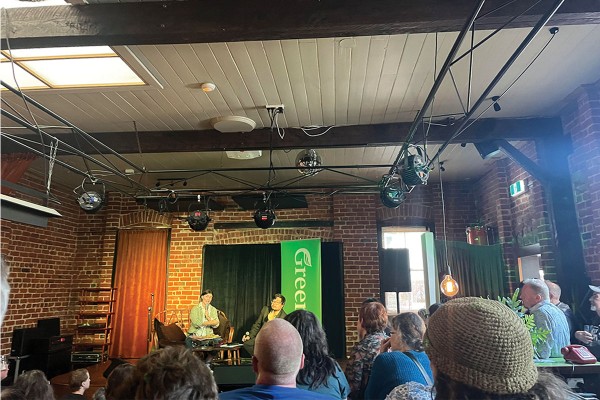

Before making their case for the upcoming election, Green Party Co-Leader Chlöe Swarbrick and Dunedin electoral candidate Francisco Hernandez joined Critic Te Ārohi for a more intimate Q&A over at Pearl Diver. Chlöe didn’t eat the crusts of her potato pizza, but we’ll put that down to our extensive list of questions we demanded answers to: from why students should vote for the mastermind behind airport shuttles (Francisco Hernandez), to how to prevent the narrative that romanticises living in shithole-flats for the ‘student experience’.
Critic: What do you guys think stops young people from seeing politics and politicians as ‘for them’?
Starting bold, Chlöe reckons that politics is intentionally presented as “very boring”, in the same way economics is. From her perspective, it’s taught in a way that expects students to regurgitate information, as opposed to critically understanding the creation of such systems. She recalls her mind being blown when she first began studying law, realising that it all really is “made up”. “It’s crazy that in your first few years of law school that you’re basically asked to regurgitate black letter law, as opposed to critiquing and understanding how it is produced and where it comes from. And that is reflective of power.” Bearing this in mind, Chlöe would deny that young people are apathetic toward politics. “I think that is a misread of the situation whereby young people are intentionally made to feel powerless.”
Critic: Let’s move onto climate change and the Paris Agreement. How would you respond to criticism that climate policy places too much financial pressure on everyday people, and the rise of climate anxiety?
Chlöe explains that with the actions the current Government are taking to “shred” domestic climate action, the country becomes liable to pay other countries to reduce their emissions under the Paris Agreement. She added that the Government has also exposed us to more extreme and frequent weather events and denied the job opportunities that might have arisen from government investment in climate change action. This inaction “not only erodes our ability to adapt to a changing climate and build our resilience, but has also put us on the hook to pay billions and billions of dollars more to other countries to do the work that we should be doing here at home. And that chicken’s going to come home to roost real soon.”
Ultimately, Chlöe emphasises that the climate crisis is a cost of living crisis. “Every time the Government takes its hand off the wheel in climate mitigation or in climate adaptation, we see the increase of the cost of living disproportionately borne by lowest-income New Zealanders.”
Francisco adds that what gives him hope is New Zealanders. We are a “country that is full of fair-minded people that value the environment. Last election, National […] basically gaslit people into voting for this terrible Government, and I think New Zealanders know the reality they're living in. I think that's why this Government is panicking and that's why they're trying to suppress voters, because they know they can’t win a fair election. That's why they're doing these cultural wars too.”
Critic: In Dunedin, as you know, there is a culture of romanticising living in filth. What role do you think the media has in pushing this narrative? And how can [we] stop that?
Chlöe takes the first question without hesitation, listing off three policies: rental warrants of fitness, registering property managers and landlords, and applying rent controls. “They’re just baseline requirements for healthy homes to be meaningfully implemented, and for landlords to be accountable.”
Francisco agrees that student poverty has become normalised, and that students are often treated as a “feral underclass”. He believes this discourse is perpetuated not just by local media, but broader normalisation of student poverty as a culture. “We need to make sure that we're denormalising student poverty by actually making it easier for students to live.”
A passerby stops to tell Chlöe that she’s “fucking awesome”. Chlöe laughs, and replies that she tries her best.
Critic: Chlöe, what did you think about David Seymour calling you a ‘demagogue’?
“Oh, man,” she laughs, before making a Stranger Things joke. “He desperately wants attention, and I hope that he finds a way to find peace in his heart.”
Critic: Do you have any advice for young people on how to use social media positively and avoid falling into echo chambers of extreme views fed to them by algorithms?
Chlöe points out that our social media infrastructure is “owned by billionaires with an incentive to capture as much of our attention as possible – and one of the major ways that they do that is by generating outrage. That is not a recipe for a cohesive society.” However, remembering this fact can help us to have a critical lens on the content we consume. She recommends a courtesy Google search to check things are legit, and to not take “anything that any politician says, ourselves included, as gospel [...] Do your own research.”
“Touch grass, basically,” Francisco agrees. They recommend going outside in general. “Breathing. All good.”
Critic: In terms of AI, lots of students are currently worried about job prospects, especially when picking their degrees and seeing the erasure of some entry-level roles. What would you say to reassure them?
Francisco sighs. “I think we need to realise that what’s happened to the job market is a political choice by the Government, right?” He acknowledges that students are worried about employment prospects, and points to the Government’s “over-reliance” on AI as a key component of the current job market. It’s something Francisco says he and Chlöe are keen to correct when they “get back in this year.”
At this point in the interview, Pearl Diver is packed to the brim for their Q&A with the Dunedin public.
Critic: Can you give us one final pitch before you have to go and address the masses out there?
First up, Chlöe stresses that everyone needs to enrol thirteen days before elections now – a change recently made by the current Government. She describes the change as “naked voter suppression.”
If you are considering voting Green, she says that they aren’t just asking for people to believe in them as a party, but believe in themselves and our values as a country. “[Practicing] those values means that we actually get the country that all of us deserve [...] We actually need a government of change, not just to change the government. And only the Greens can provide it.” She says the Greens are interested in a far bigger and more important debate than “what Chris is going to be Prime Minister.”
Francisco said that the Greens not only care for students, but have “real concrete solutions to address their concerns.” He points to his ability to deliver this personally, drawing on experience from his term as 2013 OUSA President. He introduced Scarfie Shuttles that became the Dunedin Airport shuttles, and free breakfast.
There are 400,000 tertiary students in this country. “That is an immense political power,” Chlöe says. “That is more people than those who voted for the Greens last year. That is enough to sway an election. That is enough to choose a government,” she urges. “The issues that everybody are facing are not individual issues of their own cause. They are systemic issues which are generated by the economic and policy settings that successive governments have chosen.”
On that note, Chlöe and Francisco take their seats inside to answer another round of questions from the audience. Critic can sum up the event using the words of another student who was present, who had previously thought of politics as an “incompetency game”.
“I have hope now.”
