



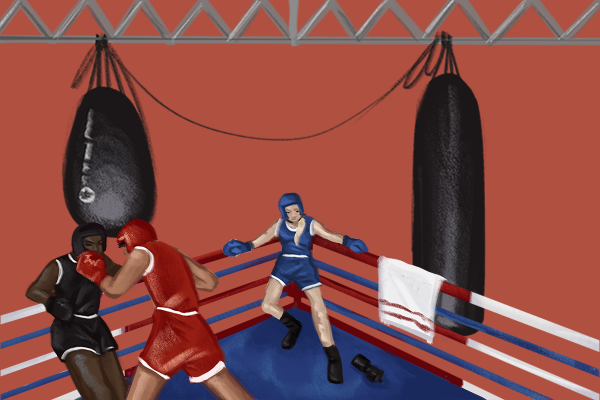

I have spent much of my university career just figuring it out. I’ve failed papers, and excelled in others. I’ve created work I am deeply proud of, and work that should never see the light of day. In short, my transcript would tell you that it’s been rough. However, what it doesn’t show is my resilience, or the path I have carved for myself. Through every setback, I’m still standing, and my shortcomings have become proof of my power.
Whānau, what I mean to say is that it's all about perception. What observation fails to tell us, experience will. Boxing is no different. For me, the boxing gym is a place where I can exist in my fullness, in a way that remedies the parts of me I’m still trying to understand. It has both push and pull, weaving us into whānau, holding us like a mother – like Papatūānuku. Fighting sees people at their strongest and at their most vulnerable, both disciplined and comforted. It is to break and and to rebuild, to learn and to know, to take hit after hit, and still see your whānau in your corner; to exist wholly, in body and in spirit. So many seek refuge in the ring. We find connection in shared pain and shared growth. Perhaps it is through boxing that we share our stories, and even more importantly, perhaps it is in the ring that we learn to digest the feelings that brought us there. Ki ngā whānau mekemeke – be empowered in the knowledge that the spirit of your blood runs deeper than your body. Every jab, block and roll is a perpetuation of your resilience and a profound display of unshakable mana. Boxing is a guide, a map, and a foundation for deep, raw healing.
Boxing is Rongoā
As a child, my māmā took up boxing and anchored us in something that truly changed the course of our lives. It is the strength she found in boxing that brought me to the ring, and her example that inspired me to follow in her footsteps. My journey with boxing, although still budding, is already thoroughly rooted in my mental, spiritual, and emotional wellbeing. I met with five accomplished boxers that play important roles in Dunedin’s boxing community to speak with them about the ways boxing extends beyond the ring and is, at its core, medicinal.
Although ‘rongoā’ commonly refers to holistic Māori healing practices, Chase Reihana-Hailey, owner of Ōtepoti Boxing Club, shared his whakaaro on how boxing fits into that category. Boxing means “everything” to Chase – it is purpose, and belonging. “It’s a platform for you to release your energy that isn’t needed within your hinengaro. It’s an art.” When he’s in the ring, tikanga Māori is his compass, “every decision that I make is based on rangatiratanga, manaakitanga, kotahitanga, whanaungatanga, and kaitiakitanga.” The boxing club runs Punch with Purpose, a corporate charity fight night and a chance for boxers to stand for their whānau, their tūpuna, and their wairua.
Bruce Ranga is one of the most recent participants involved with Ōtepoti Boxing, and he fought for the first time as a wero from his son. “It was all about challenging one another,” Bruce shared. “I’m blessed to share this space with him [...] It’s hearty, it’s just uplifting. I find aroha in this whole room.” Many hold this space dear, recognising boxing as a catalyst for growth. We learn, lead, and share our knowledge through this discipline, on an even playing field. “There are gang members, police officers, rangatahi – we’re all one here,” Chase explained. These whanonga pono ensure that everyone moves as a unit, regardless of experience or skill level – we meet kanohi ki te kanohi. “Whatever someone’s been through, whatever they've done, whatever the reason that brought them here, it doesn’t matter once they step inside the gym.”
According to Chase, boxing is for the people that are cast out, oppressed, or who felt different in school. Boxing is about finding special skills within themselves, and “unlocking those tools.” Boxing is for everyone – we are connected through a shared struggle to be something; to have a purpose, make a decision, or be in a moment. Chase added that while boxing is for everyone, “it’s really special for the people that know struggle, because they have the hunger to be someone, to do something – and that type of hunger can’t be given to you.” Boxing is for the marginalised because we know intimately that starting point. That moment of powerlessness before the breakthrough. “It ain’t all violence, it ain’t all gang members,” Chase emphasised. Instead, the core of boxing is aroha, love and respect: “we push ourselves to be warriors.” The boxing gym is filled with people who all want to be the best, but Chase is adamant that you “never really know someone until you’re in the gym bleeding with them.” The totality of someone's person can not be summed up in a single title.
I resonated with Chase’s words, and the way that boxing has such acceptance for my wholeness. I have a long history of mistakes, but boxing taught me not to reduce myself to these things. Boxing is a lens that encompasses the diversity contained within an individual, speaking not to the superficial, but to the completeness of their personhood. I am whole because of my faults, and when I fall I will get back up again – whether in the ring or out. “Boxing keeps me connected to my tūpuna and ensures that I know that in my heart, they’re guiding my way,” Chase shared, speaking to the spiritual aspect that boxing provides for him. “If I can centre myself back to them, then I can achieve anything I want to do. In the ring, everyday, I always lean on them. It keeps me humble, it keeps me grounded, it’s the light to my pathways. Tihei mauri ora!”
Chase and I briefly touched on overcoming stereotypes and adversity within boxing. “People look at our industry and assume,” Chase admitted. “‘Māori this, Māori that’, or judge us because of what we do. You learn to have thick skin, there will always be people trying to bring you down.” The community boxing provides is vital in overcoming that challenge. “I have some pretty good people around me, and the people I hold close to my heart, they always ensure I make the correct decision.”
That’s another aspect of boxing that’s healed me. As a wahine Māori, I have feared that my anger is offensive. I have worried that expressing my hurt makes me seem aggressive, or that my pain poses a threat. Boxing has shown me that it makes me human. My anger is not a stereotype, but an integral part of the human experience. I must know anger to know joy, and in turn, know my pain to know myself.
Boxing Is A Lifeline
Boxing leaves no place to hide. You confront yourself at your most vulnerable, and there is no choice but to start patiently from the beginning. Boxing marries your internal and external spaces – you must be attentive to the things within you. It requires growing all the parts of yourself, possibly one of the most vulnerable states we can find ourselves in within any given sport. Because boxing not only teaches you how to fight and defend yourself, but it teaches you to control your emotions, to calculate your next move before reacting.
Boxing as something “violent” can only be seen in its physicality. When I first began fighting, my initial focus was on the power that you can feel when partaking in this sport. Upon reflection, I see the stillness that is possible when you work all parts of yourself into cohesion. Boxing can be about training hard, and about feeling strong and powerful. Boxing can also be about healing, surrender and stability. Boxing, in its truest form, is a lifeline.
I spoke with boxer (and my māmā) Jaime Heperi. My māmā took up boxing to survive. “I’d had quite a challenging life in terms of external adversity. I was a single mum, in an on and off, quite abusive relationship and working laborious, lower paying jobs,” she shared. Māmā struggled with poverty, and being Māori, isolated on her own whenua.
Boxing gave my māmā the “groundwork” to launch herself into a version of herself that she was happy with. In boxing, and other fighting disciplines, you start from scratch, and you must leave your ego at the door. “The first time I went, I thought I could already throw hands a little bit,” she recalled. “I learned quickly that I had to humble myself.” It was only when māmā realised that boxing wasn’t just a sport that everything clicked for her, she had to construct a framework that allowed her to succeed. “I’d never started a thing and taken it to competency,” she said. “I was getting good feedback, and realised I was learning and getting better.” Māmā describes boxing as a pillar within the life she has now, equipping her with skills that transcend the physical. She was learning how to address the complexities of her inner world, and at the same time, manifest that healing externally.
Growing up, it was me, māmā and Ezra, my little brother. We are not the whanau we used to be. Although there is individual growth, māmā spearheaded that change for us. Recently we adopted Patu, my baby brother. It has been the greatest blessing to see him come into the kind of love we learned to create. Boxing played a huge role in building us a foundation, and building us a home. The adversity we overcame will be nothing more than a story to him, and one day, nothing more than a memory to us.
Boxing helped māmā reclaim confidence in connecting with both herself and others. Training with others rebuilt her community, but when she was in that ring, she knew she had nobody but herself. “And as someone who was conditioned to abandon themselves to survive, training boxing means that you have to show up for yourself again and again,” she reflected. It is communal and individual. “I think loving and appreciating people whilst being completely aware of their limitations, and acknowledging their strengths, has been something that the boxing community has given to me.” Boxing takes everyone as they are, and so you learn to do the same – taking the good and the bad.
Losing a fight or having a bad day at training doesn’t mean anything to the people you train with. You both arrive and leave in your authenticity – that’s what matters. My māmā showed me how boxing provides fullness to those who feel empty. In our heaviest spaces that threaten emotional desolation, boxing nurtures – reaching the tenderest parts of ourselves that we stonewall to protect. Boxing is the promise of calm after the storm.
Boxing Is A Mindset
“It’s a very lonely space in that ring,” Matthew Crawford told me, a long-time boxer and coach. “Mindset is most of it. I say 60 percent mental and 40 percent boxing.” He thinks it’s easy for outside baggage to follow into the ring. “Always control the things that you can control.” Show up to the ring, give 110% and back your skills. Whether you win, lose or draw – “you can live with that.”
In the ring, your biggest obstacle is yourself. Your first win has to be within your mind, then with your opponent. Stay grounded. Tell yourself you are going to win. Remind yourself that you are here because you are capable, not lucky. Boxing is a sport of dedication. Expect the most of yourself to get the most. Nestled deep within your personhood lies your reason. Why are you here? What is your goal? How hard are you willing to work to get it? Only you know.
Part of showing up to fight are the logistics: being on time, recovery, nutrition, training, and visualisation. The other part is harder – not attempting to control what you can’t. When you are busy trying to control every little aspect of your situation, you’re trying to make yourself comfortable. There’s nothing wrong with feeling comfortable, but our best growth often comes from being uncomfortable. By sticking to what’s familiar, we minimise the scope of our learning. We must experience discomfort until it is comfortable, and then we raise our bar and start again. “Some days you don’t wanna get up out of bed, you’re feeling quite down,” Matthew acknowledged. But that’s not the end of the story. “You get to the gym, and you leave feeling like a new person. We’re just all fighting a different fight.”
As a boxing coach, he testified to how boxing can support people from diverse backgrounds. It’s one of the things he values most about boxing. “Because for me, if I can make someone else’s life better, then I can see that I’m doing a good job. You see them improve outside of the ring as well.” The mental focus boxing demands cuts through the outside noise. At training, when we’re focused on perfecting a jab or a two, we give ourselves much needed space. Stress becomes a reason, not a guide.
I’ve come to value the separation between myself and my worries, because burdens need to be shared. I do not need to be heavy to stay grounded, but light and responsive – like I have to be in the ring. Mental health has been a strong theme throughout my life. High school was a mess, and I’m sure the teenage hormones didn’t help at all. I stopped caring, and sunk into unhealthy decisions, both personally and socially. I gave up on things I had always been passionate about, and resigned myself to thinking it was who I was becoming. I was accepting a life without passion or purpose. But it was just a moment in time. Boxing equipped me with the skills to identify these delicate spaces, and not to view them as final. That empty ache will pass, as it always does, and I’ll emerge from it better than before.
Boxing Is Resilience
There is a special strength needed to stand in the ring, knowing the only other person in there wants to knock you out. Being confident in undertaking such a challenge isn’t easy. In fact, it may be one of the hardest things I’ve done. But confidence must be built. It starts with bravery, and from there, confidence grows. Your decision to do something difficult is only the beginning of your success. When you learn to navigate the ring, you learn to navigate life.
I often think that our days can feel so singular. We get out of bed on cold mornings, we go to our jobs or the gym on the days we feel tired, and we pull the dreaded all-nighter to finish the assignment we’ve had two weeks to do. Boxing taught me that I am not an island, and that my community is my footing when I navigate personal challenges. Boxing is a teacher of confidence, perseverance, and how to exist individually within a community.
I had a kōrero with post-graduate student Henry Russon about how boxing can be a supportive framework for student-life. Henry said boxing helps him focus on the immediate task, rather than becoming overwhelmed by the bigger picture: “When you’re in the ring, you’re fighting or sparring, and the only thing on your mind is that. If it’s anywhere else, you’re probably gonna get hit.” Henry says that being knocked down teaches you to approach the situation differently the next time, and that boxing helps you emotionally regulate in situations where you might respond with anxiety or anger. “You tend to deal with that better because you have the means to handle heightened emotions in the ring. It’s helped me learn to back myself. When you tell yourself over and over that you actually can do it, you start to mould yourself into that person.” But boxing doesn’t come without its failures. “You get injured, a broken knuckle or something, or you lose a fight. It sucks, but you learn. It’s the same when you don’t do so well on an assignment or an exam. You realise, in the grand scheme of things, it doesn’t matter too much. You’re learning.”
Student life can be emotionally, mentally, and even physically tough. With the pressure of assignments or mid-winter blues, it’s easy to be caught up in the academic demands of university. But it's how we deal with this pressure that truly testifies to our capabilities – far more so than a grade. In my second year, I spontaneously moved to Auckland for no real reason. Word of advice, whānau – don’t rush a solo move to a different city. Not only was I navigating a new city and university, but I was doing so with the same old issues I had in Ōtepoti. It was scary, lonely, and I felt like an idiot who had just separated herself from her support network. I eventually moved back and felt like a failure. I know now that moving wasn’t what I needed. I learnt that the hard way, but I don’t regret the move at all. It gave me clarity, and forced me to face my problems head on. I thought everyone would judge me for coming back. But really, they were just happy to see me.
Something really important about training boxing is the grace you need to give yourself. As someone newer to boxing, I have felt like a complete egg in the gym. I know that when I’m learning to throw a new punch that my technique will be rough. And, to top it off, I know I’m surrounded by people that get the pleasure of witnessing the mess that is my left rip. But any embarrassment was short-lived. No one cared that I wasn’t perfect – they cared that I showed up. I had to learn how to look like a dick, because only then was I able to afford myself the space to improve.
I’m certainly not the greatest boxer, but I’m far better than the version of me that stepped into the gym 11 months ago. I am stronger and more self-assured than ever. I’m the version of me that dared to try, and one day, I’ll be the version of me that sees it through to the end. Boxing taught me that I can never fail if I try, and that a setback is just that – a setback. A bump in the road, another stepping stone. Being such a vulnerable sport, you are bound to fail in boxing at some point. You should expect it. And when it comes, learn from it. Your shortcomings do not define you. Your process of reflection in these vulnerable moments summarises your character much more than your mistakes.
Boxing Is Whānau
All sports build a sense of community, but the community I have seen born of boxing runs deeper than this. It is whānau; and for some, it is whakapapa. The connections we build within boxing play a huge role in taking it from a sport into a lifestyle. In the boxing gym, we meet in a neutral space, but share a common goal – to be better. Whether physically, mentally, relationally, or individually, our desire for improvement unites us before we even set foot in a gym. Not only this, but boxing is a beautiful way to strengthen your relationships with those you already know.
I have grown to know my māmā in a way that I’m not sure I would have had I not boxed with her. My understanding of her is deeper than ever before because I, at 21, have been blessed to understand her through the lens of boxing. I have seen her fight. Essentially, I am learning my māmā within a context that shares with me the things that don't come to us easily through words – and we are both writers, so it isn’t for a lack of trying. Boxing peels back the layers. The boxing gym has bore witness to the best and worst of our relationship, and still welcomed us back every time.
Ryan Henry, Head Coach and owner of New Zealand Fight and Fitness Academy spoke to me about the connection between boxing and whānau. “I would like people to be able to come in and feel like it’s their gym,” he said. Working and boxing closely with his whānau, Ryan recognises the value of that experience. He wants the gym to extend whānau beyond blood. “We’ve had boxers sleep on our couch for six months before because they had nowhere to go. We had someone come down for uni and ended up on our couch. So, quite often, you’re cooking extra meals at home over the years,” he shared.
The gym turns strangers into family, the ring turns a fight against each other into a fight for each other. Ryan strives to create a positive gym culture that can sustain these connections. “The main thing is feeling safe. Because it is a fight gym, we don’t want them to feel intimidated. We forget when we’re here all the time,” Ryan admitted, speaking to how a first-timer might feel when walking by or wanting to come in. As the world rushes by, I sometimes find it hard to remember to stop and connect with those around me. Like all students, I find myself walking with my head down, running to my next lecture, or hunched over in a Central Library booth. Perhaps when we incorporate connections with other needs, such as health and well-being, we can learn to nurture these relationships in ways that can accommodate a busy schedule or student lifestyle.
Ryan spoke of his experience coaching his children and watching them fight. “As a dad, that was quite tough,” he said. “My wife, Cherine, who has boxed too, knows what needs to go into it. So I think as a mum, watching your kids box is a stressful event for them also.” Despite this, Ryan reflected that he’s “learned a lot” in those periods, admitting he likely “expected too much too soon.” Ryan’s driving point was that boxing gave his children the confidence to go after their dreams – no matter what that looked like. “It taught them to put themselves out there, even if they were unsure about how it would go.” A true culture of whānau within the gym is more than friendship, and is more than mentorship. It’s when you show up after a week off and no one says anything but “good to have you back”, and knowing that they believe in you. Whānau in the gym is unfiltered support – pushing you to hit harder, lift heavier, last longer. Through mistakes, trials, or self-doubt, they’re the ones who will tell you “I knew you could do it.”
Boxing Is An Artform
Boxing and boxers continue to be misunderstood as violent, thuggish, and threatening. But I know what this sport is. Boxing is an artform. My boxing community come from vastly different backgrounds, but their experiences intersect in a space that resonates with aroha, mana, and strength.
From the outside, boxing appears as only a physical reality. In truth, it encompasses the entirety of the human experience. Boxing will always welcome you with open arms – it knows your struggle. You do not need to fight. You do not need to be fit, or strong, or even coordinated. Boxing has, and will continue to embrace all that you are. Your wairua extends far beyond your perceived limitations. You, simply as you are, belong in this community – the very second you decide you want to be a part of it.
