



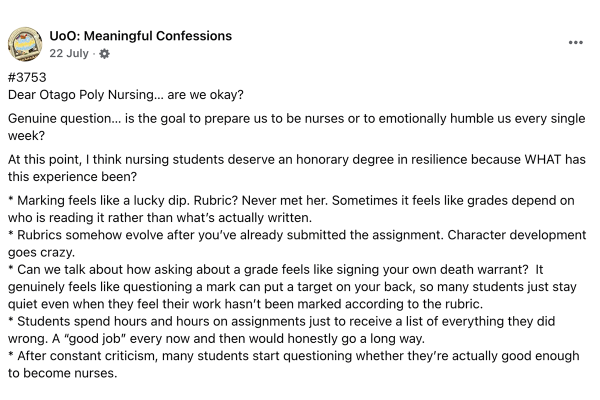

An anonymous post, titled "Dear Otago Poly Nursing… are we okay?" appeared on the University of Otago (UoO) Meaningful Confessions page on the 22nd of July. The post complained that nursing students were being "emotionally humbled" by marking, bad lecturers and inconsistent, recycled lecture content, among other things.
Lengthy complaints are the bread and butter of UoO Confessions. But in this case, a mere two hours and forty-seven minutes later, every Otago Polytech nursing student received a private message from their department. This message, seen by Critic Te Ārohi, asked students to consider their online presence carefully, and direct their feedback to lecturers or Student Success.
"It has come to the school's attention that comments about, and critique of, [Otago Polytechnic's Bachelor of Nursing] Programme (including comments about lecture content, lecturers, placement allocations and support of students) are being posted online,” the message read. “While the original post seen this morning is anonymous, the 'likes' are not anonymous." Apparently UoO Confessions is a favourite for staff and students alike.
The message was posted in full to UoO Confessions a week later on the 5th of August, with the Otago Daily Times and Free Speech Union covering the story in no time. While the original 22nd July post received 222 reactions, the post with the message got 332, making it the 2nd most engaged-with post so far on UoO Confessions this year. Safe to say, saying “The ‘likes’ are not anonymous" did not have the intended effect. The head of nursing has since apologised for this phrasing to the ODT and Free Speech Union, maintaining that they were just "trying to look after the best interests of our students."
In any case, the new Confessions post expressed anxiety that the Polytech had given "[no] reassurance that students would be safe from retaliation" for posting, or even for liking the posts. When approached with this concern, Hayden Croft, the Polytech's Head of College for the College of Health, stressed that "whilst we would hope that any concerns could be raised via [the usual] channels for our students before they felt that they needed to try voicing them elsewhere to gain traction, public criticism of any Otago Polytechnic programme or service would not be grounds for expulsion."
Still, the complaints outlined in the original post remain. But Critic has found the nursing school divided, with students offering varying opinions about the state of their schooling. Brianna*, a third-year nursing student, told us that the post that publicised the department’s message wasn’t quite accurate. The post had said that the Polytech hadn’t given an "invitation for anonymous feedback”, but the Polytech admin actually had followed up with an anonymous survey and arranged a class rep meeting on the 24th and 30th of July – well before the August 5th UoO Confessions post.
Trish*, a second-year nursing student who fully agreed with the original Confessions post, was still agitated weeks later. She brought up a 24th of July departmental message she’d received from the Polytech, stating that nursing professionals and nursing ākonga needed to meet Nursing Council social media guidelines, which appeared to be the reasoning behind why the original post had been a problem. Every nursing student Critic spoke to agreed that the Nursing Council guidelines were “pretty strict” and "drilled into" them during their studies. However, Trish was confused why anonymous feedback ran up against the guidelines.
Nursing is different from other courses. According to Brianna, the Nursing Council's rules were "strict" because nursing is a “very public profession”. However, according to her, the professional obligations around social media are mostly concerned with never, ever breaching patient confidentiality, and not appearing "on the piss" in nursing/Polytech scrubs. As such, Trish expressed her frustration that the original UoO Confession got any kickback at all. In her view, it had nothing to do with patients, and contained no identifiable details regarding the complainant or lecturers. Trish conceded that how "you present yourself as a nurse" is important for "public trust toward the profession" but noted that her cohort are still students.
Basically, this discourse has really confused a lot of nursing tauira about what is or isn’t allowed on social media. Trish thought the guidelines were just that – a way of training nursing students to the standard they would be held to in the workforce, but not actual rules enforced during their period of study. On the other hand, Brianna spoke to unspoken customs behind the guidelines. According to her, nursing has a culture that encourages advocacy for patients, but "everybody knows everybody [in the profession]. So don't make a fuss." A registered nurse also offered her spin to Critic: "no one wants a militant doctor, nurse, or teacher."
Hayden Croft, Head of the College of Health at Otago Polytechnic, helpfully clarified this bind. Student nurses are not actually registered, practising nurses, and as such Nursing Council rules do not mention them or explicitly bind them — although students still must adhere to their educational institution’s policies and rules. Croft, however, told Critic that the Council is the regulatory body of the Bachelor of Nursing programme, and holds it to a certain standard. So student nurses must also follow the Council's codes of conduct, which require professional behaviour online, as well as in hospital workplaces. The NZ Nurses Organisation more explicitly sets out the common rules covering both student and registered nurses, such as "do not make disparaging comments about teachers”, and that those standards are "assessed from the first year of nursing education”.
Some students got that. Charlotte*, a first-year student, had "held [her] tongue" around friends who were in favour of the original post, and were apparently "very disparaging" about the nursing programme in general. Privately, she felt that the matter “shouldn't have been taken to Facebook [...] I do think it was very childish." She thought the original post violated social media guidelines by "bashing the institution" in a way that made "Otago Polytechnic look shady and untrustworthy," and other nursing students by proxy. That upset her. "Because we're not shady. I'm trustworthy. I'm just trying to get my degree and be a good nurse."
Brianna had been "pissed off" by the "likes are not anonymous" message, calling the phrasing “a soft threat." Nevertheless, she dismissed some bits of the original post from her perspective as a third-year student. On complaints about tough assessments, critical feedback, and uneven lecturer skill, Brianna simply said, "welcome to tertiary study."
So if a first-year and a third-year can both agree that the complaints were kind of overblown, why the public meltdown on UoO Confessions? After all, the last complaint voiced on UoO Confessions about nursing was literally in 2022, when everyone was shitting themselves over COVID. It’s been a minute without any big online discourse about the programme.
Trish points her finger at the curriculum, which she feels her cohort are being used as "guinea pigs" for. While she stressed she wasn't blaming individual lecturers, she described it as "incoherent” and “disorganised" with repeated, recycled lecture content. Trish and other second-years apparently want a way to talk to the person who designs the curriculum, not just the lecturers.
The Otago Polytech told Critic that they want to guide feedback like this off social media, and toward the School of Nursing leadership, the Otago Polytechnic Students' Association (OPSA), the Polytech concerns and complaints policy, or student class representatives. However, Trish dismissed turning to class reps for support: "how much can a class rep do if they're so tied to the lecturers [...] We can't really 100% voice our concerns to them."
Critic reached out to OPSA about whether they had received any complaints from class reps, or whether the Polytech was listening to class reps, but received no response by the time of print.
Charlotte and Brianna placed the problem elsewhere. Brianna was more sympathetic with the lecturers, claiming they were under work pressures because "a lot [of staff] have been made redundant." Charlotte said studying nursing has always been "rigorous" and that she estimated 10% of her first-year tutorial group had dropped out and second-years were just being "unprofessional" on UoO Confessions. However, the Polytech's Hayden Croft denies both of these claims. He asserts that, across 2025-2026, course retention for the Bachelor of Nursing increased by 3.9%, that no redundancies had been made at a departmental or teaching level in the last three years, with vacancies filled as they arise. So maybe the problem lies elsewhere.
Nursing students have to complete long placements at medical facilities throughout their course. Of these internships, the final 9-week transitional placement is most important – a springboard into active practice. The unpaid nature of these placements adds cost pressures to students, especially amid the current spike in fuel prices. This year, sortition for transitional placements has changed, exacerbating this stress. Previously, nursing students were asked to 'rank' individual transitional placement preferences, like geriatric or mental health, from 1 to 5. Now, students are asked to identify three 'gaps' in their experience.
Third-year Brianna felt the new questionnaire made transitional placement look "more of a luck of the draw." Students care immensely about which ward they are sent to because it has a large bearing on which nursing field they get hired into. While Hayden Croft maintains the "answers that our students give within the survey are taken into account when transitional placements are allocated – dependent on placement availability," Brianna and Trish both claimed that these are not taken into account, and that the change is driven by a need to put nursing students "wherever" because there are "less placements" to go around.
This change seems to be driving some stress. A third UoO Confession alleged a Polytech staff member had said (regarding transitional placements) that they could “help you to 'reframe' your thoughts about your placement, but I do not have 'spare' placements to move people into." This post got much less traction — besides a comment from an account made that same day warning the anonymous poster that "news travels fast in the healthcare sector." But the post has reached anxious second-years, like Trish. She says nurses on her placement have told her that "if you want to be popped in the deep end with little to no support, stay in New Zealand." Polytech's Hayden Croft told Critic that clinical lecturers are available for academic support visits during placements, and that a variety of scholarships exist for financial support.
However, not all students receive scholarship support. As such, Trish thinks many are "not privileged enough" to sustain themselves in these placements. Trish, Charlotte, Brianna and all the students we spoke to have claimed to have heard placement horror stories: students having to camp in tents near hospitals, or sleep in caravans on placement, all while hearing of a marked increase in abuse towards nurses.
Every nursing student we spoke to was "painfully aware" that it's a tough time for nursing in New Zealand right now. The Government claims that over the last three years, 2,100 nurses have been hired. That runs in stark contrast to what Simeon Brown, the Minister of Health, admitted in parliament on 19 August: between March 2024 and March 2026, nursing has only grown by 54 FTE (full-time equivalent), a unit that indicates the workload of an employed person. That does not account for high nursing turnover (8-13%). The Opposition claims this as evidence of a "hiring freeze", which the Coalition Government has claimed does not affect frontline healthcare workers. The statistics may be contested and debated, but those concerned are at best demoralised and at worst packing their bags for Australia.
Trish said that while she doesn't "necessarily sit down and go, 'oh, at the end of this, I might not get a job’'' it is definitely something that sits in the back of her mind. She thinks it’s “no wonder” graduates are legging it across the ditch. “In Australia you'll be way more supported. You'll get a job in the field you want to do. They talk to us about nursing retention and all this sort of stuff, but it wouldn't be a problem if, I don't know, if we were paid a liveable wage and if we had guaranteement of having a job after this." Trish said that with the combined stress of assessments, placements, changes to placement allocation, and the nurses shortage, the world was telling nursing students to "suck it up" and burnout. So she felt the original post wasn't about disparaging anyone, it was just saying, "Look, are we okay?"
Charlotte, the most opposed to the original post, agreed with Trish on this point: "It's very worrying to think that once we put in all this work – all our placement hours, get our degrees – we might not have a job. And even if we do get a job, we get treated really badly for minimal pay." Apparently, the negative press coverage was "brought up quite a lot" when she spoke with other nursing students. "A lot of us plan on moving overseas, where we'll hopefully get treated better – but it's the same over there. Nurses are just treated poorly. It's just a fact."
Charlotte already knew about many of the problems in nursing because her mum does it, but despite them, nursing is still her passion. “I have never been more passionate about anything in my life,” she shared. "You can't be doing it for the money. You have to be doing it because you want to help people. Doctors diagnose, and nurses cure." For Trish, her reasons for being angry and not jumping ship were the same: "We've dedicated our lives to this."
Hayden Croft wants students to know that learner experience and wellbeing is Otago Polytechnic’s “top priority” and that they welcome feedback. “We will continue to ensure the voices of our students are heard at every opportunity.”
*Names changed
