33 Boys, 42 Kilometres, 50 Grand
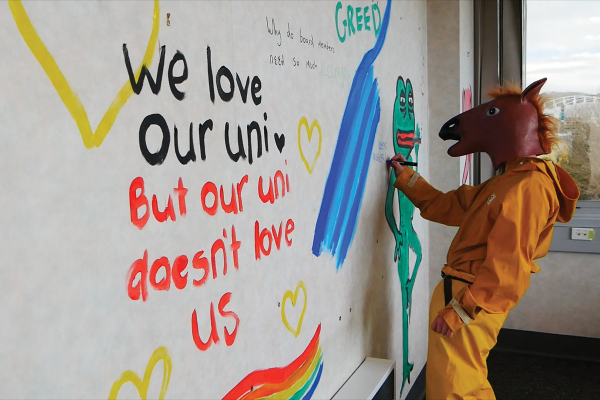
Three people, including one student, were arrested for intentional damage on Tuesday afternoon. The arrests came after a group of mostly students “repurposed” a disused office block on the second floor of the Business School by painting the walls to protest staff cuts and “University mismanagement” of the $60m deficit. This charge - upgraded from the original wilful damage - carries a maximum sentence of seven years in prison.
One of the most prestigious sporting organisations in the world graced Forsyth Barr in the past few weeks: FIFA. A look on Wikipedia might suggest that Dunedin may not have been the most successful choice of venue based on the game stats. But while numbers are boring (though maybe not as boring as Palmerston North), they only tell us so much. It is what the people say that matters. So, what are the numbers? A total of 16 goals scored over six giving an average goals per game of 2.7. An average attendance of 12,615 - although this average drops to just 9,949 when the newly coined “Sell Out Sunday” game between the Kiwis and the Swiss is discounted. Zero knockout fixtures. Zero wins for the Ferns. One grimace emoji. If you were fortunate enough to wander through Otago Uni Link on the 13th of July, you might have seen a FIFA World Cup stand with an opportunity to spin the wheel and have a chance at winning great riches. The only cost: your email, and all the value that may be extracted from that. For many the wait proved fruitful. A student a few leagues ahead in the queue admitted his guilt: “I spun the wheel three times, each time it landed on ‘better luck next time’; I still left with my pockets stuffed with tickets and a hideous hat upon my head”. Japan versus Costa Rica hosted a mass of Costa Ricans who could be seen dancing and skulling beers relentlessly through half-time. The Japanese managed to drown out the Costa Rican minority with the banging of drums and orderly shouts of “Nippon!” In spite of their newly acquired Kiwi fanbase, the Costa Ricans succumbed to Japan 2-0. The stadium, although at half capacity, was jovial, with intermingling between fans of differing allegiances and ages. However, this “friendly” match-up was trivial relative to what was at stake when the Football Ferns took on Rossocrociati (the Swiss team) in the Barr. The game was a sellout, with all of Dunedin’s population crammed in to see if the Ferns could reach the Last 16 for the first time at a FIFA World Cup. Sadly, it wasn’t to be. A possible watershed moment had passed for the Ferns. Critic Te Ārohi noted the disappointment of many fans, but also a greater sense of pride amongst those in attendance. “Many people forget that we hadn’t won a World Cup game before this tournament” a group of ultras informed me, “to win two and reach the last 16 would’ve been extraordinary”. Even some who attended with sarcasm in mind had been turned; a number of blokes confessed to Critic Te Ārohi that “the level of football was beyond what they expected”. The people seem to have given the game a resounding thumbs up.
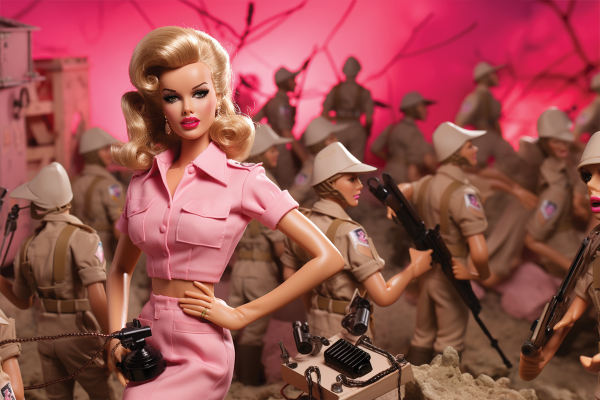
It was a Sunday eve. A slight drizzle sprinkled the still, cold air. Civilians strolled around the Octagon. Armed with their e-tickets and pink uniforms, Barbie militia were beginning to mark their territory. Little did it know, Rialto Cinema was about to be shell-shocked. Critic sent our slayest field journalist to chronicle the advance of the pink army. Walking into the trenches, the air buzzed hot with anticipation. Close to a hundred uniformed Barbie militia had stationed themselves in the foyer, clutching their large popcorn choc-top combos, ready for any sign of enemy activity (Oppenheimer viewers would soon be arriving for their screening in Cinema 2). It really was no-man’s land. The only men seen were a few boyfriends being held hostage and some fathers seeking desperately to reconnect with their daughter’s inner child. As the numbers of valiant soldiers began to grow, a sense of resolute determination and frustrated impatience came over the crowd. Finding myself in the midst of a swarming pink sea of Barbie’s acolytes, I realised I was in the trenches. Never did I think I would make it this far. My jumbo Coke Zero started to slip out of my hands as my palms began to sweat and my heart rate rose. The ticket marshall had taken up his station at the bottom of the stairs. Cinema 3 was only two flights away. The troops were alert and ready. This is what they had spent their entire life training for. All the blood, sweat and tears would not go to waste now. Finally, the orders to mobilise began: “Ok, everyone, if we can please line up in an orderly fashion and allow me to scan your ticket,” said the ticket marshall. The velvet barricade was removed and bedlam ensued. The troops could not wait a second longer to execute their mission; springing up out of the trenches, armed with fanatic zeal, they made a run for it. Thundering up the stairs, anyone would think Oppenheimer was having a live-action screening next door. One of the cinema lieutenants attempted to control the swarms. “Oi, no running!” He bellowed in his patriarchal, mansplaining voice. But the pink paratroops had forgotten themselves. The adrenaline of being out of the trenches and into the field was overwhelming. The ticket marshall’s efforts were fruitless, and many, many tickets would have to go unscanned. I was quickly swept up with the tide of militia. Hurling up the stairs, I held onto my comrades and made my ascent with bated breath. I thought about writing home in case I didn’t make it. In that moment, everything was put into perspective: how much had I risked in the name of honest journalism? Was I out of my depth? I tried to hide my fear behind a pair of giant pink eyeglasses. Barbie World is not what it seems. It’s a warzone out there. But as soon as we entered the cinema itself, I knew I had made it out alive. An eerie sense of calm engulfed the atmosphere. The invasion campaign was over. Now it was time to numb the trauma with a pink-powered pronouncement of the problems with the patriarchy. Our valiance would not go unrewarded.
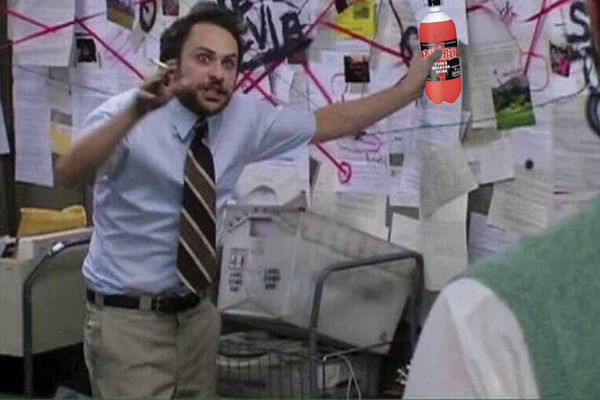
In issue 15 (the one with the rad skiing rat on the cover from a few weeks ago) we published in the TL;DR section of the news that the DCC and Police were allegedly trying to phase out the sale of Nitro. This was inaccurate, and we apologise for any upset caused by this news. But we had good reason to think that: a sign boasting their logo, inside a liquor store, told us so. And thus began one of the longest-lasting headaches of the year (it was only a week). The TL;DR was based on a message from one of our reporters in the Critic staff chat saying “Apparently the police and council are trying to phase out Nitro?” They’d heard this from their partner who works at a Super Liquor and is plugged into chat about liquor licensing, where Nitro has allegedly been thrown around in health risk convos. But this was all hearsay, and something we really should have checked before putting it in the mag (again, sorry). The Vice President of OUSA, Imogen, then sent us a photo on Friday, July 28, of a sign she spotted in Leith Liquor stating that Nitro was “no longer available due to changes in the Liquor Licensing Laws (SOLA)” since it has “high levels of Guarana & Caffeine and is deemed a health risk.” The sign had the logo of the New Zealand Police and the Southern District Health Board at the bottom of it. This wouldn’t be outside the realm of possibility given recent Police activity, like their opposition to Countdown’s liquor licensing over the sale of high-strength single-serve beer (which they weren’t stocking anyway lol). This would all naturally lead you to believe that Police really were behind it. Right? Wrong. “Police aren’t looking to oppose licences based on them selling Nitro,” the Dunedin Police said in an email sent to OUSA President Quintin. “Nitro isn’t illegal, so stores can sell it.” They weren’t even aware of the issue, and said they would be “happy to go speak to the stores and clarify”. As for the Southern DHB, it doesn’t even exist anymore. It was dissolved in July last year as part of a nationwide overhaul of the DHB system and replaced by Te Whatu Ora. And Quintin couldn’t find anything of substance about the liquor licensing law SOLA that was referred to by the sign, either, despite spending what he said was half a conference searching. At this point OUSA’s Vice President, President, and Critic Te Ārohi were all left scratching our heads. Where’d the fucking sign come from? Students for Sensible Drug Policy (SSDP) had been following up on the supposed “health risks”, as well, and got a response from Nitro in simply responding: “Nar bollocks!” Seriously, they said that. I guess that tracks, though. Imogen had a new theory: “I bet it’s internal at each liquor store rather than the police or actual law changes because Nitro is so cheap.” Turns out she was (mostly) bang on the money. After being bounced between different store managers at Liquorland, and following a tip from Jai at SSDP - who’d been told by Anderson’s Bay Liquorland that the decision had most likely been made by the owner of Leith Liquor, Andy Bay, and Meenans - Critic got a meeting with the elusive owner. He confirmed to a reporter that he was the one who made the call to take Nitro off the shelves in his stores - not the Police or the (non-existent) Southern DHB. Bang! We got him. I nearly wept with relief. It was closure almost as sweet as a drunk apology text from your ex. The owner said “maybe 60%” of the decision was because of a string of robberies at his store in Andy Bay that have targeted Nitro, being both a very effective and easily concealable drink. Along similar lines, Leith Liquor stopped stocking tobacco a few years back after it had been the target of violent robberies across the country. He also cited conversations that have been happening around liquor licensing in Aotearoa and high-percentage single-serve drinks (Nitro technically isn’t meant to be single serve, but let’s be honest). “Under the social aspect of it being a product that is highly sought after but also pretty high on the scale of not being socially acceptable, I made the decision to take it off the shop floor,” adding that the store’s location means that he’s been “looking after students for 13 years” and always tries to have their best interests at heart. As for the sign? “A bloody idiot,” he said. “[I] could only apologise for the police and liquor licensing” mentions in the sign “because it was done off my own bat. It had nothing to do with them whatsoever.” In the moment, he supposed he’d been thinking that it would be a lot simpler to offload the blame onto higher authorities, and avoid any grief over it in the process. He didn’t think anything more of it until he got word while overseas from his stores about some students who wouldn’t stop calling about Nitro. But now the Police want to know why he used their logo. If it weren’t for those meddling kids, huh?