



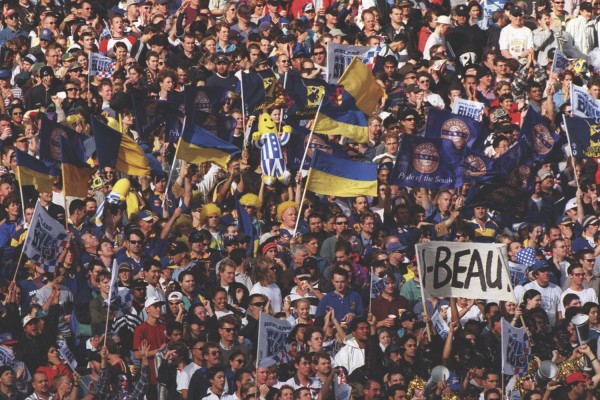

Most will remember the first Sunday morning they woke up in their single bed at their first-year hall. For many, it probably felt like coming up for air after holding your breath, with O-Week stretching out in front of you. Endless, scarfie possibility. With so much going on during orientation, many may struggle to know what to do with themselves. So many events, IDs to photograph, and lecture rooms to find. But if there’s one thing you do in your first week of Uni, it should be attending a rugby game at Forsyth Barr.
2026 marks thirty years of Super Rugby. That’s thirty years of the Highlanders – thirty years of the games that are integral to student culture. Even if you don’t even really like rugby, we reckon that the Highlander’s Zoo could convert anyone into being a fan. ‘The Zoo’ is the nickname of where the rowdy supporters of the Highlanders are seated – mostly Otago University students with beer in hand, flaking blue and yellow facepaint, cheering at players on the nearby ground. It’s loud, fun, and if you asked a random participant after a game who had won, there would probably only be a 50/50 chance they could answer correctly. Going to the Zoo isn’t about the rules of the game, or the names of the players – it’s about the atmosphere. You can get hot chips, beer, scream your lungs out and feel a sense of camaraderie that rivals the Pint Night line. The only person who doesn’t like The Zoo is your dad watching it from your hometown. Or maybe the security guard who had to deal with vomit and shit (literal) on the stands.
Otago student culture and the Highlanders are childhood best friends. They bounce off each other, inseparable and charming. Critic feels like a proud mum by being able to document the thread of that friendship for 30 years.
The Kickoff: 30 Years of Highlanders
The Highlanders team was founded in 1996, drawing its name from the Scottish founders of Otepoti Dunedin. Despite the love for Forsyth Barr and The Zoo, before them was Carisbrook and the Terraces – and they are sorely missed.
Carisbrook (known locally as ‘The Brook’) was the Highlanders’ home turf from its inception. Located in Caversham, the venue had a capacity of around 29,000 – on par with Forsyth Barr’s 30,750. Nicknamed the ‘House of Pain’, Carisbrook had an intimidating, Spartan-esque atmosphere. The conditions on the turf were often difficult and wet, presumably instilling a healthy fear of trenchfoot in any visiting team. The Highlanders played their first-ever Super 12 Game at the ground in 1996. Carisbrook was demolished mid-2011, superseded by Forsyth Barr. It was a day of mourning when the giant fell, even from across the world. Eddie Butler, former Welsh captain, was ultimately upset to hear of its demise (despite the Welsh enduring a fair round of pain at the hand of Carisbrook). “There is nothing the outside world should like to see more than [Carisbrook’s] closure… but hell, we need these special places, where opponents tread with trepidation.”
It has always been difficult to not love rugby in Dunedin – the generous rounds of frost and the steaming of your breath encourage pulling a blue and yellow striped scarf tighter around your neck, or huddling closer to your seat. During the early years of the Highlanders, a railway embankment above The Brook offered fans a clear view of the ground, coined the ‘Scotsman’s Grandstand’. Passing trains would slow to a crawl or stop on the track, giving fan passengers a chance to watch the thrall. Toward the Eastern end of the ground sat The Terraces, an uncovered concrete embankment where students sat to watch the game. With no proper seating, students often brought sacrificial couches along with them to avoid sitting on the freezing concrete. If the Zoo is filled with animalistic supporters, the Terraces were feral in their turnout. Given the high student population of our city, many non-locals become loyal to the Highlanders as well as their hometown teams – making for a confused but passionate crowd. Students were jammed shoulder to shoulder, sometimes stealing the playing team’s thunder through burning their couch seating and running unchecked onto the field to get high fives and autographs from players. Love it or hate it, the Terraces were the birthplace of Otago symbols such as the rugged up Scarfie, and controversial couch burnings.
Marc Ellis: Scarfie to Player
As mentioned, the threads of student culture and rugby are intertwined – not just restricted to brief, glorious streaks across the field. I’m unsure if you’ve ever stopped to ask where rugby players come from, but a lot of them are actually students when they first start playing professionally. Take Marc Ellis for example, the epitome of Scarfie to player, who came to Otago to study. Marc was originally a Wellington boy, but became a proud Otago rep when he moved to Dunners for University. He was 19 when he first began playing rugby, with bright blue eyes, a confident smile and striking dark hair, staying in University College (‘UniCol’). He was studying fulltime toward a Bachelor of Commerce, though it “may as well have been parttime”, given it took him 5 years to get the degree. Happens to the best of us.
Juggling playing for the University and Otago was “fun”, but meant that he was often off to bed early on a Friday night when all of his mates were out at one of the many student pubs of the 90’s. He recalls cooking up lamb chops and tomatoes on a grill his Mum had gifted him – his pregame meal of choice (lamb chops are a “cornerstone” in his life, apparently. He made a Scarfie cookbook if you’re interested). Trying to get in the correct mental headspace for a game the next day when there were parties going on his floor wasn’t always easy, and sometimes even shutting his door on it wouldn’t stop him from being exposed to “social temptation”. Critic imagines Marc like Lightning McQueen in his trailer, chanting “I am speed”, while his hall-mates slur the lyrics of Bliss, the walls of his room vibrating.
However, it doesn’t seem like Marc actually missed out on too much in terms of Scarfie antics. In his book Crossing the Line, Marc references an extensive list of escapades during his time at Uni – a kind of breatha Bible in terms of fun you could get up to. One night involved leaving the Cook, getting naked and dancing around some street signs which had been set on fire, then having to leg it when the police soon arrived. Further intriguing yarns include graciously receiving a small kunekune for his 21st, which quickly became a key part of the Footrot Flats whanau, with a nest in the bathroom. However, Marc’s female flatmates lacked the same level of appreciation, and the writing was on the wall. Thankfully for them, the next time they saw the pig was in the form of pork chops. What goes around comes around.
Marc remembers looking out his window on one of his first nights at UniCol, and seeing a bunch of guys drinking out of large beer bottles on the street and throwing that at a concrete wall. “If the bottle didn’t break, they’d yell ‘super-bottle!’” He knew he’d come to the right place, describing UniCol as “magnificent”, but that he’d often end up just closing his curtains and turning his lights off to shut it all out – even when the guys began teeing up golf balls and aiming them at the UniCol windows. His arm has gotten more rubbery with age, but at 19 years of age his worldview was “myopic” – no amount of super-bottles could distract him. Rugby was what he wanted, and it’s what he got.
Marc was a Carisbrook gladiator, playing many games at the venue. He’d walk into the changing rooms, and an hour later run out to greet 30,000 people filling the amphitheater-style grounds. The Terraces were teeming with students – couches burning, people dressed in all sorts of absurd outfits or occasionally “nothing at all.” One time, he observed a streaker running across the field in the middle of a game. ‘Look at this prick’, he remembers thinking, before realising it was his flatmate. “They were fun times [...] I recall [Carisbrook] with much fondness – the sort of loose aspect – and the student support thereof.” He reckons what makes rugby as a game great is the people who enjoy the atmosphere of it all – as the students on The Terraces did. It’s the social aspect of the game, and the people that come in appreciation of that. “They’re paramount,” he insists. Creating games that are fun enough to drag your un-sporty flatmate to is what matters. There’s a genuine showmanship in a good game of rugby, well aside from the rules, shareholders or technical prowess of the players.
Marc played rugby up until the 2000 season before retiring for other, more entrepreneurial pursuits. He established the iconic Charlie’s juice brand in 1999, and went on to become an iconic television personality. When asked what inspired the change of occupation, Marc observes the shift from amateur to professional rugby. “I played five years of amateur and five years of professional [rugby] in the end, and three years playing League, and then I went back to rugby and the rugby I went back to was four years into its professional era [...]”. The professionalisation of rugby began in the early 1980s, when advertising became more prominent in rugby. The Ranfurly Shield was first sponsored in 1985, and Japanese telecoms company Kokusai Denshin Denwa was the principal sponsor of the inaugural Rugby World Cup in 1987 (hosted in Australia and New Zealand), which went on to be won by the All Blacks. It was this event that solidified the commercial potential in rugby, and incentivised News Corporation to secure the television rights for the game in 1995. The revenue gained from this deal meant that the New Zealand Rugby Football Union contracted the All Blacks as well as players for the new Super 12 competition (now known as Super Rugby). This kickstarted a wave of sporting professionalism felt right across the globe.
By that point, there were teams of nutritionists, psychologists and physiotherapists to catch up with after games – no doubt messing with Marc’s strict diet of grilled lamb chops and tomatoes. “I’ve always said that in professional rugby you have to be so smart that you can turn off, or so stupid that you’re not turned on,” Marc says. “But if you’re somewhere in the middle, it becomes quite burdensome.” Rugby for him had become less of a passion, and more “like a job”. That’s the potential risk of following your passion, and monetising what you love. Nowadays, he reckons students that do get into professional rugby achieve no small feat. “I’d be impressed with the students who do it at a top level while continuing their degree. It’s literally a 40 hour a week job, you know?”
The path for students into a gig with the Highlanders is relatively wellbeaten. The Uni solidified their relationship in 2014 with an advertising deal, and many of their current team are ex and current students. You don’t have to be keen to get on the field either – the Highlanders offer internships for marketing, communications and commerce oriented students. For Marc, getting involved in professional rugby from a young age was all about balance. “Therein lies a little bit of a challenge,” he admits. “If you shoulder tap a kid who’s fifteen with a bit of talent who’s not inclined to study or prefers to run around, they may hang their hat on one hook.” His advice to younger players coming into the profession is to elicit support from people who have already been around the block – “the Council of Years”. Those who have been in that position before usually have a valuable perspective on what life holds beyond rugby. Marc emphasises that even Christian Cullen (“the best player I ever saw”) only had six years with the All Blacks. “It’s a very short window of opportunity”, he says. The Highlanders now benefit from a Personal Development Manager, there to explore and enable extra-curricular interests outside of rugby, ensuring that there are future career pathways setting the players up for life.
As of June of 2023, Marc bought shares in the Highlanders with some of his fellow ex-teammates, and was appointed as a director. “Any reason to spend more time in the best part of the country with solid Southern folk needs little encouragement,” he said in a statement. “As the late great Gordy Hunter would say, ‘Don’t forget your roots lad, and don’t be afraid to give back”. Marc seems to have stuck by this rationale, telling Critic that the further South you go, the better people get. Despite his varied career, he still ultimately reckons that the Highlanders have something special to offer. People down South consistently support the team, and have done so for a “very, very long time”, whereas he reckons that if the Warriors lose a few games, the seats might be “pretty empty”. But so long as the Highlanders keep being supported, they’ll keep winning. “Success breeds success,” Marc says, with a sense of finality.
Lucas Casey: The Rising Star
22-year-old Lucas Casey is one of the youngest players on the Highlanders, recently graduated from the University of Otago. He’s tan with dirty blond hair, and an easy-going demeanor. In the spirit of thirty years of Super Rugby, Critic asks Lucas if there’s a player he models himself off of. “I think everyone who plays number 7 always goes Richie McCaw, but I always remember Michael Hooper as well. And Dan Carter.” Despite being from up North, Lucas also reveals that he didn’t really grow up supporting the Blues. “It always felt like there was a gap,” he says, explaining that his Dad is from Timaru, and an avid Crusaders supporter. Despite being physically from up North, it seems like Lucas was always destined to become a Southern man. He lets us in on how he became a Highlanders fan as well: “I forget the exact game, and I wish I could point it out, but there was a game where the Highlanders beat the Crusaders – and they just should not have won at all. They were massive underdogs [...] And then as soon as I was in the under 20s, I was just like, ‘this is where I want to go’.”
Lucas just finished his Bachelors degree in Management and Marketing last semester, taking four years, and plans to graduate soon this year. “Hopefully not on a home game weekend,” one of his colleagues laughs. Lucas has already checked the dates: it’s when the Highlanders are playing the Chiefs away, and they’ll be back in time for graduation. These are the things you worry about as a young professional rugby player. For him, no other University stuck out like Otago: he’d had uncles that had attended in the 90’s who couldn’t speak higher of their experience, and the whole culture felt completely student oriented. He reckoned he’d fit in pretty well.
Lucas was selected and debuted for the Highlanders against the Crusaders last week, something that many aspiring players from his hometown of Kerikeri dream about. Lucas had been going along to his local club since he was about four or five. “In small towns, there’s not a whole lot to do,” he explains. “So filling your weekends with sports and mates is how you meet people.” He loved it, and just never really stopped doing it. Rugby is “all [he’s] ever done.”
When he got to Otago, he didn’t have anything lined up rugby-wise. He knew he wanted to keep playing, but felt like a small fish in a very big pond. “Being from a small town, you never know how good you are until you start playing against [other schools].” He began playing for Kaikorai Rugby Club and it turns out he was pretty good at it, quickly rising from the Colts to the main side. Last year, he captained the Demons to Premier Club Rugby glory in the Speights Championship Shield in July, to kick start an extensive whirlwind season culminating in the Log O’ Wood (the Ranfurly Shield) safely stowed away for the summer, and a Highlanders contract just around the corner.
Lucas is someone you’d probably refer to as a rising star – and he has the right temperament to cope with it. When he was selected for the Highlanders at 21, he didn’t feel overwhelmed, but excited. “Grateful for how it all panned out. And I got a degree under my belt as well.” When asked how he learnt that he was in the running for the Highlanders, Lucas tells us that he was playing NPC when he got a text from Jamie Joseph, current Head Coach of the Highlanders (soon to be All Blacks?), asking to catch up. “It was a bit of a shock, a bit out of the blue,” Lucas laughs. Lucas had a standout performance in his 2025 Bunnings National Provincial Championship (NPC) season, highlighted by a memorable two-try performance in Otago’s Ranfurly Shield victory over Canterbury. Maybe that text from Jamie wasn’t as out of the blue as he might think. Reflecting on the collective Ranfurly Shield performance, Lucas described the experience as “awesome.” He explains that being from a smaller region, there was never really much heard about the Shield (Northland last won as “North Auckland” in 1978). “And then you come down [to Dunedin] and you look at the history against Canterbury and it puts it into perspective how cool it is, and how important. The feeling around Dunedin was pretty priceless.” Lucas says it’s something he’ll never forget. Players and fans alike understand the historical significance of what the Ranfurly Shield means to our national game, inspiring excitement and ‘Shield fever’. The boys had successfully pulled off their first triumphant shield challenge against the Red and Blacks since 1935. The shield clocked upwards of 2,000 kms last season, changing hands five times before settling in Sam Gilbert’s warm embrace. The log has been an important cornerstone of the NPC resurgence, amidst a struggling climate where maximising fan engagement has been a key focus for those at the helm of NZ Rugby.
Initially, Lucas felt a bit under pressure knowing that he was being watched for recruitment, but that feeling soon switched to relief. Jamie didn’t really ask him to do anything different, or give him anything to touch up on – just keep playing how he was playing. It was a “confidence booster” more than anything. A few weeks later, it was all done and dusted: Lucas was set to be a Highlander. Nowadays, most of his time is spent at Highlanders HQ, filled by meetings, gym sessions and various trainings.
Lucas had his first pre-season game the other week against the Crusaders in Timaru, which he described as “fast, hot and good” (that’s what she said). He already had some strong minutes with the NPC side, which he felt was good in bridging the gap. He says there is still a jump between the two, but he finds it helpful to remember that he’s “here for a reason”, as opposed to just being “happy to be there”. Jumps in standards become the new standard for him – he says that he now plays to “make an impact”. In terms of personal goals for the season, he reckons he would love to run out once this season and get a debut in front of a pumping home crowd. Safe to say he ticked that one off pretty quickly, getting the nod to start in Round One against the Crusaders last Friday, playing a key role in an unreal home win over our neighbours from up the road. The ‘Landers looked like a well-oiled machine, while the Zoo was in fabulous form, evoking strong nostalgia from years past. Lucas might need to set himself another goal for the season, but clearly the sky is the limit for the young man from Kerikeri!
Like Marc, Lucas is aware of the need to strike a balance between playing professionally and being a young bloke in Dunedin. “I was pretty lucky it didn’t kick off too soon,” he admits. “Some boys come down and they’re straight into it in first and second year, but I didn’t join an NPC team until my third year.” He spent his first years at Uni with mates, at the pub, and enjoying his time like many others. He reckons other young players might miss out on that aspect, but it’s been a “huge” part of his life that he’s made the most of. “I’ve made lifelong friends, and achieved some of that balance.” In saying that, he admits that he doesn’t do a whole lot outside of rugby nowadays, something he blames on his upbringing. “Growing up in a small town, all we did was play rugby. You go about your week, play rugby, maybe have a few beers afterward, and repeat.” It’s a habit he might never shake, but he says that Dunedin is a “pretty awesome place” with lots to do. There are always people to catch up with too – either at Baa Bar or the Bog, his two favourite pubs.
Now that he’s a fifth year, many of his University mates have moved on, and things are beginning to mellow out. He’s ditched student flatting, trading glad-wrapped windows for double glazing, opting to live with his girlfriend in a “much nicer house”. He’s now looking forward to growing as a person, but isn’t super fixated on any major personal goals. Given he’s done with his degree, he’s able to fully focus on rugby for the next while – something unique to him compared to many of his teammates. There’s heaps of players who are still enrolled in part time study. “It’s worked out well,” he says. “Now it’s just figuring out what else I’d like to do alongside rugby [...] I’m just so grateful for how it all panned out. I wouldn’t change anything, the people I met [...] Going to Kaikorai Rugby Club, I love that place as well. It all just felt like the perfect last couple years. I guess my advice would be to keep enjoying it, keep making mates.”
30 Years Under The Belt
In some ways, so much of the game has changed – but in others, not at all. The blue and yellow still wrap tight around our necks, but the couches don’t burn the way they used to at Carisbrook. The cold concrete of The Terraces has given way to the polished roof of the Forsyth Barr Stadium.
Professionalism may have ironed out some of the chaos, sure. There’s at least an attempted reduction in feral streakers, and pork chops have been traded for nutritional plans. But the pulse is still there. It’s in the roar of the Zoo, in numb-fingers clutching hot chips, in first-years finding their people in a sea of strangers. The game’s grown up – and the student culture has too. But the love affair between childhood best friends? Still kicking.
Critic will be giving away free Zoo tickets to all of the home games this year, so keep an eye on our socials to be in to win.
