
Carys Goodwin
Politics Editor
Articles by Carys Goodwin
89 articles found. Displaying page 4 of 8.
-
News
 Issue 18 03/08/2014
Critic tackles election year | Issue 18
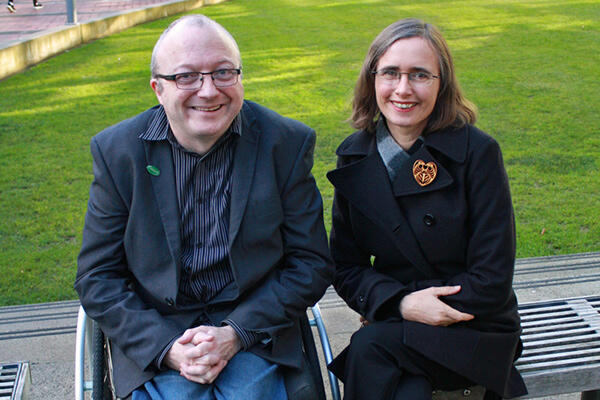
Disability rights are not often talked about at university. Given that almost one in four New Zealanders are disabled in some way, it is definitely a topic that should make more waves at Otago. I spoke to Mojo Mathers of the Green Party, who is the first profoundly deaf New Zealand MP, and Chris Ford, a Greens list candidate, disabled, and strongly involved with disability advocacy. The issues that disabled people face are as much social as they are monetary, a concept Chris explained to me as “the social model of disability.” He and Mojo both argued the most disabling part of being disabled is the way they’re treated, and a lot of work needs to be done to change the way employers and the public considers disabilities. You’ve both done a lot of work in the disabled community. What is one of the main things that the government needs to change in how they support disabilities and disabled people? Mojo: Well, New Zealand has signed the Convention on the Rights of Persons with Disabilities, but the government really needs to step up and give full effect to implementing the convention. That covers all areas of life from accessible buildings, to employment, to access to information. The overarching principle is that disabled people have the right to full participation in society on an equal basis with other people. Chris: I think that that’s quite a fair summation from Mojo. I feel that the UN convention is something that we, as disabled people, have fought for internationally for a long time. And now that it’s there, we should utilise it as a tool to create the equality that we as disabled people seek. So I’ve seen you do some work with making sure Christchurch is rebuilt fully accessible; is that one of the main issues you’re pushing for? Mojo: It’s definitely one of them. To ensure that the Christchurch rebuild is fully accessible will require that the building code and standards are updated, so it will have the nation-wide implication that progressively all new buildings will become accessible. And they should be, in the 21st century. Chris: And also the other concern that Mojo has been campaigning on too has been earthquake-prone buildings legislation, and that is a real concern because what the government is proposing is to decouple the present requirement that when buildings are earthquake strengthened or fire strengthened, that they are also made fully compliable with current building access standards. Now, to decouple that requirement means that a lot of our buildings, including heritage buildings, will not be able to be made accessible, and therefore that will deprive not only disabled people but also older people, also parents pushing strollers, and so forth, of the right to full access to public buildings. Mojo: Absolutely, because it’s the only mechanism we currently have in law for updating older buildings to modern accessible standards. If we take it out of the Earthquake-prone Buildings Amendment, then we’ve missed an opportunity for upgrading and modernising older buildings. What is the government currently doing? Mojo: The earthquake disability leadership in Christchurch organised a petition, which I launched with them, signed by over six thousand people. It was handed over to the government last year, so the government has done a review of the building code act and they have come up with a list of recommendations for action. But that won’t be presented until after the election to the minister. The next area I want to talk about is regarding disabled students. Because it’s not something I often hear about, and I was just wondering what in particular you’d like to see happen support-wise? Mojo: The different universities have different levels of support for students with disabilities. So I know that at Victoria University they’ve really led the way in ensuring a lot of support is available for students to pursue their studies. It’s incredibly important that disabled people have the ability to continue to up-skill and access further education, particularly because there are so many barriers to entering employment as it is, so they need to have the opportunity to gain these skills. So there’s a lot that universities could do to be more accessible; I’ve had students approach me about things like accessible information, or things like showing videos without captions, which makes it very hard for deaf or hearing impaired students, things like providing documents in accessible formats, and then, of course, some university campuses are very difficult to get around for students in wheelchairs, so there’s a lot that needs to be done. Chris: And I know from being a graduate with a disability about the various barriers that I encountered back in the 1990s here at Otago; they were far more surmountable than they are today. I think that in terms of relative comparisons that Otago performs well in its support for disabled students. But there is a lot more yet to do. I do know that the legacy of the late Donna-Rose McKay is very well felt here, and I think that her legacy needs to be built on and that includes the students around New Zealand as well. And also the other thing, and even though it may veer slightly off the question, is the issue of employment for disabled graduates. That is a really big issue. I’ve found that myself at various times that getting employment has been a real difficulty for me because of the attitudes of employers. That’s a real issue for a lot of disabled graduates. They see, as I’ve seen, their peers go ahead and get jobs whereas disabled graduates find it more difficult to access employment. And I think, really, the realisation of the UN convention is just one way in which disabled people and disabled graduates will be able to realise their dreams of being able to land jobs just as quickly as their non-disabled peers. Mojo: Touching on employment, one of the things that really comes up time and time again is the importance of employers focusing on the skills of disabled people; rather than what they can’t do, what they can do and what they can bring to the job. Because very often we can work around barriers. We have the concept of “reasonable accommodation,” which means sometimes maybe slight modifications of the job description, or not requiring a driver’s license if driving isn’t part of the job. These sorts of things. Is there anything currently in place to support disabled graduates? Chris: It’s the same sort of employment packages that are available for other people. But I think that more needs to be done to ensure disabled graduates are able to land appropriate jobs that utilise their skills to the fullest. And I think that will require government funding and support. And I think that that’s quite a crucial thing. Mojo: There are support agencies, but there is a lot more that can be done. I think recently there has been an initiative to work with employers across the country to educate them about disability, and because there are often a lot of assumptions they hold; that disabled people just can’t do certain jobs. The same applies to me; there was the assumption by a lot of people that a deaf person could not possibly be a Member of Parliament, and could not possible do the job, and I often got questioned on that. How could you be an MP? How can you do that? So the negative attitudes and assumptions will often put disabled people in a box and people have very low expectations about what they can achieve and what they’re capable of achieving. So there are a lot of strategies that can be employed to help out the way people view disabled people and the way that we support people in achieving their ambitions? Chris: That’s right. And also, I think that the Greens are showing, with Mojo, myself, Chris Perley, and Rachael Goldsmith, that disabled people are politically active, that we are able to be candidates. I think the Greens are very committed to improving the representation of disabled people on the list, in particular. And I think that’s a good start. Mojo: Absolutely, because actually to help create change and be part of a changing nation, we need to see disabled people widen their representation; it’s very important that we are able to stand for local government, central government, and be part of that change. Instead of having decisions made for us. One last thing, which is about animal welfare, because that’s your other big “thing,” Mojo. So a lot of noise has been made about animal testing, especially around cosmetics at the moment, and I believe you introduced that amendment before – ‘cause I know it’s a recent Labour policy – am I right in thinking you introduced the amendment? Mojo: Yup. I currently have an amendment to the Animal Welfare Amendment Bill that would ban the animal testing of cosmetics in New Zealand. I put it up at the select committee stage and we had a lot of discussion about it, and in the end the National Party MPs voted against it. But they said “oh, we support the intent, but we need more time to consider it because of possible unintended consequences.” So that was quite frustrating, but there is still an opportunity for the National Party to change its mind and vote for it at the next stage of the bill. Just for a lot of curious people out there, does that involve no animal testing IN New Zealand? Or does it involve banning products that have been tested on animals OUTSIDE of New Zealand? Mojo: To ban the sale of cosmetics [that have been tested on animals] would require a separate bill, because the Animal Welfare Bill only covers New Zealand. So it still needs support. Obviously it’s always been our policy as well, to oppose cosmetics being tested on animals wherever they come from, so we were really delighted that Labour had stepped up and agreed to that policy as well.
-
News
Issue 17 27/07/2014
Greatest hits / Greatest shits | Issue 17
Greatest Hit This week’s Greatest Hit is an easy one. Just hop onto labour08.co.nz, refresh a few times, and you’ll see why. Perhaps campaign-year-specific websites aren’t the best idea if you’re not going to maintain them. Greatest Shit Normally I stick to New Zealand politics with these sorts of gaffes, but sometimes it’s necessary to move beyond our cosy bubble. I don’t doubt you’ve heard that Israel is bombing the shit out of Palestine, and you’ve probably seen posters around the University for the Free Gaza rally that took place a couple of weekends ago. What you might not have seen, even though it went viral, is that an Israeli soldier took it upon himself to Instagram a Palestinian child in the crosshairs of a sniper rifle. That’s not just shit-worthy, that’s disgusting.
-
News
Issue 17 27/07/2014
Politweets | Issue 17
We love you too? The novelty account of #TeamKey A few MPs got into this hashtag. It’s just common sense. Ba-dum-tish.
-
News
 Issue 17 27/07/2014
Critic tackles election year | Issue 17
This week’s interview was much more successful than Te Ururoa’s. I spoke to David Seymour, the ACT candidate for Epsom, about everything from student loans to shades of yellow. The most notable discussion topic? His fascination with NZ First MP Tracey Martin, about whom he regaled me with stories after the interview finished. To be honest, I don’t blame him. I’m pretty fascinated by Tracey myself. So I have read the tertiary section of the ACT website - funnily enough, I do try to research. It doesn’t really say anything about whether you’re supportive of the weekly student allowance and the weekly student loan? So I mean, first of all, when you look at policy for students, I’m not really into making policy for a life phase. It’s a little bit like having policy for midlife crises and policy for menopause. The truth is that we make policy for people who go through different periods, so as far as “are we in favour of a universal student allowance,” no. Basically because if you look at it from your whole life’s equation, why would you want to pay a whole lot more tax later in your career, remember you’re going to be in the workforce for forty years, and a student for four, when there’s actually, you know, clearly most people can actually pay back their living costs. Okay, I see you. It does say you’ll add interest onto student loans. Is it for everything? Yeah, it’s for student loans, and again, you have to put this into context … The question is, do you want to invest in your own education and pay it back with some sort of real cost basis involved, or do you want to put all of this funding into a massive pool and fund a whole lot of bad choices of other people? That’s really the choice for people when they look at their whole career with tertiary education being only a small part of it at the beginning. But if you’re adding this interest scheme onto the student loans and then saying you’re going to deregulate the market, similar to what we’ve just seen happen in Australia, how can you guarantee people are going to have the amount of money to be able to pay that back? Well at the moment a lot of people don’t. There is a hard tail of people who are not paying back their student loans. So we’re not arguing about whether or not there’s going to be people like that, there always will be. What we’re arguing about is do we want the highest quality education possible? And you’re not going to get that if you put an arbitrary cap on the fees, because it means that you’re basically trading quality for quantity, and that’s actually bad for students. But then doesn’t it incentivise only those who are in the highest bracket to go into education? Or are you saying that student loans will still cover fees completely, exclusive of the cost? Yeah, but I’m not saying you should have higher up-front fees. I don’t believe that. The rationale for having a government student loan scheme is this: you can’t sell yourself or your future income as a guarantee, and so actually there is a missing market for private lenders. Therefore there’s a justification for the government to intervene and loan you the money up-front. So it’s kind of a … tweak of the way we view it. ‘Cause there’s sometimes the assumption that high-interest student loans will lead to a system that we’ve got in America where people can never pay off their student loans, and are just chipping away at the interest rather than the actual loan. But that’s happening here, too. The difference is they’re a country that has, what is it, three of the top five universities and most of the top fifty. What we’ve done is chosen to have high quantity, low quality education by regulating fees, and everybody has to go along and do it, because if they don’t, it’s assumed that you weren’t even good enough to do that. It’s actually making us worse off to have subsidised and price controlled, low quality education. So would you say there should be some government education that’s of a lower quality and in addition have the free market education? Or are you saying we should get rid of it altogether? I just think we shouldn’t try and control the prices. Okay. Let’s turn to Epsom. Now, do you think you, the ACT Party, will reach the five per cent threshold? I think it will be a huge challenge for ACT. It is still possible, anything can happen in the last six weeks of an election campaign, when the focus really goes on. But if ACT is only able to succeed in one electorate, one electorate that’s in Auckland, why not simply stand for a seat on the Auckland Council? Why bring the whole country into having the ACT Party as one of the parties in government if you’re only representing a tiny, tiny minority? Well that’s how elections work around the world. It’s often voters and a few marginal seats that decide the result. If you don’t like the fact that the majority decides and it’s always a few people at the edge who decide which way to jump and where the majority is, then you should be opposed to having government doing so many things: charging so much tax, running so many services, regulating so much of your life. Okay. I mean, it has been recommended that we get rid of the coat tailing rule altogether, so yeah. I’m kind - All electoral systems are imperfect; I have never been to or heard of a country where people love their electoral system. The truth is that the best feature of an electoral system you can have is consistency, because then people can organise to try and get the policies they want under the system that exists, rather than having the goalpost moving. That’s actually undemocratic. Do you believe climate change is anthropogenic? Yeah. And do you believe we, the New Zealand government, should do anything in the form of mitigation or should we stick to adaptation? Well, I’m not sure that the New Zealand government is in a position where it can do much about this challenge. One of the possible things it could do, well, it could introduce some sort of tax or trading scheme as it already has on carbon but to the extent that doing that starts to push industry offshore and European consumers start choosing Danish butter off the shelves instead of New Zealand butter, bearing in mind that their cows live in stalls and consume huge amounts of energy while ours kind of just walk around on the grass and are very efficient, then we could actually make global emissions worse. Secondly, it is true that we’re such a tiny fraction of global emissions. Our contribution is negligible; the main contribution we make is we actually set an example. And so what example are we going to set? If we tax our industries offshore, and there’s serious economic and political repercussions for doing so, then the message New Zealand could end up sending the world is “don’t do this, you’ll get voted out.” Would I support a carbon tax that was revenue neutral and in line with what other countries are doing? Possibly. But until that time, I’d far rather bet on the creativity of free people arranging their affairs to deal with the upcoming challenge than trying to get the world’s governments together to agree on a scheme, and I think that’s the practical reality. So are you supportive of Climate Voter? Yeah, I’ve come across these groups, and I think they have really let their cause down. I find them to have quite an exclusionary sort of attitude. In most of my dealings … I’m not pointing my finger at these particular folks, but I tend to get the feeling that they’re trying to drive other arrows. For example, they want to make you use public transport, well you know, I’m not necessarily sure that that’s the best way to adapt. It may be that the cost and the time lag in trying to reshape cities to a high enough density that public transport becomes viable for a large number of people, actually, is an inefficient way of getting to the same goal, when private vehicle transport is becoming more efficient every single year. So you’d prefer to push for those sorts of initiatives in more rural areas than the move towards public transport? ‘Cause Auckland’s obviously really dense compared to the rest of the country. Yeah, but what matters is compared to the level at which the kind of public transport that, say, Generation Zero are advocating. I’ve been to three cities where public transport appears to work: New York, Tokyo, and London. Auckland’s not that dense. I’m just saying that my general impression of those guys is that actually they tend to bundle climate advocacy with other causes that I don’t necessarily agree with, and I think they do themselves a disservice and the whole theme a disservice. Shoot, shag, marry: Tracey Martin, Clare Curran, Paula Bennett. Fuck … Um, I think I’d have to get to know them on a personal level first. What if we say: reject one from parliament, re-elect one into parliament at the election, or realign one to a different party. Oh, reject Tracey Martin. I mean … wow. She’s an inspiration. I wish I were as clever as she thinks she is. But sadly not many people can be. I’d re-elect Paula Bennett. I think, and I’m serious, when the history of this period is written … Paula Bennett will probably be the most remembered minister, because she has fundamentally renegotiated the terms of the welfare state from being open-ended entitlement to a system of mutual obligation. And that is an extraordinary change. It has taken forty years to get there, and I think one of the reasons that Jacinda Ardern’s attacks on her are so flaccid is that Labour knows that what she’s doing is fundamentally right. So Paula Bennett should absolutely be re-elected. And Clare Curran, she seems nice enough, so let’s realign her, see if we can make her an ACT MP. What’s your favourite shade of yellow? Mustard. Isn’t the ACT colour canary? It varies according to focus groups.
-
News
 Issue 17 27/07/2014
Apathetic student voters just don't give a fuck
Voter enrolment statistics as at 20 July 2014 reveal that Dunedin North is one of the worst electorates in terms of 18-24-year-old voter enrolments. With just 51.35 per cent of the young population enrolled, Dunedin North is only better than the 35.47 per cent of Auckland Central. National enrolment is currently at 68.86 per cent. Given the density of 18-24-year-olds in the Dunedin North area, the lack of voter enrolment could point to two issues. Dunedin North MP David Clark highlights the first, “a lot of students have chosen to enrol at parents’ addresses. For many, it is their most stable contact point for ‘official’ mail during their student years.” This in itself poses problems for voter turnout on Election Day, as it could mean these students are unable to vote in Dunedin North when they arrive at the polling booth to do so. This year’s election takes place during the semester, making it especially important that students are enrolled in Dunedin North. Second, this statistic could be indicative of a larger youth engagement problem. Despite numerous campaigns to push for enrolment of university students, such as RockEnrol, Get Out and Vote, Vote Maori Vote, and the official government enrolment campaign, youth enrolments still appear low. The Internet Party has also pushed for voter turnout, with its “Party Party” tour framed as “one big party inspired by getting the youth out to VOTE!” The diversity of the strategies employed to engage voters shows the urgency of their message. Clark considers it “a real shame” that enrolment overall is low. He says that the age group is “at a life-stage when many people are actively thinking about big issues and are likely to bring a thoughtful view to the ballot box.” This could point to disconnect between the voter engagement groups and the voter. It raises questions about whether or not the number of groups has diluted the strength of the message, and if the importance of enrolling to vote has descended into nothing more than background noise. With regards to the way media and advertising is targeted, Clark suggests “voters are bombarded with publications and advertising that is laden with assumptions not necessarily shared by the student population. This can lead to a feeling that ‘politics’ is about someone else.” If the numerous campaigns are to be effective, there is an argument to be made for streamlining the messaging. “The decisions made by politicians will affect this age bracket longer than any other age at the ballot,” Clark argues. Irrespective of cause, the statistics are a worrying indication of the extent to which Otago students are not connecting with the political dialogue that has been had so far.
-
News
Issue 16 20/07/2014
Greatest Hits / Greatest Shits | Issue 16
Greatest HitsRecently Back Benches featured a number of youths. Hailing from Labour, National, Greens, NZ First, and ACT, these youths had a go at hashing out a few pressing issues. They also had a go at each other. This week’s Greatest Hit goes to an amazing call from ACT’s Louis Houlbrooke, who, fed up with the ‘70s-dressed Curwen Rolinson of NZ First, yelled “the only thing bigger than your tie is your ego.” Greatest ShitsIf I didn’t make it clear enough last week, I’m not exactly Cameron Slater, aka Whale Oil’s, biggest fan. I wasn’t particularly looking forward to his contribution to the Tania Billingsley chat, and lo and behold, he didn’t disappoint. First, he tried to argue the whole affair was a smear campaign by the left; second, he tried to say rape culture doesn’t exist in New Zealand, something even Paula Bennett disagrees with. Describing his coverage as insensitive and oblivious is pretty euphemistic.
-
News
Issue 16 20/07/2014
Politweets | Issue 16
Fake Russel explains the new Green policy. There’s a parody account for everything these days, including POLS102.
-
News
 Issue 16 20/07/2014
Critic tackles election year | Issue 16
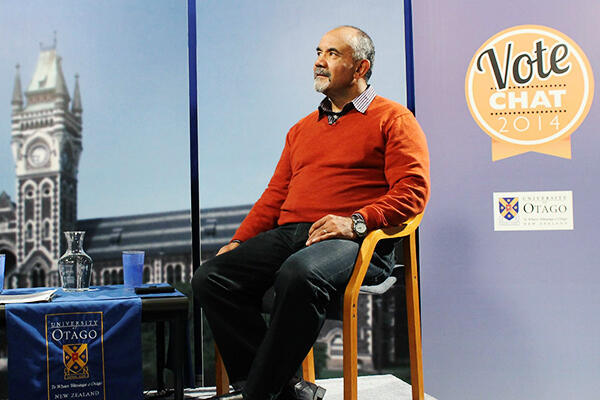
Since taking on the job of Critic’s Official Politics Nerd, I’ve been able to chat to a number of politicians. Normally, this results in a combination of great discussion and inappropriate questions (and answers). The opportunity to interview MPs and the like is not often awarded to students, and I enjoy being able to present student-related talk to the Otago populace. I take it seriously. This week, however, left me feeling a bit put out. I spoke to Te Ururoa Flavell, co-leader of the Maori Party, after he appeared on Vote Chat. It was disappointing. Disappointing because I truly value what the Maori Party brings to the table and was looking for some interesting discourse; disappointing because they’d requested the interview, not the other way around (the person I’d been in touch with was so enthusiastic about getting in touch and was truly grateful for the opportunity, so I feel bad that it turned out as it did); and disappointing because I’d given the topic areas in advance, so it wasn’t as though I sprung anything on Te Ururoa that he couldn’t have prepared for. He was 25 minutes late, first of all, and didn’t bother to inform me that he wouldn’t be on time (I texted the person who’d been in touch with me after 15 minutes, so I did find out he was still planning on coming along). Second, after I asked the first question, he requested that I stop the recording (I restarted it after about 10 seconds) while he shuffled incessantly through a number of thick paper-filled folders to gather the answer. It really wasn’t a difficult question. Third, when he finally found the sheet he was looking for (three and a half minutes after I asked the first question), the answer he read off was word for word what is on their website. Funnily enough, I’d thought to look up the Maori Party’s tertiary education policies in advance. As a result, I felt as though the whole affair wasn’t taken seriously; that it was just a student magazine, and Te Ururoa wasn’t particularly interested. I wasn’t impressed. Hence this write-up. In all honesty, it’s insulting to be dismissed as a disillusioned and “lost” sector of society when the very reason we’re disillusioned is due to a lack of engagement on the politicians’ part. It’s their job to capture our attention, and to appeal to us on both a personal and a political level; not taking us seriously is a dangerous step towards losing not just a vote for their party but a vote at all. The apathy is not inherent, and politicians shouldn’t treat it as such. It has been nurtured through being considered “just students” and having our political intelligence condensed down to a few buzz phrases that don’t capture just how important and formative these years are in figuring out what we value and what we ought to. With Te Ururoa sitting across from me reading policies off a list it became abundantly clear that this was not about engagement, it was about publicity. Students aren’t in the political sphere because we want to be used as examples of politicians embracing diversity or youthfulness, we’re here because we do actually care. It’s particularly ironic that Te Ururoa claimed the Maori Party wants to “hear our voices” given he couldn’t remember off the top of his head how he planned to do so. The meaningful dialogue I’ve been taught to crave for four years wasn’t there, leaving in its place what seemed like the assumption that a proper discussion wasn’t worth it. Perhaps he was tired, or perhaps his lateness left me bitter from the start; either way, I felt as though the whole scenario wasn’t worth it, and that thoroughly annoyed me. “Go hard or go home” is a mantra Scarfies swear by; a little piece of Hyde Street wisdom that commands the utmost respect. It shouldn’t just apply to Scarfies. So the first thing I wanted to talk about was general student education policy. I know the Maori Party is very pro-universal student allowance and all that sort of stuff. A lot of parties are. So I was just wondering what specifically would attract students to your party? [Shuffling through papers] I’m looking because there’s one that the students’ association put to us just recently. And it was about accommodation grants? National Students’ Association [referring to New Zealand Union of Students’ Associations]. Put it up by 40 bucks or something … Okay so the student allowance currently sits at around $175, well the loan does. The allowance for accommodation? Yeah we get what’s called living costs, which is a weekly allowance or loan, depending on your financial situation. So $40, did you say? No it was … that’s what I’m trying to blimmin’ get. [More shuffling] So is it something put to every party by the NZUSA? Or was it just the- I think it was, but everybody had to, um … So everybody either endorsed it or something like that. Okay, now I’m a bit closer. [Eureka moment] Well I’ll just go through some of those things ... [Next few minutes recited verbatim from the tertiary education section of their website maoriparty.org/our-policies-kawanatanga ] You mentioned increasing Māori representation on student councils and that sort of stuff: what about trying to engage students, specifically Maori students? I noticed there was something on the Vote Chat Twitter feed about the serious lack of engagement with Māori people in general, what about students? So one of the things we have is that we actually have two former presidents of the NZUSA in our offices at the moment … And so you can understand that we have a good lobbying voice on the part of students, so that’s the first point. Second point is that we’ve always tried to get in touch with and get next to student bodies to ensure that we do hear their voice, and of course social media has opened up the whole opportunity to engage with students and these young people. So I’m not the expert, but things like Twitter and Facebook and stuff that we’ve all opened up now to engage actively, so there’s that element, but also an open invitation to the national student body, which we hope has been passed on, to have direct access to us as MPs, so that we can get a better feel for what students’ issues are […] Do you support initiatives like Rockenrol? Are you going to do anything with them? Yup, we’ve already issued a number of press releases on Rockenrol and think they’re doing a great job. There’s Vote Māori Vote, a younger group who’ve gone out there voluntarily to try and encourage people to vote as well, so we’re right behind them. The fact of the matter is that young Māori, young people, generally, are not taking up the opportunity to get enrolled, secondly to vote, and in fact many people are taken off the roll as well. Because they’re moving, year to year, move from point to point, and therefore they send the papers out, they don’t get sent on, you leave it, and they get taken off the roll, and nobody’s any wiser. So when it comes to election time, that’s not as if it’s sort of taken up. We’re definitely after more people voting, absolutely. Yeah, we’ve got quite a big campaign around here for enrolling to vote, and I think you must’ve seen the big “enroll to vote” sign downstairs. Just to change topic a little bit, so coming into the next election, would you prefer to see a Labour/Greens coalition or a National government? Well that’s sort of out of our hands, ‘cause all we can do is … We’ve got to get in first, so our priority’s just to grow ourselves. And then everything else takes care of itself afterwards, so if the question is “will we work with one side or the other,” the answer is yes. Simply because we recognise the fact that unless you’re at the table, you do not get anything. That’s the plain cold hard facts of politics, so if by chance, and, well there’s a couple of things. First is the maximum we can get is seven seats. So therefore we’re relatively small players. We’ve got to get them, the next question is that we’ve got to be asked to join the coalition, so we mightn’t get asked, and when we do get asked, we’ve still got to negotiate the terms of that arrangement, so the terms of arrangement with the National Party at the moment is “relationship accords,” which is different from a coalition agreement, so that allows us to vote with the budget only, to agree to disagree, and to no surprises. So all we have to do is tell them we’re going to disagree with them and they say “yeah fine.” We’re in the best position because we can still implement the things we want to by way of our relationship accord because of the fact that we get ministerial appointments, we get policy hits, which are negotiated, and budget gains. So doesn’t matter, one way or another, we’ll see how it plays, but we are determined to make sure we’re part of the relationship. But where would you prefer? I know it’s cheeky of me to ask, but if you could choose, would you rather the left or the right? We don’t see it like that. It’s about what we can negotiate because we don’t get placed, we don’t believe that we’re left, we don’t believe that we’re right, we believe that we’re Māori and that gives a different response to how parties deal with us. We’ve had six years with National, we don’t know what it’s like to work with Labour and/or a Green coalition, we haven’t had any discussions with them, so we don’t know how it’s going to go.
-
News
Issue 15 13/07/2014
Greatest hits / Greatest shits | Issue 15
Greatest hitAs a “young person,” there’s nothing more cringe-worthy than watching non-youths attempt to become well versed in the wonderful world of the Internet if they don’t really understand how the Internet works. That makes social media campaigns hit-or-miss, and means they can either be really great or really ridiculous. Fortunately, this is the Hit section, and the Greatest Hit here goes to the recent explosion of political hashtags. Or, more specifically, the fact that the parties are gaining traction by using them. The National Party has two that have been floating around - #3moreyears and #TeamKey; the Labour Party has recently got #ForABetterNZ off the ground, and the Green Party has been using #Green2014 for a little while. As it becomes apparent just how important social media presence is going to be for getting that ever-slippery youth vote, it’s cool to see some of the parties embracing it with open arms. Greatest shitThis is not overwhelmingly recent, but it’s such a good one I can’t resist – Trevor Mallard, of the Labour Party, wants to revive the moa. In isolation, it’s a relatively cool idea; imagine if we had gigantic birds roaming the streets? In election year, it’s ridiculously hilarious. Apparently Cunliffe said of Trev’s plan, “the moa is not a goer,” but Mallard definitely isn’t joking: “I only want the small moa in Wainuiomata. I don’t want those that are 240kg and 3.5 metres tall. I’d like ones that I could pat on the head.” Beautiful.
-
News
Issue 15 13/07/2014
Politweets | Issue 15
Rude. You go, fake Hekia. Poor Brazil. Truth. Fake Russell gets on Labour’s Kiwi-everything bandwagon.
-
News
Issue 15 13/07/2014
Critic tackles election year | Issue 15
The world of political discourse has always, and will always be, full of people who speak really loudly. Sometimes, these people are members of parliament or those who are otherwise politically involved. Sometimes, they’re politics students who happen to write for a student magazine and enjoy trying to capture your attention with mildly outrageous sound bites. And, sometimes, they’re miscellaneous people who have somehow become popular on the Internet for writing blogs. Given the obvious (and accepted) bias of most of these blogs, it can sometimes be difficult to know where to look in order to get a balance of left/right analysis. This week’s Critic looks at a few of the more well known blogs: Kiwiblog; The Daily Blog; Whale Oil; and The Standard. KiwiblogKiwiblog began as the personal blog of David Farrar, a National Party advisor. It now boasts a team of contributors, but is still predominantly the brainchild of Farrar. Given Farrar’s involvement in the National Party, the blog is, indeed, centre-right. He largely takes the time to critique Labour’s policies, Cunliffe, and, as of late, Internet-MANA. If you scroll down the pages, you’ll find the word “Labour” everywhere – there’s a significant tendency to focus only on what the Red Team is doing, paying much less attention to minor parties; there’s also not as much mention of National as one might expect. For those who sit on the left, Farrar’s blog is useful largely to scroll through and ascertain what points of policy might be most heavily criticised. Farrar often quotes news reports to make a point, which may compromise his credibility given the perceived bias many feel the NZ Herald, Stuff, etc., have. Where Farrar shines is in his dedication to presenting the numbers. He consistently analyses polls, has polls featured down the side of the blog, and spends blog post after blog post analysing the way they could play out. Similar to the analysis presented on iPredict, Farrar is important for understanding how the right interprets possible election outcomes. The Daily BlogSwinging back over to the left brings us to The Daily Blog. It’s a relatively recent addition to the political blogging spectrum, but comprises a large team of left-leaning politicians, pundits, reporters, and general political riff-raff. Edited by Martyn Bradbury, The Daily Blog presents more like an online newspaper, with sections including “Deconstructing Headlines,” “Media Watch,” and “The Liberal Agenda.” Given that it has authors who hark from all parties to the left, there isn’t considerable bias any which way within that. It focuses most thoroughly on social issues, and is often used to defend controversial positions (a notable example being the recent Green policy on abortion) or critique right-leaning releases. The Daily Blog is, in my opinion, most significant for its work in calling to attention the bias we see in major news sources. From the way images are presented in online Stuff articles to the lack of reporting on minor parties, The Daily Blog has made its mission to present current events as they ought to be presented if you sit to the left. There is a strong bias in the way New Zealanders are presented information; it pays to look beyond the general newspapers and see how the “other side” interprets important issues. It also strays from general media critique to present opinion pieces on plays, films, and other cultural outlets. Whale OilWhale Oil is the pseudonym for Cameron Slater; his blog, Whale Oil Beef Hooked, is arguably the most well known in the New Zealand political blogosphere. And doesn’t he know it. With an “About Cameron Slater” page that includes such ego-filled gems as “Cameron Slater doesn’t do quiet, and as a result he is a polarising, controversial, but highly effective, journalist that takes no prisoners,” and, “He is fearless in his pursuit of a story. Love him or loathe him. But you can’t ignore him.” Slater sits strongly to the right, a social conservative who prides himself on holding various politicians to a certain standard of morality that excludes most progressive ideals. He presents readers with tidbits such as a “daily proverb” and “trivia,” as well as a thread for “general debate.” Whether it’s due to the general readership or the heavy moderation standards on the page, these debate threads tend to be a number of people praising Slater for his analysis or lamenting NZ’s “good old days.” If you’ve wondered where the conservatives go to hang out, it’s not at a Colin Craig picnic; it’s in the comments on Whale Oil’s posts. Of the stories Slater has broken, the revelation that Len Brown had been having an affair with Bevan Chuang has been the most high profile. People are encouraged to send tips to Slater, so should you feel you have any gossip you’d like him to pay attention to, there’s a place for that (although, personally, I would discourage the practice – any power to Slater is more power to someone who pens posts called things like “Labour’s rape laws plan to destroy your civil rights,” but I digress). The StandardThe Standard is similar to The Daily Blog in that it’s a collection of left-wing bloggers who aim to present the “real” side of the story. Unlike The Daily Blog, however, its authors aren’t so obvious. Where The Daily Blog reads somewhat like a party of the most well-known left-wing bloggers blogging about left-wing things, The Standard is, comparatively, a covert operation in presenting the facts as they aren’t presented in the media. Its overarching sections are “economy,” “environment,” “international,” “media,” “politics,” and “social issues,” which provide a good indication of the general subject matter of the website. The main focus of the website is largely critiquing National and ACT policy, but also has a significant “under cover” presence, with anonymous hacks presenting what it’s like behind the scenes at various conferences and meetings.
-
News
Issue 14 06/07/2014
Politweets | Issue 14
Well, that’s nice, Paula. #DJSuMo You’re not wrong, Tau.


