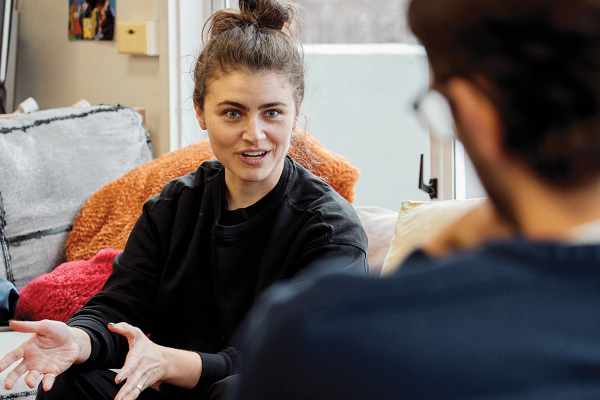

Whether you love her or hate her, over the past few years, it’s been hard to ignore Chlöe Swarbrick. The 29-year-old Green Party Member and Auckland Central MP was elected to office at 23, making her the youngest politician to enter parliament since Marilyn Waring in 1975. In 2023 she’s still the youngest sitting MP, something she sees “as an indictment on the House of Representatives.”
Chlöe has been a vocal advocate for drug reform and pushing for harm reduction, which was the focal point of the 2020 Cannabis Legalisation Bill and the more recent Alcohol Harm Minimisation Bill. The latter would have banned alcohol sponsorship and advertising from sports in attempts to deal with our binge-drinking problem. Her approach to drug and alcohol policy has garnered both criticism and confusion from people, so she set the record straight. “The spectrum of regulation for substances is, at one end of the extreme, criminal prohibition. And at the other end you have a complete legal free market without regulations or restrictions,” she explained. “You then have an economic environment that is conducive to those entities operating in such a way that they exploit vulnerable communities to make a quick buck.”
Chlöe said that the way to pull back from these extremes is what people would consider ‘liberalisation’, but freely accessible weed isn’t actually what she’s all about; instead, she's about sensible regulation of cannabis - and alcohol, too. “I was arguing for regulation where none exists at the moment. What frustrated me, particularly from the National Party, was pointing to how we have failed to regulate alcohol.” So she proposed her Alcohol Harm Minimisation Bill, which National didn’t support. “Turns out they don’t want to do that.”
The bill didn’t make it past the first reading, failing 85 votes to 29. However, there was one small victory, with the government deciding to adopt part one of the proposed bill: local councils will have more power to control alcohol sales, trading hours, and locations in their borders. And it’s small victories like this one that Chlöe reminded us we need to celebrate. In a world where young people feel burnt out and stagnant, remembering that “we actually got something done” is the only way to keep moving forward.
“I have been hustling hard over the last few years to try and support as many younger and different people in politics to get involved,” she said. Chlöe didn’t intend on being a politician, nor does she think of it as being a ‘career’. “My approach to politics has never been as a career. I actually just want to get stuff done. I am more than happy to blow up my job if I think it would contribute to something actually happening.”
On the topic of getting shit done and the current state of affairs, Chlöe finds the lack of action from our current government frustrating, especially after the pandemic. “What’s really gutting about that collective experience is that all of us actually saw firsthand that the government is capable of things that we’ve been told our entire lifetimes were economically or politically impossible,” she said. “Whether it's flexible working arrangements for people with disabilities or single parents, or direct payments to people who need it or rent freezes, they all happened overnight and that demonstrates that all of those things were always a matter of political willpower.” Chlöe went on to explain that the pandemic was like a portal to an alternate reality, a brief glimpse into what could be. “We seem to have lost that cultural awareness of what is possible within our politics.” Personally, her politics are “unashamedly quite radical[ly] left wing… but I also believe that if I’m not making a difference for the communities I represent, then I need to go home.”
And finally, the question on everyone's mind: What does Chlöe make of the financial shitshow the tertiary sector is facing? A few weeks back, Prime Minister Chris Hipkins told us the government wouldn’t bail out the university due to wanting to maintain Otago’s ‘financial autonomy.’ Chlöe reckoned that was “a really cool thing for a former student president to say.” Not only did she believe that the government ought to support universities financially, she believes that the government's role is to recognise that tertiary education is a public good: “It’s not just about economic and productive outputs… It’s also for upholding democracy.” She said that the 1984 neoliberal reforms coupled with the 2011 implementation of Voluntary Student Membership have undermined the tertiary sector, disempowering students – and we’re still seeing that play out today.
While for most young people it may seem like the world is ending, Chlöe reiterated that voting and political action is important, and that change is possible. “Students need to realise they are not a small voting block. There are 400,000 students and 120,000 landlords,” she said, which really puts things into perspective. “But look at how much disproportionate political power is wielded by those with capital.”
In a politically polarised world, Chlöe has some interesting takes on things. Some may see her as a raging commie, while others may think she isn’t radical enough. In a political arena of burgeoning populism and cults of personality, strong characters like Chlöe can net the hearts and minds of voters by personality and relatability alone. “Depending on what side of the fence you’re on,” she said, “populism may be positive or negative. [But] I think it’s far more important to look at the ideas and the evidence that are underpinning our values.” She said that populism has become more popular since the 1984 reforms and that the individualistic cultural norms they championed “are associated with the mental health crisis and feelings of loneliness and isolation, which undermine our collective capacity to generate political change.”