Fresh Stress Relief
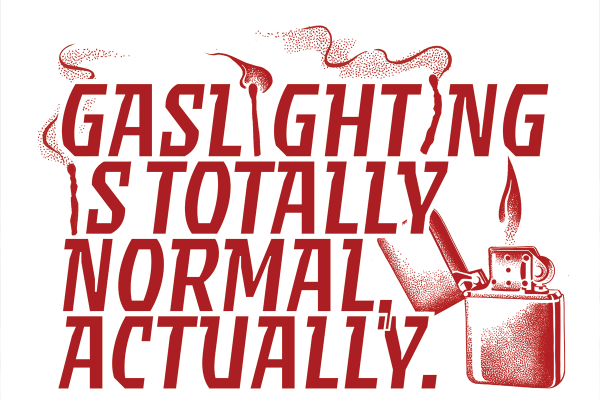
Gaslighting is totally normal, and I can’t believe you didn’t know that. Assuming you’re a loyal Critic reader, I’m sure you know all about gaslighting by now. We can’t seem to publish an issue without mentioning the word, and we even ran a feature earlier this year wholly dedicated to it. It had its merits and was definitely memorable, but I hated to see such a benign and commonplace topic demonised in this manner, which is why I felt motivated to write a response. Generally speaking, students are a pretty well-educated population, so you’ll trust me when I say this: Gaslighting is normal. Duh. Gaslighting is so normal, in fact, that it was Merriam-Webster’s word of 2022. I won’t patronise you by defining it, since you really should know what it means by now. Okay, well, to spare you the embarrassment of messing it up in front of your friends like you always seem to, gaslighting is persistent deception for one’s own gain, usually characterised by causing the “victim” to question their memories, perception, or even sanity. That’s where my issues with the prior Critic article come in – it characterised a lot of manipulation as gaslighting when it was just that: manipulation. Manipulation is extraordinarily commonplace – a lot of normal social etiquette involves manipulation. When you want the last slice of cake, how often do you actually say so? Versus being like, “So who wants the last piece?” In older generations it’s even worse: how many times have you watched your mum and aunty do the whole, “Oh, that was delicious but I’m so full, you have it” ritual. Just eat the fucking sponge, Sandra. See what I mean? Good, I figured. If every day social manipulation is this dance of reading between the lines, then gaslighting is when you leave no space between said lines and blame the other person for not magically getting it. That’s where my main argument against Critic lies, which I’m sure you’ve spotted by now. The Uni isn’t “gaslighting” us – bureaucratic PR jargon is as nonsensical to them as it is to us. If it’s intended to be misinterpreted and you fall into the trap of misinterpretation, then maybe it’s your fault and you should watch where you’re stepping. Anyway, what’s a little manipulation just between friends? Don’t tell me you’ve never pranked one of the bros, or told the bestie that her outfit is a slay when it’s barely even a flesh wound. In a lot of these cases it’s character-building, and you’re just looking out for them in the long run. For it to be “gaslighting”, some kind of power dynamic must be involved. If you have that much power over your loved ones, or they have that much power over you, then maybe you should reconsider your relationships. You should take a long, hard look at your friends anyway. Maybe you spend too much time with them – it really can’t be good for you. You’re in therapy, right? Gaslighting is not only normal, it’s normalised. Like a lot of terms adopted into pop psychology and colloquial language, the meaning of the word has become desaturated over time. The word’s origin is the 1940 film noir Gaslight, which details an elaborate murder cover-up. The perpetrator convinces his new wife that she’s high-strung and hysterical as she “imagines” seeing the gas lamps flicker downstairs, when really the dancing flames are a result of him sneaking into the house while searching for his previous victim’s possessions. No one believes her, and it gets to the point where she’s almost institutionalised. This intentional and systematic pattern of abuse, the very questioning of one’s sanity, is almost unrecognisable from the way we use the word “gaslight” today. In reality, the things we currently refer to as “gaslighting” are relatively harmless, commonplace, and easily avoidable. If you’re reading this, you’ve probably been studying for a while, and have a good amount of media literacy. Basically, you should know better than to misappropriate the word, and you should know better than to fall for the method. True gaslighting involves a longform pattern of abusing trust, for predetermined benefit for a party with power or status. Admittedly, this trust can be minor, like a media source you generally like, and the benefit can be as simple as shitposting for pay. Gaslighting can make you question your sanity and even plant false memories – say, for example, writing a response to an article that never existed. Trust no one. Question everything. And remember: gaslighting sucks, and I can’t believe I almost made you think otherwise. This must be so embarrassing for you.
Whether you love her or hate her, over the past few years, it’s been hard to ignore Chlöe Swarbrick. The 29-year-old Green Party Member and Auckland Central MP was elected to office at 23, making her the youngest politician to enter parliament since Marilyn Waring in 1975. In 2023 she’s still the youngest sitting MP, something she sees “as an indictment on the House of Representatives.” Chlöe has been a vocal advocate for drug reform and pushing for harm reduction, which was the focal point of the 2020 Cannabis Legalisation Bill and the more recent Alcohol Harm Minimisation Bill. The latter would have banned alcohol sponsorship and advertising from sports in attempts to deal with our binge-drinking problem. Her approach to drug and alcohol policy has garnered both criticism and confusion from people, so she set the record straight. “The spectrum of regulation for substances is, at one end of the extreme, criminal prohibition. And at the other end you have a complete legal free market without regulations or restrictions,” she explained. “You then have an economic environment that is conducive to those entities operating in such a way that they exploit vulnerable communities to make a quick buck.” Chlöe said that the way to pull back from these extremes is what people would consider ‘liberalisation’, but freely accessible weed isn’t actually what she’s all about; instead, she's about sensible regulation of cannabis - and alcohol, too. “I was arguing for regulation where none exists at the moment. What frustrated me, particularly from the National Party, was pointing to how we have failed to regulate alcohol.” So she proposed her Alcohol Harm Minimisation Bill, which National didn’t support. “Turns out they don’t want to do that.” The bill didn’t make it past the first reading, failing 85 votes to 29. However, there was one small victory, with the government deciding to adopt part one of the proposed bill: local councils will have more power to control alcohol sales, trading hours, and locations in their borders. And it’s small victories like this one that Chlöe reminded us we need to celebrate. In a world where young people feel burnt out and stagnant, remembering that “we actually got something done” is the only way to keep moving forward. “I have been hustling hard over the last few years to try and support as many younger and different people in politics to get involved,” she said. Chlöe didn’t intend on being a politician, nor does she think of it as being a ‘career’. “My approach to politics has never been as a career. I actually just want to get stuff done. I am more than happy to blow up my job if I think it would contribute to something actually happening.” On the topic of getting shit done and the current state of affairs, Chlöe finds the lack of action from our current government frustrating, especially after the pandemic. “What’s really gutting about that collective experience is that all of us actually saw firsthand that the government is capable of things that we’ve been told our entire lifetimes were economically or politically impossible,” she said. “Whether it's flexible working arrangements for people with disabilities or single parents, or direct payments to people who need it or rent freezes, they all happened overnight and that demonstrates that all of those things were always a matter of political willpower.” Chlöe went on to explain that the pandemic was like a portal to an alternate reality, a brief glimpse into what could be. “We seem to have lost that cultural awareness of what is possible within our politics.” Personally, her politics are “unashamedly quite radical[ly] left wing… but I also believe that if I’m not making a difference for the communities I represent, then I need to go home.” And finally, the question on everyone's mind: What does Chlöe make of the financial shitshow the tertiary sector is facing? A few weeks back, Prime Minister Chris Hipkins told us the government wouldn’t bail out the university due to wanting to maintain Otago’s ‘financial autonomy.’ Chlöe reckoned that was “a really cool thing for a former student president to say.” Not only did she believe that the government ought to support universities financially, she believes that the government's role is to recognise that tertiary education is a public good: “It’s not just about economic and productive outputs… It’s also for upholding democracy.” She said that the 1984 neoliberal reforms coupled with the 2011 implementation of Voluntary Student Membership have undermined the tertiary sector, disempowering students – and we’re still seeing that play out today. While for most young people it may seem like the world is ending, Chlöe reiterated that voting and political action is important, and that change is possible. “Students need to realise they are not a small voting block. There are 400,000 students and 120,000 landlords,” she said, which really puts things into perspective. “But look at how much disproportionate political power is wielded by those with capital.” In a politically polarised world, Chlöe has some interesting takes on things. Some may see her as a raging commie, while others may think she isn’t radical enough. In a political arena of burgeoning populism and cults of personality, strong characters like Chlöe can net the hearts and minds of voters by personality and relatability alone. “Depending on what side of the fence you’re on,” she said, “populism may be positive or negative. [But] I think it’s far more important to look at the ideas and the evidence that are underpinning our values.” She said that populism has become more popular since the 1984 reforms and that the individualistic cultural norms they championed “are associated with the mental health crisis and feelings of loneliness and isolation, which undermine our collective capacity to generate political change.”