
-
Columns

Editorial | Issue 20
It has always intrigued me that you can receive a barely-passing mark for an assignment and have no idea what you did wrong. I recently got such a report back. The “Discussion” section had only ticks – with a mark for the section of 13/30. Yet another section not only had the same saturation of ticks, but also had the comment “very good,” which I chose not to see as condescending. My mark for the section? 11/20. In fact, the only lost marks that I know how to remedy are the two (thanks, mystery marker, for the lenience) subtracted for submitting the assignment late. There were clearly much bigger issues at hand but I haven’t the faintest idea what they were. Now, my job here at Critic is relatively intense so I’m under no misled ideal that I’m going to be an excellent student while I polish off a token final paper. I’m not realistically aiming for much more than I received – it’s a bit of a box-ticking activity, to be honest. However, any feedback would certainly be beneficial for my dangerously close attempt to pass at the end of the semester. The truth is, students have paid for that feedback. It doesn’t matter if someone doesn’t have the capacity to put in quite as much effort as one otherwise should for a paper. Such examples as this, strangely enough, should be treated as political alarm bells. With student loans being a hot topic of debate going in to our looming General Election, this sort of behaviour highlights the disjunct between how people currently see tertiary education and how it’s supposed to work. Tertiary educators see it as being entirely the student’s responsibility to learn. Because, you know, it seems that most people are expected to go to Uni. This is fair, to some degree, but look at the student loan you can expect to have acquired by the time you finish your degree. It’s insane. One way or the other, students are spending a fortune for education as a commoditised service. You are literally buying it from the University. And that purchase, more often than not, is not worth the money because those supplying it simply don’t give a fuck that you paid them thousands of dollars to make the learning process easier than a Google search. As the system currently stands, tertiary education in New Zealand is legally a privilege and not a right, which people often mistake it for. And so the question I have is this: do tertiary education providers come under the Consumer Guarantees Act? Failing to offer adequate academic feedback certainly doesn’t fulfil the requirement that a service is “carried out with reasonable care,” as the Act requires. Zane Pocock Critic Editor
-
News

Disabled student mistaken as drunk
During Dunedin’s Illuminate Paint Party, which took place at Forsyth Barr Stadium on 10 July 2014, a University of Otago student was denied entry due to appearing intoxicated to staff. In actual fact he suffered from a number of physical disabilities. Critic spoke with the student, Richard, who is actively involved in sport at the University. He asked us not to publish his last name. Richard said that when he approached the stadium staff on the door, he lightly stumbled due to his disability. The staff member on guard asked him how he was; his stutter was then taken as a sign that he was too intoxicated and was denied entry into the premises. “I pleaded with staff for about two and a half hours, but they weren’t having a bar of it.” After attempting to explain his disability to multiple staff members, as well as two police officers, Richard was still denied entry into the stadium. Richard stated he had only consumed three standard drinks that night, hours before he left home. “I had completely burned it off and wasn’t feeling any effect by the time I had arrived at the Paint Party.” The student said he was “extremely shocked” by what had happened, saying, “nothing to that extent had ever happened before.” Although it was the first time an issue such as this has occurred at an event OUSA has been involved with, for similar reasons, he has been unfairly denied by bouncers at Dunedin’s Boogie Nites and Capone on two separate occasions. A family member of the student later contacted the University’s Disability Information and Support Office to inform them of the incident, who then contacted OUSA and staff at the Forsyth Barr Stadium. General Manager of OUSA Darel Hall said that as soon as they were informed, OUSA immediately offered the student a refund of the $40 ticket cost. Hall said, “It isn’t clear who should be held responsible. [OUSA are] not the promoter; it wasn’t our event, we just provide health and safety.” Either way, OUSA refunded the individual “because it’s a pretty unfortunate situation.” Since being made aware of the incident, OUSA has looked into various ways that they can prevent such mistakes from re-occurring. “We’ve been trying to think about any kind of systemic procedures we can put in place in terms of ID cards. [OUSA] has looked into whether there was any kind of national structure that allowed people who have certain disabilities to verify that.” OUSA have spoken to the stadium in regards to the idea, who have stated that they would be willing to cooperate if it was implemented in the future. The student told Critic he has not yet had an apology from OUSA, or staff at the stadium, since they have been made aware of the mistake. However, OUSA said they apologised to the student’s brother when he recently made contact with them. Hall said he sympathised with the Stadium staff. Having previously been an Alcohol Health Promoter, he said it is “extremely hard work” trying to determine an individual’s level of intoxication. “There are all kinds of things that you need to take into account to make a judgment of whether or not you think someone is intoxicated. There isn’t an objective standard of what intoxication looks like.” OUSA is not aware of any similar incidents occurring at past events involving the University, “It’s a relatively rare occurrence,” Hall noted, though, “If there are circumstances where people need individual care, we are happy to do that.” Melissa Lethaby, Manager of Otago University Disability Information and Support, told Critic she believed OUSA “handled the matter very well.” When she was informed of the issue, she immediately contacted Hall who “was very responsive.” She said, “I feel comfortable that Darel Hall and the team will do what they can for future events.” President of OUSA Ruby Sycamore Smith said, “OUSA believes in an inclusive environment and we’re sorry this happened to a student at an event we had a presence at. We’ve worked with the student and their family along with the University’s Disability Support, OUSA Student Support, DVML and others to create a policy which will mean this won’t happen again.”
-
News

Execrable | Issue 20
We got a wee bit excited last Executive meeting after the team appeared to be having productive discussion. It didn’t last long. The meeting began with some good old-fashioned OUSA scandal. OUSA President Ruby Sycamore-Smith announced that she had entered into a relationship with Critic Editor Zane Pocock. As it is Critic's responsibility to hold Ruby and OUSA accountable to students, action had to be taken to address the obvious conflict of interest. Zane has stepped back from having editorial rights over Critic content that covers OUSA’s activities, handing the task to the News Editor. The issue was discussed after Critic staff were asked to leave the room, so when it was officially announced in the meeting, no comment was made by any Executive members. Ruby also declared that she would no longer be chairing the meetings of Planet Media Dunedin Limited (a wholly-owned subsidiary of OUSA under which Critic falls) due to the conflict but would remain on the board whilst Admin VP Ryan Edgar took over. Planet Media holds direct governance over the Critic Editor’s management, so it is also a conflict of interest for Ruby to chair the board. Ryan then discussed changes to the Elections Policy. There are conflicting statements with the internal policy and the constitution in that “one policy says we must have an abstain option, the other says we don’t have to and another says do whatever.” Section 5.6 was removed from the elections policy, which states there must be “an option to abstain from voting” until the constitution could be amended. The second edit was to correct a typo in 9.14 of the Elections Policy from “no” to “not,” so it was not “not” anymore. The third edit was made to section 9.8, which states that candidates cannot campaign in “a manner that implies endorsement by OUSA.” Any Executive member outwardly supporting a candidate must make it clear that they are “acting as an individual, outside of their official OUSA capacity.” Any campaign materials involving the Executive member, including social media posts, must also clearly display a disclaimer that their support is “in no way an endorsement by OUSA.” Ruby concluded the policy talk pointing out that the Executive should thoroughly read the policy and “if there is something that sticks out like a sore thumb, say something so we can turn it into a positive thumb.” OUSA General Manager Darel Hall had his operations report passed. He outlined that a recent survey revealed that students do not use the student handbook diary and its future was being considered, but that the wall-planner and Critic magazine were widely used. Darel is also focussing on health and safety standards, with a focus on earthquake safety measures. The squash building is back to a satisfactory level in regards to building standards. OUSA Finance Officer Paul Hunt discussed whether there should be a committee for religious groups. There was a lack of input from most of the Executive but Paul observed, “Religious and country groups are more where you go along and hang out together rather than doing stuff.” Recreation Officer Henri Faulkner then talked about religion, or something along those lines – Critic was unable to decipher the many words that were said and the rest of the Executive looked equally confused. No decision was made and Ruby, clearly irritated by the complete lack of constructive input from anyone, said “it would be good to put a piece of paper in the agenda so we have some context. So the discussion can be constructive.” Welfare Officer Payal Ramritu then addressed her five items on the agenda. On her mission to make OUSA Executive members more accountable, she asked Critic how this may be achieved through the publication. Critic responded that they simply needed contentious issues to be openly discussed in Executive meetings. The discussion then returned to talk of timesheets and Ruby quickly pointed out that there was strong objection to the idea when she suggested it at the start of the first semester. Ryan commented, “I don’t care anymore.” The only agreement was that the Executive would return to giving a round-up of their progress at the end of each meeting. Expecting some pressing issues on accountability to be addressed, Payal then discussed microwaves and the free breakfasts offered to students. She requested more microwaves, saying “the average wait time is 7.5 minutes” and most were either unavailable outside of business hours or broken. She also requested peanut butter, marmite and marmalade for the free breakfasts held at Student Support. The Executive agreed this would be looked into as Ryan pointed out the request was “pretty unsubstantial and uncontroversial.” Critic notes it got pretty substantial and controversial once raisins were discussed. “We want more raisins,” Payal said, “Can we just have more raisins?” “How many do they get?” asked Darel. “They get about three and want eight.” “But that’s a 300 per cent increase. What about four raisins?” asked Darel. He agreed to look into the issue soon. The meeting finished with a round up of what each Executive member had recently achieved. This consisted of nothing interesting and is available at the end of the Executive minutes on the OUSA website. Instead of printing their summaries, the screenshot from a recent conversation between the 2013 OUSA President and the 2013 Critic Editor was much more entertaining. There was a final comment on accountability, tactfully used by Ruby. She asked the Executive three times to join her on the stage for the upcoming graduation ceremony, finally needing to say, “It’s important to make sure you are seen. It dove tails into accountability.” Payal finally agreed to assist, but no other Executive members volunteered. Since the meeting, the peanut butter issue has been dealt with. The raisins issue is still to be addressed.
-
News

$10,000 street art fund not enough
Dunedin’s first Street Art Festival is set to take place in October. With a $10,000 Dunedin City Council grant for more artwork, organisers have raised a further $5,000 to bring international street artist Dal East to the festival. The contributions of 11 artists have been confirmed to attend the festival, which will take place as part of the Vogel Street Party on 18 October 2014. The line up includes international artists Dal East, the return of Phlegm, Pixel Pancho, and Mica Still from Wellington. The festival will include Dunedin artists Sean Duffel, aka Ghstie, Andy McCready and Jon Thom. The Dunedin City Council has granted $10,000 from the Central City Heritage Reuse grant to the owner of the Chipmunks building to bring Italian street artist Pixel Pancho to Dunedin. The festival, which is being organised by a group of volunteers from Dunedin Street Art, is, according to their Facebook page, “In a city which proudly boasts New Zealand’s first public Art Gallery and first Art Society, we are embracing our evolution.” However, the matter of how it is being funded and who is involved does not blend well with some Dunedin residents. One Dunedin artist, who wished to remain anonymous, believed the project “stinks of nepotism.” He says some of the local artists include people that have been employed in other capacities by Tourism Dunedin and aspects of the event appear to be self-promotion of some artists. “We are being asked to pay $5,000 to get Dal East over here when we have a bevvy of incredibly talented NZ street artists,” he said. “I think they are undervaluing NZ street artists and making the ratepayers cough up for no reason.” When asked how the New Zealand artists would be paid for their contributions to the festival, Justin Cashell, a member of Dunedin Street Art who also works for Tourism Dunedin as Tactical Branding and Marketing manager, declined to comment. The Dunedin Street Art’s Facebook page also states, “The art will attract people to visit Dunedin and help them really understand us as a city and as a people.” The idea for the festival evolved from the “ripples” created by Belgium artist ROA’s work in Bath Street and Phlegm’s work he completed in April 2014. ROA is renowned for his giant paintings of black and white animals. In March 2013, Critic reported the plans for the Warehouse Precinct’s development for “creative” plans, and it seems the street art project is one of the stepping-stones towards achieving these plans. “It’s not for us to force creativity – it is about creating the spaces in which people can find those synergies and inspirations,” DCC Heritage Planner, Dr Glen Hazelton, told Critic.
-
News

Labour announces tertiary education policy
The Labour Party has announced the tertiary education policy that they plan to implement if they are elected to government. The policy was released by Labour’s Tertiary Education spokesperson Maryan Street. It promises “a Labour Government will fully review the student support system – including allowances, loans, accommodation support and scholarships – with a view to increasing access and making the system fair, transparent and sustainable.” According to the statement, the first step the Labour government will take is to reinstate the student allowance for postgraduate students and those studying longer degrees, such as Clinical Psychology. They will also remove the restriction for medical and dentistry students on access to student loans after seven years. “New Zealand needs more highly skilled people for a knowledge-based future and preventing postgraduate students from accessing allowances stands in the way of that,” Street says. The statement dubs the abolition of student allowances for postgrads as “a thoughtless and mean initiative of Steven Joyce’s” and claims that some students who were close to the end of their courses have been forced to leave because they could not afford to finish. The statement also announces Labour’s intentions of reinstating post-doctoral fellowships for recent PhD graduates, capping fees at four per cent (but reviewing the cap on enrolments to make it more flexible), reinstating students’ associations, not proceeding with the Education Amendment Bill proposed by National, and reviewing the Tertiary Education Commission “to reinstate its intended strategic purpose, instead of the tick-the-box organisation it has become.” Students have given mixed opinions on the policy. “It’s a step in the right direction,” according to fifth-year Law student Finbarr Noble. “Reinstating Students’ Associations is great, as are the promises not to proceed with the Education Amendment Bill and to restore democracy and autonomy to our universities’ councils,” he said. “That said, I reckon it will take more than just modest commitments to restore people’s faith in tertiary education, particularly university education and its value.” Some were more sceptical. Second-year Commerce and Botany student Cambrian Molark noted that “all of the policies sound like great ideas on the surface, although [Labour] haven’t acknowledged where the money to fund the various schemes will come from … they seem promising for students with little attention paid to the details.”
-
News

Salient Editor Fails at Playing Critic
Cameron Price, Co-Editor of Victoria University’s student magazine Salient, has brutally failed at an attempt to troll the intellects at Critic. Price recently put himself forward for multiple executive positions in the VUWSA (Victoria University of Wellington Student Association) elections for 2015. Price originally applied for the roles of President, Vice-President (Engagement), Equity Officer, Clubs and Activities Officer, and Campaigns Officer. For reasons unknown to Critic, he withdrew from the election soon after. Price then attempted to play Critic for mere fools, insisting he was still running in the campaign, the desired result being that Critic would print a false story. Whilst outlining the likeness he had to Labour hopeful Tamati Coffey, Price assured Critic he was “the change VUWSA needs.” Though he is not putting himself forward to mend the said inefficiencies in VUWSA, he was extremely quick to point out what he believed the current Executive members were doing wrong, or simply not doing at all. “[Throughout VUWSA] personal politics get in the way of pragmatic achievements being made. Too often the idea of consultants and focus groups and stakeholder planning takes over,” he commented. Price states that in 2013 only one thousand students voted in the VUWSA elections. Following this “the resulting Exec got to spend $10,000 of students’ money.” Price believed this was “outrageous” considering that “Salient’s funding remained the same.” It is alleged that VUWSA “don’t get anything done except for a mediocre O-Week and a sausage sizzle now and then.” Although he is not intending to do so himself, Price believes “we can do better than that. Yes we can.” He also had a great deal to say about current VUWSA President, Sonya Clark. Price believes Clark has been “openly endorsing one of the candidates,” who goes by the name of Rick. “Her and Rick had a gentleman’s agreement last year that he wouldn’t run against her, and then he would succeed the next year.” Price believes this is an “undermining of democracy” and “totes inappropes.” Although Price was unsure of how Critic became aware of the story, he said, “If it’s through Sonya you should know she talks a lot of shit. You can print that if you’d like.” Critic was unable to contact Sonya Clark for a comment on Price’s accusations. Nominations for the VUWSA elections closed at 4.30pm last Tuesday. Voting will take place from Wednesday 20 August to Friday 22 August, with winners announced shortly after.
-
News
Aoraki faces worst student numbers in the country
Aoraki Polytechnic continues to record a decline in student numbers, according to figures released by the Tertiary Education Commission. The figures show that Aoraki is losing students at a faster rate than any other New Zealand university or polytechnic. In 2013, numbers dropped from 915 to 664 over the course of the year – a substantial 27.4 per cent. The decline comes at a rough time for Aoraki, after finishing last year with a deficit of three million dollars and a string of redundancies. To make matters worse, Aoraki’s chief competitors in the South – the University of Otago and Otago Polytechnic – both recorded a growth in numbers, defying national trends. However, Aoraki Polytechnic’s CEO Alex Cabrera believes the figures do not accurately reflect Aoraki’s “new focus.” “Aoraki is in the process of transitioning into areas of priority for the region,” states Cabrera, “so our [numbers] do, and will, look different as we work through this process.” Cabrera blames a “buoyant employment market“ for loss of students, with “prospective students securing jobs” instead of beginning or continuing study. “We are making provisions for growth in part-time, flexible, work-based programmes of study to appeal to people already in employment,” states Cabrera. These “provisions” include a cadetship programme, work-based and project-based learning, and a remodelling of the trades programme to now include two days of workplace engagement for every three days of study. In addition, Aoraki plans to introduce a new Diploma in Agribusiness Management and Horticulture, alongside new Painting and Decorating programmes and a “more flexible delivery model” for Carpentry. The Otago Daily Times reported that the Tertiary Education Commission figures only included “student achievement component'' (sac-funded) places and did not account for enrolments by international students, non-Government funded places and students participating in other Government schemes. Otago Polytechnic communications director Mike Waddell reported to the ODT that the “Otago factor” was a key reason for the increase, stating that he believed Otago Polytechnic’s success was largely down to the “quality of the programmes and the quality of the staff.” Sac-funded numbers grew from 2,425 to 2,647 at Otago Polytechnic, while student numbers at Southern Institute of Technology grew from 2695 to 2924. In spite of facing some daunting figures, Aoraki’s Cabrera remains “excited for the future.” “We remain committed to continue to support our community … Aoraki Polytechnic’s focus is on quality education most relevant to the students and industries in the region that we serve.”
-
News

Toroa College blowing the budget even more
Toroa College’s recent upgrade and expansion has gone over budget by even more than previously reported, with the total cost of the refurbishment now being over budget by almost $1 million. As previously found, the extreme difference in cost was recorded as being an error in the estimated cost. The latest University Council meeting, held on the 12 August, stated that an extra $915,000 was spent on the upgrade and expansion of the college, due to “an approved project overrun as a result of a QS error made on the cost estimates for the project.” In last month’s council meeting, the refurbishment of the college was recorded at being only $580,000 for the January to May period. The total cost of the upgrade spent, however, was upwards of $4 million, higher than the $3.01 million that was allocated for the upgrade. The excess $915,000 that was spent on Toroa College and its refurbishments includes the construction of an additional 20 rooms and a larger central common room. This has been in conjunction with the refurbishments carried out at other colleges around campus such as Carrington College and Aquinas College. The refurbishments at the college are the most extensive since the college was first established 18 years ago, with the new common room allowing residents to be able to relax, study, watch television, game and enjoy time with other Toroa residents. The University Council report also revealed that $1.894 million in extra, externally funded research was received due to “greater than expected income from non-reciprocal research.” Departmental and divisional variances of budget were covered during the Council meeting. Major variances in budget were found in the operating costs of the University, with expenditure for the year to date at $297 million, $4.053 million over budget. Laboratory expenses, reference material costs and travel and accommodation expenses accounted for $1.6 million of the variance. $1.7 million of the overspending was due to academic salary costs, due to “higher than expected research activity.” The Health Sciences and (other) Science divisions, respectively, recorded budget blowouts of $1.486 million and $450,000. A lack of tutors and demonstrators was cited as a cause of this overrun of the budget.
-
News
Unaccounted leave leaves accountant unaccounted for
A former University of Otago student has been removed as a member of the New Zealand Institute of Chartered Accountants after giving false medical certificates to his former workplace and a fake reference to a recruitment company. At his hearing on 5 August 2014, Simon Michael Collins was found guilty of providing false medical certificates to his former employer. The decision said Collins’ former workplace was to be suppressed. An analysis of his LinkedIn profile indicates that he was working at Deloitte in Christchurch at the time. When questioned about the accusations, he stated he received medical treatment, including surgery, in Timaru during the 11-day period he was absent from work. However, this was proven to be untrue. He also provided to a recruitment company a previous manager as a referee, but used his own home telephone number as the “manager’s” number. It is believed he either gave a telephone reference impersonating his manager or arranged for another person to impersonate him. He also failed to respond in writing to the initial complaint when the discovery of his fraudulent behaviour first came to light. After being found guilty of the charges and as well as being stood down from the NZICA, he has also been ordered to pay $9,348 to cover his court costs. As listed on his LinkedIn profile, it states he had been working for De Lorenzo NZ Ltd since November 2013 as General Manager and also as a Financial Controller for Enzo International Ltd. The hearing decision read “repeated dishonesty is however incompatible with membership of the Institute.” “Professional disqualification is a very rare event. There are 100,000 members of the new combined Australia and New Zealand professional body, CAANZ. That there are so few cases of dishonesty is evidence of the strong professional mores of accountants,” Professor Colin Campbell-Hunt, Head of Department of Accountancy and Finance at Otago University, told Critic. “These people are, after all, put in positions of great trust over the most sensitive of human transactions – money,” Campbell-Hunt continues. As for the strong reputation of Otago’s graduate accountants, Campbell-Hunt does not believe the case of Collins will hinder the reputation of the finest graduates. “We are proud of [the graduates] and the reputation of an Otago degree in these subjects will undoubtedly be influenced far more strongly by them than by the odd bad apple,” says Campbell-Hunt. “Having said that, we are putting more and more energy into lifting the standard of our degree.” “Nobody in this Department is interested in delivering second-class teaching or producing second-class graduates.” Collins was registered as a Provisional Member of the NZICA, which as another Dunedin accountant pointed out means, “he has either (a) never sat his exams to be a full Chartered Accountant or (b) failed the exams.” The process to become a Chartered Accountant usually takes two to three years, costs around $10,000 and includes a six-hour exam.
-
Columns
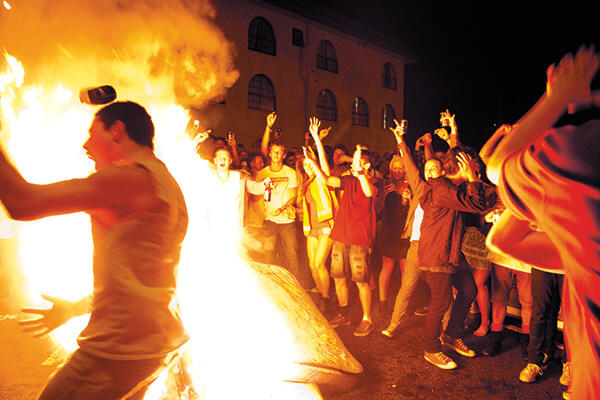
Bouncing off the halls | Chronicles of Castle
Due to the great success and controversy of last week’s Bouncing Off the Halls, Critic is back with more stories of booze, boobs and bodily fluids. This time we’re moving away from the stomping grounds of Dunedin’s filthiest freshers to the drunk, disorderly, disgusting and depraved pastures of Castle Street, the infamous student ghetto to which many call home. Be warned – she’s not pretty. To start with a bang, we must begin with the tale of one dirty Castle damsel who was lucky in love at the end of a night out. The horny maiden dragged her prince back to her flat, where he was struck with sudden hunger pains that needed urgent and immediate attention. No matter that they were in the lounge, the ravenous lad went a-snacking on his lady-friend. Unfortunately this midnight feast was to the shock and horror of her flatmates who entered the lounge only minutes later to see their friend in a rather compromising position. An escape was needed for our young male hero who quickly dialled the number of his sober driver. Unfortunately the love story was not to be. The girl was shocked to discover his sober driver was his mum and that he was still in high school. Cheers, Dunedin, for doing your part to solve the world hunger crisis, starting with those who need it most – the children. Speaking of hunger pains, another student was walking home from town when a young lady asked for a bite of his Pita Pit in exchange for some friendly fellatio. Satisfied that his Bachelor of Commerce had finally come in handy, the student happily offered her a bite and headed home to do the dirty. Critic works this out to be approximately 30 cents for the deed, give or take any indulgent extras. Earlier this year, one Castle student-cum-groupie showed Tinie Tempah some Southern hospitality, shedding and bedding the English rapper during his visit to Dunedin. For the sake of our own, Critic sincerely hopes Tempah was packing a tad more than his name suggests. Castle Street was recently treated to the Gay Box’s annual party, which boasted over $3,000 worth of alcohol for the lucky guests and saw both walls and brain cells demolished in one ridiculous night. One intoxicated student must have mistaken a cracked wall for a bathroom as, according to the terrified onlooker, “he whipped out his cock and peed in the hole!” All other students in attendance report complete and total memory loss. Christchurch students, who have frequently come down for the sole purpose of destroying North Dunedin, have faced a swift vengeance. Dunners lads recently visited the Garden City, ransacking and ravaging Christchurch in a way that would make a mother proud. Critic has even heard reports of one student defecating inside a pair of shoes. In other news, a naked lock-in resulted in an awkward morning-after for the residents of one frisky flat. The night quickly and inevitably descended into an alcohol-fuelled orgy, which would have been okay if not for the 50 per cent participation rate. While half the room writhed and moaned, the other half looked on, presumably praying for salvation while planning their crying wank later that night. To end on a high, three female students were caught smoking an unidentified illegal substance outside the Marsh Study Centre early last week. They avoided charges by claiming they were participating in a psychological study on the effects of drug use on study habits. When this didn’t work, they performed a cheeky flash and fled. Top marks, Castle Street. Top marks.
-
News

Dunedin-destined Drugs; Prison-destined student
A 21-year-old male student from Otago Polytechnic has been charged with importing class A and class B controlled drugs. The recent drug haul, which found LSD and MDMA (ecstasy) on Monday 11 August, had an estimated value of between $3,000 and $7,000 for the LSD and approximately $50,000 for the MDMA. Critic spoke to Detective Hamish Barrons of the Southern District Organised Crime Squad about how the product was found. “The arrest was as a result of three importations that were intended for Dunedin," said Barrons. The drugs were sourced online from Germany and the United Kingdom, but were intercepted at the Auckland Mail Centre. This resulted in the surveillance of a PO BOX and two search warrants being executed by Police and Customs. Barrons contends that the drugs were for a commercial enterprise. He believes they were intended for mixing with other products and sold in capsules on the Dunedin market. The student is facing a number of other charges in connection to the drug seize on top of charges for importing Class A and B drugs, and is possibly looking at a number of years in prison. Drug Foundation Executive Director Ross Bell described the drug haul as unusual in terms of LSD. "They're not commonly seen in New Zealand; there is not a huge market for LSD but it seems to be beginning to see a comeback," he said. Bell remarked that this kind of drug find is quite rare, but spoke of the health risks of the student market that drugs were likely intended for. "We are going to end up with a lot of novice users or people who do not know how to stay safe ... People need to be careful." The ecstasy was seized in a crystalline form, but it is thought that this would be "cut down" and mixed with undesirable products. It is worth about $450 per gram in the crystalline form. The student appeared in the Dunedin District Court on Tuesday morning. The standard sentence for this level of drug importation depends on the person’s criminal history. "The thing is that he is only 21 but dealing with drugs in such high quantities. He will probably end up with a pretty harsh sentence," said Bell. "This will affect everything; his employment, his travel, for the rest of his life. That is the reality." Bell reminds those who do choose to take drugs, such as LSD and ecstasy, to do so in a safe environment and to be in the right frame of mind. He also pointed out that when dealing with ecstasy to do so in moderation, especially those doing it for the first time. Karen Heine from OUSA Student Support urges those with issues to seek support. "People can absolutely come to Student Support to have a chat about what they're going through and the various avenues of support available to them," she said.
-
Columns
Te Roopu Maori column | Issue 20
The New Zealand general election is fast approaching and there are an abundance of storylines and sideshows regarding it. On 20 September everyone over the age of 18 who is a New Zealand citizen can have a say in whom they believe can represent them in our parliament. As a politics major I often hear questions like “who should I vote for?” and “What’s the point? Nothing changes anyway.” Young people have the worst turnout of all age groups and this is even worse among Māori voters. There are many reasons for this, ranging from apathy to ignorance. We as young people do not want to get involved because we don’t see any direct benefits. This leads to a vicious cycle that leaves the decision making with the baby boomers who look out for themselves and strip us bare because they think we are too lazy/apathetic/ignorant to have our say. To be fair that’s an outright yarn. The system needs to better encourage youth to vote. There is a genuine feeling amongst at least my peers that the current parties and candidates have not earned our vote. What makes this election interesting is for once the youth vote is actually being targeted. The arrival of the Internet Party and the Internet-Mana alliance, whatever their true motivations, have made a pledge to target youth and the “internet generation.” Their brand of popular appeal backed by celebrities and musicians has certainly captured the attention of the media and it will be interesting to see if that can translate into youth turnout. So even if there is just one issue that grinds your gears, take a minute to decide who you think will make the biggest impact to bring about change. While John Key and the National Party have a substantial lead, under our MMP system it is still a very tight race. Every vote counts and perhaps this is the opportunity to have your say that could determine who the next government is and how much power they wield. Whether you sit on the right or the left, have your say; it is your right. But if you don’t, just remember that you can’t have a feed if you’re not at the table. For more information on enrolment and the election head to www.election.org.nz Te Hau White Tumuaki Tuarua o Te Roopū Māori (Vice president of Te Roopu Maori)
-
News
A Season of Fire and Ice: The Game of Premier League Thrones
This week we go to the Weirwood and Valyrian steel football desk where over the past few years our two favourite things to illegally stream online have been HBO’s violent, softcore-pornography drama, Game of Thrones, and the less violent but equally awesome male soap-opera that is the English Premier League. While the next season of Game of Thrones is still many, many months away the 2014/15 Premier League has just kicked off so to get in the mood for the season ahead we have put together an unexpected mashup, recapping the events of the last few seasons of both “games.” These days, spoilers are viewed as a crime worthy of beheading so readers beware: Spoiler Alert! Spoiler Alert! Spoiler Alert! House Lannister of Manchester City “Hear Me Roar” The Lannisters have a precarious hold on power in Westeros owing much to their political machinations and the deep pockets of overseas financiers. This is very similar to the recent rise of Manchester City, whose Middle-Easton owners have financed the purchase of many sell-swords who have helped City to the Premier League title in 2012 and 2014. If City boss Manuel Pellegrini doesn’t deliver continued success he might meet the same unfortunate fate as patriarch Tywin Lannister. Manchester City retain the services of their “King Slayer” Sergio Aguero who will always be remembered for his injury time goal that won them the Premier League in 2012, ripping it out of the hands of their bitter rivals, Manchester United. Also amongst their ranks is everyone’s favourite little imp, David Silva. “A Lannister always pays his debts” is a well known line from the show and Manchester City have had to make good on this pledge by paying a £49 million pound fine as punishment for breaching the rules of financial fair play. House Targaryen of Liverpool “Fire and Blood” The Targaryens ruled Westeros for many years before being knocked off their perch by the Baratheon usurpers. Similarly, Liverpool ruled the roost in England for many years before the introduction of the Premier League saw their power decline to the benefit of their great rival, Manchester United. The young but strong-willed Daenerys Targaryen has spent previous seasons breaking chains and recruiting new soldiers from Qarth to Mereen whilst nurturing her young dragons: the temperamental Drogon and his siblings Rhaegal and Viserion. The young but strong-willed Liverpool boss, Brendan Rodgers, has been on a similar recruitment drive of his own from Portugal to Germany while also nurturing his own young dragons, last season’s temperamental top scorer Suarez and his understudies Sturridge and Sterling. At the end of last season Daenerys was heartbroken to learn that Drogon had killed the innocent daughter of a goat herder and has since disappeared, whereabouts unknown. During the World Cup, Rodgers was equally heartbroken to learn that Suarez had bitten the innocent shoulder of yet another opponent and has since disappeared, transferred to Barcelona. House Tyrell of Chelsea “Growing Strong” The Tyrells are a modest House with only a limited amount of recent success of which to brag about. Much like Chelsea in the capital of London, the Tyrells’ current power and status in the capital of Kings Landing is derived through their money and shrewd political machinations. Despite Chelsea’s recent emergence as a powerful player, they lack the respect of the wider footballing community just as no one truly respects the Tyrells, criticising both for being nouveau-riche usurpers. Both the Tyrells and Chelsea have had to enter into marriages of convenience for their long-term benefit and survival. Margaery and Loras have been pimped out to the Baratheons and Lannisters to help solidify the Tyrells’ positions of power in the same way that Mata and Lukaku were sent north to United and Everton at different times to try and take away points of Chelsea’s more immediate title rivals. Although her half-witted son Mace is the head of House Tyrell it is the canny old Matriarch Olenna Tyrell who is really pulling the strings. Her subtle but effective playing of the "Game of Thrones" is par excellence with the brilliance of Chelsea manager Jose Mourinho who plays the Premier League mind games better than anyway and constantly gets the half-witted Chelsea owner, Roman Abramovich, to stump up the cash to help the team keep “Growing Strong.” House Martell of Arsenal “Unbowed, Unbent, Unbroken” Oberyn Martell arrived in the capital at the start of last season full of swagger and memorable one-liners. Much the same way Arsene Wenger and his Arsenal side started their season, leading the table for the majority of the season and over the busy Christmas period. In Oberyn’s “trial by combat” with “The Mountain” he gained the upper hand in the early stages and we all thought he was destined for victory until his ego got in the way; instead of finishing off The Mountain he insisted that The Mountain confess to the rape and murder of his sister. This lead to Oberyn suffering a skull crushing defeat that came as quite the shock to the disbelieving audience. This was reflected in Arsenal’s eventual downfall. The team on top of the table after Christmas and New Year has historically gone on to win the title but, like Oberyn, Wenger got a little too cocky and refused to splash the cash in the January transfer window as his ego is built on consistent success without the big spending of his rivals. He refused to purchase another striker and Arsenal ran out of steam and ended up suffering a soul crushing defeat that came as quite a shock to their disbelieving fans. House Stark of Tottenham Hotspur “Winter is Coming” While the cockerel mascot of Tottenham Hotspur isn’t nearly as intimidating as the Direwolf sigil of House Stark there are many similarities between the two nonetheless. The Starks fight to maintain control of the North of Westeros while Spurs find themselves constantly under siege in their seat of power in the North of London. Like the honourable and much liked Ned and Robb Stark, recent Spurs managers Andre Villas-Boas and Tim Sherwood have met the same fate as their honourable Stark counterparts, all of these beheadings coming as an untimely shock to their respective audiences. In recent seasons Jon Snow, the Starks’ best swordsmen, decided he wasn’t fitting in at Winterfell and decided to “take the black” and head north to join the Night’s Watch on the “The Wall.” Similarly, the very popular Gareth Bale, Spurs’ best striker, decided he wasn’t fitting in at White Hart Lane and decided to “take the white” and head south to join the Los Blancos in Real Madrid. With the loss of Bale many Spurs fans feared the often mentioned winter had finally arrived and with most of their elders dead or sold, both Spurs and the Starks will be relying on their plucky younger generations to fly the flag. House Baratheon of Manchester United “Ours is the Fury” In Robert Baratheon and Sir Alex Ferguson you had a fat, red-nosed drunk in charge of a respected House/club. They were both past their prime when they passed the crown to their illegitimate heirs, Joffrey and David Moyes, who both proved to be unfit leaders that were universally despised as a King and a manager, one for being generally sadistic and the other for being generally incompetent. Their time on the throne was cut short, being poisoned out of the top job by those close to the throne. New United boss Louis van Gaal will need to have a major internal shake up to bring back the fury that made United so feared and revered. While Wayne Rooney is as dumb as Hodor, he is also the Stannis of Man United. Urged on by his greedy Melisandre-esque wife, Coleen, Rooney claims that he is the rightful heir to the captaincy of the United and England teams. However, many people disrespect him and his claim, accusing him of being unfit to lead because he is overpaid and underperforming.
-
Columns

ODT Watch | Issue 20
Seriously? It appears the ODT has got reoccurring beef with Kim’s large frame. Only 30 minutes? That definitely doesn’t give enough time to fully convey the complex procedure that is hand-washing. On first glance, we wondered how someone could look so happy when holding a dog crap and headline it “good fortune.” (The dog looks appropriately guilty at least.) Turns out that suspiciously dog poo-looking heap in her hand is a melted smoke alarm … ODT really needs to polish its photography skills. Oddly enough, that sounds more smelly than good. Classic ODT, using a pun at completely the wrong time. With a fatality rate of 95 per cent and nobody willing to pay for vaccine or treatment testing processes, Ebola is not exactly a pun-worthy topic. You know we’re in a sad state of affairs when the only way to get people to the library is through selfies. Oamaru Public Library has succeeded in boosting attendance by launching a contest where people come to the library, take a selfie amongst the books and upload it to Facebook. Props to them for capitalising on our generation’s neurotic self-obsession.
-
News

Critic Tackles Election Year | Issue 20
Since I’ve already featured an article in which I followed Clare Curran around for an afternoon, I figured it was only fair to take a look at two of the other people vying for the spot: Hamish Walker of the National Party and Shane Gallagher of the Greens. Initially, I was hoping to host a debate between the two of them, but Hamish is a very busy man and ended up being unable to make it. My dreams of a verbal swordfight were shattered. He emailed me answers instead. I still spoke to Shane, however, and gave him the opportunity to respond to some of the things Hamish said. In case you’re thinking “BIAS,” one way or the other (inevitable), think of it like this: Hamish got the day to mull over his responses and present them in a written format (and the last question was only asked of him); Shane got the last word and was able to hear some of Hamish’s responses. If Hamish wants to respond to anything Shane has said, he is invited to write a letter to Critic. For ease of reading, they’re presented as follows: Shane’s answer to question, Hamish’s answer to question, Shane’s response to Hamish. What are some initiatives you have to improve employment for people in Dunedin South? Shane: Well, we have a range of issues, ‘cause we try to approach everything holistically, so the headline things are: the $1b research and development fund, which is looking at industries that are green and sustainable; one of the key areas that Dunedin could be looking at there is biofuel, so biofuel development. We have a lot of woody fuel, with the city forests. I know that Celsius, which is a New Zealand biofuel company that’s now gone overseas because it wasn’t able to get the venture capital, wanted to base one of its processing plants here in Dunedin, but wasn’t able to raise the funding. […] We’ve also got IT design, the Green Investment Bank, which we’re proposing, so people come up with innovative ideas of their own, then get loans from that. Hamish: I would love to see more opportunities for people (and high school students in particular) to try work experience across a number of different businesses and industries in Dunedin South. […] We also need to make it easier for students to get work once they graduate. I would like to see more students placed into internships during study where more “real world” experience is gained and gives students that experience. […] After six years of a National Government, we now have more youth engaged in education, training or apprenticeships now, than ever before. […] Ministry of Employment, Innovation and Business estimate the 90-day trial introduced a couple of years ago has resulted in an extra 13,000 jobs, mainly to people who wouldn’t have been given that opportunity under old employment law. Shane’s Response: Well the 90-day trial hasn’t improved any jobs, it hasn’t given anyone extra jobs; it just means employers are more likely to sack you. It doesn’t actually create jobs, this is some sort of fallacy that you have some sort of change in the way you can employ someone and suddenly this magically creates jobs. Jobs are created by stimulus in the economy, activity in the economy, and so the idea that you can magically create jobs by changing the working conditions is not tenable; it makes no sense. And unless there’re actual jobs there, in the economy, how can you transition to them from education? Again, it’s just not joining the dots, there’s no sense to that, there’s no continuity. [In-study internships] might be an okay idea, but [since 1988] […] people’s wages have remained flat while productivity has massively increased, and that money’s gone somewhere, and we know where, it’s gone to the very top, because that’s what’s driven inequality in New Zealand. So the thing that drives economies is you need to start getting money into people’s pockets so that they can spend, so you want to increase the wages, so you need to increase minimum wage and get them working on a living wage, cause people shouldn’t have to subsist on a wage they simply cannot live on in order to boost the profits of a company. […] What about businesses? What do you plan to do to help them? Hamish: I would like to see more interaction between businesses in Dunedin. Networking between different businesses through local business associations/groups/employers association allows them to work together on common problems and that can only be a good thing. Moreover, I would also like to see these groups working with students more. The transition between university and work would be smoother, not only for the student, but more so for the employer if they have more say on what they want from students upon graduation. Shane’s Response: I mean, [networking between businesses] is one of those catchphrases that actually means nothing, and one of the things they could have done, for instance, was ensure that Hillside Workshops actually were able to build trains. Because when you take jobs away and hand them off to China or hand them off to Spain or wherever, you’re taking away jobs and you’re taking away money within the economy. So Hillside Workshops did a lot of subcontracting to engineering companies throughout the whole of South Dunedin, and South Dunedin is a major engineering hub, and it has always been one of those hidden secrets; those open secrets that no one really knows about. But Hillside Workshops was a really major engineering hub, and now that has been taken away, you’ve torn out the heart of the engineering sector in Dunedin. It’s still there but it’s struggling. Another issue for Dunedin South is poverty, as many of the population hubs in the electorate are dense and poor. What do you plan to do to help people who’re struggling? Shane: Again, we’ve got a lot of policies, which line up together or come together as jigsaw pieces, so again we want to raise the minimum wage, we want to get people being paid the living wage, we want to reduce costs by reducing people’s power bills, we want to extend the insulation scheme. […] And by also introducing our NZ Power idea we can actually reduce people’s power bills by $300 a year. […] If people are healthier and happier and have a bit more money in their pockets that stimulates your society and your economy. We also have the Carbon Tax: we’re going to give people a tax cut, and it’s a $2000 tax-free allowance that will basically mean you get an extra $300 a year. It doesn’t sound like a huge amount, but again, with the savings from your reduced power bills and increased spending power from being able to have a decent wage through a minimum wage job, these things all add up. Hamish: I will work with a number of different agencies to get a good stock take of what the main problems are out there. I will then lobby for the needs of the people of Dunedin South. […] I will be talking to different groups, for example church groups, community groups, and other organisations to see where we can help each other out. The Student Army is one example of the benefits the community can achieve when it comes together. I have also visited community hubs in Dunedin South where people struggling to put food on the table meet regularly for play groups and soup kitchens. These hubs are doing great things for the community and families involved. Shane’s Response: Again, he’s denying the fact that these are systemic problems created by his government. I mean, they’ve created the situation in Dunedin where we have poor jobs; we’ve lost 44,000 jobs in the manufacturing industry alone. And Price Waterhouse Coopers has estimated that if we went down the green sector route, the green industrial route, that that could be worth $22b a year to us as an economy. […] The balance between local government and national government in Dunedin is complex, and often leaves initiatives and people falling through the cracks. How would you increase the efficacy and efficiency of the relationship between local and national government? Shane: Well, we need to actually start talking to local government on a real level. One of the interesting conversations I had with Mayor Cull was that when they met with the Minister for Local Government that they were uniquely unimpressed by his dismissive and aggressive attitude, that he was basically telling them how to do their jobs. And what we really want to do is partner with local government, ‘cause local government can have a lot of initiatives, and they come up with the local solutions. […] Hamish: It’s important to have a good working relationship with the mayor and councillors and be fully briefed on what’s happening in the district. I need to be fully aware of the local council and what they are doing and what their aspirations are for Dunedin South. Shane’s Response: Again, look at the track record of what National’s done. We had Environment Canterbury turn around and say ‘we don’t like what you’re doing’; then the National Government simply abolished democracy in Canterbury because they didn’t like what ECAN were telling them. […] There’s not an environment in which local government and national government have trust in each other because any local government body now always has to second-guess themselves about if it is going to upset the National government. Let’s again look at the record, because the record is pretty poor on this matter. With regards to providing facilities for the community, who should do what is often difficult to ascertain. What do you believe your role would and should be in this context? Hamish: I will work tirelessly and dedicate myself 100 per cent to the people of Dunedin South. The people will identify the facilities they need and I will lobby forcefully on their behalf. While we are on the topic of community facilities, I would love to see a facility in Dunedin South where youth have somewhere to hang out during the weekends (especially in the evenings), which will keep a number of them out of trouble.
-
News
Politweets | Issue 20
Nice. Probably. I don't know but we definitely should. Poor Col.
-
News
Greatest hits / Greatest shits | Issue 20
Greatest HitWithout a doubt, Greatest Hit this week goes to Nicky Hager, who has created what can only be described as a “shitstorm” in response to the publication of his new book. Prior to its release, the hilarious Twitter speculation alone was enough to warrant it this prized award; but Dirty Politics, released Wednesday 13 August, one-upped its anticipation by being entirely full of juicy scandals about some of our most beloved politicians and political commentators. Whale Oil was thoroughly unimpressed. Greatest ShitWinston always says that imitation is the sincerest form of flattery, but it’s hard to be stoked when AUSA hits Yahoo NZ with a story they copied from Critic. Essentially, using our supreme and complex analysis, they too figured out how much it would cost certain politicians if they went to university today. They even presented some of them with certificates. Unfortunately, they managed to get Steven Joyce’s cost wrong, undercharging him by about $2000. Presumably, this is because they fatally forgot to include miscellaneous Massey fees in their costing.
-
News

Home away from home or really expensive prison?
Following reports from past and present students from the University of Otago Halls of Residence, Critic has spoken to numerous parties to address complaints regarding hall life. A number of students have reported to Critic that their time at their hall is “cliquey,” “lonely” and “not safe enough.” As well as this, students and Student Support report that rules appear to be getting stricter each year, but in all the wrong ways. A resident of Arana said that he agreed with the comments made regarding hall regulations and that despite the same levels of alcohol being consumed each year, the rules turn the halls into “a bit of a prison.” Critic spoke to Advocate & Student Representative Coordinator Philippa Keaney, who said that Student Support gets “quite a few reports” from unhappy students at the halls. She said that there was “definitely” an issue with loneliness across all the halls, but this is understandable considering it is many students’ first time away from home. However, she agreed with the issue of certain halls, particularly the more prestigious halls, having a higher rate of “cliquey” attitudes. She said, “Loneliness and cliquey-ness are two very different things.” She does not notice the same issue with students who flat together, whether first years or not, “the only social issue with flatting really is not getting along.” A large part of the issue may be from certain halls excluded themselves from general first year events. For example, holding their own Toga parties, separate to the rest of the University events. OUSA Colleges Officer Jess McLean points out that OUSA continues to promote clubs and recreation as “a great way to get out and meet new people.” Acknowledgement needs to be given to the fact that these first year students are living within the atmosphere of this “clique-ness” though and, as Jess says, “it can be like a mini high school sometimes!” Director of Accommodation Services James Lindsay says the University is unaware of the reputation of Knox, Arana and Selwyn have as having a superiority complex over other halls. “However a perception that each college is different could be held by students themselves. Some colleges do, for example, tend to attract a majority of students studying particular courses, such as health sciences or teaching.” He says that this may “lead to the establishment of a different character or culture for each of the colleges that mirrors the predominant mix of students.” Keaney believes the only way for the halls to address the superiority issue is to “diversify the intake.” She says that, for example, situations like at Knox, where there are students “whose parents, aunties, uncles, etc.” have attended the hall, “just adds to the issue.” Keaney also said that the safety of women in the halls was a major issue: “It’s like they pretend nothing even happens.” She said that there is no form of advice in the hall handbooks and a solid policy needed to be in place. Keaney said that at meetings with Lindsay and the former Colleges Officer Brydie Ockwell, the halls defended themselves saying that the Residential Assistants were trained in dealing with incidents. Keaney says training the RAs is “just not good enough” and that there needs to be a consistent policy across the halls. OUSA are supposed to be working on a policy, but with the change in Executive Rep, they are still waiting on a draft. Jess said the hall policy on sexual assault “is moving forward” and plans on meeting with Student Support later this week. In regards to the students who were recently asked to leave Unicol, there were rumours that the students’ rooms were actively searched whilst they were on holiday. The Proctor said that it was “absolutely not policy” to search peoples’ rooms “without an absolutely cast iron reason.” He says, “it is a student’s home,” but individual rules are with the Halls depending on what was signed in the contract. Lindsay said that cleaning services are required each week to enter rooms when students are not present; “also college staff may enter rooms for health and safety reasons when a student leaves for semester breaks, for example.” He said that this is done to check heaters or lights are not left on, or windows are not left open. “If a smell of cannabis is detected, staff will act to check the source to ensure no illegal activity is taking place on the premises.” Another student complained of some halls blocking certain websites. In response to a Facebook post, he said “even though they're paying $300ish a week for the privilege of their own room they're not allowed to watch BangBus4 the Re-Bangening in the privacy and comfort of their own bedrooms.” He adds, “It just seems a somewhat too paternalistic view to take towards young adults, especially when they're the ones paying the bills.” A resident at Cumberland said she felt the early kick-out time was “endangering us.” She explained that in the freezing winter months, being kicked out of the hall at 9pm meant students were taking bottles to the park and drinking there, “just relying on our alcohol blankets when we’re preloading.” Keaney said that this was “really irresponsible for [the halls] to do.” She was aware that some halls had that policy in place but may only loosely follow it. Students at a number of halls confirmed that the rule was firmly enforced at several other halls. The Cumberland resident said that, if she were home, she would be allowed to responsibly drink in the house and their hall is supposed to be “a home away from home.” Critic asked if the University would support a move to encourage halls to allow drinking in the dining halls later in the evenings. University of Otago Director of Accommodation Services Mr James Lindsay said,“Rules about alcohol consumption in Colleges are in place for good reasons … Experience of running these colleges shows that not all college residents drink alcohol, and nor are they comfortable with the consumption of alcohol by others next or near to them.” He adds, “Some colleges already allow alcohol to be consumed at certain times … all regulations are tailored to the character of each different college community.” Jess said, “If there was a demand for it [from students] then OUSA would be interested in discussing a better solution with the colleges, especially as the North Dunedin bar scene has changed and colleges are a safer place.” As a resident at St Margaret’s, she believes her hall deals with it well: “They don’t restrict times when alcohol can be consumed, instead they have repercussions if you can’t use it responsibly.” Knox was widely known as one of the heaviest-drinking Halls of Residence affiliated with the University, but it appears that since the change of Master, the hall has gone “from one extreme to the other,” says Keaney. Residents who misbehave at Knox are required to buy New World vouchers for the OUSA food bank. Keaney says, “Now we are overwhelmed with New World vouchers.” She believes it has almost gotten too strict, with some students being punished for talking too loudly on the phone when coming back from a night on the town. “Friends are having to sneak their drunk mates in back from town. Their mates who also live at the hall.” It believes it has almost created an “underbelly of drinking.” A former Knox student, who was a resident in 2009 and 2010, said residents were “encouraged to drink with our friends over dinner [as a] a way to encourage us to drink in a positive way.” He also attended Unicol, which he says “was an equally great time but different.” Critic spoke to the Proctor, who said, “You don’t booze after tea.” He believes that allowing students to drink in the hall until 9pm is “very generous.” He explains that trying to get Halls to allow students in the dining hall to drink would pose “a huge problem” with the much bigger halls. He said that, “at the end of the day, the attitude of just getting smashed before town needs to change.” He explained that “years ago we would have all gone drinking and then hopped in a car. No one would do that now. We just have to change attitudes.” He suggests that students go to town earlier so town isn’t starting at midnight and can get going at 9pm instead. The former Knox student believes that it is a shame Knox is heading down “the same road as the other halls.” He says, “including Knox these days, they are resorting to just putting a blanket over the issue of alcohol.” He says everyone is kicked out at 10pm at Unicol regardless of their drinking level. At the same time, he said, “It was pretty unbelievable what we got away with. They went too far trying to enforce rules.” He says, “I could have walked in with two bottles of vodka and would have got away with it. I understand that is probably not a good idea either.” The University clearly holds a favourable look on all of the Halls but speaking to a number of students and with OUSA it is clear that there are still many issues to address, especially in terms of the wellness of first year students. We all know that the issue of where freshers drink needs to be addressed, particularly with student bars closing down. RAs cannot be expected to deal with the sexual assault process, and Halls should be helping, not hindering, students with getting involved with the rest of the University. OUSA Colleges Officer Jess McLean says, “We would ask anyone who is having any issues to get in touch with OUSA Student Support.”
-
Features

The freedom mission
Bell Murphy’s eyes light up as she tells us the story about the homemade pumpkin wine, which had flooded the floor at Black Star Books when left to brew over a weekend. On the ground between Bell and I, a woman carefully paints a banner for an animal rights protest to be held in the Octagon the following day. Two more young, darkly dressed people arrive – one brings brioches from her work and offers them to everyone in the room. By the time Bell finishes her recount of light-hearted experimentation the whole room is laughing. The atmosphere is homely and relaxed. It feels like a flat, not the heart of Dunedin’s largest anarchist collective. I follow Bell into Black Star’s kitchen. She continues to talk to me as she starts to gather together ingredients for a large community dinner. It’s Friday, which (more times than not) means Black Star is hosting People’s Kitchen. “An anarchist cooking” – you may wonder – “could she be making napalm?” When Bell isn’t looking I stare down into the large pot on the donated stovetop. The red liquid looks and smells like tomato soup, not a mixture of gelling agent and petrol. “It took a few years of being around anarchist ideas to get to the point where I had enough of an understanding to call myself an anarchist,” Bell tells me, ignoring my suspicious stares. “I still feel uncomfortable about labels because I don’t know what they mean in other people’s heads. I’d rather have a conversation about the actual ideas.” 2005 was the first time Bell heard about Black Star at an anarchist conference in Christchurch. In 2009, Bell became a part of the collective. Now, she is one of the longest running active members still involved. During school almost every student will be involved in something community related or even a vaguely activist event like a bake sale to raise funds and awareness for a social cause. But for most in a country like New Zealand, that’ll be as far as they’ll go for an ideology they believe in. Bell, on the other hand, was an activist from an early age and has never stopped protesting. At fifteen years old and living in Hastings, Bell began to find out about animal testing and factory farming. It was her fervent concern for animal rights that became her entry point into activism. Angry and brave, Bell – with resources and support from SAFE – helped organise actions against Napier’s Marineland, where they had dolphins in captivity, and against those who aided the exportation of approximately one million live sheep each year to the Middle East for Halal slaughter. But it was several years later when Bell was in Auckland that she realised there were splits between safe activism and hard lined anarchist activism. “People think anarchism is about chaos and destruction but that’s a leap from the actual definition of anarchy to an assumption about what the result of anarchy would be,” Bell explains. “The word ‘anarchy’ means without leaders or no hierarchy. In order to get things done without leaders you have to have other forms of organisation. Anarchism is about finding ways to organise without authority.” It is these questions of social power that preoccupy most anarchists. The political philosophy of anarchism has played an interesting role in New Zealand’s politics and continues to be present within organisations (like info-shops and publishing collectives) dispersed throughout the country. Both The Freedom Shop and the anarchist publishing company Rebel Press in Wellington are examples of current organisations centred around anarchist causes. In Dunedin, too, anarchism continues to have an interesting role. In Waitati, near Dunedin, there was a small anarchist scene in the 1970s. Oddly, involved in this scene was a man called Bruce Grenville who was an anarchist, film obsessionist and producer of artful stamps. Grenville gained notoriety for a hoax involving the fabrication of the Utopian Sultanate State of Oecussi-Ambeno on the Island of Timor. He also discovered in a Napier garage sale a long-missing 1965 original episode of Doctor Who. Fast forward thirty years to 2003 and the infoshop Black Star Books emerged in Dunedin. Now, Black Star’s official address is 111 Moray Place. However, the premises is hidden at the back of the building, resulting (as their website states) in “the phenomenon of people asking ‘where the F*** is Black Star Books?’” Luckily, there are detailed online instructions to finding the place. Those not familiar with Black Star might know its sister project, The Crooked Spoke, which sits at the end of the driveway just behind the infoshop. The Crooked Spoke is a bike repair project that provides help and the use of tools and bicycle parts for those wanting to look after their bikes. With synched opening hours to Black Star the two initiatives support each other in various ways. With a purported Facebook mission of “freedom” the infoshop serves a range of functions, which include that of a community space in support of flax-root (a play on grass-root) organising, as well as selling a range of independently-produced literature, patches and t-shirts that all relate to a diverse range of subjects such as anarchism, animal liberation, community and workplace organising, art, queer sexualities and genders, indigenous struggles, feminism and radical ecologies. Black Star also provides a photocopying service, for koha, for community groups, causes and events. While this makes it a radical space for radical ideas, “radical” doesn’t actually mean battle plans and full-blown revolution. “Radical is another term that is often misunderstood,” Bell elaborates. “What radical actually means is looking at problems from the roots rather than trying to reform the branches of the system. Radical politics doesn’t just go ‘oh we need a new prime minister’ – that would just be pruning the branches or polishing the apples. Radical politics says ‘actually the problem is at the roots and we need to pull this tree up and plant a new one.’” The infoshop is organised and staffed by a collective of volunteers who work non-hierarchically and make decisions by consensus. This decision-making is implemented in almost every anarchist get together, even when the neo-nazis turn up to threaten their kind, as Bell tells me: “They tried to come in [to an anarchist conference in Christchurch] and threw beer bottles at us. We had to decide quickly altogether what our responses would be. The ideas were discussed until a decision was come up with that everybody in the group was happy with. We came to the consensus that we’ll have a few people sitting passively outside not engaging or discussing things with the neo-nazis but just observing.” As well as non-hierarchal, Black Star is an open collective, which means anyone is welcome to join as long as they are willing to volunteer some time and only make choices for the collective through decentralised and consensus decision-making. “Everyone’s membership in the collective is contingent on everyone in the collective being in consensus on them being part of the collective,” Bell tells me. “We’re an open collective and so people are welcome to join but the basic requirements would be that you come to meetings and participate in the space in some ways and that people agree with basic principles in our manifesto. As long as they have a commitment to consensus-based decision-making and to challenging any kind of authoritarian, oppressive behaviour and not tolerating racism, sexism and classism. When we do have differences, we try to work through them.” While The Crooked Spoke had to tell someone, who had a repeated history of sexually aggressive and inappropriate behaviour and refused to take accountability and responsibility for it, to leave years ago, Bell doesn’t believe Black Star has had such an incident. ”The people I know who are involved don’t take themselves that seriously and generally have a good sense of humour,” Beau Murrah, a frequent Black Star member who became involved when he met members at Zinefest in 2013, told me. “I disagree with a huge amount of the literature and many of the ideas of fellow people involved at Black Star but that is exactly what I like about it – being exposed to new and colourful things.” In this way, the infoshop rejects all forms of domination and discrimination, whether they are class exploitation, patriarchal privilege, racism, incarceration of refugees, homophobia, animal exploitation, or religious dogma. I ask Beau if this open mindset means that anything, including illegal activities, could occur on Black Star’s premises: “Blackstar itself engages in no illegal activities. Out of respect for CORSO, who host Blackstar, we don’t condone drug use on the premises because it might impede on other activities that take place on the complex.” I leave Bell and other supporters of Black Star to continue cooking and return to the library area. From an initial browse, it doesn’t seem like the place stocks The Anarchist Cookbook – the infamous guide book filled with instructions on how to make explosives, telecommunications phreaking devices and how-to-riot. It’s the one product of anarchist history that I was familiar with. The original book, written by a passionate 19-year-old William Powell, was made in protest of the United State’s involvement in the Vietnam War. Although Powell is now a born-again Christian working for an NGO in Kuala Lumpur and has adamantly renounced the book, various versions and expansions of The Anarchist Cookbook are still available online. The Anarchist Cookbook is internationally known and likely to be one of the central images of anarchy for most non-participants. Empty handed, I turned around to re-examine the numerous shelves of zines and books wondering what purpose they served. Beau later tells me that these zines, like “any other printed material, host words or images – but a zine is a zine because of the nature of the DIY medium itself. There is something particularly freeing and creative about making a publication yourself for a limited run.” In search for similar stories to that of the origins of The Anarchist Cookbook and delving further into overseas practices of anarchism, when I met with Bell another time she told me that before coming to Dunedin she travelled Europe for four and a half years – during which she moved between different squats and anarchist social centre spaces. “There are so many more people in Europe and layers of history of anarchical organising to be built in and many abandoned buildings to squat in. The anarchist scene is much bigger and connected there. I met anarchists as I went and found out about other anarchists’ spaces and projects in different cities. I lived on protest camps and I volunteered labour, like helping out cooking in People’s Kitchens or finding goods for Free Shops, in exchange for staying. I also helped build barricades sometimes when spaces were at risk of being evicted by the police, which involves scavenging whatever materials you can find and thinking creatively.” Creating barricades and other more overt acts of militant resistance are frequently linked to anarchy. However, there are many different types of anarchist thought that take the idea of non-hierarchy more in one direction than the other. “In general, anarchists aren’t pacifists in the sense that sometimes a use of force can be necessary and effective in defence for whatever the project is. It depends on the context, I don’t believe there’s ever going to be just one tactic that’s appropriate for all campaigns,” Bell tells me, who has been involved in overseas riots and demonstrations where there was heavy confrontation with the police. “Peaceful, non-violent protest works great in countries where nearly all human rights are respected and lives are worth something according to the powers that be, which is a privilege we have in New Zealand. But, for example, the Zapatistas people in Chiapas, Mexico had an indigenous uprising to try and defend their lands, which were being confiscated, and their indigenous sovereignty. They armed themselves for this defence but they were facing the Mexican military that didn’t have respect for their lives. They managed to create an autonomous zone of indigenous sovereignty – they couldn’t have done that without using arms. I’m not going to sit on a high horse as a white, western activist and say that the Zapatistas people should have practiced non-violent, peaceful protest.” As Bell tells me this, I look around the cafe where we sit drinking coffee. Considering what I’ve learned about anarchy, something still bugs me. I ask her if, despite her ideals, what she felt about the inevitable reality where she had to submit to the consumption of products of capitalism and participation in systems of central government. Focusing on consumption, Bell’s response was enlightening: “I don’t feel any sense of moral superiority in terms of my consumption practices because, at the end of the day, I don’t think it’s possible to consume ethically under capitalism. You might be eating the most animal cruelty-free meal, but who grew those soybeans? How were they shipped here? Were the labourers paid who picked those beans? You could drive yourself crazy trying to figure out the most puritanical ethical way to consume, but at the end of the day, putting all the onus onto individual people to consume ethically in order to make the world a better place is actually a way of distracting from the real systems of power and decision making that provide us with the options that we have for consumption.” “To be able to live off everything that you’ve grown yourself in a completely ethical way means having to retract from society and go live in the hills somewhere, and even that’s a privilege that not everybody has. A solo mum with five kids doesn’t have the ability to take some moral high stance and extract herself completely from capitalism and the state, but neither should she have to bear the brunt of feeling guilty and responsible for the destructive or unethical production processes that go into the products that she has to buy because she can afford them. It’s complicated. It’s really complicated. We all have to start with what we can. We have to have those conversations about the fact that the way that things are organised at this point in history and in our culture are not inevitable, they’re not the best way and they’re not going to stay this way because things always change. We need to try to be active and imaginative about how things could change.” I end the interview with Bell and we get up to leave from the staff cafe at the university. Disrupted by the drilling sounds the whole way through our conversation, we both stop to stare down at the huge construction work on the Leith. Considering the huge costs of this, Bell notes the campus wide cuts to tutorials. This final observation, on the back of what I’ve already learned from talking to Bell and going to Black Star, leads me to consider other changes around campus and purported changes that national parties hope to win the general election on. I turn back again to look at all the pulled up dirt and – while I’m still to understand a lot about anarchy – I find myself searching for those flax roots.
-
Features

Trans Life
Gender identity is so ingrained in our culture that we often don’t think about it until we meet somebody who doesn’t conform to traditional ideas of a “masculine man” or a “feminine woman.” Even with advances, such as the legalisation of same-sex marriage last year, being trans* presents legal and social problems (which cis-gendered people don’t have to worry about) simply because their personal identity does not match our arbitrary ideas of “male” and “female.” The word trans* is an umbrella term to include anybody from a diverse range of genders, sexualities, and identities who do not identify with a binary cis-gender. Identities include transgender, genderqueer, genderfluid, and agender, among others. “Cis” is a word for people whose gender identity conforms to their biological sex as assigned at birth. Intersex people are born with both male and female physical characteristics. I spoke to Dragonair* (alias chosen after her favourite Pokémon, which morphed from one form into another) about what it is like to be a transgender person in Dunedin. She says coming out was “awesome” and the support of the people around her has been “overwhelming.” But being transgender isn’t easy. “I am a woman,” Dragonair tells me, “but trans* is an undeniable part of that. If somebody asks I’d say female, but it’s the same as any minority or oppressed group. I don’t want people to think ‘this is my transgendered friend,’ it would be better to say this is my friend. Other than that, things like feeling generally uncomfortable or a point of focus in public spaces can often be a discouraging thing, especially if you’re shy anyway. I’m kind of trapped within tolerant circles – elsewhere I feel I am treated differently, like a novelty or something. I’ve also only recently come out, so my trans* experiences are limited. I fear the violence, hatred and discrimination many trans* people face. At my last job people used my old name behind my back. It concerns me to think of the opportunities I may be denied on the basis of my gender.” She doesn’t feel she “should” have been born in a “different body,” as though there was some kind of mistake. She says, “That’s a common kind of phrase that’s used to describe transgender people but it doesn’t necessarily work for me because it implies some sort of pre-determined sort of thing, like there’s some kind of reason behind everything. It’s almost a religious idea. So ‘should have been?’ No. Another often repeated thing is ‘I’m a woman in a man’s body’ or vice versa. But I don’t think that that whole idea of having the ‘wrong’ body is really true in any sense. I think this idea of men and women and gender is almost arbitrary. I think a lot of it is social construct. Yes I was born a girl, in the sense that there was something kind of innate in me that made me think that my biological body was not correct or right. But I think that so much of my experience of being transgendered is social, and it can’t be captured in saying I was born this way. I think so much is what you are conditioned to believe.” A common misconception is to conflate a gender with a certain sexuality. As transgender actress and producer Laverne Cox puts it, “Being gay is about who you want to go to bed with. Being trans* is about who you want to go to bed as.” Likewise, if somebody is attracted to a trans* person, they may feel unnecessary confusion over their own sexuality. Dragonair says, “I remember a guy once saying it would be gay if he wanted to make out with me, which is technically not true, but it shows people still have that misunderstanding. It wouldn’t be gay to make out with me because I’m not a man, I’m a woman.” Education A study from Auckland University of 8000 school children this year revealed that 1.2 per cent of them identified as transgender, and a further 2.5 per cent were unsure of their gender. Nearly 20 per cent of those who identified as transgender had attempted suicide and around 50 per cent had been physically abused. Yet there is a gaping hole in our education system that leaves many school-leavers uneducated about different queer identities, with most of sex education focused on heterosexual sex, safe sex, and reproduction. The burden then falls on members of the queer community to educate others on their personal identification, which often gets tiring and sometimes intrusive. Dragonair says, “If you’re presented with a concept and you don’t understand what it means, don’t make assumptions. Treat each person as an individual and don’t ascribe to them a whole set of ideas about what they may or may not be. Know that it’s OK to ask questions but remember self-education is a big thing. It’s not the responsibility of queer people to do that.” She compares the experience to an Indian woman with a bindi being constantly asked, “what does it mean?” when you could easily educate yourself about it. She says, “It would be kind of nice to just sort of hang out at parties and not have people asking you that. I don’t want anyone to think I’m speaking on behalf of trans* people because I’m telling you my personal experience.” Dragonair doesn’t take offence to curiosity, but says, “It is an intimate thing and sometimes part of it is explaining to people that there are limits to what you can ask. I suppose the big thing is what “genitals do you have?” I haven’t actually been asked that too many times, which is good. It’s not always a conversation you’d want to have.” Not having virtual strangers asking about your genitals is a privilege cis-gendered people generally take for granted. Why should anyone feel they have the right to ask somebody that? Most people have some concept of binary transitions, from female-to-male or vice versa. Things are perhaps more difficult for Kerry, who is non-binary gendered and asexual. “Either of those identities mean like a half hour conversation explaining what the fuck it means. It’s so tiring and it would be nice to be able to not have it assumed, or, failing that, to be able to come out and have people know what it means.” And it can get in the way of everyday life and study. Kerry is often asked questions about their gender and sexual orientation and says, “It’s not always particularly invasive stuff but a lot of political shit as well. It’s like, I’m just in a lab, I don’t actually want to have this conversation. I want to move on with my day.” In their experience what makes life difficult is this every day, low-level stuff. They say, “The big things are rubbish, but you know, you walk into a room and everyone gets your pronouns wrong, or hearing people make snide comment, and it’s like, oh, I don’t feel safe here.” Transphobia The malevolent effects of misunderstanding and intolerance are felt by Kerry who has been bullied by strangers for not conforming to a mainstream gender identity. They told me “The times that I’ve been the most scared were in first year. I was at Knox and I had to walk down Castle Street to get home every day. I was seventeen and just starting to figure shit out. I didn’t really have a support network like I do now. On the summer afternoons where you get groups of guys drinking on the lawns – they yell and throw stuff and it’s quite scary. It was like walking a gauntlet to get home every day. I got grabbed once going down Castle Street with my little brother who’d come down to stay. A bunch of guys threw something and we stopped, and they started yelling, “Are you a boy or a girl?” I ignored them. My brother was freaking out. He was fourteen. I ignored them and kept walking, but they came over and grabbed me and wouldn’t let me go until I gave them an answer. My brother was terrified.” And the bullying often holds a threat of violence. Unfortunately this experience is so common for Kerry they have become hardened to it. They feel un-phased when people throw bottles at them unless it gets close to hitting them. If one of their friends gets cornered and harassed, they feel relief that they weren’t physically hurt. Kerry even said, “One of my friends got jumped outside their house by a couple of guys and punched a few times. They cracked one of the bones in their face. It was like, thank fuck they didn’t end up in hospital. It was a relief. Again, that’s especially with trans-feminine people. There’s a good chance of getting really, really hurt.” Verbal abuse is common. They told me “I was walking home a while ago and someone stopped in front of me, spat at my feet, and said “fag” and kept walking. I thought, “Yes! They didn’t think I was a woman!” That should not be my response to that!” Toilets on campus Queer Support have submitted a proposal to Vice Chancellor Harlene Hayne to get more gender-neutral toilets on campus, asking that half of all toilets be designated gender-neutral. The proposal also includes changing the standard male/female signs to include all male or female identifying people. Kerry explains: “We want all the signage changed on half of all existing bathrooms. We recognise that’s it’s important to have those single spaces available, especially for survivors of sexual violence. It’s not fair to force them into vulnerable, open spaces, but it’s also an important part of the proposal, acknowledging and getting sort of written support from the university that binary-identified trans* people are welcome to use the facilities of their identified gender. You shouldn’t be forced into the other gender or into the neutral spaces, which is what we are kind of worried about.” A signage change to include male or female identified people will hopefully increase awareness that gender is not always correlated to biological sex, and help people with diverse gender identities to feel welcome in gendered spaces. “Passing” “Passing” is the insidious idea that a transgender person is automatically aiming to “pass” as the socially perceived construction of the binary gender they identify with. It carries the implication that the person is not actually of the gender they are presenting, but are “passing,” like there is a test being sat, and as though if they make the mark they are succeeding at fooling the perceiver. It is a nasty, destructive concept. Dragonair is scathing of the concept of “passing,” saying, “I think it’s stupid on so many levels. It’s a very outdated concept. In older generations, everything was binary. If you came out as being trans*, you had to make the full change as much as possible, as though that’s what you should want, and that’s not the case. For example some transwomen might want to have hormone treatment, have hair removal, have breast augmentation and all these things but they might want to keep their genitalia. I think in old times part of the parcel was that you did everything possible. Another reason why it’s ridiculous is because you’re not passing, you’re being. So passing still implies the idea of trickery or defeat. It doesn’t hold to the idea that you actually are who you say you are, it’s not a façade, you are being. If you fail at this really arbitrary rule, it’s seen as a really bad thing. It shouldn’t matter. It’s a kind of disgusting thing. Like the idea that if I want to use a female restroom in public, I should be doing my best to present hyper-feminine so that people know that I’m really trying to pronounce my femininity and say, “I’m allowed to be here.” I don’t think that I should have to do that.” “Passing” as a concept is a double-edged sword in that it implies that if the person doesn’t “pass” the arbitrary conditions of the observer then they have failed somehow, and if they do “pass” they may be perceived as having succeeded in “tricking” the general public into thinking they are something they are not. The idea of “passing” and it’s implied “trickery” is portrayed over and over again in mainstream media, with transwomen in particular depicted as people setting out to trick poor, innocent straight men into making out with women who have male genitals. In reality, the threat of violence regularly makes transwomen, in particular, very weary of so much as flirting with somebody without them telling them they are trans*, for fear of being accused of deception and “provoking” violence. Transwoman Amy P. explains: “For a trans person, a cloud hangs over every flirty interaction. I met a guy at a social event recently and got the feeling he might have been flirting with me, but I didn’t know if he knew. I was scared a little the whole time because he was much larger than me. I waited a month and a half of hanging out, without so much as a touch on the arm, before telling him. It took that long for me to feel sure I’d be safe either way. If you’re saying to yourself, “Well, you shouldn’t have led him on!” remember that some men consider simply being in the room with them to be “leading them on.” You think I’d be safer wearing a sign around my neck? Some people are enraged just by the fact that I exist.” Bureaucracy Bureaucracy presents further problems for trans* people. It is difficult for people to have their gender changed on official forms like birth certificates and passports, requiring the person to undergo psychological analysis and often to have begun physical changes like hormone treatment or surgery. To get gender changed to an X, showing an agendered identification, is practically impossible, and something usually reserved for babies officially identified as intersex. Dragonair says, “It’s something that I feel should be a lot easier. The only thing that so far I’ve been able to change without having to pay money and sign a form is being asked to be called “Ms” by some people. You can’t ask to be called by a preferred name. Again, a little thing that’s not being beaten up in the street, but still adds to the frustration of showing that people aren’t accepting of change.” The future On the upside, Kerry says their involvement in the political movement has been wonderful and they feel that attitudes toward trans* people is starting to change. They say, “As soon as things get into the public eye, which is mostly thanks to Laverne Cox (who is the first transgender person to be nominated for an Emmy award), everyone gets excited about it. It’s going to lose its novelty value in a bit but at the moment everyone’s excited about it and it feels like things are changing. A spike in visibility is going to improve things at the ground level. Even if it still takes ages for the bureaucracy to change and you still have to get through all the paperwork, to get whatever transition healthcare you need, to have more of the general population understand it and be OK with it is going to make a huge difference.” Both Kerry and Dragonair insisted they speak from personal experience and not on behalf of the trans* community as a whole. It is particularly important to remember that just as trans* people are expressing their gender identity, so are cis-gendered people; the only difference is that a cis-gender doesn’t invoke the same level of inspection from others. Dragonair says “Just the idea that you’re expected to behave in a certain way because of something biological. It’s ridiculous. Everyone comes into contact with gender, everyone is constantly presenting gender, everyone has a gender identity, but as a trans* person that your experience forces you to question it really, really strongly. Not everyone goes through that.”
-
Features
Remote - An island in a sea of startups
When you hear the word “remote,” it doesn’t exactly conjure up feelings of prosperity, abundance and opportunity – feelings that we are told to look for in our chosen career paths. However, for some of us, not putting on suitable office attire (or even pants) and logging on from the comfort of our homes is a reality. There seems to be a mystique around the concept of working from home or being a “remote worker,” an illusion of pyjama-clad grandeur with an easy ride to comfortable success. But what does it really mean to throw off the shackles of a nine-to-five office job and take up residence in the sunniest corner of your home? “Woah, back it up,” I hear you say. “What’s all this remote nonsense you’re blabbing on about?” Combining your place of work with the space that you are living isn’t a new concept, in fact, it’s one that’s been around for thousands of years. It’s pretty easy to forget that prior to the industrial revolution and the introduction of factories that necessitated a specific place of work, a lot of what we commonly referred to as “work” took place in and around the humble dwelling we now call home. Obviously working from home isn’t a great fit for all job descriptions or industries. While the concept of a surgeon working from their garage or a lawyer Skyping a court-room from their living room is an amusing idea to behold, the truth of the matter is that, in practice, the concept is mildly horrifying and mostly unachievable. However, some jobs naturally lend themselves to being “remotified” (no that’s not a word, yes I will use it) and they’re not all just reserved for programmers or developers. You may have been tempted by the intriguing advertisements for get-rich-quick or work-from-home schemes scattered across the pages of websites if you happened to find yourself on the Internet without an ad-blocker. You may have even heard of a story of a friend of a friend’s grandmother who actually took the bait and was swindled out of a healthy inheritance. Thankfully for us, signing up for a work-from-home scheme isn’t the only way of achieving that work/life balance we’re all so desperate to attain. For the titans of the business world, remote working appears to be a divisive concept. Some herald it as the revolution of the modern working environment whereas others hotly refute its claims to increase productivity and job satisfaction. Then, as always, there are those of us that just can’t decide which side of the fence we’re on at all. Someone who was in the “against” camp is the current CEO of the billion dollar empire Yahoo, Marissa Mayer. When Marissa was appointed in early 2012 she caused a media storm after an internal memo, which informed their hundreds of remote workers to ship in to Yahoo offices or ship out permanently, was made rather external. The reason behind her decision was that there was a collaborative aspect that was lost when workers communicated digitally, only a mildly ironic statement from a company that offers online communication and collaboration tools. Before Marissa became Yahoo’s CEO she worked for another big name in the business – the biggest name – Google. Marissa was employee number 20 and their first female software engineer. She was instrumental in building a large part of what we now know as Google. It’s not surprising to hear that Google, alongside other tech giants Apple, try to keep their telecommuting employees to a minimum. So it begs the question, if the big names in business aren’t getting on board then is there any merit in it at all? There are pros and cons to every situation in life and working from home is no different. In the case of Yahoo, a company that employs people across a multitude of locations and divisions, having some of its workers based at home disconnected from a large portion of its core personnel just didn’t work out. For companies of that size, with extensive infrastructures and bureaucratic policies and processes, the concept of letting some of their staff work from home is unfathomable. On the flipside, there are some notable large-scale tech enterprises that have managed to successfully navigate the challenges of having disparate team members. The volunteer creators and administrators of the film community site IMDB (Internet Movie DataBase) didn’t even meet each other until they were all in the same room signing a contract that passed IMDB into the hands of Jeff Bezos, the founder of Internet stronghold Amazon. Technology plays a crucial part in making this all possible, even in just the last five years we’ve seen huge advances in the software and systems that support remote working, you no longer have to dial in to your company’s intranet via an ominously titled “Virtual Private Network” to collaborate with the rest of your team. Technology makes up for the most part the tools of the remote workers trade; not being equipped with the right ones can be the difference between a successful venture or a failed experiment. It’s probably no coincidence that Jeff Bezos and his Amazon peeps are now a huge part of what makes remote working possible. When Amazon isn’t selling you novelty toothpick holders, discounted iPhones and all the meaningless shit in the world that money can buy, it’s selling you “web services.” The aptly titled Amazon Web Services is just one of the names in the realm of cloud computing and it’s a pretty big one at that. So what in the hell is cloud computing? Put simply, it provides platforms and interfaces that connect large repositories of data to “The Internet” (read in the tone of SpongeBob’s “Imagination”) where people like you and I can access it from a multitude of locations. Please note that, much like the Internet itself, descriptions of cloud computing (like the one given above) almost always don’t tell the full story, but they almost always work well enough for us laymen, so don’t panic. The Cloud, while it enables so much of what we can do, is only part of the puzzle – the other pieces are made up of the services within the Cloud, and to the remote worker, these services or tools are what make it all possible. An increasingly popular model for distributing these tools falls under the category of SaaS or Software as a Service – subscription-based services that live in the Cloud. These include Google Drive and Gmail, Salesforce, Facebook, and local export heroes Vend and Xero. SaaS companies are the volatile life-blood of the delicate eco-sanctuary that is the startup world, they come and go as quickly as discerning consumers dictate. As soon as one fails to create an audience for itself, another five will step up to take its place. It’s an exciting, dynamic and rapidly mutating environment and it’s the first port of call for anyone with plans of world domination. Everyday life in a startup is tough; resources are tight and things are constantly changing. This isn’t a place for someone who isn’t comfortable with change and lots of it, most of which you can only hope is for the better When I left high school I didn’t go the same route as most of my classmates. I decided against the glossy pamphlets and framed accolades of academia and instead headed into the workforce, or what every parent affectionately calls “The Real World.” It didn’t take me long to figure out what jobs I didn’t like doing. Year after year was a process of elimination while looking for a job that held the delicate balance of being something I was interested in as well as being something I was capable of doing. For someone who didn’t go to University this was proving to be a challenge that was all too insurmountable. Then, almost happenstance, I attended a startup weekend that I had ummed and ahhed about going to, only deciding to at the last minute. Boy, am I glad I went. If you’ve never been to a startup weekend and the opportunity arises, take it. You will learn so much about yourself in one weekend that you won’t even care that you sacrificed two extended sleep-ins (the usual leisurely 2pm wake up calls) for the experience. After the 48 hours was over, I was fizzing. I had pushed myself to the limit, tested boundaries and flexed “muscles” that I didn’t even know I had. I was totally hooked. I left the weekend with a renewed sense of urgency and purpose, the prospect of becoming an entrepreneur lit a fire within me that I didn’t think was possible. When I had left school five years previously, being an entrepreneur wasn’t something that seemed probable or attainable. Legends like Zuckerberg were an anomaly. But now it’s not a totally foreign concept to hear of another young hotshot making their first million before they’ve even hit their legal drinking age. I had always wanted to work for myself – the ability to control the hours I worked, the environment I was in and have the freedom to decide what I wanted to do every day – and being an entrepreneur seemed like the answer. A couple of months nurturing the seedlings of a startup, a million unexplored ideas and one too many interactions with total ass-hat “entrepreneurs” later, it’s fair to say that I became disillusioned with the concept. They tell you that all it takes is an idea, passion and shit tonne of hard-work. They’re right about one thing, it’s a metric shit tonne of hard work and, unlike some jobs where you can relax for a bit or rest on your laurels, you only get out what you put in – and what comes out is significantly lower percentage that what you started with and a side of burnout. With unrealistic dreams of creating the next Facebook firmly rationalised and only the embers of my original fire remaining, I started to lose faith in the entrepreneurial dream and the world of startups. My job at the time was coming to a close and I had to make some big decisions about what direction I wanted to head next. Then I saw a post from a local startup whose own product I used every day. They were looking for staff. My heart soared at the thought of it and I threw together the world’s most informal cover letter that exploded with an embarrassing amount of enthusiasm. Fast forward one month and I was working remotely from a spare room in our flat at an unused dining table, part of a small (but effective) 100 per cent distributed team in a rapidly evolving and growing tech startup. My role is one on the front line, helping users navigate the no-man’s land between confusion and clarity. It’s arguably (depending on who you talk to) one of the most important roles in a startup – in fact, in any business, as your interactions with them will colour their decision about whether or not to stick around. Those of us who have ever worked in a customer-facing role know that there is no end to the service or support that you can provide. The power of the Internet means that you can have customers located in any part of the world that might need your help at any point in time. In my first few weeks as a remote worker I effectively worked for 40-something hours a week (when I was only contracted for 30). It even became a running joke and a source of amusement for my co-workers at my horror of realising it was 3pm and I hadn’t taken a break for lunch yet. In startup life you’re measured on your output. As a remote worker you’re the one that has to manage your time. I was always aware of my perfectionist tendencies and I knew I had difficulty letting things go but with my transition to life as a remote worker I quickly realised the true level of my workaholism. Any lingering doubts I had about the “high work ethic” statement on some god awful iteration of an old CV were now long gone. Unlike most jobs where there are honeymoon periods before the excitement wears off and you settle into tedious patterns of mind-numbing rhythms, you don’t have that opportunity. Everything is moving just a fraction of a second faster than you can keep up. All you can do to keep your head above water is to stay one step ahead of the customer and forget the rest. You can have as many virtual tools at your disposal (I think our current running rate is about 14) but there are times that these aren’t enough and you long to hear a voice or see a face and experience physical contact in something as simple as a handshake. While the technology that facilitates and makes remote working possible is advanced, we’re still a long way off teleportation. That being said I will say one thing of isolation, it does force you to make the most of the interactions that you do have. Long gone are the days of cleaning toilets, night shifts that end in the early hours of the morning and standing on concrete floors in $10 shoes that make your feet ache for hours afterwards. As I sit in my “home office,” which resembles more of a rummage room filled with unloved items lying in wait for a garage sale than a place of work, I look back over my close to 10 years in the workforce and reflect on where I’ve come from and what I’ve achieved. There is nowhere I’d rather be than here, on an island in a sea of startups. Because while there’s sand in my pyjama pants, the reception’s not always great and at times the beach is empty, as far as the eye can see the view on the horizon is an amazing thing to behold.
-
Culture
Gary Currin
Milford Gallery Exhibited until 27 August 2014 Gary Currin was in Wanganui in 1952 and has been exhibiting his work since 1976. His paintings and exhibitions have gained national momentum, placing Currin within the sphere of significant New Zealand artists alongside people like McCahon, Hotere, and Woollaston. Currin was a finalist in the Wallace Visa Gold Award in 1999, and a finalist in the James Wallace Awards 10 times since 1995. He also won the “people's choice” vote in 2004. In 2008 Currin won the grand prize in the Team McMillan “Where Brush Meets Bonnet” BMW Art Award and, in 2011, a merit in the NZ Painting and Printmaking Award. His work is included in various significant collections and, excitingly, he is currently being exhibited here in Dunedin at the Milford Gallery. The exhibition title, Hints for the Incomplete Traveller, encapsulates the experience of Garry Currin’s paintings. The works are suggestive rather than explanatory; Currin tells part of the story but leaves viewers time and space to extend and complete the narrative as it suits them. From my perspective, the painting seems to reflect the moments a traveller vaguely remembers. His work is stretched across the gallery walls, drawing on cinematographic traditions of representation. Currin’s paintings allude to sepia-toned photographs or frames from faded eight-millimetre film and each small panel reveals a self-contained world where individual stories overlap and time and place are fluid. Currin directs the framing and focus of each “shot,” revealing only parts of the wider narrative structure and, in this, it seems that Currin's paintings are not merely allegories conveying meaning through symbolic representation, nor do they seek to imitate reality. Rather they employ a sort of lyrical form of abstraction, where the emotive and expressive qualities of colour, shape and brushwork, capture first the artist's feelings, and subsequently the viewer's. Landscapes appear to be the subject, yet the dark shades, the atmospheric smudges of light and shadow, present moments of another world that shifts between experience, memory and dream. The oil paint allows for this type of rendering, as the fluidity of the medium parallels the fluid nature of memory, dream and reflection, as it passes through our thoughts as flickering, blurred fragmentary images. It’s very Edvard Munch. The individual paintings in the exhibition are small, intense works and they radiate within their delicate frames. Currin uses overexposed points of light as visual signposts that draw the eye into and across the surface of the panels. Using a limited palette, he layers tone upon tone, creating a rich depth within the lightness of the framework. More figurative than his earlier bodies of work, Currin has populated the stories with people and places that are almost recognisable. (Almost, as they appear as half-forgotten memories, which have warped and changed over time.) Accompanying the “storyboards” is a single large work on canvas, which showcases Currin’s skill with his medium. From a raised point of view, the viewer looks down onto a shifting landscape that is touched with light. Dominating the foreground are shadowed plains and a solid sweep of hillside; Currin captures simultaneously the solidity of the landscape, and its mutability. Behind Currin's paint application lays a history of New Zealand's art. If we are looking for signs of our painterly traditions there are hints of John Gully's somewhat Arcadian landscapes, a certain darkness of the New Zealand psyche implied by Colin McCahon, and even Toss Woollaston's "mountainous scrumblings," come to mind when looking at Currin’s work, but in the end Currin's paintings provide us with a visual negotiation of man's subtle and shifting relationships with the land, with history and with our sense of the spiritual.
-
Culture

Guardians of the Galaxy
Rating: A It was a big risk for Marvel to move their massive franchise into space. After all, the Space Opera is a swing-or-miss genre that began with one colossal hit, in the form of Star Wars, but has been predominantly misses in the 40 years since. The coming weeks will tell if Guardians is commercially a hit, but by God, let me tell you now, it sure as hell is a critical one in my books. Based on one of Marvel’s lesser-known comic book franchises, Guardians of the Galaxy opens the scope of the cinematic universe to, well, the universe itself. The story starts when a young Peter Quill (Chris Pratt) is abducted into space, and then quickly jumps 26 years in the future, introducing Quill to us as the space outlaw he has grown up to become. He and an unlikely group of other outlaws, including the scheming and wise-cracking raccoon Rocket (Bradley Cooper) and the outrageously adorable tree man Groot (Vin Diesel), band together to overcome a threat to the universe. James Gunn has accomplished with Guardians what every action movie tries and seldom few achieve, and that is melding comedy and action into an experience that is both exhilarating to watch while at the same time being awesomely fun. The movie expertly balances stunningly conceived and executed action sequences with scenes of dialogue and character development that you can not only enjoy, but also invest yourself in. So few films in this genre create dialogue-heavy moments that aren’t dull, awkward or entirely expositional. Gunn has created a movie (well, franchise, with the announcement of the sequel) that has characters and relationships that have you eagerly waiting for action sequences to finish, so that you can watch them interact once again. It is not without great thought that I compare this movie to Star Wars. But the truth is, this movie is so exciting and fun that it has the potential to be this generation’s Star Wars. I am not normally a repeat viewer, but I am desperate to see this movie again!
-
Culture
Under the Skin
Rating: A+ Harvesting human flesh for your alien homeworld’s meat industry is a tough job, but someone’s got to do it. Scarlett Johansson (or ScarJo, as she likes to be called) plays an enigmatic seductress that has a disgusting job to do here on Earth: luring local Glaswegian men into her van with flirtatious chit chat, and driving them to her scary meat grinder house, where she proceeds to get naked with them until they die. Naturally, not one of these men ever protests, because, come on, ScarJo beeeuuubs! When you know ahead of time that this movie was filmed using hidden camera footage of real people from the street, it makes it shocking to watch. One assumes the CGI and full frontal male nudity scenes were filmed after informing the men about the production, but other than that, it’s terrifying to see her messing with real people’s heads. Let’s just say this project probably wouldn’t get the approval of the ethics committee. The amazing thing is that this story works despite only a tiny amount of dialogue and absolutely zero exposition. To find meaning (and plot!) in this film, we have to think literally, laterally, and deeply about what we see. We follow the alien carrying out her meat grinding function until she catches a glimpse of herself (itself?) in a mirror, and is suddenly confronted with that ultimate existential question: who is looking back? Thus begins the incredible journey of this film, the opportunity for an alien to explore the concept of the self in our contemporary world, and choose not to do what it is told. This theme of disobedience, to me, immediately red flags The Matrix trilogy, a thematic homage perhaps reinforced when the alien tries to experience chocolate cake and orgasms. This alien has the appearance of a human, and may even be able to converse and feel sensations, but through its behaviour it reveals itself to us to be horrifyingly lacking in the most essential human trait: empathy. This is a simply astounding film, for philosophers and ScarJo anatomy enthusiasts alike.
-
Culture
The Dark Horse
Rating: A+ The Dark Horse echoes the conversation around Maori urbanisation started by Once Were Warriors and, in my opinion, supersedes it. Set in Gisborne, The Dark Horse tells the based-on-life story of Genesis Potini, who is a one-time chess champion. Released from institutionalised care for severe bi-polar disorder, he is forced to move in with his gang-member brother. In a move to restore normalcy to his own life, he joins a chess club for kids. Many aspects of the plot are clichéd, but it’s the cliché that opens a new and more honest vantage point on this type of story, a classic “overcoming of adversity for a shot at the championship.” Genesis teaches disadvantaged youth, leading them on to a tournament in The Big City, complete with montage scenes of them growing as a group. But the reality of the situation is powerfully banal: the tournament is in a dank community hall, their team is scrutinised by a white-gaze based on their class and ethnicity, and Genesis’s recovery is slow. No one’s surprised, It’s the way of things – Gisborne not Hollywood. The central theme is the potency of culture. Characters of Maori decent who are completely disengaged with their heritage have replaced their culture with one of violence, aggression, bitterness and rage. The Dark Horse pulls focus onto the innocence of youth, and most poignantly, the brutal way in which gang culture rips this from the lives of the children it touches. This film engages in an astute exploration of mental health. There is an intimacy in the cinematic realisation of Genesis’ lapses in connection with reality. The audience is an intimate witness to his suffering and attempts at recovery. The sense being that this is a directly proportional portrayal, neither downplayed nor sensationalised. James Napier Robertson has worked in New Zealand media as an actor since the early 2000s. In 2009 he wrote and directed his first feature length film, I’m Not Harry Jenson. With his only other directing and writing credit being a short film, The Dark Horse is astonishing.
-
Culture

Ferris Bueller's Day Off
Classic Film I once asked my family if I could skip school and stay at home; unfortunately, they said no. Ferris Bueller’s Day Off always makes me wonder if my hypothetical day off would have been as cool as his. Probably not. I mean, I asked if I could stay at home. Sooo not “choice” of me. Ferris Bueller (Matthew Broderick) decides that it’s too beautiful of a Chicago day to be spent taking a test on European Socialism. He manages to convince his parents, as well as the whole town, that he’s ill, despite the disbelief of his sister and the Dean of Students, Edward Rooney. Ferris then forces his best friend, Cameron Frye (Alan Ruck), to help get his girlfriend, Sloane Peterson (Mia Sara), out of class. Cameron hesitantly agrees and impersonates Sloane’s father, informing Rooney that her grandmother has died. Plot twist: she’s been alive this whole time! What ensues will make you laugh and feel as though you’re in Chicago with the trio as they eat pancreas, visit an art museum, and sing on a parade float. Did I also mention that they drive around in a 1961 Ferrari 250 GT California Spyder convertible? In some ways, the moral of the film is, if you’re going to skip school, do it with style. Don’t fall into the trap of, you know, suggesting to your family that you should skip school and stay at home all day. While some reviewers panned the film for being too self-indulgent and disliked the protagonist’s “rebel without a cause” personality, this film is a classic. It’s a fountain of unforgettable, impressive quotes, and the parade float scene remains etched in time. Matthew Broderick perfectly describes the film as a “lightning flash of your life” and I personally think this film should be appreciated for what it is: a moment of youthful freedom shared with your very best friends. As Ferris Bueller says, “life moves pretty fast; if you don’t stop and look around once in a while, you could miss it,” and that is valuable advice we should all remember.
-
Culture

Vegetable and Blue Cheese Hipster Soup
I decided to call this soup hipster soup as when made in its purest form, from the sad-looking veges at the bottom of your fridge, it costs you next you nothing but somehow taste delicious. You can also make it wannabe hipster soup by buying and making it with new veges and then dressing it up in that $420 moth-eaten designer cardigan also known as blue vein cheese. I am ashamed to say that I made wannabe hipster soup. I had to go and buy my vegetables for it – mainly because my shelf of the fridge resembled a barren wasteland. I did manage to find some yellowing cabbage, however ... Use up any vegetables you have lying around. The recipe below is merely a guideline. Use a drained tin of chickpeas to add substance and body to your soup. Throw in a couple of chopped up potatoes and kumara too so it thickens nicely. Frozen spinach portions are a really cheap way to add greens to your soup without the cost. You could be super hip and add the kale that you purchased at the farmers’ market on Saturday, too. Stirring in some crumbled blue cheese makes all the difference. I’m not usually a blue fan but in this it is exceptionally delicious. Wait for it to go on special or use the Edam that has been sitting in the back of the fridge since late last year. Ingredients (Makes a really big stock pot’s worth) 3 large carrots, diced 3 stalks celery, diced 2 onions (red or brown), diced 6 cloves garlic, minced 1 leek, diced 3 handfuls spinach (fresh or frozen) 4 medium sized potatoes, chopped into chunks 3 small kumara, chopped into chunks 1 can chickpeas, drained 1 tablespoon olive oil 4 cups chicken stock 4 cups boiling water 1 teaspoon chilli powder ½ teaspoon cayenne pepper 1 teaspoon salt Freshly ground pepper 50g blue cheese plus extra for topping Also try adding pumpkin, cabbage, kale, parsnip or broccoli. Method In the olive oil, sauté the onion and garlic until translucent. Add in the carrot, leek and celery and sauté with the chilli, cayenne and salt until slightly softened. Throw in the potatoes, kumara and chickpeas and stir to coat them in the chilli. Pour over the chicken stock and water then leave to simmer away for half an hour until the vegetables are all soft. Throw in the spinach and cook for a few more minutes so it is cooked. Use a stick blender and blend until smooth. Stir through the crumbled cheese and season well with pepper. Serve with a further sprinkling of blue cheese and you are good to go!
-
Culture
Rogue Legacy
Rating: A We are currently living in the midst of the Renaissance period for the platforming genre. Over the past couple of years Indie developers have created a litany of amazing new platforming experiences, which is incredible when you consider that at its core platforming games really only consist of jumping from platform to platform. Nevertheless, we have been treated to some amazing titles, including: Spelunky; 1001 Spikes; and now what has become, potentially, my favourite platformer of all time, Rogue Legacy. So what is it that we have to thank for this period of amazing platformers? The rediscovery and influence of the “roguelike,” of course – a subgenre of game descended from 1980’s Rogue whose most basic mechanic is that the death of a character means restarting the game, or at least starting from the beginning again. Like in the Platforming Renaissance, contemporary game developers have been looking to this tradition with great success. Playing platformers of the 80s and 90s is an experience coloured by both the frustration of failing, and having to start again, a game, and the glee of completing it, which was made all the sweeter by the attrition it took. Developers such as Cellar Door Games, responsible for Rogue Legacy, are emulating this experience while using modern technology and techniques to enhance it in ways previously unthought-of. The premise of Rogue Legacy is an age old one. There is an ultimate evil in a castle, and it is the sworn duty of one family to vanquish this evil. However, Rogue Legacy stretches this premise to it’s limit, by creating a roguelike in which each time you die you must choose an heir to continue your valiant quest, but setting no limits on the number of heirs you can use to accomplish this. In my first playthrough it took me a hilarious 226 generations to complete the entire castle. Of course it is possible to use significantly less (one of the game’s trophies challenges players to do it in less than 12), but I was having too much fun just exploring the castle and slaying bad guys, feeling myself become increasingly more formidable and skilled with each generation. The castle itself is broken up into four sections, each with a distinct aesthetic and monster set. It takes time to become familiar to the strategies and traps of each area, meaning that it will take a significant number of generations before you are familiar enough to finish a whole area and kill its boss. For those thinking that playing the same map over and over again sounds boring, you’re in luck. The map is randomly generated in each play-through, meaning that every new hero’s quest is unique. Of course, it is possible to pay a portion of your loot to fix the structure of the castle. But I couldn’t find the fun in that, and preferred instead to plunder and pillage with a fresh castle each time. Much like the castle, each heir you choose feels unique also. This is due to a hilarious and clever system of traits. Each time you die you get a choice of three heirs to carry on your quest. These heroic men and woman each have their own distinct name (which lapse after a period into Sir and Lady whomever the II, III, IV etc.) and also a distinct build including a class, ability and a set of traits. The class dictates what kind of fighter you are and, similarly, the ability supplementing this, such as magic spells and offensive and defensive skills. However, the traits are much more character orientated. For example, a trait might be that you’re colour blind, which would make your next run of the castle in black and white. Some have gameplay effects, such as this, while others just flesh out your characters personality or appearance such as the fact that they are bald, or nostalgic, or even gay. The goal of each run, especially early on, is more about collecting gold than beating the game, as you can use this gold to unlock skills, buffs and vendors to enhance and supplement your character and experience, making the game progressively more feasible. This mechanic also builds your castle with each upgrade, which makes you feel like you are building your family at the same time as destroying the evil nearby. This clever, amusing and progressive game is an absolute joy to play. It is the kind of game that you hope never ends, and thankfully due to it’s roguelike structure it never needs to completely. Also the levelling system is so robust that you can continue to build your character and home long after the evil has been vanquished.
-
Culture
New this week / Singles in review
Merchandise - Green Lady Merchandise are a trio from Tampa, Florida. “Green Lady” is the second single from their upcoming album After The End. The track is a shameless rock ballad, in the same trajectory as Oasis' “Champagne Supernova” or Suede's “Beautiful Ones.” With the grandiose of The Smiths, and also with a significant portion of their charm, the production is huge, lush and vibrant – an interesting contrast to their first single “Enemy,” which was built on a Rolling Stones-esque acoustic guitar riff, perhaps showcasing the versatility of the band's songwriting. The Growlers - Good Advice The Growlers are a five-piece based in Orange County, USA. Their sound is a mixture of folk, surf and psychedelic rock, recalling a little bit the sound of the first psychedelic era during the late 60s. Self-described as “Beach Goth,” the band’s new track “Good Advice,” Brooks Neilsen's voice is as raspy as ever, crooning about loneliness. You can sort of imagine him brooding in the faded morning sun, looking apathetically out across the ocean and kind of, like, just sighing. Allison Crutchfield - You Lean In To It by Allison Crutchfield Allison Crutchfield is better known as the lead vocalist for New York punk band Swearin'. The track “You,” however, comes from her new solo EP Lean Into It. Drawing more from 90s pop and bringing to mind artists such as Liz Phair and Alanis Morissette, the song is melodic with an interestingly immersive chorus, the hook containing just the one word, “you” – the only word it seems that can sum up the frustration of the romantic situation taking place within the track. The production is lo-fi, laid back, and charming. It is a beautiful bedroom recording, with fuzzy guitar and some well-executed piano lines. SOPHIE - Hard SOPHIE is the stage name for a mysterious producer based in London. Known for his colourful visual style and innovative, fresh take on dance, trap, and electronic music. “Hard” is a jagged, rhythmic, hip-hop influenced, dance track. With quirky guitar lines and glittering synths executed over trash can drum beats. It is a fun and sinister sounding offering from the UK enigma. Mr Twin Sister - Blush Mr. Twin Sister is a five-piece dream-pop/chill-wave band based in Long Island, New York. The single, “Blush,” is from their upcoming, self-titled album. Having drawn comparisons to acts such as Cocteau Twins and Portishead, Mr. Twin Sister is a little more laid back. Well, with this track they certainly are anyway. The production is on the lighter side of dream-pop, or trip-hop – quite minimalist and lush. Andrea Estalla's soulful voice is definitely captivating, as the song gently unravels itself through waves of feathery synth.
-
Culture

Download of the week: Two Cartoons - Tiny Terrors
Two Cartoons are Dunedin pop heroes Isaac McFarlane and Brad Craig, who, as of this year, are based in London. Their music is a mixture of summery indie-pop, pop-punk revelry and overall fun and good vibes. You can download both their EPs for free from their bandcamp page, twocartoons.bandcamp.com, which is an extremely generous proposition indeed. They are currently finishing up their new album. Look out for them at the end of the year as they are expected to be making a homecoming this summer.
-
Culture

FKA Twigs - LP1
Rating: A+ "I love another, and thus I hate myself,” Tahliah Barnett (FKA Twigs) chants over the first two minutes of LP1. Her delivery is bold. Her voice warped and affected. Layer upon layer, resembling a sort of Kate Bush, alien choir. If there is a phrase or message that conveys the essence of this album, it’s this wrenching mantra. You can almost feel the potent insecurity underpinning those words. Laid open, shameless and bare. Heart-breaking in its tragic bluntness. It's not quite the type of self-loathing or self-hatred that cripples, however, but one that continues to strive, almost as if hounding some unattainable sense of perfection. This is not your typical, slightly pathetic, pity party, angst-for-the-sake-of-it kind of deal. Instead these feelings seem to be seeded from a brutal, unrelenting ambition and a constant need for self-betterment. “I love my music, so I want to produce, write, and serve my music. I've had to learn about EQ frequencies, and programming, and space, and clutter, and how to be a better piano or bass player, everything. You can have big aspirations, but then you realise your skill level or your insecurities are holding you back. So you start to hate yourself, because it's so frustrating!” Barnett expresses in an interview with Carrie Battan. You can hear the meticulousness, production-wise. The jagged percussion, panned left to right, slicing in, out and across, through a sleek mixture of bass synth, digital effects and acoustic instruments. Her voice tender, strong, heavily produced but still dripping with emotion – almost as if she is retreating behind an otherworldly mask. If you look at the image that graces the front of LP1, you'll find yourself locking eyes with a rather peculiar portrait of Barnett. Her presence is almost doll-like, from that strange sheen on her left cheek, to that cold, vacant stare. A feeling of artifice radiates from her cold, gleaming face. The almost alien-like nature of it emphasising the shell Barnett must become in order to conceal herself. “When I trust you we can do it with the lights on” she sings on “Lights On,” an interesting look at the insecurities of having sex in full view of each other. This track is followed by album highlight “Two Weeks,” a green eyed, sensual, sexual, trip-hop ballad. “I can fuck you better than her,” Twigs croons. Reaching the climax with a masterful, sweeping bridge that references Air Supply. “Pendulum” is the other major centrepiece of the album, with Barnett's subtle delivery, traversing and ultimately transcending a soundscape of sharp, wooden, staccato percussion. “I'm a sweet little love maker,” she sighs, as an ethereal array of synthesisers swoop and swell around her. Clocking in at just over 40 minutes in length, LP1 is an insular pop album. Unique in terms of its blending of sounds, highlighted by Barnett's own voice. It is down-tempo, yet immersive and bombastic. It's epic, but intimate. Fragmented but still strangely cohesive. “Is she that girl from the video?” Twigs sings on the song “Video Girl,” referencing her earlier claim to fame as a backup dancer in pop music videos. This record cements Tahliah Barnett's place as someone whose talent reaches far beyond that.
-
Culture

White Fence - For the Recently Found Innocent
Rating: B- Gentle, psychedelic rock music with some great guitar moments – the penultimate track “Raven on White Cadillic” really shines. Frontman Tim Presley sounds like a world-weary Syd Barrett, nightingale-singing through a warm, beautifully mastered mix. However, as a whole, For the Recently Found Innocent underwhelms. Poor sequencing was a problem and the album feels directionless and derivative. Will I be playing this on repeat? No. But it’s definitely worth a shot if you’re looking for something understated, inoffensive and full of lo-fi charm.
-
Culture
Burial Rites
I am a wide reader, and will read just about anything; I have even been known to read the phone book in those moments of bibliographic desperation. Hannah Kent’s debut novel Burial Rites, however, finally stumped me. I have had no motivation to read this book. Zip. Nada. Zilcharooney. On paper Burial Rites should have become a new favourite: it’s historical fiction, it is set in Iceland, it has weird names that any linguist should appreciate. Despite its paper credentials this book just never hooked me. Set in the freezing farmland of 1800s Iceland the plot retells a real historical event from a black sheep’s point of view. The murderer Anges Magusdottir was the last prisoner in Iceland to be executed for their crime, and the novel is Kent’s attempt to fill a historical story with fictional empathy for Anges. I am not saying that the real Anges should have/shouldn’t have died, but it is very difficult to get a reader to remain engaged when the moment they open the book they know the protagonist is going to die. Everything about this book was so predictable. Every moment and interaction was exactly as I expected. Yes we know from the outset that Anges is to die but that doesn’t mean that the story leading up to the point has to be all spelled out. As I started reading I began to set up a bingo game of clichéd predictable moments and soon found my card full. There’s the gruff, lewd guard and company, the thwarted love interest with a curious desire to suck Anges’ fingers. Oh and how could we forget the inquisitive child who befriends the wretched woman. Kent’s novel followed convention so closely that there was no room left for the reader’s imagination. In many historical fiction novels, the authors try to draw the reader in with the nitty gritty of life in that time. Sometimes this works and the reader gains a new appreciation for the historical background, but in Kent’s case it all felt clichéd. From the descriptions of landscape, of sex, of farm life, nothing seemed original. All the characters felt like stock characters without their own individuality. The setting as well did not leave me with a sense of having lived in Iceland with the characters. I have never been to Iceland in real life. Perhaps people there really are leftover cast members from Les Miserables and maybe the scenery doesn’t leave you with any great memories; I seriously doubt it. Human experiences are hardly ever so blankly gratuitous. Fiction has the power to delve into aspects of humanity that we normally gloss over. Kent’s book, however, only explores its characters on a purely superficial level. There never seems to be any development in the layers of the story. The whole book is focused on the execution while pretending to be distracted by the day-to-day moments that comprise the bulk of the book. In spite of all my issues with this book, the author has won an award and other people have enjoyed it too. As an example of historical fiction it is accurate in detail but lacking in the execution (pun totally intentional). I think that Kent has tried to please the reality of the history too much and neglected the reality of the fictional world in doing so. Overall it is not an engaging read but not a difficult read either. Big words, small chapters, yet I still could hardly drag myself to the finish. At best it is a procrastination read, the sort of book that only becomes readable when there’s a test in the morning.
-
Columns

Defending the kingdom | Issue 20
From 4–8 August the University of Otago chapter of the Student Animal Legal Defense Fund (SALDF) hosted “Animal Law Week 2014.” You may have noticed some of our posters around campus, especially in the vicinity of Richardson Building. You may even have gone to a few of our events. But who exactly are SALDF? And what do we do? To answer that question we must go back to 1979, not in New Zealand, but in the United States of America. There, legal professionals who were active in shaping the then-emerging field of animal law founded the Animal Legal Defense Fund (ALDF). ALDF has since worked to protect animals through the law in a variety of ways, including: filing lawsuits to stop animal abuse; expanding the boundaries of animal law; providing free legal assistance to prosecutors handling animal cruelty cases; working to strengthen anti-cruelty laws; encouraging the American government to enforce existing animal protection laws; and providing public education. Part of their work also saw the creation of many SALDF chapters, which as the name suggests are law student groups that are affiliated with the Animal Legal Defense Fund and share its mission to protect the lives and advance the interests of animals through the legal system. Most SALDF chapters are located in the United States and Canada. This Otago chapter, founded in 2010, is unique in that it is one, if not the only, chapter of SALDF outside of North America, something we are incredibly proud of as we come to the end of our fifth year. Our aim is to help protect animals in New Zealand through the law and make sure they are fairly represented in the legal system. We do this in a number of ways, including: hosting guest speakers; attending workshops; documentary screenings; and holding student-run seminars on animal welfare issues. However, our busiest time of the year is our annual “Animal Law Week,” where we dedicate a week to hosting events and seminars to spread animal law issues across campus and beyond, and this year’s Animal Law Week has been one of our most ambitious ever. We’ve had superb guest lectures on “An Introduction to the New Zealand Animal Welfare Act” and on “Research on Marine Mammals and the Law,” a meet-and-greet with famed Australian judge the Honourable Michael Kirby, a fitness class fund-raiser at UNIPOL in support of the SPCA, some student-run seminars, and we even teamed up with the Otago University Veganism and Animal Rights Society for a vegan lunch and documentary screening. Otago SALDF would like to thank all those who attended our events and helped make this year’s Animal Law Week our best ever. We also wish to thank Nicola Wheen, Marcelo Rodriguez Ferrere, Michael Kirby, the Otago University Faculty of Law, UNIPOL staff, Otago VARS and Dunedin SPCA for their work and support in the organising and running of Animal Law Week events. Also our special thanks go to Danielle Duffield, Otago SALDF's founder, who has since graduated from Otago and moved to work in Auckland. If you would like to know more about Otago SALDF please join us on Facebook.
-
Columns
Science, Bitches | Issue 20
A fish splashes around a saltwater marsh in California, its silvery flank flashing like a mirror in the sunshine. An ant quietly slips away from its colony in the canopy of a Thai forest. And a mouse in New Zealand suddenly loses its fear of cats. All of these animals are the victims of mind control. Remember the Animorphs book series? With the slug-like Yeerks that got inside your brain and treated people like giant finger puppets? As much as I loved those books, I knew that my bitchy English teacher wasn’t really infested with a mind-controlling parasite – but some members of the animal kingdom aren’t so lucky. Such as that unfortunate fish. Normally, he would stay away from the water’s surface, out of sight of predators; he would use his streamlined body and darker back to avoid drawing attention to himself. But on this fateful day, he’s doing the opposite – rising to the surface, splashing and exposing his reflective underside; the perfect target for a hungry bird. So why is he doing it? Because the trematode Euhaplorchis californiensis wants him to. This trematode, like many parasites, has a life cycle that is dependent on several hosts. Firstly, the larva swims around until it’s eaten by a horn snail. That snail is then a snack for our killifish, and while it’s being digested, the parasite makes its way along a nearby nerve and into the brain cavity. Here, it forms cysts, which make the fish shimmy like it’s the 90s – an easy feed for a shore bird. Once eaten, the parasite reproduces in the bird’s intestines and releases eggs in the poo. These eggs will be picked up by a snail, which will be eaten by killifish, and the cycle will re-start. Think the killifish is alone in its peril? Think again. Spiny ants aren’t, by nature, particularly rebellious animals, so when a lone ant wanders off, you should be intrigued to know that she will travel to the underside of a north-facing leaf, about 25cm off the ground. Once there, she will bite the main vein of the leaf and stay there for the rest of her life – which won’t be long, since a giant fungal stalk will shortly erupt out of her head. This fungus is Ophiocordyceps unilateralis, and once it has eaten our ant from the inside out and given her what looks like some sort of avant garde hat, the stalk will explode, showering fungal spores over the rest of her colony. These newly infected “zombie ants” will climb to the underside of a north facing leaf, 25cm off the ground, bite the main vein ... I think you get the idea. At this point, we’re not too hopeful for our mouse. Why does it stop being afraid of cats? Because Toxoplasma gondii wants him to be eaten. How does it do it? Mind control. Healthy mice have a strong aversion to cat pee, but infected mice will practically bathe in the stuff, allowing the parasite to make it to the next host, the cat. But remember when I said your English teacher wasn’t infested with brain parasites? Well, I might be wrong; about 25 per cent of New Zealanders have been infected with Toxoplasma at some point – if you’re healthy, there aren’t any symptoms, but considering that the effects persist in mice even after infection, it might explain why we like cats so much … That’s science, bitches!
-
Columns

Queer Eye | Issue 20
I like to think that I give a crap about people living in poverty. I give monthly to charities, I sign petitions, I educate myself and try to help educate others. I am pretty much a saint, but I don’t know what to do to help queers in poor countries. I sometimes wonder what motivates me to try. I know that one explanation for why I try and help poor people is white guilt. I have studied history and politics, therefore I know a bit about how historic events have led to massive fiscal imbalances in the world. I know about colonialism and wars for resources. I know about the slave trade and illegal resource extraction. I know that as someone living in a “First World” nation, I directly benefit from all this historical injustice. I also have guilt as a “liberated queer.” I feel guilty when I see the likes of Uganda passing laws that could lead to the death sentence for “homosexual offenders.” I was recently in Tonga where homosexual acts between two men is punishable by up to 10 years in prison or perhaps even a whipping! Seeing this kind of oppression makes me feel guilty because I cannot fully enjoy my own freedom while others are subject to this injustice. Furthermore I feel guilt as it is through colonialism that many anti-homosexual laws were propagated throughout the world and have remained on country’s statute books. Some 80 countries still criminalise consensual homosexual sex. Over half of these rely on “sodomy” laws left over from British colonialism leading to criminalisation in 40 of the 53 Commonwealth states. Some are now trying to make their laws even more repressive. Last year, Burundi's president, Pierre Nkurunziza, signed a law criminalising consensual gay sex. Finally I feel guilty as a Christian when Christianity is one of the major driving forces that maintains anti-homosexual laws and even supports those pushing for laws to go further. According to gay-rights campaigner Peter Tatchell, conservative religious groups are importing politicised homophobia into Africa. The Ugandan MP who proposed the “Kill the Gays” Bill is a member of The Fellowship, a conservative American Christian organisation. “Africa must seem an exciting place for evangelical Christians from places like America,” says Marc Epprecht, a Canadian academic who studies homosexuality in Africa, as quoted by the Economist. “They can make much bigger gains in their culture wars there than they can in their own countries.” Clearly my guilt is not useful for me or for those oppressed by draconian laws. So what can I do? Firstly I need to avoid the many pitfalls that would lead to me repeating the mistakes of my ancestors. I need to avoid imposing Western concepts of what it means to be sexuality, sex and gender diverse. I need to avoid the white saviour complex of trying to “save” those from less developed societies. What I need to do is give money and support to grassroots campaigns in these countries working for social and political change in their societies. I need to tell my friends and family about the work of these groups and get their support as well. I need to encourage my government to accept people seeking asylum because of their sexuality or gender identity. I need to advocate for better education of the challenges faced by queer people everywhere. These things will make the world a better place.
-
Columns

Too much screens | Issue 20
The Larry Sanders Show is set in a very particular time and place, namely the world of US late-night talk shows between 1992 and 1998, when the show was airing. The formula has remained largely unchanged for decades now: a man (it’s always a man) wears a suit, and sits behind a desk for an hour, telling topical jokes, and charming celebrity guests. The order of the segments goes: Monologue (host stands), titles, comedic sketch or segment (host sits), first celebrity interview, comedy sketch, second celebrity interview, musical act (sometimes stand-up), closing credits. Any variation from this formula would be seen to disrespect the format’s rich history. In the world of The Larry Sanders Show, Larry Sanders is one of the big talk-show hosts, airing against Letterman, Leno, and Arsenio Hall, following the formula at 11.30 p.m. each weeknight. The Larry Sanders Show splits its time between behind-the-scenes goings-on of the production of the Larry’s talk show, and the talk show itself. The former are shot on film (the way we're used to seeing fiction shot) and follow Larry, the vain, aging host, and the others who work on the show’s staff. The talk show sections are shot like a real talk show: on videotape and in front of a live audience. The disconnect between what goes on when the cameras are rolling and when they aren’t highlights that the kind of charisma it takes to host television isn't the same as real-life charm. To the audience at home, tired after a long day, Larry is a breezy, funny man, making slightly-hacky, topical jokes and engaging in light banter with famous people. But off-stage, Larry is a neurotic, preening man desperate for validation, friendly only to those he needs to impress, and surrounded by a staff who similarly bow to him or not depending which way his head is turned. Although now commonplace, The Larry Sanders Show was ahead of its time, having fictionalised versions of real-life celebrity guest-stars engage in the same two-facedness as Larry, maintaining a charming persona in front of the audience, but being backstabbing, awkward, or generally rude in-person. Especially impressive was the calibre of celebrity that this small cable sitcom was able to attract over its seven-year run, including Jennifer Anniston, Alec Baldwin, Hugh Hefner, and Sean Penn, and many more names that were surely impressive in the 90s but have since been left behind. The show’s illusion was also upheld in terms of musical guests, featuring performances by Sting, Butthole Surfers, Warren Zevon (who gets forced into playing ‘Werewolves of London’ after initially refusing), and the Wu Tang Clan. As well as being a fascinating (at least, fascinating to freaks like me) time capsule of US celebrity culture in the 90s, and a detailed look at the world of US late night talk shows, The Larry Sanders Show is a hilarious, uncompromising satire of Hollywood and the personalities it both selects for and breeds. Further, it provides an idea of the kind of fireworks that occur when those personalities come into conflict, a display only stifled by the sedative presence of cameras and an audience.
-
Columns

Love Is Blind | Issue 20
Critic’s infamous blind date column brings you weekly shutdowns, hilariously mismatched pairs, and the occasional hookup. Each week, we lure two singletons to Di Lusso, ply them with food and alcohol, then wait for their reports to arrive in our inbox. If this sounds like you, email critic@critic.co.nz. But be warned – if you dine on the free food and dash without sending us a writeup, a Critic writer will write one under your name. And that won’t end well for you. Dane CrossI’ve never really been on a date before. All my previous romantic endeavours have been in that time-honoured New Zealand tradition of first becoming friends and then throwing alcohol and sex into the mix. But if every date were as funny and charming as mine was on Thursday, and also came with a free bar tab, I’d try and do it every night of the week. I was feeling pretty apprehensive about the whole thing as I sheltered in an alley down from Di Lusso and hastily drank a final beer for confidence. However, I needn’t have worried; my date immediately distinguished herself as a woman of class and distinction by showing an appreciation for whisky and agreeing that we should spend more of the tab on drinks than food. We guessed one another’s majors (Commerce and Religious Studies) and found out we were both from Wellington with all the mutual acquaintances that that entails, who will no doubt find this all pretty amusing. I was impressed by my date’s ability to mix her liquors as she went through some fancy rum cocktail, a White Russian (although she’d never seen the Big Lebowski), as well as double Gin and Tonics and some whisky. By this time we’d drunk away the bar tab, which seemed like the appropriate moment to head back to hers stopping only to pocket the left over cheese and crackers from Di Lusso. We played some beer pong and though I may have some talents, hand-eye coordination is not one of them – even at the soberest of times – and I was comprehensively beaten by her flatmates. We retreated to her bedroom to listen to some records whereupon not only was my date kind enough to sit on my face but she also proceeded to fuck and suck me with a skill and enthusiasm normally reserved for couples on their wedding nights or soldiers returning from war. And so after a thoroughly enjoyable evening I left my date with my phone number and a mouthful of DNA and wandered drunk and happy into the night. Thanks Critic, thanks Di Lusso, thanks Obama and, most of all, thanks to my date. Faye ReaganA week before turning 23, in what I can only put down to being a pre-quarter-life crisis, I allowed my flatties to sign me up for the Critic blind date. So it was with a bit of lipstick and liquid courage that I made my way to Di Lusso to meet my fresher soul mate. Instead, I found myself face to face with an attractive fifth-year with an accent. Well, this was unexpected. Cracking straight into it, we guessed each other’s degrees, myself assuming he was a music kid based on his fashion sense and then being slightly embarrassed when he was in fact a Law major who was also from Wellington. I was impressed when he went straight for the whisky and relieved we were both on the same page when it came to the bar tab – spend the minimum amount on food and as much as possible on alcohol. I knew I was in for a good night when I mentioned the need to make up an outrageous report, to which he replied, “or we could just have a bit of fun and not have to make it up …” Point noted. So, back to my flat, it was in order to down a Scrumpy and play a bit of pong and vinyl – but I should probably cut to the whole reason people read this article, shouldn’t I? Surprisingly, given how intoxicated we both were, it took him all of two seconds to flip me over and start strong and hard with my favourite position – enough for me to reach the famous “O.” I tip my hat or, in this case, I’ll throw a blow job/69er in the mix for any guy that can make me bite my pillow that hard. So after all the fun, and a quick exchange of numbers, my soul mate went on his way. Cheers Critic for the hookup.