More News from Issue 21
-
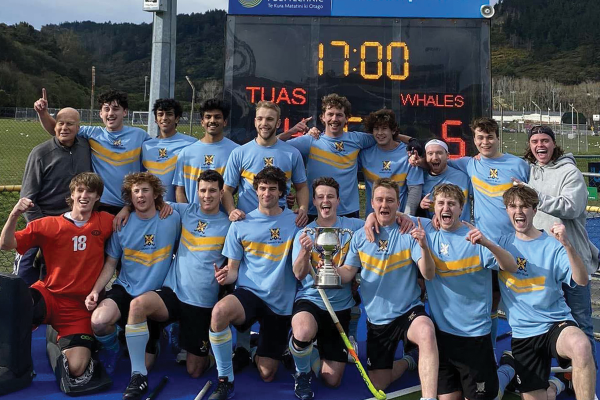
Uni Whales Win Hockey Championship
The University Whales performed the impossible on Saturday, August 19, winning the premier men's hockey competition in a stunning shootout victory. Blub-blub. After an initially slow start to the season, the team has been called the “most unlikely of champions”. Before two shootout wins in the quarter and semifinals in the weekends leading up to the match, the team had only won six of their fifteen games in the regular season, losing nine to finish fourth out of the six teams in the league. “Basically, we went from not having beaten any of the top three teams outright in the regular season to winning the entire championship,” said Gabe, one of the team players. Remarkably, the same pattern occurred just two years ago for The Bombers, a B-level Dunedin ice hockey team, who lost nearly every game in the first half of their season, won every game in the second half, and then swept the finals. Something about hockey and comebacks in Dunedin, it would seem. So how was it done? A masterclass in hockey, or simply great goalkeeping? Critic Te Ārohi sat down with team player/coach Josh Wypych to find out. The experience was “pretty unreal,” said Josh, who also told Critic that “during the season we hadn’t been there at all, half our games had been blowouts.” The Whales lost 5-1 to both Taieri and Kings United, two teams they would eventually beat in their stellar run. Sure, they had “glimpses”, but “these didn’t come away.” In the end, Josh reckoned, “We can either shit the bed or flip the switch when we go down… in the finals we really pulled together.” Down 3-1 in the final game with only 8 minutes to go, this switch certainly flipped. The team scored two crucial penalty corners to equalize with only a minute and a half to go. After a “frantic minute left of play,” Josh said he was pretty confident in the abilities of their goalkeeper, Hugh, to get the job done. “Obviously you always think you can win it, but it wasn’t until we won our first shootout against Albany” - a team boasting NHC Otago keeper Felix McIntosh - “that I felt pretty confident we could go all the way.” To this degree, Josh was spot on, as the Whales came home to take the title in a best-of-three shootout against a talented Taieri side boasting three New Zealand Under 21 players. The Whales weren’t without their fair share of national stars, though, bringing one cap Black Stick Benji Culhane back into the mix as the regular season ended. Josh’s sly smile as he talked about this was hard to ignore as he deemed the impact of the young fullback as “pretty unreal, to be honest.” Black Stick ring-ins or spectacular shootout form; whatever way you put it, the stars seemingly aligned for the Whales three spectacular weekends in a row (with Critic being assured the post-match celebrations were similarly as spectacular). Coming from nowhere to win the entire competition, the Whales team of 2023 has firmly rooted themselves in the history books of Dunedin hockey, leaving the older clubs grumbling in their wake. Though the team is set to lose six or seven players next year, Josh is still confident that the team will have enough in the tank to make it three titles in four years. And that’s the kind of confidence which wins shootouts, hopefully for many years to come.
-
New Religion Club Goes Rogue
Wednesday, August 23 seemed an ordinary day in OUSA Clubs and Socs. Until the lights went out, mysterious figures emerged from the shadows, and a variety of sacrificial snacks were put on display. Yes, you’ve guessed correctly: the Society of Religious Studies Enthusiasts (SORSE) sat down for their first meeting - a viewing party of Greta Gerwig’s Lady Bird. Probably not the first choice of your high school RST teacher, but they had reasons. With a successful movie night and a whopping 24 Facebook group members under the belt, SORSE has begun to establish itself as a confident member of OUSA’s panoply (it’s a word) of clubs and societies. That is, until Critic Te Ārohi got a whiff of scandal: rather than getting “stuck behind the legality,” said the group’s co-founder Hannah, SORSE decided to go AWOL and start their society outside the watchful gaze of OUSA. Naturally, this leads to the question: will we have a quasi-church vs state brawl on our hands? In response to murmurs, Hannah came out publicly, telling members, “There’s still a lot of room and time for what SORSE becomes to be discussed or decided.” Additionally, SORSE and the Religious Studies Department is expressly guided by an acceptance of all beliefs, choosing to focus on the analytical study of religion as a sociological phenomena. To this degree, SORSE’s cultish behaviour appears even more bizarre. To reckon with the justice of this issue, we got in contact with Keegan Wells, OUSA’s Postgraduate Rep and “proud graduate of a Religious Studies minor.” Despite this affiliation to the department, Keegan was shocked upon hearing the news of the religious studies students gone rogue. Controversially, she stated, “I think whenever these small departments hang out with each other outside their already small classes, it’s just a big circle jerk really.” Keegan went on to say that she simply could not “condone being affiliated to OUSA,” questioning if “the religious studies kids are too afraid,” to reach out. Taking the side of the students, Keegan mused that the group's independence was “a perfect metaphor for not accepting a pansophical overlord just as they do every day in their studies.” Proving the Religious Studies grindset does not stop. Furthering her critique, Keegan argued that isolation “reinforces the astigmatism around religious studies that everyone is religious when the opposite is true.” Keegan’s solution for this stigma and fear fostered within the group was simple, “They need to bow down to their OUSA overlords.” Hannah did admit to Critic Te Ārohi that there were plans to “chip away at the OUSA affiliation stuff on the side,” so maybe we will see SORSE bow down to their masters after all. Though the foundational meeting only garnered an audience of five or six, the sheer amount of snacks on offer showed that SORSE means business in future, having already secured backing from the University’s Religious Studies Department to go ahead with brewing plans. The group plans to open itself up to more religious studies themed movies, quiz nights, and even panels from students and lecturers on specific topics close to the hearts of many. Check SORSE out on Facebook. If you’re interested they may let you in (especially if you can write a constitution).
-
Won’t Someone Think of the Children?
Throughout the election cycle, politicians get asked a lot of questions - in the debating chamber, on the tiles outside Parliament, on the TVNZ debate stage, in the RNZ studio, on the side of the road. The sum of these questions can paint a picture of the values and concerns of at least some portion of the population, and of what political leaders plan to do with that information. Subsequently, what gets asked in town hall settings, by the party faithful, and how leaders respond can provide some uniquely focused insight.