Statistics
from Issue 5 ()
from Issue 5 ()
Associate Professor Allan Blackman, a lecturer for Otago’s Department of Chemistry since 1991, resigned from the University in December last year to take up a position at Auckland University of Technology’s School of Applied Sciences. Earlier that year, Blackman became engaged to an Otago student studying towards her Honours degree in Chemistry. Blackman’s relationship is not the only one, with a number of relationships between students and lecturers occurring within the University. However, these generally involve older postgraduate students. In an institution involving over 22,000 staff and students, it is to be expected that some interactions may progress to something more. One student met his match on the NZ Dating website, only to find out during his lecture the following week that the one-night-only partner was his lecturer. The lecturer was wearing a wedding ring this time. Another student attended a social event with her lab group, only to end up staying the night with the tutor of that lab group. She avoided attending subsequent labs, but says they remain friends and her assessments had all been graded before the event. Former OUSA President Logan Edgar was in a relationship with his tutor in 2012. However, tutors tend not to mark their own students’ work so the tutor held no influence over his grades. Critic notes that his current 32-year-old girlfriend probably stretches the age gap more than any tutor would, and we send our congratulations. Critic has no doubt there are many more of these stories – however, it is the on-going relationship with a much older, much more senior staff member that appears to cause more of a stir. Professor Lyall Hanton, Head of the Chemistry Department at Otago told Critic “the greater the imbalance, the more uncomfortable the University is.” Lyall says that following the issues with Blackman, the Department have had to “re-establish boundaries.” He explains that although this is the only incident where a staff member in the department has crossed the line, other staff members are now “more cautious about providing socialising opportunities.” All NZ universities state that when there is a conflict of interest, such as when a staff member enters a relationship with, or has had a relationship with a student, “a disclosure of interest is required.” Their policies all indicate that “staff members must inform, verbally and in writing, the person to whom they normally report” and when this person is involved in the conflict of interest, “the staff member must report it to that person’s manager.” All tertiary institutions follow the policy that “staff should not be involved in supervision or assessment of students with whom they have a family or personal relationship.” The University of Otago has the most thorough policy among the other NZ tertiary institutions. A review was made to the Ethical Behaviour Policy following the murder of 22-year-old Otago student, Sophie Elliott. She was tragically killed by her former boyfriend and Otago tutor, Clayton Robert Weatherston, in 2008. The policy now states that the University “strongly discourages” intimate personal relationships between staff and students and that staff should do what they can to avoid relationships occurring. The policy states that the relationship “has the potential for, or could be perceived as, compromising the fundamental duties inherent in teaching and learning. Staff members have a responsibility to students to assess their work fairly, objectively and consistently across the candidature for their particular subject/course.” The policy states “in settings where there is a difference in power between people, such as staff and students at the University, the potential for harm is greater and special care needs to be taken to avoid conflicts of interest.” Massey, Christchurch and Victoria Universities all state in their policies “the University strongly discourages intimate personal relationships between staff and students and staff should avoid entering into an intimate personal relationship with a student at the University, particularly a student for whom they have responsibility.” Each policy goes on to state that “such a relationship risks taking advantage of the intrinsic trust, power and status differential implicit in the staff-to-student relationship.” All three run by a policy where should a conflict of interest arise, the supervisor or Head of Department should be notified and will need to determine ways of dealing with the situation (e.g. not assessing a particular student’s work or having no involvement in a recruitment process). At Otago, “the person to whom the matter is reported must ensure that processes are put in place to manage or remove the conflict of interest in the best way possible and in a transparent manner, and the staff member will be an active participant in the process.” Lyall explains that this means “the responsibility is on staff to not actively pursue behaviour that could lead to relations.” The Tertiary Education Union believes there are “grey areas.” Tertiary Education Union president, Lesley Francey says it is a topic which requires an “ongoing review.” She believes that “if there is a power imbalance and the lecturer has power of the grades of a student, then it is totally inappropriate.” However, she says that if the staff and student are in different departments and the grades of the student cannot be affected, then “I don’t see a problem.” AUT, Blackman’s current place of work, did not respond to questions regarding their policy. According to their policy online, no more than “a disclosure” is required. Critic contacted Blackman who predictably had “no comment” to make. However, Critic speculates that the lack of policy at AUT would lend to a more appropriate work environment for Blackman.
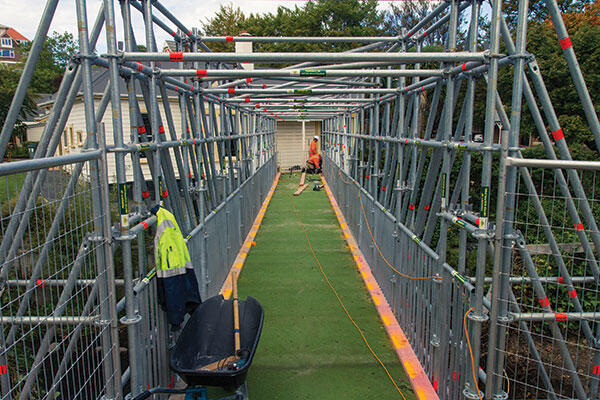
An unforeseen $100,000 is to be spent by the Otago Regional Council (ORC) on installing a temporary footbridge across the Leith as part of the flood protection works, causing further disruption to staff and students. The ORC is currently in the middle of a $5.4 million flood protection scheme in the North Dunedin region, which includes widening the Leith channel on the western side in order to increase its flood carrying capacity, according to ORC Engineering, Hazards and Science Director Gavin Palmer. Installing the temporary footbridge will cause some construction delays and as a result the flood protection works will now continue into June, meaning that disruptions and delays will still be present during mid-year examinations. Palmer said the temporary footbridge will remain in place “until such time as the works to the existing footbridge are completed.” The footbridge will be the same width as the current bridge, be able to hold an equal capacity and have a ramped approach to account for the difference in level between the two banks of the river. When questioned by Dr Michael Deaker about why the need for a temporary bridge was not foreseen in the flood protection works, Palmer said that access across the Union Street Bridge and Dundas Street was still available, and “it was not until late in the piece” that they expected an alternative form of access would also be necessary. University Chief Operating Officer John Patrick said that while the “works are important,” they are “causing significant inconvenience for all campus users.” Patrick said the main areas of disruption for students are “Castle Walk and St David Street,” and this was due to “the substantial civil works being undertaken and the site facilities and plant required to complete this current stage of flood protection works.” While Palmer couldn’t confirm the full cost of the footbridge, he said the project was still within budget and that he was unaware of any public dispute regarding the cost of the bridge. Ratepayers would contribute to the cost of the works, while the University would contribute to the aesthetic of the project given its lack of contribution as a non-ratepayer. According to Palmer, “the project reduces the flood hazard of the Water of Leith and thereby provides social and economic benefits to areas that are directly flood prone.” According to Critic, “the project also reduces the need for students to walk slightly further than usual and thereby reduces the mental and physical benefits that active people are typically prone to.”
Three Otago students have beat out thousands of teams from all over the world after being selected to compete in a seven-day mission across Europe using only Red Bull as currency. Red Bull Can You Make It positions 100 teams from all over the world in London, Paris, Milan and Vienna with a case of 24 cans of Red Bull, giving them from 4 April until 5pm on 11 April to make it to Berlin. Brother and sister, Chessie and Finn Henry, along with their friend Tish McNicol, are representing the University of Otago as “the Freedom Hunters” and are the only team from Australasia to be part of the 100 competing teams. Critic spoke with one of the Freedom Hunters, Chessie Henry, who said the trio made a split decision to enter one day out from entries closing, which involved a pretty “casual” one-minute submission video. A week later, the trio received a call saying, “We’d been shortlisted as one of the teams,” and stating “that if we could confirm our passports, we were good to go,” said Henry. The following day, Red Bull rang to say the team had been officially selected and were off on an all expenses paid trip to Europe to compete. Specifics on what is involved are scarce, with Henry saying, “apart from the fact that we are starting in London, we don’t know anything about [what the competition involves].” She said they would have “no money. No food. Just Red Bull.” However, Henry said they were “just really banking on people’s good will, [and] that they’ll find it funny or want to help us out.” She added, “for the most part, [we’re] just really excited.” Despite the trio joking about it, Henry said they were all in training. “We’re trying to go for a run every day, especially if it’s going to be a sprint to the finish line.” Other preparations suggested included learning the haka “so we can be like ‘we’ll do the haka for you if you take us this far, or give us a bagel.’” Henry said people could track the team’s progress in the lead up to the event online and on Facebook, and keep updated while they make their way to Berlin. It will undoubtedly be worth keeping an eye on the team who proclaim they’re “up for anything,” and that “there’s not much we couldn’t get with a Red Bull and a grin from Finn.”
NORML have further questioned the boundary of the University’s Smoke-free policy by looking to an archaic property right known as the Queen’s Chain that considers riverbanks to be public property. In his repeated attempts to “break down the policy,” Otago NORML spokesman Abe Grey contacted Critic speculating that the Queen’s Chain protects the banks of the Leith from the policy. Critic’s investigations into Grey’s claims suggest that the area along the Leith may be considered as part of the Queen’s Chain, although the limited application of the concept in New Zealand and the University’s management of the area would indicate that the area is still within the Smoke-free policy. Critic spoke with Senior Surveying Lecturer Mick Strack who said that the basic philosophy behind the Queen’s Chain was that waterways should be set aside for public use. However, he said that while “land has been set aside around our waterways when required, and when surveyors have chosen to do so,” the Queen’s Chain concept has “never been absolute.” Walking Access Mapping System (WAMS), which identifies public land in New Zealand, acknowledges that the “Queen’s Chain … [has] been affected by erosion in some cases.” WAMS indicates that the area along the Leith from St David Bridge to Union St is public reserve land and “can generally be expected to be open to public walking access.” Strack added that “in the sense that the Leith is classified as a river, it is eligible for being set aside as a reserve.” However, Strack suspected “that one way or another, the adjoining land owner has some sort of jurisdiction over the management.” DCC City Planner Lianne Darby confirmed Strack’s position. She said the parcel of land in front of the Clock Tower building is held in Computer Freehold Register OT299/36 and is “owned by the University of Otago.” She said that there is “no esplanade reserve or strip in this location” meaning a “Queen’s Chain” is not a possibility. She added that it “certainly looks like the University are responsible for the land” in front of the Clock Tower, citing that “usually stopped road is transferred to the adjoining land owner.” Grey added that he wanted the University to “be forthcoming with their explanation” of the policy, rather than the vaporous explanations he had felt from them thus far. Incidentally, NORML appear to be categorised as something other than “smokers,” considering that the ODT last week reported there were few breaches of the policy and that “there had been no backlash against the policy from smokers.”
The recent trial of a 25 per cent discount on Dunedin bus services is “proving pretty successful” says Otago Regional Council (ORC) Chairman, Stephen Woodhead. A noticeable increase in patronage means the discount trial will continue until 30 April 2014, after which the Council will decide whether it remains permanent. Woodhead says the discount is being offered exclusively to students as a direct result of “student associations canvassing the Council.” OPSA president Rebecca Swindells said students have been calling for a bus discount for some time. “Many students are on tight budgets, parking is expensive and in limited supply, so the more students that use buses the more money is in their pockets,” she said. The trial allows all first year students at the University of Otago, Otago Polytechnic and Aoraki Polytechnic to get a free Go Card. Returning students can get a Go Card for the usual fee of five dollars. Within the first month, students made over 18,000 trips on Dunedin buses. However, the Council does not yet know how this compares to last year. According to Woodhead, a full data analysis will be made in April to assist in the current restructuring of bus services. The restructuring is intended to increase bus usage throughout Dunedin and make it easier for students to live outside the North Dunedin area. Critic spoke with one bus user who criticised the discount as being misleading. He said that the Go Card discount has been around for years, meaning the discount is closer to 15% for existing card holders. OUSA President Ruby Sycamore-Smith says, “we’re really impressed with the students and how active they have been in the trial.” She believes that from the numbers using the service, “we can see a continued relationship with ORC and the student discounts.”
A University of Otago student previously convicted of selling Ritalin to other students has had his conviction quashed in the Court of Appeal, after his co-offender was discharged without conviction after admitting to the same offence. The Court of Appeal last week revealed its decision to discharge Druvi Patrick Rodrigo without conviction, declaring Rodrigo’s offence to be “drug dealing at the lower end of seriousness.” In April 2013, Rodrigo pleaded guilty in the Dunedin District Court to selling a Class B drug, Ritalin, between 1 February and 28 September 2012. He was sentenced to 10 months home detention and 200 hours community work. Rodrigo, a Commerce student at the University, was forced to suspend his studies to carry out his sentence. Rodrigo carried out his sentence only to discover that the co-offender who supplied the “trays” had been discharged without conviction. Rodrigo subsequently appealed his conviction with a new lawyer. Police identified Rodrigo’s involvement after they became aware of an associate supplying prescription Ritalin to other students at the University and examining text-message data that incriminated Rodrigo as a Ritalin supplier. A police search of Rodrigo’s home on 27 September 2012 revealed 17 20mg pills in Rodrigo’s room. Rodrigo later divulged these pills were sent to him by an Auckland supplier in “trays,” each containing 10 capsules, and that he had been selling the drug since February to students, believing it would help them study. He also planned to use the profits to buy more Ritalin for his own use. Following his original sentencing, Rodrigo was diagnosed with attention deficit hyperactivity disorder (ADHD), for which Ritalin is prescribed. Kidd urged the Court of Appeal to consider Rodrigo’s actions as directly affected by his untreated condition. The Court of Appeal took this reasoning into account, alongside Rodrigo’s age, his lack of prior offending and desire to travel to the United States and Canada to visit relatives. Evidence that Ritalin improves concentration in people not affected by ADHD is largely anecdotal. People using the drug as a party stimulant or study aid should be wary, as many experts warn its similarity to methamphetamine means it has high addiction-forming properties and possible long-term effects on concentration.
This week’s OUSA Executive meeting had a climatic end, with Education Officer Jordan Taylor announcing his resignation from the Executive. Critic’s last Execrable highlighted Jordan’s “sheer incompetence shown in his organising of Sex Week,” and that he was “already following a very similar pattern to his efforts last year.” Jordan’s resignation is effective from 28 March. A motion that the Executive give Jordan a group hug was put forward by Nick, and seconded by Ryan, and a cutesy cuddle puddle quickly took place after it was highlighted “we’d be in breach of the constitution if we don’t do it now.” Nali quickly made clear to Critic that “free hugs are the only promise I will ever make.” When Critic contacted Ruby after the meeting, she expressed a sympathetic goodbye to Jordan, saying, “It’s a real shame to see Jordan leave. He’s been so valuable and done some really great work for the Exec, and we wish him all the best for the future.” In more typically dry Executive activity, Ryan was responsible for chairing the meeting in Ruby’s absence. All received the Budget Seminar notes and the Executive agreed to approve the Provision of Service Agreement between OPSA and OUSA, which permits OPSA students to use Clubs, Sports and Societies facilities of OUSA for an annual student services fee of $10,000. The agreement doesn’t overtly stretch OUSA in any way, with only around 2.5 per cent of the Recreation Centre’s use attributed to OPSA users, but is basically a way of helping OPSA out with their reduced funding. Results for the 2014 Capping Charity were announced, with Rape Crisis being the chosen charity after an underwhelming 58 people took part in the poll. A $350 New Zealand Red Cross donation request was met with feelings of coercion and extortion, and was said to “not be something we’ve done in the past.” Despite the noble cause, Nick summed up the sentiment as “we could pay $350 or let people die.” Deciding that the charity had no student relevance, the donation was not moved, especially after the only relevant student “charity” anyone could think of was NZUSA. Similarly, a proposal by a Marketing Management group asking OUSA to provide sponsorship for a group assignment to gain awareness for Canteen Dunedin was again met with reservations. Ryan pointed out that “as it’s for a paper with many groups, it sets an unwanted precedent,” while Nick made the good point that “20,000 students should not pay for you getting an A.” The rest of the meeting concerned the Executive expressing their general approval for creating an MOU between Rate My Flat and OUSA in order to provide the necessary $5,000 to launch the site that will rate Dunedin flats on their level of insulation, dealings with landlords and general worthiness to rent.
First, let’s go to the rich mahogany rugby desk where we find lots of excuses for the Highlanders suffering an unexpected home loss to the Force last weekend. A narrow two-point loss will have knocked their confidence a bit but it was close and every cloud has a silver lining (and all those other well worn sports clichés that could be invoked here). They will just have to take it one game at a time. The reality is that it’s early days of a long season so I will not abandon ship at this early point. However, I will allow myself to say – even if it is at the risk of starting off the process to joining the Chiefs’ bandwagon – Waikato are looking strong. Actually, I have always supported the Chiefs – in a roundabout kind of way. When I was younger I didn’t really understand what the Waikato was. I just knew I was geographically obligated to hate the Crusaders and I didn’t like the Blues and the Hurricanes because they were the evil big cities. So I would always support the Chiefs when they weren’t playing the Highlanders. (There, not a bandwagon jumper – although I am definitely not a Breakers fan anymore ... ) This week we continue the road to Brazil with a look at the very tough Group B that contains both finalists from the previous World Cup. While it has not been given official “group of death” status yet, stay tuned for that in a few weeks. Next week we will continue our football “analysis” and have an “in-depth” look at the UEFA Champions League that is shaping up very nicely. Spain UEFA - Union of European Football Associations Population: 47 million Currency: Euro Capital: Madrid Language: Their nickname – La Furia Roja (“The Red Fury”) – has been warranted recently. FIFA World Ranking: 1st Qualified: Winner of qualifying Group I Fun Fact: They’re the only team in history to have won three consecutive major tournaments: World Cup 2010 and Euro 2008 and 2012 History: They’ve had a pretty easy qualifying run but lost the Confederations Cup final to Brazil. Key Players: Barcelona provides an experienced spine for the team with Xavi, Iniesta and Fabregas. The Manchester City trio of Silva, Navas and Negredo shows the depth they have. Prediction: Are among the favourites but some tired old legs will catch up with them in a semi-final loss to the eventual winner.. Netherlands UEFA - Union of European Football Associations Population: 17 million Currency: Euro Capital: Amsterdam Language: The team is often informally, and incorrectly, referred to as Holland by many. FIFA World Ranking: 11th Qualified: Winner of qualifying Group D Fun Fact: Dirk Kuyt could reach 100 caps during the group stages if he plays all three games. Wesley Sneijder can also bring up a hundy if the “Flying Dutchmen” make it to next round. History: Went from being runners up in 2010 to not making it out of their group at Euro 2012, but recently went undefeated in qualifying for Brazil. Key Players: Manchester United striker Robin van Persie, who was the overall top scorer in World Cup qualification with 11 goals, has the firepower to win big games. Prediction: A very solid squad that should go through. They will be a threat in the knockout stages but won’t make it back to the final. Chile CONMEBOL – Confederación Sudamericana de Fútbol Population: 18 million Currency: Peso Capital: Santiago Language: in Spanish, fans call them La Roja (“the red one”). FIFA World Ranking: 15th Qualified: third place in the South American group. Fun Fact: Consistency without any major success recently makes them the Arsenal of international teams. History: Best result is an irrelevant third place in 1962 when they hosted the tourney. They have recently beat England in London. Key Players: Arturo Vidal of Juventus and Barcelona winger Alexis Sanchez are capable of producing game changing moments. (Well, they do on FIFA 14.) Prediction: The dark horses of the group. The “South American home ground advantage” could benefit them. Australia AFC – Asian Football Confederation Population: 23 million Currency: “Aussie dollar” Capital: Canberra Language: Their nickname – the “Socceroos” – is derived from an uneducated-sounding understanding of English. FIFA World Ranking: 63rd Qualified: Finished as runner up of Asian Group B Fun Fact: In 2006 they became the first team to qualify for the World Cup via a penalty shoot-out when they beat Uruguay 4 - 2 in Sydney. History: Only two wins from their three previous World Cup appearances. Recently were thrashed 6 - 0 by both Brazil and France. Key Players: I like their captain Mile Jedinak who plays for my boys Crystal Palace in the Premier League. Prediction: Lowest ranked team who are there to make up the numbers. A few lucky goals maybe but no wins. The shrimps will be on the barbie quite early.
Last week, Critic’s most beloved Tertiary Education Minister opened up the university council chat once more. National has been no stranger to the evolving relationship between student participation and our university overlords, and the Education Amendment Bill (number two) is no exception. We first covered this story in Issue One, and given that public submissions are now open until 30 April, this week is dedicated to understanding more thoroughly what the Bill has the potential to change. The ChangesFor those of you who don’t frequent the Parliament website (home of Parliament TV screenings and handy-dandy MP lists), you should know there exists a Bills Digests feature, which explains quite extensively the background and provisions to different bills. As it aims to be largely objective, this is a good place to extract a neutral summary of the Education Amendment Bill (number two). There are four main changes that are outlined. Of these, the most explicit change is that university and wānanga councils will be decreased in size, from 12-20 members to 8-12; a second change is that this numbers game will include three or four appointed ministers, meaning roughly a third of the councils will be hand picked by the Government. They must have “governance capability.” It also includes the provision that at least one member must be Māori. The rest of the members should have relevant knowledge or skills (Critic has to ask: who were you appointing who didn’t have relevant knowledge or skills to necessitate that qualifying statement?) and should accurately reflect New Zealand’s general demographic composition. Third – and this is especially important for students – is the removal of the provision that council members must include student representatives. Essentially, this means there do not need to be any students on the university councils to legitimise them; they can operate exclusive of actual student membership. Finally, the Bill will “clarify the duties and accountabilities of individual council members.” Which, if you have a hunt through the actual text, can be boiled down to “don’t be a dick or you’ll be booted.” The Good NewsThe point of making such changes is to streamline our council system. By reducing the amount of bureaucratic nonsense ascribed to university councils, Joyce argues that new university councils will be flexible. This freedom of choice will boost our international standings, create competitive and effective councils, and will further enhance Māori student participation. In recognition of the lack of student membership, Joyce points to long track records of student involvement, and doubts that this will change significantly upon the Bill making it into law. When the initial announcement of the Bill was made, Joyce succinctly described the benefits by commenting, “New Zealand universities would benefit from smaller, more flexible councils which support them to perform at a high level and to be nimbler, more adaptable, and better organised than big overseas universities. The proposed governance changes will, alongside measures proposed in the new Tertiary Education Strategy, assist in preparing universities for the challenges of the next 20-30 years.” The aim, therefore, is fluidity and elasticity of council membership. The Bad NewsIf you read Issue Three, you will remember David Clark’s snappy one-liner telling us that Joyce is taking away the student voice. That is the essence of the main criticism surrounding the changes. Without compulsory student representation, it would be very easy to do away with students on councils at all. In reflecting institutions that comprise of, well, students, this is a dangerous potential oversight. More than that, however, is what it means the councils will actually look like. In particular, the new provisions mean a third of every university council will be government-appointed, increasing dramatically the role Parliament has in influencing our universities. Having councils independent of government is an important notion, as endangering that separation endangers academic freedom and the like. It’s impossible to banish the images of Umbridge’s Hogwarts takeover in the fifth Harry Potter book (the educational decrees, the firing of beloved teachers, the banning of clubs without express permission to form, etc.) With that terrifying image in mind, it’s not hard to explain the staunch opposition this bill has got from student associations. Indeed, ignoring their protests would be an uncomfortable indication of things to come – if the changes are opposed but ignored, surely this will be indicative of a future where students are routinely ignored on other issues, too. Even in a fundamental democratic sense, this bill has issues. Representative democracy is intended to be just that – representative. Removing this clause in council composition does little to defeat the argument that National is “attacking democracy.” David Clendon argues, “Staff, student and community representatives are vital to these councils making sound decisions, as they represent the exact groups that universities and wānanga exist for.” Without members who understand the hums and ticks of university life, it’s easy to see that decisions could be full of oversight and detrimental to the exact people the council is supposed to aid. So?Get that hollering student voice on paper and submit something to the Government. Whether it’s a crudely drawn ASCII picture of Steven Joyce naked or a truly heartfelt letter of love towards Hekia Parata, get it out there. You can do so on the Parliament website, which also includes a helpful how-to guide if you’re unsure how submissions work.
For ACT, making a difference is what we’re interested in. Not disrupting debate, like Young Labour’s twit who wrote in this column last. There are people who work for nothing, providing fine services to the vulnerable and voiceless, and he thinks making a difference is following John Key about, making his ministers cry. He says so with no shame. No surprises, though. His party leader wants to take control, for instance, from communities, parents, and children, who are presently making a difference with help from Partnership Schools. Many from struggling communities of Northland want these schools; but Labour promises to snatch them away, all because the tantrums of unions stood in for compelling argument. ACT stands for handing control over our lives and communities back to where they belong instead of in the hands of the Government, whichever party that may be. In our individual lives, and in the life of our communities, the real differences are made from our own efforts. ACT gets it. Labour doesn’t want you to.
Greatest HitsOn Wednesday morning a new set of changes to the electoral law was passed. While there is considerable criticism about a number of aspects, there is a particular redeeming feature that will finally catapult our elections into modernity: now you can enrol to vote online. For those of us who prefer to use the Internet to snail mail, this is great. Unfortunately, you can’t quite vote online yet, so you still have to leave your computer on 20 September. Greatest ShitsAnadarko has failed once again. Despite the Government’s insistence that deep sea oil drilling is a good idea, the Texan company has been unable to hunt out fossil fuels in Otago and is set to say goodbye to NZ waters. This comes as much frustration to the pro-oil lobby, while anti-oil protesters are able to happily say, “I told you so.” When asked about the failure, the chief executive of the Petroleum Exploration and Production Association of New Zealand said, “the oil is where the oil is and the only way to find it is to drill for it.” Thanks for that pearl of wisdom, David.
Tau Henare goes wild with this hashtag. Clare looks towards a new dairy product for the next parliamentary drama. Green MPs target Key's memory loss. Probably not the best use of your time, Jacinda. Yes, because those two parties agree on so many other fronts. If you value terrible jokes, vote #InternetParty.
There are at least two sides to every tale … especially one spanning over several years, involving high profile business owners, a secret Facebook page and a potential police cover-up. The ODT have told one side of the story, but after Critic was given access to the private Facebook discussion group “Metro Exies” and made contact with Benjamin Hanssen whilst he was overseas, we can now disclose further details of the dramas that have been unfolding in Dunedin’s bar scene. Almost everyone Critic spoke to describes their rival businessmen as “dodgy as fuck,” and with such accusations flying both ways it’s hard to see just who the good guys are. In November 2013 the ODT printed an article entitled “Bar owner left trail of bitter creditors.” This followed news that Benjamin Hanssen, former owner of Monkey, Metro and Diamond Lounge/Rumours, was “the bar owner involved in employing gang members to intimidate rivals, and was alleged to have knowledge of concrete being poured down the drain of a rival establishment.” Hanssen insists the majority of it is pure fiction “but makes a good story,” and is “based on two or three people out to get me.” Hanssen says, “if I really wanted to stop them and fuck them up, I would have done a better job than putting sewage in my own car park.” He said he was not given the opportunity to comment prior to the ODT’s article going to print and is now “in the process of speaking to solicitors ready to take the ODT to court [over] false accusations and slanderous comments.” In February 2014, two months after closing Monkey Bar’s doors, Inland Revenue won their case in the Dunedin High Court to liquidate Metro Bar Ltd, 2 Mooses Tavern Ltd, The Church Nightclub Ltd and Professional Hospitality Staff Ltd. These are the companies through which Hanssen has run the Dunedin bars. The case was over quickly with Hanssen saying he “knew it was a losing battle.” Hanssen told Critic he poured all of his fortune into trying to keep the bars afloat, but in the end “I just couldn’t keep up with the sinking market.” He said he tried to plan ahead, but each month the situation just got worse. He now has “no doubt [that] the tax department will prosecute me for not paying taxes.” Hanssen has a history with a number of past business owners, but he defends himself saying he is “no more ruthless than any other businessman.” He says that if he had done anything wrong, there would be more than one person who had made official complaints against him. In 2009, Kirstin Diack made a complaint to the Serious Fraud Office and in 2011, she made a complaint to the Registrar of Companies regarding a property development company, Wakanui Developments Ltd. Diack worked for Hanssen during one of his periods of bankruptcy (2002-2005) and during this time was instructed to set up companies for him. In NZ, it is illegal to run a company when bankrupt. The complaint alleged that Hanssen was “not a fit person to own, manage or direct a company in New Zealand” and he was accused of owing creditors “in excess of $800,000.” Diack says upon discharge of the bankruptcy, “[Hanssen] immediately resumed as the director.” The companies have since been liquidated, as per Diack’s predictions in the complaint letters. Hanssen claims his relationship with Diack goes back 20 years and the pair finally fell out when a property deal went wrong and Hanssen lost “nearly half a million dollars.” Diack’s response was that the only reason Hanssen lost out on any deal was because “neither the liquidator nor the lenders wanted to deal with him ever again.” Hanssen believes there is a small team wanting to bring him down after “not getting their own way” in deals or employment relations with him. He says there are three people with “vendettas” against him - Kelly Gilan, Nicholas Vague and Bradley Roberts. He says that they all have their own secrets so “are not the ones to be talking” in contrast to his own record which he says “is all a matter of public record.” Diack, who made the official complaints, has not met any of these three people but says “he has burnt a whole lot of people and we’re just watching out for who he burns next.” Gilan, who is currently serving time in jail, and Vague were not available for comment, but Critic spoke to Roberts, who was General Manager for Metro from 2011-2012. Roberts has been looking into Hanssen’s past for the last year and says that Hanssen has a complicated network of companies. “The more tangled it is, the harder it is for creditors to chase debt.” Hanssen believes this is “an interesting assertion to make.” He says “I was a conglomerate. I’m operating in two of the highest risk industries: hospitality and property. Anyone with commercial law experience would be able to make sense of my companies.” Hanssen says Roberts has “destroyed my reputation” and that “he has rung almost anyone I have done business with in the last 25 years.” Hanssen and a business partner of his, Hamish Lay, claim they have both had Roberts “harassing” and “cyber bullying [them] on an epic scale” since last year. This includes threats to family, friends “and even on my dog’s life.” Hanssen told Critic “I am fine with people attacking me. I made my own decisions. But some of the people you are dealing with are attacking friends and family around me.” The online attacks included Roberts creating a fake Benjamin Hanssen profile on Facebook, adding his friends, family and clients to it and then posting damaging statements referring to his business history. The cyber bullying was reported to police; Roberts was called with a warning and no further complaints have been laid. Roberts says his actions are because “I give a shit about people. I got sick of him ripping people off, especially students working for him trying to make ends meet.” He says that until now, no one has stood up to him because he can be “intimidating to people he perceives as below him or vulnerable.” Following the sale of Malbas, now known as Capone, disagreement over who owned the chattels within each bar caused a dispute between Greg Paterson, who owns the building, and Hanssen. Paterson believed the chattels in Metro belonged to him, which Hanssen denied. On a Friday night, “a group of thugs showed at Diamond lounge to take everything,” says Hanssen. The “thugs” showed up again and ripped more out, including the tills worth $5,000 each and half of the illuminated floor. When he called the police, Hanssen says “two showed up and refused to help unless disturbance of the peace was occurring. And if I tried to stop the thugs, they were going to have me for assault.” Hanssen said it cost $15,000 to shut that night and it “finished the premise for me.” Hanssen says he then “arranged for my agents” to remove the product back from Capone, to which “five squad cars showed up at Capone for my guys.” Hanssen and his business partner, Lay, believe someone in the police was informing Paterson. The night that Hanssen attempted to claim chattels from Capone was the night concrete was poured down one of the drains. “It was just two mature business men arguing over chattels as part of a business deal, not a repossession as made out by the media.” He says the police invented the story involving Mongrel Mob. “If it was Mongrel Mob, I wasn’t aware as they were not patched.” He said “people are watching too much Breaking Bad. It’s not like you call 0800 MOB.” He says it was just a friend helping out. “The hysteria over this is incredible.” Critic tried to contact the police several times, however, they were not available for comment. Critic spoke to Iain Nellies and Don Millis, Principles at Insolvency Management Ltd, who are looking after the case. It has been suggested that Hanssen and his business partner, Kerry Thompson, are placed on the banned directors list. Information is still being gathered in order to file the first report on what assets are available but Nellies said “[Hanssen] is operating through a company which is a separate legal entity, so the debts stay with the company.” He said there is “nothing stopping him from continuing, as Hanssen is just working with the law as it is at this time.” With the current legislation, New Zealand offers a “free and open economy to do business in.” He explains, “there are, I won’t say loopholes, but things could be exploited if you’re not of the mind to do correct business.” Just last month, Hanssen changed one of his company names from Westland Adventures to Northern Technology Ltd. This company will be selling “home automation technology.” This includes clever light switches, remote controls and “stuff for rich people with too much money.” Hanssen says he is “no more dangerous or reckless than any other business man” and has “no reason to not return to Dunedin to tie up loose ends.” He says “I put my heart and soul into Metro and no one would have been sadder than me [to see it go].”