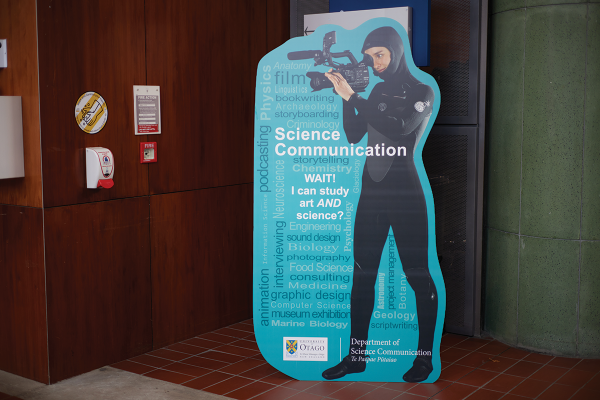
Science Communication Department Fears the Axe
Local greenie grandma Rosemary Penwarden was found guilty of forgery by a recent Dunedin High Court trial. Rosemary sent a fake letter in 2019 to attendees of an oil conference in Queenstown telling them it had been postponed due to the climate crisis. Though the letter was meant to be satirical, she now faces up to ten years for forgery. Apparently the law doesn’t understand sarcasm. Rosemary is considered something of a legend in the Ōtepoti climate scene, especially for budding young climate activists like Zak and Jett, describing her as a “household name”. As a grandmother, she was quoted by her close friend Bruce Mahalski saying that she wouldn’t think of anything more useful to do than “try to save a liveable future.” Zak met Rosemary while he was involved with School Strike 4 Climate. “She’s been around fighting this fight for generations,” said Zak, “She’s totally an inspiration.” Jett was in complete agreement, calling Rosemary a “role model as to what fostering a relationship with Papatūānuku looks like.” Likewise, she appears to draw inspiration from students like Zak, having told Bruce that, “despite all of the doom and gloom of the scientific projections I do feel some sense of optimism for the future and that’s mainly because of all the amazing young people I work with in the climate movement.” Zak described his reaction to the verdict as being like a “call to arms… I just want to do more to just show how absurd this is, especially in the context of being in the climate crisis. What she did of course was to raise awareness and attention, and now she’s being treated like a common criminal and that’s kind of insane.” “Honestly I think it was pretty poor from the Court,” said Jett. “The letter was clearly sarcastic. The ruling shows that we value corporate interests over climate interests and the right to expression of speech.” He added that young activists might be likely to be scared off of humorous protest based on her situation and turn towards more disruptive methods. “That’s a poor outcome for all involved.” Rosemary was unable to comment on her situation until her sentencing on September 8 where she hopes to be discharged without conviction.
A website detailing how many properties your landlord owns has been shut down following discourse with the Deputy Privacy Commissioner. The founders of the website believe this decision was “influenced by landlords and property developers”. A press release from the founders sunset_flowers has revealed that their website ‘What does my landlord own?’ (WDMLO) has been shuttered over concerns of privacy breaches, with the DC (Deputy Commissioner) saying that all New Zealanders, regardless of age, wealth or any other status have a right to privacy, indicating that the listing of all properties owned by a given individual somehow violated that right. Website founders said that while the shutdown wasn’t explicitly ordered by the DC, the changes they would’ve had to make in order to satisfy the Office of the Privacy Commissioner [OPC] would effectively neuter the site. A spokesperson for the Office said that “under the Privacy Act, agencies that collect and hold personal information have a duty to protect it and respect it to avoid causing harm to people.” The creators claim that the “multiple inaccurate statements and frivolous claims” made by the DC in their “subjective interpretation of the Privacy Act” raise “serious questions about the values of the Deputy Commissioner and the Office of the Privacy Commissioner as a whole.” In a press release, the website creators mentioned that the OPC cited complaints from individuals as a reason for their investigation of the site. The founders have received a few complaints themselves, “disproportionately (>90%) from landlords.” So, assuming that the same people are complaining to both them and the OPC, “the ‘members of the public’ [the OPC] claim to be acting in the interest of” are almost entirely landlords, who the founders don’t exactly believe represent the public. They also suggested that the OPC’s request for extensive personal information on the website's founders was itself an ironic violation of their privacy. The purpose of the website was to hold accountable the people who benefit from the “hundreds of thousands of people in Aotearoa [who] live in cold, damp, mouldy, and otherwise unhealthy rentals” while the price of rentals continue to climb. In the opinion of sunset_flowers, this is a goal that the Deputy Commissioner is showing an “obvious contempt” for in. The website, upon first release, received such immense attention that the server crashed: 75,000 searches in the first 48 hours. It used publicly-accessible data to list all properties associated with a given name, but the system wasn’t perfect, sometimes combining multiple individuals with the same name or assuming one owner owned an entire block rather than a single building. Now that it’s being shut down by the founders rather, they worry that landlords will be able to continue hiding their hoarded wealth from the public. But, to keep their mission alive, “we’ve made the software behind WDMLO open source in the hope that others will setup similar search tools.” Jade, a third-year, agreed with the message behind the site: “It's not fair being kept in the dark, and leaves a very unequal power dynamic between landlords and tenants.” But for now, the founders pushed users towards Terranet, “a website which provides a similar service to WDMLO”. Terranet hasn’t been shut down, which the founders said could be due to the fact that it’s “marketed at property owners, not at tenants… This too raises questions about whose interests the DPC is acting in.” The OPC cannot “confirm or comment on complaints about a particular agency”, and the website is being taken down by the owners in lieu of making requisite changes: changes they believe would be antithetical to the site’s purpose.
I read Zak Rudin’s Critic Te Ārohi article with interest (‘MINOR CONFUSION! Announcement elicits fears’). As the person who apparently said several things quoted, I want to set the record straight, as a number of comments have been misinterpreted, conflated and confused in the telling. I also need to address claims in an earlier article about syphoning off of sector funding. I was part of a question-and-answer session at the TEU conference on Budget day. The Government had just announced a number of investments in the sector and the Minister was there to talk about them. I mentioned I had been to Otago recently and had had discussions with the VC and Chancellor about its situation, and I was confident they were taking the steps necessary to address the university’s financial issues. At no time did I say we were talking to Otago about “funding universities via student debt” or raising fees. Universities are independent by law. We can’t and don’t tell them how to manage themselves, and it’s an important principle to maintain. What I did tell the conference is that the tuition subsidy increase of 5% would make a material difference ($521 million over four years) and that the Ministry of Education would soon be consulting on the Annual Maximum Fee Movement for 2024. These two facts have been conflated and misinterpreted. The basic maths is that universities could never be funded by increasing “student debt”. Domestic student fees only cover about 19% of university costs and fee increases are capped. Critic also published “$355 Million for Tertiary Sector Reappropriated” which made a number of incorrect claims as a result of confusing funding, fees free and student loans. The key point is, an additional $521 million in this year’s Budget is going to tertiary organisations to support teaching by increasing the amount of funding for each equivalent full-time student. Funding for future years is only an estimate because, as Otago has seen this year, the student numbers you expect are not always what you end up with, and the Government is not going to pay for students who aren’t there. As to whose side am I on? I’m on the side of a vibrant and sustainable university sector that has the interests of learners at its centre. I get that there is a lot of uncertainty in universities – for students and for staff. It’s something a lot of people across the country have faced in the last three years. Universities are a vital part of our society and economy and we all have an interest in them being highly successful and, of course, financially sustainable. An important part of our role is understanding what they are doing and communicating that to the rest of government, because the Government has billions invested in them and huge expectations in terms of the contribution they will make to our future. I also want to assure you that the TEC takes the learner voice very seriously. We regularly meet with student representatives, at local and national level, to hear their perspectives and build them into our plans and policies. If Critic or OUSA has questions about what we’ve said, recent announcements, or how the tertiary funding system works, the TEC is always willing to answer them. Ngā mihi nui, Tim Fowler And a Response to this Response… Kia ora team, I offer a brief response to Tim Fowler's recent correction piece. I appreciate that perhaps this has been a miscommunication rather than deliberate obfuscation. While Mr Fowler’s intent may have been to present two distinct points, the hundred or so tertiary sector delegates and student representatives in the room interpreted the comments offered differently to Mr Fowler’s apparent intent. Nonetheless, we are pleased to hear that there have been no closed-door discussions about increasing student fees as a funding mechanism, and agree that this would be a nonsensical approach. Regarding the assertion that “the Government is not going to pay for students who aren’t there,” hopefully we can come to an agreement that slashing public institutions and damaging quality research output due to a lower-than-expected student cohort is equally nonsensical as a funding model. Ngā mihi, Brandon Johnstone Payroll Administrator, HR Services Human Resources Division University of Otago | Te Whare Wānanga o Otāgo