More News from Issue 22
-
Is the New Statue Backwards?
Flogging a dead horse to some degree, Critic Te Ārohi asked the University for any word on why the infamous white box still hasn’t been lifted outside St Dave’s. A bit like a kid in the backseat of a car repeatedly asking their parents “Are we there yet?” Once again, we were stonewalled, only being told they “are expecting to be able to unveil the pou whenua before the end of the year.” In the absence of any real knowledge of the subject, students of the Otago University have had enough, finding themselves lost in a hole of conspiracy theories and bottomless rage in reaction to the continued delays. Critic Te Ārohi reached out to the disgruntled many, uncovering some curious theories that can only come from the boredom of looking at a white box day in and day out. Speaking bluntly, one student Griffin said, “Who gives a fuck?” asking that the University simply remove the white box so students could live free of internal torment. Another student, Esther, repeated Griffin's sentiments, stating, “I didn’t know it was there as a box, that’s not going to change when you take the lid off.” But what’s stopping this process? The University said, “It will be revealed to the public once the remaining work and the appropriate tikanga Māori measures have been completed.” This answer is consistent with reports issued to the ODT and Critic Te Ārohi months ago, so what gives? One student, Briar*, got to thinking on the issue, stating, “It’s all a conspiracy… my theory is that the University is using the statue as a base for a network of underground tunnels.” Her second theory - one we understand is shared by many - was that “they’ve got it the wrong way around and haven’t figured out how to turn it back yet.” That would be embarrassing. Suspiciously, the University ignored our question asking if there was any truth to these rumours. Asked about the likelihood of a conspiracy, Lily told Critic Te Arohi, “Yeah it’s possible.” Still she argued, “Would it really make a difference which way you face it, no one’s going to notice once it’s out.” To this degree, she mused that it was perhaps the University’s delay which would make people notice. With a prophetic tone, Griffin took a different stance, stating, “This way or that way, it’s still watching over the people and keeping them safe.” Possibly alluding to the pou whenua’s existence as an omnipotent entity entrapped in the casing of a white cube, Griffin’s comments further emphasised the great need for it to be unleashed from its cage. Though the University is “expecting to be able to unveil the pou whenua before the end of the year,” the student cries of “get it over with already” are mounting. Until it is eventually unveiled, the conspiracy lives on. A trapped deity or a statue simply turned backwards: we’ll leave that for you to agonise over. *Name changed.
-
Where Does Your $1,015 Fee Go?
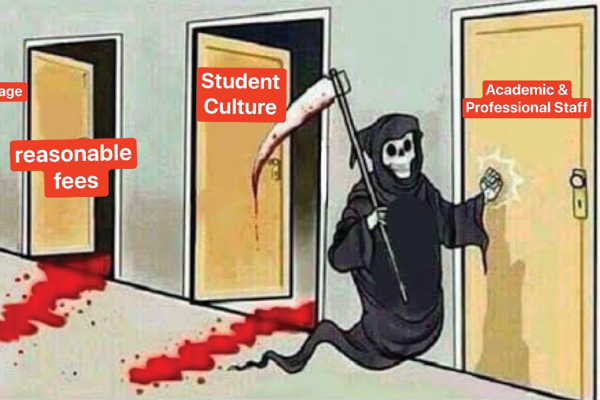
You probably paid about $1,015 to Otago as a Student Services Fee. Why do we do this? Where does it go? Imagine a group of students wondering where all their money is going as they are sitting around eating instant noodles. And then, lo and behold: a $20 million student levy fund! The money that vanishes from our pockets into the fund goes to several causes. This is all available on the Uni’s website, but we know you’re not looking at that, so we’ve basically just reprinted it here. Recreation (includes sports, fitness, Unipol, clubs and socs and internet): $8,420,538.46, or $425.96 each. Because you can have all the Wi-Fi and Zumba classes you want for the cost of a few weeks’ rent. Subsidised health support: around $8,408,855, or $424 each. What, are we giving our campus doctors gold-plated stethoscopes? Assistance with advocacy and accommodations: around $1,449,230.77, or $72.73 each. You’re paying to help resolve flat disputes whether you like it or not. Advice and information on careers: around $1,305,934.07, or $65.40 each. Preparing us for the well-paying employment that will enable us to pay off our uni loans in a century or two. Media: roughly $2,678,571.43, or $17.93 each. Critic would like a word, and a raise. Pastoral counselling and care; chaplain: around $144,615.38, or $8.00 each. Ah yes, mental health: worth about half the media budget <3 Financial support: about $12,692.31, or $0.70 each. Wow, what a spender! That should cover at least half a textbook, right? The million-dollar (or, in this case, twenty million-dollar) issue is now: what would be a better way to spend $20 million? Do students in Dunedin desire cosy apartments? Fresh food? Clothes? Trusted transportation? Dentistry? Alcohol/drugs? Or perhaps simply an additional $1,015 in hard currency? However, students need not fret since the University Council is on the case. They’re like the referees in this grand financial brawl. They consider our fee-setting requests, compile survey responses (who doesn't like a good survey?), run discussion boards (better than a flat party, right? ), and even communicate with groups like OUSA. They serve as the guardians of our financial future, making sure that the following generation of students may continue to pursue their dreams of being students. Or something like that. I think they also make a lot of money. For more info on where Otago spends our student fees go to https://www.otago.ac.nz/studentservices/otago626140.html
-
An Inconvenient Tooth
Labour has announced a plan to provide free dental care by - in part - training more dentists, but students in the country’s only dental school are asking: who’s going to teach them?
-
Science Communication Changes Confirmed
Students at the Department of Science Communication received confirmation last week from Pro-Vice Chancellor (Sciences) Richard Barker of changes that will be made to the Department. The Department is still set to be disestablished, with just a distance-only Postgraduate Certificate and Diploma remaining after current Masters students complete their studies in 2024. In July, Critic Te Ārohi reported on the “proposed changes” that were pre-emptively sent to students in the Department from its head, Jesse Berring, who told Critic that what he’d “hoped to do was be as transparent as I possibly could about what was happening and how it would affect individual students and their options going forward.” He also wasn’t aware that the communication was pre-emptive. Lily, one of the Masters students in the Department, said that when they first received the email from Jesse, her first reaction was “disbelief” at not only being told that the course she flew halfway across the world for was being dismantled, but that they weren’t even supposed to know for another month. After taking on a self-described “investigative role where I have been trying to put some of these puzzle pieces together and look back at the history and all these different decisions,” Lily said that she realised “this really was a long time coming… unfortunately upon learning more, it didn’t seem that surprising after all.” “Which then made me feel a lot more kind of bamboozled. Like, oh my God, I was sold this promise of this great program and great opportunities and everything’s going so well. But that really wasn’t the case.” So while Lily and her peers acknowledged that the bigger changes were out of their control, they couldn’t help but feel they got “the short end of the stick” in terms of their own education, which they were determined to advocate for. But without any initial clear student process for feedback, it felt like “building the plane as [we] fly it”. The biggest thing they wanted was for “somebody to listen to us and to take us seriously.” Jesse’s advice at the time to the Masters students who would be most affected by any changes was for them to be “as selfish as possible in terms of what is in [their] best interests for your research.” For instance, with the film programme being cut the question of a documentary thesis was up for debate. Would the equipment and support still be available? Since the proposed changes were announced, Masters students have pushed strongly for their voices to be heard on the matter through news articles, one-on-one meetings with the PVC, a letter of demands from the cohort and 28 individual written submissions. The cohort’s letter to the PVC said that their main concern was that the proposed changes to the Department would mean they “will not receive the quality of education that we have been promised by the University.” Among their requests were adequate technical support, staffing supervision, thesis funding, and resources to be able to complete their Masters in 2024. Richard told students that these submissions were “carefully considered by an advisory panel who, ultimately, recommended the Department be disestablished” with programme and staffing changes to take effect from 2024. The requests for existing resources to be kept for the duration of Masters students studies were approved, while fixed-term contracts for additional supervisory staff still need to be worked out. Still, that’s better than the original announcement of two out of five staff being retained. Critic Te Ārohi spoke to Jesse about the changes the department will be seeing, who said, “My role is to be a cheerleader for the programme going forward, acknowledging obviously the stress and difficulties that the current students have experienced. But given the constraints that we’ve been operating in, I’m really trying to highlight what remains on the table.” He called it “making lemonade out of lemons.” We’re not really sure what else you do with lemons, but maybe a science communicator could tell us. Oh, wait. What Jesse wanted to make clear was that “although change is unsettling, it’s also unavoidable in some circumstances.” He acknowledged that the film programme (which has been the “most expensive aspect to run”) on the chopping block has been a “big draw historically”, the essence of the Department will remain in the new programme in providing “a basic skillset in science communication practice.” And although it's distance-only, that doesn’t mean on-campus students enrolling in the course wouldn’t be able to complete it from Dunedin. From the students’ end, Lily said that now that they’re on the other side of the consultation process, she’s glad she and her peers were so vocal about their studies: “The moral of the story is: if you’re a student in a department affected by the management of change process and you feel like your faculty are not appropriately representing your interests, you need to kick up a fuss otherwise you’ll miss the opportunity to make your needs heard. They’ll try to make decisions made behind closed doors but at the end of the day no one can advocate for your interests besides you.”
-
Tramping Club Gets Sick
As many students ventured home over the mid-sem break, 45 members of the Otago University Tramping Club (OUTC) took a bus to the West Coast for their annual Copland Trip. Now they all (well, most of them) have Covid. “You, about 20 others, and counting got Covid from the Copland Trip” reads a comment on one of the many “I’ve got Covid” posts following the trip on the members-only Facebook page, paired with a pic of a double-striped positive test. Hit them up if you need a week off work anytime soon. The club only had one bus and packed every member into it. Marinating in their own bodily fluids for multiple days on end, it’s no surprise that germs (also the nickname for tramping club members) were spread around. Either that, or you’ll have to believe the club’s incest rumours. When approached for comment, Liam (the merchandise and media officer) said, “You had to be there.” And apparently this conundrum isn’t new to the supposedly “healthy” club. “Same thing happened last year, and the year before I think,” says Jacob, the club's beloved bus driver. Liam, secretary of OUTC, again claimed that “you just had to be there” to understand what truly happened. The other twist is what this will do to their AGM on September 13th. The club has around 830 members, meaning 83 will need to be in attendance to meet the 10% quorum. Presumably those on the trip would be the ones more likely to engage in that sort of thing. Emily, OUSA Clubs and Socs Rep, told Critic Te Ārohi AGMs are “as important as energy drinks during exam season, you legit have to have them to be a club.” Fingers crossed the 20-odd members will be recovered to come and elect the new exec. Someone has to keep the annual Copland-Covid trip continuing into the future. But do people really care about Covid anymore? “I forgot that it still existed,” said one student, Kaia. Max echoed this sentiment, saying, “Nuh-uh.” But is it Covid that doesn’t matter, or just the Tramping Club? Hunter said that no one was all that phased, “unless their trip was to a nursing home.” When the OUTC bus driver was asked if this was on their trip itinerary he responded, “You had to be there.” Who knows, man, it seems like you just had to be there.