OPINION: Everyone dresses queer now and it’s fucking with my gaydar
I doubt many Americans are walking around their college campuses with Otago University jumpers. You don’t need to visit Michigan to rock U of M gear. You don’t need to know how to pronounce “Worcester'' to look like an alumni, and the only reason I can think of for a stranger to wear a University of Massachusetts jumper is so that they can remember how to spell Masochoossets. And yet, you’d think that every other student at Otago had some sort of connection to an American university based on their wardrobe alone, forking out upwards of $70 to boast connections to random states no one has had any intention of visiting like Iowa or Pennsylvania (or, God forbid, Ohio). Not that there's anything wrong with these states (except Ohio) - it’s just that they’re not exactly hot travel destinations. So why rock the logo? Anna, a student here who owns a University of Wisconsin jersey, says, “I think American fashion creates some of the best vintage clothes, and sometimes that happens to be University gear.” In fashion terms, “vintage” is defined as clothing at least 20 years old. Anna has never been to Wisconsin, and actually “probably couldn’t point to it on a map”, although “I think it’s in the cold part” of the country. Nice! Maybe it’s because whatever America does, everyone else does too. Maybe you can blame it on the emergence of globalisation after the Second World War. Maybe it’s Maybelline. Either way, the US saw booming economic growth and mass-produced industrial outputs and atomic weapons and, apparently, university jumpers. Mass-produced ready-to-wear garments – more commonly known as fast fashion – only took off in the 1960s, when youth culture really separated from the adult world and overseas production allowed for cheap and easy clothing. While it took a bit longer for “street style” as we know it to take off, youth has always been a hot commodity. Street style often played a part in youth culture and social movements as a way for all groups to express their own type of fashion, though in the coming decades streetwear would eventually be picked up by luxury brands. Fashion kinda has a trickle-up effect: trends start at the fringes of society before slowly becoming mainstream. Gen Z also has a penchant for activism and social equality, and buying vintage for environmental reasons is now commonplace, when op-shopping used to be looked down upon. While sweatshirts have been around since the 1930s, it wasn’t until the 1990s that street style really took off in the US. Brands like Stüssy and Champion contributed to the rise of skate fashion and streetwear, leading to the classic ‘90s college crewnecks and jerseys we know and love. Laila, a fellow student thrifter, says she doesn’t tend to gravitate towards university jumpers per se, she just loves vintage clothing. “I believe it’s such a good way to preserve history, through clothing - it goes to show how well-made vintage pieces are if they’ve managed to stay in good condition for so long!” Again, bear in mind that “vintage” is only 20 years old, and prior to the Shein and Zara era of disposable fashion we see today. And it just so happens that a lot of the vintage clothing happens to come from American university alumni. Apparently. However, is it the environmental side of vintage that is appealing, or is it the status? What’s the point in buying vintage if no one knows it’s vintage? American streetwear has that undeniably “vintage look”. Kendall Jenner and Hailey Baldwin have been spotted wearing college-type merch; but the designer brand, high-fashion versions. There have even been TikTok trends to take old vintage clothes from your parents’ wardrobe and style them. “Vintage” is so hot that stores like Glassons and Cotton On even have vintage sections in some of their stores, and Cotton On even dropped American varsity-branded sweaters. But Cameron, a born and bred Dunedin thrifter, told us that “I think the appeal of those American vintage styles has definitely died down.” “While they’re still commonly seen on the streets, I liked it a bit more when the rarity and uniqueness of the sweaters – especially being in NZ where American clothes don’t just show up often – created a bit of appeal,” Cameron said. However, questions of authenticity have been raised about fast fashion companies labelling clothes as vintage. “Without sounding elitist or anything, the sort of ‘fast fashion-ification’ of these styles kills it for me,” Cameron said. “Finding a cool vintage sweater I like gets a bit undercut walking past Hallenstein’s, who sell a recreation of it with generic university or sports teams plastered on it.” Laila avoids these markups by mostly thrifting: “I believe it outweighs fast fashion in all areas – there is no downside to thrifting because in the end I’m reusing clothes and extending the life of items that are in perfectly good condition.” She also loves to “find unique items that don’t break the bank!” However, the cultural phenomenon of American vintage seems to defy a lot of the usual reasons for buying secondhand clothing. Katy*, who formerly worked at a fast fashion shop that sold American vintage, told Critic, “I remember going through these garbage bags of clothing, a lot of which was stained or damaged.” A lot of this vintage isn’t quality, but is it worth the extra cash? “I remember seeing tags that said ‘Goodwill - $4’ and replacing them with $80 tags for [very common clothing store brand name],” Katy said. Cameron referred to thrifting as a “profoundly social thing” among students here, and Laila said that “Dunedin thrifting culture is very prevalent with students. I believe it’s the most efficient form of consumerism, and it’s incredible to see this translate into the digital spaces such as Marketplace and Depop. The ability to utilise those tools has changed the thrifting community.” While a lot of the thrifting ethos is absent from the American vintage craze, it’s always good to think about where your fashion is coming from. And, maybe if you have the local university logo splashed across the front, that’s a lot easier to remember. *Name changed.
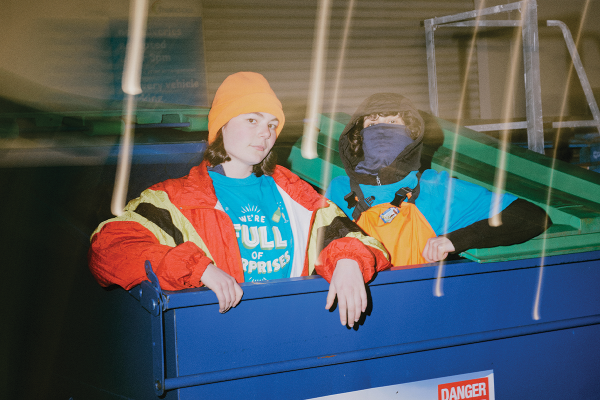
Disclaimer: OUSA does not endorse dumpster diving as it can have serious legal ramifications. Joey, a local fashion dumpster diver, told Critic Te Ārohi dumpster fashion “is fast fashion”. As in, you’ve gotta be fast: “I don’t want to get caught knees deep in dumpster grime and my future wardrobe.” It’s a no-brainer that the fashion industry is cooked. Every year, around 100 billion clothes are made, but each is worn an average of only seven times. As a result of mass scale industrial production (mostly done through slave labour), fashion accounts for around 10% of global greenhouse gas emissions. Water use is also a big one. It takes 2,700 liters of water to manufacture that cotton t-shirt you got from Glassons. You could make 103 pints of beer with that. “Jared” The “Jared” look is perfect for the cold Dunedin winter months. The “Jared” boasts a stylish discarded promotional “Meat and Seafood week” supermarket T-shirt overtop of a light cotton button-down shirt. To complete the look, “Jared” sports a fluffy monkey mask underneath a warm pink beanie. You can bet your ears won’t be cold beneath all that synthetic-dumpstered fabric. “Full of Surprises” With the “Full of Surprises” look, you can have it all. The baby blue t-shirt creates a playful summer vibe. This is perfectly counterbalanced with the 5-or-so checkered and striped button-down shirts, neatly tied around the waist. Dunedin’s weather is unpredictable, so you can rest assured that you’ll have plenty of layers to be prepared for all four seasons. Fully complete the look with oversized gumboots for all the puddle stomping of your wildest dreams. “Tradie: Anonymous” Want the tradie clout without the Polytech course or the five years’ experience? We can help you look the part. The fluorescent orange jumpsuit has a road cone-esque aesthetic, ensuring you won’t get hit by oncoming traffic, but not guaranteed to keep you safe from breathas on a night out thinking you actually are a road cone. The jumpsuit also has great functionality; we’re talking pockets, straps and adjustable buckles. What’s more, the slippery fabric means that the next time you spill your noodles, the liquid will slide right off. “Space Trooper” This silvery, shiny onesie illustriously reflects light, making you shine just like a star. As with the “Tradie: Anonymous”, the “Space Trooper” fit is a one-item outfit, making it ultra-convenient to slip into. As Critic Te Ārohi understands, there is no calcium in space. So, on the off chance SpaceX hires you to model for a promo vid, make sure to fuel up on Puhoi Valley Fresh Organic Light Milk from your local dumpster. You can include an optional extra of a head torch which Critic Te Ārohi understands did not come from a dumpster but is apparently an essential item for dumpster diving. CUTS Stitch Kitchen, located at 474 Princes Street, is devoted to zero-waste and community building, offering classes and workshops to repair and upcycle your clothes. But let’s face it, most of us are too busy trying to juggle uni with existential crises to have the time (or skill) for that. Another alternative for escaping the throws of fast fashion and giving that water laden Glassons t-shirt another life is op-shopping. It’s not as labour intensive as making your own clothes but of course, it still costs money. Perhaps, it’s time you consider dumpster fashion: It’s hot, kinda feral and doesn’t cost a cent. It’s also ethical as fuck. Johnny, another local dumpster diver said “wearing dumpstered clothes makes me feel like a genuine rascal. The style is nonsensical and often stupid, a perfect mockery of our wasteful society.” Johnny has had some pretty good fashion hauls in his time. “One time we pulled out four walking sticks and a possum fur beanie,” said Johnny. While Johnny has made effective use of the beanie, wearing it “most days”, the walking sticks have not had much use…yet. Critic Te Ārohi employed the service of four semi-professional models to show just how hot dumpster fashion can be. All of the clothes pictured came from dumpsters, and were supplied by anonymous sources. For legal purposes, Critic Te Ārohi had no part in the acquisition of the dumpster apparel. To fully embrace the “Jared” look, put a road cone on your leg. What you lack in balance, you’ll make up for in style. But, be warned: if you decide to adopt the “Jared” look, there’s a good chance you’ll develop scurvy. All that meat and seafood and no fresh fruit and vegetables has left you with a serious deficit of vitamin C. But fear not; 4.8 liters of Keri’s freshly squeezed orange juice found at your local dumpster should set you right. No doubt you’d be fast as fuck with that road cone on your leg. Love the Jared look but can’t face the idea of a crippling vitamin C deficiency? Well w You might be wondering, what surprises are in store? Well, if we told you it wouldn’t be a surprise now would it. Suffice to say that you’ll definitely get noticed with this fresh fit. Not to mention the red fluorescent raincoat and orange beanie complete the practical and fashionable aesthetic. Got no clean pants because of all your past noodle stains? Well with the “Traide Anonymous” look, no one would know. Not to mention the black hood and balaclava create a genuine anonymous aesthetic, allowing you to fulfill your greatest tradie fantasies without bumping into any of your commerce friends who would expose you for the fraud that you are. Astronomy got you dreaming of the stars but not a billionaire able to hop on a rocket to get there? Well keep dreaming with this slick new “Space Trooper” fit.