Jack Montgomerie
News Intern
Articles by Jack Montgomerie
30 articles found. Displaying page 1 of 3.
-
Features
 Issue 26 06/10/2013
Prole Life
Short of cash and facing a dreary job market, Jack Montgomerie put his BA(Hons) to good use and took on a series on menial factory jobs. From shaft-mastering, to sorting the crackers from the shitties, Jack faced a crash course in how the other half lives. “It’ll only be a few months,” I assured my Mum. “I’ll stay in Dunedin – there’s bound to be more jobs than in Wairarapa.” Having passed my final papers, and with nothing to do until my departure for a TESOL gig in mid-September, the winter stretched out ahead of me. As I scanned TradeMe Jobs and Otago Daily Times classifieds, however, my heart sank. Any illusions of holding a cushy (or even bearable) office job were discarded alongside the rejection emails that trickled depressingly back into my inbox. I realised the humbling truth: unable to commit to a job for more than a few months, my painstakingly accumulated skills and education had all the market value of a dropped pie. I was, in effect, a prole, a pleb, or one of those countless other names my classmates had used to casually insult the people who did the jobs we were all too good for. For the first time, I made a rent payment that was not covered by StudyLink’s wonderful weekly transfers. Seeing how this decimated my bank account, I reluctantly shuffled into the WINZ offices on St. Andrew Street. The depressing, open-plan office brimmed with “work brokers” and copies of the in-house magazine, Rise. Its cheery pages told stories of wise case-managers successfully sending teen mums out of the nursery and into call centres. When I learnt of the three-week stand down period for a benefit, I fled. WINZ’s vague promise of jam tomorrow was not worth the enormous stigma of becoming a beneficiary. The wolf was now truly at my door. Money making-schemes rushed feverishly through my mind. Cannabis would require too great a capital investment, not to mention too much waiting until maturity. Psychology experiments were insufficiently numerous to keep me going. Finally I accepted my fate, and headed to one of Dunedin’s temporary labour agencies, Select Recruitment. Their promises of hard work, long hours and poor working conditions were strangely comforting. Following the recruiter’s advice, I headed out to buy steel-capped boots. As much as I would have loved to buy organic vegan iguana-skin boots made by artisanally-trained FARC rebels raising money for breast cancer survivors, my meagre funds compelled me to head to the Warehouse, where a lonely man sat on the shoe-trying bench. Seeing the boots, he asked me where I would be working. “Maybe the Gregg’s factory,” I replied, recalling the recruiter’s list of employers willing to accept whatever unskilled hands the agency could provide them. “Then tell Rob Finch, if you see him, that Chris says hi.” I told him I would, and then hurried to aisle 14 where a special announcement over the shop’s loudspeakers informed me that there would be a free giveaway. There, in the style of a religious revivalist, a travelling saleswoman gave a sermon to a hushed crowd about how her ever-sharp knife would save us from the trials of filleting fish, slicing tomatoes and cutting hammers. A squat Maori lady and a tall man with a limp were one of many to receive this serrated sacrament. I left with a complementary potato peeler, not knowing that the pair would be my future workmates. My first assignment was indeed the Gregg’s factory. After donning a hairnet, dustcoat and gloves, and inserting earplugs that rendered most people incomprehensible, I was shown how to use the heat-sealing machine. At the start of our little production line, two tempo workers scooped coffee into plastic packets of Gregg’s “Red Ribbon Roast.” A full time worker weighed it. I then picked up the bag from the table where it was placed, pressed a pedal to heat-seal the bag, and passed it to another worker who marked its “best before” date. I then repeated the process thousands of times for an entire week. With the earplugs in, the factory quickly became a very solitary place, despite our constant teamwork, and my mind wandered easily. I quickly learned that developing a rhythm would be necessary if I was to keep pace with Sosefina, who weighed the bags before placing them onto the small metal table. Fortunately, “the Bosch” – a large, noisy machine that performed a mechanical process similar to our manual one – provided me with a suitable tempo. One day I arrived to find that our team had been moved upstairs, to a warm, airy room full of tanks. The process was the same, but the sound was not. Without the Bosch’s regular clanking to keep time, I had to improvise lest the bags pile up. “Steve Gutenburg, Steve Gutenburg,” I chanted in my head, and this seemed to do the trick. While the Mighty Ducks star’s name had just the right number of syllables to pick up, turn, seal and pass on the packets, it clearly had a greater significance. I was, I realised, not like Steve but rather like Johannes Gutenburg, with my crude version of a printing press. The message I left on the little coffee bags read, “I am vacuum-packed and delicious.” Like most things that are printed, this was totally fictitious. The bags were half full of air, and Greggs’ coffee tastes disgusting. Its only buyers, I suspect, are those possessing a faint, vestigial chauvinism that tells them to “buy Kiwi made.” Such a mantra appeared all the more ironic after I entered the break-room one morning to find the factory’s engineers peering into a little plastic bag in which they had trapped a cricket. It had apparently hitched a ride from Vietnam, where the factory’s coffee beans are grown. They had named him George (after the royal baby) and were urging him to “eat some yoghurt, it’s right in front of you,” as I returned to the factory floor. Our team of five (two scoopers, one weigher, one sealer and one boxer) was suddenly reduced to four as our production line became more automated. A machine now poured coffee powder from a long pipe, eliminating the clouds of dust that manual scooping created and, to my delight, the coffee-clogged nostrils I had consequently endured. However, the stampy satisfaction of sealing bags was therefore replaced by a new role: opening the packets by pushing them headfirst onto a metallic knob. As the “shaft-master,” my field of vision became even more solipsistic. Staring at the stainless steel appendage on the workbench, I watched my surgeon-like reflection disappear several times per minute under the upended bags. This, I imagined, resembled the final vista of those who die when their organs are harvested. Distressing though that thought was, my simple task was soon made more stressful as it came under the gaze of the efficiency-seekers. Glenys, the big boss of the factory, borrowed my wristwatch one Wednesday. Counting the number of packets we produced per minute, she pointed in my direction and told her off-sider Diane, “we’ll get rid of that one after a few days.” By Friday, my brief sojourn at Greggs’ had come to an end, and Select’s Amanda sent me a smiley face-infested text message asking if I’d “like to be on call tomorrow” for a variety of one-off jobs. Being on call has a purgatorial quality to it. Unable to plan for the day (or the night) ahead, I floated about, performing mundane household tasks as I waited for the phone to ring. It seldom did. When I was finally called up, however, I was in for a treat. A conference for GPs was to be held, and able hands were needed to erect the accompanying stalls. Heavy though the work was, constructing the fake little market in the Edgar Centre afforded me a glimpse at some of the strangest advertisements I’ve ever seen. Somewhere, an acid-addled “Creative” had been paid to produce the following advertisements. Compared to the factory’s dust and drudgery, this was the closest I got to a cultural experience during my months of prole life. Early one Sunday morning, I was called in to work at Mainland Poultry’s Zeagold plant in Waikouaiti. Donning, once again, white work-wear and a hairnet, I was placed in front of a conveyor belt by Sheryl, my affable supervisor. The belt began to move, and from behind a steel wall came hundreds of eggs. “The crackers go in this one,” Sheryl instructed, placing a fractured shell into a cardboard tray. “The commercials go here,” she said, popping a poop-smeared egg into another, “and the shitties go into this one.” There have never been eggs as unappetising as those in the third tray. I later learned that they were made into a household brand of pavlovas. The slightly dirty eggs went to commercial kitchens, and “the crackers” were broken into buckets and sent to McDonald’s and Cookie Time to be made into scrambled eggs and biscuits respectively. A quarter of a million eggs passed across that belt daily, although they soon began to resemble stones. To break out of this lucid hallucination, I attempted to strike up conversation with my colleagues. Shona, a self-described Critic-lover (“it’s got heaps of swear words”), told me tales of race-fights in the Australian abattoirs where she used to work. “There was this car-park,” she enthused, “and all the Aussies would gang up on the Maoris and the Filipinos.” Shona hid from the fisticuffs, in both the chiller and her growing alcohol dependency, which resulted in her eventual sacking. Other belt partners included Wiremu, a moko’d nose flautist who provided the soundtrack to Vincent Ward’s later works, and Huia, who became frustrated with another machinist’s failure to crack the “crackers.” “Look at all these eggs, son,” she exclaimed, “look at these fucking mountains!” As my workmates’ names suggest, Sir Tipene O’Regan’s prediction that “in 20 years, New Zealand will have a brown proletariat” seems to be coming to early fruition. My passable performance led me to be promoted to the position of “pallet wrapper” in the storeroom. This job was significantly more challenging, consisting of processing order slips and wrapping boxes of cartons of eggs in plastic film using the fantastic “spinny” machine. It wove a wonderful web of glad-wrap around the eggs, while I filled out order slips and placed “FRAGILE” stickers on the outside. Charlie, a recession-ruined former property investor, had warned me of the job’s pace while he graded eggs. “I only lasted a day there,” he said glumly. “They said I was slowing them down.” Certainly, keeping pace with the entire factory’s output was challenging. The upside of the job was finding out where all of these eggs were going. Unlike the workers themselves, many of whom were doomed to eke out an existence in the social prison that is Waikouaiti, the eggs were shipped to several exotic locations, including Singapore, Hong Kong and Tahiti. “I fucking hate this place,” one worker confided in me, and I suggested that she hide in the middle of an export pallet to await her shipment to some foreign shore. I sometimes wondered whether the workers had, like me, found themselves in the job by fate, or had made some God-awful series of choices that had trapped them there. Answers were consistently tenuous. Harry had broken his foot while enjoying a post-town feed of fish and chips and lost his temporary job at the port as a consequence. Ted, who had escaped the Nazis as a child, was getting back to work after a head injury. Jordan was saving money and even hoped to buy my second hand scooter when I left, but a sudden bill broke the deal for him. In all manner of ways, it seemed, we were cursed to work our whole lives through. It would be easy to read this story and remind oneself how lucky one is, or to chuckle at the absurd, mundane and miserable lives of others. However, I challenge the reader to imagine themselves in such an uncomfortable position and wonder if this is the “God’s own country” their ancestors sought to build.
-
News
 Issue 23 15/09/2013
TEU Fears Minister’s Uni Council Changes
A lecturers’ union says it is afraid that Tertiary Education Minister Steven Joyce might shrink University Councils and stack them with ministerial appointees. The Tertiary Education Union’s (TEU) National Secretary Sharn Riggs says any changes replacing staff and student representatives with ministerial appointees would be “an attack on democracy and on academic freedom.” In 2009, the government passed the Education (Polytechnics) Amendment Act that, amongst other things, reduced the size of polytechnic councils from a maximum of 20 members to eight and allowed the government to appoint half of them. The Minister has since appointed dozens of polytechnic council members, some of whom have been controversial. One of Joyce’s most contentious appointments is Mary Bourke, whom Joyce reappointed as chairperson of the Western Institute of Technology in Taranaki. A letter from the Institute’s staff in March called on Joyce to sack Bourke. The letter alleged, amongst other things, that Bourke had bullied staff. The Minister already has the ability to appoint some university council members, and his choices so far appear to reflect his desire that “universities take a more entrepreneurial approach.” ANZCO Foods chairman Sir Graeme Harrison, whose subsidiary company CMP locked out 100 workers from its Rangitikei meatworks in December 2011, was appointed to the Lincoln University council in July this year. PricewaterhouseCoopers partner and former Meridian Energy director Catherine Drayton joined the Canterbury University council at the same time. TEU communications and campaigns officer Stephen Day told Critic that ministerial appointees had voted for funding cuts for a number of courses. He feared that if the appointments process was extended to universities, ministerial appointees could force further cuts on unwilling university communities. “At the University of Canterbury last year, when they were looking to close up theatre programmes, the council was able to engage in democratic debate. They eventually overturned the proposal put forward by the Vice-Chancellor and backed by ministerial appointees. If that vote had gone ahead without the staff and students there, then that would have been a different outcome.” A spokesperson for Joyce did not respond to Critic’s questions regarding current polytechnic council appointments or possible changes to university councils, insisting only that any decision was “weeks away.”
-
News
 Issue 23 15/09/2013
Jones: Racist, Fascist Wanker?
Labour leadership candidate and self-described “kingmaker” Shane Jones has suggested that migration to Christchurch from other countries be restricted, and that beneficiaries be forcibly relocated and put to work in the city’s reconstruction. The list MP and former immigration minister told Critic, “I’ll be brutally straightforward; before we start bringing any more Filipinos et cetera, [we must] make sure we are not leaving young Kiwis on the scrapheap,” and said that “it’s a tragedy that courses and apprenticeships have not been actively supported by the current government.” Immigration Minister Michael Woodhouse estimates that of the 35,000 workers required to rebuild the earthquake-stricken city, 17,000 additional people must be trained or allowed to move to the city from other countries. The Ministry of Business, Innovation and Employment has issued 1,278 work visas related to the rebuild. A little over 16,000 working age New Zealanders have currently been receiving the unemployment benefit (recently renamed Jobseeker Support) for more than one year. Rex Gibson, manager of the Christchurch Migrant Centre, has previously stated that one of the reasons foreign workers have been easily accommodated in Christchurch is that several male adult workers will often flat together. In comparison, “if they were tradespeople from New Zealand, for six people we’d have to find six houses, and that’s just not available in Christchurch at the moment.” When Jones’ comments were presented to him, Mr Gibson told Critic “Filipino rebuild workers are all tradespeople. Very few unemployed plumbers, electricians, scaffolders, carpenters, drain layers, etc., can be found anywhere in the country.” He also questioned Jones’ suggestion that migrant workers live in overcrowded housing, saying, “The 10:2 ratio is far from my experience. Jones also suggested “I don’t buy the notion that because ten Filipinos can live in a two-bedroom house we should favour them over Kiwis; I find that obnoxious.” He also claimed that “immigration and migrant labour has … skewed property prices in Auckland.” Jones proposed that the government erect “workingmen’s quarters” for those employed in construction projects. “The people of Canterbury that are young, unemployed people must be made to work on the Christchurch rebuild.” Just over 30 per cent of Canterbury’s 2,256 unemployment beneficiaries are aged between 18 and 24 years old. When asked what should happen if such measures should prove insufficient to provide enough domestic labour for the reconstruction effort, Jones told Critic, “if there’s still a shortage, there’s no scarcity of young workers lounging around in provincial centres in New Zealand and, indeed, in Auckland.” Asked if the relocation of unemployed young people ought to be forcible, Jones replied “absolutely … I’d thoroughly pursue the option that just as people go and relocate to Australia to work, well hello, you’re not staying on the dole any longer. If you’re able-bodied, capable of working, go through a work readiness course et cetera, and it’s not beyond the wit of … a government that I lead to come up with a solution for temporary accommodations et cetera, go to Christchurch, go to work.” Jones denied that such a scheme was comparable to the Depression-era relief camps – which the Labour Party once criticised – saying, “I don’t know of anyone who doesn’t want to see Kiwis rebuilding Christchurch.” When quizzed about his view on Grant Robertson’s suggestion of rent controls in the city, Jones declared himself “in taihoa mode” until he had seen details of the plan, but said that “if we’re prepared to essentially manage the cost of energy,” referring to the Labour Party’s state power-buying scheme, “it’s not a huge ideological step to move towards managing the costs of accommodation.”
-
News
 Issue 22 08/09/2013
Council to Railroad Cars Into Cycle Lanes
The Dunedin City Council looks set to implement a transport strategy focusing on cycling, walking and public transport in the downtown area. However, a group representing local businesses has accused the strategy of neglecting its needs, prompting a sharp online response from the Mayor. The DCC’s hearings subcommittee received 64 submissions from individuals and organisations before it produced the draft transport strategy, which outlines the Council’s plans for transport infrastructure and rules for the next 30 years. The strategy outlines seven key objectives: 1. An affordable, responsive, effective and safe road network. 2. Affordable and convenient public transport. 3. Good connections for business and freight, including excellent connections to key gateways. 4. Sustainable transport choices and a reduced dependence on oil for transport. 5. Efficient movement of vehicles and freight. 6. Urban form and design that creates high levels of accessibility to key destinations. 7. A safe and pleasant place to walk and cycle. The Otago Chamber of Commerce CEO John Christie said that the Chamber consulted a number of “wise heads” before deciding that the draft strategy failed to emphasise the need for an uninterrupted freight link to the port. The current strategy allows for the possibility of a heavy traffic bypass on the east of the city. Alexis Belton, co-founder of the Feet Street group, which submitted in favour of pedestrianising downtown areas, claimed that “pedestrianisation myths” were “empirically unfounded,” and offered Auckland’s Vulcan Lane as a successful example that Dunedin should follow. His group believed that increases in foot traffic would offset any difficulties resulting from the changes, which would “produce a more pleasant urban space.” Belton claimed that the owners of Mac’s Brew Bar were one of several businesses who supported the idea. Christie said the Chamber’s members were alarmed by suggestions that the Octagon and parts of George Street could be pedestrianised, as this would likely make stocking and servicing businesses harder for downtown retailers. He said inner-city businesspeople also worried that pedestrianisation would discourage shoppers from coming to the inner city. The strategy’s “Focus on Freight” section claims that the “Your City, Our Future” survey carried out by the Council in 2011 suggested that Dunedinites wanted “improved rail services in Dunedin and more use of rail for freight movement.” In fact, a summary report of the survey (which involved some 4,000 citizens) released at the time stated that “advocating for better connections in and out of the city (e.g. flights into the city, rail transport, state highways)” received a mean public rating of 3.62/5, compared to a mean of 3.33/5 for “improving cycling facilities.” Christie said that while the Chamber is supportive of cycleways in principle, cycleways can endanger both cyclists and motorists if poorly designed. The Chamber also believes that the draft strategy “had a heavy leaning towards more cycleways, issues around sustainability, and yet the base documentation wasn’t there to support those.” Christie was concerned that the strategy “makes assumptions that can’t be validated by the facts.” He believed that the document’s assumption that “fuel prices will continue to increase” ignores the growing efficiency of vehicles. Dr. Herbert Harris, one of several transport consultants and traffic engineers commissioned by the Chamber to write a submission, was more damning. He called the strategy “akin to a reading study” that “even in this role … is inadequate.” Harris recommended the strategy be rewritten by a joint working party consisting of the DCC and the Chamber of Commerce. While Christie said the Chamber is generally pleased with Cull’s performance as Mayor, His Worship used Facebook to express his displeasure, fuming that “our local Chamber of Commerce … seems stuck in a smoke stack industry time warp.” The Transport Strategy will go to a full council vote on 23 September, the last time the council meets before local body elections on 12 October.
-
News
Issue 21 01/09/2013
Acklin Calls It Quits After Nine Illustrious Years
Recidivist drink driver, Elvis impersonator and Dunedin City Councillor Bill Acklin has announced that he will not seek re-election when the city votes for its council in November. Cr. Acklin, whose business dealings have previously left him owing $190,000 to the Inland Revenue Department, told the ODT he had chosen to put his three children and new partner before his civic role. He also confirmed that a “turbulent private life, at times played out in public,” was influential in his decision. “Eventually, you sort of think ‘well, how difficult do I want to make my life?’” Acklin told the ODT. Acklin, now in his third term as a Councillor for the Central Ward, is one of seven incumbent councillors who voted for the controversial Forsyth Barr stadium, which cost the Council $162.7 million, has left the city with more than $144 million of additional debt, and continues to cost ratepayers $9.1 million annually to operate. Crs. Paul Hudson, John Bezett and Andrew Noone, who voted for the stadium spend, have confirmed that they will stand for re-election in November. Despite the massive stadium bill, Cr. Acklin told the ODT that he felt the covered sports pitch was providing Dunedin with economic benefits, and was “a huge statement that this city is going forward.” Acklin also criticised the $47 million cycle network which the DCC and New Zealand Transport Association are set to fund over the coming years, calling it a “pet project” of “a handful of people.” Acklin says he will continue to manage Bill Acklin Entertainments and work for Energy Saving Centre, a company that may benefit from the passage of a local bill setting minimum insulation standards for rental properties. Acklin would not rule out a future bid for council or mayor.
-
News
 Issue 20 18/08/2013
Christchurch Rebuild a Safety Shocker, Says Worker
A temporary worker in the Christchurch rebuild has alleged shocking health and safety lapses during his time there earlier this year. Ferdinand Schuster, a 20-year-old German student on his gap year, told Critic that he had been put at risk and injured due to unsafe practices on a number of Christchurch building sites. Schuster started working in Christchurch in January, and says he was immediately exposed to dangerous practices on sites that he was sent to by the temporary labour agency Allied Work Force (AWF). When assigned to a concrete job in Darfield at 4am one morning, Schuster said the gumboots he was issued for the job were too short, and resulted in wet concrete touching and burning his skin. “You don’t even feel it, but after the work I had two massive wounds on my legs.” Seven months later, scars from the incident remain visible. On another occasion, Schuster and a friend were tasked with cleaning up a building site containing Pink Batts. “It was just a few rooms filled with rubbish and insulation … the air was just full with dust, which is not healthy for you.” The pair was only issued with gloves and dust masks after stating that they would not start work without them. Schuster alleges that at another worksite, he was made to drive a roller, despite having no previous experience or licence. He said that his worst experience was when “they gave me a jackhammer and said I should make a hole in the concrete floor. They don’t give me glasses, so the guy said ‘yeah just start like that,’ showed it to me [for] like a second and I was, ‘alright,’ did it one second and recognised, fucking hell, if I would do that, without safety glasses … I would be blind.” To add insult to injury, Schuster claims that he and other workers were denied the return of part of an equipment bond they paid. “They say, ‘oh you didn’t give us back some of our equipment.’ Which is a lie, and they just do that with I don’t know how many people, and you can do nothing. … I don’t want to know how much money they make with it.” Schuster told Critic that he had heard of other cases of health and safety lapses besides his own, and believed that excessive equipment bonds had also been taken from other workers. When contacted by Critic, AWF’s Canterbury and West Coast Manager Ray Cuthill denied that such a bond was taken from workers, and said that workers were only charged if they “took off” with equipment. He said he suspected he knew which company Ferdinand may have been working for when he received his concrete burns, but refused to name them. Cuthill said he was unaware of the safety lapses alleged by Schuster, but encouraged him to contact AWF about his “upsetting and disturbing” allegations, saying “we send workers to clients and expect them to treat them as if they were their own workers, their own sons and daughters. We don’t expect them to put them at any risk.” Cuthill refused to comment further until he had been contacted by Schuster. The Labour Party’s labour spokesperson, Darien Fenton, described Schuster’s allegations as “bloody disgraceful.” Fenton has previously argued that a lack of labour inspectors and health and safety inspectors – which number 35 and fewer than 100 respectively for the entire country – could be contributing to such lapses in health and safety. Fenton said government restructuring meant the inspectorate was stretched, telling Critic, “I question how we can be making sure that workers are safe or their rights are being considered when we have such a run-down workforce.” Asked if she thought labour inspectors could have prevented Mr. Schuster’s concrete injury, she agreed that this was unlikely, but also blamed the government for making it harder for workers to raise health and safety issues at work. Fenton said that “workers’ rights go hand in hand with health and safety at work.” She believed that the introduction of a 90-day trial period by the government had discouraged workers from raising health and safety issues for fear of losing their jobs. Minister of Labour Simon Bridges was unavailable for an interview. In a written statement he told Critic that while he could not comment on individual cases, “I take reports of alleged workplace health and safety failings seriously, as does the Ministry of Business Innovation and Employment. Anyone with concerns should be immediately reporting them to the Ministry’s Health and Safety Group.” The Minister called Fenton’s concerns about labour inspectors “ill-founded,” saying seven health and safety inspectors were working in the Canterbury region, and that an operational structure launched in July would increase that figure. Bridges said $11 million of funding over four years would be put towards supporting programmes to implement the “aspirational commitments” of the Canterbury Rebuild Safety Charter – a voluntary agreement between employers and government agencies to try and encourage safe workplaces. Some of the Charter’s articles include “2. We have systems in place to encourage and support worker engagement in health and safety,” and “8. PPE (Personal Protective Equipment) is worn at all times by everyone. No exceptions. No excuses.” AWF, which employed Schuster, is listed as one of the Charter’s supporters. Ron Angel, the Engineering, Printing and Manufacturing Union’s (EPMU) national industry organiser for building and construction, told Critic that “we are hearing more and more stories of people who are employed as temps facing similar sorts of issues, a lack of health and safety.” Other issues included migrant workers who had seen their hourly wages drop from $26 to $22 per hour after being brought in by a company. Angel said that while joining a union was “not the solution” for many temporary workers, the EPMU and its associate organisation, Safe Rebuild, were trying to raise such issues with primary contractors and project managers by holding employers to the Charter. Another of the Charter’s articles states that “All workers will receive basic health and safety training prior to starting work.” In this regard at least, Schuster’s experience conformed to the Charter. He was charged $80 by AWF for a one-day course run by the company. “I am told after I get the health and safety course then I will get the full-time job that they promised me.” He described it as “five hours’ wasted time … a ridiculous card with ‘health and safety,’ and it changed nothing.” After completing exercises – including a dice game in which an incorrect roll resulted in death – workers completed a test by answering questions together. Nobody failed.
-
News
Issue 20 18/08/2013
University Council Meeting
The University Council unanimously endorsed a strategic document as well as a flatting standards bill, and engaged in light-hearted banter at its meeting last Tuesday. Council Member Michael Sidey clapped when Vice-Chancellor Professor Harlene Hayne told the meeting that her two-year anniversary as Vice-Chancellor was coming up. The enthusiastic Sidey was also full of praise for the University’s “Strategic Direction to 2020” statement, calling it “an outstanding document.” The Vice-Chancellor told the meeting that “this document makes … the application of that research knowledge for the public good and commercial outcomes.” She also spoke of the need for universities to diversify their income streams. A financial report revealed that externally-funded research has fallen in recent years. $41 million of external funding was received this year, 1.5 per cent less than budgeted for, and down from a peak of over $45 million in 2011. The University appears unlikely to engage in substantial use of online courses in the short term. The document states that the University intends to encourage the use of technology in teaching, but that “Otago will remain a predominantly campus-based university” until at least 2020. With regards to “the Otago experience,” the document stated that the University will “use a mix of education and regulatory measures” to “nurture healthy and sustainable lifestyles” over the following seven years. The University has previously supported the notion of a liquor ban in North Dunedin, stricter rules at the Hyde Street Keg Party, and is currently funding OUSA’s “It’s Your Call” anti-peer pressure campaign. There was no mention of whether the University would continue to provide Toroa College students’ dinners through the Student Union food court, which Critic sincerely doubts is healthy. A financial report revealed that the University has 17,894 equivalent full-time students, down 2.4 per cent from the same time last year. In the year to date, 31.6 per cent of the University’s tuition costs come from tuition, with the rest being met by government funding. A property report showed that the University’s rates-free property portfolio continues to expand. It has now completed its purchase of “LivingSpace” on 192 Castle Street. The apartment building will likely become the home of the Humanities Division when the Burns Building is demolished. The University has also bought its records services building on Hanover Street. OUSA President Francisco Hernandez spoke in favour of the local bill, which would allow the Dunedin City Council to set minimum standards for heating, insulation, indoor temperatures, ventilation, draft stopping and drainage on rental properties. He told the University Council that poor housing had long been a problem for students. He quoted a 1973 Critic editorial, which stated that “if nothing positive is done soon in the field of student accommodation, future generations of students at this University will be forced still further into the clutches of unscrupulous landlords and forced to live in conditions far worse than any that those in positions of authority in the University and the city would permit their own children to live in.” Speaking after the meeting, Hernandez told Critic “I’m pretty confident that rents won’t rise to the extent that students find it harder to meet the cost of living.” He believed that an oversupply of rental housing, council assistance to landlords to install some insulation and the high rate of return he claimed that landlords received from their properties would limit any increase in the rents that students paid for their flats. University Council member Judge Oke Blaikie, who had been shocked by the state of Dunedin’s worst flat when he saw it on Campbell Live, suggested to the Council that the number of couch fires in North Dunedin might be reduced if flatting standards were improved. The Vice-Chancellor agreed that better accommodation was indeed associated with “more positive behaviour.” Following this bizarre exchange, the Council unanimously approved Hernandez’s motions, which were seconded by Associate Professor of Zoology Liz Slooten. After the vote, the public was excluded from the meeting to consider a number of confidential issues.
-
News
 Issue 20 18/08/2013
No Confidence Distraught as Tenci Wins By-Election
OUSA has a new Finance Officer after Nick Tenci trounced loveable sock puppet No Confidence at the close of voting in last Thursday’s by-election. In the final count, the third-year Finance and Biochemistry student received 470 votes (81.31 per cent). “No confidence in these candidates” received 108 votes (18.69 per cent). Tenci will replace Lucy Gaudin, who is now OUSA’s Accounts Administrator. Tenci said he was “delighted” with how the campaign turned out. His only competitor, Ryan Edgar, who held the position of Finance Officer in 2012, left the campaign last Monday. Unlike Catholics, OUSA candidates are allowed to pull out close to a campaign’s climax. Edgar, whose platform consisted of a vaguely-worded promise to buy the closed Captain Cook Tavern, is understood to have pulled his candidacy after hearing of Tenci’s relative popularity. Tenci told Critic that “I kind of took my foot off the pedal once Ryan dropped out,” and he appears likely to carry this relaxed attitude into his new role. Tenci confirmed that he was “absolutely” entering the position without any preparation. “Lucy [Gaudin] told me it was fine to turn up unprepared … pissed, even.” However, Tenci said he did not intend to pre-load on Cindy’s before the next OUSA executive meeting, which will be held on Wednesday at midday. No Confidence, meanwhile, was last seen drowning its sorrows with a pack of Diesels by the Leith. “I don’t know what I’ll do with my semester now,” Mr Confidence sobbed. “I mean, I never really expected to win, but I needed a good excuse not to study. I suppose I’ll have to give BSNS106 my all and hope for the best, even though I have no confidence in my ability to pass it.”
-
Features
 Issue 19 11/08/2013
Calling the Cranks
While reporting the news, I’ve come to learn that some so-called “important” people will always be in demand for comment. Ministers, businesspeople and academics are forever having cameras and dictaphones shoved at their overexposed gobs. Meanwhile, more marginal characters get passed over for media coverage. This week, it was time to give New Zealand’s rough diamonds a chance to sparkle in the media limelight by asking them the key questions on the real issues of the day. Richard ProsserThe Investigate magazine columnist and New Zealand First MP earned infamy when he suggested that young, male Muslims be banned from flying, and wrote that he would not “stand by while [the] rights and freedoms of … New Zealanders and Westerners are denigrated by a sorry pack of misogynist troglodytes from Wogistan.” Prosser has since retracted the statements, but has he changed his tune entirely when it comes to Muslim menaces on the footy field? We’re wondering about the upcoming NRL judiciary decision. Sonny Bill Williams is out for two weeks awaiting the decision about the alleged shoulder charge on Willie Mason – do you think that careless move could be due to Ramadan and Sonny Bill lacking meals? I’m not seeing a connection to be perfectly honest. Well as you know, Sonny Bill is a convert to Islam- So he would’ve been fasting, but yeah no, ah, all I can say is that from personal experience having, having done the odd fast in the past it doesn’t sort of affect your daily energy levels at that point that much. Even that sort of mental agility, obviously he didn’t mean to – do you think he meant to shoulder charge? I didn’t actually see the incident in question so I can’t really comment on it. So you don’t think Sonny Bill has taken any sort of militant approach to his play since he converted? What, converted to league, or converted to rugby? To Islam. No I don’t know at all mate. Who are your picks for the rest of the season? Haven’t worked them out yet. And ah, what’ve you thought of Sonny Bill’s performance in boxing? I guess if he enjoys it that’s a good thing. I’m not a big fan of it myself but there you go. Do you think we’re likely to see more of these sporting polymaths in the future, switching between codes all the time? I guess, you know, sport’s an area that’s becoming more and more professional so I suppose people who can make a living by doing these sorts of things will take their dollars where they come. Do you think New Zealand First needs to have some kind of policy which would promote code-switching? I can’t see us having that as a policy. Richard Prosser, thanks very much for your time, have a good afternoon. You too, cheerio. [Hangs up]. It was deeply distressing to hear to see this formerly self-described “freedom-loving, gonad-equipped, libertarian go-getter” embracing “the twin evils of diversity and multiculturalism.” One can only hope that Prosser sees the light and ceases to be a “weak, stupid, effeminate, erectile dysfunctional, naïve, apologist, namby-pamby, thumb-sucking, lefty pinko” before SBW runs onto Moore Park with 20 kilos of TNT strapped to his chest. Martin DoutréThis Canadian-born self-styled “astro-archaeologist” claims to have uncovered evidence of a pre-Maori Celtic civilisation in New Zealand. Along with arguing that a government conspiracy lay behind the September 11 attacks, and exchanging friendly correspondence with Holocaust denier David Irving, Mr. Doutré believes his findings about megalithic “astronomical alignment grids” in Northland are being covered up by the political establishment in a corporate Maori money-grab. What would Doutré think of the all-Maori X-Factor final? Mr. Doutré, we’d like to know your thoughts on Jackie Thomas winning TV3’s X-Factor. Um, I don’t even know anything about that. Well she beat out Whenua Patuwai and Benny Tipene in the final, and she’s now gone on to record her single “It’s Worth It,” debuting at number one in the New Zealand charts. No I’m not really into it. I’m a jazz trumpet player and I don’t know a thing about it. Well what did you think of her initial audition, singing “Skinny Love” by Bon Iver? I’m an old guy of 66, I don’t really follow any of that much, I’m afraid. Well Daniel Bedingfield effectively ensured that she’d be in the final by threatening to quit if she wasn’t brought back, do you have any opinion on that? I really, I know nothing of the whole thing … I don’t even know who she is or what she does. Well she’s Nga Puhi on her father’s side, from Greymouth, formerly unemployed – is this a success story for the West Coast? Ah, OK, what sort of music does she do? What sort of category would you put her into? Well, she started off with covers. I guess pop music. Oh, OK. Who would you have preferred to see winning X-Factor? I don’t know, I don’t even have a TV these days, I’m off in a whole different world. Thanks for your time. Doutré’s ignorance of what is arguably the most important cultural event in New Zealand ever suggests that the author of Ancient Celtic New Zealand casts doubt on his current reputation as one of New Zealand’s foremost anthropologists. One can only hope that this interview will encourage him to delve into how the “Northern Alignment Sequence” of megalithic stone structures he discovered led to the formation of True Bliss in 1999. Don RichardsDon is the founder of Positive Money New Zealand. The group aims to end fractional reserve banking and create a new Monetary Policy Committee, which, according to its website, “authorises the creation of a certain amount of new money … The government is free to use this money however it chooses. … all in all, $500m could be added to the economy in a little under 20 minutes, at the cost of just a few hundred dollars.” Did Richards see an ally in renowned rap artist Kanye West? So you’re in favour of “positive money” and you outline your views on your website. Well positive money means money is created debt-free by the government rather than private transnationals for their own benefit. Right, and in recent years we’ve heard hip-hop artist Kanye West sing “La, la, la la wait ‘til I get my money right, la, la, la la then you can’t tell me nothing right.” Is that the sort of message that Positive Money wants to send? I don’t agree with Kanye West on most things, though I don’t actually know the contents of the song. Well that was off the album Graduation. In another track, “Good Life,” he sings “Have you ever popped champagne on a plane while getting some brain? Whipped it out, she said ‘I never seen snakes on a plane,’ Whether you broke or rich you gotta get biz. Havin’ money’s not everything, not having it is.” Yep, OK. Do you think Mr. West’s recent album Yeezus suggests a new outlook on his part? The track “New Slaves” includes the lines, “What you want, a Bentley? Fur coat? A diamond chain? All you blacks want all the same things, Used to only be niggas, now everybody playin’, Spending everything on Alexander Wang, New Slaves.” That seems to suggest a kind of anti-materialism on his part, especially when we consider its pared-down production values. Without knowing the context of the songs, I couldn’t really comment. Positive money’s more about reclaiming control of our money supply away from the multinational banks and allowing the government to create money interest-free. What then, about Kimye naming their baby North West? I have no thoughts. You have no thoughts? No. Mr. Richards, thank you for your time. While Don’s frosty response to Yeezy’s monetary ruminations doesn’t look promising, Critic looks forward to the day when Kanye is put in charge of the mint, printing everyone in hyperinflation-wracked New Zealand enough dollar bills to get their rubbish-bin fires started. Sean PalmerSean is the Chair of Monarchy New Zealand, an organisation dedicated to keeping the face of whoever’s bum happens to be on the British throne on our $20 notes. MNZ’s website argues that monarchies provide a better gender balance. While this might be a little contentious now that little George has been born, there were more important questions to be asked about a very important British nobleman. Sean Palmer, I’m sure you’re all very excited about the news of the new successor? I’m sorry, do you mean the new legislation, or …? No, I mean the news that’s coming out right now about the new Doctor Who. Peter Capaldi is tipped to replace Matt Smith at the helm of the show. Ah, how does that relate to Monarchy New Zealand? Well, he is a Time Lord. Uh huh. And I notice on your website you are displaying telephone boxes. Uh, yeah, I think that’s a reference to the ones in Christchurch. Not a reference to the TARDIS? No, can’t say that it is. I’m sure we have several ardent fans in the organisation, but um, yeah, um. Is the foul-mouthed Scotsman who played Malcolm Tucker in The Thick of It really fit for this title? Um … Is it perhaps time for a female Doctor? Should the Time Lord aristocracy be modernising? … Some have suggested that Billie Piper should instead take the role. Hello? … While Sean was clearly taken aback by our questions, it’s critical that the organisation defends the latest incarnation of the Doctor. Otherwise, we could see the absurd situation whereby Doctor Who fans are allowed to vote for Daniel Rigby or, God forbid, Idris Elba, as the Time Lord. Mary ByrneThe National Co-ordinator of the Fluoride Action Network New Zealand is pretty sure she knows what’s what when it comes to assessing the evidence for water fluoridation. Celebrating after the Hamilton City Council voted to stop adding fluoride to its water supply, Byrne said she was sure that “fluoride is linked to many adverse health effects such as arthritis, thyroid dysfunction, lowered IQ and hypersensitivity.” How would this fact-focussed dental campaigner cope with the relationship reversals of a silver-screen vampire? First of all, Katy Perry has said that her meeting with Robert Pattinson after he broke up with Kristen Stewart was purely about being a supportive friend. Do you believe that? Oh, I think you’re asking the wrong person. I don’t know what you’re talking about. So pop star Katie Perry- What’s that got to do with fluoride? Well she was talking to Robert Pattinson, famous for portraying a vampire, shortly after he broke up with co-star Kristen Stewart, and said she was just providing support. Does that have any credibility? Why would you be asking me this? Are you wanting to talk about fluoridation or what? What’s the point of this? That she denies that there’s any relationship between them. Oh this is just a joke, obviously. I can’t be bothered wasting my time with this, this is ridiculous. You’re obviously not wanting to talk about fluoridation, are you? [Hangs up]. Byrne’s response is disappointing to say the least. If Fluoride Action is serious about recruiting the youth of today to their cause, they would do well to understand that the crypto-fascist dental propaganda machine is a fervent user of fang-filled films to sell their deadly message. Any sign of a break between the toothy twosome of Kristen and Rob should be a cause for celebration at FANZ. The investigation revealed a shocking lack of preparation and research by the organisations interviewed. Critic sincerely hopes that these cranks read up swiftly on current affairs like Snooki’s post-baby body and Beyonce’s latest on-stage hair nightmare before they receive further serious media attention.
-
News
 Issue 19 11/08/2013
The GCSB Bill
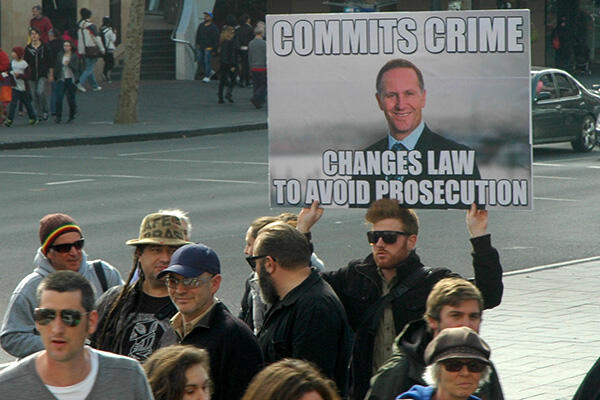
What is the GCSB?The Government Communications Security Bureau (GCSB) is, amongst other things, New Zealand’s external spy service. The intelligence agency was set up by then-Prime Minister Robert Muldoon in 1977. It was tasked with keeping government communications and computers secure, and spying on the communications of other governments and security threats. New Zealand’s other spy agency, the Security Intelligence Service, has tended to collect foreign and domestic intelligence. The GCSB Bill is set to redefine the laws that guide the GCSB, principally by allowing it to spy on New Zealanders. Why is it in the news?The GCSB Bill has been brought into the spotlight following a series of government mishaps, which led to the amendment of the bill. The amended bill has passed its second reading in Parliament, with 61 votes for and 59 against. As Critic went to print, the bill was in the Committee stage. However, due to the Opposition’s delaying tactics and an urgent debate regarding the Fonterra contamination scare, this process is expected to take a week longer. What is it all about?In 2007, an $8 million police and SIS investigation and raid of activists in the Ureweras generated questions about the proper role of New Zealand’s spy agencies. In 2012 John Key revealed that the GCSB had illegally spied on MegaUpload founder Kim Dotcom during a police investigation that resulted in the arrest of Dotcom and his business associates by some 76 police officers. The spying operation was illegal because German-born Dotcom had been a New Zealand resident since 2010. The law then prohibited, and still prohibits, spying on New Zealand residents. In response, the government commissioned a review of the GCSB’s compliance with legislation, internal processes and systems by Cabinet Secretary Rebecca Kitteridge. In a political scandal, the Kitteridge Report was leaked to the media in April this year. It revealed that Ian Fletcher, the head of the GCSB (and childhood friend of the Prime Minister), had lied about illegally spying on New Zealanders. The report stated that the GCSB may have illegally spied on 88 New Zealanders over a 10-year period. An investigation by retired public servant David Henry, the so-called “Henry Inquiry,” then attempted to find the source of this leak. On May 8, John Key instigated the Government Communications Security Bureau and Related Legislation Amendment Bill. The bill would grant the GCSB the power to assist other National Security branches such as the New Zealand Defence Force, New Zealand Police, and New Zealand Security Intelligence Service. Simply put, the bill would allow the GCSB to spy on any New Zealand citizen with the permission of the head of the GCSB (which would be Key). This would mean, for example, that spying on Kim Dotcom would have been legal. Why should we care?The GCSB bill could remove layers of privacy and protection for citizens. But what does it matter if you have nothing to hide? The bill would allow the government to have access to all sorts of information. It would grant access to Internet search history – allowing them to view your favourite porn sites, searches on how to grow cannabis, and the ability to read personal emails and track phone calls and text messages, not to mention plenty of less obvious forms of surveillance. Otago Professor of Computer Security Hank Wolfe warned Critic that what one might think is innocent information can be trawled, and the GCSB “can go back to it in five years. They can accumulate information on anyone.” This all raises the question of balance between privacy and security. It is important for a country to maintain national security, but it is debatable whether the Government’s ability to review one’s choice of Internet porn is such a huge threat to the nation. CriticismsThe Prime Minister has declared that New Zealand faces the same security threats as any other nation. He has stated that New Zealanders have trained in Yemeni terrorist camps, and that attacks like the Boston bombing could occur on New Zealand territory at any time. He therefore implies that having access to citizens’ private information could prevent terrorist activity. Dr. Wolfe believes Key is using scare tactics. “There is no reason to institute such an oppressive law,” Wolfe claims. “New Zealand is not at risk.” Foreign correspondent Jon Stephenson agrees that “this is a sales job on a very controversial piece of legislation.” The bill has been criticised for being open to wide interpretation and flagrant abuse. In a media release dated 6 August 2013 by the New Zealand Law Society, Austin Forbes QC stated that “the Law Society is not convinced that the proposed wording of the principles provides adequate or effective safeguards.” Key has also been criticised for the pace at which the bill has been brought through Parliament, with little time being set aside for debate. Labur Party leader David Shearer has attempted to slow the process further by proposing a supplementary order paper during the committee stage of the GCSB bill. This would allow for more input from other Parliamentarians. However, it is unlikely the paper will be accepted. Dr. Wolfe explained that with the aid of GPS on smart phones and keypad sensors, extraordinary amounts of information about large numbers of people can be accumulated and browsed. Alarmingly, once a phone is bugged, the conversations around a cellphone, whether calling someone or not, can be recorded through these technologies. Keypad strokes can also be recorded. “It’s [total surveillance],” stated Wolfe, “what the communists did, and we criticised them for that.” Governments spying on each otherFormer Revenue Minister Peter Dunne has voted for the GCSB Bill, even though the full contents of Dunne’s email exchanges with Fairfax reporter Andrea Vance were made available to the Henry Inquiry against his wishes. David Shearer has declared that Dunne should withdraw his support for the bill because the government had accessed his emails without his permission. However, Dunne looks likely to provide the government with the single extra vote it needs to pass the bill. ProtestsOn July 27 2013, thousands of people took part in demonstrations organised by the group “Stop the GCSB,” whose supporters include New Zealander of the Year Dame Anne Salmond. Protestors have also waited outside Dunne’s home at unsavoury hours of the day, “to give him a taste of what it feels like to have your privacy intruded on,” according to one protestor. The protestors and other critics of the bill have alleged that empowering spy agencies to collect vast amounts of data on New Zealand citizens has the potential to turn the country into a police state. Ulterior motivesProfessor Paul Roth of the Otago Law School specialises in intellectual property. He believes that the GCSB Bill could be a case of New Zealand trying to “keep the giants happy” and gain political capital with large powers like the United States. “We have to stand back and realise the position of New Zealand in the world,” Roth told Critic. “The issue is that New Zealand is a very small, weak country.” New Zealand already operates part of the international ECHELON spying network from its Waihopai base as part of the “Five Eyes” agreement with the United States, the United Kingdom, Canada and Australia. The arrest of Kim Dotcom in 2012 also had foreign links, having been initiated by a request from a US federal prosecutor. Due to delaying tactics employed by opposition parties in Parliament, the bill is unlikely to be passed for at least another two weeks. In the meantime, opponents of the bill are hoping that massive public opposition will prevent the GCSB from being empowered to spy on New Zealand citizens. Dr. Wolfe believes urgent action is required to stop the bill becoming law. “In 1984 New Zealand stood up for what they believed in. We need to stand up again.”
-
News
 Issue 19 11/08/2013
Audit Ordered by Orders
A pre-election report from the Dunedin City Council (DCC) has confirmed that council workers have been tasked with calculating a new, higher figure for the construction of the Forsyth Barr stadium, believed to be at least $260 million. The DCC’s CEO Paul Orders included the announcement in his report on the state of the Council’s finances last Monday. This latest effort to add up costs comes more than a year after an accounting firm produced a comprehensive report detailing the costs and funding of the indoor sports field. The cost of building Forsyth Barr Stadium has long been a matter of contention. When the idea of building a new stadium in time for the 2011 Rugby World Cup was first mooted by the Carisbrook Stadium Charitable Trust in 2006, an estimate of $150-$180 million was produced by the group. By 2007, the DCC estimated that the stadium would cost $188 million to build, and the price tag for the sports ground has been growing ever since. In 2009, then-Mayor Peter Chin was telling the media he was confident that no more than $198 million would be needed to construct the covered pitch. In May 2012, PricewaterhouseCoopers’ Eric Lucas and Steven Drain produced a report detailing the cost of the stadium and how it had been funded. They stated that building Forsyth Barr Stadium had cost $224.4 million, due in part to numerous cost overruns in equipping the stadium. The DCC had contributed $162.7 million to the project – far more than the $91.4 million for which it had planned. This was largely due to the DCC’s optimistic expectations of private funding for the venture not materialising. The result of these budget blowouts has been a drastic increase in council debt. Orders’ report states that the DCC’s core debt now totals $227 million (with an additional $144 million of debt outstanding on the stadium) as well as $249 million of debt attributed to Dunedin City Holdings Limited. Orders says that this will severely constrain the DCC’s ability to engage in major capital expenditure projects for the foreseeable future. Despite these major financial blunders, Orders says no council staff will be fired. Orders said that legal advice he had obtained suggested that blame could not be laid with any individual staff member. Nonetheless, he was confident that such mistakes could be avoided in future, telling the Otago Daily Times that “lessons have been learnt and will be implemented in any future projects.” Mayor Dave Cull says the new stadium cost estimate will include the cost of purchasing Carisbrook Stadium (which the DCC recently sold at a $2.3 million loss), the $0.4 million debt write-off given to the struggling Otago Rugby Football Union in March, and the cost of rerouting State Highway 88. He said the public should decide whether such costs should be counted in the stadium bill. Critic speculates that the latest totting up of the stadium bill may have some political motivation. An unknown source has suggested to the ODT that the estimate will top $260 million. This total is higher than any before seen, and is set to be released at a date closer to this year’s local body elections. Of the Councillors who voted for the stadium expenditure, John Bezett and Andrew Noone have confirmed that they will stand again. Three others are understood to be standing down, while Crs Bill Acklin and Paul Hudson are yet to confirm their intentions.
-
News
Issue 18 04/08/2013
Otago’s Hip Hop Diversity on Display
Monday 29 July saw the annual International Cultural Night (in aid of the Otago Community Hospice) take place at the Teachers’ College Auditorium. The night, which was organised by OUSA and the International Cultural Council, began with a kapa haka performance by Te Roopu Maori. The audience was then treated to a variety of performances from ten Asian and Pacific cultural groups, as well as two dance items from the Afrotago group, all of which were ably introduced by ICC executive members Dean D’Cruz and Jayani Kannangara. Stand-out performances included the Otago Malaysian Students’ Association’s colourful folk dancing; a series of humorous musical items, sketches and skits by the Otago University Thai Students’ Association; masterfully choreographed Indian couples’ dancing; and the Brunei Students’ Association’s medley, which ranged from Bruneian folk songs to Madonna’s “Like A Prayer.” Many of the items included mixtures of traditional and contemporary dance and music, such as a brief “Gangnam Style” homage by the Pacific Island Students’ Performing Arts Group and an extraordinary display of hip-hop dancing by one member of the Sri Lankan Students’ Association. OUSA International Students Officer Kamil Saifuddin told the audience at the Teachers’ College auditorium that weeks of work had gone into the preparation of the pieces, and praised the work of all involved. Hospice Representative Lyn Chapman said the organisation was grateful for the effort the performers had put into the event. The results of the audience vote held after the performances revealed the Indian Students’ Association’s number to be the general favourite. Second and third places went to Otago Malaysian Students’ Association and the Brunei Students’ Association respectively. The evening ended with a prize draw from sponsors of the event, including ANZ’s Danni Pattison – who congratulated the performers in Mandarin – and Chopsticks 101 owner Dick Chou, who gleefully handed out meal vouchers to fortunate concertgoers.


