-
Columns

Editorial | Issue 26
With letters flooding in to Critic, it is high time to address the feature “Call Me Crazy,” published in Critic Issue 24 (22 September). Before I go on, if I’m honest with myself, there is a balance in my opinion here. On one hand, without the benefit of hindsight, I would likely have published this feature in its same form nine times out of ten. On the other hand, I deeply regret aspects of the feature that trivialise what is a very important issue, and one that I personally have always been very careful to treat maturely and progressively. To get the controversial opinion sorted first – and I’m sweating as I write this – I believe there is sound justification for why the feature in question was printed. The piece was written with the best of intentions, wherein it was to add to the widening discussion around inadequacies in our mental health system, highlighting aspects that may be missed in standard reporting on the issues at hand. Critic has very competently reported on mental health issues in the past. I remember being told when we published an issue themed around mental health awareness back in 2012 that our features were likely to be used by the Southern DHB as examples for other media of how to treat these issues. Those were more straight-laced pieces; the article published two weeks ago was envisioned as giving importance to mental health awareness in a format that our readership would find interesting and approachable. However, from a technical point of view, the immediate and obvious fault to identify was that Critic did not seek comment in the form of giving right of response to the Southern DHB, whom the article criticised – this was an honest oversight. There was also oversight in getting a balanced collection of responses from people who have spent time at these institutes – whether they be patients or staff members. The overwhelming response that letter writers presented Critic with was that, quite simply, we assumed the opinions of these groups and got it wrong. Most are greatly appreciative of the services provided. Rather than criticising the increasingly limited nature of these services, people are instead grateful for the hard work and selfless passion that staff put into their increasingly limited roles. Yes, the institutions in discussion are often run-down, but there is a bigger issue at play here, and we got our criticism wrong. I have always believed that media is representative of the public in much the same way as elected officials are. In fact, by being in a position where you are empowered to actively criticise, it follows that media should be held accountable in much the same way as politicians. The fact that this is seldom followed in New Zealand is something that I have always been critical of, and to be quite frank I have found it refreshing that Critic has been held so accountable regarding this piece. If you have been in touch with us about it, I genuinely thank you and encourage you to maintain a watchful eye over both us and our country’s wider media landscape. Zane Pocock Critic Editor
-
News

National media: Halls want porn
Last week, 19-year-old University of Otago student Anton Hovius attracted nationwide attention after accusing the University of “draconian” alcohol and Internet usage policies at the Halls of Residence. His comments on the strict alcohol rules and blockage of various file sharing and pornography sites were reported on by the Otago Daily Times and later picked up by the NZ Herald. Hovius, a former resident of Toroa College, says the local and national media “spun it as if I bust down the door of the ODT and yelled at them.” He was approached by the media after running his campaign for 2015 Colleges Officer on the basis of pushing for fairer internet policies. “Their focus was on the pornography,” he says, “but, you know, ‘sex sells,’ so I get it.” He says losing the position is “not about being a sore loser” and that he enjoys being able to speak out without the limits of being under an organisation such as OUSA. He adds that because he is not a part of the OUSA Executive, “it’s good because I don’t have to speak under the guise of any formality.” OUSA President Ruby Sycamore-Smith commented, “It’s important for the students to voice their opinions as it encourages identification of various issues and areas where we can seek improvement.” Critic has covered the policies put in place by halls in the news feature “Home away from home or really expensive prison?” In the piece, various students and OUSA staff reported feeling uncomfortable with the alcohol policies placed on students in halls – an issue also discussed by Hovius. The University’s Student Accommodation Director James Lindsay told the ODT that the “primary aim of colleges was to provide an environment where students could focus on their studies.” Hovius responds that as halls are a living space, “you don’t need to be made to feel like you’re at uni all day, every day.” Sycamore-Smith adds, “OUSA believes Internet speed ought to be a higher priority than censorship. We are of the opinion that students should be able to monitor their own censorship in regards to various websites. However, we are also aware that there are other contributing factors that need to be considered in regards to the Internet.” Critic asked Hovius about his thoughts on the legal liability placed on the University with the questionable legality of most pornography. He responded, “Shouldn’t we be banning YouTube then?” Hovius agreed there were reasons to ban certain file sharing sites, but that there are still a lot of unnecessary walls in place. Hovius says he has found a lot of the responses to his comments amusing, “they say I have to find a girlfriend and I have to stop masturbating.” He responds, “I know people can survive without porn, and there are definitely better things to do, but this has sparked the conversation.”
-
News

Electoral Commission pays for enrolments
The recent 2014 New Zealand General Election involved enrolment drives from both OUSA and the Electoral Commission. Those hired by the Electoral Commission are paid depending on how many people they enrol, whereas other parties, such as OUSA, receive no payment. Murray Wicks, the Electoral Commission’s National Manager of Enrolment Services, told Critic that they hire field workers to encourage people to enrol and vote. "Any group cannot have any affiliation with any party ... or any political motivation to be hired," said Wicks. The individuals get reimbursed for the number of valid enrolments they collect. The aim of the Electoral Commission is to be proactive in the way they enrol individuals. Although it is an offence not to enrol if you are eligible, they prefer to implement field workers to enrol rather than enforce the fine. However, this method could potentially be discouraging to other groups who receive no payment for their enrolment efforts. Critic spoke to Ashlea Muston who, with her partner, was employed by the Electoral Commission to get people enrolled. Both are affiliated with Generation Zero but as part of the job they were to remain impartial. Muston spoke of the potential of OUSA and the Electoral Commission to work together to gain as much enrolment as possible in the student area, but that the plans had fallen through due to a lack of cohesiveness between workers for the Electoral Commission and OUSA. "From a logistical point of view when I had already been in contact with each of the different halls and arranged a time for us to come in [to the hall], and then to have another party come in, and trying to arrange the same thing, it causes confusion." Situations such as residential hall sign ups met with both parties attempting to contact and visit the halls, increasing confusion of who was supposed to be coordinating the enrolment drive and raising the question as to why an organisation with a budget of $28,000 to get enrolments received no payments but individuals did. OUSA President Ruby Sycamore-Smith said, “OUSA has not been paid for any of the enrolments as we wanted to support those non-for profit organisations that were part of the election drive.” “OUSA does not want to capitalise on students who were enrolling to vote. We literally just want to encourage and support as many students to enroll and to vote. Because there are so many hands on deck there will naturally be an overlap and, if anything, that’s a positive, as students really have no excuse not to enroll or vote!” In New Zealand it is an offence not to enrol if you are eligible, with the risk of a $100 fine and a further $200 fine if you are further convicted. Muston and the Electoral Commission declined to say how much employed individuals received per enrolment. Critic understands that this could be d ue to the strong commercial competition the Electoral Commission faces.
-
News

City council efforts to recover its vehicles elusive
Controversy continues over the Dunedin City Council’s $1.5 million Citifleet fraud case, with the DCC saying that it will be difficult to recover any of the vehicles sold to individual buyers, as most buyers seemed to have purchased the vehicles in good faith. The DCC found themselves in the middle of a scandal earlier this year, due to the $1.5 million of missing proceeds from the sale of 152 council cars. Earlier last week, according to the ODT, council members said that the DCC would not even be seeking to recover cars bought by individual buyers. This was due to the fact that Brent Bachop, who was culpable of conducting the sale of the cars within his role as Citifleet manager, died shortly after being approached about the discrepancies. However, while DCC Communications and Marketing Manager Graham McKerracher said that the DCC is unable to answer questions until the police investigation is complete, upon which the Council will release the full Deloitte report, when he was asked if the DCC would be recovering the vehicles sold to individual buyers, and if processes would differ when the sale involved multiple buyers and multiple vehicles, McKerracher said the DCC is “considering all legal remedies open to us.” Also, while the DCC Chief Financial Officer, Grant McKenzie, also stated last week that the council had already received legal advice not to pursue recovery of cars bought by individuals, McKenzie also told the ODT, “That [the decision not to pursue individual buyers of council cars] would not be the same … if people bought multiple vehicles.” McKenzie said the focus would centre on specific buyers that bought the most vehicles, for, “if you look at it from a practical point of view, that's where you'd be focusing, isn't it?” By this logic, it seems the investigation will now shift to focus on the buyers who bought the greater number of vehicles – this is understood to include members of a Dunedin family that bought 25 cars in total during Bachop’s time as Citifleet manager. The fraud investigation has currently cost the council upwards of $20,000, and resulted in the loss of two council members’ jobs, including former Infrastructure and Services Manager Tony Avery in late August. Citifleet manager Kevin Thompson resigned this September, although he is said to not be involved in the alleged fraud. Deloitte’s comprehensive report has been referred to Police, as well as the Serious Fraud Office, and the council’s insurers, QBE. Bidrose has stated that the police investigation is expected to be completed by Christmas, upon which, the Deloitte report will be released to the public.
-
News

Letter to the Shredditor?
University of Canterbury students have complained that their resident student magazine Canta has failed to print letters, suggesting Canta has a bias towards certain student associations. Complaints come from the coverage, or lack thereof, of the University of Canterbury Students’ Association’s (UCSA) decision not to take action against the Engineering Society’s (ENSOC) controversial promotional video that was released earlier this year. In May, ENSOC released a promotional video for their store, which was a mock of 50 Cent’s “Candy Shop.” The individual in the video painted himself black, to be like, you know, 50 Cent. The video caused a stir within the University, especially from the feminist society on campus, FemSoc. Shortly after, UCSA released a statement saying that they would not take formal action against ENSOC. Their justification was that the video “did not break their constitution or the recent amendment to our constitution … (i) to commit to representing all student diversity, including culture, religion, gender, ability, age and sexual orientation, and to supporting equality in theory and in practice.” On the UCSA’s Facebook page, student responses were extremely hostile. Students claimed they were “totally ashamed of the video” and that the UCSA decision was “spineless.” Comments also said that the UCSA constitution had been “stomped to the ground” and “blinkered away” by the decision. It is alleged that students of the same opinion then contacted Canta, through the “Letters to the Editor” forum, to express their views on the decision. However, these were not published. A student told Critic, “A lot of letters were sent to the editor complaining of [UCSA’s decision], but [Canta] never publish anything that is against UCSA.” The student said, “There is a definite trend [in the letters to the editor] towards supporting ENSOC and UCSA.” The student claimed that Canta purposefully does not publish letters that oppose decisions made by UCSA in general. After UCSA released their decision on 27 May, Canta cut their “Letters to the editor” section entirely for the following issue. The President of FemSoc, Sionainn Byrnes, alleges similar experiences. Byrnes said, “[FemSoc have] tried to write articles and letters in the past, as individuals, [and] often those few that are printed are accompanied by sort of rude messages and pictures. Recently I think we've tried less just because there isn't a whole lot of confidence in Canta – from a lot of students, not just FemSoc.” Critic spoke to Greg Stubbings, who has stepped in as acting Editor of Canta whilst Editor Hannah Herchenbach is on leave. In response to the allegations, he said, “I can say without any hesitation I have never not printed a letter like that.” He said the claims were “a bit of a myth” and “that’s almost slander to say that I would never print something like that … I’m definitely not hiding behind anything.” “I would love to see someone point to a letter that hasn’t been printed, I think they would find that either they had sent it to the wrong email address, which is possible, though we do check the old [address] quite regularly, or I dare say it’s a historical issue where they have maybe in the past sent them and they haven’t been published … but that’s long before my time,” said Stubbings. “Personally, in my time, I have never not printed a letter.” Critic notes that the students who made the claims were not able to provide any specific letters that had gone unpublished by Canta. In regards to Canta's decision not to publish letters in the issue following the decision, Stubbings said this was due to the fact that this was the last issue of the semester. He said, “It wasn’t a political decision, it was more like a ‘we’re not getting many letters in, should we just scrap it and do something completely different for the last edition for the semester?’” Stubbings further added, “A lot of people feel that Canta’s on [UCSA’s] side since Canta is controlled by the UCSA … People think that their letters wouldn’t get printed so they don’t even send them in … [However,] the reality is not that at all.”
-
News
Election of students to University Council
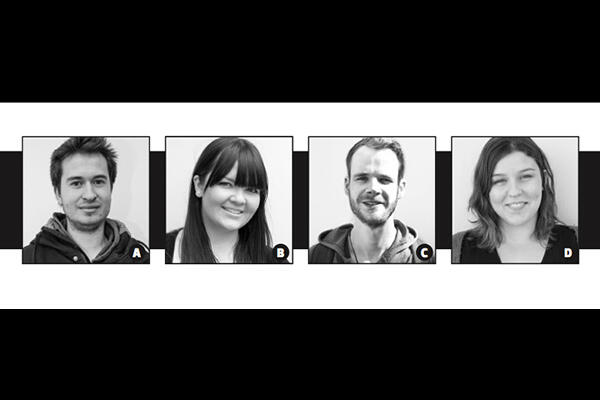
Voting for the two student representatives on the 2015 University of Otago Council runs from this Wednesday 8 October through to Friday 10 October. Voting will be conducted via an online voting site, with students notified on their student email addresses. The candidates standing are OUSA President-elect Paul Hunt, current OUSA Education Officer Laura Harris, OUSA Recreation Officer-elect Jonathan Martin, and Ashlea Muston. Paul Hunt [A] My name is Paul Hunt and I will be your 2015 OUSA President. The success of Otago University is dependent on student success. That is why a strong student presence on the University Council is vital. I am seeking your vote to be one of the student representatives on University Council for two reasons. First, I have experience advocating for students. As OUSA Finance Officer and a club President, I have lobbied officials and sat on a range of committees. A student representative needs to be able to persuade officials and not fall into line for appearances sake. Second, I am accountable as OUSA President. You can talk to me direct or via email/telephone. A student representative needs to be responsive to student views. As an elected representative, I must listen, consult and take student views on board. I support Laura Harris’s bid to be a student representative on University Council. Laura has extensive experience on University committees. She has a track record of effectively representing students in her role as the 2014 OUSA Education Officer. Vote Laura Harris and Paul Hunt to be your 2015 student representatives on University Council. Laura Harris [B] My name is Laura Harris and I am currently a 3rd year English and Linguistics student. Since the beginning of April 2014, I have been the Education Officer on the Otago University Students’ Association Executive. This position has given me the opportunity to have an invaluable connection with the student collective. As a further result of my experience as a student representative on various boards and groups within the university, I feel I am well situated to represent students in a council setting. I believe I will have the time commitment necessary to fully engage myself with representing the student voice to the best of my ability. It is also via this platform that I wish to articulate my support for Paul Hunt for University Council, as in light of his recent successful bid for president of OUSA, he, too, is perfectly poised to advocate on behalf of students next year through the medium of University Council. Thank you for your consideration. Jonathan Martin [C] Students are the lifeblood of the University. We are here to learn and develop – that means we need to work alongside the University to help us achieve that. As a fifth year law student, I have seen substantial change in student life on campus. Further changes are coming and sound representation and tact is required to ensure the student voice is heard. This has to come from the top. If you want someone who takes action beyond words then vote Jonny Martin for the University Council 2015. Less talk, more action. My policies: - Further the support for student initiatives and start-ups; - Create new educational courses that take on a student-led approach; - Facilitate improved resource access to clubs at faculty level; - Enhance the relationship between faculty specific groups and their academic counterparts; - Protect student nightlife culture; - Grow and expand the volunteer opportunities to students; - Increase the reach of student groups to satellite campuses; - Push the profile of students as positive actors; and - Advocate minority interests to ensure diversity is encouraged. Ashlea Muston [D] Kia ora everyone, I’m seeking your vote to stand as a student representative on the University Council in 2015. The University Council is where the key decisions are made for the university and its students and staff – from fee rises to the long-term plan. I will work hard to ensure a strong student voice is heard in all decision-making processes, and hope to have the privilege of being elected. I have five main priorities: - Do a better job of proactively communicating University Council decisions to you; - Actively discourage continued fees increases for students; - Advocate for more study spaces for students; - Improve diversity awareness on Council and encourage the implementation of better reviews of facilities and support services for all students; and - Promote university sustainability, including divestment from fossil fuels, energy use and efficiency on campus and better transport options for students. Vote Ash Muston for University Council in 2015. A strong voice; good communication; diversity; and sustainability.
-
News
Bodgies and wodgies take the stage in Dunedin
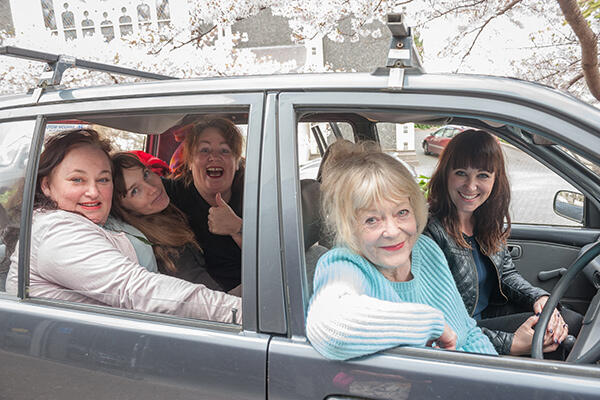
Moon at the Bottom of the Garden, brainchild of playwright Sarah McDougall, began as McDougall’s Master of Fine Arts (MFA) work piece at the University of Otago. Now, with a few adaptations, it will be performed at the Dunedin Public Art Gallery from 10 – 19 October 2014 as part of Arts Festival Dunedin. The festival includes music, theatre, dance and visual arts events, as well as a circus. The play is based on four generations of women whose family is “riddled with estrangement, addictions and traits passed forward as a direct result of being implicated in a murder,” said McDougall. “The matriarch and her young self have coping mechanisms that serve, or cease to serve, formed to cover secrets and guilt,” she said. Director Julia Edwards added, “It's about family dynamics of women through the eras who are all holding a lot of baggage.” The play features a cast from all over New Zealand. Irene Wood, of Outrageous Fortune and Go Girls, plays the protagonist, Nana Rose. Edwards said, “The girls that we’ve cast have all got that ability to show a bit of their ugly side as actors … [and] they work so hard, there’s so many laughs.” McDougall said the girls are “a hard working group of women who have dived deep into the script, themselves and the characters to make new theatre.” The idea came from a book, All Shook Up by Redmer Yska. The cover featured a photograph of a group of “bodgie” and “widgies,” terms used to describe New Zealand youths in the 50s. The book itself is based on the 1995 Jukebox murder whereby a young man murdered another over a girl they were both smitten for. The second man was given the death sentence and hung shortly after. “I read the chapter on the Jukebox Murder … all I could think about was the girl, the widgie from 1955, how would she be affected after being implicated in a crime where two young men died over her, and how might that affect her life,” said McDougall. The play itself is set in Dunedin. “There’s a lot of prominent Dunedin culture involved,” says Edwards. Speaking of the time in which the play was set, McDougall said “an influx of GIs and merchant sailors after the war brought in new music, and fast cars; the culture of bodgies and widgies knew how to party.” She said, “It is likely you will recognise some of your own family in this play, or families you know, damaged in some way, those that hold back secrets, pass things forward, yet hold fierce love for each other.” A limited number of student tickets are available for Thursday 16 October at 1pm. These will cost $15 and can be sourced on the play’s Facebook page, “Moon at the Bottom of the Garden Productions.” Regular tickets will be range from $15–20 and can be purchased at the Dunedin Art Gallery or Ticket Direct from the Regent Theatre.
-
News

Brit takes over Critic but everything is hunky dory
The new Editor of Critic for 2015 was announced last week. Josie Cochrane is “well chuffed” to be handling the reigns next year. She’s a blonde British case, both literally and metaphorically, and resides in the yonder hills of Dunedin. Floppy Jockles, Joppy Flockles and Flippy Whipples are just some of her many personas, but she prefers to be addressed as Cosie Jochrane when nicknames are required. “None of those names are a reference to body parts,” she claims. Josie is renowned for her vehicular incompetence. Her gold Nissan Bluebird, with a collection of tickets left in the windscreen and an expired Warrant of Fitness, can be found hanging around the OUSA buildings. You can also look for a car with the keys left in the door, ready for anyone to nick it. Occasionally the boot is left open, too. It’s hard to miss. Josie says she is ecstatic about having an allocated car park for the year, “it’s going to save me at least $500 a semester on parking tickets. Now the meter man can pick on someone else. Those DCC tossers.” Critic recommends that she just pay for parking once in a while. “No,” she says. “I get away with it sometimes when he’s in a good mood.” Josie plans on moving closer to campus in anticipation of more late nights and even more early starts. She currently resides in a “Harry Potter-style cupboard” in her flat beyond the Octagon. She says she will miss her flatmates and the way her room sways in the wind, but late night walks have their limits. When asked how female leadership will change the scene for Critic, she assures us that she will be painting the office pink and placing flowers on everyone’s desk. We asked fellow staff how they felt about her promotion from News Editor. Dandan Blackball, a designer, is angered by “another bloody foreigner taking jobs from hard working Kiwis.” Josie is an immigrant from England and, despite her strong accent, is somehow incapable of imitating any other British accent. Blackball also promises to encourage the implementation of biometric scanners so that no one has to come and lend her keys during the year. “She’s banned from owning a set,” he says. Four keys have been lost this year. Josie had to give up her role for Cookie Time following the offer of Editor, so the existing team also fear they will now miss out on their regular Cookie Time donations and, instead, will have to cope with Josie’s failed attempts at banana protein pancakes or any other form of “creative” baking. Her Instagram explains the result. Finally, she wants to ban snails from the Critic fish tank, as she believes that the regular slaughters should not be encouraged. “I’ve walked in here one too many times and witnessed a blood bath. It’s not happening again on my watch,” she says. The Critic goldfish, Gold Bastard and Gyarados, have an affinity for the taste of local Dunedin snails. “I don’t mind if they eat each other, but don’t take it out on other species.” Critic assures you that we don’t condone cannibalism and Josie is not a vegetarian. Critic wishes her, and ourselves, good luck. God help us.
-
News
New Zealand universities have work to do
The Times Higher Education World University Rankings have ranked the University of Otago in the 251–275 bracket. The score continues Otago’s steady decline in the rankings over the last few years. Last year, the university was placed in the 226–250 position. In 2011, it was in the 201–225 lot. The results were also bad news for other New Zealand universities, with all institutions either slipping or stagnating in the rankings from last year. The University of Auckland fell to 175th place, a marked shift from its place at 164th in 2013. Both the University of Victoria and the University of Canterbury remained the same, ranking 276–300 and 301–350 respectively. The Times rankings use 13 separate performance indicators to examine the universities’ strengths. “Research, knowledge transfer, international outlook and, uniquely among global rankings, the teaching environment,” says Times Higher Education Editor, Phil Baty. Baty believes New Zealand will have to “invest and work strategically to stay competitive,” in order to improve their university ranking on the world stage. While New Zealand enjoys the “geographical advantages in the thriving Asia-Pacific region,” Baty argues it is failing to hold its own with “intensifying” competition in the “global knowledge economy.” This growing competition largely hails from Eastern universities, says Baty, as the rankings provide hard evidence of a “power shift from West to East,” with two Asian universities in the world top 25 for the first time, and 24 Asian institutions in the top 200 – four more than last year. “There is little doubt that key East Asian nations have emerged as powerhouses in global higher education and research, while traditional leaders including the UK, Canada and the US, risk losing significant ground in the global knowledge economy.” Baty attributes the success of the higher-ranking universities to “strong government financial support, strong leadership and a strong commitment to excellence in higher education and research.” The top five universities in order of rank were: The California Institute of Technology; Harvard University; University of Oxford; Stanford University; and University of Cambridge. Across the Tasman, the universities enjoyed better results, gaining a new top 200 entrant. The University of Adelaide placed 164th and the University of Melbourne moved up to 33rd position.
-
News
We are the champions, again. *Yawns*
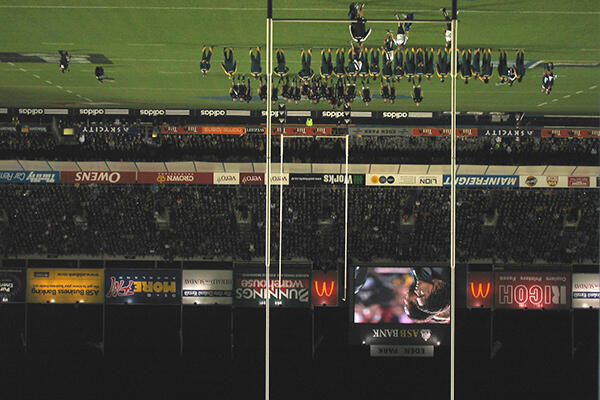
Back to the shiny, black and trophy-laden rugby desk this week where we are wrapping up our code coverage for this year with a little review of the recent Rugby Championship and some very early and unnecessary World Cup hype. As is old news by now, the mighty All Blacks have won yet another Rugby Championship with a game in hand, turning last weekend’s trip to South Africa from an epic title decider into another dead rubber. Now I should be more excited, even over the moon at winning our third consecutive Rugby Championship, but I couldn’t help but become a little bit bored with the All Blacks having become so predictably dominant recently. It is a bit cheeky to suggest that a tournament involving the other top 3 ranked teams is a walk in the park but the statistics would suggest that this is definitely the case. As I write this before the final game in Johannesburg, we may well have lost that one. But, at the moment, the record books indicate that in the 15 previous matches in the Championship since 2012, the All Blacks have played 15, won 14, drawn 1, and lost 0. Just give us the World Cup now and save us the trip ... I will admit that the results this year look easier and more comfortable on paper than it actually was in reality on the field. South Africa managed to push us all the way in Wellington a few weeks ago with the game finishing 14–10 and that 12–12 draw in the opening game against the Wallabies in Sydney, the game that broke our record-equalling test-winning streak, could have easily gone their way. But we always find a way to win, so given the form of the All Blacks since the last World Cup it would be hard to realistically imagine any other result apart from them defending their title. However, the final in London is still over a year away so who knows what disasters might befall the team between now and then. We all remember the injury crisis of 2011 with our number 10s dropping like flies, leading to Stephen Donald being called back from his whitebaiting trip to win us the Cup with his penalty goal. Sounds like an inspirational plot from a made-for-TV movie … In an attempt to mitigate the chances of injuries affecting the World Cup, the 2015 edition of the Rugby Championship will have a shortened, three-week format with the teams only meeting once. The All Blacks and Argentina drew the short straws and have to play two of their games away from home. This could give the other teams a small glimmer of hope at winning the “tournament,” which would give them a big boost of confidence ahead of the World Cup. If we are going to lose some games and pick up some injuries then hopefully it happens in these games rather than in England when it really matters. I can see Steve Hansen using these three games as a time to experiment with his team and being happy to concede this rather inconsequential battle for a better chance at winning the war come next October. Although, if everyone stays fit, I can’t imagine there being too many new faces coming into the squad between now and next year. The Sonny Bill factor does make the midfield selection area an interesting one to watch but expect a pretty predictable line up for our first game against Argentina at Wembley Stadium next September. It’s hard to find some decent opposition these days The first of the losers this season are the mercurial South Africans, who struggled to limp past Argentina but then gave us our biggest challenge. It is hard to find many positives to say about the Springboks who play a boring but brutal style of rugby and rely far too much on their kickers and the borderline criminal tactics of their genetically modified forward pack. Of course, the ‘Boks will be quietly confident of their chances at the World Cup even though an easy run through the group means that they are likely to run into Australia or England in the quarterfinals. They have an experienced but aging squad, and with several of them likely to retire after the tournament, they will be keen to go out on a high note. South Africa remain as our closest challengers on the field. Australia have not been particularly impressive so far this season. The Wallabies will be looking forward to the All Blacks’ return trip to Brisbane for the dead-rubber Bledisloe Cup fixture on 18 October. It will act as some encouragement before the Aussies head out on their European tour. They need to steady their ship because after the 51–20 thrashing that we dealt to them at Eden Park, they have looked pretty shaky and unconvincing. However, I have a feeling that things should all come together for them at the World Cup next year, although they do have, arguably, the most challenging of groups to get through, with hosts England, Wales and Fiji to contend with. Even though South Africa have provided the All Blacks with our most challenging tests, recently and historically, a victory over Australia still remains worth more – emotionally, at least – than a victory over anyone else. Despite losing all their games, Argentina have improved with some close results, finishing within seven points of Australia and South Africa and not getting absolutely blown away by the All Blacks. The experience gained by the Pumas in the Rugby Championship is starting to show and they will be looking forward to facing up to the All Blacks again as they are in our pretty easy group, along with Tonga, Georgia and Namibia. The way the draw is structured and likely to play out should see the Los Pumas into a semi-final at least. Anything less than that will be a little disappointing seeing as they have been holding their own against the world’s top three ranked nations. They need to send a few more players over here to play regularly in Super Rugby to give them more top level experience.
-
Columns

ODT Watch | Issue 26
Battle of the sheep took place right under our noses, with “Big Ben” taking the win. Old time favourite Shrek had his unofficial world record for heaviest fleece nabbed by Big Ben’s 28kg wool load. ODT reports that there were no hard feelings between the two. Maybe because Shrek the sheep has been dead for three years, not to mention that sheep don’t exactly have the emotional capacity to feel “hard feelings.” After a baby was kidnapped in Auckland hospital last week, the Dunedin hospital has considered improving security. However, it concluded that security was tight enough. … In other words: without shirts, the Army wasn’t that well kitted out, were they? Some poor plumber finally got snapped for exposing too much crack on the job. If this isn’t an overestimation of photo-shopping ability, we don’t know what is. In the past we have ribbed on the ODT’s photo editing skills and it appears they haven’t been reading: this recent attempt leaves the viewer especially perturbed. Poor Irene van Dyk.
-
News

Critic just isn't going to stop tackling election year
At the time of writing, Labour is in turmoil. Once again, they are undergoing a leader selection process that is bitter and catty. The accusations of being “beltway politicians” are coming thick and fast and the spectre of election failure isn’t going away. Even New Zealand’s mainstream media sunk to a new low, with the Herald releasing a Buzzfeed-style article called “13 bizarre things David Cunliffe has said in the past 24 hours.” That, in itself, was bizarre. There are two main contenders for the leadership currently: Grant Robertson and David Cunliffe. Let’s take a closer look. David Cunliffe: Unfortunately for Labour, Cunliffe led their party to the most catastrophic loss they’ve had in almost their entire history, managing to capture the attention of only a quarter of voting New Zealand. But Cunliffe doesn’t think his time has come to an end, and aims to finally lead Labour into power in 2017. He has the support of unions, or something. Most interestingly, the Young Nats have re-ignited their campaign in support of Cunliffe for Labour Leader; take that how you will. Grant Robertson: Last leadership race, Robertson lost to Cunliffe. This time around, however, he considers himself ready. Based in Wellington, Robertson has the support of many of the younger members of the Labour caucus, and he has proclaimed that he “could’ve toppled John Key.” For some, this confidence is off putting; for others, it’s just a case of the ABCs – Anyone But Cunliffe. John Campbell: There is, however, one other potential candidate. Considering the mainstream media has decided to report on Facebook likes, I’ve decided to hedge my bets on an up-and-coming Facebook page: John Campbell for Labour Leader. Confident on camera, charming and willing to ask the tough questions, Campbell is a perfect candidate to lead this splintered party to victory in 2017. Although Labour’s last run-in with a TV star turned out less than successful (sorry, Tamati Coffey), Critic believes this time will be different. Only Campbell can combine true care for the disadvantaged with a winning smile. Only Campbell can be loved enough to appear on our TV screens every weeknight at 7pm. Only Campbell can rejuvenate Labour. A statement on the Facebook page notes, “some have been asking if John has already thrown in his name for leadership. We have it on no authority at all beyond our own hopes and dreams that he is considering it, but is simply awaiting your support.” Please, for the love of Labour, someone start an Avaaz petition.
-
News
Greatest hits / Greatest shits | Issue 26
Greatest HitThis week we’re going international for the Greatest Hit: to Hong Kong. After a change to Hong Kong elections that would mean only “China-approved” candidates would be able to be elected, students began an intense protest for democracy, storming Hong Kong’s Civic Square. Sometimes it’s good to step back and realise we’re lucky to be democratic, when so many places still have to fight for that right. Greatest ShitGood old Karen Price. The environmental lawyer married to David Cunliffe has previously graced our pages in a Greatest Hit. This time, unfortunately, her story is not quite so great. Last weekend, a Twitter account (TarnBabe67) emerged, attacking users who did not support Cunliffe. Apparently it was Karen Price behind it.
-
News
Exams are just two weeks away
The time is near, the assignments are (mostly) over and now it’s time to put all that information into your brain. You probably should have started studying for exams a while ago, but realistically this guide has just got you thinking, “Ah, I should go and pick up my course reader/ open that textbook/ check what papers I’m even taking.” First thing’s first, if you have any lectures or tutorials on offer this week, go! These lectures tend to give you a pretty basic run down of what might, or might not, be in the exam. They also often give you some tips on how the test will be examined. Most lecturers want you to do well in their paper, so make the most of having them there and ask all the questions you can think of. For RevisionOrganise your lectures and readings into a relevant order. Ditch anything that you know for sure will not be in the exam. Create questions about the material. Carefully read each section and give answers to the questions. Reflect on the material – adding examples and relating prior knowledge to your answers enables you to contextualise the material. Recite and recall the information – keep asking questions, and then recall the answers to them, to yourself. Doing this with someone else works, too. Review and review again. Run through your lectures and check no material has been missed. The more you know as you re-read, the more you will keep picking up. Mindmaps – These are a fabulous way to cover each topic. Start with a headline in the middle, then no more than eight points from the start and eight points from those eight points. If you know exactly how many points are off each central point, this makes memorising the mindmap in the exam much easier. Flashcards - Depending on how you like to learn, hundreds of cards with a question/ term on one side and the answer/ definition on the other, can be an easy way to learn a lot of content. Use good ol’ pen and paper - Research suggests that laptops may impair learning because their use results in shallower processing. Students who took notes on laptops performed worse on conceptual questions than students who took notes longhand. Although laptop owners may have taken more notes, their tendency to transcribe lectures verbatim rather than processing information and reframing it in their own words is detrimental to learning. Work with concentration - One hour of concentrated study is worth several hours of distracted study. If you can learn to work with concentration, you will achieve more in less time. If you have to cram - Learn the shallow stuff. Highlight key information, vocabulary and the most essential topics. Make mindmaps of the most essential topics and redraw them until you can’t visualise anything else. Trying to cover everything for that paper in a couple of days will only result in hyperventilation and a worn out brain. Set up a plan - Print out a timetable and allocate a topic to each hour of study. Spend less time on what you know and much more time on what you don’t! It’s easy to work the other way round. Study buddies - Finding a group to study with, providing they are the dedicated sorts, will keep you on track, provide reviewing time and give you the opportunity to explain ideas to someone else. Research has shown that explaining concepts to someone else and reading ideas out loud help you recall the information better in future. Exercise - Classes at Unipol are cheaper during the exam period for a reason. Look after your body as well as your brain, so that you can do your best and give your eyes a chance to rest. Though, Critic does not recommend exercising with your eyes closed – and don’t read whilst running. Also, pack healthy lunches, get enough sleep and avoid late nights. The ExamAllocate your time evenly. Spend 30 seconds at the start of the exam working out how much time you have per mark. Answer the questions given to you, not the ones you think should have been set. Analyse the questions. This is not a word association test, so explain yourself. Multichoice Exams: Complete the easy questions first. For the harder ones, eliminate the ones you know are wrong. Take a step back and see which answer makes common sense. Sometimes choices are grammatically incorrect and therefore incompatible. Rule out these possibilities. Essay questions: Plan your essay. This is where mindmaps are gold. Start with a general introduction paragraph. Define the essential terms and concepts. Address the questions using theory and empirical evidence. Conclude the essay by linking back to the introduction. Get to the point with essay questions. Time is marks. Reduce Test Anxiety - Mentally, physically and emotionally prepare yourself if you are one to get stressed for exams. If you prepare adequately in advance, you will be more confident for the exam. Ensuring you are familiar with the material and practicing past papers will help reduce your fear of the unknown. Emotionally prepare - Set yourself realistic goals from now and remember that you will achieve a lot more in the future than just good grades. Schedule chill-out time during this period of intense study, whether that’s a movie date with the flatties or a baking some cupcakes. Work hard, look after yourself, and remember, exam results are not the be-all and end-all.
-
Features

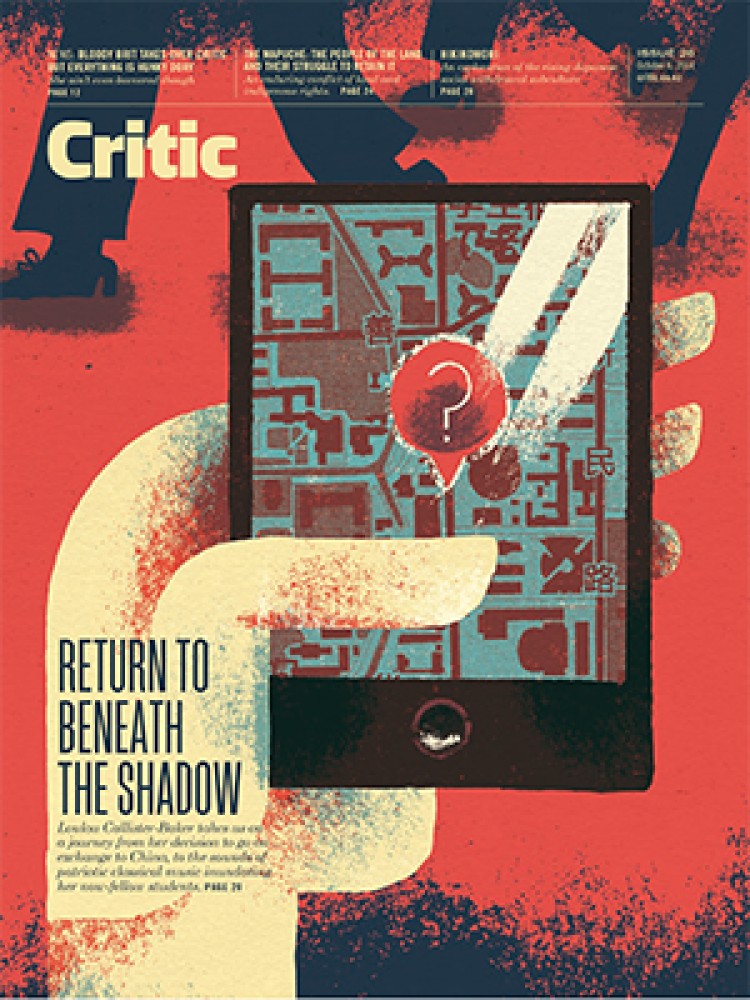
Return to beneath the shadow
As the pilot beside me pulled the small plane’s steering wheel towards him, the absent co-pilot’s wheel hit my knees. For this reason (and my resolute pursuit of urban isolation), I pushed my entire body against the side of the plane and placed the clunky headphones on my head. Out the window, I watched the mud flats lining the tarmac become a vast, indecipherable expanse of brown that merged with the dark sea and then disappeared. I wasn’t overseas yet but the journey had started. It smelt like the very old man sitting behind me and of the pilot’s sweat. It smelt like adventure, sort of, or the end of something to make way for something new, at least. Before we took off, inexplicably wide-eyed, the old man had asked what day it was. Although the woman beside him told him – Wednesday – I wondered how could it be. It was more than just another day. It was My Day. When the Life Coach came to stay at my parents’ apartment a month ago, she asked if I had felt a yearning in my chest before I decided to go on exchange to China. I wasn’t sure if it was that. The only thing I had felt inside me was whatever I had last eaten, and that was in my stomach. But, still, I had booked my flights; dwelled on the experience, becoming deeply lost in the abstract for a year; and, several hours ago, repacked my overweight suitcase at the Wellington airport. However, the second part of the trip (Wellington was the first) was not so much about “finding myself” and more about “finding myself on an isolated island in very close proximity to my parents.” Yes, it was them and I again. While they had behaved in the airplane (mostly because I couldn’t hear them over the sound of the roaring propellers), on arrival at Great Barrier Island they troubled me. In order to earn “Man Points” Dad insulted my heavy suitcase in front of the local male who had come to pick us up at the tiny airport. Mum then mentioned that her ankles were cold and tried to climb inside the pickup car but returned, terrified by her discovery of the small child sleeping inside the car. I looked off into the distance, wondering what it all really meant. When we arrived at our house, the sky had turned a deep grey and the wind had picked up – an ominous mood soon exemplified. Inside the house, broken glass covered the floor. It was an omen, I thought. However, Mum squealed in a sadistic delight after closer inspection of the crime scene. A bird had entered the house and disappeared again – but not without leaving its mark – everywhere (Dad later informed a visiting architect that birds do not have anal sphincters, hence the chaos – at this the architect had politely sipped his tea and looked carefully at his watch). A ferocious cackle sounded. I turned to find Mum standing over the damaged books. “The bird had taste! It didn’t get the high-end literature,” she exclaimed then looked at me. “Burn A Dance With Dragons first!” I backed away slowly. Throughout the following days I felt increasingly nervous about my exchange. Impossible to comprehend the next six months, I escaped for long walks despite the high winds - to knock sense into, or out of, me. I tried not to think but, still, it felt so definitely like a certain time in my life was over. I couldn’t shake it. After one particular walk, I wanted to tell somebody, anybody – even them. I returned home. My parents were standing at the window looking out. They cared, I thought; they were there for me. I waved but neither returned the cheerful gesture. Quickly I realised they were looking past me. I turned around, all that behind me was the garden. Oh, I realised. “The Garden,” their new child and my new, far more exciting and far more rewarding, adopted sibling. I had been replaced. You see, parents can control their garden (sort of) and they can trust their garden’s future to have some predictability – unlike their real children. I entered the house. My parents made a huddle formation, devising a complex plan to prevent the local gardener from mowing their herb patches again. At this point I was reminded of Dylan Moran’s excellent summary of adulthood, which roughly begins with “go and find a job. Go and get a flat. Find somebody else, put them in the flat, make them stay,” and ends with (punch line spoiler alert) “sit, radio, dinner, hmm – gardening, gardening, gardening. Death.” Reluctant to confront the truth of it all, I skulked off. But on the last night, before I was released into the world, harmony was restored. Mum cornered me with a strange lingering hug – she looked as surprised as I did by the embrace and yet she continued. I was touched. Later, Dad and I attempted to sing together while cooking dinner. However, we quickly retreated to Thunderclap Newman’s “Something in the Air” when we realised we shared the hereditary disease of Song Lyric Dementia, made worse by the fact that it triggered in both of us in exactly the same parts of every song we attempted. And, soon, something was in the air. Me. Thanks, Thunderclap Newman. Around 6am the pilot announced our descent into Hong Kong. I hadn’t got up from my seat the entire trip, the sound on my movie had cut out 30 minutes into the flight, and I had started to feel detached from reality. Again. But I slid the window shutter open to watch the plane dive through the thick clouds. A sprawl of ocean, barges, land and construction sites slowly rose up towards us. In the various shades of brown and grey in the early morning light, everything below looked industrious and far removed from anything I knew. And yet, as I looked around at the other passengers on the plane, alone and serious, I realised many would have family, friends, or business in Hong Kong. For them this was nothing unusual; it was all entirely ordinary. But for me, in a state of contained bewilderment, I questioned how this could ever be normal. Sudden heat surrounded me beyond the doors of the Hong Kong Central train stop – heat and anonymous walls of glass that towered either side of the road. Rescued only momentarily from the heat by a friend in a taxi, I soon returned to the streets in search of a tram stop. After being pushed aside then squished into a corner, I moved through the crowd on the tram and clambered the stairs to search for a seat at the front. 20 minutes into the journey, as my Hong Kong SIM connected me to online, I, too, began to feel connected to the surroundings. My descent into the reality of Hong Kong was still continuing. The tram pierced through a dusty rainbow of apartment blocks, pedestrians clutching sun umbrellas and food stores with sacks of miscellaneous contents that spilled out onto small display mats, which lined the streets below. After two days roaming the narrow roads between the condensed high rises of Hong Kong I realised how passively I carried myself. Among my myriad crises, this one was the most apparent. Any person in a crowd could push by me and I would instinctively apologise each time, as if my existence itself was an obstacle. Although I am inclined to over think (everything), when I talked to ex-pats at a bar about this later they all agreed – to be in a big city you need to assert, assert, assert. I realised I needed to be confident in the space I occupied even if I had no idea where I was or where I was going, otherwise I would be physically and psychologically trampled by the overwhelming and constant rush of people. Crisis analysed, somewhat. Over my stay, I asked my friend, a long time Hong Kong resident, many questions about travel and the impact it has had on her life. In one restaurant, as a bowl of dumplings was placed on our table, she began to recount to me stories about her own experiences. One time, when she was twelve years old, she caught a plane to meet family friends in India. But when she arrived in New Delhi she learned that her friends were delayed. As a child, she could have wept and attempted to return home to New York. Instead, she went to her hotel and worked out arrangements to explore the city. In the concoction of people, colour and noise that is India, this would not have been simple. The next day she made the long trip to Agra to visit the Taj Mahal. She went to markets. She was lost then found again by her driver. And as I listened to her speak I became wide-eyed with awe. When we left the restaurant and when I eventually left Hong Kong, my friend had filled me with a sense of calmness as well as thankfulness for her (unrelenting) generosity. My friend’s stories also reminded me of two other adventurers who were on my mind while I embarked on my China adventure. The first was James Bertram, a New Zealander, who later became a Rhodes Scholar and a journalist in China. Bertram’s is a highly unusual story – one of adventure and “firsts” (including an interview he conducted with Mao Tsetung in Yan’an). Then there was Theresa Butler (my great, great aunt) who was the first New Zealand nurse to serve in WWI and awarded the 1914 Star for her service (she was one of only four New Zealanders to receive this award). Butler, it seemed, did not want to miss out on the action when the men of New Zealand went off to war. It is these adventurers’ stories, as well as that of a small girl making-do alone in India, that gave me “permission” to go ahead and make-do with my journey to Beijing. My experience of the dense metropolis of Hong Kong fell away to a large highway and (rare) blue sky as I made my way by taxi from the Beijing airport to a family friend’s home. I felt a muddled sense of relief and confusion. The driver had seemed angry when I asked him if he knew the address I had shown him but, when I placed my sunglasses on, he turned around and said “niiiiiice.” From there on, using my limited Chinese, I asked him about himself and described to him why I was in Beijing. However, despite the good humour, it soon transpired that he had no idea where we were going. With a large smile he parked beside a building complex and sped away. When I turned to the skinny boy guarding the entrance to the complex to ask if he could let me in, he simply replied, “No. I do not know you.” He made a good point, nobody here knew me, which raised the question: how do I “get in” at all – into places, friendships, a Beijing frame of mind? After being rescued by my family friends and spending a wonderful two days with them, I had to leave the safety of their connected and established lifestyle in search of my own. But when the taxi driver dropped me off at Tsinghua and I attempted to get him to drive me to Building 19, he quickly gave up on my fragmented Chinese and me. With a cheerful yell, he rode off leaving me with my suitcase and a splash of phlegm that he had hocked up before he went. It was hot, there were Chinese students on bicycles everywhere and I was confronted with a huge campus without a map. I stared at my overweight suitcase. It offered no help. And so I walked forward into the depths of the famous Chinese institution. But, soon, I really did have to stop and consider my actions. In the glaring sun I squinted down at my phone and waited for Google to do something. Instead it froze and I with it. It was an accented “hello” that drew me from my looming despair. I looked up at the man who stood in front of me with his bicycle. “I’m not a thief, check my ID,” he introduced himself, and then proceeded to tie my suitcase to his bike. He gestured for me to sit on the back. Slightly terrified, I got on. Using fragmented English he explained that he was from Pakistan but doing his doctorate in Chemistry at Tsinghua. The only thing he knew about New Zealand was that it didn’t have snakes, which was the answer to a test question for him when he was in primary school. 15 minutes later we arrived at the building. He rushed off to buy me two Cokes and returned to aid me through the process of acquiring a room. Although thankful for his generosity, I started to become increasingly confounded by his constant offers to buy me everything I needed. But it was only after a week of daily phone calls that I decided to interpret his behaviour as overbearing and inappropriate. This problem was unexpected. When you do not share a first language with someone – as is the case with most people I met during my first week at Tsinghua – you are often protected from the less idealistic aspects of their personalities but you are also limited in that way too – something I should have been more aware of, especially as a travelling woman. As Vanessa Veselka wrote in an essay for the American Reader: “True quest is about agency, and the capacity to be driven past one’s limits in pursuit of something greater. It’s about desire that extends beyond what we may know about who we are ... Women [...] are restricted to a single tragic or fatal choice. We trace all of their failures, as well as the dangers that befall them, back to this foundational moment of sin or tragedy, instead of linking these encounters and moments in a narrative of exploration that allows for an outcome which can unite these individual choices in any heroic way.” After Vanessa talked about the issues of narratives, she added, “But [narratives] also keep us safe. They mark our place in society and make sure we’re seen. Therefore, the only thing more dangerous than having simplistic narratives is having no narrative at all, which is deadly.” It is early days yet but in the fantasy world of travelling, there are some darker realities – of both people and China – that I must understand too by establishing my own story, my own “narrative.” Now, as I write, I can hear patriotic classical music from the fields across the road from my hostel. The music woke me up this morning and will only finish later this evening. Every now and then a ferocious chorus of “yi, er” sounds out either to signal a positioning change or to accompany ceaseless marching. Variations of this process continue for more than eight hours a day, everyday, for three weeks. The voices I can hear are those of the “freshers” at the leading university in China – freshers who would have obtained full marks in all their school exams, been the top school students in their towns and somehow had the funding to cover the university’s high fees. While learning to physically endure, these kids are (well, ideally) filled with a sense of belonging and patriotism. Like most things I have experienced so far, it is bewildering. But, perhaps as is the nature of humans, I will become used to it and it will become another part of the story of my own quest.
-
Features

The Mapuche: The People of the Land and their struggle to retain it
Sharing their home with a six billion dollar timber industry, the Mapuche people of Aracaunia are the poorest in Chile. After centuries of land wars and inequality, the Mapuches, meaning “people of the land,” are beginning to break the silence, uniting to fight to get their land back and get the same rights and privileges as non-Mapuches. After spending a semester on exchange in Chile and studying the Mapuche culture, I was intrigued at the serious lack of recognition the Chilean government has given the Mapuche and how they have mistreated them so poorly. While New Zealand has faced its own issues in dealings with our indigenous, the Maori, we are clearly well ahead of many Latin American countries in this respect. It all began when the Spanish came to Chile in 1541 and began to take land off the Mapuche, the largest indigenous group in Chile, in their quest to conquer more of Latin America. The Mapuche resisted becoming part of the Chilean state until 1880, when the Chilean Army invaded and occupied Mapuche territory. It was then that the majority of the Mapuche’s land was taken from them, creating the on-going land conflict that continues today. Things started to look more positive for the Mapuche when Salvador Allende came into power from 1970–1973. Allende passed an Indigenous Law, officially defining “indigenous” and recognising the Mapuche people as an indigenous culture. He also began to restore communal lands of the Mapuches. However, in 1973, the military coup organised by Augusto Pinochet to overthrow Allende was one of the most savage in history. It has been reported that the new government held thousands of people in the national stadium, where the majority were killed. A National Commission on Political Imprisonment and Torture report found that 3,216 people were killed or went missing during 1973 and 1990, and survivors of political imprisonment and/or torture stood at 38,254. The dictatorship of Augusto Pinochet lasted from 1973 to 1990. In the 1980s, Pinochet was questioned over the deaths of South American government members and was to be tried for numerous violations of human rights, most of which occurred during his attempt to illegally supress political opponents. He was also accused of enhancing his income by swindling government funds and participating in the illegal drug and firearms trade. He continued to deny these allegations up until his death in 2006. During Pinochet’s regime, he reduced the land of the Mapuches from 10 million hectares to 400,000. He gave land to forestry and timber companies, creating a strong economic income for Chile but creating severe poverty and economic struggles for the Mapuche people. In that last decade of Pinochet’s regime, the Mapuches began to be described as “terrorists” after attempting to take back small allocations of land from the 95 per cent that was taken from them. Limited land has been given back to the Mapuche people but what has been returned is in such terrible condition it cannot be used to cultivate plants. Land restitution efforts have been minimal, especially considering the value of the forestry and timber industries to the government, and certain investors those ventures had, like the former Governor of Araucania, Andres Molina Magofke, who had a 42 per cent share in a timber company in the region. Araucania is also the poorest region of Chile and is regularly in drought as a result of the timber factories’ high usage of the region’s water supplies. Attempts by the Mapuches to reclaim their land have seen them treated as “terrorists” and jailed. In 2002, a 17-year-old boy was shot dead by police as his community were occupying private land. The Chilean police are known for their violent tactics and, having seen them in action after football games, this is no surprise. The Chilean media thrives off these incidents and are renowned for creating a spectacle out of them. The words “ethnic cleansing,” “ethnic violence,” “terrorism,” and “separatism” are regularly used in articles involving Mapuche activists. During his regime, Pinochet created a law that has been used against the Mapuche people. The law gives anonymity to witnesses in court, imposes higher sanctions and penalties for crimes and sees that people are held without bail before trial. In July 2014, the Inter-American Court of Human Rights acquitted eight Mapuche rights’ activists, who were convicted in 2003 under this law, after finding their rights to freedom of expression, presumption of innocence and their right to question a witness had all been violated. The current President, Michele Bachelet, promised during her first term, which was from 2006–2010, that this law would not be applied under her power. However, in 2009, Miguel Tapia Huenulef was accused of being involved in an arson attack on a private estate in Araucania. Police alleged they found a sub-machine gun, ammunition clips, two grenades and bomb-making materials. But, like every good story, there are two sides. For Huenulef’s family, the real terror came from the 50 police officers that raided their homes, racially abused them, threatened them with guns and stole money and cell phones, before planting evidence. In her 2013 campaign for re-election, Bachelet acknowledged the law’s shortcoming and once again vowed not to use it. “We’re at a juncture to expand and recognise the rights of Chile’s indigenous communities,” said Bachelet in June 2014. Imagine it was illegal to celebrate the New Year. Well, that is what happened to the Mapuches under Pinochet’s regime. Since the dictatorship terminated, it has been permitted to celebrate publically but, in 2013, the Santiago Times reported that political prisoners in the Manzano de Concepcion were banned from celebrating the event by the government, causing a huge uproar from Chilean human rights groups as this deprives their right to celebrate one’s culture and religion. “We need to have respect for the victims and a sense of prudence with respect to the magnitude of the crime and the social effect that it has produced,” Interior minister Andres Chadwick stated on his disapproval of the celebrations. The Mapuche New Year, Wu Tripantu, meaning “new sunrise” in Mapudungun, occurs on 24 June at the start of the winter Solstice. They believe that the New Year begins with the cycle of the earth as, from this period onwards, plants begin to bloom, marking the shift in seasons. Coincidentally, the main day of celebration on 24 June falls on the National Indigenous People’s Day. There was a significant difference in the celebrations in 2014 as President Michele Bachelet attended a ceremony in Santiago, acknowledging the debt the Chilean state owe to the indigenous people. She announced the expansion of indigenous political representation, strengthening of institutions and facilitating the process of returning disputed ancestral territory back to the Mapuches of Araucania. This marked a significant development for the Mapuche and many Mapuche are impatiently awaiting evidence of fulfilment of these promises. The Mapuche language, Mapudungun, has still not been recognised as an official language, despite 11.4 per cent (1,508,722) of the Chilean population identifying themselves as Mapuche (although the 2012 census has to be redone, as in 2013 it was realised that 10 per cent of the population was missed) and in 2007, it was estimated 30–40 per cent of the Mapuche spoke Mapudungun. Comparatively speaking, English, Maori and New Zealand Sign language are all official languages of New Zealand, with Maori being added in 1987. The Mapuche are still pleading for bilingual education nationwide. A pilot bilingual education program was implemented in Temuca and 400 schools throughout Chile are bilingual. However, Mapuche Professor Elisa Loncon of the Catholic University of Santiago believes they are restricted by quality control and a lack of specialists. “They need changes in the constitution so the demand for linguistic rights can advance because the non-indigenous decide for us. The Mapuche language does not hold the same status and social prestige of Castilian (Spanish),” believes Loncon. During my travels around Santiago, I got chatting to a taxi driver, Carlos. He is Mapuche and had come to the city to make money so that his parents could afford to keep their farm and live off the little land they had left. 30 years ago, while my parents were probably rocking around in denim jeans, lycra and polyester shirts, Carlos had never worn or seen clothing that was not made of wool. He still recalls stories of his grandparents fighting over their land. “The laws don’t favour the Mapuches,” he told me, with great resent. Integration into Chilean society for the Mapuches has been difficult and they are usually made to keep to themselves in the outer suburbs of the cities. Racism towards the Mapuches is still a common occurrence, especially in middle- to high-class Chilean society. A good friend of mine was invited for dinner at her father’s friend’s house. His cuico (posh) wife started enquiring about what she was studying. When my friend told her that she was studying anthropology and was doing a paper in Mapuche culture, she shrivelled her nose and obnoxiously said “what’s the point in that?” It is this society that has made it nearly impossible for Mapuches to integrate into the Chilean society and attempt to mend the bridges that were burnt so many years ago. There is little support towards the Mapuche and they are generally expected to keep to their own cultures and people. Mapuche women are often hired as maids for the upper class non-indigenous Chileans but besides that, there is little interaction between the two cultures. The media’s influence contributes to the negative perception of the Mapuche. There are very few Mapuche publications that allow them to express themselves and are often excluded from sharing their opinions in mainstream Chilean media, making them greatly vulnerable in their torn society. An interview with Claudio Barrientos, the former Director of the University Diego Portales History School, reveals that he believes the media play an important and influential role in the opinion of Mapuche in Chilean society. “For some time the media have been creating stigmatisations and negative stereotypes of the Mapuche community members and activists. It was the media that reinforced in the public sphere the concept of “terrorist” or “terrorism” to label the protests and land claims in the indigenous movement in Araucania,” he stated. But the Mapuche people are not going to be giving in any time soon. In the latest census, despite one million residents of Chile not being counted, the number of people who identify themselves as Mapuche had risen from 4.3 per cent in 2002 to 11.5 per cent. This is a huge step and is just one of the small things that is what Jose Bengoa calls la emergencia indigena and he believes that there is a growing surge of pride and self-identity of indigenous groups who are going to fight for what they have had taken off them. While this could be a step in the right direction towards creating equality between the indigenous and non-indigenous, there is also a chance that it may create more tension between the different cultures. Otago University Associate Professor of Anthopology Ruth Fitzgerald described the difficulties indigenous groups can face when they make the move from their original territory and live in the cities. “To create authenticity of their traditions and mobilise indigenous rights, they need to package their identity to get support and this can create problems.” However, she believed that indigenous groups had definitely developed more powerover the past one hundred years, after having been ignored for a long time. Tension has also risen over the police’s treatment towards the Mapuche. In August 2013, Human Rights Watch (HRW) reported the alleged unlawful use of force by police against Mapuche. Police were accused of firing rubber bullets outside a hospital where Mapuches were gathered to visit patients who were admitted to hospital after a previous attack from police. There was no reported provocation or warning. However, any crimes involving Carabineros (policemen) on active duty are subject to the jurisdiction of military courts. The HRW criticise this saying, “such military courts do not meet any international standards of independence and impartiality.” This is just one of many examples of the corruption present among the Chilean police, and after having seen them in action trying to vacate street parties post-football matches, they are clearly advocates for violence and not afraid to enforce it. During a protest in October 2013, around 700 members of the Mapuche community took to the streets of Santiago to demand their land back. The protests turned violent when police used a water cannon to disperse the demonstrators. It is unnecessary acts of force by the police that bring out the violence in the Mapuche, provoking them to react and therefore succumb to violence. But for the police, this just becomes reason to arrest them and call them “terrorists.” In a poem by Mapuche poet Elicura Chihuailaf, translated from Spanish, he writes “it is a strange form of terrorism, because terrorism creates fear and death, and here our town are apparently terrorists, that only has victims in its favour, those that have died are our people, therefore it is a strange type of terrorism.” With the Mapuches doing all they can in their power to turn their history around and take a stand for what they deserve, the next few decades are going to be an interesting period in terms of their progress. President Bachelet is certainly aware that changes need to be made in respect to the government’s treatment of its indigenous people, as they are certainly far behind on meeting human rights expectations. There is definitely a need to revise some of the current laws that will help protect the Mapuche people, without legalising true violence and terrorism. It is not necessarily a question of Mapuche integration into Chilean society but the ability to accept Chile as a multicultural society with a strong indigenous culture.
-
Features

Hikikomori
It’s 9.30am, the day before your first exam. You’ve finally managed to turn off the snooze button and heave yourself out of bed. After a 40-minute shower and a breakfast worthy of MKR you drag yourself back to your room. You frantically get ready to head to Central to begin the study you planned to start weeks ago. There are clothes all over the floor and it’s freezing. Finding something acceptable to wear will be a struggle, and what’s that you’ve just remembered? You’ve forgotten to do your washing. You sigh, ditch the plans to go to the library and instead decide to stay in your trackies and study comfortably at home. No distractions. In bed. Cringing at the mess on the floor you climb under your covers and prop up your laptop. Five emails, four Facebook birthday posts, three Buzzfeed lists, two Elite Daily articles and one Upworthy video later and it’s already 11.47am. How did it get so late? Arghh. There’s so much to do! You decide you’ll start at 12.00pm. But then you glance back at the clock and it’s 12.02. You’ve missed the hour. You’re feeling pretty sleepy. Maybe you’ll just take a quick nap … Now take that feeling and multiply the pressure and stress by 100, and you might be starting to feel like 15-year-old Haruki. One day, overwrought with pressure from his school and family, Haruki shut himself in his shoebox-sized room, severed all contact with the outside world, and did not emerge for nine years. His only human interaction was mediated through the Internet. He spent month after month sleeping all day and slouching in front of a computer at night, devoting the majority of his time to searching the web, playing video games and anime. Haruki is a hikikimori, a Japanese term coined by psychologist Tamaki Saito to describe a young adult who isolates himself in his room, withdrawing from all social interaction outside of his home (notably school or work). The name comes from the Japanese word hiki, “to pull,” and komoru, “withdrawing,” and is used to describe both the condition and its sufferers. According to the Japanese Ministry of Health, Labour and Welfare, a person is considered to be a hikikomori if he refuses to leave the house for a period of six months or more. Known as Japan’s “missing million,” hikikomori account for an alarming estimated one per cent of the country’s population, and the numbers are growing. For a country around the same geographical size as New Zealand, that’s roughly the population of Auckland. 80 per cent of hikikomori are men, most aged between 15 and 30. Many spend their days or nights playing video games, surfing the Internet, reading, pacing the room, or drinking beer and sochu, a type of Japanese vodka. Others will do next to nothing for weeks on end. Understandably, everyone feels the need to retreat from life sometimes. Nothing beats spending a day snuggled in bed watching Game of Thrones or ditching the lab for an afternoon of FIFA, but any more than a weekend as a recluse is usually enough to make anyone go a bit batty. Could you possibly imagine spending nine years in your room, as Haruki did? Unlike severe agoraphobics, some hikikomori do occasionally leave their rooms. This may be to eat with their families or dash out in the middle of the night to a konbini, a 24-hour Japanese convenience store. But not Haruki. For years Haruki’s despairing parents were forced to leave food outside his door, not once seeing their son’s face. As many “shut-ins” start as school drop-outs, almost all live with their parents. While to us the idea of a 30-year-old man hiding in his parents’ house might seem a little strange, Japanese children commonly live at home well into their 20s. Even with the country’s economic downturn, many parents remain able to support their children indefinitely – and continue to do so. Some parents of the first generation of hikikomori have supported their now adult children for nearly 30 years. This poses the foreboding question: what will happen to these shut-ins when their parents die? The more time spent in isolation, the likelihood of a hikikomori re-entering society becomes less and less. As time passes, a shut-in is likely to become increasingly aware of his social failure, in turn losing his self-esteem and sense of worth. As a result, the prospect of leaving home becomes ever more daunting. With this grim prospect in mind, one must wonder why parents don’t do more? Sadly, having a hikikomori as a child is a source of shame in Japanese culture, so many parents are reluctant to reach out to counsellors or psychologists for support. Many are scared their children will self-harm or react violently if disturbed. As the problem has spread in Japan, an industry has over-time arisen to help. Fortunately there are now parent support-groups, halfway houses and psychologists who specialise in hikikomori, including one who offers his services to shut-ins via the Internet. Nevertheless, hikikomori remains a massive and growing societal problem. Although similar cases have been found in countries such as South Korea, Taiwan, Italy and the United States, Hikikomori is a culture-bound syndrome that is largely unique to Japan. In the last decade it has become a social phenomenon, appearing in multiple books, films and manga comics. Fueled with literal “pent up” frustration, a small number of hikikomori have captured media headlines by committing abhorrent crimes. In 2000 a 17-year-old “shut-in” hijacked a bus and killed a passenger. Another kidnapped a nine-year-old girl and held her captive in his room for almost a decade. Atrocities like these reveal the horrific psychological effects of societal isolation. For some hikikomori the frustration of wanting to live a normal life, yet being incapable of doing so, becomes unbearable. Tragically, in extreme cases, some hikikomori channel their anger into aggressive acts against the outside world. In his book Shutting Out the Sun Michael Zielenziger interviews a hikikomori called Jun who described his pain as “an arrow pointed deep inside of me.” Jun would ride his bicycle out at night when everyone was asleep: “listening to music and getting high from exercise, that’s the way I coped … If I didn’t go out at all on those nights … I probably would have done something violent to my parents.” Research shows that most hikikomori, whilst anti-social, are not violent. As the New York Times observes, most shut-ins are “too trapped by inertia to leave their houses, much less plot violent schemes.” Instead hikikomori tend to suffer from depression or from obsessive-compulsive disorders. The New York Times writes how one hikikomori took multiple showers a day and wore gloves “as thick as an astronaut’s” to prevent germs. Another would spend hours scrubbing his family’s shower tiles. His brother claimed it was if he was “trying to clean the dirt in his mind and his heart.” Whilst some hikikomori have pre-existing personality disorders such as autism, psychological symptoms are often simply a result of years of confinement without social interaction. Michael Zielenziger believes hikikomori “cannot be diagnosed as schizophrenics or mental defectives … nor are they classic agoraphobics who fear public places but welcome friends into their own homes.” Instead, he argues that the condition is more closely linked to post-traumatic stress disorder. So, you might be wondering, if these people do not have pre-existing psychological conditions, what trauma compels them to completely withdraw from society? Tamaki Saito, an expert in hikikomori who has seen over 1,000 patients, believes the problem largely stems from social and familial pressures. After a humiliating defeat in World War II, Japan feverishly sought to recreate the nation’s success by accelerating economic growth and forcing children into an intensive education system. Consequently families put huge amounts of pressure on children to excel in school, attend elite universities and obtain prestigious careers. Those who do not follow this path are seen as failures. As eldest sons bear the brunt of the pressure, hikikomori are often first-born sons from middle-class families. In a way we can relate to this sort of academic pressure. I’m sure those swamped in second year law readings, battling BIOC 192, or suffering a minor aneurism from the seven per cent HUBS 192 test, would agree – Uni can be a bitch this time of year. However Japanese schooling is a rigorous race to the top that makes Health Sci look like Beauty Therapy. Students describe school as “shiken jigoku,” or examination hell. Most students study for up to 18 hours a day to prepare for rigorous entrance exams. Competition is cut throat and bullying rampant. Even preschoolers are under pressure. Toddlers, and even some who are younger than two years old, are put into cram schools to be prepared for kindergarten tests. A person’s future may be decided by as young as five. Entrance tests determine whether a child is accepted into a prestigious elementary school, in turn paving the way to a good university and a successful (ideally corporate) career. If unsuccessful, one is forced to accept the alternative: attend a less-acclaimed public school, have limited opportunities, and bring dishonour to the family. Otago graduate Tom Hay is currently teaching at a Technical High School in Japan. Although his school is less academic than most, students are still under extreme pressure to excel. Tom describes how, in addition to academic commitments, “everyone is expected to belong to a club,” with extracurricular activities “dominating students’ lives.” He made a wise choice not to coach the school baseball team – they practise at 6am every morning and then after school, until dark. If this isn’t even a highly acclaimed school, can you imagine what the pressure must be like at the top end? Exacerbating the problem is Japan’s sagging economy. People still buy into the myth that teeth-gritting work will bring success. This attitude simply does not reflect the economic realities of post-boom Japan. The sad truth is that even when hikikomori are psychologically prepared to re-enter society, they may well lack the qualifications to survive. Based on his experiences, Tom also claims that Japanese society “isn’t a culture where it’s easy to be alone.” He notes that the “intense, collectivist social atmosphere also plays into this, and can be too much for some.” Students spend all day surrounded by peers at school before travelling home, usually on a packed train, to a small, cramped apartment. Even at home they are unlikely to have time alone. Most families live in dense, highly populated areas and it is not uncommon for three generations to live in the one household. Besides a need to perform, there’s pressure to conform. There’s a Japanese saying that “the nail that sticks out gets hammered in.” As a result, those who don’t adjust to fit the societal mould risk falling through the cracks. Dunedin students get to rebel by dressing like hippies, joining the International Socialists, and smoking grass out on the Union lawn. By contrast, uniformity is prized in Japan. The students at Tom’s school choose to wear their uniforms in the weekends, even if they don’t have to go to school. They’ll wear them to the mall, to the movies and even to amusement parks – not because they don’t have the money to buy other clothing, but because they all want to look the same. In a society where conformity is everything, rebellion comes in a much more subtler form: hikikomori. And can you blame them? I know that if I never had any time alone and was pressured to succeed and conform from infancy, I too would be tempted to say “to hell with it all.” But let’s step back for a second. If secondary students aren’t all off taking drugs, surely that’s a good thing? Hikikomori may be a problem in Japan but let’s face it, young people all over the world exhibit anti-social behaviour. Particularly in the U.S, where guns and drugs are far more readily available than elsewhere, youth violence is much more commonplace. Is it really right for us to automatically assume West-is-best and that Japanese society is, by contrast, callous and cruel? School socialisation, arguably, is in part responsible for Japan having one of the lowest crime rates in the world. Long school days ensure students are kept busy, off the streets and performing well. Japanese students are very well educated, with a literacy rate of 99 per cent. 95 per cent of secondary students graduate, which is pretty impressive considering that upper-secondary schooling is not compulsory. Despite people’s fear of failing, Japan has an unemployment rate of 3.7 per cent compared to our 5.6 per cent. Surely this shows that missing out on a good school isn’t necessarily the end of the world? The question comes down to this: how do you determine a nation’s success? Should “success” be measured in literacy statistics or by some indicator of the people’s happiness? In Japan’s highly uniform neo-Confucian society, which stresses the importance of obedience, prestige, achievement, discipline, and group harmony over individual identity, it’s difficult to be the black sheep. In Shutting Out the Sun, Zielenziger interviews the mother of a shut-in who claims “Hikikomori value the intangibles,” however they “cannot speak out because there is no place in Japanese society that allows them to … A person who challenges, or makes a mistake, or thinks for himself, either leaves Japan or becomes a hikikomori.” So maybe hikikomori aren’t that anti-social after all? Maybe it’s just society that’s messed up? Zielenziger then recounts the conversations he had with several hikikomori men over a period of several months. He describes these men as “intelligent, stimulating, highly open and responsive adults full of cogent ideas and fascinating insights into society and themselves.” Doesn’t that description sound like an Otago Uni senior undergrad? (I can’t bring myself to say freshers are “full of cogent ideas”). Next time you are tempted to stay in your trackies, go into a dissertation-induced hibernation and spend all night in front of a computer scree, just watch out. Before you know it, you too may be labelled hikikomori.
-
Culture

Custard filled chocolate éclairs
I made mini chocolate éclairs the other day. Not wanting to brag or anything but they were amazing. Rather than filling them with whipped cream (which you, of course, can do) I filled them with delicious homemade custard. The lesson here is that if you cover your food with enough flowers and artistically sprinkled freeze-dried raspberry crumbs, the entire Facebook world will overlook your shitty icing efforts and praise your excellence! Choux pastry is pretty simple to make. It doesn’t need to be made at a specific temperature or left to rest for X hours. The way choux pastry works is that the moisture in the batter evaporates during the baking process and forces the pastry outwards, resulting in an expanded pastry stick with a hollow centre. You need to slice these down the side with a sharp knife as soon as they come out of the oven or else the remaining steam will be trapped and cause the pastry to go soggy (not ideal). Make sure you use small eggs (size 5–6) so that the batter isn’t too wet. You can also make bigger fingers as well as circular éclairs; these will, of course, take slightly longer to bake (probably closer to 20 minutes). IngredientsMakes 14 mini éclairs For the Choux: 40g butter ½ cup boiling water 75g plain flour 2 small eggs 2 teaspoons white sugar ½ teaspoon vanilla bean paste For the custard: 2 small eggs 65g white sugar 35g plain flour 1 cup milk ½ teaspoon vanilla bean paste For the chocolate icing: 30g butter, melted ¼ good quality cocoa 1 cup icing sugar ¼ teaspoon vanilla bean paste Couple of splashes of milk To decorate: Freshly picked flowers Crumbled freeze dried raspberries ÉclairsPreheat the oven to 200 degrees and line a tray with baking paper. Melt the butter in a small saucepan, then add the water and bring to the boil. Add in your flour and stir until a ball of dough forms that comes away from the sides of the pan. Transfer you dough ball to your stand mixer (or you could do this by hand). Mix in the sugar and vanilla then one egg at a time. Make sure the egg is fully incorporated before the next one is added. Beat until the mixture is smooth. Transfer the mixture into a piping bag with a 5mm round tip fitted. Pipe small éclairs out by piping backwards and forth a 7cm or so line. Remove the pressure you place on the bag and make a quick jerking movement back over the line of batter to finish the éclair. Bake for 15 minutes or until they have turned golden brown and are hollow sounding. As soon as you remove them from the oven, slice open the side to release the steam. Leave to cool fully. CustardWarm the milk over a low heat in a saucepan. Beat together the eggs, sugar and vanilla, then add in the flour. Mix until all the flour has been incorporated. While still mixing, pour in the warm milk. Beat until the flour mixture has dispersed. Return the custard to the saucepan. Warm the custard over a low heat while stirring until it thickens to a pipeable consistency. Be careful not to let it boil. Leave the custard to cool in the fridge so that it further thickens. Chocolate IcingMix all the ingredients together in a small bowl. Add enough milk so that it forms a smooth, pourable consistency. You want to be able to dip the éclairs into it but not have it run all over the place. AssemblyUsing a piping bag, fill the éclairs with a line of cold custard. Carefully dip each éclair into the chocolate icing. Use your finger to spread it around if it needs it. Decorate with a sprinkling of crushed, freeze-dried raspberries and a flower. Keep refrigerated until serving time.
-
Culture
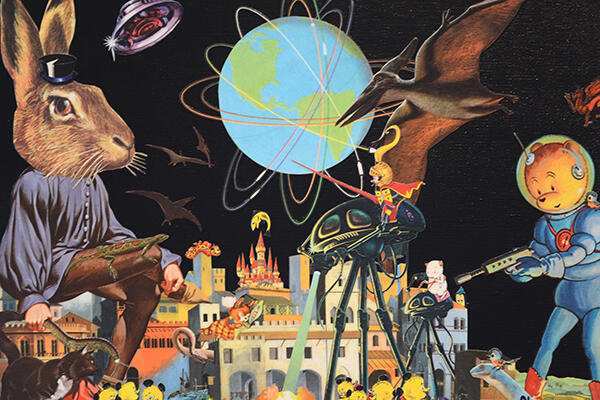
Review: This World is your Oyster
Mint Gallery New Zealand-based collage artist Peter Lewis has been forming, re-forming, configuring and reconfiguring popular culture and its images since 1990. Peter‘s work has been featured on CD covers in New Zealand and in the United States, in the San Francisco-based art magazine Churn and, more recently, in the New York art and fashion magazine Fifth Avenue. His work has been exhibited throughout New Zealand, in Germany and briefly (and without authorisation) at the Museum Of Modern Art in New York City. A selection of Peter Lewis’ work is included in the book Masters: Collage. Lewis admits that he has been “cutting up magazines and rearranging images for over ten years now, and some words to describe my collages might be: psychedelic; weird; lurid; and wry,” which perfectly describes the current exhibition at Mint Gallery, This World Is Your Oyster, too. Over the past decade, Lewis has been living, working and travelling around America, getting inspired by people, popular culture and places – Portland, most recently. His 2013/2014 trip to the US was a key source for his current exhibition. There he attended his first US show in Portland and spent two days in San Francisco with his art hero and mentor, master collage artist Winston Smith (album artwork: Dead Kennedys, Green Day, Ben Harper). Many of these pieces attempt to capture the transitory moments of travel, and instead of being carefully staged compositions, they are snapshots in time, which resemble a kaleidoscope of colourful and kitschy images, juxtaposed against one another. They all go in different directions, defying gravity and challenging the viewer to make sense of their surreal, contrived, wayward world. As a viewer of such compositions, one is required to make their own interpretations, embodying the thematic undercurrent of each piece, which draws attention to the magic of imagination. Most of the pieces are set in what I would assume to be space, as the background is black and each piece often features some kind of weird spatial looking image – like an asteroid, a UFO, a cartoon image of the world – with layers of other images arranged in the foreground. Each piece (especially “Travel is Dangerous” and “Fire Walk With Me”) pretty much looks like the result of a Hieronymus Bosch- or Salvador Dali-type, who took some acid, went into a 90s-kid’s cupboard, pulled put all their old posters and K-Zone magazines, cut them up and rearranged the images on a canvas to create a nonsensical, popular culture collage – in the best way possible. There are pictures of flying dinosaurs, fish-headed planes, fairy-tale characters, numerous rabbit heads, World of Warcraft characters, a moon, and Fantastic Mr Fox. I’m not really too sure how to make sense of the images collectively, but it is this nonsensical element that makes the work so fun to look at. It’s like reading Alice In Wonderland or Fear and Loathing; I feel like it’s so cool and maybe really clever, but what the fuck does it mean? Considering all of the works, I think this is the whole purpose; to question how we perceive popular culture and all its commodification. Popular culture is a messy but magical meshing of so many things – strands of history, culture, people, places, moments, everything – and it seems Lewis, in his art, is drawing attention to this, and asking the viewer to challenge the idea culture can be limited to one perception, when there is such an excess and every individual will interpret moments, artefacts – life – differently.
-
Culture
The Giver
Rating: B+ We are currently in the midst of the latest film fad, with a litany of studios trying to cash in on the success of The Hunger Games by also creating post-apocalyptic young adult movies. Though The Giver fits comfortably into this fad, it has a few advantages over the other members of the bandwagon. Firstly, the book in which the movie is based was written in 1993, long before the current literary fad began, so it has some unique ideas to communicate. Secondly, this movie was a passion project of the great Jeff Bridges, which gives the whole thing a huge dose of legitimacy in my opinion. The Giver is set within a confined community in which each member has been designed, bred and raised to live in uniformity with others in the society. Outwardly this uniformity has created a Utopia in which everyone lives in peace. However, it becomes quickly apparent that this peace has come at the price of human emotion and memory, with everyone’s emotions being chemically controlled. The protagonist Jonas is bestowed the greatest honour in this society as the Receiver of Memories, this allows him to regain his full spectrum of emotion and be allowed the memories of humans past. The narrative itself is quite comfortable, spending the majority of the film exploring these concepts of discovering emotion and memory and only really introducing conflict at the end. However, the concepts are strong enough to carry the movie and at times are really quite profound, leading you to reflect on our capacity as humans for a dynamic range of powerful emotions, and how pain really is necessary if we also want to experience the greatest of emotions. These concepts were so successful mostly due to the performances of Jeff Bridges and Meryl Streep. Jeff Bridges in particular gave a performance that was intensely evocative and powerful and really illustrated the pathos and importance of the films central themes and ideas. The Giver may be just one of many in an overcrowded genre, but it undeniably has some of the most engaging ideas to communicate.
-
Culture

Teenage Mutant Ninja Turtles
Rating: B+ I like movies that don’t require a whole lot of cerebral activity, because all of my available neurons go toward passing my classes. However, TMNT was hilarious, in an “I can’t believe these are 21st century graphics” sort of way. Let’s start with the obvious, shall we? The turtles. Dudes are ‘roided up. I was never a huge fan of the cartoon as a kid, but I am fairly certain they aren’t supposed to be a potential source of terror (until they start with the kitschy teenage dialogue and angst). And there’s just something about them that doesn’t look quite real. They don’t quite fit with their surroundings. Okay, they are six-and-a-half feet of mutant turtle, but they still don’t look real enough. And don’t even get me started on Master Splinter! Taught himself ninjutsu from a textbook, my ass! Having ranted about the steroided superturtles and their odd graphics let me say that I do find the character development charmingly funny. I giggled a few times, and I finished the movie thinking that Michelangelo was kind of adorable. Rafael was an awesome big bro, Donatello works the badass nerd thing, and Leonardo is an all-round good guy. Megan Fox’s character April develops a bit as well, though I spent most of the film trying to figure out what was different about her. She plays a passable heroine though, which I guess is all anyone can ask for in a movie about ninja superturtles. No, my real issue with this film were the parallels to other films. Hey, glowing green serum that transformed four itty bitty turtles into giants? Ahem … Hulk. Some sort of chemical bomb to be launched from the top of a pharmaceutical corporation’s roof in New York, which will level the population? Ahem … Spiderman. And finally, the whole Master Shredder/Master Splinter thing was a tad too Darth Vader/Yoda to be any sort of original? Cue heavy mouth breathing. Overall, it was an all right film. The action sequences were pretty good, and they nailed the male, teenaged personalities shtick. I’ll probably buy it when it comes out, not sure fans of the show will emerge from the theatre happy, though.
-
Culture
The Life of David Gale
Cult Film Given Sir Alan Parker’s high directorial pedigree (Mississippi Burning, Bugsy Malone, Pink Floyd – The Wall, among many others), a collaboration with Kevin Spacey (Gale) and Kate Winslet (Bitsey Bloom) is a mouth-watering proposition. However, this was a film universally panned by critics. Why am I writing a review of it then? I’m not entirely sure, but there’s just something about this one. David Gale is a professor of philosophy opposed to the death penalty and a brilliant scholar who cannot defeat the Texan Governor who “hates killing so much he will kill to stop it.” He then finds himself falsely accused of rape, subsequently acquitted, but then ends up on death row for the disturbing and brutal murder of a terminal leukaemia sufferer, who is also a good friend and fellow anti-death penalty activist. Pretty intense stuff. While it’s clear that the justice system is convinced of his guilt, the journalist Bitsey Bloom refuses to accept it. The story now revolves around her reconstruction of events through Gale’s flashbacks, and grizzly investigations into the death. Somehow the film ends up taking two hours, but it has a semi-morbidly fascinating air. Unfortunately the audience is left in the dark most of the time, in an attempt to set the film up for a gripping finish. Winslet and Spacey, to their credit, are very convincing in their roles and carry the film through its more uninspiring moments. It’s easy to be drawn in by its frequent twists and turns and heavy subject matter. However, its immense directorial and casting potential is ruined by a plot that takes too many turns and distastefully flashes words like ‘innocent’ and ‘rape’ across the screen in an attempt to be more dramatic. But if you want to know how it all ends, give it a watch.
-
Culture

Hook
Classic Film Hook is basically a representation of my childhood; I watched it so many times I destroyed the VHS. Given my attachment to all things Peter Pan and disinclination to actually grow up, it’s probably a fair representation of my current psychological state as well. This was one of my most beloved films as a child, and I couldn’t imagine anyone other than Robin Williams playing the adult version of that most beloved character, Peter Pan. Of course, being a grown up (ugh) and a lawyer (hmmm), his name is Peter Banning and in the beginning he’s kind of an uptight ass. Robin Williams bought a kind of magic to every personality he ever portrayed, and I don’t think I love any of his films quite like I love Hook. He embodies everything about the character Banning, from the stressed, grown-up lawyer we are presented with for the first half hour, to the man that finds who he is, and who he was, throughout the rest of the movie. Julia Roberts is a charming, heart-breaking, badass Tinkerbell and Dustin Hoffman plays, in my opinion, the best rendition of Captain Hook ever committed to film. Through the interplay of these fantastic actors and the magic they bring to the silver screen, the viewer is drawn into Neverland with them, with the Lost Boys, with the pirates of the Jolly Roger and with the mermaids of Mermaid Lagoon. Hook is a more mature version of Peter Pan than the original Disney cartoon, though not quite so mature as Barrie’s original play. It also reveals a new theme or moral the older you are when you watch it, yet I am as enthralled by every scene now as I was when I was three or five. Watching it again this week, in the knowledge that all we have left of Robin Williams was heart breaking. However, it also made what he left to us all the more precious, because it is a rare actor that can bring the heart and the joy to characters like Peter Pan that he could. If you haven’t seen this film, you need to. It is a perfect example of the magic of Robin Williams.
-
Culture
New this week / Singles in review
Iceage - How Many “How Many” is the third single from Copenhagen-based band Iceage, who are right on the cusp of releasing their third album, Plowing Into The Field of Love. Where first single “The Lord's Favorite” had a twisted, country influence and second offering “Forever” seemed like a long lost Birthday Party track, “How Many” is a euphoric, blitz of jagged, cold, postpunk fury. From the archaic stabs of piano, to the fluttering, guitar discordance, the group paint a picture of monstrous bleakness. “I have a sense of utopia of what I truly ought to do,” Rønnenfelt moans, expounding on his inability to live up to his own expectations. This track has a lack of control that seems to breed a lunacy; an undercurrent that simmers beneath the surface of the song’s icy splendour. Thom Yorke - A Brain in a Bottle Thom Yorke has released a new album, Tomorrow's Modern Boxes. Never afraid to experiment with new ways to package his music, the Radiohead frontman has released the album through torrent service BitTorrent. “A Brain In A Bottle” is the opener of the album and is also available to download for free. The album in its entirety costs six dollars. The track features a beautifully textured, electronic soundscape that is at times circled by a surrounding sonic buzz or a hostile siren-like noise. Yorke's falsetto is as sensual as it is haunting, and sizzles across the glassy, crisp percussion. Future Brown - Wanna Party [Ft. Tink & 3D Na'Tee] Future Brown is the resulting collaboration between the talented trio of Fatima Al Qadiri, Nguzunguzu and J-Cush. “Wanna Party” also features the talented New Orleans rapper 3D Na'Tee and Chicago's Tink, who contribute a mesmerizing series of rhythmic, deadpan verses. The production is something I really love. The soundscape is beautiful, cold and machine-like. With ethnic, ambiguous samples that are truly hypnotic. The beats comes in and out like gears shifting in a factory, helping the track transition beautifully from one section to the next. Tala - Alchemy TĀLĀ is an artist from South London who is set to release her EP Alchemy in mid-November. This single of the same name is a beautiful, glistening, pop ballad, emoted over an atmosphere of broken mirrors, glitchy samples and other remnants of chaos. The track showcases TĀLĀ at her most accessible to date, but still contains the finesse of her electronic, instrumentals featured in her earlier work on the Duchess EP. Marianne Faithfull - Late Victorian Holocaust Marianne Faithfull has sustained quite a wonderful career, and is one of the only active artists from the scene we now remember as Swinging 60s London. Her voice is raspy, full of weight and drenched in what sounds like a cold, bitter exhaustion. “Late Victorian Holocaust” comes from her upcoming album, Give My Love To London. Though the track's lyrics are written by Nick Cave, Marianne sings them with conviction and a polarising, dreary honesty. A brooding, gothic ballad, the song is a haunting remnant of the scene in which Marianne was very much a part of. The track also features bone-chilling strings that highlight the dark, ominous instrumentation wonderfully.
-
Culture
Download of the week: Strange Harvest - Astronaut [NZ]
Strange Harvest are a local duo who make haunting, beautifully textured, electronic music. “Astronaut” is a chilling, down-tempo, pop song that features majestic sounding keyboards and wonderfully noisy guitar playing. The soundscape is wondrous and full of static and strange machine-like chugging. You can download the song for a name-your-price deal from the group's bandcamp, strangeharvest.bandcamp.com. Also be sure to check out their equally engulfing, previous two albums.
-
Culture
Artist Profile: Luckless
Luckless is a self described “two-piece melodic, neurotic, melancholic indie rock band from Auckland.” Having just released their sophomore album, Critic's Adrian Ng catches up with songwriter Ivy Rossiter to talk about her group's new record. Was there a moment that made you want to do music? I’ve always played music, and I’ve always wanted to play my own. I remember listening to crappy singer-songwriters at the age of about 13 and wanting to be able to DO THAT. Then I was going to punk rock shows and writing zines at age 18 and 19 and was simultaneously passionately inspired by the scene and deeply depressed because I didn’t want to be just in the audience any more. I think that was when I realised that I would be happier as a failing musician than as a successful anything-else. But it took me a very long time to summon up the chutzpah to actually commit myself to jumping into the abyss of putting pen to paper and feeling like I was allowed to write. Not many people tell you that you’re not going to be any good when you start – they’re more likely to tell you that you’re either born with it or you’ll always be a faker. I had to spend a lot of time making terrible music before I came up with anything I was remotely proud of. Your new album is titled Vindication Blues, was there a story behind that name? Vindication Blues is that combined feeling of self-righteousness and depression you get when everything you predicted would go wrong, did go wrong. Perhaps it’s self-sabotage, but I prefer to think that it’s just supreme realism. What was the process like this time round compared to your debut release? This record came together much more quickly than the debut. The first record was a culmination of a few years of writing, and the recording process was stretched out over an entire year, done in dribs and drabs when we could find time at the studio. For Vindication Blues, all the songs were written within a year, and we spent three weeks at The Sitting Room in Lyttelton and one week at The Lab in Auckland, and then it was done. It was a lot more raw and immediate than the first one – more live playing and more sophisticated, production-wise. And perhaps it’s a more personal record, less abstract. Did anything special influence the songwriting process? I split up with my hometown of Auckland at the end of 2012 and spent most of the following year travelling and playing music. That dislocation and alienation of being rootless and away from any kind of spiritual home definitely fed into what I was writing about. I landed in Lyttelton, where many of my working-musician-comrades live, and found a lot of support and inspiration here, especially in the work ethic of those same friends, who are forever writing and performing and bettering their craft. I think this album came out as well as it did because of the level of commitment we were able to bring to it. Finally, if you could steal a musician's songwriting powers, who would it be? Lyrically, John Darnielle from The Mountain Goats. One of my favourite lines of all time is from his song “Old College Try” from Tallahassee: “the way those eyes I’ve always loved illuminate this place like a trashcan fire in a prison cell / like the searchlights in the parking lots of hell.” Musically, St Vincent. Her guitar-playing and her arrangements and her experimentation are like lighter fluid torching all the rest of the guitarists I’ve ever seen.
-
Culture
The Very Hungry Caterpillar
Warning: The following critically acclaimed piece contains spoilers of the material in the book. Solace is Caterpillar. Societal image issues. Eating disorder bullshit. Three phrases that come to mind when I think of this book – a book that lures the eyes more than a hair-flicking Robert Pattinson lures a 12-year-old girl. Claustrophobics beware: our main character is caged from page two, forcing reader empathy right to the point of tears with the pre-larval, leaf-eating worm with legs. Like a sentient city in a snow globe, our Caterpillar must be ambling to scratch the skin membrane of its egg prison. The Very Hungry Caterpillar then pulls some Shawshank Redemption shit and “POP!” from the egg emerges our hero. Our larval friend joins society and, if one reads between the lines, the plot consists of our friend making a choice. To its right lays a path of various fruits in various numbers, each one day from each smorgasbord. To its left is the latest edition of the Caterpillar Girlfriend magazine, spotlighting a skeletal image of the Caterpillar Selena Gomez. Her figure like that of a slightly hairy pencil in a loose fitting, size zero, silk bathing suit. Those weak of will might fail, but not our Caterpillar. Our friend skips to the right as we follow with the page flicks. In addition, as a point of criticism, I felt that days Tuesday through Friday were really just filler. It felt very much like new fruit, new number, but the same shit. At this point of the book (pages four to eight) you wouldn’t miss much by skipping ahead. The only thing that persists is our hero’s hunger that, like our love for the main character, is unending. That is, until day six, Saturday. Yes, it’s great that our main character managed to ignore society’s views about how caterpillars should appear, but come Saturday we find out that our hero has an eating disorder. Six sugary, two meat, one fatty dairy and one vegetable were the meals chosen. Clearly the Caterpillar saw the food pyramid on Friday and decided to eat that too. We’re so full we now have a stomach ache. So what to do? Our hero can’t put his stubby legs into his mouth and vomit – they are just too small. However, we can tweet about this problem, #DesignsAgainstBelemia. No pharmaceutical company is making antacids for caterpillars. It must endure; it must survive. Sunday it has a salad and it’s all good. After the events of Saturday did our main character really think there would be a consequence? A recycled plot device from page two sees the hero re-caged in a cocoon. Once again caught, once again freed, once again lonely. The membrane replaced by silk walls but the effect is the same. Worse still it’s a room for two, our hero and the villain, a caterpillar geneticist. Injection after injection, experiment after experiment, our hero must endure two weeks of pain and transformation until it is such a freak that it manages to bite its way to liberty. Overindulgence has made a freak from a beautiful individual. It is Caterpillar no more.
-
News
Kia ora nga Tauira Maori o Te Whare Wananga
YAY. It is that time when we’re nearing the end of lectures and the beginning of EXAMS! Yahooooo. This will be our last column for the year in the awesome Critic magazine. I would like to thank everyone who has been involved with TRM this year: no matter how small or how big your contribution, it has been amazing! We have just completed a huge month full of elections and I, for one, am glad its over. However, specific congratulations to our new TRM executives 2015! Thank you to all the voters – a whopping 312 Māori students voted in TRM elections. Ka Pai! Our hot topic this week is all about Te Rōpū Māori Hui Motuhake (AGM). This is where your new executives for 2015 will be introduced to you all. But more importantly, this is also where changes are made. So please read the proposed constitutional amendments and send in your feedback (for example, if you agree or disagree with any changes). Have your say because this affects all of you in some way. We hope to see you there! Also we have the financial budget to submit at our AGM, which makes it even more important for you all to have a look and have your say. If you agree, disagree or have patai, please send them in to TRM email before the AGM. On a more fun note, if you want to chillax and sing some waiata before exams come along to TRM whare and give us a “G-sharp.” You all know how I love karaoke I will totally join you with an “E-minor.” Best of luck for your exam preparation. You are all most welcome to use TRM whare and if you need any support, let us know and we will sort it out together. Love you all. Peace out!
-
Culture

The Wolf Among Us
Since the phenomenal runaway success of Telltale Games’ The Walking Dead from 2012, the gaming world has waited with bated breath to see what Telltale would produce next, and if they could repeat their past successes. The Wolf Among Us was that follow up game, and though it is not quite the revelation that The Walking Dead was, that in no way diminishes the fact that Telltale has once again shown the depth and breadth of storytelling available through the point-and-click adventure genre. Wolf Among Us is based on a series of graphic novels called Fables. Set in New York City, Fables is about fairy-tale characters that have moved from their realm and seek to live in secret in the human world. Though Fables is about children’s fairy-tale and fantasy characters, it is very mature, communicating its stories of these characters through a gritty, Noir style that highlights the disturbed nature of many of these stories and characters. The Wolf Among Us functions as a prequel to these graphic novels. A wise move from Telltale, as it allows players to jump in without being familiar with this lesser known series. This five-part episodic adventure follows Bigby Wolf, the anthropomorphized version of The Big Bad Wolf, who functions as the Sheriff of all Fables (“Fables” being the name given to fairy-tale characters living in the human world). Throughout the five episodes you play as Bigby as he seeks to solve a series of murders that have been committed against Fables. As a Noir narrative, you can expect all of the intrigue, suspense and violence that have become synonymous with this genre since the days of Raymond Chandler. However, what you can’t expect is to have the same emotional experience that no doubt many of you had with The Walking Dead. However, before you chalk this up as a failure on Telltales part, it needs to be recognised that this difference in genre is bound to produce difference in experience. For example, though The Wolf Among Us lacks the same depth of pathos, it makes up for it in exhilarating action. Each episode contains at least two or more moments of very clever action sequences. These generally take the form of brutally violent fight scenes. The regularity and quality of these action sequences is very impressive considering that the point-and-click genre is not known for producing games that have action at all, let alone the excellently conceived and executed action that Telltale has produced. However, as is becoming expected of Telltale, the focus of the game is mostly on character interaction, development and branching decision-making. Throughout the game Bigby meets a diverse cast of varied and interesting fairy-tale characters, such as Snow White, Beauty and the Beast, Georgie Porgie, Ichabod Crane and just about someone from every other fairy tale that you can think of. In fact the lore is so deep that even if you don’t run into a fairy-tale character, the game is overflowing with references, Easter eggs and codex information about almost any character you can think of. Each of these characters are a superbly conceived real world counterpoint to their fairy-tale self, often supporting and subverting facts about their character as is necessary to illustrate the disturbing nature of these stories. For example, Georgie Porgie (who kissed the girls and made them cry) is a sleazy and abusive male chauvinist who runs a strip club. As you play through the game the dialogue decisions you make not only build out Bigby as a character, but also establish and build relationships with all of these characters. These relationships, positive or negative, directly affect the progression of the story and there are bound to be many moments where you’ll wish that you had been nicer to a character, or perhaps that you’d been much, much meaner. The Wolf Among Us is an ambitious and tonally divergent next step for Telltale as they build off of their past successes. Though the game does many things well, including their new integration of action, a fascinating cast of characters and an intriguing and eventful Noir narrative, all of these factors suffer from the fact that the game never manages to connect with you emotionally. You’ll no doubt want to keep playing because the game is fun, but there’s little chance that you will want to keep playing because you care, which I think at it’s root is the magic of the point-and-click genre.
-
Columns
Science, Bitches | Issue 26
I’m pretty sure everyone reading this has had antibiotics before. To be honest, they’re pretty great. But the way we use them has to change. When Louis Pasteur first noticed a fungi killing his bacteria, the arms race between bacteria and antibiotics began. In 1928, he noticed that a compound the fungus made was killing all the bacteria in his petri dishes. This turned out to be penicillin and it was amazing. If you had a bacterial infection, this new wonder drug could stop it. Fast forward to 2014, and we’ve got a plethora of antibiotics to choose from, but we’re actually getting worse at treating infections – I’m sure you hear about outbreaks of antibiotic resistant bacteria like MRSA all the time. So what happened? Why did we start losing the race? It’s a pretty simple answer, actually – evolution. I’m sure you all understand the concept survival of the fittest. It’s pretty easy to grasp. Take a population (2000 freshers?) put them in an environment (first year health sci?) and only the ones that can cope will make it to med school. Now that’s only one environment – take the same 2000 students and drop them in a desert, a different group would “survive.” Or if you sent them to X Factor, it would be a different group again. If you were going to get even weirder with this experiment, imagine if you took the “survivors” and made them have kids with each other. You put their kids in the same situation, and the ones that survive would have kids that were bloody good at memorising stuff/finding water/singing. It’s not that the environments have created that trait, it’s just taking advantage of natural variation found in the population – some people are brainy, some are sporty, some are arty. Now imagine that instead of waiting a couple of decades to have kids, these people could reproduce every 20 minutes. And imagine that the “environment,” or selection pressure, is an antibiotic like penicillin. It only takes a small change to the DNA of one bacteria for it to become resistant to penicillin, so if you take penicillin, that’s the one that will survive. If it has a chance to grow and reproduce, most of its offspring will have that same DNA change that makes them resistant. If you try to use penicillin on this new population, it won’t work very well. So what you’ve got to do is, basically, kill them all first time around. When you take antibiotics, feeling better doesn’t mean you can stop – even when the infection is gone, a couple of bacteria might still be hanging around. But that’s all you need to become re-infected, except the next time it’ll be harder to kill. So, PSA: always finish a course of antibiotics. Oh, and they don’t kill viruses, so if you have a cold then stay well away – all they’ll do is hurt your friendly bacteria! The problem is that antibiotics are used all the time, globally, so inevitably some slip through the cracks and become resistant. But the good news is that they often lose resistance over time – if you’re not in a desert, why would you practice finding water? So maybe we just need to cut down on our antibiotics a bit. Antibiotics are great, but we should only be using them when we really need them. That’s science, bitches!
-
Columns

Defending the kingdom | Issue 26
While teaching and travelling in what is now Zimbabwe and Malawi, my grandmother chose not to accept the barriers of apartheid. She stuck out as a lone white woman amongst African friends knowing that at least a passive stand was the moral thing to do. Parallels between racism and speciesism have been made in this column before; an obvious one here is that choosing not to eat meat in the face of societal norms is equivalent to my grandmother rejecting the status quo accepted by Europeans in Southern Africa. This analogy came to mind when she pointed out that the sheep, cows, pigs and chickens we eat would not exist if there were no industry breeding them for slaughter. This is an argument I had seen before but was not entirely sure how to address. It is certainly more complicated than “but I like bacon too much” but, to me at least, seems just as ludicrous. With the help of Carl Scott; who recently scaled a 20m high pig farm silo to promote “vote[s] to stop factory farming,” I worked through what is wrong with justifying slaughter by saying the existence of farm animals depends on the meat industry. First, there is nothing wrong with the animal not existing in the first place. But once it is born, restricting its autonomy and putting it through physical and psychological suffering in the name of meat is evil – as discussed in earlier columns. Farm animals getting a life and people getting to eat their flesh are the “positives” of meat, but this does not outweigh the negatives endured by the animals, the ecosystem and society. The wide-ranging implications of farming are topics for past and present columns, but it is certainly worthwhile pointing out that from a human perspective, far more people could be fed, and fed well, if we used our land to sustain plant-based diets. This point is best explained by an ecologist, but it is simple enough to understand that the land used to feed stock, both directly by grazing animals and indirectly by producing feed, is not going to sustain less sentient life if farm animals do not exist. The land could sustain wildlife, like great tracts of forest used to. Or, as is far more realistic, the land could grow food for far more people. The root cause of all animal welfare issues and the phenomenal rate of animal extinction is humankind’s inflated sense of entitlement to everything on Earth. If we are that great, perhaps more of us should be fed. If not, or if we want to enjoy a more diverse, beautiful and sustainable planet, we should be reducing monocultures that exist to feed animals that exist to feed us, via the aforementioned enslavement and suffering. Either way, people don’t need to control and then end lives for lives to exist. Like my grandmother chose not to embrace white privilege, we should not accept the way things are just because they are convenient.
-
Columns

Queer Eye | Issue 26
A pretty, young, white, rich, heterosexual, cisgender woman got up at the United Nations and made a speech about how important it is for men to get on board with movements towards greater gender equality. It was a nice, non-confrontational speech that has already been spread widely on social media and has been picked up by most major global news outlets. She conveyed a simple message that we need to stop scaring men away from feminism and that they need to be included because patriarchy hurts them too. Now I don’t want to focus on what might be wrong with this this speech but rather focus on what was right. In my humble cisgender male perspective, it is important to continue extending an invitation to men to take an active role in movements that promote gender equality and to do so in a non-threatening way. Many men want to be better and to do better but have no idea where to begin. I specifically believe it is the role of men who have already begun a feminist journey to be evangelists for other men to join in. One person who helped me on my feminist journey was a blogger called Michael Urbina who penned an article called “101 Everyday Ways for Men to Be Allies to Women.” Reading this I rejoiced (in quiet smugness) at how many of his suggestions I was either consciously or subconsciously already doing. I also enjoyed fun tips, like: “Turn magazines that promote sexism and unhealthy body image backwards at your local supermarkets and newsstands.” This whole feminism thing sounded fun, achievable and a way in which I could be a great ally for women! There were a couple of tips, though, which I thought were a bit silly and over the top. One said, “Walk on the other side of the street when a woman is walking towards you at night.” I thought this was a little ridiculous especially in the well-lit and safe streets of Dunedin. Of course this was my male privilege at work as I was to find out just a couple of weeks later. It happened to be evening and I was walking home from the Octagon when I turned a corner and ended up on an empty street following a lone women. By the looks of her mat and clothes she had just left a yoga class. It was autumn so I was in my usual black jacket and I should mention that I have a fairly tall and broad build. I was following her at what I thought was a safe distance of about 50 metres but she heard my steps and glanced behind her. My silhouette was clearly disturbing to her as she kept glancing back as she picked up her pace. Her glances became more and more anxious as she upped her pace into a sprint. I stopped, stunned as I realised that she was terrified about being along on an empty street with me just because of my size and gender. So, men: I join with Emma Watson to call on you to become a part of the movement for gender equality. To do this you must first educate yourself. Read some articles, read some blogs and, most importantly, read books written by Bell Hooks, Betty Friedan, Virginia Woolf, Judith Butler and Margaret Atwood. Then take your learning and apply it in your everyday life by understanding your privileges and taking concrete steps to challenge them.
-
Columns

Too much screens | Issue 26
I'd love to visit New York City. I feel like I know exactly what it would be like. Part of the reason I'm so certain is that there are a bunch of shows I love which largely take place around Brooklyn and Manhattan, which definitely feel like they're happening in the same place. With any luck, that place, that New York, is the real one. The shows I'm thinking of — Louie; Girls; High Maintenance — take place in a city at once bustling and relaxing, grey and colourful, uncaring and highly communal. It's a city where the rent is exorbitant, so everyone's low-key poor, but it's full of places to get great, cheap food, so everyone eats out. It's a city where the unexpected is dependable, and where young adults can find their people, no matter how specific their interests. Broad City is another show that takes places in that same New York. Like those other shows, Broad City is a very loose affair, following the shaggy, slightly surreal adventures of two young women bumbling around in New York. Abbi, an aspiring illustrator but day-time gym cleaner, is the more serious of the two, half-heartedly attempting to control her life, but largely indulging her laziness and desires to buy everything at Bed, Bath and Beyond, while Ilana does exactly what she wants, and is miraculously still employed even though she regularly sleeps in the bathroom stall for most of the day, and leaves whenever she feels like it. If you've seen Peep Show, you can think of them as rough distaff counterparts to Mark and Jez. Unlike the bipolar relationship shared by the El Dude brothers on that show, though, Abbi and Ilana's relationship is remarkable for its strength. Although Ilana's reckless and unpredictable, rather than being a source of conflict, there's a definite sense that's exactly what Abbi values about her. Similarly, Ilana thinks Abbi's the shit, and would do anything for her, including definitely sleeping with her if she was into that. That strong female friendship is important, because as much as the yellow cabs and bodegas, sexual weirdness from gross men is part of the background noise of the New York these girls live in, from the diapered guy who hires them off Craigslist to clean his house for cash, to the greasy, pelvic-thrusting locksmith who shows up when Ilana loses her keys. These guys are so caught up in their sleazy little worlds that they end up implicating anyone they come in contact with, and the girls' response is generally to get to a safe distance, then point and laugh. Looking past the central duo, the rest of the show is filled with hilarious, distinct, secondary characters, in particular Ilana's dentist/sometimes sexual partner Lincoln, played by the inimitable Hannibal Buress. Anyone familiar with Buress knows how particular his brand of comedy is, but it fits in easily here. Even the one-off characters leave an impression, from yoghurt-eating courier depot attendant Garol, to Amy Poehler's martially-challenged chef in the finale, to every one of the girls' previously-unmentioned and probably never-to-be-mentioned-again friends in the episode where they desperately try to get to a wedding. All in all, Broad City is a very accepting show, aware of its protagonists' flaws, but celebratory of the small pleasures they find in each other and the city around them. It doesn't matter if you're terrible at your job, or if the super hot guy you slept with turns out to be terrible at comedy, or if after a day of trying you failed to buy your own weed, like a “real adult;” as long as you have good friends, and live near some of the world's best pizza places, you'll have a good time and things will be fine.
-
Columns

Love Is Blind | Issue 26
BoyWell, we didn’t have sex. I thought I would save you all the time by just coming out and saying that. But for those who want to read on … It was as I went to the Octagon that I realised that I didn’t know where Di Lusso was. Resembling a man with his thumb up his arse, I managed to Google Maps my way there. And there she was. It was like the scene in the movies where the guy stares at the girl across the room, the girl who is perfectly lit and whose hair is blowing playfully in the wind. She was the one … standing next to my Critic blind date. Yeah, the person to her immediate right was to be my date for the night. After some negotiation, we settled on the cheese platter for the meal. This was partly strategic on my behalf, as it would assist in masking the smell of Wednesday night’s lasagne that was inconveniently making a rapid exit in a gaseous form. After gagging my way through conversation, I hastily made a polite beeline for the yet untarnished porcelain. With the kids floating happily in the pool, I put on a brave face and went back out to make more mundane back and forth. Being plied with wine didn’t really stimulate anything other than an exchange of niceties. With the night bombing more than the current situation in Iraq and Syria, it became especially apparent that it was my time to leave when her flatmates turned up to round off their red card. I headed back home for what was always destined to be a late night sparring session with Samuel L. Jerkson. A big shout out to Critic for sending me on a blind date with my sister’s friend. GirlAs the only single and willing girl in the flat, I took it upon myself to sign up for the Critic Blind Date. However, unwilling to let my flatmates off that easily, I pulled a red card that involved setting the rest of the flat on blind dates of their own. Arriving at Di Lusso with a spring in my step, I patiently awaited my date. Having been unlucky in the love department for my three years in Dunedin, I decided to lower my standards for the night. When my date finally showed I realised that perhaps I had not lowered them enough. I don’t want to give this fella’s identity away but I will go as far as saying he was a mixture of Prince Harry and Prince William, having both the fiery locks of Harry and the premature male pattern balding of Will. But that I could have handled. The fact that he was the older brother of a friend was too much, and I realised that this date was not going to come to a “happy ending” as first hoped. To make the most of a pretty awful situation, I attempted to enjoy the available bar tab. My date, however, was more interested in the food on offer and managed to hoover his way through the entire “Big Cheese” platter. Charming. The chat was average at best and I found myself trying not to yawn as he bragged about how well he’d done in a previous marketing assignment and all the “banging” chicks he’d met on Tinder. When the bar tab was as dry as my panties, I flicked a text to my flatmates to come to the rescue. They hit Di Lusso like a tornado and my date was lost in the debris, never to be seen again. Date, if you’re reading this, I hope you got home okay. All in all, it was as if I was having a date with my brother, or maybe even an uncle. Cheers, Critic, for the drinks.


