

Strange Harvest are a local duo who make haunting, beautifully textured, electronic music. “Astronaut” is a chilling, down-tempo, pop song that features majestic sounding keyboards and wonderfully noisy guitar playing. The soundscape is wondrous and full of static and strange machine-like chugging.
You can download the song for a name-your-price deal from the group's bandcamp, strangeharvest.bandcamp.com. Also be sure to check out their equally engulfing, previous two albums.
Culture
More Culture from Issue 26
-

Custard filled chocolate éclairs
I made mini chocolate éclairs the other day. Not wanting to brag or anything but they were amazing. Rather than filling them with whipped cream (which you, of course, can do) I filled them with delicious homemade custard. The lesson here is that if you cover your food with enough flowers and artistically sprinkled freeze-dried raspberry crumbs, the entire Facebook world will overlook your shitty icing efforts and praise your excellence! Choux pastry is pretty simple to make. It doesn’t need to be made at a specific temperature or left to rest for X hours. The way choux pastry works is that the moisture in the batter evaporates during the baking process and forces the pastry outwards, resulting in an expanded pastry stick with a hollow centre. You need to slice these down the side with a sharp knife as soon as they come out of the oven or else the remaining steam will be trapped and cause the pastry to go soggy (not ideal). Make sure you use small eggs (size 5–6) so that the batter isn’t too wet. You can also make bigger fingers as well as circular éclairs; these will, of course, take slightly longer to bake (probably closer to 20 minutes). IngredientsMakes 14 mini éclairs For the Choux: 40g butter ½ cup boiling water 75g plain flour 2 small eggs 2 teaspoons white sugar ½ teaspoon vanilla bean paste For the custard: 2 small eggs 65g white sugar 35g plain flour 1 cup milk ½ teaspoon vanilla bean paste For the chocolate icing: 30g butter, melted ¼ good quality cocoa 1 cup icing sugar ¼ teaspoon vanilla bean paste Couple of splashes of milk To decorate: Freshly picked flowers Crumbled freeze dried raspberries ÉclairsPreheat the oven to 200 degrees and line a tray with baking paper. Melt the butter in a small saucepan, then add the water and bring to the boil. Add in your flour and stir until a ball of dough forms that comes away from the sides of the pan. Transfer you dough ball to your stand mixer (or you could do this by hand). Mix in the sugar and vanilla then one egg at a time. Make sure the egg is fully incorporated before the next one is added. Beat until the mixture is smooth. Transfer the mixture into a piping bag with a 5mm round tip fitted. Pipe small éclairs out by piping backwards and forth a 7cm or so line. Remove the pressure you place on the bag and make a quick jerking movement back over the line of batter to finish the éclair. Bake for 15 minutes or until they have turned golden brown and are hollow sounding. As soon as you remove them from the oven, slice open the side to release the steam. Leave to cool fully. CustardWarm the milk over a low heat in a saucepan. Beat together the eggs, sugar and vanilla, then add in the flour. Mix until all the flour has been incorporated. While still mixing, pour in the warm milk. Beat until the flour mixture has dispersed. Return the custard to the saucepan. Warm the custard over a low heat while stirring until it thickens to a pipeable consistency. Be careful not to let it boil. Leave the custard to cool in the fridge so that it further thickens. Chocolate IcingMix all the ingredients together in a small bowl. Add enough milk so that it forms a smooth, pourable consistency. You want to be able to dip the éclairs into it but not have it run all over the place. AssemblyUsing a piping bag, fill the éclairs with a line of cold custard. Carefully dip each éclair into the chocolate icing. Use your finger to spread it around if it needs it. Decorate with a sprinkling of crushed, freeze-dried raspberries and a flower. Keep refrigerated until serving time.
-
Review: This World is your Oyster
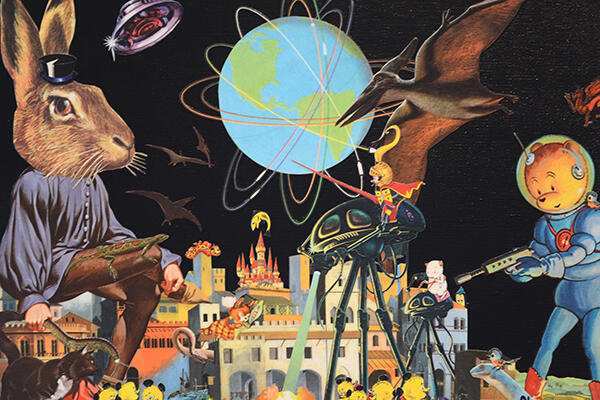
Mint Gallery New Zealand-based collage artist Peter Lewis has been forming, re-forming, configuring and reconfiguring popular culture and its images since 1990. Peter‘s work has been featured on CD covers in New Zealand and in the United States, in the San Francisco-based art magazine Churn and, more recently, in the New York art and fashion magazine Fifth Avenue. His work has been exhibited throughout New Zealand, in Germany and briefly (and without authorisation) at the Museum Of Modern Art in New York City. A selection of Peter Lewis’ work is included in the book Masters: Collage. Lewis admits that he has been “cutting up magazines and rearranging images for over ten years now, and some words to describe my collages might be: psychedelic; weird; lurid; and wry,” which perfectly describes the current exhibition at Mint Gallery, This World Is Your Oyster, too. Over the past decade, Lewis has been living, working and travelling around America, getting inspired by people, popular culture and places – Portland, most recently. His 2013/2014 trip to the US was a key source for his current exhibition. There he attended his first US show in Portland and spent two days in San Francisco with his art hero and mentor, master collage artist Winston Smith (album artwork: Dead Kennedys, Green Day, Ben Harper). Many of these pieces attempt to capture the transitory moments of travel, and instead of being carefully staged compositions, they are snapshots in time, which resemble a kaleidoscope of colourful and kitschy images, juxtaposed against one another. They all go in different directions, defying gravity and challenging the viewer to make sense of their surreal, contrived, wayward world. As a viewer of such compositions, one is required to make their own interpretations, embodying the thematic undercurrent of each piece, which draws attention to the magic of imagination. Most of the pieces are set in what I would assume to be space, as the background is black and each piece often features some kind of weird spatial looking image – like an asteroid, a UFO, a cartoon image of the world – with layers of other images arranged in the foreground. Each piece (especially “Travel is Dangerous” and “Fire Walk With Me”) pretty much looks like the result of a Hieronymus Bosch- or Salvador Dali-type, who took some acid, went into a 90s-kid’s cupboard, pulled put all their old posters and K-Zone magazines, cut them up and rearranged the images on a canvas to create a nonsensical, popular culture collage – in the best way possible. There are pictures of flying dinosaurs, fish-headed planes, fairy-tale characters, numerous rabbit heads, World of Warcraft characters, a moon, and Fantastic Mr Fox. I’m not really too sure how to make sense of the images collectively, but it is this nonsensical element that makes the work so fun to look at. It’s like reading Alice In Wonderland or Fear and Loathing; I feel like it’s so cool and maybe really clever, but what the fuck does it mean? Considering all of the works, I think this is the whole purpose; to question how we perceive popular culture and all its commodification. Popular culture is a messy but magical meshing of so many things – strands of history, culture, people, places, moments, everything – and it seems Lewis, in his art, is drawing attention to this, and asking the viewer to challenge the idea culture can be limited to one perception, when there is such an excess and every individual will interpret moments, artefacts – life – differently.
-
The Giver
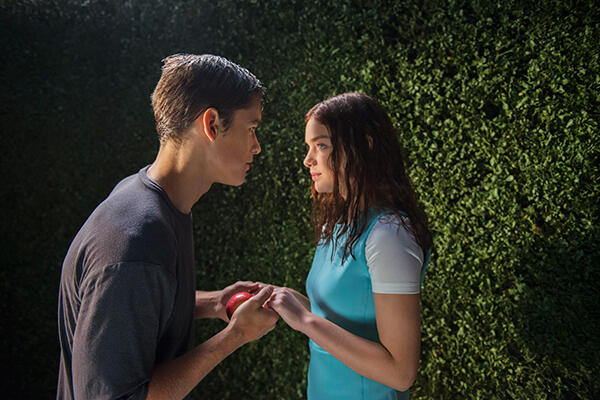
Rating: B+ We are currently in the midst of the latest film fad, with a litany of studios trying to cash in on the success of The Hunger Games by also creating post-apocalyptic young adult movies. Though The Giver fits comfortably into this fad, it has a few advantages over the other members of the bandwagon. Firstly, the book in which the movie is based was written in 1993, long before the current literary fad began, so it has some unique ideas to communicate. Secondly, this movie was a passion project of the great Jeff Bridges, which gives the whole thing a huge dose of legitimacy in my opinion. The Giver is set within a confined community in which each member has been designed, bred and raised to live in uniformity with others in the society. Outwardly this uniformity has created a Utopia in which everyone lives in peace. However, it becomes quickly apparent that this peace has come at the price of human emotion and memory, with everyone’s emotions being chemically controlled. The protagonist Jonas is bestowed the greatest honour in this society as the Receiver of Memories, this allows him to regain his full spectrum of emotion and be allowed the memories of humans past. The narrative itself is quite comfortable, spending the majority of the film exploring these concepts of discovering emotion and memory and only really introducing conflict at the end. However, the concepts are strong enough to carry the movie and at times are really quite profound, leading you to reflect on our capacity as humans for a dynamic range of powerful emotions, and how pain really is necessary if we also want to experience the greatest of emotions. These concepts were so successful mostly due to the performances of Jeff Bridges and Meryl Streep. Jeff Bridges in particular gave a performance that was intensely evocative and powerful and really illustrated the pathos and importance of the films central themes and ideas. The Giver may be just one of many in an overcrowded genre, but it undeniably has some of the most engaging ideas to communicate.
-
Teenage Mutant Ninja Turtles
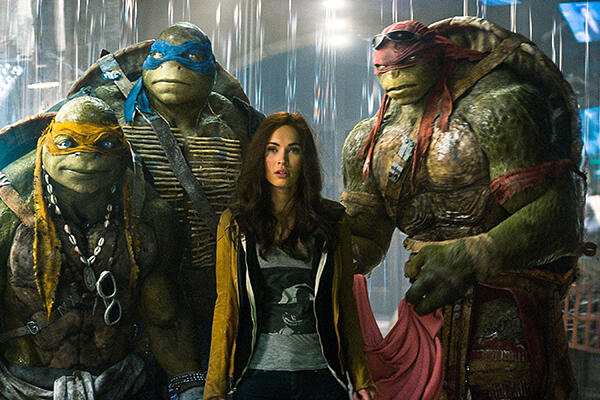
Rating: B+ I like movies that don’t require a whole lot of cerebral activity, because all of my available neurons go toward passing my classes. However, TMNT was hilarious, in an “I can’t believe these are 21st century graphics” sort of way. Let’s start with the obvious, shall we? The turtles. Dudes are ‘roided up. I was never a huge fan of the cartoon as a kid, but I am fairly certain they aren’t supposed to be a potential source of terror (until they start with the kitschy teenage dialogue and angst). And there’s just something about them that doesn’t look quite real. They don’t quite fit with their surroundings. Okay, they are six-and-a-half feet of mutant turtle, but they still don’t look real enough. And don’t even get me started on Master Splinter! Taught himself ninjutsu from a textbook, my ass! Having ranted about the steroided superturtles and their odd graphics let me say that I do find the character development charmingly funny. I giggled a few times, and I finished the movie thinking that Michelangelo was kind of adorable. Rafael was an awesome big bro, Donatello works the badass nerd thing, and Leonardo is an all-round good guy. Megan Fox’s character April develops a bit as well, though I spent most of the film trying to figure out what was different about her. She plays a passable heroine though, which I guess is all anyone can ask for in a movie about ninja superturtles. No, my real issue with this film were the parallels to other films. Hey, glowing green serum that transformed four itty bitty turtles into giants? Ahem … Hulk. Some sort of chemical bomb to be launched from the top of a pharmaceutical corporation’s roof in New York, which will level the population? Ahem … Spiderman. And finally, the whole Master Shredder/Master Splinter thing was a tad too Darth Vader/Yoda to be any sort of original? Cue heavy mouth breathing. Overall, it was an all right film. The action sequences were pretty good, and they nailed the male, teenaged personalities shtick. I’ll probably buy it when it comes out, not sure fans of the show will emerge from the theatre happy, though.
-
The Life of David Gale
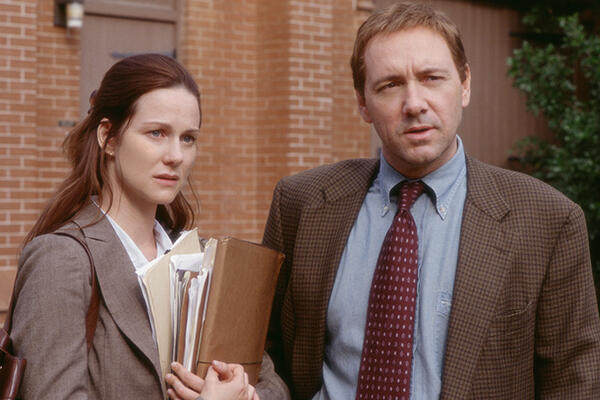
Cult Film Given Sir Alan Parker’s high directorial pedigree (Mississippi Burning, Bugsy Malone, Pink Floyd – The Wall, among many others), a collaboration with Kevin Spacey (Gale) and Kate Winslet (Bitsey Bloom) is a mouth-watering proposition. However, this was a film universally panned by critics. Why am I writing a review of it then? I’m not entirely sure, but there’s just something about this one. David Gale is a professor of philosophy opposed to the death penalty and a brilliant scholar who cannot defeat the Texan Governor who “hates killing so much he will kill to stop it.” He then finds himself falsely accused of rape, subsequently acquitted, but then ends up on death row for the disturbing and brutal murder of a terminal leukaemia sufferer, who is also a good friend and fellow anti-death penalty activist. Pretty intense stuff. While it’s clear that the justice system is convinced of his guilt, the journalist Bitsey Bloom refuses to accept it. The story now revolves around her reconstruction of events through Gale’s flashbacks, and grizzly investigations into the death. Somehow the film ends up taking two hours, but it has a semi-morbidly fascinating air. Unfortunately the audience is left in the dark most of the time, in an attempt to set the film up for a gripping finish. Winslet and Spacey, to their credit, are very convincing in their roles and carry the film through its more uninspiring moments. It’s easy to be drawn in by its frequent twists and turns and heavy subject matter. However, its immense directorial and casting potential is ruined by a plot that takes too many turns and distastefully flashes words like ‘innocent’ and ‘rape’ across the screen in an attempt to be more dramatic. But if you want to know how it all ends, give it a watch.
-
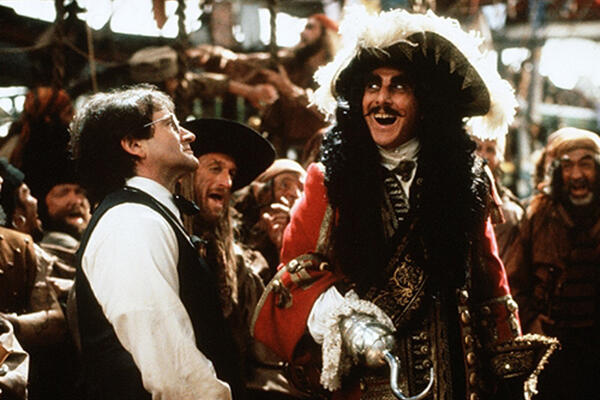
Hook
Classic Film Hook is basically a representation of my childhood; I watched it so many times I destroyed the VHS. Given my attachment to all things Peter Pan and disinclination to actually grow up, it’s probably a fair representation of my current psychological state as well. This was one of my most beloved films as a child, and I couldn’t imagine anyone other than Robin Williams playing the adult version of that most beloved character, Peter Pan. Of course, being a grown up (ugh) and a lawyer (hmmm), his name is Peter Banning and in the beginning he’s kind of an uptight ass. Robin Williams bought a kind of magic to every personality he ever portrayed, and I don’t think I love any of his films quite like I love Hook. He embodies everything about the character Banning, from the stressed, grown-up lawyer we are presented with for the first half hour, to the man that finds who he is, and who he was, throughout the rest of the movie. Julia Roberts is a charming, heart-breaking, badass Tinkerbell and Dustin Hoffman plays, in my opinion, the best rendition of Captain Hook ever committed to film. Through the interplay of these fantastic actors and the magic they bring to the silver screen, the viewer is drawn into Neverland with them, with the Lost Boys, with the pirates of the Jolly Roger and with the mermaids of Mermaid Lagoon. Hook is a more mature version of Peter Pan than the original Disney cartoon, though not quite so mature as Barrie’s original play. It also reveals a new theme or moral the older you are when you watch it, yet I am as enthralled by every scene now as I was when I was three or five. Watching it again this week, in the knowledge that all we have left of Robin Williams was heart breaking. However, it also made what he left to us all the more precious, because it is a rare actor that can bring the heart and the joy to characters like Peter Pan that he could. If you haven’t seen this film, you need to. It is a perfect example of the magic of Robin Williams.
-

New this week / Singles in review
Iceage - How Many “How Many” is the third single from Copenhagen-based band Iceage, who are right on the cusp of releasing their third album, Plowing Into The Field of Love. Where first single “The Lord's Favorite” had a twisted, country influence and second offering “Forever” seemed like a long lost Birthday Party track, “How Many” is a euphoric, blitz of jagged, cold, postpunk fury. From the archaic stabs of piano, to the fluttering, guitar discordance, the group paint a picture of monstrous bleakness. “I have a sense of utopia of what I truly ought to do,” Rønnenfelt moans, expounding on his inability to live up to his own expectations. This track has a lack of control that seems to breed a lunacy; an undercurrent that simmers beneath the surface of the song’s icy splendour. Thom Yorke - A Brain in a Bottle Thom Yorke has released a new album, Tomorrow's Modern Boxes. Never afraid to experiment with new ways to package his music, the Radiohead frontman has released the album through torrent service BitTorrent. “A Brain In A Bottle” is the opener of the album and is also available to download for free. The album in its entirety costs six dollars. The track features a beautifully textured, electronic soundscape that is at times circled by a surrounding sonic buzz or a hostile siren-like noise. Yorke's falsetto is as sensual as it is haunting, and sizzles across the glassy, crisp percussion. Future Brown - Wanna Party [Ft. Tink & 3D Na'Tee] Future Brown is the resulting collaboration between the talented trio of Fatima Al Qadiri, Nguzunguzu and J-Cush. “Wanna Party” also features the talented New Orleans rapper 3D Na'Tee and Chicago's Tink, who contribute a mesmerizing series of rhythmic, deadpan verses. The production is something I really love. The soundscape is beautiful, cold and machine-like. With ethnic, ambiguous samples that are truly hypnotic. The beats comes in and out like gears shifting in a factory, helping the track transition beautifully from one section to the next. Tala - Alchemy TĀLĀ is an artist from South London who is set to release her EP Alchemy in mid-November. This single of the same name is a beautiful, glistening, pop ballad, emoted over an atmosphere of broken mirrors, glitchy samples and other remnants of chaos. The track showcases TĀLĀ at her most accessible to date, but still contains the finesse of her electronic, instrumentals featured in her earlier work on the Duchess EP. Marianne Faithfull - Late Victorian Holocaust Marianne Faithfull has sustained quite a wonderful career, and is one of the only active artists from the scene we now remember as Swinging 60s London. Her voice is raspy, full of weight and drenched in what sounds like a cold, bitter exhaustion. “Late Victorian Holocaust” comes from her upcoming album, Give My Love To London. Though the track's lyrics are written by Nick Cave, Marianne sings them with conviction and a polarising, dreary honesty. A brooding, gothic ballad, the song is a haunting remnant of the scene in which Marianne was very much a part of. The track also features bone-chilling strings that highlight the dark, ominous instrumentation wonderfully.
-
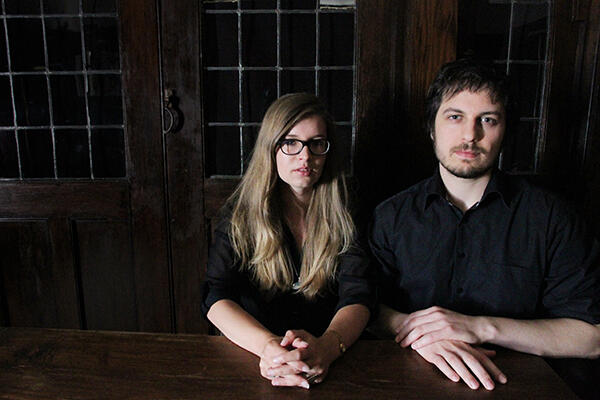
Artist Profile: Luckless
Luckless is a self described “two-piece melodic, neurotic, melancholic indie rock band from Auckland.” Having just released their sophomore album, Critic's Adrian Ng catches up with songwriter Ivy Rossiter to talk about her group's new record. Was there a moment that made you want to do music? I’ve always played music, and I’ve always wanted to play my own. I remember listening to crappy singer-songwriters at the age of about 13 and wanting to be able to DO THAT. Then I was going to punk rock shows and writing zines at age 18 and 19 and was simultaneously passionately inspired by the scene and deeply depressed because I didn’t want to be just in the audience any more. I think that was when I realised that I would be happier as a failing musician than as a successful anything-else. But it took me a very long time to summon up the chutzpah to actually commit myself to jumping into the abyss of putting pen to paper and feeling like I was allowed to write. Not many people tell you that you’re not going to be any good when you start – they’re more likely to tell you that you’re either born with it or you’ll always be a faker. I had to spend a lot of time making terrible music before I came up with anything I was remotely proud of. Your new album is titled Vindication Blues, was there a story behind that name? Vindication Blues is that combined feeling of self-righteousness and depression you get when everything you predicted would go wrong, did go wrong. Perhaps it’s self-sabotage, but I prefer to think that it’s just supreme realism. What was the process like this time round compared to your debut release? This record came together much more quickly than the debut. The first record was a culmination of a few years of writing, and the recording process was stretched out over an entire year, done in dribs and drabs when we could find time at the studio. For Vindication Blues, all the songs were written within a year, and we spent three weeks at The Sitting Room in Lyttelton and one week at The Lab in Auckland, and then it was done. It was a lot more raw and immediate than the first one – more live playing and more sophisticated, production-wise. And perhaps it’s a more personal record, less abstract. Did anything special influence the songwriting process? I split up with my hometown of Auckland at the end of 2012 and spent most of the following year travelling and playing music. That dislocation and alienation of being rootless and away from any kind of spiritual home definitely fed into what I was writing about. I landed in Lyttelton, where many of my working-musician-comrades live, and found a lot of support and inspiration here, especially in the work ethic of those same friends, who are forever writing and performing and bettering their craft. I think this album came out as well as it did because of the level of commitment we were able to bring to it. Finally, if you could steal a musician's songwriting powers, who would it be? Lyrically, John Darnielle from The Mountain Goats. One of my favourite lines of all time is from his song “Old College Try” from Tallahassee: “the way those eyes I’ve always loved illuminate this place like a trashcan fire in a prison cell / like the searchlights in the parking lots of hell.” Musically, St Vincent. Her guitar-playing and her arrangements and her experimentation are like lighter fluid torching all the rest of the guitarists I’ve ever seen.
-
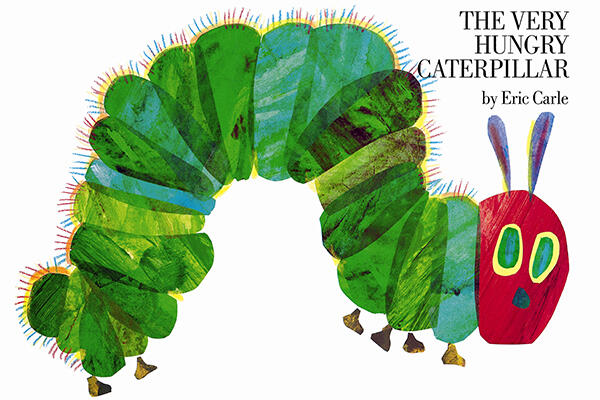
The Very Hungry Caterpillar
Warning: The following critically acclaimed piece contains spoilers of the material in the book. Solace is Caterpillar. Societal image issues. Eating disorder bullshit. Three phrases that come to mind when I think of this book – a book that lures the eyes more than a hair-flicking Robert Pattinson lures a 12-year-old girl. Claustrophobics beware: our main character is caged from page two, forcing reader empathy right to the point of tears with the pre-larval, leaf-eating worm with legs. Like a sentient city in a snow globe, our Caterpillar must be ambling to scratch the skin membrane of its egg prison. The Very Hungry Caterpillar then pulls some Shawshank Redemption shit and “POP!” from the egg emerges our hero. Our larval friend joins society and, if one reads between the lines, the plot consists of our friend making a choice. To its right lays a path of various fruits in various numbers, each one day from each smorgasbord. To its left is the latest edition of the Caterpillar Girlfriend magazine, spotlighting a skeletal image of the Caterpillar Selena Gomez. Her figure like that of a slightly hairy pencil in a loose fitting, size zero, silk bathing suit. Those weak of will might fail, but not our Caterpillar. Our friend skips to the right as we follow with the page flicks. In addition, as a point of criticism, I felt that days Tuesday through Friday were really just filler. It felt very much like new fruit, new number, but the same shit. At this point of the book (pages four to eight) you wouldn’t miss much by skipping ahead. The only thing that persists is our hero’s hunger that, like our love for the main character, is unending. That is, until day six, Saturday. Yes, it’s great that our main character managed to ignore society’s views about how caterpillars should appear, but come Saturday we find out that our hero has an eating disorder. Six sugary, two meat, one fatty dairy and one vegetable were the meals chosen. Clearly the Caterpillar saw the food pyramid on Friday and decided to eat that too. We’re so full we now have a stomach ache. So what to do? Our hero can’t put his stubby legs into his mouth and vomit – they are just too small. However, we can tweet about this problem, #DesignsAgainstBelemia. No pharmaceutical company is making antacids for caterpillars. It must endure; it must survive. Sunday it has a salad and it’s all good. After the events of Saturday did our main character really think there would be a consequence? A recycled plot device from page two sees the hero re-caged in a cocoon. Once again caught, once again freed, once again lonely. The membrane replaced by silk walls but the effect is the same. Worse still it’s a room for two, our hero and the villain, a caterpillar geneticist. Injection after injection, experiment after experiment, our hero must endure two weeks of pain and transformation until it is such a freak that it manages to bite its way to liberty. Overindulgence has made a freak from a beautiful individual. It is Caterpillar no more.
-
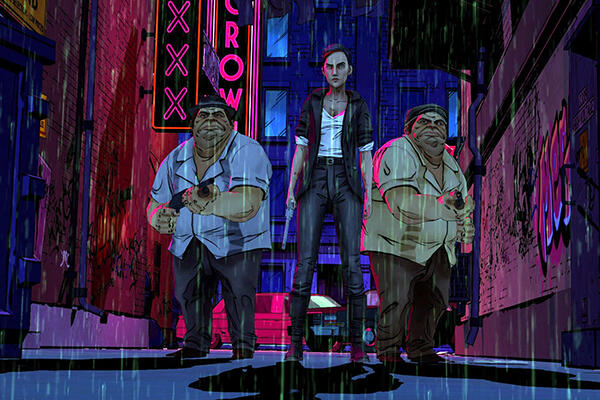
The Wolf Among Us
Since the phenomenal runaway success of Telltale Games’ The Walking Dead from 2012, the gaming world has waited with bated breath to see what Telltale would produce next, and if they could repeat their past successes. The Wolf Among Us was that follow up game, and though it is not quite the revelation that The Walking Dead was, that in no way diminishes the fact that Telltale has once again shown the depth and breadth of storytelling available through the point-and-click adventure genre. Wolf Among Us is based on a series of graphic novels called Fables. Set in New York City, Fables is about fairy-tale characters that have moved from their realm and seek to live in secret in the human world. Though Fables is about children’s fairy-tale and fantasy characters, it is very mature, communicating its stories of these characters through a gritty, Noir style that highlights the disturbed nature of many of these stories and characters. The Wolf Among Us functions as a prequel to these graphic novels. A wise move from Telltale, as it allows players to jump in without being familiar with this lesser known series. This five-part episodic adventure follows Bigby Wolf, the anthropomorphized version of The Big Bad Wolf, who functions as the Sheriff of all Fables (“Fables” being the name given to fairy-tale characters living in the human world). Throughout the five episodes you play as Bigby as he seeks to solve a series of murders that have been committed against Fables. As a Noir narrative, you can expect all of the intrigue, suspense and violence that have become synonymous with this genre since the days of Raymond Chandler. However, what you can’t expect is to have the same emotional experience that no doubt many of you had with The Walking Dead. However, before you chalk this up as a failure on Telltales part, it needs to be recognised that this difference in genre is bound to produce difference in experience. For example, though The Wolf Among Us lacks the same depth of pathos, it makes up for it in exhilarating action. Each episode contains at least two or more moments of very clever action sequences. These generally take the form of brutally violent fight scenes. The regularity and quality of these action sequences is very impressive considering that the point-and-click genre is not known for producing games that have action at all, let alone the excellently conceived and executed action that Telltale has produced. However, as is becoming expected of Telltale, the focus of the game is mostly on character interaction, development and branching decision-making. Throughout the game Bigby meets a diverse cast of varied and interesting fairy-tale characters, such as Snow White, Beauty and the Beast, Georgie Porgie, Ichabod Crane and just about someone from every other fairy tale that you can think of. In fact the lore is so deep that even if you don’t run into a fairy-tale character, the game is overflowing with references, Easter eggs and codex information about almost any character you can think of. Each of these characters are a superbly conceived real world counterpoint to their fairy-tale self, often supporting and subverting facts about their character as is necessary to illustrate the disturbing nature of these stories. For example, Georgie Porgie (who kissed the girls and made them cry) is a sleazy and abusive male chauvinist who runs a strip club. As you play through the game the dialogue decisions you make not only build out Bigby as a character, but also establish and build relationships with all of these characters. These relationships, positive or negative, directly affect the progression of the story and there are bound to be many moments where you’ll wish that you had been nicer to a character, or perhaps that you’d been much, much meaner. The Wolf Among Us is an ambitious and tonally divergent next step for Telltale as they build off of their past successes. Though the game does many things well, including their new integration of action, a fascinating cast of characters and an intriguing and eventful Noir narrative, all of these factors suffer from the fact that the game never manages to connect with you emotionally. You’ll no doubt want to keep playing because the game is fun, but there’s little chance that you will want to keep playing because you care, which I think at it’s root is the magic of the point-and-click genre.


