-
Columns

Editorial | Issue 21
The great Oil spill of 2014 has spread to the students, with recent email conversations released by the anonymous Twitter account @whaledump indicating a conspiracy by Cameron Slater and his buddy Aaron Bhatnager (who is inextricably tied up in Judith Collins’ latest of many headaches) against an Otago student politician back in 2012. For context, Beau Murrah had his name brought into attention-grabbing disrepute by Cameron Slater in a blog post titled “All about Beau Murrah,” as a reaction to what Murrah later publically admitted was a lapse in judgment. In a debate on the blog, he had suggested that Slater consider “pulling a Charlotte Dawson,” who at the time had just made an attempt on her own life. Murrah completely fucked up; it was a tasteless comment but he apologised in such a way that even Slater reportedly considered removing the original post for a brief moment. Yet Google search Beau’s name two years later and this is still the first link you will be served. Defending his decision to keep the original post live, Slater states “I am an advocate of owning your own shit. I don’t hide my past posts, even though some of them are terribly embarrassing and re-reading them is sometimes just awful, the fact is that I wrote those and I should own what I did and said in the past. This is one of those situations that should serve as an example to all.” Everyone keep that in mind as the shit-storm around him unfolds. The classic university student can often be angry and make comments that they would later irrevocably retract. Beau even identified this at the time, labeling himself “some university student troll.” A large level of forgiveness should be expected as the country’s future leaders find their feet, working out through trial and error what is appropriate and what is not. The leaked emails, however, reveal that there was deep sense of political angst involved in Slater’s attack on Beau, with the “little cunt” being a “Winstonite.” He was also explicitly looking for the future career of a student to be “extinguished” over one comment. The full exchange is reproduced below, and it speaks for itself: September 10, 2012 Aaron Bhatnagar, 9/10, 5:06am The little cunt is a Winstonite. http://www.critic.co.nz/news/article/1729/new-zealand-first Cameron Slater, 9/10, 5:06am yup I am going to hang him out to dry Aaron Bhatnagar, 9/10, 5:07am Have at the son of a bitch Ah good Cameron Slater, 9/10, 5:07am also a law clerk whose career has just been extinguished Aaron Bhatnagar, 9/10, 5:07am Yes, I see that. So, so, so very very sad Cameron Slater, 9/10, 5:07am i've got a screen shot now incase he tries a delete I think about now he is having a moment of regret too late Aaron Bhatnagar, 9/10, 5:07am Yes, he has gone quiet Cameron Slater, 9/10, 5:09am http://www.linkedin.com/pub/beau-murrah/30/718/22b September 11, 2012 Aaron Bhatnagar, 9/11, 9:25am Pleased to see that son of a bitch got a nice WO mention today Cameron Slater, 9/11, 9:26am yep and farrar is clocking him tomorrow Aaron Bhatnagar, 9/11, 9:26am Gooooood To take a step back and generalise the wider issue at hand, one thing’s for sure: considering a lot of the information contained in Dirty Politics is undeniably linked to the Prime Minister’s office, the population of New Zealand is confronted with the reality that the administration that took over the Government in 2008 is very, very different to that which they voted in. It doesn’t make the left wing any more competent, but until there’s such conclusive evidence against them, it certainly shows them to be a hell of a lot more honest. And on the appearance of Labour’s competence, there could in fact also be a much bigger media issue at hand, as Politics Editor Carys Goodwin explores in her profile of David Cunliffe on page 12. Take that how you will. Zane Pocock Critic Editor
-
News

Dunedin City Council at centre of $1.5 million fraud investigation
The Dunedin City Council has been left reeling after a $1.5 million fraud scheme was uncovered within the council’s Citifleet department earlier this month. The alleged fraud involved $1.5 million of missing proceeds from the sale of 152 council cars. According to Dunedin Mayor Dave Cull, the discovery was made during “a series of internal process changes” instigated by Chief Executive Dr Sue Bidrose. During the implementation of new financial measures, a staff member noticed an inconsistency between the numbers of Citifleet vehicles and the numbers recorded on council books. The three-month investigation, led by Deloitte, came days after the sudden death of Citifleet manager Brent Bachop on 21 May, and has so far cost the council $200,000. According to the Otago Daily Times, his death came just days after being approached about the discrepancies. Deloitte’s comprehensive report has now been referred to the police, along with the Serious Fraud Office, and the council’s insurers, QBE. Originally Bidrose intended to release the report to the public. However a legal counsel advised waiting until the police released their verdict before publishing the material, to ensure the police investigation was not impeded. Cull states that the DCC still intends to release the report, although the timing will depend on “advice [received] from the Crown Solicitor.” Unsurprisingly, the revelations have caused many to question the efficiency of the local council’s internal systems. The Mayor seems to agree, attributing the fraud, which spans over a decade, to “inadequate internal checks and balances within the DCC. “We have taken, and are continuing to take, measures to address this,” said Cull. However, in a recent article published by the ODT, many Councillors are pointing fingers away from the DCC, and towards the council’s contracted financial auditing service Audit NZ, of which the council has paid $1.15 million in fees to since 2005. In another report, the ODT revealed that the DCC twice ignored Audit NZ’s recommendation of a new audit and risk subcommittee; a recommendation made in 2007 and 2010. Audit NZ claims publicly on their website that the service has its limits, and while “provid[ing] reasonable assurance that the financial statements are free from material misstatement … an audit is not intended to detect all fraud or errors that may exist.” Audit NZ further asserts, “The governing body and management have primary responsibility for detecting and preventing fraud and errors.” Bidrose and Cull insist the financial auditing service is not to blame. “Generally fraud is picked up by internal, not external auditors,” states Cull. Bidrose agrees, claiming current internal changes are being made to rectify past failures within the council’s procedural system. “It’s important to note that we didn’t just stumble over this,” said Bidrose, “we found it during the changes we made and are making.” Various strategies have been proposed in order to “tighten up” DCC processes, states Cull. These include the introduction of a new audit and risk subcommittee, an updated “whistleblower” policy, and the publication of all tenders awarded through the DCC Tenders board on the DCC website, for “greater transparency.” Cull remains positive about the work already done by the DCC, comprising of an initial review of internal audit work, and a review of the risk management framework – both measures anticipating further appraisal of all key DCC policies that relate to fraud and cash handling. In addition, the DCC is launching a “fraud awareness campaign,” involving training for all staff, and a re-evaluation of internal processes around staff “receiving gifts, tickets or hospitality.” Amid the controversy of the unprecedented scandal, Cull claims to be “totally satisfied” with senior management’s handling of the issue. Similarly, Bidrose remains adamant that public transparency and tighter processes are the way forward. In a recent press release, Bidrose says he is confident that the DCC remains “an organisation in which people can have confidence. “The people who work here are overwhelmingly decent, hard-working public servants committed to the best interests of the city.” Furthermore, Bidrose and her senior management team state publicly they remain “committed to getting to the bottom of any issues and ensuring we have best practice across the board.” The DCC reports “a small number of staff” are currently engaged in “employment processes” as a result of the scandal.
-
News

Execrable | Issue 21
To kick off the meeting, apologies were made on behalf of Hamish Barker, who had to leave the meeting early due to other commitments. Welfare Officer Payal Ramritu was also unable to attend due to car troubles. OUSA’s affiliation with the Justice in Palestine group was first discussed. The Executive team were all rather content with the affiliation; however, Henri Faulkner abstained from voting as he had not read the memo related to the affiliation. His role in particular focuses on clubs, societies and recreation at the University - let that sink in for a moment. With no other issues arising, the affiliation was agreed upon. Discussion on the Blues and Golds policy amendments took up a great deal of the meeting. Consideration was first given to President of Te Roopu Maori, Mariana Te Pou, having a seat on the Committee. OUSA President Ruby Sycamore-Smith believed it was “great” and there were no objections from fellow Executives. Issues arose with OUSA’s lack of an International Students’ Officer, meaning a missing seat on the Golds Panel. It was suggested that Payal take on this role, to which everyone agreed. Henri then asked who currently chairs the Golds Panel. Looking rather confused, Ruby replied “you’re the chairperson … this is your hub.” This was unknown to Henri, who believed he “just chaired the Blues.” All was eventually resolved. Mariana now has a seat on the Blues and Golds Panel; Payal has a seat on the Golds; and Henri retains his position on Golds, now that he is aware it actually exists. Colleges and Communications Officer Jess McLean spoke of her desire to have a place on the OUSA Health and Safety Committee. The committee is currently having issues with tile and vinyl flooring in areas, with which Jess has past experience. Jess said she has been involved in “a lot of work with flooring through [her] parents,” and was worried that would be a conflict of interest. Ruby, OUSA’s resident expert in conflicts of interest, said it was not and she noted Jess’ particular interest in health and safety issues. Jess now has a seat on the committee. With regards to the operational report for July, OUSA General Manager Darel Hall put forth the motion that an extra $500 of Executive money be put towards Environment Week for promotion. The budget was previously $500, and would now be increased to $1,000. Finance Officer Paul Hunt was asked if he had any issues with this, but with no real answer, the extra funding was agreed to. Paul had a lot more to say when it came to the Dunedin City Council’s newly proposed alcohol regulations. He wanted OUSA to oppose four aspects of the changes, should they appear in the DCC’s final proposal. These included a mandatory 3am bar close time; a 1am start to the “one-way door” policy; a ban of shot sales after midnight; and the clearance of people from outdoor areas after 11pm. The Executives decided that since this issue affected students, they would oppose the regulations as a body. Ruby also informed the group of an idea that “$1,500 from Exec General [Budget Line] 4930 be approved for the OUSA enrolment and voting campaign.” With the addition, the budget for the campaign is now set at $28,000. The OUSA also calculated a possible upper-end value of their election advertisements to check compliance with the new Electoral Commission rules, which stipulate that any organisation or group exceeding $12,300 of election spending must register as a promoter (a third party to the election advocating to vote or not vote for a party, whether or not the name of the party is stated). OUSA’s calculation came to $11,500; to play it safe, OUSA will register as a promoter. With little reaction from the Executives, the increased funding was accepted. With regards to the updating of job descriptions discussed in previous Executive meetings, Admin Vice President Ryan Edgar announced that these were nearly complete. Ryan was hoping to meet with fellow Executives individually regarding their descriptions in the next few weeks. Ryan also hopes to clean up the external polices left by previous executive members, many of which referred to genitalia statues around Dunedin. Ryan said this was “pretty weird” and that the policies included some “pretty wonky stuff.” Laura mentioned that the puppy room was also a success. Talks began on the possibility of a kitten room, which Ruby said would be “in the mix” as discussions with the SPCA had already begun. After the Executive members fell into a doze, it was noted that there were free sausages in the OUSA fridge. Catching perhaps the most attention all meeting, the Executives decided they would run a few sausage sizzles, as well as offering free sausages at the OUSA free breakfasts. Critic considers the sausages to be an excellent supplement to the much-anticipated raisin increase.
-
News

Proctology | Issue 21
Once again, the Proctor has had reports of misbehaviour at the Botanic Gardens in recent weeks; there have been two particularly large groups who have been caught drinking in the gardens. The Proctor said that one group swiftly left the gardens once Campus Watch arrived, but the other group was “not quite as compliant.” The group consisted of over 30 “problematic first years from the halls.” The Proctor understood that it was possible that the students were not aware that alcohol is “not a good look in the gardens,” but despite this the students have been forced to make large donations towards the gardens to cover costs such as the clean up of bottles, vomit, and urine, as well as the repair of damaged flowers. There have been additional problems at Woodhall gardens with “barrels of beer” being drunk in the gardens. Families have reported the unwanted crowd to Campus Watch and the Proctor has advised that students stay away from any of the gardens when drinking. In more penis-related reports, a middle-aged man was caught on CCTV in the microbiology building pleasuring himself. The police released an image of him on the Dunedin Police Facebook page, which garnered enough attention to identify him. He has been charged with committing an “indecent act.” He has also been trespassed from University buildings and grounds. When asked what the sentencing for the charges usually consist of, the Proctor said it depends on the person’s history. He was unaware of the man’s history of indecent acts, either publically or privately. Another student has been charged with “unlawfully interfering with a vehicle.” Campus Watch caught the intoxicated man trying to move a scooter from a flat’s front lawn to the other side of the road. He told the Proctor that it was “just for fun,” and nothing more sinister. The Proctor said that “in this particular instance,” they chose to believe him rather than indulging the possibility that he was committing theft. There have other vehicle related incidents, including one student who had their windscreen wipers stolen. The Proctor said that when he asked the offender why he took them, “he really didn’t seem to know.” In a separate incident, the wing mirror of another car was kicked off the car at a college car park. The Police are also trying to find the person or persons responsible for breaking windscreens and slashing tyres around Dunedin recently. A number of tyres were damaged on cars parked in South Dunedin areas, and other cars have had their windscreens smashed in Shiel Hill, Andy Bay, Musselburgh, and St Kilda, potentially by someone firing a BB gun. The Proctor felt it was a “real shame” any vehicle damage was committed by any students especially because, “quite often the damage is towards cars belonging to fellow students.”
-
News
Otago University I.T.S. members no longer have hair
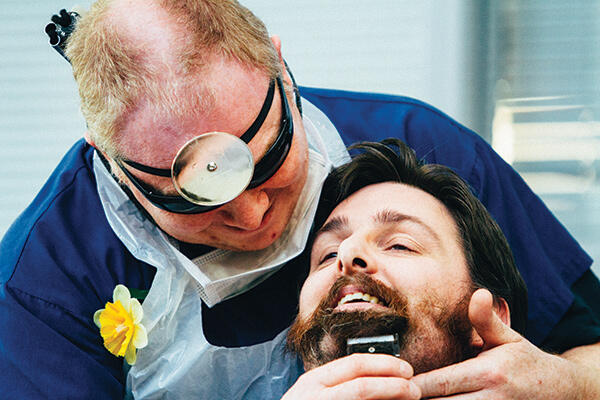
Two members of the University of Otago’s ITS Service Desk team have had their faces shaved by a blind man to support the Cancer Society’s annual Daffodil Day fundraiser. Customer Service Representatives David Steer and James Inger had their faces shaved by their blind colleague Simon Fogarty last week. When asked if he was nervous about shaving Steer and Inger’s faces, Ferguson said, “They were. I wasn’t, really.” The event, Fogarty’s Facial Full Monty, was held in the Link on Wednesday 27 August. Sandy Wilson of Physics, herself a cancer survivor, also had her head shaved into a mohawk. During the shaving event, $463.70 was raised, but Ferguson expects much more to be coming. “If we raise enough money we will consider having Simon shave our heads too,” Inger told the Otago Bulletin. ITS run a Daffodil Day initiative annually and this year have a number of events running, including the shaving event, selling daffodils, and a white elephant stall. Fogarty says the stall is for people to get rid of their junk, “whilst hoarders come and buy it.” Fogarty said the ITS department enjoy getting involved because “the Cancer Society is a great cause and I don’t think there’s anyone who hasn’t been affected by cancer in some way.” In an email sent to staff after the event, ITS Administration Team Leader Denise Moulin said, “thanks to David and James, who so willingly agreed to be shaven when asked, and to Simon Fogarty, who has missed his calling as a barber.” She also thanked Nurse Barkman and Dr McFarlane, “whose first aid skills were not required - thankfully.” The ITS department are hoping to raise “as much as possible,” says Ferguson. “If we raise $500, fantastic. Any more is even better. [The Cancer Society] do good work and help a lot of people in need,” he said. When asked how the idea came about, Fogarty said “they hadn’t had a shave in a number of months. Denise suggested they shave them off for the cancer society and I said would pay $50 to have the pleasure of shaving them. “Because I’m totally blind, it turned into a way we knew we could make money,” he said. Staff and students can stop by the ITS Leith Reception Desk to donate.
-
News

Endangered Dunedin fish eaten by hungry trout
Native Dunedin freshwater fish are enduring delays in their protection programme by the Department of Conservation, even though they are acutely and chronically threatened. The non-migratory Eldon’s Galaxias, a subspecies of the Galaxiid family that is native to New Zealand, has been declining due to changes in land use, the impact of introduced species, and water abstraction. However, DOC and the Minister of Conservation, Nick Smith, have defended the issue by saying that is due to sponsorship deals to eradicate trout. Dr Richard Allibone, an Otago graduate, discovered Eldon’s Galaxias over 20 years ago. They are only found in two rivers in the world – the Taieri and the Tokomairiro River. Green Party Member of Parliament Eugenie Sage asked the Hon. Nick Smith about the cause of the delays. Smith said the delay of the “Galaxias Eldoni” (or Eldon’s Galaxias) conservation effort was caused by, “ongoing negotiations with the landowner (City Forests, a Dunedin-owned forest products company), who is looking to sponsor the programme. Work is expected to be completed by the year’s end,” he said. Peter Ravenscroft from DOC Dunedin contends that the targets have not actually been delayed, but they are instead in the early stages of scoping out the stream and canvassing sponsorship to get trout numbers down; trout are major predators of the Galaxiid. “Trout have gotten into the creek; we need to see if it is feasible to take out the trout, otherwise there is no point in putting money into Eldon’s if we can’t get the trout out,” Ravenscroft stated. To do instigate this removal effort, DOC has had to collaborate with City Forests. Lan Pham, a previous employee of DOC and a founder of the Working Waters Trust, spoke of Galaxiids as the “forgotten fauna of New Zealand.” She explains that to protect species such as Eldon’s Galaxias, the trout need to be removed from areas such as above waterfalls, where the Galaxiids are less vulnerable. This action has raised concerns from Fish and Game, who claim that the trout removal would eventually extend to the Clutha River, a popular tourist spot for enthusiastic fly-fishers. Another issue is the underfunding and drastic restructuring DOC experienced last year. Eugenie Sage argues “National’s underfunding and restructuring of DOC has left many gaps and caused low staff morale, which is impacting on the great work that DOC does. Our unique native freshwater fish are in crisis … We need strong rules that ensure our rivers are clean and safe for us and our native fish to swim in.” 74 per cent of native freshwater fish in New Zealand are endangered.
-
News
Otago Students win National Brand Challenge
Four students from the University of Otago have successfully taken away first prize in the New Zealand Brand Challenge. Run by the New Zealand Marketing Association, the competition involved six universities from across New Zealand. Taylor Wheeler, Josie Cochrane, Ryan Edgar and Logan Edgar were all selected to represent Otago. John Guthrie, a marketing professor at the University, coached the group for the competition. Given a week to plan their pitch, the university teams were given the task to present a 15-minute case around a business challenge based in New Zealand. The subject of this year’s competition was the Farmers Trading Company and how to best target one of the segments aged below 30 years old. The Otago team presented an idea that centred on in-store suit tailoring, “presenting Farmers as more of a sexy brand that could attract young professionals,” said Josie Cochrane. Taylor Wheeler told Critic: “It was a stressful week preparing our presentations. Coordinating varying schedules proved to be particularly challenging … “John [Guthrie] really put the pressure on us for the week and doubted we would pull it together in time. But I think his passion for us to succeed and the fact he made us constantly question ourselves was key to our win.” Ryan Edgar astutely noted that this pressure “made the cold ones after slide down pretty nicely.” Guthrie said the win is a great result for the Otago brand: “It reflects the quality of the students and the quality of the teaching. It especially reflects the very high international quality of the Otago Business Case Competition programme.” Although he cannot yet guarantee that the students will move on to compete internationally, Guthrie said “their success certainly puts them in the frame.” Three of the team members all regularly compete in similar competitions at a local level and Guthrie said the trio had previously won a local competition earlier this year. The fourth team member “won a number of competitions last year.” The winning team was also invited to attend the TVNZ Marketing Awards at The Langham Hotel, Auckland. At the event, held last Thursday, the trophy was re-presented to the team. Guthrie said: “This will be in front of 750 people who are from New Zealand's largest companies. This is a seriously major brand waving opportunity for the team.” The team urges other students to get involved in such competitions in the future. Ryan Edgar said “the experience [from case competitions] is rare to get anywhere else during your time at University. It's very real-world and that's what employers want.” Wheeler added, “I would highly recommend students to get involved with the extra-curricular opportunities that Otago offers.”
-
News

Government still wants you to stop smoking
October has been christened “Stoptober,” as the government pushes to implement a new anti-smoking campaign. According to a recent press statement, “the campaign, funded by the Ministry of Health’s Pathway to Smokefree New Zealand 2025 Innovation Fund, aims to generate 43,000 quit attempts, with 10 per cent of these successfully quit at three months.” The campaign will mostly be digital, supporting smokers who want to quit with daily texts and emails, a Stoptober app, and a self-triage tool for those wanting more support. The campaign has been met with mixed responses from smokers. According to Lily Redgrave, an Otago Polytechnic student smoker, it’s a “grand idea. The only way people seem to really quit smoking is if they commit to it, and this programme seems like a way to get people committed. I also think it’d be quite fun receiving little texts every day.” She did note, however, “it could be annoying to be reminded every day of what you’re missing.” Mac Veitch, a University student who also smokes, was critical of the initiative, stating that “40,000 attempts seems a bit optimistic,” and pointing out that “personally, I wouldn’t get many perks out of it, especially since I don’t have a smartphone of any kind.” Another smoker, Alannah Guinness, raised the issue of originality, commenting “I’ve already tried QuitLine without success and this sounds basically identical … I don’t know what this really offers that you can’t already get year-round. QuitLine emailed and texted me all the time and it was super irritating, so this campaign doesn’t really sound like my kind of thing.” Advertising for the campaign begins this month, with radio and television campaigns on the cards. Radio stations Flava, ZM, Hits, and Radio Hauraki will be encouraging listeners to enrol for the campaign throughout September, and will offer motivational support during October. Events will be held in Auckland, Hamilton, Tauranga, Wellington, and Christchurch, as well as around 30 regional events featuring “the campaign’s huge red ‘Stop Ball’,” according to the press statement. Television advertising featuring Piri Weepu will also be broadcast in the first two weeks of this month, aiming to increase sign ups.
-
News
Watching for madness at the movies
A new study carried out at the University of Otago‘s Wellington campus has named ten of the best movies that they recommend medical students view in order to facilitate self-directed learning in psychiatry. Lead author Nick Wilson says that there is significant international literature on the use of movies for teaching psychiatry, but that until now, there had not been a systematic process used to select a list of movies that might be optimal from both educational and entertainment perspectives. The Otago study has been published in the journal Australasian Psychiatry. The selected topic areas for the new study of movies were the top five mental health conditions from the Global Burden of Disease 2010 study. From a total of 503 potential movies sourced through a range of sources, including published literature and websites, 23 were selected for viewing and more detailed critique. Silver Linings Playbook is a romantic comedy, staring Jennifer Lawrence and Bradley Cooper, but has detailed insight into the characters’ mental health issues. The father, who is played by Robert De Niro, displays traits of obsessive-compulsive personality disorder. Another Year is a movie detailing the heavy drinking culture of the characters and shows how deeply embedded the nature of alcohol use is in many people’s lives. Depression and chronic unhappiness are also major themes. It shows various health professional activities, including counseling, in a positive light. The authors recommend that further research could evaluate the extent to which medical students actually watch such movies, by assessing the level of withdrawals from a medical school library and surveying student responses. Critic advises the authors to consider also getting The Pirate Bay on board. The paper also suggested the value of discussing these movies in semi-structured classroom sessions.
-
News
Another year, another trophy for the All Blacks
To the predictably triumphant rugby desk where the World Champion All Blacks have locked away the Bledisloe Cup for the 12th year in a row with Richie and the boys setting some new records along the way. Their haul of 51 points at Eden Park was a record against the Wallabies, our man Aaron Smith kicking a rare conversion to seal the record! Also, by scoring two tries, Richie set the world record of most tries scored against a single nation with 11 of his 23 tries being scored against Australia. After the damp squib 12 – 12 draw in Sydney this was quite a turnaround. The Bledisloe Cup is one of those things that you always hear about but never actually know what it means. What is a Bledisloe? You have probably never asked. Not some extinct Australian mammal like you may have been led to believe, but Charles Bathurst, first Viscount Bledisloe, was actually New Zealand’s Governor-General in the early 1930s and he donated the trophy that was first played for in 1932 at his behest. Another interesting fact for your next pub quiz: the Bledisloe Cup is the largest rugby trophy in the world, making the World Cup winner’s William Webb Ellis trophy look rather small and pathetic in comparison as they stand side by side in our overflowing trophy cabinet at NZRU headquarters. Now, there is nothing better than beating the Aussies and I have ranted and raved about the format of the Rugby Championship and Super Rugby many times on these hallowed pages, but this latest rout has brought up the same old questions again: why do we play our two games against Australia first and then alternate between playing Argentina and South Africa? I doesn’t make much sense to me. I am sure Argentina will eventually improve and in the coming years surely the Springboks or the Wallabies will knock us off our perch but so far I have been unimpressed with the new format of the Rugby Championship which still pales in comparison to the exciting and unpredictable Six Nations. It sure is lonely at the top ... Wouldn’t it make more sense to keep the Aussies’ slim chances of regaining the Bledisloe Cup alive until the end of the Rugby Championship to build the anticipation so we can hear more of Justin Marshall’s nonsensical, sycophantic ranting and raving in the pre-match build-up shows? Now we only have the dead-rubber Bledisloe game in Brisbane to look forward to before taking on the United States in Chicago on 2 November and then on to rule Britannia with matches against England, Scotland and Wales. NZRU rolls out the red carpet for SBWThe other big news recently was that even though Sonny Bill Williams is still playing rugby league for the Roosters in the NRL, he has been given the all clear to join the All Blacks on their Northern tour in November. The NZRU has told SBW that he won’t have to turn out for Counties-Manukau in the ITM Cup despite their own rules stating that you have to have played in the preceding competition to make the All Blacks squad. I guess rules and bones are meant to be broken. I bet the likes of Ryan Crotty and our man from the Highlanders, Malakai Fekitoa, won’t be thrilled about the news. Both of them have just broken in to the All Blacks this year after putting in the hard yards over the last few Super Rugby and ITM Cup seasons. With the World Cup in England next September they both would have been looking to the end of year tour to cement their place in the squad. However, there may be hope for Crotty and Fekitoa. Maybe Conrad Smith will decide to stay home with his new baby and Dan Carter is more than capable of covering in the centres. With Beauden Barrett and Aaron Cruden both providing plenty of options at number 10 maybe the selectors will realise there is an easy solution to their selection headaches in the centres and ditch Ma’a Nonu. If only I was one of those selectors. This latest SBW drama is all too similar to his eleventh-hour decision to join the Kiwis for last year’s Rugby League World Cup in the UK where he changed his mind at the last minute at the expense of Tohu Harris who was probably packed and sitting on the plane when he got the awkward phone call. There are also rumours that SBW’s grand plan has him eyeing a spot in the Sevens side that will head to Rio in 2016 for the Olympics. Again this could result in one of the young guys who has devoted his development to the less glorious Sevens game losing his place to Sonny Bill Williams, the code-swapping glory-hog. However, after failing to retain their gold medal at the Commonwealth Games you can’t blame the NZRU for trying to put forward the best possible team for the game’s Olympic debut. This may well be one of those “don’t hate the player, hate the game” scenarios. SBW has also expressed interest in becoming the new All Whites goalkeeper, claiming the starting centre for the Tall Blacks and following Jeff Wilson’s footsteps of being both an All Black and a Black Cap at the same time. Ok, I may be joking with these examples but what I am not joking about is New Zealand’s obsession with naming things after the All Blacks; riding on the coattails of their success, performing some weak and laughable renditions of the haka. Skinny, white hockey players on an empty Malaysian astroturf don’t command the same respect as the All Blacks in front of a sold-out Eden Park. Despite my weekly slagging off of Ma’a Nonu in this column, I will relent slightly and give him props for putting in consistently good performances of “Kapa o Pango” and “Ka Mate.” Much better than my drunken performance in a Welsh pub after an All Blacks test win in Cardiff in 2010.
-
News

Critic tackles election year | Issue 21
DISCLOSURE: Carys is a Green Party hack who is hardcore hacking it up for the election. But don’t worry – she has a few National Party friends who don’t hesitate to send in angsty letters to the editor when she strays too far into shill territory. In David Cunliffe’s ideal government there would be Labour, the Greens, and New Zealand First, with Labour the “strong lead.” There’s no chance Russel Norman would get the finance portfolio, and Cunliffe is “ruling out having Internet-MANA in the government,” probably to the distaste of the Internet Party’s growing following. The potential next Prime Minister of New Zealand has a clear vision of what he’d like the country to look like, even if the Labour Party has, in the past, appeared to be crumbling around him. In the lead up to the election, Cunliffe has rarely been painted as the staunch leader; whether part of a Dirty Politics smear campaign or a conscious effort from the Labour Party campaign team that Labour should be, well, a team, the result is a serious contrast between the presidentialised representation of John Key and the group of Positive Thinkers. This makes for an interesting point of analysis. We’ve all been plugged full of John Key media, from the #TeamKey hashtag, to the entirely John-focussed opening night broadcast. The National propaganda factory presents us with a man we can trust – someone who’s one of us; someone we can have a beer with. We’re not voting for National, we’re voting for John. Labour haven’t made the switch towards Americanised style presidential campaigning. A focus on community and improvement has led to a campaign with many faces, and their endearing DIY lens flare broadcast effort pulls together many members of the MP team. When comparing it to the National campaign, there’s a greater sense of diversity, but there’s a lesser sense of a Real Personality running for Prime Minister. Despite following New Zealand politics so closely this year that I’m now convinced I have no other skills and interests, I’m still not entirely sure who David Cunliffe actually is. Part of it, no doubt, is that the media have not been kind. Stuff and the New Zealand Herald have been quick to point out the moment Labour makes a wrong move, painting them as the party of gaffes and mistakes. They’ve been represented as dishevelled and not ready to lead – much to the distaste of their members. As a result, or perhaps the cause of the less-than-favourable treatment, Labour has consistently polled poorly. It also means we’ve not been treated to a proper look at David Cunliffe as a person. The closest we came was during John Campbell’s “at home with the politicians,” but Cunliffe’s extremely impressive wife easily eclipsed his performance. There aren’t puff pieces about Cunliffe as there have been about Key, and in the wake of the Dirty Politics scandal, most of Labour’s positive media attention has come from their policy announcements. Given that these have been relatively well received by members of the public who’re left of centre, it’s another inexplicable piece of Labour’s 20-something per cent puzzle. Then there was my personal favourite article, a piece by Deborah Hill Cone, titled, “Cunliffe’s problem is that he just isn’t sexy,” as though Cunliffe’s sex appeal has some bearing on his ability to run a political party. Cone’s article inadvertently reminded me of a quote from an Ian McEwan short story, Butterflies, in which the narrator comments, “my chin and my neck are the same thing and it breeds distrust.” The irony of the description is in the ending, which reveals the narrator to have killed someone, thereby absolving his lack of distinct chin and neck of being the reason for the distrust. As is McEwan’s custom, the use of a thoroughly disturbing mental image to prove a relatively simple point is effective; I find the idea that one shouldn’t trust someone because they’re “not attractive enough” is more disturbing to me than McEwan’s narrator. I don’t think it is fair Cunliffe is frequently judged as not having a friendly enough face. As far as I’m aware, he hasn’t killed anyone, and he has certainly proven himself to be relatively trustworthy. So where does the aversion stem from? With this in mind, I set off on an intrepid journey to meet the man when he visited campus the other week. He was in Dunedin for a whirlwind of meetings that included a meet and greet, a policy announcement, and a tech start-up visit. When I arrived at the meet and greet, he was swamped with students, left, right, and centre. Red clad #TeamCunliffe members formed a cluster just nearby, led by Dunedin North MP David Clark, whose job was to make sure each intrigued member of the student public was given an adequate amount of time with the man. It was busy, and I realised very quickly I wasn’t going to get the long, in depth sit-down I’d hoped for. Instead, I got two and a half minutes and a selfie. Cunliffe handled himself well, effortlessly moving from person to person and seeming utterly unphased by the swarm of eager onlookers, and made at least three jokes while I spoke to him. It’s hard making a full evaluation of someone in just a few minutes, but my first thought was: “He’s nice. He’s nice and he knows what he wants.” I asked him first about his tertiary education policy, which was released the Monday before his visit, and was covered by Critic (much to Salient’s distress, as they mistakenly thought they’d got the exclusive). There was nothing overwhelmingly surprising in the package: re-instatement of postgrad allowances, re-establishment of proper representation on university councils, and “increased funding for courses where New Zealand can create wealth.” When I asked what that meant, Cunliffe rattled off “science, maths, economics,” a mildly disappointing clarification for the Bachelor of Arts (Hons) in Politics student I am, but he clarified he meant “a stronger alignment between the needs of the employment market and the courses that are taught.” I didn’t manage to get too much out of him about changes that weren’t mentioned in the package – when I asked if he’d reinstate the early repayment bonus, he said he’ll “come back to me on that,” and when I asked if he had any changes in mind for living costs and allowances, he said “that’s a matter for the review.” Cunliffe certainly has his “no way I’m going to tell you” responses down pat. For the record, he also thinks Judith Collins should resign. While I wasn’t able to get coffee with Cunliffe and chat about our hopes and dreams, I did get a sense of what he was like; he has a confidence and a competence that I find reassuring, and was straight-forward about his intentions for, what he hopes, is the next Labour-led government. The next stop on Cunliffe’s Dunedin journey was the Hunter Centre, where he was all set to deliver a policy package aimed at Dunedin. Labour supporters flooded the main area, much to the surprise of the unsuspecting students who were studying at some of the tables, and it didn’t take very long at all for the space to fill up. Cunliffe was a celebrity, and I have no doubt there were people in that audience who only decided to vote for him having seen him speak in person. The actual announcement was the most Labour thing I’ve ever heard. He spoke of positivity, of how New Zealand ought to be “the fairest, most decent society in the world,” and of the “rock-star economy” (which reminded me of a quote from Richard Leckinger, who commented at an arts debate something along the lines of “the rock-star economy is going to be found auto-asphyxiated in a hotel room with white milk-powder around its mouth”). He spoke of everyone getting a “fair go” so often I wondered if he was being paid by Fair Go to do so, and noted he’d save Invermay, much to David Clark’s joy. Most importantly, I think, is he announced a massive, multi billion-dollar upgrade of the Dunedin Hospital. I left before the speech finished; I’m positive (ha) I missed nothing too much of note, and I completed my main task of the day – meeting and talking to David Cunliffe. Despite the tiresome media condemnation and reporting of relatively unimportant mistakes, I liked him. He was clear and straightforward, a quality that’s extremely welcome in the wake of Nicky Hager’s revelations about the secret underbelly of the Beehive, and was willing to answer the questions I threw at him in quick succession. With the election now less than a month away, I look forward to seeing Cunliffe and Key go head-to-head in the leaders debates, and I look forward to seeing how Stuff and the Herald go about reporting them. In case the coverage is less than favourable (inevitable), you heard it here first: David Cunliffe is cool.
-
News
Politweets | Issue 21
Winston are you okay, are you okay, are you okay, Winston? Poetic. Tragic. Ouch. That’s the real Asenati, too.
-
News
Greatest hits / Greatest shits | Issue 21
Greatest HitThere are a few contenders this week, what with the UBS apparently giving out airline sick bags to anyone who bought a copy of Dirty Politics and the hilarious election broadcasts screening, but Greatest Hit has to go to one of the underdogs of the election: the Civilian Party. They recently selected their deputy leader, Golden Mayan Sweet Pineapple Product of the Philippines, commenting that if it is elected, it “will be the first pineapple MP in our nation’s history. Indeed, it is the first pineapple candidate in our nation’s history. That it has taken us until 2014 to get to this point is a shameful reflection of our past.” What a forward-thinking selection from the Civilian Party. Greatest ShitThis week the Greatest Shit is a bit of a double whammy. It starts with Pam Corkery, who went off her nut at the Internet-MANA campaign launch. After journalists tried to hassle Kim Dotcom into an interview following a questionable “hacking” comment, Pam called a journalist a “puffed up little shit” and asked “when will you glove puppets of Cameron Slater just piss off?” The second piece of this Shit, however, goes to the media reporting of the I-M campaign launch in the first place. Until Pam went wild, they seemed to have no intention of reporting on the policy releases, instead choosing to screen John Key wandering around holding a piece of paper, or something. Policy is probably more important.
-
Columns

ODT Watch | Issue 21
Why has this never happened to Dan Carter?! “Error” of epic proportions: TVNZ aired a raunchy condom advertisement during a TV movie about New Zealand’s most high profile rape trials. Sometimes unfortunately placed advertisements can be hilarious … not so much in this case. Anything would have been better than a condom ad: even the Big Save Furniture ads. Another cute pun from the ODT. On a side note, whatever happened to teaching kids the recorder? We used to blow such a sweet tune on those bad boys. A 70-year-old man managed to swim 34km in 12 hours and 45 minutes, but apparently the record breaking swim wasn’t exhausting enough as he needed a brewski to “help him sleep.” This dude’s controversial hairdo has made the front page of the ODT not once but two days in a row, reminding us we can always rely on the ODT for extensive coverage of interesting and relevant news. The kid was forced to cut his hair to make it “less extreme” but to us his “unapproved” haircut on the left looks marginally different to the “approved” cut on the right, further showing how ridiculous this story is as news.
-
News

Consumer Magazine - is New Zealand’s icon of consumer protection hopelessly compromised?
Consumer New Zealand has long had a reputation as the guardian of the New Zealand consumer. Active since 1959, they claim they are “dedicated to getting New Zealanders a better deal.” And their biggest pitch has always been their independence. When Critic spoke to David Naulls, Deputy CEO and Content Editor of Consumer, he said independence was a “vital” aspect of the company. “We’ve been independent for the last 55 years, we take no advertising for instance, and we don’t accept corporate donations at all so we are beholden to no one in terms of the products we test and results we get.” The same statements are used liberally throughout their advertisements, with one reading, “We're so independent, even our ad isn't attached to this magazine." Yet in the past decade Consumer has changed face in many ways. The introduction of new schemes has bridged the gap between themselves and the companies they test. It could be said that due to this, their independence is compromised. Critic investigated programmes introduced in the past few years, analysing the effect they have on businesses, as well as consumers around New Zealand. In 2009 Consumer introduced their Consumer Recommends Endorsement Programme: staff at Consumer test a product and, if the product is found to meet their expectations, it is granted “Consumer Recommends Status.” Much like the use of the Heart Foundation Tick, a company cannot advertise the Consumer Recommends brand mark on their product simply because this status was reached. In order to use the Consumer Recommends brand mark on the product, businesses have to pay Consumer a $5,000 fee. Licenses to use the brand mark for non-financial products or services are valid for six months and licenses for financial products or services are valid for three. Once the license expires, the product can then be retested to ensure it still meets the required standard. If this is the case, the businesses will be charged another $5,000 license fee to continue use of the brand mark for the next three to six months. When questioned on the need to continuously charge businesses for this, Naulls said, “[the fee] was a way of protecting our brand; lots of firms or businesses would quite often advertise our test results and we would have very little control over that or not even know it was happening.” He said the reason the fee was introduced with the programme was so that “[Consumer] could control more of what was happening about the publication of our results more widely.” Consumer's entire purpose is advertised as delivering members the most accurate information when it comes to products and services. On their website, under the heading “Why was the Consumer Recommends Programme Developed?” it states, “The endorsement programme was launched to recognise excellence and to provide consumers with 'at a glance' information on products and services that have been awarded Consumer Recommends status.” That is a difficult claim to support when it comes to the finer details. Consumers aren’t getting “at a glance” information on products that have passed Consumer's tests, but instead the businesses that have paid Consumer the license fee and passed the test. A product can meet Consumer requirements, but there is no “at a glance” recognition of this unless a business fronts up with $5,000 every three to six months to use the logo. It could be said that the programme doesn’t necessarily “recognise excellence,” it recognises payment. Critic gave Naulls the following scenario: “Say you test two businesses with a high quality product and they both pass the test, but one is a small, Kiwi businesses who can’t really afford to pay for continuous use of the logo, do you think they will lose out customer-wise?” To which he replied, “Well, possibly, but we think that there would be few business that would be so small that they couldn’t afford the license fee.” This was rather interesting considering that the businesses that currently hold the license are large organisations including Panasonic, Dettol, Persil, Goldair, Breville and Sunbeam. In regards to what the license fee goes towards, Consumer claims, “all revenue from the Consumer Recommends Endorsement Programme is used to increase the scope of product testing, advocacy and investigative work.” Naulls had a similar justification: “it’s partly to bring in some extra money for the testing programme, so it helps fund the programme.” This seems to contradict the idea that they are an independent body that are not reliant in some way on the funding of businesses. According to their website, there are currently 16 businesses who all together hold 26 temporary licenses to use the Consumer Recommends Brand Mark. Taking into account the cost of a license, Consumer would have received at least $130,000 in 2014 from private companies. According to their 2013 Financial Report, 40 such licenses were granted in 2013 generating revenue of $200,000. Earlier in 2014 Consumer also introduced their Consumer Trusted Accreditation Scheme. At the time Critic went to print, accredited businesses were 2Degrees Mobile, Inspire Net Ltd, Power Shop Ltd, and Shoe Clinic. These companies are listed both on the Consumer website, as well as in the magazine. Much like the other, this programme is promoted as “an initiative designed to advance the interests of New Zealand consumers.” The Consumer website states, “By accrediting businesses committed to delivering exceptional and fair customer experiences beyond consumer law requirements, we are providing consumers with confidence and leading the way in raising the standards of retail and service providers.” The quality of a business is measured by the following eight principles: exceptional customer service; fair returns and refund policies; fair handling of customer complaints and a dispute resolution process; fair contracts; clear pricing; integrity of privacy and data policy; accurate advertising; and access to a customer-friendly website. If a business meets these criteria, they can be listed as one of Consumer’s accredited businesses. At a price, that is. Based on their annual turnover, businesses will be charged up to $25,000 per year to be accredited, even though they have already been proven to meet the criteria. Naull told Critic their philosophy is “ultimately to protect the interests of New Zealand consumers and our members.” In order to stand by this, it would be assumed that Consumer would make their members aware of all business that met the credentials. Accredited businesses also have the opportunity to offer special deals to Silver and Gold members of Consumer. Currently, deals offered include 10 per cent off a monthly plan with 2Degrees, and $100 off your first 12 months when switching to Powershop. Conditions of the Accreditation Scheme state: “Businesses also pay a rebate fee on deals offered to members.” This fee is agreed between Consumer and the business. On that subject, Consumer currently has three different membership types: Gold, which costs $99.95 per year; Silver, which costs $9.95 per month; and Bronze, which is free. In regards to why the memberships cost, Consumer states, “While we do have other sources of funding including sales of Consumer magazine, government project work, the Consumer Recommends Endorsement Programme, and the Consumer Trusted Accreditation Programme, our work is financed in the most part from Consumer membership fees.” Understandably, the features members have access to within Consumer are based on what you pay. The only aspect that seemed alarming when it came to this concept was in regard to Consumer’s Advisory Service. The website states: “The Consumer Advisory Service is available to all our Gold and Silver members for any Consumer-related issue and Bronze members for an issue or complaint about a Consumer Trusted business.” Critic questioned Naulls on the following issue: “If a Bronze member had a consumer-related issue, but could not use the service, wouldn’t you say this affects the whole idea of judging businesses fairly?” To which he replied, “Actually, yeah, that’s one I hadn’t really thought about too much … What we’ve done there is if your complaint is with a Consumer Trusted Business, then if you’re a Bronze member our advisory service will advise you about it and possibly assist as well. For complaints against other types of business which aren’t part of the Consumer Trusted Programme … that’s only available to our Gold and Silver members.” Naulls said this has been the case for the past 25 years. When it came to the independence of Consumer, there was not any great issue in a financial sense. Financial reports show that the majority of funding still comes from membership fees, meaning Consumer is not heavily reliant on corporations in that respect. In 2013, 83 per cent of the revenue, an amount of $5,091,670, was made through membership fees. Interest income accounted for four per cent of revenue. 13 per cent included revenue from business development, website maintenance, endorsements, newsstands, single report sales, and foreign exchange gain/loss. Consumer also occasionally received grants from their charity, the Consumer Foundation. In 2008 $17,000 was received, in 2009 $11,500, and $10,000 in 2012. Mark Hughson, Consumer’s Financial Controller, said Consumer New Zealand is also requesting a grant application for 2014. It is clear that the way in which businesses are promoted through Consumer has seen a drastic shift. Naulls told Critic that although businesses pay for certain aspects, they do not affect the research process – “results are results, nothing changes that.” This is all well and good, aside from the fact that the way those results are promoted through Consumer relies on the willingness and ability of companies to cough up the cash.
-
Features

Returning Home
I have to hold my beanie down as I walk from the airplane across the tarmac. I also have to clutch my backpack to my chest. Both hands occupied, I am left to pretend that my skirt isn’t ballooning up in the wind leaving my butt on display to the old couple behind me. Yeah, Wellington. I get it. You’re not like Dunedin – you have wind. Distracted by the weather, I suddenly wonder if they’re there. I squint through the strands of hair that plaster my face. Oh yes, they are. There’s no mistaking it because there’s no one else waiting except my two parents. They’re standing so close to the sliding door that the other passengers ahead of me have to squeeze past them in order to get into the airport. But, being parents, as a unit they somehow confirm and exemplify their own oblivion to the social protocol of stepping aside. It’s endearing. I smile, despite myself. I walk past the sliding door, directly into them. “Hi.” Mum’s eyes glisten and Dad – well – Dad is about to hug me when he catches the eye of someone he knows from work. A lesson on parents: distant acquaintances from something ambiguously work related > supposedly cherished and beautiful daughter. As Dad walks ahead of us, Mum uses the opportunity to leverage herself into the position of The Better Parent, because family hierarchy is a constant battle. “I made your father drop me off before he parked because I wanted to be right there when you got off the plane,” she hurriedly whispers to me as she glares at Dad’s back. “You’ll never guess what he did. As I was walking I checked behind myself to see if he was there. At the far end of the airport I saw a man running strangely. It was your father. He was imitating a zombie from one of his shows. So I started to run.” “But you were on the other side of the airport,” I reply, mortified; the mood exemplified by the sharp talons of the eagle sculpture swaying above our heads. Again, Wellington, I get it. “No, it didn’t matter. I got into survival mode.” Yes, this happened. My parents had been chasing each other through the airport. Now I am, for all to see, associated with them. I took a wide step to the left of Mum and Dad who had regrouped by the baggage claim. At least they had promised to take me out to dinner. As we head to the car, Dad was out in front. Again, Mum pops up beside me. Where does she keep going? The Better Parent tone was back for round two. “Look at him – he’s forgotten where he parked the car,” she noted as Dad walked up to the wrong car twice in a row. She starts to cackle at her comment. Ahead of us, Dad – almost sensing this – puffs up his chest, as if further filling the space he occupies make up for any attacks on his masculinity. How do they survive alone together? I worry in an onslaught of concern and slight bemusement. It is too much. The small Miramar restaurant is quiet when we arrive. A calm quiet, unlike the weighted silence underlying the suspiciously casual conversation between Mum, Dad and I. I tense. We sit down and spend several minutes scanning the menus. I can’t look at the prices – a full course meal and wine for me alone would be my rent for the week. Dad orders wine and actually checks if I am okay with his choice. I shrug. What opinion can I have when my wine choices typically taste like the $7.99 they cost? “Well, that’s done; we can go now!” I joke after the long process of ordering. I have to laugh loudly because neither parent joins me. “Loulou ...” Oh no. It is that tone. The you-and-your-future tone (which actually is the you-and-the-future-we’ve-prescribed-for-you tone). The underlying, weighted silence is about to be broken. “We watched a great film about a LAWYER the other day,” Mum comments. Smiles all around the table. “Oh, well you know how much I love films,” I reply. Mum frowns and passes the ball to Dad. Parent teamwork – there’s no way I can win. I will have to play it out. “I was working with some great LAWYERS – the bill was exuberant! Ha ha. Money. Jobs that earn money,” Dad adds. I smile more. “I’ve been thinking a lot about writing recently,” I reply. “What do you think about that? Me becoming a writer?” Mum’s hands clench. Dad’s smile remains but his eyes go a flat grey. “Actually, I’m also really interested in art and –” The sirens go off – they have the same sirens for whenever I mention my friends who are trying to make it as musicians and parties that may or may not involve cannabis. “We just want you to be happy ...” Dad cuts me off. “Well, don’t you want me to be doing something I love then?” “Yes, of course. Money isn’t everything – ” “... But?” “But you need to survive. Ha ha. Pursuing Law doesn’t mean you have to neglect your interests in social causes, or writing, or art!” Mum exclaims. “Also, can’t you just fall in love with an accounting student?” Dad chips in, excited by the moment. They had done it. They had breached the parent taboo subjects: work and love. I could see the instant guilt in their eyes – they knew that I knew what they had done, but they couldn’t help themselves. During many nights of pillow talk before I returned home, my parents would have identified these issues about My Future and decided to bring it up at an appropriate time. I know my first night home wouldn’t have been that time but there’s the desire of self-control and the actual follow through of that when the time comes. Also, they’re my parents. “I’m 22 years old, I’m 22 years old,” I whisper under my breath. “Who wants dessert!” Dad’s voice interrupts my mantra. Oh my gosh, I do. I want dessert. I am child. I am always going to be their child. “Yes,” I say weakly. Despite the turbulent start, the next week at my parent’s apartment is great. When everyone is out, I pee with the toilet door open. In the morning, I make myself espressos and eat my dad’s coveted muesli mix. I even add yoghurt AND Nutella to it. Their food is MY food. I sit by the heater until my cheeks are pink. I read. I work. I nap. In the evenings, we sit around the table and drink (good) wine. Dad makes Mum and I chai tea after dinner. We’re functioning. We’re a team. I’m lost in the Honeymoon Period of returning home. But, too soon, eccentricities start to break through the warm, fattening illusion. One night, while Dad and I take plates into the kitchen after dinner, Mum corners us with an accusing look in her eyes. “SOMEBODY has left a peanut butter mark on the couch.” Dad and I look at each other, neither of us reply because it could have been either of us. We try, but in the end we’re both like that – we’re Food Spillers. “I’m going to be frank with you, it looked more like a peanut butter poo.” A scream of laughter rolls through me. Why is the word “poo” so great? I’m caught off guard and Mum is spurred on by my reaction. She hears my laughter and sees it as another opportunity to reach for that Better Parent status. “You know how your FATHER leaves apple cores around the house? Well, the other day, I finally felt it was MY MOMENT to rebel.” I looked at Dad; he looked at me. “Yes,” Mum replies. “I threw an almond out the window.” What. I just … I cannot comprehend the moment. All I can do is rush to my computer to tweet about it. Moments later, I relay the tweet to Mum and her face crunches up with such joy at her own joke that she almost chokes. “There’s more to it than that,” she says once she has contained herself. “I’ve now started throwing apple cores too.” Again, I don’t understand what’s going on and why she has started doing this. I’m at a loss. Do my parents need help? Can apple cores falling from three stories up kill people? The rush of questions are interrupted when Dad passes me a cup of tea to deliver to Mum, who is somehow back in the lounge already in a deep conversation on her cellphone. She moves quickly – too quickly. It’s unnerving. As I pass the tea to her she gestures dramatically and, to my horror, the hot, brown liquid flies everywhere. I freeze. If it was me I would be severely punished. But, no, I tell myself, this was clearly Mum’s fault. She cackles wildly on the phone. “I’ve just spilled tea, EVERYWHERE!” she laughs to her friend, pauses, then adds: “No, don’t worry my slave is cleaning it up ...” I huff loudly. “Oh she wouldn’t like me saying that.” In that moment, I realise my mum is Lucille from Arrested Development. Who does that make me? Terrified of becoming the Buster type, I quietly back away from the lounge and retreat to my bedroom (read: the study with a bed in it because my parents have moved on and who am I even?). But it’s not just my parents’ quirks that cause the Honeymoon Period to evaporate. I am also a – or, rather, the – problem. Forget anti-aging creams, just return to your parents’ home – it takes years off. Too many. I quickly become 16 again, but, for me, being 16 is no John Hughes movie. One afternoon, two weeks after I’ve returned home, I send Dad a text asking him to pick up a particular face wash while he’s at the supermarket. My instructions are clear: I list the brand name, the colour, the shape. Then I wait. I get strangely excited about replenishing stocks – it’s a moment of unspeakable satisfaction when you start again on a new bottle of the same product you have been using for three years in a row. When I hear his keys turning in the apartment door, I run to him. He smiles broadly. “Hello, pumpkin!” No, not you - I think - it’s the supermarket bags that I’m here for. But as I reach down to take the shopping from him my heart plummets. He’s got the wrong face wash. I let out a high-pitched sound. Yes, I squealed. The fact that Dad actually tried makes me feel instantly guilty for this reaction, which – logically – only makes me angrier. I can’t look him in the eyes. I am betrayed. “What’s wrong!?” Dad exclaims. He doesn’t get me. No one here gets me. Thud. The plastic bag with the face wash falls to the ground. I am alone in this crazy world. I return to my study-turned-half-hearted-bedroom. I need time. My next mistake nearly destroys the family. A few nights later, during dinner, we get onto the conversation of relationships. It’s a risky subject with parents: they want (financial) security, anyone will do; you want love, no one’s good enough. You feel four years old when you’re five-and-a-half times that (though, seriously, Dad refuses to accept my age and genuinely thought I wouldn’t be able to get into a R18 gig – it was a confusing moment). Then, all of a sudden, when I thought I was being reflective, I comment about a past girlfriend of Dad’s who called him up several years after they broke up begging for him back. It turns out that was told to me in Father-Daughter confidence. Mum didn’t know. Her eyes widen. “This confirms EVERYTHING,” Mum informs Dad. Dad looks at me, then at Mum. I drop my phone in shock. “That was a stupid thing to do,” Dad comments. “One of many,” Mum replies, looking at him. “It was 23 years ago, let it go.” I am stuck in the corner of the room that somehow doesn’t have an exit except the window and we’re on the third floor. The tension is high. In a crazy moment I drop to the ground and begin to quietly crawl towards the door. It’s all I can think of. My parents accept my gesture. I’m out again. I skulk off to my room. A week before I leave again (it was a month at home in between university and going overseas) the Life Coach comes to stay. She’s a family friend and she coaches mostly $500,000-a-year Chief Executives. On the final night of her stay with us, she returns to the apartment and engages me in a conversation about my journey. Suddenly, everything is turned around. I know who I am, sort of! I am Dorothy in Oz. I am Alice in Wonderland. Home is finding myself – and it’s been there all along. “Yes,” I think as the Life Coach talks me through career choices and lifestyles in front of my parents. She jokes that it’s new age counselling – bring your parents to the room. But still I can’t stop thinking “yes” at everything she says. My parents nod along too. Then the next day is the day before I leave again. Mum and I find ourselves engaged deep in conversation. I am on her level. We are friends. We’re a team again. This is it – this is what it feels like to be a grown up. “It was great talking to your friend, the Life Coach, last night,” I tell Mum as we walk along Oriental Parade, clutching our takeaway flat whites. “Yes, she had so many good things to say!” Friendship – Mum and I are on that boat and soaring through the sea. “What stuck with you, Loulou?” Mum asks. “Well, just to be 22.” The moment is profound. The wise words sit in front of us. Maybe I could stay? I could do this. I eagerly wait for Mum’s analysis of my lesson. I look over to her. Her expression is thoughtful. “B22,” she utters. “Yes?!” “What vitamin is that?”
-
Features
Geocaching
When I was young, I used to draw maps and mark an X on the spot where I wanted to find treasure. There never was any, but today there are more than 2,500 hidden treasures in Dunedin. Every day in our city these treasures are found, swapped around, and put back for you to find by a whole community of curiosity curators. They are geocachers, in operation since the early 2000s. They make the underneaths of park benches, holes under trees, and shadowy staircases places of hope, not fear and mild revulsion. Despite the prize-winning description of “new age treasure hunting,” there is very little gold to be found: geocaching considers itself to be tech-tastic, which means it’s all about the virtual reward. Technology leads you to the X, but whatever’s buried will invariably disappoint; instead, you log your successful find online for some digital glory. In this sense, enthusiasts could more aptly be said to be going on adventures; it’s all about the journey. The quest starts at geocaching.com. There are a few other sites out there, but this is the oldest and the biggest. You’ll need to sign up, but it takes less than five minutes and costs you nothing. When searching for a cache to hunt, you can type in your region, city, or area code; it all depends on how much you plan to travel. As a pedestrian, I confined myself to an area code. A list will come up of all the caches. The ones highlighted in green are for beginners, and I strongly recommend starting from the beginning. The easiest one closest to me was “Three Stars (Otago)”: the co-ordinates were S 45° 52.645 E 170° 29.979 (you can convert the type of co-ordinates on the website). The ways in which the cache I was hunting was described were: “an easy walk-by,” and “stealth will be required.” It sounded perfect for an unfit, professional lurker like myself. To do it, you’ll need a GPS-enabled smartphone, Internet access, and a pencil. Back in the day, you either printed out a page of the Internet or spent massive bucks on a handheld GPS (with a print-out of the clues). It took plenty of time and dedication and, says Sam, a geocacher from way back: “it was good when you found the cache, because then you could go home.” Thanks to my super-fancy Android abilities, I anticipated much faster satisfaction. You don’t realise how big a small, pinpointed area is until you’re in it. I was standing exactly where my smartphone said I should be, and completely failing to see my reward. I denied that I was unobservant and clueless, and instead doubted my GPS. I wandered over to the Speight’s Brewery to ask if they knew what their co-ordinates were. They didn’t, but they sold me a pencil. I went back to look with fresh eyes, and sat down to survey my environs. I looked back at the description printout, along with the clue I’d been too lazy to decrypt: I did it then. It was just a simple re-shuffling of the alphabet; I was a beginner. More difficult codes and ciphers can include numerical systems, images, logic, and other various “puzzles,” sometimes in stages. Even the co-ordinates you’re given can be a trick. I found that my clue was “sit on the step and right hand down.” I slowly stretched my right hand down, the anticipation of finding a treasure building just as much as the fear of spiders jumping on my exploring hand. I clutched at nothing, and nearly threw my Speight’s pencil in an angry outburst. I didn’t, though, because then I would have had to pick it up. I went back to the spot my GPS had led me to earlier, and found another step. I sat down, and stealthily clawed in a downward direction. I felt something, and it wasn’t a spider! It was a very tiny black container, and I anticipated finding jewels inside, or at least a novelty USB. It was a scrap of paper carrying the names of past finders. I felt cheated. Malevolently, I signed my name as “Dicks.” Benevolently, I snapped my pencil in half and put it inside as a reward for the next hunter. I later realised that what I’d thought to be the rain-smudged names of young children named for their parents’ favourite captchas were “codenames.” In the age of the Internet, “codenames” – i.e. your Reddit username – are necessarily more unique than your actual first name; using it guarantees your glory won’t be usurped by a copycat Jessica. I suppose my contribution of “Dicks” wasn’t too out of place. Once upon a time, I would not have been so thwarted by the game. The first geocache was set up in Oregon, USA, back in the year 2000. The co-ordinates of a plastic, black bucket were posted on a forum, and when it was found it contained books, food, money, software, a slingshot, and – this really ages it – videos. What a find! A cache half that rich is one I would gladly hunt for up to an hour! The first caches were all like this, and searching for them was called a “GPS stash hunt.” Eventually people realised that this sounded super shady, which, along with the “suspicious activity” one is inevitably investigated for after too many evenings spent crawling under park benches, meant a name change was required: geocaching was born. The free-spirited lifestyle of the geocacher seems light-hearted and outdoorsy; it’s easy to forget that something else that happens outdoors is dying. While searching for their caches, unfortunate souls can occasionally stumble upon a corpse, or part of one. People have found a man who guillotined himself, a dead hunter, someone hanging in a forest, and the body parts of a murdered woman in Auckland were found in concrete containers near the cache. There was also a wasp’s nest five metres from the cache. Sometimes geocachers don’t find the dead; they become it. In 2011, an experienced geocacher in Dresden, Germany died trying to retrieve an “easy” cache, and in 2012 an American man fell to his death geocaching in some mountains. The lesson to be learned from this – particularly in a country with great but perilous scenery like New Zealand – is to know your limits. If you feel like a cache is dodgy, or the terrain is shaky, don’t be afraid to go back and try another one. On the other hand, acquainting yourself with what caches look like can save your life: In 2008, stranded hikers in Oregon were lost and close to death, able to contact a rescue party but unable to tell them where they should search. In their snow cave, they stumbled across a cache: they told search and rescue about it, who were able to use the website to pinpoint their position and save their lives. This was an inspiring note to end my research on, but before I went hunting again I wanted to find out what kicks people were actually getting out of this game. I found out about Travel Bugs, track-able items which are often put into caches with a goal in mind: each person who finds it must move it closer to a certain location. Recently, the “Lone Star Wanderer” completed its mission of travelling from Spokane, Washington to Galveston Island, Texas. It sounds like a small trip across the country, but on its way it passed through Russia, Europe, Cyprus, and the Bahamas. One person I spoke to had been part of a movement to move a Travel Bug from the bottom of New Zealand to the North Pole; an ambitious quest for a human, let alone a bug trapped in a box. Our brave hunter found the bug, and decided to move it to a new location another day. He forgot about it. “Now it just sits in the back of my closet,” he admitted to me, “I can’t look at it, because I realise that I can’t even handle the responsibility of a children’s game.” He turned away in shame, and wandered back to EB Games. I wasn’t convinced that geocaching was for kids: I struggled at the “beginner” level, and apparently I’m an adult. However, reading forums about it I quickly learned that the community calls people who aren’t into geocaching “muggles.” This suggests that even if the game isn’t for kids, it’s at least for nerds. There is actually a cache called “Muggleicious” in Dunedin, but it’s for premium members only. One cache in Dunedin includes in its description, “this is muggle country, and they can appear at all times of the day.” Unlike vampires, muggles are a 24/7 threat, and can cause serious headaches. To combat the threat of a cache being “muggled,” many hiders disguise their caches. They might look like bolts, be painted in camo, or tucked away into a dark spot where they can only be found by plunging your fingers into the unknown. There’s a solid rule in geocaching of “put your hand in every hole.” This is a terrible idea in places like Australia, where every hole hides death, but in friendly Dunedin it’s a good modus operandi. Not all caches are the size of bolts, though: the original caches were large plastic buckets, perfect for holding bountiful treasures. If I was going to get something out of this exercise, it was a big bucket I needed to find. I searched the website and finally found a cache along the Pineapple Track. It was rated “large,” meaning it could hold at least 20L, and it was the oldest cache in the South Island; it’s one of the oldest in the country! I knew people would respect such an antique, and keep it filled with reverential treasures. In keeping with the historic nature of the cache, I took my oldest book and some mints for “swaps.” Google Maps told me it was only a 14-minute drive from my house to S 45°50.066’ E 170°27.094’, which is where I could park the car and continue on foot. It was wrong. It was a half-hour drive from the city centre, although – full disclosure – I was mislead by the instruction to park “at the Bull Ring,” something I’d never heard of but assumed I’d find when I saw a cow. My tip: listen to your co-ordinates, not livestock. Once there, I had a half-hour walk up 150m ahead of me. The track was well-worn and easy going, but it was utterly freezing. I began to dream of a box full of blankets, and a gun for the shrieking chorus that was Nature. I finally got to the top, and glanced down at the printout: “don’t forget to stop and admire the panoramic view of the city and the Taieri plain.” I agreed that I should take in my surroundings, and serenely sipped on three of the six Vita-Gos I’d brought, while gazing at the far-off metropolis of Mosgiel. It was very relaxing. Earlier I’d been as cold as an Antarctic cache, but the sun and the walk had warmed me up to the point where I’d been able to take my sweatshirt off and tie it around my waist, just like my athletic Facebook friends who go hiking for fun, and not because of familial obligations. A tiny bird wasn’t further than four metres from me, and the sand-coloured grass made the world seem topsy-turvy. In my head, I had become John Carter: I was on an alien world, but I was in control. I was the powerful one. I surrendered to the hunt, and wandered around for a while humming and chest-beating like Matthew McConaughey. Sufficiently amped for the box, I went back to the ground zero co-ordinates and checked the clue I’d deciphered ahead of time, which I won’t reveal in case you want to do it yourself. Some of the previous logs had said they’d had to crash through the bush a bit to find it. I had picked up a big stick on the hike up especially for beating up nature with, so into the bush I dove. I poked and prodded at every flax bush, rock, and grassy mound; I walked the required six metres in every direction, because I didn’t trust myself to accurately determine “south-west;” I began to narrate my own actions; and finally, I found my prize. My stick struck out at a flash of white underneath a bush. It made a tapping sound – I’d struck plastic! I pulled it out, and was pleased to see that there were some really sentimental, sweet treasures in there. I signed the logbook, this time with a codename and nothing phallus-esque, and put my swaps in the bucket. I only took one thing out, as a souvenir. When I saw that the treasures inside were more of emotional than financial value, I knew I couldn’t take those from someone who would pass them on better than I would. I didn’t want to be that guy with a Travel Bug in his closet. It was good when I found the cache, because then I could go home. The trip had been rewarding up until I figured out that plenty of other people had found the cache, too. After some reflection, I realised that I may not have been special, but the journey was satisfying, and at least I wasn’t proving myself by going to some of the most dangerous caches in the world: the one in the middle of Compton; the one in a Bagram war zone; or the one involving leaping over a several-hundred-foot-high chasm. Here in Otago, it would seem, we have the perfect environment for geocaching. Americans are often banned from placing caches in historic areas and national parks, and police stop any kind of “suspicious activity” (damn muggles); a common complaint from Europeans is that there just isn’t enough nature to get into and rummage around in (and Australia and Asia are full of scary animals). A global complaint is that most of the caches are small (prizeless) and urban (easy and homogenous). New Zealand has very little dangerous wildlife, and Dunedin is the perfect size for getting the most out of urban/nature variety. The terrible “swaps,” though, are more than a pain: they’re totally off-putting. All the caches in my area were old Kodak film cannisters that held nothing but a scraggly scrap of paper and a beat-up pencil. I know geocachers are afraid of muggles, but maybe you could let them help: urban caches are like hard-to-find, shitty Christmas crackers. If we all keep our eyes out for tiny black boxes and agree to put something of worth in them – even just $2, or a small magnifying glass – then maybe geocaching could be worth it. Oh the other hand, caches out in the wild – or even just a 15-minute drive wildwards – can be the impetus for a little appreciation of nature. I’d never done the Pineapple Track before, and it was what my mother would call “invigorating;” it made me sneeze and I didn’t feel the need to go to the gym later. And, of course, there’s nothing to make you appreciate the disappointment of urban caches more than the filthiness of natural ones.
-
Features

The calcium curse
Oh dairy me, what can the matter be? The dairy industry in China is in a state of disarray. At the same time, the world’s fastest growing nation not only wants their milk, but they would like the kiwi liquid gold from the land of milk and honey, without the pipeline botch ups, if you please. That pure-white goodness from the bottom of the world, a substance which New Zealand seems to be quite skilled at pumping out in excessive volumes. This is the commodity of kings. The new oil. Or, as we say in China, 牛奶 (Niú nāi). With nutrition ratings soaring, and calcium aficionados nudging Asian consumers into milk-driven mania, there is little doubt that this is a product that is here to stay. Yet a host of scandals now plague the industry, including the current botulism dilemma, which handed Fonterra some serious reputational hits, whilst pushing their profits down 53 per cent when compared to the same period the year before. In light of the hygiene scares, which spurred Chinese importers into a foreign milk-induced frenzy, they now realise how much they too want to play the dairy game, and on their own terms. How New Zealand responds to this demand is critical and has obvious repercussions for the nation’s balance sheet, as well as our sustainability story. Thus there is little doubt that there is more at stake in the agribusiness game than mere calcium. The drivers of this industry indicate that there are deeper issues at hand, and the impact of rising costs of production are endangering any attempt at sustainable dairy development. The triggers of this concerning trend, namely higher feed costs, higher energy and increasing competition on the global land market, are contributing to a milk shortage that is casting a long shadow. As well there are a growing number of industry exits due to low gains and high operational costs. However demand is still skyrocketing and the estimated nine-million-ton supply shortage of raw milk is naturally raising alarm bells. Moreover consumption is expected to increase another 50 per cent by 2015. Which means more than a lot of weird, wild and wonderful new dairy products to grace the shelves of Chinese supermarkets (which, after having lived in the buzzing metropolis of Shanghai, by the way, delivers a constant stream of consumer surprises every time you decide to peruse the dairy food aisles of your nearest mother of a Chinese supermarket). Whilst some of the demand can be met by imports, the majority must come from China. Indeed, the prevailing procurement model that has primed China for reliance on American alfalfa feed is well overdue for a rethink. China is ready for a solution. Fortunately, there appears to be a prospective pundit in the race to achieve the dairy dream; a beacon of hope hailing from the cleaner pastures of New Zealand. Who are they? Progressive companies like New Zealand biotechnology company, Taranaki Dairy Technologies, which is now in its fourth year of carving a niche for itself in the China dairy sphere, and is treading an impressive path towards agricultural sustainability. TDT is currently testing the feasibility of a dairying model that replenishes the land by drawing upon the fundamentals of the classic kiwi dairy framework. The sustainable path TDT is treading not only produces positive long-term environmental outcomes, but is geared towards greater financial benefit for the farmers. Its hallmarks are astonishingly attractive: low cost and high profit. What farmer wouldn’t be drawn to that kind of forecast? The ability to achieve higher profit margins is due to the diminished use of inputs, which relies on the use of grass-based pasture. Furthermore, TDT’s refined manure management methodologies contribute to the closed system theory being so ecologically sound. Irrigating the natural way with less energy-intensive resources offers farmers the opportunity to improve soil quality whilst benefitting from enhanced profit margins. This farming style harks back to the New Zealand pastoral concept of each farm producing the feed required for the herd using primarily grass-based perennial pasture, and dealing with the effluent in the most efficient way possible. For the China context, the beauty of the feeding method lies in the balance of perennial grass and alfalfa with locally grown maize silage, topped off with a small amount of grain and additional protein. The grass or alfalfa grown by the farmer will either be used as fresh cut or made into silage, which preserves the nutrient qualities. In addition to this soil nourishment is the tried and true spray irrigation technique, which draws upon the liquid fraction of the effluent, which crucially reduces fertiliser costs. Transposing this technique to TDT’s imminent Tangyuan project presents exciting possibilities, especially considering the financial prospects. The fiscal incentives speak for themselves. Milk production via the TDT technique costs the farmer one RMB less per kilogram of milk. Scaled up, these savings could seriously impact on the profitability of domestic farms and the future viability of their dairy industry in China. With the ability to enlarge the Tangyuan farm model to 5,000 milking cows at full capacity, the forecasts predict future profits in excess of 400 million RMB per year, and an IPO in five years time, which is no mean feat. Basically, this flagship farm will demonstrate just how effective more sustainable models can be in the context of China’s dairy industry. The opportunity for China to learn from New Zealand’s know-how in the dairy domain has become increasingly evident. The agreement last year marking a “new stage” of development for China and New Zealand’s agricultural co-operation is testimony to such strategic dialogue. The plan, signed by Minister for Primary Industries Nathan Guy and his Chinese counterpart, Han Changfu, sets the stage for various co-learning and information-sharing opportunities. From animal science research, farm management practises to productivity enhancement; mutual awareness of the importance of agriculture is at the core of the countries’ bilateral relationship. The obvious contrasts in farming practise and deep cultural understanding pose obvious challenges to the efficacy of these arrangements. However there is no doubt such cooperation will prove to be fruitful given the respect for New Zealand’s environmental protection, development of modern agriculture and our consciousness of striking a balance between urban and rural land. Indeed our national dairy superhero, the Fonterrameister, is doing everything it can to cast its long shadow over our Chinese trading partner. The company’s recent announcement of a cool $300-million-deal with a US-based pharmaceutical and healthcare goliath, Abbott, marks the dairy giant’s second foreign joint venture. This follows Fonterra’s other major coup early in July, where they hooked themselves up with UK dairy company Crest to successfully market those magical infant formula ingredients, galacto-oligosaccharide and demineralised whey. The “farm hub,” which aims to produce “high quality dairy,” is expected to start production in 2017 assuming it wins consent from Chinese authorities. Fuelling these moves is the crazy infant formula demand spikes, thanks to the growing prosperity and greater prevalence of working mothers. Taking a partnering approach with the US is interesting, in light of their questionably unsustainable models of dairying. Although the big guns at Fonterra claim that the partnership approach will enable rapid development to hit their target of delivering one billion litres of milk in China by 2020, the underlying conditions of this merger call for closer examination. Yet the New Zealand industry is not flawless. A few noteworthy blemishes on its dairy record are bound to arise sometime in its lifecycle, a fact which is making China all the more eager to develop its own successful industry. It is now taking what it can from those who have projected their dairying success on the world stage. Indeed the Chinese Government is giving “top priority” to funding rural environmental development, in recognition of the chronic pollution affecting the vital elements of the dairy trade: soil; water; and air. The impact of coal pollution on dairy farms, particularly in the coal-rich Shanxi region, is a cause of major concern. Pastures coated in coal-dust, and the resultant heavy metals cows are absorbing, tell a dark tale about the quality of milk that farmers are able to reap from their poor heifers. To add salt to China’s unsustainable wound is the seemingly blind reliance on the dominant procurement farming model. The herd instinct mentality of the industry giants is fostering a growing dependence on feed grown offshore. Instead of strategic use of low cost fertile grassland, this model feeds on the hunger of the US trade imbalance, and the desire to fill those empty shipping containers on the way back to China and satisfy the American growth engine. With feed prices actually surpassing the price of milk, resulting in a milk feed price ration below one, and imported clover costing 30 per cent more than domestic products, the impact on the livelihoods of Chinese dairy farmers is a real concern. Inject into this agricultural equation a generous dose of American soft power, through the likes of the US Grain Council Initiative which is singlehandedly funding Agricultural Universities for Chinese students, and you have a recipe for a farm our dear old Uncle Sam would be proud of. Not only is this unsustainable in terms of China’s access to manageable inputs, but the environmental costs of this process are wholly inequitable for all stakeholders. By insisting on this trading arrangement, the US is basically shipping the world’s most valuable resource from the already parched Western states to the Mainland, in order to keep pace with the burgeoning demand for “good quality pasturage”. This virtual water dilemma raises a plethora of downstream problems and is not an easy fix. Such is the desperation in some states like Southern Nevada that a three-billion-dollar pipeline to import groundwater has been proposed. This pipeline would only deliver less than half of the embedded water this district shipped to China in alfalfa bales in 2012. How a-maize-ingly inefficient! Not only does this liquid scheme seem simply ludicrous, but it emphasizes just how inequitable this resource arrangement truly is. The perversity of a situation in which American taxpayers are paying to protect the unquenchable Chinese thirst for milk, reflects the growing incoherence of American agricultural policy, and the need for China to shift gear to a more sustainable model of dairy farming. But it gets worse. On top of the obvious carbon footprint and escalating transportation costs, the procurement model pitched to the Chinese farmers as the ultimate dairying tactic also presents high effluent disposal costs. The model being imposed on them is at odds with the New Zealand-based method of using the liquid faction of the effluent as a natural irrigator to provide rich soil nutrients. Instead, the procurement model places value on artificial efficiency over proper processing of waste. The “solution” simply involves hauling off tons of dung and overlooking the critical disposal dilemmas. This phenomenon is sparking tensions amongst rural communities, and planting the seeds for conflicts between the dairy companies and local residents. Such is the case for the local farmers in Changwang, who are now forced to cope with cattle odour, manure lagoons, and tap water that turns yellow. Nice one, Uncle Sam. Meanwhile, any hope of alleviating the disposal dilemma through methane-burning electric power stations seems to be producing little more than hot steam, as the electricity produced costs three times more than what farmers can afford from the grid. Thus manure is clearly not being used effectively and is ultimately requiring more energy to either treat, transport or discharge into the increasingly polluted waterways; outcomes which are all symptomatic of unsustainable agriculture. It is imperative that the dairy industry exhibits greater foresight. It really ought to look beyond the cost effectiveness of the trade imbalance towards a future that does not involve exporting virtual water to China bale by bale. It must fix its gaze past the paradigm of resorting to leasing parts of the EU’s poorest regions as part of the “farmland grab” to shoring up suitable land for forage production. This phenomenon – either concerning or innovative, depending on your views of Chinese expansionism – is paving the way for Chinese companies to rent thousands of hectares of land in far-flung corners of the globe like Bulgaria’s Northwestern Severozapaden region, to produce corn, forage and sunflower. As it so happens, this part of Bulgaria in the Vidin district has about the lowest GDP per capita in the EU and is ripe for the Asian picking. Such investment is expected to be in the realm of 30 million euros in the medium run, with further multimillion dollar injections into animal breeding as the project really begins to take off. So, it seems pretty clear that China, as is the case for New Zealand, must hone its vision towards a future that does not rely on unsustainable methods of dairy production and instead foster a greener culture of waste management. It is vital that the country seeks to restore its vast landmass through a complete circular system of utilising the natural resources readily available to farmers. Such a method ought not to be conditional on US trading arrangements, but instead conditional on a more sustainable approach to farming and ultimately a higher quality dairy product. It is precisely these reasons why more sustainable New Zealand-inspired models need to offer viable solutions to our Asian brothers. The dragon has been unleashed in the race to the bottom of the milk bottle. That damn calcium has well and truly entrenched itself in the heart and soul of the Chinese population. But the insatiable craving for calcium needn’t be an absolute curse. China can have its milk and drink it too. It might just take a bit of kiwi ingenuity to really get the liquid flowing.
-
Culture
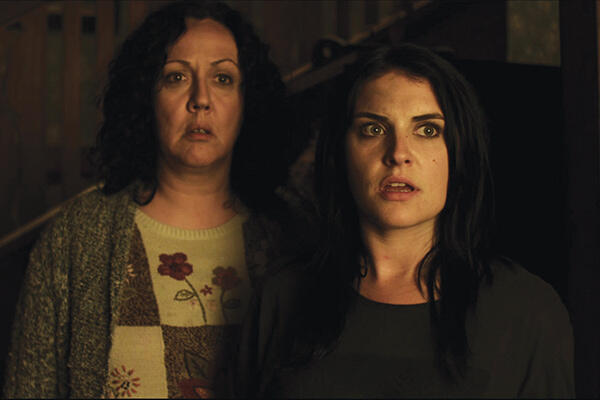
Housebound
Rating: A- Does anyone else feel the pressure to love any film made in New Zealand? Like there’s a special place in hell for those that don’t support Kiwi comedy? What I’m saying is, I do. So when reviewers and punters alike starting raving about Kiwi-made horror-comedy Housebound, a voice inside my head akin to Roz the secretary of Monsters Inc. retorted: we’ll see. And what I did see was completely refreshing, hilarious and promising for the future of New Zealand film. Housebound follows protagonist Kylie (Morgana O’Reilly), a delinquent charged with eight months of house arrest in her small-town mother Miriam’s (a hilarious Rima Te Wiata) home. As if Miriam’s small-minded chitter-chatter and casual racism aren’t torturous enough, Kylie discovers her old family home is obnoxiously haunted. The film took off to a slow start that had me very nervous. Don't get me wrong; the beginning half hour was funny and scary, but it was also very typical. The first handful of scenes were full of tired tropes: suspenseful music; stock shots of the haunted house under an ominous sky; the discovery of files that explain the sordid history of the building, blah blah blah. I had settled myself in for an enjoyable but thoroughly predictable couple of hours. HOW WRONG I WAS. This film has three twists. THREE. As soon as you'd wrapped your head around the first bombshell they'd drop another, then another... then another. I haven't made so much noise in a movie theatre since Sacha Baron Cohen's Bruno (which I think we can all agree was visceral). Although Housebound employed the same "someone creepy appears very quickly when you weren't expecting them" technique over and over again, goddamn does it make you jump. Johnstone managed to slightly alter each "shock" moment just enough that each one was funnier, scarier and more ludicrous than the last. I haven’t laughed this much in a long time. I am proud to say Housebound is international funny, not just Kiwi funny. Quote me.
-
Culture

The Expendables 3
Rating: C+ In the long tradition of The Expendables series repackaging the exact same action-hero products you have seen before in 80s’ movies, comes The Expendables 3, a film with no original dialogue. Some might say that the way they rework each action actor’s iconic catchphrases (such as “I’ll be back!”) into their new films ad nauseam is a bold and wholly new genre of self-referential parody genius. Not me, however. From the moment I saw the first Expendables film, I knew that every bad-but-great old action movie I ever loved from late night TV was going to be ruined by the same actors trying to do their thing all over again in a series of much more modern, and much less interesting or authentic, sequels in the coming years. And, sadly, Ex-3 did not fail to deliver on that score. As if seeing Jean-Claude Van Damme doing a pathetic parody of his flying-kicking younger self in The Expendables 2 wasn’t bad enough, now we have “Crazy Mel Gibson” doing that whole suicidal Lethal Weapon thing all over again. It sucks. None of the evil they create for his on-screen character is as disturbing as the YouTube videos out there of his drunken, misogynistic, anti-Semitic torrents of spousal abuse. Wesley Snipes too is back in a poor, poor reprisal of his role in Stallone’s Demolition Man. But blow me down was that Harrison Ford doing a Han Solo cameo!? Awesome … I guess. Oh, I tried so hard to like it. But there comes a time in every young boy’s life when he watches a shoot-em-up film, and instead of being excited by the bloodlust, he breathes in deep, accepts his new place in the world, and says out loud: “Oh come on, there’s no way they could have survived that eight-story freefall and then killed those 60 guys who were waiting for them right there with tanks. This is bullshit.” Son, today you are a man. The one and only good part of this film was Antonio Banderas’ cameo, reminiscent of PUSS … in boots!
-
Culture
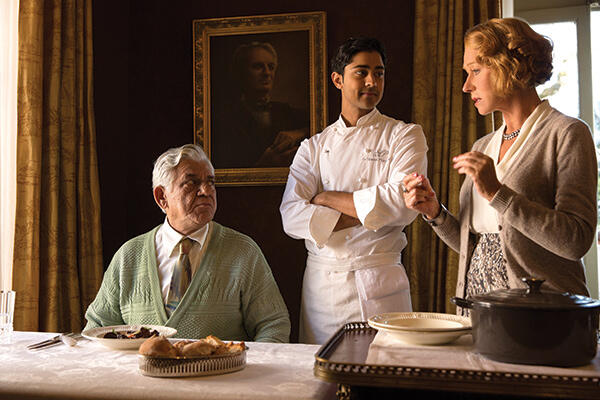
The Hundred-Foot Journey
When I procrastinate, I try to do it with class. As in, I’ll be my foodie self and watch seven episodes of Kitchen Nightmares. To me, “foodie” just means you’re addicted to food porn. The Hundred-Foot Journey is not just a feel-good film; it’s a feel-good opportunity to satisfy those foodie needs. The Hundred-Foot Journey focuses on the Kadam family and, in particular, Hassan (Manish Dayal). Following the fire that killed Hassan’s mother and destroyed their restaurant in India, the Kadam family relocate to France. The journey is cut short when Papa Kadam’s (Om Puri) car breaks down. Reassuring the family that “brakes break for a reason”, they eventually settle down in a French village and even open up their own restaurant. However, 100 feet away from ‘Maison Mumbai’ is a Michelin one-star restaurant run by the strict Madame Mallory (Helen Mirren). The interaction between Madame Mallory and Papa is initially one of hostility. Insults are thrown and there are many attempts at sabotage. However, their humorous war later adds a deeper element to the film: the issue of racism. The seriousness of this topic adds a dash of reality and I felt it enhanced the cookie-cutter plotline. The film has a central focus on the development of Hassan, who is a promising future chef. With the lessons learnt from his mother, the cookbooks left in his new home, and advice from sous-chef Marguerite (Charlotte Le Bon), Hassan soon becomes an acclaimed chef and pushes the boundaries of the culinary world. He even gets a taste of romance (pun completely intended) – it’s predictable but nice. However, the film’s unravelling of the generic, happy ending dragged on. At one point, I became more interested in the cinema’s curtains. Fortunately, the close-ups of elegant dishes and long shots of the village redeemed the ending. Overall, The Hundred-Foot Journey was a heart-warming film to watch and it’s definitely a good fix for the foodies.
-
Culture
Jumanji
Classic Film A nostalgic 90s’ classic, which I’m sure many of us have been revisiting in the weeks since Robin William’s death. The film is about a magical board game named Jumanji, which conjures deadly jungle-related things with each roll of the dice. There are killer mosquitoes, lions, carnivorous plants, etc., and the only way to get rid of them is by finishing the game. Four characters (played by Robin Williams, Bonnie Hunt, Kirsten Dunst and Bradley Pierce) wind up playing Jumanji, and must attempt to complete it while escaping the terrors it throws at them. As an adult, I can no longer pretend Jumanji is the flawless masterpiece I once thought it was; the first 15 minutes feel like a Goosebumps episode, the ending raises all sorts of logistical questions, and the “face your fears” message is a bit too simplistic for a movie that features so much danger that one would be well-advised to run away from. Also, the villain is played by the same actor who plays the protagonist’s father, with no in-story explanation, bringing with it a Freudian WTF factor that probably doesn’t belong in a kid’s movie. However, the things that are still awesome about Jumanji outweigh any faults. The characters are well fleshed-out and entertaining to watch; Williams and Hunt are both just as adept at drama as they are at comedy, and they strike the perfect balance. There’s some real suspense as well, and the special effects are generally pretty amazing. And I think a big part of why I loved this movie so much as a kid was that the action sequences are taken just as seriously as those in movies for adults. They are just as imaginative, well-constructed, suspenseful, and entertaining. Jumanji drew some criticism for being too scary for young children, which is understandable. But there’s a lot of heart and comedy that balances the scares, and for kids who aren’t old enough for Kill Bill, it offers a level of action and excitement that most other family films don’t.
-
Culture
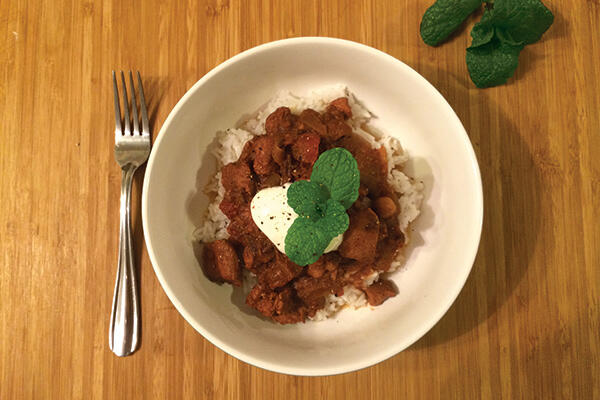
Slow cooked moroccan chicken
I stayed home sick today. It was miserable outside and I sound like a man. A man with a blocked nose. I took advantage of the day of paid sick leave at home to fill the house with the smell of slow cooked Moroccan chicken. I usually make it on the stove but I find it far easier and way more delicious to throw all the ingredients into a slow cooker and whack it on for six hours or so. The flavour has more time to develop and the chicken melts in your mouth. I don’t really have a set recipe for this. It is sort of my lazy cooking meal. Very little effort is required. I just sprinkle over the spices in approximate quantities. Add more or less if you wish. If you are making this in under an hour just brown the chicken in a splash of olive oil along with the spices. Add the onion and garlic and sauté until soft. Pour over the tomatoes, chicken stock, chickpeas and dates and leave to simmer for 45 minutes until nice and thick. IngredientsServes 4 500g chicken thigh, cubed 1 teaspoon chilli 2 heaped teaspoons cinnamon 2 heaped teaspoons ground cumin 1 teaspoon paprika 1 teaspoon ground coriander ½ teaspoon turmeric 1 teaspoon salt Freshly ground black pepper 2 onions, sliced 4 cloves garlic, minced 2 400g tins of chopped tomatoes 1 400g tin of chickpeasv ½ cup chopped dates; 3 cups chicken stock Rice, plain yoghurt and fresh mint to serve. MethodPlace all the chicken ingredients into a slow cooker. Cook on high for six – eight hours. Give it a stir every so often if you can. Serve atop rice or couscous and with plain, unsweetened yoghurt and fresh mint leaves, maybe even some chopped nuts too. I feel like I need to insert some anecdote to fill in the lack of word count. Sorry, Zane. It is seriously that easy. You should make it.
-
Culture

Profile: Zac Fay
Last Friday night I went to Dunedin-based artist Zac Fay’s first official exhibition, Blood Eagle, at Kiki Beware on George Street, and it was so effortlessly great. Unfortunately the exhibition is now over, but because Zac is local, naturally I felt it would be appropriate to meet and greet and discuss art in the flesh, so we sat down at Nova for a quick espresso. Fay is 23 years old and was born and bred in Dunedin. Aside from spare time doodling, he worked for a year as an assistant at Van Brandenburg architects in Dunedin before he left to study marketing. The architectural elements of his work and his decision to exhibit it in a clean, modern and architecturally reflective space stemmed from his interest in architecture. Other than that, he gets a lot of inspiration from cartoons and other illustrative artists. His favourite graffiti/street artist is American contemporary illustrator and street artist Neckface, whose work is generally congruent with Fay’s. The exhibition at Kiki took Fay a month to do and was comprised of eight A4 pieces, six A5 pieces and two A3 pieces. In terms of the creative process, he says his process is quite basic but it works. Fay starts with a light pencil outline, which he then goes over in ink, before filling in chosen areas with water colours and the occasional hint of gouache. Fay’s images are what he describes as “creepy and creature-like” but still friendly as the characters and images appear both comical and cartoonish. When I first saw the exhibition it reminded me of Salad Fingers, but not so anguished and cynical. The creepy subjects are juxtaposed with subtle saturations of water colour that “tone down the subjects a bit,” as they contrast the sharpness of the black inked lines and in doing this, instead of appearing horrifying or gruesome, his images feel more light-hearted and seem to represent a specific state of ironic, modern melancholia. This theme runs through his whole exhibition with images of things like stubbed-out cigarette butts and daggers with blood on them, filed lightly with pastel-like blue, red and black watercolours. His work is playful but well-constructed and is thematically coherent. Outside this exhibition (in Dunedin spirit) Fay has collaborated with other local creative friends and fellow artists, including commissioned prints for local brand Clothes I’ve Made, where he designed t-shirt prints: “I did a Gucci-esque print for them, and a Street Sharks inspired one.” Fay has also done some work for the Public Gallery and has extended his reach to Melbourne, where he has done album covers for his friend, Scapegoat Mercy (soundcloud.com/username-21). With not much else to say about his work apart from the fact that he was overwhelmed by the positive response, numb by excitement on the night, and thankful to his girlfriend, Briar, for being the “brain” behind his creative impulse, Fay finished his long black before he pulled out his sketchpad showing me a quick drawing of a bloody dagger he had done for a best friend and, gathering his things together, he assured me he would pen me a piece that features knives and blood and cigarettes – specifically, a dagger impaling a bunch of cigarettes. Fabulous! Uncertain when his next exhibition will be, Zac is enthusiastic to keep drawing and working, and I am looking forward to seeing more in the future.
-
Culture
New this week / Singles in review
Lauryn Hill - Black Rage (Sketch) The actress and musician Lauryn Hill only has one album under her belt, but that hasn't stopped her from releasing the odd single now and then. “Black Rage (Sketch)” is a slow burning, RN'B track, dripping with her trademark boldness. While it borrows the melody from “My Favourite Things,” a song from The Sound of Music soundtrack, the subject matter at hand is not quite the same. Hill tackles issues deeply entrenched in her past and present society, regarding race and injustice. Her vocal performance is mesmerising and the production is rich and gritty. Pharmakon - Body Betrays Itself Pharmakon is Margaret Chardiet, a noise artist from Brooklyn, USA. After her debut album from last year, Abandon, Chardiet is set to release her second album, Bestial Burden, on Sacred Bones records. “Body Betrays Itself” is the record's first single and gives a good glimpse of what to expect. The track is a writhing soundscape of deep, ominous synth and booming drums. Something you would include in a post-apocalyptic soundtrack or your next barbecue, perhaps. Chardiet's voice is venomous, and raw; a visceral and engaging track that kind of sounds like hell. Caribou - Our Love “Our Love” is the second single from Dan Snaith's project Caribou. It is from the upcoming album of the same name and will be the Canadian musician's fifth to date, following the stellar Swim from 2010. “Our Love” is a house-influenced, electronic-trance track. The rhythm is hypnotic; the backing vocal hook vibrates up and down and conjures an almost otherworldly euphoria. It's definitely a song for standing under the neon lights in the early hours of the morning. Electric Wizard - Sadiowitch Hailing from Dorset, England, Electric Wizard are one of the most renowned doom metal bands around, known for their incorporation of stoner rock as well as sludge. Four years removed from their seventh studio album, Black Masses, the band return with “Sadiowitch,” the single to their cheerfully titled upcoming album, Time To Die?. The track is a propulsive, nightmarish acid trip. More psychedelic, classic Black Sabbath than heavy doom. Jus Oborn's trademark sneer is on top form. Vince Staples - Blue Suede At present, Vince Staples is probably best known as the guest MC on Earl Sweatshirt's track “Hive.” The 21-year-old Long Beach rapper has been busy, however, preparing his debut album set to be released on Def Jam records. “Blue Suede” is the lead single from his upcoming album titled, Hell Can Wait. The track is built over a dark, almost terrifying, landscape of blaring synths and grimy beats, resembling a police siren, booming out across a dark, cold neighbourhood. “All I wanted was them Jordans with the blue suede in them.”
-
Culture
Download of the week: Iron Tusk - Iron Tusk EP (NZ)
Iron Tusk are a local Dunedin progressive metal band, featuring the talents of Adam Wells on drums, Scott Herriott on guitar, Jake Langley on vocals and Shane Hellyer on bass. Members and ex-members of Dunedin metal luminaries Ignite The Helix, Threads, El Schlong and Twist of Fate. The Iron Tusk EP is an impressive blend of riff-based metal and progressive rock dynamics. You can download it for a name-your-price deal on irontusknz.bandcamp.com.
-
Culture

Merchandise - After The End
Rating: A- Formed in 2008 in Tampa, Florida, Merchandise has undergone reinvention after reinvention. Cementing themselves, at first, as a punk band, they soon evolved into an off-kilter, experimental, alternative, pop outfit in the early 2010s. After experiencing mild success with 2012's Children Of Desire the group found themselves signed to 4AD this year and, as time has taught us, the group were on the verge of reinventing themselves once again. This time the result of the band's musical restlessness comes in the form of the glistening After The End. A classy collection of beautiful, lush ballads and blissed out, hook-based pop songs, which reference 80s guitar-pop luminaries such as The Cure, Blondie, U2 and The Smiths. The record's larger than life production signals a classic move made by bands trying to make an impact after being signed to a bigger label. Which is to make full use of their increased exposure by offering audiences a more polished sound, making their music more palatable for the general public. However punk or indie you may consider yourself to be, this move can sometimes be a good thing for both the band and fans alike. In fact, I think most bands should try their hand at writing a pop song. There is nothing wrong with aiming to release more immediately likable songs, however miserably it may end up backfiring at times. Lucky for us, though, Merchandise execute this challenging endeavour with confidence, authenticity and moderate success. First of all, production-wise, the record is rich and warm, and skilfully produced by the band themselves. The guitars sound majestic, with each string sounding like it could've been crafted out of strands of Jesus' hair. The organ and synth act to further emphasise the luminescence, sweeping in every now and then, to add various layers of sheen. Perhaps the most intriguing part of Merchandise's present, grandiose pop escapade, is the rich, vocal performance provided by frontman Carson Cox. Sounding one part Morrissey, one part Julian Casablancas, and one part early Scott Walker. His voice brushes by effortlessly across the mix, like velvet on velvet. It all goes down smoothly but, at times, perhaps too smoothly. The album opens with “Corridor,” an instrumental track, which floats softly on a bed of acoustic guitars and atmospheric synth. At 2:47, this track is also the shortest track, which is a feat considering a third of the other nine songs are supposed to be full-blown pop singles. In fact, most of the songs. “Enemy” is an obvious single, based on an acoustic guitar riff that sounds like an ethnic version of “I Can't Get No Satisfaction” by The Rolling Stones. The next three songs, “True Monument,” “Green Lady” and “Life Outside The Mirror” are sweeping ballads, perhaps meandering at times. However, the arrangements are humungous and, in terms of sound, could be considered a cousin of Joshua Tree-era U2. Side two of the album starts off with “Telephone,” which is the most 80s pop thing on the album. With a groovy pop bass hook, and a chorus that Whitney Houston would be proud of, “I wait and I wait and I wait by the telephone.” “Little Killer” is definitely the standout track. It is undoubtedly the most upbeat song, sounding like The Cure in full-fledged pop mode. The last three songs, “Looking Glass Waltz,” “After The End” and “Exile and Ego,” see the band return to a much slower paced approach. Carson Cox croons through the final 16 minutes, sounding like Scott Walker on his first four albums. Huge lavish songs, with a hint of dry emotion, setting off visions of long dusty roads and heartbroken heroes. As a whole, After The End, is an immersive experience but one that perhaps relies on its huge, lush, sound instead of making the most of its pristine pop environment. The record does tend to drag, not because of one particular song but because of the bevy of slower paced songs that seem to be bunched together. The band carry these songs with moderate success; even Cox's golden voice starts to come off whiney after a while. When Merchandise embrace the challenge of writing pop singles, however, they truly do succeed, with highlights such as “Enemy,” “Telephone” and “Little Killer.” After The End is a clean, polished, pop record by a band that has never before fit that description. It could have been a little more interesting, but there are some excellent moments indeed.
-
Culture

Where'd You Go, Bernadette
Before Maria Semple was a novelist, she was a screenwriter for Arrested Development and Saturday Night Live. With the Arrested Development aspect in mind, there is no doubt that Semple can write great, satirical pieces. Her latest novel, Where’d You Go, Bernadette, is no different. In this novel, Semple draws from her own personal, and very much first world, problems of living in Seattle. Semple experienced the pain of not having a personal assistant and also felt that all 634,535 inhabitants of Seattle hated her. These anxieties are channelled through the novel’s missing person: Bernadette Branch (née Fox). A friend inadvertently recommended this book to me. Well, it popped up on my Goodreads feed and I couldn’t help but pry into my friend’s literary life. I just like to know what other people are reading. I’m also just a very nosy person in general. However, after reading the blurb, I found myself wanting to know more about the novel. I was also quite taken with the front cover. There’s an air of captivating mystery about it that makes me genuinely want to know the answer to Bernadette’s whereabouts. The illustration on the front cover consists of bold, solid colours. Despite its simplicity, the portrait of Bernadette immediately caught my eye. In some ways its simplicity is ironic because the story itself has a lot of twists and unexpected elements. For some reason though, eye rolling always ensues around books that are categorised as “chick lit” and Where’d You Go, Bernadette certainly gives off that chick lit vibe. However, this novel does not deserve eye rolling of any kind. As the winner of the 2013 ALA Alex Prize award and a nominee for the 2013 Women’s Prize for Fiction, Where’d You Go, Bernadette shouldn’t be pigeonholed by first impressions. I didn’t expect myself to enjoy this book as much as I did, but the fact that I finished it within two days proves otherwise. From the very first page, the reader becomes well acquainted with the Branch family and the people who, unfortunately for Bernadette, surround them. The novel is made up of letters, e-mails, magazine articles, and police reports. Bee Branch, Bernadette’s daughter, briefly narrates in between these documents. Semple’s unique, epistolary style was a rollercoaster ride into inner workings of the Fox/Branch family and we enter at a time where their lives are beginning to fall apart. The unravelling of their hint of quirky, upper class lives is spurred when the family start preparing for their trip to Antarctica. This sets off a chain of events that take a major toll on Bernadette. She becomes completely dependent on Manjula Kapoor, her assistant from India (whom she has never met), and eventually detaches herself from the outside world. Bernadette and her absence fuel the events of the novel and the outcomes ultimately change everyone’s lives. From the Branch family to their neighbours to Bernadette’s psychologist, no one remains unscathed. I definitely had my moments of eyebrow furrowing. Firstly, Bee is actually short for Balakrishna. Bernadette named her daughter after Krishna, the eighth incarnation of the god Vishnu because Bee was born with a heart condition that gave her skin a blue tinge. Maybe I’m being too sensitive but that just doesn’t sit quite right with me. Secondly, there were things Bernadette wrote to Manjula that made me cringe. A bindi is not just “a red dot,” thank you very much, Ms Semple! Despite those moments though, Where’d You Go, Bernadette is an engaging, adventurous book and one I highly recommend.
-
Culture
Luftrausers
This may or may not be something you consider when pondering video games, but join me for a moment in thinking about how a game feels to play. Think of your favourite game … Now instead of its art, sound or gameplay mechanics, I want you to think about how the game feels. Does it feel light or heavy? Floaty or grounded? Smooth or stuttered? These can be vague concepts, but I’m sure with some thought or a conscious examination when playing you will be able to determine the weight and feel of any game. Take for example a Call of Duty game; they are famous for being incredibly fast, smooth and grounded first person shooters. Now compare that with another first person shooter such as Arma that is realistic in how heavy, slow and stuttered it feels. When you think about these differences in feel they seem obvious, but there is a reason you need to think about it, because the feel of a game is supposed to be a sub-conscious experience. That is why a game such as Luftrausers feels so unique to play, because it very clearly asks you to consider the feel of the game and how that affects your experience with it. Luftrausers is a 2D airplane shoot ‘em’ up title developed by the talented indie team Vlambeer, who you might also know as the developers of Ridiculous Fishing. Expressed through the tone and aesthetic aptly associated with the WWII era German military, Luftrausers has players commanding an airplane against hordes of enemy planes, boats and blimps. The plane you command varies greatly depending on which combination of weapons, hull and engine you pick. As well as changing the way you fly and engage in combat, your choice of these three specifications also changes the challenge you are presented. These challenges vary from achieving a certain score, to destroying a certain number of enemies or with a particular method. In itself these challenges are fun and varied enough to engage players in hours of aerial mayhem. However, it is the combination of the challenges with the airplane specifications that really makes this gameplay special. You see, each different component you choose (weapon, hull and engine) drastically changes the way the plane feels to fly and shoot with and then combining these different components creates a staggering selection of varied fighting and flying styles. This innovation is what makes the feel of the game such a keen focus. Your first several hours with the game will be naturally be inclined to experimenting with these different components and how they change your experience with flying. You find yourself being drawn to a certain combination. For example, I preferred using weapons that were slow and precise but delivered huge amounts of damage, but then combining these slow weapons with fast and agile engines and hull. However, though you may find a preferred play style, the game pushes you to constantly have to change your aptitude with different play styles, as the challenges are tied to the components. This means that your experience with the game is constantly changing, you have to repeatedly retrain yourself to operate and fight with drastically different feeling airplanes. The game has no story, but instead opts for challenge as the hook for continued play. The clever design means that the challenge the game offers is constant and evolving, allowing you the feeling of becoming more proficient while still having you continue to chase the carrot at the end of the stick. When I began my time with Luftrausers the unique controls and flying functionality were alien and confusing. However, with only a little practice I quickly found myself not only comfortable with the controlling, but excited by how the game allows you to become quickly proficient with its mechanics. This adds another layer of fun in just racking up high scores and the feeling that you are constantly one more attempt away from gaining a new and impressive high score. Luftrausers is a game unique in tone, aesthetic and, as I have demonstrated, in how it feels to play. It is so satisfying in this uber-realistic digital landscape to realise how much joy only a few pixels properly designed and executed can offer.
-
News

Interview: Kevin Hague - Green MP
Kevin Hague is a current Green MP, and looks after their health and sport policy. In the interest of providing something of note to the P.E. students that isn’t on the sport pages, I asked him about what policies he advocates for in the complex network of elite sport and school activities. I also asked him about health and mental health policy. We have a big P.E. department down here, and it was explained to me that the National Government’s initiative Kiwisport is one of the main changes they’ve made to sport policy in the last six years. Would the Greens keep Kiwisport? I’d want to talk to P.E. teachers about how the programme is working in practice. When National introduced it, I was pretty strongly critical, because the programmes that they ditched to free up the funding to do Kiwisport were programmes that were more broadly based, and focused on getting larger numbers of kids physically active more generally than sport. The Green Party says sport is great for those kids who are suited for it and like it, but a pure focus on sport stops physical activity for a whole bunch of other kids for whom sport is not their thing. Walking might be, or biking noncompetitively. Or yoga. We used to have a whole bunch of programmes that were designed for making everyone active; money got pulled out of those and got put into Kiwisport, which no doubt was good for some kids, but probably bad for a whole lot of others. Now it may be that in some schools that they’ve been able to apply the money more generally to be able to still achieve the goals of the old programmes, and if that is possible within constraints, I would rather adjust than overturn. So, if it’s possible to just adjust Kiwisport to ensure that all schools are doing that general participation thing, that’s what we would do. Would you change the nature of the split funding so that there are more resources given to sports clubs and schools? I’m not sure, to be honest; and I think probably school-based programmes are hugely important. So we want to make sure that they are adequately resourced. There’s a project that’s called Project Energise, which started in the Waikato actually, and has been extended a little bit. That’s actually shown really good results, and that’s about physical activity every day for primary school kids and actually preschool as well, so early childhood education. I want programmes like that in every school. When it comes to the funding of sports clubs, I guess the big issue is that the actual need is currently hard to determine because they’re getting so much revenue from the gambling industry, from pokies trusts and things, which we want to axe. We don’t want sport being funded by gambling, so what we will need to do is quantify how much money that is, and how much money the sports clubs need, because it’s unfair on the sports clubs to simply pull that money out. It’s likely that more money will need to go into sport, probably through something like the health sponsorship council, which started a transitional fund when tobacco sponsorship was banned. Health sponsorship council got set up to provide sponsorship funding for sport and other things that tobacco had been sponsoring. So that you didn’t make everyone go cold turkey- Hahaha, great pun. Oh, I’m sorry, I didn’t mean it … Cause otherwise a whole lot of other things would fall over. So what we want to do is make sure that sports clubs actually have the appropriate level of funding and sports trusts as well, which is the other level. Do you support the sport-through-investment scheme whereby teams and athletes that have the potential to do well and to win are the ones who get the funding? No. I guess there are different reasons why the state is interested in sport. And I would argue the main reason is that physical activity results in healthier people who actually would have better outcomes in every aspect of their lives because of physical activity. So that’s primarily why you do it, and ultimately (although it’s hard to directly link up the consequences to the action), you’ve got reduced health spending as a result of that, because people don’t get as sick. Now that’s not primarily about elite sport; so you probably do elite sport, I guess there’s an argument around elite sport that says if New Zealanders are doing really well on the international stage, that will reverberate. So the fact that the All Blacks are a really good rugby team probably inspires a whole lot of people to actually get involved in physical activity. One of my sports is cycling, so I see Anton Cooper winning the gold medal at the Commonwealth Games for mountain biking and he’s … 18, 19, and that will probably inspire other kids and young people to actually take up biking. So there is a role for government funding of elite sport associated that. But otherwise it’s just kind of national identity and feel good and potentially a bit of marketing; that would be the argument for funding America’s Cup, for example; it’s basically entirely about marketing New Zealand. So you’d have to do the equation then not on the physical activity it promotes, but whether it returns money to our economy. If it doesn’t, then no. You would support dishing a bit of funding to teams and initiatives that don’t have major sponsors? Yes. One of the main arguments you hear tossed around about privatising healthcare is that higher profits drive innovation in the health sector. How would you encourage this innovation without privatisation? In my experience, I’ve seen the best innovation come from necessity actually, which is an example of a totally reverse argument, which says if you’re short of money, then you innovate. Not that I’m suggesting that as an approach, but in my experience I think where I see the most creative thinking is where people are secure but motivated around quality improvement. For example, Counties Manukau DHB has got a partnership with a National Institute of Health from the US (and I think there’s now a UK partner as well), and it’s like an international healthcare quality improvement collective, and they’re doing really interesting things. I was on the quality improvement committee – well, I was the West Coast DHB Chief Executive before I became a politician – and again what I found was that people really wanted to find ways of improving quality. There’s no sense of “everything is as good as it can be;” people are genuinely excited about quality improvement cycles. What they get turned off by is where you do a pilot but there’s never any money for it to actually get rolled out, and it never goes anywhere. There’s 15 different pilots happening around the country, and there’s no commitment to making the system learn from the best of those things. Those are the things that turn people off. When I look at private healthcare, I don’t see a lot of innovation. Well, innovation perhaps in cost control, but I think there are some counter examples. Kaiser Permanente in the United States actually has pioneered quality improvement and patient flow kind of stuff, but I look at the private sector in New Zealand, and I do not see that as a significant source of innovation in our environment. It’s clearly not generally true that profit motivation drives innovation at all, and as I say, some of the best innovation has occurred in really resource-constrained environments. Do you support making dental care cheaper? Yup, but that gets to the boundary between public and private, of course … What we’ve got now is a situation where healthcare costs have grown, and bridging the gap across the things that are privately funded becomes increasingly unaffordable. All anyone can do is nibble around the edges, which is why our primary care policy extends to 18; it’s not primary care for everyone, because we know that that’s an unaffordable cost at this point. On dental, we’ve already got free dental to the age of 18; our policy this time around will extend that to students, beneficiaries, and superannuitants. Most DHBs have some schemes for low-income adults as well, but it tends to be urgent care, so it’s not really a comprehensive service at all. What sort of initiatives do you support to strengthen how we deal with mental health in New Zealand? Well, again, the first thing is more resourcing. And it gets back to the question of “what’s the overall resourcing for the healthcare sector?” So if you under-resource, then heaps of things don’t have the money to actually play the role that they should. Mental health is a classic. Always described in the past as a ‘Cinderella service’ – constantly overlooked and in the corner. We had the blueprint and the mental health commission. So the blueprint basically set out, “here is the amount of each mental health service you need in each area.” And in the mental health commission, so there was dedicated funding each DHB got for that; the mental health commission saw money going into it. All DHBs except West Coast DHB, in fact, just saying, failed to meet their blueprint volumes … Now the mental health commission has been disbanded, and it’s not available to ensure that DHBs put the money where it’s supposed to go, so things are drifting backwards. What we would do is, first of all, ensure, as with every health service, prevention in the first place, so addressing those environmental determinants like marginalisation, poverty, racism, and discrimination. [The] next level is self-care, so actually providing resources for person in the lounge to actually say, “I’m struggling with feeling depressed, stressed, overwhelmed, super anxious, where can I turn.” Helplines and services that people can go to directly. Ensuring that primary care actually has a full range of brief interventions that GPs or practice nurses can themselves do directly; a bit of that’s happening and good referral pathways into other mental health services both specialist in-patient acute services and community based services … Pretty much the only bit of that whole spectrum that’s properly funded now is, and even that you’d argue probably not, is in-patient acute. Every other thing is underfunded and underdeveloped. All of those bits need attention and, in particular, the thing I’d say is the biggest problem is that the residential support services, so people who’ve got significant mental illness, right now or episodic, who need some level of support but who are not in fact acutely ill will end up staying in acute units because there isn’t some other service to discharge them to, which then in turn means that your acute unit with people who actually don’t need that level of service, which means if you’ve got someone who’s acutely ill in the community, there isn’t a bed to refer them to in the acute unit. So you’ve got a total mismatch of need and service. So improving the capacity of community based services actually changes that. DISCLOSURE: Carys is a Green Party hack who is hardcore hacking it up for the election. But don’t worry – she has a few National Party friends who don’t hesitate to send in angsty letters to the editor when she strays too far into shill territory.
-
Columns
Science, Bitches | Issue 21
So why would I bother talking about the naked mole rat – a pink, hairless, toothed rodent from eastern Africa? Perhaps you better know them as the species that charismatic sidekick from your child/teenhood was (Kim Possible, anyone?). Have you ever Google image searched for a naked mole rat? If not, save it for a minute when you need a laugh. National Geographic describes these animals as “bratwursts with teeth.” How’s that for a mental image? Let’s look beyond the phallic appearance of these wrinkly, toothed creatures and see what else goes on in their burrows. What do naked mole rats and bees have in common? Unlike all other mammals, the naked mole rat lives eusocially, meaning they live in a colony and collectively. They behave not unlike a hive of bees or a nest of ants (though I think you will find that the naked mole rat does not produce honey). They spend a majority of their lives underground, in massive burrows of interconnecting tunnels that can be a few kilometres in size! The naked mole rat has a queen, who suppresses the sexual activity of the females around her. Only a few males are sexually capable, while all the other males and females are simply subordinates. These subordinates will be soldiers, workers and babysitters for the queen and her pups. This is fascinating, as this is behaviour usually reserved for insects, certainly not mammals. They have tiny little legs, not so good for burrowing. Instead they use their massive rodent teeth to carve away at the earth. The social life of bees is fairly similar – the queen bee does all the reproducing, while the others tend to the hives and look after the young. The queen bee keeps the others in line using pheromones – scented chemicals that affect the behaviour of the bees around her. The naked mole rat queen, on the other hand, must bully those around her to keep them in line. She needs to be able to fight off any females who try to take her place. Another weird fact about the naked mole rat: they can move their front teeth independently, like a pair of chopsticks! Why else should we care about these half-blind, wrinkled, stumpy-legged and, frankly, ugly rodents? They have very long lifespans for rodents and they are resistant to cancer. How does that work? The body usually does its best to stave off cancers through a mechanism called contact inhibition. This means that cells physically contacting one another inhibit their neighbours from growing and dividing when they’re not supposed to. Cancers arise when this inhibition is faulty, along with other genetic changes to the cells. Naked mole rats have more proteins that can maintain this contact inhibition than humans do, making them highly resistant to cancers. You can now probably see why these phallic animals fascinate scientists. And that’s science, bitches!
-
Columns

Queer Eye | Issue 21
Warning for graphic surgical trauma/abuse The first words that will have been heard by most of the people alive on this planet today — statistically, about 99.95 per cent — are a triumphant “it’s a boy!” or “it’s a girl!” But what about the others: that one child in 2,000? Intersex is an umbrella phrase that describes over 30 conditions in humans, all of which lead to a body that cannot be easily categorised into “male” or “female.” This can be due to variance in any of the five factors generally accepted to constitute biological sex: chromosome number and type; gonads; sex hormones; internal reproductive anatomy; and external genitalia. In some conditions, for example, Complete Androgen Insensitivity Syndrome (CAIS), where the body is unable to respond to the masculinising effects of testosterone and other androgens, the person may well live their entire life not realising they are intersex unless they are karyotyped (chromosome mapped). In many cases, though, there is visible genital ambiguity at birth. The birth of an intersex child will typically be treated as a medical emergency, with immediate intervention obviously required: a child might grow up not fitting absolutely into the binary way we have decided the world works? The horror! The medical interventions in question are usually extensive, invasive, traumatic, and often incredibly painful. In essence, the medical team in attendance will “pick a side” based on the infant’s genitalia, and proceed to “correct” the body to better fit what children of the elected sex are supposed to look like. This may include hormone therapy, removal of internal gonadal tissue, and major reconstructive genital surgery, all before the child has left the hospital for the first time. Surgeries will often be on going throughout childhood, and almost always result in major scarring and the partial or complete loss of sexual sensation. Even putting aside the obvious problems with deciding on a) the sex someone else is going to be and b) the medical treatment they “ought” to have to bring them in line with how you think that sex should look, performing the surgeries you have deemed necessary so early in life can lead to its own set of problems; the often-inconsistent results will only become more so as the person grows, with some people suffering such horrific consequences as sudden, massive tearing and haemorrhage as the scar tissue finally becomes unable to keep up with the growth of the tissue around it. We are unable to predict the gender of a child based on their physical sex at birth. That’s a fact. Depending on the survey population, anywhere between one and three per cent of dyadic (non-intersex) people identify with a gender other than the one to which they are assigned. That’s 21 million people across the world, 130 thousand in New Zealand, and over 600 at our own University of Otago. 21 million physically “normal” people for whom medicine got it wrong. What level of arrogance can possibly lead to thinking you have the right or the capability to make that call for people who don’t even have a clear physical sex for you to make a statistically-based guess on? To perform invasive, traumatic, and often experimental genital surgeries on infants who have not and cannot give their consent? It’s time for the medical profession to pull its head out of its collective ass on this one.
-
Columns
Defending the kingdom | Issue 21
For all of us over at the Law School, the Honourable Michael Kirby requires no introduction. He served as a Justice of Australia’s highest court from 1996 until 2009. Though he is well into his 70s, Michael is now chairing the UN Human Rights Commission of Inquiry, investigating human rights abuses in North Korea. A couple of Tuesdays ago he gave a devastating account of the current situation. He later met with the LLB Hons students and SALDF. Michael Kirby has been a personal hero of mine for a long time. Beyond frequenting my textbooks, he is also openly gay and a passionate advocate of animal welfare. And he is a really lovely person with a wicked sense of humour and an acute interest in Marxist philosophy. While from a judiciary traditionally dominated by straight conservatives (mostly white, middle-class men), he is admired by us filthy left-wingers. You can imagine my excitement when I happened across him in the foyer of Richardson and was introduced to him by our Dean in the lift. Michael then sat next to me in the Law staffroom, as he listened to our Honours students speak about their theses, and then gave his own views on the animal rights movement. He spoke of reading a book on the meat industry in Australia and New Zealand, then never eating meat again. He is moving towards veganism, though he did ask Mark for tea with milk. Interestingly, Michael’s long-term partner Jan (pronounced “Yahn”) is unapologetically carnivorous. When Jan argues that humans were designed to eat meat and that our brains expanded when we did, Michael responds with “as our brains expanded, so did our sense of morality.” He wanted to know New Zealand’s laws on live export, and stressed the ethical concerns and risks of allowing cows to be removed to jurisdictions where we can have no say in their treatment and killing. He described the ways of killing animals in these countries as “grossly disrespectful and degrading.” However, SALDF’s Publications Officer, Oska Rego, pointed out the current situation of intensive animal farming in New Zealand – you, dear reader, must have been living under a rock if you hadn’t noticed the “Stop Factory Farming” nationwide protests. SALDF discussed with Michael New Zealand’s laws on stunning an animal before slaughter; this is a controversial practice because it is inconsistent with Islamic and Jewish beliefs. However, Michael considers that if we must kill animals, ultimately, it is more important to do it as kindly as possible (stunning is unanimously considered kinder to the animal than not) than to honour religious practice. Michael Kirby is known for his eloquent and moving judgements. True to reputation, he left us with the reminder that “they feel anger, distress, fear, and pain, and the killing is very frightening and painful for them. And we definitely know that larger mammals feel love.” Your Honour, I submit that the human larger mammal does not love other animals enough.
-
Columns

Too much screens | Issue 21
It's the 1980s, and prolific (if not actually talented) horror author Garth Marenghi is at the height of his fame. Naturally, he makes the move to the small screen. But his envelope-pushing scares are, for whatever reason, pulled from the schedule before airing. Until now. The network has uncovered these lost episodes of the hospital-set, occult-themed horror/drama series, intercut them with modern-day interviews with the main cast members (except for the mysteriously-unaccounted-for female lead), and is now beaming them into your home. If any of the above yarn was true, it would be right up my alley. The fact that it's actually a metafictional creation of comedian Matthew Holness (who writes and stars, just like his character Garth Marenghi) and director Richard Ayoade (who you may know from The IT Crowd, and who wrote and directed the excellent Submarine) somehow makes it even better. Presented as if it really were a shoddy 80s television series, Garth Marenghi's Darkplace builds a mythos around the cut-rate horror author and the character he plays on television, who is transparently based on how the author sees himself. By alternating between interview segments and the show itself, Garth Marenghi is quickly revealed to be a self-serious egomaniac. He seems to believe that his writing has the same level of cosmic importance as his show's protagonists' combination doctoring/hospital-administration/demon-slaying. As we learn from the excerpts at the beginning of each episode and from his television scripts, however, he's a hack. An excerpt from one of his many novels reads: "Something was pouring from his mouth. Blood? Blood. Crimson, copper-smelling blood, his blood. Blood. Blood. Blood. And bits of sick." His writing's clumsiness extends to his characters; every other character exists to reinforce the awesomeness of the troubled-but-brilliant Rick Dagless, M.D., or to stand in his way before reluctantly acknowledging his genius once he solves this week's nonsense supernatural drama. Where the show-within-a-show is a hodgepodge of "scary" tropes, however, the real Darkplace constructs an elaborate mythology around the fictional series' actors, and sells it all through its note-perfect direction and visual style. The fictional Darkplace is a mess, with boom mics straying into shot, cruddy visual effects, and atrocious line-readings. Every one of those production mistakes builds up the sense that what you're watching really is some delusional artist's labour of love. In one memorable segment, a character explains in an interview that the episodes were running as much as eight minutes short, and that although they tried to keep it away from the dialogue as much as possible, "anything without dialogue was considered for slow-motion." The metafictional gags run just about as deep as you care to follow them; for instance, you may notice that the model of the hospital, used in establishing shots between scenes, is surrounded by a barren wasteland, while the rooftop scenes show the hospital to be surrounded by a bustling city. These touches function as jokes, but also help sell the idea that there really was a half-assed "visionary" in the 80s who went to the trouble of creating a TV show simply as a temple to his own genius. Over the course of its six episodes, Garth Marenghi's Darkplace builds entrancing stories at three levels of fiction. At the bottom is a dingy, ramshackle 80s curio, with an obvious author avatar at its centre. Above lies that show's egomaniac author and a group of actors who wouldn't dream of saying no to him (except for the one who did, and is likely buried somewhere in the eastern bloc because of it). Finally, at the real-world level, we have the group of skilled comics/film-makers who created it all, slavishly recreating the trash of yesterday to make it all plausible and most importantly funny. Darkplace's six episodes pack a hell of a punch.
-
Columns

Love Is Blind | Issue 21
Critic’s infamous blind date column brings you weekly shutdowns, hilariously mismatched pairs, and the occasional hookup. Each week, we lure two singletons to Di Lusso, ply them with food and alcohol, then wait for their reports to arrive in our inbox. If this sounds like you, email critic@critic.co.nz. But be warned – if you dine on the free food and dash without sending us a writeup, a Critic writer will write one under your name. And that won’t end well for you. DonnyHey. I got the email from Critic one day before the date, since the guy pulled out, which was out of the blue. After talking with the flat mates, I was convinced to go. Date night. To be honest, I thought I’d be calm, after reading Critic’s blind dates weekly – I thought I had it sussed – until the flat mates ripped into me. So heading there pretty nervous, I thought to go five minutes early since the date is usually 10 minutes late, which would give me time to ask the bar staff for some tips, but my date was already there. The deep end, as they say. My date was attractive, smart and interesting. After getting the gist of what to do from the bar staff, I’d thought to get the ball rolling with conversation and avoid awkward silences. We ended up spinning yarns in various topics from history to politics and even travelling, which was fun. Overall I had a good time; without her being creative and interesting, I would’ve had a dull night. I didn’t get her number, since I got nervous at the end. Sorry, guys. I let the team down. Oh well, my loss and some else’s gain … But it was worth the experience. Now, up to the flat mates to step up! Cheers to my date for being a good sport; your company was a pleasure. Thank you to Critic for organising a decent blind date, which I enjoyed. Also a big thanks to Di Lusso and the bar staff for your great service, I definitely enjoyed dining there. MarieIt’s 7.26pm. Crumbs, I’m a touch early. He’s going to think I’m some perpetually early control freak. No matter, just ask the handsome bartender for the house wine and sip it thoughtfully by the fire while you wait. 7.28pm. Footsteps and a rumbling bass of a voice: “I’m here for the blind date,” it says to the bar wench. Damn you bar wench, why do you have to be so effortlessly beautiful – this was meant to be my night. I stand and face well-dress giant of a man with a dazed look in his eyes. He says something inaudible, presumably his name. He’s well dressed and he smells nice. The smelly kind of nice-smelling kind of man. 10 points to the Giant. We find a seat and start chatting. Our conversation as dry as the wine I was sipping. His mumbles included blasphemy such as gym, running, working out, gym. Things I passionately abhorred in my head, nonetheless I asked him questions with faux interest. We then talked of travel. Something I was far more akin to. And then we clicked. Stories of Mary Queen of Scots, Dracula, the Middle East and South America. Who would have guessed the Giant and I shared an avid appreciation of history. Our meals arrived. Mine the most decadent steak I had ever tried, and it took will power not to unleash the beast of hangrydom. The giant chose the pork belly and politely covered his mouth while he spoke and ate. An act that immediately made me think of my cousin. Oh shit, I was dating my cousin. The gym talk, the aspirations, the general Giganticy. He was a complete mirror image of my dear cousin, and I was not about to become the kissing kind of cousin. Still, we delved into deeper arguments about religion and addressed the real reasons as to why two strangers were sitting intimately face-to-face on a blind date. Curiosity proved to be the real motivation. My girlfriends arrived and I left with an air of triumph. A wonderful meal, and a chat with a cousin I hadn’t seen in a while. Cheers for the memorable night, Critic!


