
-
Columns

Editorial | Issue 19
As reported by the ODT on Friday 1 August, Dunedin city councillor Lee Vandervis has called for video surveillance of Scarfie-ville to “prevent vandalism.” There is a huge problem with this, and it’s because of how much students have improved their behaviour recently. Largely driven by a great effort from both the University and OUSA over the last few years, students have been working hard to correct a past prevalence of misdemeanours, all the while maintaining Dunedin’s reputation as an exciting place to grow up as young, energetic adults. The Hyde Street Party is now a well-controlled and safe event for students to let their energy off. Orientation is similar. Furthermore, the Dunedin Craft Beer and Food Festival even sees an effort by the students to provide something for the much wider community of Dunedin. It has been a huge and noticeable improvement, and people like Vandervis undermine that. The clear progress in student culture needs to be encouraged. Taking several years of steady improvements before turning around and saying "I don't trust you little fuckers" through a targeted invasion of privacy is counter-intuitive and stupid. Vandervis is looking for a silver bullet when there is none. What there is, however, is a huge cohort of students who really do care about preserving the student culture of Dunedin. No, that doesn't strictly mean binge drinking and fire starting. What it means is the conservation of a true student quarter and the existence of a true student town in New Zealand. Dunedin's half dead without the University – the commonly held belief is that there's not much else aside from the culture here to attract students. As for privacy itself, the age-old argument that you don’t have to worry if you’ve got nothing to hide should have been abandoned long ago. One of the many oppositional points to this comes down to the sheer confusing nature of law. To the best of my knowledge, one of the reasons we have a judicial system is that a lot of legislative law is extremely convoluted, and a very large portion of our law is based on precedents set by judges’ decisions and not strictly written as rules, which is the common way of seeing law. Although our situation isn’t as confusing as that in the States where they literally can’t count the number of federal crimes that exist, it’s hard to actually know whether you live within the confines of the law or not. And again, with reference to the States, sometimes people should have something to hide. Sometimes people should be breaking the law to amount pressure on lawmakers. Only in 2001 did Minnesota decriminalise sodomy, and thus, to a large degree, homosexuality. How about marijuana – there wouldn’t even be spokespeople for the huge positive change currently sweeping the States if people hadn’t lived illegally against an outdated and one-sided conservative belief system. I also struggle to trust humans. People watching the camera footage will almost surely abuse their positions. They will laugh at people and they will put footage on YouTube (even though this would be illegal itself). This rounds out my final point: why can’t we have privacy for the sake of privacy? It’s fair to object to an invasion of privacy without even thinking about why you’re objecting to it. Going by Vandervis’ logic, should there perhaps then be a camera in each cubicle of any Octagon bar? The deadly assault earlier this year scared the shit out of a lot of people. Otherwise, fuck it. You think students are apathetic? Just wait until power-tripping aggression makes things worse. I would hazard a guess that you’ll need even more security cameras keeping track of the student-spying ones. Zane Pocock Critic Editors
-
News
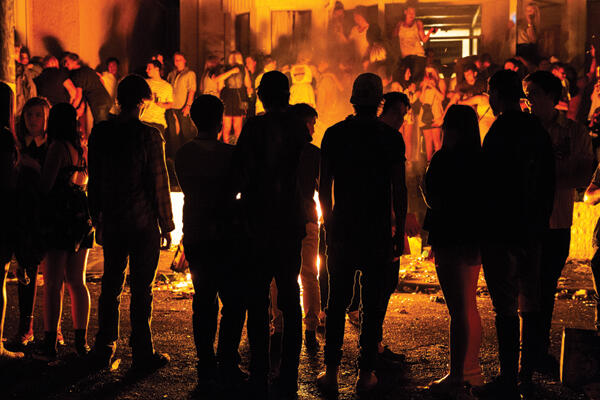
The law proves an obstacle for liquor bans
A revision of the 2002 Local Government Amendment Act will make it harder to introduce liquor bans in New Zealand cities. According to The Department of Internal Affairs website, the update, which was first announced in March 2012, aims to create “a more productive, competitive economy, and better public services.” The Local Government Amendment Act 2014 involves eight new points and these passed the third reading at the end of last month. Kevin Mechen, Dunedin City Council Liquor Licensing Coordinator, told Critic, “Before an alcohol ban is put into place it must now be proved there is a high level of crime and disorder in an area and that it is exacerbated by alcohol. Then there needs to be a belief that an alcohol ban will reduce the crime and disorder in the area.” The main issue the Act causes in regards to alcohol bans is that even though disturbances may occur in an area as a result of alcohol, there needs to be solid evidence in place to prove this. Mechen said, “The way the Act is written, we are reliant on Police data.” If disruptions in areas are not being reported to the police, this means there is no evidence to prove the necessity of a ban. The law change makes it extremely difficult for the DCC to implement liquor bans in areas of disturbance in North Dunedin – a topic that has been discussed a great deal in the past. Mechen told Critic, "A Health Impact Assessment was done by a contract company a few years ago." He said, "it was considered that a North Dunedin ban would be making a statement that students with alcohol are a problem.” Mechen said that, during the assessment, “OUSA recommended that rather than just North Dunedin, a city wide alcohol ban should be introduced.” However, it was eventually decided that a ban would be unsuccessful, and “it was better to work with the young people and try and find a solution.” Mechen is of the opinion that “the only thing a ban in North Dunedin would do is stop people drinking as they walk into town.” He said, “I don’t see or hear of too many people actually drinking in the streets so it wouldn’t be too much of an issue for the majority of students.” Instead, he argues that we need to focus on creating “a change in attitudes towards both alcohol, other people and the environment.” He said, “I don’t believe people generally, not just younger people, have much idea about what alcohol does to them, especially when consumed to excess.” Techniques to curb alcohol related disruptions in the Dunedin Botanic Gardens, in particular, has been a topic recently discussed by the Council, Police, and Otago University. The gardens are a popular hotspot for students to drink in groups, the most prominent times being “during orientation week, re-orientation week, [and] also around the end of exam times," Garden Team leader Alan Matchett told Critic>. Matchett said, "Obviously we're concerned with out of control drinking. It's where it's happening and the effects it has on the greater public ... Various stages of drunkenness, throwing things around and urinating is not very attractive to others using the gardens." When incidents do occur in the area they are generally reported very efficiently, “98 per cent of the time issues are reported to both the police and the Proctor.” Matchett said he has received great assistance from both parties. Due to the correct reporting of incidents, with careful consideration an alcohol ban may be able to be implemented in the area. However, in regards to an entire ban in the gardens, Matchett believes it would unfairly disadvantage those who were using the area sensibly. “We don’t want to disadvantage everyone who visits the gardens. Sometimes people just may want to have a wine with their family. It’s only drinking on the heavy side which causes the problem.” Matchett commented “It would be great if students were able to use as much common sense as possible. We welcome everyone into the garden, so please be aware that other people have rights too.”
-
News

Planetarium being considered for Otago Museum
Otago Museum is planning to introduce a planetarium as part of the $3.5 million long-term upgrade to the establishment. The Planetarium, if approved by the Museum’s board, will showcase the southern skies in a large, state of the art, indoor dome that would have the ability to project 2D and 3D images onto the walls. “The Planetarium enhances and compli- ments the existing and planned museum offering, tying in the stories of the Southern People, Southern Lands Gallery,” says Museum Director, Dr Ian Griffin. “This is something that domestic and international visitors will not have seen in their travels around NZ.” As for funding, the Planetarium would be included in the $3.5 million budget for the entire Discovery World development. However, the feasibility of the project is being considered. “This includes assessing the potential funding from internal sources, local, national and private funding support,” says Dr Griffin. The proposed 70-seat Planetarium is also hoped to benefit Dunedin’s economy. “As a smaller scale immersive theatre experience it would not of itself attract international visitors to Dunedin, but it might encourage them to stay longer to engage with the museum and other Dunedin attractions,” says Dr Griffin. The ODT reported on 3 August 2014 that Otago Museum director of marketing and development Caroline Cook said, “There would be nothing similar to the planetarium in the South Island.” However, Dr Griffin brought to Critic’s attention that there are some small ones in Mt Cook, which is renowned for its astronomical tourism and star gazing activities. There are two larger ones in the North Island, one in Auckland and the other in Wellington. “The planetarium here would be unique, as it is embedded within a science centre, within a Museum, and incorporates elements and stories from other parts of the museum, the region and our collections,” says Dr Griffins. It is also hoped that the Planetarium would be of benefit to the University of Otago and would help engage students on a more practical level. “We already work closely with a number of University departments, and being able to showcase the southern skies to university, and in fact all students, is a major reason for having the planetarium at the museum,” says Dr Griffin. Regardless of whether the Planetarium gets the thumbs up, the new Discovery World upgrades will still take place with a total rebuild of the current Discovery world and D-Pad – the educational suite of rooms. There are also plans to redevelop the Tangata Whenua gallery, People of the World gallery and the foyer and entrance.
-
News

Gender-neutral bathrooms better suit queer students
The installation of gender-neutral bathrooms around campus may be on the cards for the University, after a recent study by OUSA. Of the 1,357 students who participated in OUSA’s study, 43 students reported feeling uncomfortable using the current gender segregated facilities. In a recent meeting with Vice-Chancellor Harlene Hayne, Queer Support Co-ordinator Neill Ballantyne and various members of Space, a group representing queer and trans students, urged the University to update their facilities to better cater for students who “do not fit into society’s expectations of the gender binary.” The group described affected students to be anyone who “[identifies] as non-binary, non-gendered, bi-gendered, genderqueer or genderfluid.” “At the moment people are forced into a gender binary that doesn’t suit them as individuals, and therefore they might be presenting in a way which doesn’t fit within either gender,” claims Ballantyne. For these students, visiting gender-specific bathrooms carries serious anxiety and a risk of verbal assault and threatening behaviour from other students. Ballantyne said the problem was “exacerbated for trans people who may not feel that they can ‘pass’ as their gender identity.” Queer Support’s proposal calls for the University to commit to a unisex re-assigning of half the available bathrooms on campus. In addition to the transformation of existing bathrooms, a provision must be made to ensure new buildings are built inclusive of gender-neutral spaces. However, Ballantyne is quick to admit this goal is largely idealistic. “What we’re propos- ing is the best-case scenario, [but] the University is not going to do anything that costs money.” “They’ve asked us to identify the areas of campus which are the most problem-areas ... [but] there’s a disparity between what we want and what they will do.” The proposal deems the gender-neutral bathrooms in use at most of Dunedin’s Residential Colleges as “a good mandate” for the policy change. In addition, the proposal highlights the increasing prevalence of gender-neutral spaces in United States’ universities. This is to ensure all individuals remain free of “intimidation, harassment, run-ins with security, and/or violence,” as found in Portland Community College Policy. Otago University Property Services Manager Barry MacKay commented that the University does not currently provide specific services for transgender members of the University community. While a dialogue surrounding the issue has been opened, MacKay says that plans remain in their initial stages. “Property Services has been asked to investigate the provision of gender-neutral facilities in existing buildings and for their inclusion in all new buildings. This process is underway.”
-
News

Geography students fundraise for Sierra Leone
A group of University of Otago Geography students, currently studying GEOG102, will spend the rest of their 2014 study year fundraising for a school in Sierra Leone. The project is set in Kayima, a community in the far northeast of Sierra Leone. The overall aim of the fundraiser is to add a new block, consisting of three classrooms, to the town’s primary school. Through the use of sausage sizzles, bake sales, and quiz nights, the committee aims to raise $10,000 by the end of the year to cover the entire cost of the project. Donation boxes will also be placed around the University with images and a description of what the profits will be funding. Builders, carpenters and materials for the extension will all be sourced from within the Kayima community. Professor Tony Binns of the Geography Department introduced the project to the students. Binns has recently been made an honorary local chief for the work he has done for the Kayima village over the past 40 years. After meeting with 20 of the local teachers earlier this year, Binns discovered “the biggest issue was the pressure they were facing trying to fit the children in.” He told Critic, “the issue is, many children want to go to school, but there are simply not enough classrooms to allow that.” As well as the 400 students at the primary school, there is also a secondary school in the town, which currently has around 300 students. Students in the region tend to only stay in school up to the age of 14. Anna-Marie Mirfin, a Geography student on the committee, said the project is “a great chance to directly help a group of people who are in need of our support.” She said, “through Tony’s close link with this community, there’s no ambiguity about where the money raised will go; we know that our efforts will be effective. By providing more children with an education, we hope to broaden their perspectives for the future.” Sierra Leone is currently one of the ten poorest countries in the world. Binns said, “the poverty increased severely due to the devastation caused by the [1991-2002] civil war,” which “set the community back considerably.” Life expectancy in the country is only 42 years, compared with New Zealand’s average life expectancy of 81 years. Binns also noted that the country has an extremely high child mortality rate, with 180 in every 1,000 children dying before the age of five. Kayima, which is home to around 3,500 people, is an extremely remote and isolated community that is much poorer than the rest of the country. Binns told Critic the clinic in the town “also desperately needs help, as does the local secondary school.” These are both projects he is hoping to run in the future. He said “I’m keen to strengthen [Otago University’s] link with the [Kayima] community.” Students in the Geography department have spent time with Kayima community. Geography PhD student Jerram Bateman has recently spent six months in the region, continuing the work that Binns has been doing within the community. Hana Cadzow, a Geography Masters student at Otago, has also been studying in Freetown, Sierra Leone’s capital city. She is investigating the role of women in producing vegetable crops to supplement household food and income.
-
News
Otago's climate researchers get deeper pockets
The University of Otago is a key partner for the second time in one of Government’s multi-million dollar National Science Challenges. The Deep South Challenge is the second challenge to have funding confirmed, with up to $88.1 million available over the next 10 years, inclusive of Crown Research Institute funds. The University’s strong knowledge base in climate processes, oceanography, Antarctic science and related research has been a key reason for the partnership. The Deep South Challenge is one of 10 National Science Challenges. These are designed to take a strategic approach to the government's science investment by targeting a series of goals, which, if they were achieved, would have major and enduring benefits for New Zealand. The Challenges aim to align and focus New Zealand's research on large and complex issues by drawing scientists together from different institutions and across disciplines to achieve a common goal through collaboration. The University of Otago is also a partner in the “High-Value Nutrition National Science Challenge,” which is working on developing high value foods with validated health benefits. The Deep South Challenge involves researching Antarctic sea ice, with this data being used to help construct a New Zealand-specific model that can be used to make predictions about the climate and our environment in the future. By researching Antarctic sea ice growth and decay, researchers can look into how much the Southern Ocean and Antarctica are drivers of the New Zealand climate. Professor Richard Blaikie, Deputy Vice-Chancellor of Research and Enterprise, is delighted with the announcement. Blaikie said, “Greatly improving our understanding of how changes in Antarctica and the Southern Ocean may affect New Zealand’s oceans, climate and eco-systems is a clear priority, and Otago researchers are more than up to this task. This significant funding will allow our scientists across a variety of disciplines to further their important work in this and other key areas of polar research.” He said that the University’s involvement with the Government challenge “reflects the world-class contributions the University’s researchers are making in many aspects of polar and Southern Ocean research.” The Challenge will be overlooked by the National Institute of Water and Atmospheric Research (NIWA), with the University conducting research on the Deep South Challenge alongside Victoria University of Wellington, the New Zealand Antarctic Research Institute, Antarctica New Zealand, GNS Science, and Landcare Research.
-
News

Greens bribe student vote with free travel
In a statement released on 5 August, the Green Party have vowed to provide free off-peak public transport to all students, through the introduction of a new “Green Card.” Under the policy, all students attending universities, polytechnics, wānanga, Private Training Establishments and those training through apprenticeships will be eligible for the Green Card. The scheme would benefit up to 325,000 tertiary students, as well as approximately 28,000 people training under the New Zealand Apprenticeship scheme, the Greens website states. Off-peak travel will be free between the hours of 9am and 3pm, and from 6.30pm until the end of service on weekdays. It also covers all weekends and public holidays. The scheme will cost an estimated $20–$30 million per year and “will be funded by reprioritised spending from the National Land Transport Fund,” according to the press statement. Green Party Co-Leader Dr. Russel Norman announced that “the Green Card will reduce the cost of transport for students. It is an investment in students and education, and will help to reduce their costs of living ... Making transport affordable for those in education and training is a smart solution to the financial pressures facing students.” The New Zealand Union of Students’ Associations (NZUSA) has welcomed the announcement, stating in a press release that “this policy would encourage students to use public transport, and public transport suppliers to provide better routes and times to suit classes. It would free up parking around campuses while making better use of buses and trains when school students are using them.” They also praised the “universality” of the scheme, saying that “Current transport subsidies for students are incredibly inconsistent, this policy covers all tertiary students, whether they be undergraduate or postgraduate, youth guarantee or in a trades academy ... This policy builds on the good work of Councils who are providing discounted or free travel for students, and the students who have argued for those provisions. It’s great that the student voice has been heard. We wish the Green Party the best of luck that they’ll be in a position to implement this policy, we pledge to help in their efforts to convince other parties of the sense of it.” Students spoken to by Critic had mixed views on the subject. Postgraduate student Charlie Gibson described the scheme as “long overdue.” “The Green Card is a wonderful idea ... the Green Party continues to impress by explaining exactly why essential improvements in society, which we are so often told cannot be afforded, are not only affordable but practical, sensible and long overdue.”
-
News
Toroa's excess spending "much needed" say students
Toroa College's upgrade and expansion has gone over budget by more than $580,000 due to an error in the estimated cost. $1.781 million was spent on Toroa's development between January and May, compared to its budget of $1.2 million. The upgrade and expansion was put towards the construction of 20 new bedrooms, which extends the hall’s total to 152. New building standards have been a cause of the excess spending on Toroa. This was in conjunction with other renovations, which have been done to halls of residence, such as Carrington College and Aquinas College, which have had seismic strengthening for earthquake standards. Tens of millions of dollars have been spent on residential colleges in Dunedin over the past few years. Critic spoke to two former Toroa College residents about life in the hall prior to the renovations. The students welcomed the renovations, pointing out that both space and interaction among those living (or not) in the hall was an issue. “It wasn't big enough for everyone. There was a guy that died and they didn't even have enough space for everyone to be in that same room to have a meeting about it,” said one of the past residents. The common room was deemed inadequate by the students, as was the one television shared between all the residents. Toroa is widely known as having a large portion of international students living at the hall. The former Toroa residents Critic talked to said there were about 20 international students while they were there. The rest came from New Zealand and segregation between the students was obvious. However, the students felt the renovations at Toroa would help the students bond together better. The Director of Accommodation Services James Lindsay spoke to the Otago Daily Times about the importance of Toroa's developments. ''It is the single biggest and best development at the college since it started 18 years ago,'' he said. Toroa's upgrade includes a large common room named “Manawa,” meaning “heart.” "[Manawa] is already a popular place for Toroa residents to study, relax and develop lifelong friendships." 3,352 students lived in the University residential colleges in 2013 and there has also been an increase in first-year students over the past year. Renovations and the opening of the 15th residential college, Te Rangi Hiroa, have been implemented this year to accommodate for the rise.
-
News

Proctology | Issue 19
The Proctor described the streets of North Dunedin as “pretty quiet” lately but had a few stories to fill us in on with regard to campus shenanigans. Updating us on last week’s top story, the Proctor informed Critic that one of the “flashers,” reported in the last Proctology, has been caught. He explained the captivating story of how he came to hand himself in. “A young lady student who had seen the suspect with great memory saw the person she thought was the suspect get on a motor scooter and zip away on it,” he said. The student took a photo of the man as soon as she had sufficiently followed him and noted down the registration. She handed the photo into Campus Watch who passed it on to the Police. The Police used “their modern methods of finding people,” including Facebook, to spread the image of the young man. In technical terms, the Proctor said they put it on Facebook “because they’ve got a good photo of the baddie but they don’t know who he is.” Shortly after the Facebook post, somebody who knew the “baddie” persuaded him to go into the station and there he confessed to his stripping antics. The Proctor was very happy with the outcome and assistance of the “switched on young lady.” He said, “Hopefully all the young ladies can study now and focus on books rather than plonkers.” There have also been issues at the Cal labs. No stripping this time, though. The Proctor referred to complaints he had received at Burns Cal lab in particular. There have been students playing computer games against other people “which leads to cheering, yahooing, backslapping and loud noises.” He said that the people who are there to study “get brassed off, quite understandably.” The Proctor explained that the computers were “not there for people to play games on” as “Internet games use up Internet.” He added that especially near exam time, the Internet gets a lot of use. In an interesting contradiction, he said that if students are going to use the facilities, “use them quietly and for appropriate purposes, which obviously means yes, they are going to be used for games. But do it quietly and not in groups of 15.” There is also no permanent campus cop in place at present. The Proctor said it could be “a couple of months away.” Critic notes there are only a couple of months of semester left, but have no complaints about a lack of cop on site. There is currently a relieving cop, PK Kennedy, who is doing a “part-time and very good job.” The Proctor says students will know him by PK “not Paul, it is Paul, but just PK, not Paul.” Critic believes the relieving Campus Cop could be called Paul. The Proctor also said that no more “grizzles” have been made regarding the Botanic gardens. However, they are employing security staff to walk the gardens at night and to pay frequent visits to the place. Campus Watch are aware and alert for gatherings but will only attend to the Gardens “if we are called or asked to by security employed by gardens.” The Proctor also covered the usual, “we need to change the attitude towards drinking,” but in general he felt that students had been well behaved and “the streets are quiet.”
-
News

Physio Pool asks for community help to remain open
The Southern District Health Board has made an appeal to work with the Otago Therapeutic Pool Trust, the Dunedin City Council and the community in an effort to save the Dunedin Physiotherapy Pool. A meeting held on Thursday 7 August saw the board outline the issues with the pool, which have attributed to the possible permanent closure. SDHB Chairman Joe Butterfield spoke of the predicament the pool faces but acknowledged the health benefits of the pool. He pointed out that the pool was not drained last Christmas as it needs to be every year. “It is unacceptable to run the pool without draining the pool past the due date,” he said. The pool had not been drained as “there is a 90 per cent likelihood that some tiles would fall off, and as the specific tiles are no longer produced they would need complete retiling.” There was also a probability the concrete behind the tiles would need to be replaced. The cost to replace the sections of the pool is unable to be met by the SDHB. “We are already constrained with our capital expenditure,” said Butterfield. “The minute the pool shuts down, we save $75,000 ... We just don't have the cash and we can't ignore health and safety.” Critic spoke to Pool Supervisor Emma Jones, who has been with the pool for two years. Jones stressed the importance of the pool to sections of society, including those with disabilities, elderly people and individuals with injuries. “I see how people with both physical and mental disabilities benefit from their time at the Physio Pool. It's hard to justify what would be more important than an individual's health and wellbeing,” said Jones. “Many customers spoke to me about why they wouldn’t choose Moana Pool and the main reasons were the temperature, especially the elderly who struggle to keep warm after. Also the access – many of our customers would be unable to get into the pools there or, more importantly, get back out. And I don’t believe there is an area there set primarily for rehabilitate exercises.” Jones questioned the lack of marketing and technology. “There has never been any advertisement of the pool. The amount of people that don’t know it even exists is hard for me to understand, especially with the power of social media and marketing.” She also says the pool needs an upgrade to its facilities. “We don’t even have EFTPOS or a website,” she says. One way of potentially saving the pool would be for the community to fundraise to cover the repairs and operating costs for the second half of this year. The Dunedin City Council would not be able to assist the Southern District Health Board with funding until next financial year, which is why community involvement is needed in the meantime. The Save the Physio Pool petition has generated 1,029 signatures and the Facebook page has 1,864 likes. Comments by users such as Sandy Cleary speak of the importance the pool has for them. “I had a serious accident in 2004 which resulted in three broken vertebrae, left broken collarbone and ribs broken. I spent two weeks in hospital and two weeks at the Isis Rehabilitation Centre to learn to walk again. This was followed by learning to aqua jog at the Otago Therapeutic Pool, which was the best thing in the world in learning to walk again. If it hadn't been for the ability to attend the morning Physio pool sessions then I know my life would have been a lot different.”
-
News
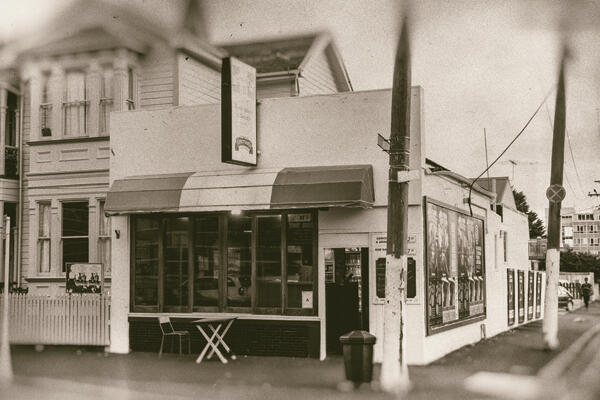
Poppa's promises nothing else but new things
The official handover of Scarfie icon Poppa’s Pizza took place on Monday 4 August. The new General Manager, Chiv Hamjra, promises, “it’s just a change of owners, nothing else,” despite plans to introduce “new things.” Considering Hamjra’s four-and-a-half-year stint at Pizza Huts around Auckland, customers at Poppa’s were concerned they would see their beloved pizzeria turn into a chain store, as rumours of a deep fryer, flavour changes and cheaper prices swarmed around campus. However, when asked if he was planning on making any changes to the existing set up and menu, Hamjra told Critic that he will “just stick with it. But we might include some new things.” “I’m planning some sort of chicken nuggets, wings,” Hamjra revealed, suggesting fears of a deep fryer joining the premises could be true. He also revealed plans to reduce prices, bring back five-dollar pizzas on Wednesday, exam specials, more vouchers for students, free items and “flavour of the month” pizzas. The talk of price reductions is described by Hamjra as “something needed.” Unfortunately, deliveries will no longer be offered, as the infamous Poppa’s car was not included in the sale. Hamjra confirmed he would continue using the secret tomato paste recipe. “That’s the main part of why people come here,” Hamjra told Critic. The previous owner, Steve Munro, owned Poppa’s for 17 years but had put Poppa’s on the market at various times over the last five years. “He’s a really good guy,” Ramja says about Munro. “Really organised, more organised than me.” When contacted by Critic regarding the new ownership and potential for chicken nuggets, Munro just said, “I wish them good luck.” The sale of Poppa’s was advertised in the Otago Daily Times for a negotiable price of $85,000. Hamjra revealed that the final figure was legally negotiated and was less than that figure. Around campus, there were mixed emotions about the introduction of chicken nibbles. “I’d get on that buzz,” one student said. “I wouldn’t buy them but I’m sure people would.” “It’s kind of verging off the gourmet side of pizzas – I don’t have a problem with that but why compete with all those chain stores,” said another student. “It’s just not Poppa’s thing.” Hamjra has been in Dunedin for one month setting up for the change over. But Hamjra doesn’t yet consider himself a Scarfie. “I haven’t been in town much, been too busy,” he admits.
-
News
Otago staff involved in penguin protection study
Researchers from the University of Otago are co-authoring a study related to the endangerment of penguin species around the world. The study suggests that due to the degradation of their habitat, caused by humans, the fate of the birds is at severe risk. Philip Seddon and Lloyd Davis are Otago professors currently writing in the journal Conservative Biology, working alongside scientists from all over the globe. Dr. Ursula Ellenberg and Dr Thomas Mattern, consultants and Zoology researchers from the University of Otago, are also co-authors in the study. The group suggests the establishment of greater marine reserves. This should include some in the higher seas and areas currently beyond natural jurisdiction. They believe this will decrease the issue of food scarcity and the risk of being caught in fishing nets. Oil pollution and climate change are also major factors towards the endangerment of the birds. Protection of habitats is absolutely crucial for their survival. There has been a severe plummet in many penguin species over the past 20 years. Last year the International Union for Conservation of Nature (IUCN) listed 11 penguin species seen as threatened. Two of the species were “near threatened” and five were deemed “of least concern.” To come up with this figure, 49 scientists examined all 18 different penguin species to examine how human activity may be negatively affecting these animals. Taken into consideration were terrestrial habitat degradation, marine pollution, fisheries by catch, resource competition, environmental variability, climate change, as well as toxic algal poisoning and disease. The study found that habitat loss, pollution, and fishing are the primary concern for the endangerment of the species. The fate of penguin populations largely depends on the world addressing the existing issue of climate change, which is threating the penguin habitat degradation on land and sea.
-
News
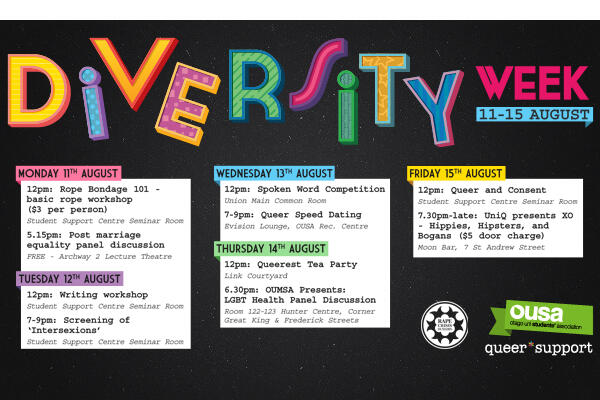
OUSA gets diverse with bondage and poetry
OUSA Diversity Week is to be held this week from 11–15 August. Queer Support and UniQ have organised the week and, according to OUSA Welfare Officer Payal Ramritu, “have worked so hard. I have no doubts the week will be amazing!” Every day there will be events held. On Monday at 12pm, there is a Rope Bondage 101 session, which is an introduction to bondage workshop, held in the Student Support Seminar Room. Critic will be attending. Also on Monday, at 5:15pm, there will be a panel on Post Marriage Equality. A few years ago, before the marriage equality bill was passed, a similar panel was held so this is “kind of a follow up event from it, what has been achieved and what is still left,” says Ramritu. On Tuesday at 12pm, in the Student Support Seminar room, there will be a writing workshop held. This will consist of two parts; one part will be a drop-in and write anything you like, and the second part will involve writing poetry for Wednesday night’s competition. On Wednesday at 12pm, there will be the Spoken Word Competition. “I'm pretty excited to see this,” says Ramritu. “I love spoken word poetry and it will be cool to see students performing their own poems.” Also on Wednesday, from 7–9pm at Evison Lounge, is a speed-dating event to meet new people and make new friends. On Thursday at 12pm, The Queerest Tea Party is being held in the link courtyard. This event has been run in the past and is “well liked.” On Thursday Night there is a screening of "Intersexions." This is a documentary about Mani Mitchell, a New Zealander who is “out and open about being born intersex,” says Ramritu. “I cannot wait to see this!” she says. The documentary involves intersex individuals revealing how they have navigated their way through this strictly male/female world and where they fit somewhere in between. Friday lunchtime will wrap up the week with a workshop on Queer and Consent at 12pm. This will be held in the Student Support Seminar Room. Finally, on the Friday evening, UniQ Otago will host a queer dance party at 10pm at Moon Bar.
-
News
New regulation sees five-year learner license limit
A new law will see a limit imposed on the length of time individuals can hold learner and restricted licences in New Zealand. The new regulation, announced on Wednesday, will be enforced from 1 December this year. Individuals who do not move onto the next stage of the Graduated Driver Licensing System (GDLS) will be required to take another Learner Licence theory test to regain their licence. The rule will also apply to those who hold a New Zealand motorcycle licence. Critic spoke to Senior Sargent Phil McDouall of the Dunedin Police, who said “40–45 per cent of New Zealanders don’t move on [to the next stage of licensing] after their learners.” McDouall com- mented that is not uncommon for individuals to be caught breaching their learner or restricted licences on Dunedin roads, causing a great deal of hazard to other drivers. “When they stay on it [a learner or restricted licence] too long, they don’t get the full driving ability that full licence drivers have,” commented McDouall. “With a learner licence they can only drive with a supervisor, because they haven’t been yet proven fit to drive alone. So those who remain on a learner licence for long periods of time don’t learn to drive as safely as those who are up to their full.” This issue is of great concern to police. McDouall said that those who remain on a learner or restricted licence and breach their conditions by driving with passengers are “a great hazard to the roads.” McDouall said that it is extremely common for individuals to be pressured to breach the conditions of their licence, stating that it is “most common in high school age drivers.” “A lot of people breach their license by taking orthodox passengers. Friends who may not have a licence themselves will often pressure friends to take them.” McDouall urges students to not give in to such demands. These passengers “can also be fined for aiding and abetting a criminal.” He said this is rather common in the Dunedin region. In New Zealand, every driving ticket you receive will give you demerit points. When individuals gain 100 demerit points within two years their licence is lost automatically. When it comes to breaching learner and restricted licences, demerit points “vary between 20 and 30 when caught,” said McDouall. “You don’t need to be caught many times in order to lose your license.”
-
Columns

ODT Watch | Issue 19
Woo! it’s about time they provided some choice on Andersons Bay road in South D. A new Wendy’s is opening for times when you don’t feel like McDonalds. Or Burger King. Or Subway. Or KFC. Or Hell Pizza. Fatty Lane, you have a serious rival. See, ODT, you can come up with attention-grabbing headlines without cheesy alliteration or naff puns! On another note, what an unfortunate last name, especially if you’re immature like us. Heh. Butt. The human race’s obsession with their phones is taken to a whole new level. This guy dropped his phone in a pond and tried to retrieve it by draining 1.8 million litres of pond water into a nearby 1000-litre toilet tank. End result? A flood of sewage, major damage and no phone: “It almost worked.” ... Yeah, almost. Anger isn't even close to what we'd be feeling if we were stuck in Hawaii. The article reporting on the Internet Party party at 10Bar a couple Saturdays ago describes the event in such a way only a middle-aged, non-partier could, all the while making not-so-subtle digs about Kim Dotcom’s weight. Yeah, we know, Kim’s a big guy.
-
News
Sarcastically celebrating a super season of super rugby
This week the Super rugby desk signs off for 2014 with a lighthearted look at how our five New Zealand teams fared over the season. We have given them a grade based on the merits of their players and performances. Disclaimer - this article contains a heavy dose of irreverent southern bias while also throwing a hefty amount of shade at the Aussies, Saffers and Ma’a Nonu. Highlanders An awesome year for the Highlanders but the poor scheduling of the test window ruined their momentum and they unfortunately ran out of steam at the end of the season. They scored the most bonus points owing to some entertainingly close and high-scoring games that ultimately helped nudge them over the line into the finals for the first time in 12 years. The “Smith brothers” were super classy as always and further cemented their starting places in the All Blacks team. Malakai Fekitoa has been a revelation for the Highlanders and proved his worth by forcing his way into the All Blacks team, hopefully at the expense of Ma’a Nonu. Lima Sopoaga has dramatically improved, setting a new club points-scoring record in a season and being very accurate with his goal kicking, something that has been a weakness of the Highlanders for some time. There was a solid scrum up front laying the platform, and Barracuda Buckman was also good value out on the wing. Up in the coaches’ box, Jamie Joseph and Tony Brown got the tactics spot-on and things can only get better next year. Grade: A+++ Crusaders They always find a way to the big game, don’t they? Appearing in their 11th final after another predictably solid season from the team that we all love to hate. The Crusaders were seconds away from a record eighth title when Richie McCaw was pinged for being offside in the last minute, setting up a 45m penalty attempt which scraped the bar on the way over, giving the Waratahs a 33 - 32 victory to secure their first Super Rugby title. Dan and Richie are being very carefully managed towards the next World Cup but the Crusaders have coped very well without them with Matt Todd and Colin Slade forcing the older dudes to play out of position upon their return. Kieran Read has been outstanding and was seen laying down the law to McCaw on more than one occasion, signaling a real changing of the guard for New Zealand rugby having already captained the All Blacks on seven occasions. Grade: A Chiefs It was always going to be a tough ask to win the competition for the third year in a row, but they proved they had the squad to do it but were let down by some ill-discipline at times, ending the season as the most penalised team. A narrow quarterfinal loss to the Brumbies in Canberra was probably a fair result that reflected their position on the table after the end of the season. Aaron Cruden really matured into the captain’s role but was held back earlier in the season due to his niggling thumb injury. Sonny Bill Williams will be returning to the Chiefs next year after two years with the Roosters in the NRL and could offload the Chiefs back to the top of the table. His mind is firmly set on getting back into the All Blacks for the World Cup in England, although there is much competition in the midfield. There has been talk of him also being keen at making the Olympics Sevens team for Rio 2016. Grade: B Hurricanes A good season on the field for the Hurricanes as they finished with the same 8 - 8 record as the Highlanders and a superior points differential but ultimately missed out due to bonus points. Wellington’s ITM Cup squad coach, Chris Boyd, will inherit a solid squad of young talent and experienced internationals when he makes the step up next year. Is it a coincidence that as soon as coach Mark Hammett leaves to coach in Wales, Ma’a Nonu is coming back to the club? However, a more important signing than an aging mercenary thug was that of Beauden Barrett, with the classy number 10 signing on for two more years in the capital. Everyone from Welly to the ‘Naki was absolutely, positively stoked that he didn’t defect to the Blues or chase bigger money overseas. Next year’s critical Carter vs. Cruden vs. Barrett battle for the All Blacks number 10 jersey will be very interesting. Grade: B- Blues Another disappointing season for the Aucklanders. The Benji Marshall experiment was a dismal failure that surprised no one. What was surprising was that he cut and ran after only six games. I am sure everyone involved in this debacle is looking back thinking “the fuck were we all thinking?” It has been a few seasons into their slump and I still can’t figure out why they have not been doing better with the coaches and players at their disposal. With plenty of All Black talent and the wily old fox Sir Graham Henry in the mix, there is no doubt that they should be doing better. I can only put it down to the destabilising influence of Ma’a Nonu. Look what happened to the Highlanders when his experimental kicking game was forced upon us in 2013. The result? 14th place! Proving he isn’t as “maavelous” as his Twitter handle might suggest. Grade: D-
-
News
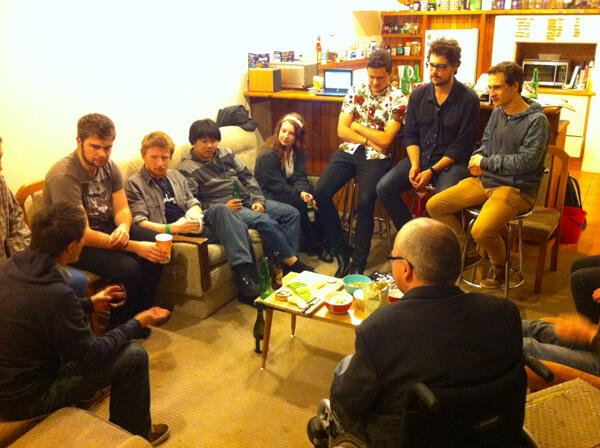
Gareth Hughes, beer pong, and how to target students
On Friday 1 August, Green Party MP Gareth Hughes made his way down to Dunedin to have what was the inaugural “Flat Warming,” a youth campaign strategy designed to bring policies to the students, not confine them to stuffy lecture theatres and awkward South Dunedin forums. The idea is to break the tension between “politics” and “youth,” which is one that Critic has touched on in the past two issues; the conclusion is that being a student, and being a youth, is very different today than it was in the past. This has been the source of much criticism in the media, stereotyping students as a single block of lazy, binge-drinking wildebeests, which far from acknowledges the fact that it is the job of politicians and political parties to thoroughly demonstrate their capacity to understand their constituents. I don’t even have to reach far to be able to demonstrate how this stereotype manifests. How did the ODT respond to Gareth Hughes’ visit? By slamming Gareth with a piece titled “Greens face binge drinking” and beginning with “the Green Party is under fire for supporting binge drinking after challenging Dunedin supporters to beat MP Gareth Hughes at a game of ‘beer pong.’” Not only is this factually incorrect (the ODT were the only ones who cared enough to write an article about it, so I don’t know where “under fire” came from), but it fundamentally misunderstands student culture and what Gareth was trying to accomplish. Students drink – that much is obvious – but we’re also capable of drinking responsibly and without getting out of control. That was the point of the event, to have a couple of glasses of wine that don’t cost eight dollars each and literally just chat. And, anyway, as 3 News reporter Dave Goosselink so astutely pointed out to me over Twitter, the better you are at beer pong, the less you drink. Gareth Hughes argued “many young people get turned off by the personality politics and focus on trivialities, so wanted to have a real discussion and get the low-down on the Green’s positions this election.” That summarises the event well, which had a warm enough environment that people didn’t feel on edge at having a politician in the room. They asked a lot of questions. Youth strategy around an end-of-semester election time provides a consistently interesting dynamic for analysing how well policies are being received, and the intensity is palpable. Gareth Hughes’ Flat Warmings are part of a wider youth strategy. Rather than being attached to an electorate, he’s attached to us. “We are putting a big focus on it and it is the first time an MP has been asked to lead on this rather than stand in a geographic seat. We still have active campus branches and the Young Greens national network that have played a big role in previous elections but this time we are investing more resources, a data-driven campaign and more focus on personal conversations like door knocking and flat-warming parties.” The flat warming “was a very effective way to communicate with students. Rather than speaking in an impersonal space ... it was a chance to speak about the issues and the election in a fun and informal way over a drink.” Funnily enough, we did actually play beer pong. Heading over to the Red Team brings us another plethora of strategies. I spoke to Georgina O’Reilly, Vice President of Young Labour, about what Labour is doing. Similar to the Greens, Labour’s youth campaign operates mainly under the Young Labour moniker, a youth-to-youth initiative that hopefully will stop any cringey, middle-aged attempts to get down with the youngsters. Interestingly, Georgina was quick to point out that students aren’t the only youths out there. There’s a big push for employment and support for trades, and Georgina explained that we need to think outside the campus mindset. If we turn to schools, it’s “a biggie” that Civics is taught throughout the education cycle. I also sent a few questions out to Katy Hendrikse of the National Party. Upon hearing about this, however, Dunedin South candidate Hamish Walker answered them himself. Katy also noted “he is excited to get a drink with you and chat about local journalism and get ‘your perspective on how to engage youth into voting.’” As for his strategy, that involves “having a bit of fun along the way.” “Government should be representative of the population and it is crucial that the youth perspective be represented. Being young myself (29) helps as I’m still connected with what’s happening with young people.” Walker has thus far been true to his intent, having participated in the recent Facebook trend, the “ice challenge.” While the ODT refused to report on Walker running into Saint Clair in a kilt, the awareness he raised by doing so shows how important it is in the student sphere to be consistent. Stunts are stunts, and they get people paying attention. Walker donated money to the Otago Hospice, made it a huge social media fanfare (attracting 30,000 views), and invited Clare Curran to participate. It apparently led to him being called “a good role model for Scottish independence.” The result was a donation from the name-caller to a Scottish hospice. The way that the relationship between students and politics will evolve closer to the election is dependent on a number of things, not least of which, the way candidates and parties plan to engage. It’s important that these strategies aren’t trivialised and condemned in local media. The three parties I spoke to are aware that students are adults. Adults who’re being told they’re the wrong kind, adults who’re making the most of this period in adulthood where we don’t have to slave over a job, and adults who’ll probably tell you to fuck off if we’re not treated as such.
-
News

Critic tackles election year | Issue 19
Laila is, without a doubt, a politician. She has deftly navigated herself across the political scene for years now, and her latest adventure as leader of the Internet Party is no exception. Even with a head cold, she was able to redefine and tear apart every question I asked her. It’s intensely interesting to watch a new, slightly dishevelled party be taken under the wing of someone so known in the political sphere; meeting her made me realise if anyone is able to give the Internet Party some clout, it’s her. I’ve got a few things I want to talk to you about. The first thing is that your tertiary policy announcement has yet to come, but I was just wondering, what are some tech projects the Internet Party wants to bring to universities? [...] The focus of our tertiary policy is on funding. So we are promoting free tertiary education, and our policy is centred on full funding of fees and a universal student allowance, and tackling the existing debt burden on people who’ve graduated. So our full tertiary education policy is going to be under development beyond the election. It’s not an area that we’ve put at the top of our list beyond the fees/student costs issue for detailed policy development pre-election. Yeah, obviously I haven’t seen it ‘cause it’s under construction, I was just wondering if there was, sort of, a technological edge. Or is that a different policy altogether? We’ll be releasing our innovation policy in the next few weeks; that will be another blockbuster of ours. It’s one of our top six platform issues, and it will certainly refer to the education system. But it’s primarily built around how we propose to make New Zealand an incubator for start-ups, and to push for the globalisation of start-ups from a much earlier stage than we currently have. So what we understand is the whole lifecycle of the tech process, and that is what we’ll be focusing our innovation policy around. Just regarding universal student allowance, interest-free loans, fee-free, etc.; that’s quite a common policy across a lot of parties. No it’s not. On the left it is. No other parties are committed to a priority of tertiary education. The Greens have a tertiary fee-free working towards policy as well. They may have it as a working towards policy, they haven’t got it as a priority ... I mean, that wasn’t new to me, but when I’m on platforms with the Greens and the tertiary institutions, that isn’t the message that they’re giving. I mean, I’m not having a go at the Greens here, but the fact is, that we are the only party that treats tertiary education as a priority, and we don’t just do it when we’re standing on university campuses. So students are a priority for the Internet Party? Absolutely. I mean, that’s why I’m the leader of the Internet Party. The one policy that closed the deal for me was free tertiary education. I have been fighting for free tertiary education since 1990, when Labour introduced the first student fees, I think it’s an outrage that my generation, who got a free tertiary education, have put these barriers in front of subsequent generations, and for me this is a bottom line of a leadership of the Internet Party, and it’s what closed the deal for me in coming into the leadership. It’s very serious ... students should not accept the line that we can’t afford it as a country. We afforded it as a country when we had a whole lot less money than we’ve got now. We are richer now than we were when we provided free tertiary education, so it is completely affordable; we’re paying for it, we’re just paying for it the wrong way. Cause, yeah, it’s transforming from a right to a privilege, which is problematic. Totally problematic, yeah. For me, the social contract depends on people experiencing the power of community as they’re growing up and developing and becoming adults. What better way to create a sense of community, social engagement, than to provide people with maximum education opportunities? And for people to understand, as I did, that we had opportunities because we lived in a democratic society. So free tertiary education is a very powerful society-building tool, and of course it’s also a very powerful economic tool, and we’ve seen time and time again countries that introduce free tertiary education overtaking us within ten years on the technology and innovation stakes. It’s a precondition to a tech economy. You’ve traditionally been a champion of women’s rights, which is fantastic, and I was looking at one of your policy incubator discussions about your intent to decriminalise abortion. Some of the negative comments were pretty horrifying. Obviously there is a lot of positive response, but I was wondering how you feel about the reaction? I didn’t see too many horrifying comments. First of all, the overwhelming reaction of our members was support. Mmm, like 75 per cent. And I think every party has people who feel strongly opposed to a woman’s right to choose. I didn’t think that those people generally put that in a hostile or negative way. There were some, but that’s their right. I don’t think you should overplay that. I think what’s great is the size of the majority in favour and I think the pretty respectable way people who either wanted to block it or oppose it went about putting their views forward on the poll. So no, I didn’t react negatively to that at all. That’s democracy. No other party is prepared to have these discussions in public. The very fact that you’ve seen our debate shows how different we are and how we’re not scared of debate. I mean, I’ve spent a lifetime in parties that try to close down every sensitive political debate. And I’m proud of the fact that we do it in the open. Within the context of the last few weeks, we’ve had big discussion about whether or not there’s a rape culture in New Zealand. So do you believe there’s a rape culture in New Zealand? I wouldn’t express it that way, I don’t think that divisive language helps to protect women from violence, and it’s not empowering language, and it’s not positive language. So it’s not the language I would use to describe gender relationships. That doesn’t mean that there isn’t rape, that there isn’t sexual violence, and there isn’t gender inequality – of course there is – but I would prefer to define New Zealand’s culture in far more empowering terms than that. Don’t like the language. What sort of terms? I think we have unbelievable power as women in this country, and we face many obstacles to using our power for good. And so the culture of New Zealand is a culture of innovation; first in the world for women to win the vote. One of the last in the world to deliver paid parental leave, so we’ve had some great highs, and we’ve taken a long time to catch up with the reality that was generated by women entering the paid workforce in large numbers. We have tough, strong women in this country, and we need to be in an environment where our equality is valued by everybody and we’ve dealt with issues like domestic violence, like pay issues. I understand the reason people use really provocative language, but it’s not something I did in the 1980s and it’s not something I’m going to do now. Why did you leave the Green Party? Well, the reason I resigned from the Green Party was because I became the leader of the Internet Party. There was a bit of a crossover, wasn’t there? Wasn’t there a period where you were still on the Greens campaign team? No, no, no. No. God, no. I resigned from the Greens campaign team well before I decided to accept the leadership of the Internet Party. So there was a significant gap? Weeks, yeah. This all happened very quickly. With things like the environmental policy, some of it’s not too dissimilar to the Green Party, so I’m wondering what’s better, or what do you think you could bring to the environmentally conscious people of our country? I don’t think it’s a question of “better and worse.” I mean, I think it’s great that we’re having a competition for the best environment policy, by the way. So do I! What better competition to have. There are some things in our policy that are unique. For instance, our commitment on renewables by 2025 for electricity is the strongest plan for that, and our focus on things like e-waste is unique within our policy. There are also those that we’ve referenced directly to the Greens, for instance, we totally support their proposal to dump the Emissions Trading Scheme and replace it with a carbon tax. We don’t agree with the way they want to use the funds from the carbon tax. So there are some differences, but there’s an awful lot of common ground, and our policy was created by three hundred of our members actively engaging in the process as well as a lot of expert input from outside the party.
-
News
Politweets | Issue 19
Ok. Things are looking up. Henare's Helpers Cleaning Service? Dairy me. Classic election move. Oh well.
-
News
Greatest Hits / Greatest Shits | Issue 19
Greatest Hit On Wednesday last week, Clare Curran participated in an AMA on Reddit, an activity that involves answering anything that the New Zealand Internet deems worthy enough to ask her. While it wasn’t full of cheese rolls banter, Clare gets points for responding to “can you please tell Jacinda Ardern she is so hot” with just “ok” and even more for fulfilling her ICT portfolio by doing something internet-y. Greatest Shit I hate to give Greatest Shit to the same person two weeks in a row, but there really is no avoiding it. Last Monday, Asenati Lole-Taylor decided to cancel her appearance on Vote Chat, which was scheduled for Friday of the same week. She left researchers with useless research, the show without a candidate, and me feeling significantly annoyed. How shit of you, Asenati. Thankfully, they managed to fill the spot with Shane Gallagher of the Green Party.
-
News

The latest assault on Palestine (a primer)
At university we are taught to be dispassionate analysts of world events, but in the face of the massacre in Gaza, academic detachment is hard to achieve. As the host of Radio One politics show The Revolution Will Not be Televised, I recently had the pleasure of interviewing Peace and Conflict Studies PhD student, Israeli peace activist Danny Fridburg. Fridburg was blunt about the vengeful public mood in Israel – a recent Tel Aviv University poll found that 95 per cent of Israeli Jews support “Operation Protective Edge.” Right-wing extremism, anti-Arab sentiment and a brutal police state has taken root in Israel. This public mood drives the belligerence of the Zionist state, which has killed over 1850 Palestinians since 7 July. After this interview my show, which is hosted by two American Jews, was attacked as anti-Semitic and we were compared to Hitler; apparently he was the ultimate self-hating Jew. So where to begin in trying to explain the current crisis and understand how attitudes like that of our aforementioned troll find any oxygen in popular discourse? Since 1967 the West Bank, Gaza and East Jerusalem, which are recognised by the United Nations as Palestinian territories that should be an independent state, have been occupied by Israel. Israeli settlements have sprung up on the West Bank. To protect the about 400,000 settlers, Palestinians are subjected to apartheid-like conditions with Kafkaesque regulations, roadblocks, checkpoints, separation walls, arbitrary mass arrests, daily humiliations and the expropriation of vital water resources. While Palestinians have long known occupation and dislocation (six million refugees live in the Palestinian diaspora), Israel has thrived, buoyed by a massive defence industry and around three billion dollars of American military aid per annum. The peace process?The 1990s was a time of cautious, if ill-placed, optimism where a just solution to the decades-old conflict looked possible. Palestinians rose up in the first Intifada, deploying civil disobedience, work stoppages and general strikes to force international recognition for their cause. In 1993 the Oslo Peace Accords were signed. They gave the Palestinian Authority (PA), led by Yasser Arafat (now succeeded by Mahmoud Abbas) and the Fatah party the right to collect taxes in a semi-autonomous statelet. The “doves” of the Israeli Labour Party almost managed to embrace the international consensus on a Palestinian state. However the 2,000 Israeli elections marked the end of Labour and, with it, popular support for the peace movement, as Israel entered its current hard right-wing trajectory. In the absence of a peace deal the Oslo Accords amounted to little more than deputising the PA to carry out the occupation on Israel’s behalf and an inevitable culture of corruption developed within the PA. Israel was now under the leadership of Ariel Sharon, a man found personally responsible by his own government for the massacre of Palestinian refugees during the 1982 invasion of Lebanon. Hamas and GazaThe PA emerged from this failure disgraced, in the eyes of many Palestinians, as it accommodated the occupation and became marked by a culture of graft and brutality. In recent weeks when protests against Israel broke out in the West Bank it was the PA that violently supressed them. It was from this failure that Hamas emerged, an Islamic political party comprised of both a military wing and a civilian infrastructure, providing schools and hospitals for a people in desperate need. Hamas are not every Western liberal's cup of tea, but neither are they Iranian stooges or the equivalent of ISIS, as claimed by American and Israeli apologists. It is true that Hamas attack Israeli civilians, something any decent person considers an act of terrorism. However, the real obscenity is that the same moral revulsion is not adjudged when the state of Israel kills civilians at a far greater rate. The absence of the historical context in Western media accounts, coupled with an atmosphere of latent Islamophobia, allows a simple insidious narrative to fester, i.e., Palestinians = Terrorists, Israel = Western Liberals. One need only look at historical examples of national liberation movements, even Israel’s own, to understand Hamas’ actions, even if one does not condone them. While many journalists are quick to point out that Hamas’ charter calls for the destruction of Israel, few if any will report the fact that the political leadership has repeatedly stated that Hamas would recognise Israel’s borders upon their withdrawal from Palestine. Hamas’ centrality to Palestinian politics, and the situation in Gaza, dates to the 2006 Palestinian elections where Hamas emerged as surprise winners. Israel, backed by the US, instantly moved to freeze Palestinian tax revenue, declared Gaza an “enemy entity” and imposed the current blockade of Gaza, turning the territory into what Noam Chomsky calls the world’s largest open air prison. The blockade, also maintained by Egypt, has effectively closed the territory to the outside world. The Israeli navy ensures that no Palestinian fishing vessels can venture more than three miles offshore and, in 2010, 10 activists who were part of a peace flotilla attempting to break the naval blockade were murdered by Israel. Gazans have been denied medical supplies and building materials such as steel and concrete. The Israeli military have devised precise caloric calculations and imposed food import restrictions designed to provide a level of subsistence barely avoiding mass starvation. In this context of widespread human degradation Palestinian militant groups like Islamic Jihad have resorted to firing crude rockets, ones that do not even have a payload, in order to pop the bubble encapsulating Israeli society. In response Israel has launched several brutal invasions and massacres. In December 2008 Israel initiated Operation Cast Lead, an offensive that lasted three weeks and killed 1,417 Palestinians and 13 Israelis (four from friendly fire). At various times throughout the blockade, the ratio of Gazan to Israeli casualties has been anywhere between 50–100 Palestinians (80 per cent or more of whom are civilians) to one Israeli. This brings us to the current offensive, Operation Protective Edge. Operation Protective EdgeIsrael’s latest obscenity has to be placed in the context of the June 2014 agreement between Hamas and Fatah to form a unity government seeking to achieve international recognition for Palestinian independence. Angered by the international community’s initial receptiveness to the unity deal, and determined to undermine Palestinian aspirations, the extreme right-wing Israeli government led by Benjamin Netanyahu looked for any excuse to divide Palestinians. Their cover came when three teenage Israeli settlers were murdered in an undeniably heinous act in June. The Israelis admit that Hamas was not responsible for this act; what they also knew, from an emergency call made by the victims, is that the three teenagers were murdered upon capture. Despite this, the Israeli “Defence” Forces (IDF) proceeded to rampage through the West Bank over the course of the following week, arresting over 500 Palestinians, razing houses and killing six Palestinians. Rinad Tamimi, an Otago student who is from Hebron, told me on my program on 18 July, that Israeli settlers forced her parents from their home at gunpoint at night, in search of the victims that the Israeli government knew to be dead. As a consequence of this provocation, Hamas rockets began to rain down on Southern Israel, forcing Israelis into their bomb shelters. At a personal level I do not condone the launching of rockets on Israel, however there remains the question of “What do you expect an occupied and violently repressed people to do?” Even more pressing moral questions include: how anyone can tolerate the indiscriminate killing of Palestinians that we are now witnessing; why the wretched Israeli justifications are being parroted in our own media; and whether we have an obligation to regard Israel as the apartheid state that is? In this operation we’ve witnessed a new blatant disregard for international humanitarian law and shocking levels of Western hypocrisy and disinterest. The “liberal” New York Times has drunk the Israeli kosher-Wine that a deep-seated anti-Semitism drives the Boycott, Sanction and Divestment movement. ABC News has displayed images of Gaza ruination and claimed that they showed an “Israeli family” trying to put their lives together. Barack Obama called the capture of an Israeli soldier inside Gaza “barbaric” and “outrageous” while having little criticism to offer of the Israelis. Israel’s repeated bombing of UN schools is disgraceful and an obscenity, however it is made even more grotesque by Israel and its allies’ attempts to blame the shelling on errant Hamas rockets. The Israeli rhetoric of Hamas holding the civil population hostage is truly revolting as it seeks to justify the IDF shooting the hostage between the eyes. Sadly this rhetoric is particularly effective amongst Islamophobes and those that have embraced a “War on Terror” view of the world (i.e. the US and many in NZ). “Friends” of IsraelI could go on about the particular atrocities that have occurred but I’d like to return to my troll and explain where fanatical supporters of Israel get their chutzpah. Not every supporter of Israel is Jewish. In fact the most strident support for Israel in America is in the evangelical Christian community. We’ve seen some of these Colin Craig-types at counter protests to Palestinian solidarity actions across New Zealand in recent weeks. This community believes in Israel more than American Jews do, with a recent Pew poll finding that 82 per cent of American Christians believe that God gave Israel to the Jews, as opposed to just 40 per cent of American Jews. This is quite a conundrum. Jewish identity is not so much about religion but a particular culture and historical experience. Aside from a not insignificant orthodox community, us Jews are not very end-timey. The importance of Israel to evangel- icals, as a Jewish state occupying the entirety of Palestine, is that it fulfils a condition necessary for the rapture and the return of Jesus Christ. The problem is Jesus is getting very angry with the non-believers who are all going straight to hell if they do not accept him as lord. So basically the “friends” of Israel are driven by a religious apocalypticism that is fundamentally anti-Semitic, as Israel will be turned into a gas chamber that will be ignited by Jesus. This religious fanaticism goes a long way in buttressing America’s military interests in the region. Israel has been a key asset for American imperial ambitions having smashed Arab armies and Arab independence. While there are many secular Jewish Zionists who believe in the importance of Israel as a Jewish state, the costs of sustaining Israel as it exists is supporting apartheid and cozying up to a retrograde anti-Semitic politics. No doubt this article has had to leave out many important events and characters by virtue of the constraints of time, space and your attention. But it is important that we find a space in campus politics to discuss one of the longest running outrages in world politics, voice our disgust at the appalling violence of Israel against Palestinians and begin the conversation about how to effectively boycott the Israeli state. If you want your social media threads to be free of horrifying images of barbequed babies, than this issue is going to require a bit more time and effort than merely crafting a clever hashtag (although I will admit to using #StopKillingChilderninGaza and #JewsforPalestine). “Dunedin for Justice in Palestine” has formed on campus and would be a good place to start. You can troll me at @OJutel.
-
Features

Bizarre cultural practices and local traditions
You know how everyone has those little bits of useless trivia that they like to pull out at any given opportunity? Well, this is probably going to be a list of those types of facts – random bits of bizarre information about the rest of the world that we would find strange; an amalgamation of odd cultural practices and festivals. A lot of these things only seem bizarre to us because we’re from another culture and setting. Everything is relative, and all that. But still, it’s interesting to look at other cultures and note the contrast with our own – considering what is acceptable here and what is or isn’t there. My father has always loved telling these kinds of stories. He’s always sharing random bits of information and telling it in this funny or ridiculous way – and he’s really good at it. I think he’s where I get my desire to be a writer from and why I collect random bits of trivia – I want to be as good a storyteller as he is. He’s definitely where I got my inspiration for this list of bizarre things. On that note, I am going to kick off this thing off with something weird I learned from him ... 1. Mucus Sucking My parents’ friends lived in the Solomon Islands and they assure us that it is common practice to help a child with a running nose by the adult putting their mouth over the child’s nose and sucking all the mucus out for them. I mean, I guess it is practical. In theory it unblocks the nasal passages. Actually in the western world we do have devices you can use to suck the mucus out, but – you know – it never goes into your mouth. What really gets me the most about this method, though, is that you do it to any child you come across. Like, not just your own kid. If you see a kid with a runny nose it’s perfectly acceptable to go up to them and suck all the mucus out for them. Upon Googling this information I found that it happens all over the world in all sort of different cultures, including New Zealand. 2. El Colacho (also known as Baby Jumping) This strange festival belongs to the Spanish and dates back to 1620. Basically the idea is that annually men dressed up as the devil jump over babies that were born in the last 12 months. While the origins of this festival are unclear, the practice seems to be connected with Catholicism – specifically, the practice is meant to cleanse the babies of original sin. Pope Benedict attempted to distance the Catholic Church from this idea however. Apparently the idea of “cleansing” one of original sin through flying devil-men is theologically problematic. Who knew? 3. Yanomami Death Rites The yanomami tribe located in the Amazon have incredibly interesting death rites. To this tribe the soul is of incredibly high religious importance. They believe that the soul of a person requires protection after they have died. There is also the belief that a soul could enter another life form, which is why the tribe refrains from eating or killing certain types of birds which are viewed as possible hosts for the souls of the dead. However, the strangest part of their rituals is that once a person dies, they cremate the body and then the dead person’s relatives eat the ash – so that their soul may live on with the rest of the family. They cook up bananas and then combine it with the ash and bones of the deceased before the whole family gathers to consume the mush. In this process, the soul of the tribe member is absorbed by the others and is free to move on to salvation. Without this process, they believe that the soul would be trapped in the world between life and death. 4. Goose Pulling Goose pulling is a blood sport that was practiced in the Netherlands, Belgium, England and North America. It involved tying a live goose to a cable or pole by its feet, and various men would try to pull its head off – which, of course, would eventually happen. What an absolutely terrible and pointlessly harmful tradition. Don’t stress about this too much, though – it’s only practiced in the Netherlands and Belgium now – and the goose has to be dead first. In Belgium, the winner of the competition is made king of goose pulling for the next year. And at the end of his reign he has to throw a big feast for his subjects! Kings can also battle each other to become emperors, and there’s a children’s tournament as well. 5. Frozen Dead Guy Days This festival is as weird as the name suggests. It’s a festival held in the town Nederland, Colorado, which celebrates the 1994 discovery of Bredo Morstel – a cryonic state corpse. A woman named Aud was keeping her father’s corpse cryogenically frozen in a shack out the back of her house. After a year she was evicted from her home due to her house having no electricity or plumbing. She informed people of her frozen father in concern that the body would thaw out. So the town reacted by continuing to have him frozen and making a festival of it. Obviously. How else are you supposed to react? The festival goes over the first weekend of March and consists of, among many other things, coffin races, a slow motion parade and even frozen dead guy lookalike contests! 6. Moose Dopping Festival The people of Talkeetna, Alaska have a weird moose-poop festival. The festival itself was created more or less to attract tourists in 1972 – and was inspired by how other states have animal themed festivals. They got moose droppings, cooked ‘em in the oven and sprayed ‘em with varnish in order to use ‘em for nugget tossing. Yes. This honestly was the best thing they could come up with. Another activity involves dropping numbered nuggets from a balloon into a parking lot as a type of raffle contest. Whichever lands closest to the centre of the lot wins. What’s the prize? I don’t know, more poop? Probably more poop. 7. Entroida This is the kind of festival that I would very much like to avoid attending. Held in Laza, Spain, this festival occurs on the three Fridays before Lent and the four days leading up to Ash Wednesday. One of the activities involves drunken people running through the streets with torches (sounds familiar, am I right? Yeah, I’m looking at you, drunken scarfies) while people not participating in the running throw dirt at them from their windows. On the official days of Entroida, Peliqueiros (scary ass masked men) line the streets and whip passers-by. When they get hungry or thirsty from this they will just go into the homes of citizens and eat or drink whatever they want. For the grand finale, the people of Laza all meet up for a big fight in the town square where they throw rags filled with dirt, mud, vinegar, ash and fire ants at each other. Doesn’t it sound like so much fun? 8. Cheese Rolling Even england has its own weird little inane traditions! There is a cheese rolling festival held annually at Cooper’s Hill near Gloucester in England. Traditionally, the festival was for the people of the local village Brockworth, but now people from all over the world partake. It involves nine-pound, round Double Gloucester cheese being rolled down the hill on which the festival is held. Then people throw themselves down the hill after it trying to catch it – which is practically impossible seeing as the cheese has a one second head start and reaches speeds up to 112km/h. So it’s really whoever gets to the bottom first who wins. As would seem obvious, people often injure themselves as they frantically roll after the cheese. This is why there are several ambulances waiting at the bottom of the hill and a volunteer group on hand to help out any injured people. Often, people actually need hospital treatment. Totally worth winning the cheese, though, right? 9. Bullet Ants Coming of Age Ritual Rites of passage rituals come in all shapes and sizes. Specifically, for the Satere-Mawe tribe in Brazil, becoming an adult involves putting your hands into gloves filled with bullet ants for 11 full hours. Just to explain fully: bullet ants (also known as Paraponera) get a one on the Schmidt Sting Pain index – which is the highest rating you can get. They’re named after the fact that being stung by one is comparable to being shot with bullets. I don’t know about you, but the prospect of having to stick my hand into the ultimate pain glove in order to become an adult terrifies me. I’m all right with the good old New Zealand tradition of drinking copious amounts of alcohol until I’m sick instead. 10. Fiesta de Santa Marta de Ribarteme As Neves - a part of Galicia, Spain - is home to a strange festival/annual pilgrimage. On 29 July every year, people who have had a near death experience make a pilgrimage to the Santa Marta de Ribarteme church – the patron saint of resurrection. The people who have gone through the near death experience are made obvious by the fact that they are in coffins, carried by their families and loved ones up to the church. However, if you don’t have anyone to carry you – you just drag your own coffin along with you. After mass, the pilgrims make their way to the cemetery before making their way through town. During all of this solemn appreciation of life, there are fireworks being set off, people selling food and music being played by gypsies. I feel like this would be an amazing, if not a little unsettling, event to witness. 11. Self-Mummification The Sokishinbutsu were Buddhist monks who would starve themselves to death, and in such a way that their bodies would mummify. This was something that happened in Japan well into the late 1800’s. The process would take 2000 days to prepare the body. For the first 1000 days they would eat nothing other than nuts and seeds in order to remove all the fat from their bodies. The step following this is to eliminate as much moisture as possible, so for the following 1000 days they would eat only a small amount of bark and drink a highly poisonous tea – which would cause diarrhoea and vomiting. After this, the monk would be sealed inside a small concrete room where they could wait to die. Yay! The reason this was practiced is because it was believed that if you were able to fully separate yourself from the physical world, when you died you would be able to become one with the world, rather than being reincarnated into it. Another 1000 days after the person was sealed away, people would come to check on the body to see if they had mummified. A lot of the time they hadn’t, surprisingly enough. However, when it did, the monk was considered to have reached nirvana. 12. Night of the Radishes This vegetable festival, first celebrated in 1897, is celebrated on 23 December annually. It is held in the main plaza of Oaxaca in Mexico. Despite the festival only last a couple of hours, it still attracts thousands of people to this area each year. Mexican craftsmen carve giant root vegetables into figures (usually people-shaped) as part of a larger competition. Even though the core part of the festival only lasts a few hours, the festivities continue over Christmas Eve and part of Christmas day. There are float parades, fireworks and street dances. All because of cute little people carved out of giant radishes. How adorable! 13. Tunarama Oh, Australia. Of course your bizarre festival was going to be called Tunarama. This is a festival that started in 1962 and celebrates the Tuna industry. It is funded entirely by donations and sponsorship and is the largest free festival in South Australia. The festival is most famous for the Tuna Toss, where people literally just toss tuna fish. People watching men toss tuna up onto trucks from boats inspired this activity. To be fair, this would take a lot of strength and skill – I don’t think I could toss any fish, let alone a Tuna. This is very much a family friendly fun event with things like watermelon eating contests and three legged races. Speaking of family friendly, or not ... 14. Kanamara Matsuri This festival really isn’t something you would want to take your kids to. Kanamara Matsuri (Festival of the Steel Phallus) is a Japanese event that celebrates the, you guessed it, and is centred round the epony- mous metal penis shrine. Prostitutes pray to it for protection from STDs, it is said to bring pros- perity to business, an easy labour, marriage and harmony within a married relationship. There is a legend associated with the festival: it involves a woman with a vagina dentata (a demon with sharp teeth lived in her vagina) who castrated two young men on their wedding nights. In the end, the young woman went to a black smith and requested a steel phallus that was used to break the demon’s teeth (?!) At this festival you will find penis art, penis statues, penis candles, penis shaped food – penis everything. These days it’s more a fertility festival and is more or less a tourist event, but the money raised is put towards HIV research – which is totally awesome! Now, go forth and impart all of this useless and slightly concerning information on unsuspecting friends and family at various social gatherings.
-
Features

The original Goth
"Emo", short for “emotional,” was a phase some of us may have gone through in high school. If we were particularly angry, we might have been called “scene.” The dark hair and clothing, the misguided misanthropy, the multitude of heartbreaks; only a few people will pull through these phases to become a goth – the graduated emo. Goth isn’t a phase; it’s a lifestyle, and one that many students are a part of. Long, lank hair, pale skin, and smoking have long been aesthetic traditions at Otago. Many of us don’t understand that we’re goth at heart, probably because that girl with the blood-red lipstick and big black hat fools us into thinking we’re comparatively preppy; she has just embraced the form that lurks within our weather-frozen hearts. Dunedin’s children are the mildly unhappy descendants of a darker past. Goth is tempered, but not dead, and history has much to teach us. Had Lord Byron not exercised so much, perhaps he could have been the father of goth; instead, it is the famous Edgar Allen Poe, and his life holds inspiration and warnings for us all. Poe’s melancholic mug was pale as Snow White’s, and framed with dark, softly curling locks; he even tried to straighten his hair, just like the darkly-inclined do today. His eyes were grey and “flashing,” and the popular images do not lie: his head was big, for it held many secrets: “His forehead was, without exception, the finest in its proportions and expression that we have ever seen.” The French poet Stéphane Mallarmé described his countenance as one any modern goth would be proud to have: Poe was “devil from head to toe! His tragic, black stylishness worried and discrete.” Poe liked his colours dark, or preferably absent: he seems to have dressed invariably in black, except for a white shirt that peeped through the surrounding protective black layers. He was said to have sometimes worn a hat, and his clothes were beautifully cared for though well worn; he was never a wealthy man, “though his manner betrayed no consciousness of the fact”. Anyone wishing to emulate his style – the “romantic” goth – should consider a cravat, a small top hat, or, surprisingly, a Panama hat. At home, he had a friend in what more spiritual goths might call a “familiar:” Catarina was a sweet, smart, tortoiseshell cat, and she shared a close connection with Poe. It’s said she would go into a “depression” whenever he went away, and to him she was something of a muse. He wrote often of “sagacious” black cats, which must have been witches in disguise; Catarina was never accused of this, but her clever antics helped Poe to describe the machinations of his fictional cats. Thankfully, the house-pet never endured the same awful fate as The Black Cat: she died two weeks after her owner’s death of what can only be imagined to be heartbreak (or starvation.) At the heart of most modern goths is a tortured artist. Like many artists today, Poe dug out the harshest, most gut-wrenching inspiration when he was at his lowest. He wrote, with bleeding emotion and sympathetic insanity, heart-breaking and haunting poems and stories. Gothic literature existed before Poe, of course: Frankenstein, The Legend of Sleepy Hollow, and the lesser-known The Castle of Otranto, written by a man who went by the ridiculously un-goth name “Horace Walpole” are some examples. However, Poe went the extra mile and actually became a black-clad, ill-fated hope vacuum. His name is synonymous with horror and nightmares about ravens, but the dark subjects of his work and the fits of insanity his characters endured were often inspired by his own life. When he was two, his mother died, and his father soon afterward. He and his siblings were split up and fostered, which, for Poe, meant a tumultuous relationship with his new father figure, John Allan. At eighteen he was heartbroken, trying to escape the military, and begging for more loans from his foster family. He dropped out of college, but managed to get Allan to fund a very small print run of Tamerlane and Other Poems, anonymously published and, like all good poems about ruined young love, inspired by the works of Lord Byron. Tamerlane tells the tale of a great conqueror on his deathbed, lamenting the loss of his youthful love. It contains the beautifully bleak line: “And boyhood is a summer sun/Whose waning is the dreariest one,” alongside an angry adolescent challenge: “O, I defy thee, Hell, to show/On beds of fire that burn below/A humbler heart – a deeper woe.” These lines are completely stereotypical of the misunderstood, pained heart that lurks within every eyeliner-d scenester. At the age of 27, Poe married his 13-year-old cousin Virginia, with whom he’d been living on and off. It wasn’t so unusual to marry his cousin, but the age difference did not abide by the classic “add seven to your age and halve it” rule, and they knew it: on the marriage certificate, Virginia is listed as twenty-one. Plenty of fears could ensue for Virginia’s safety here, but the reality is conjectured to be that she and Poe were close in a brother-sister kind of way. He nicknamed her “Sis,” after all. He’d lived with her family in the past, and after they married the two of them lived together with Virginia’s mother, Poe’s aunt. Some people believe Poe was never interested in sexual relationships, and some believe Virginia died a virgin, but friends of the couple said that the two slept separately until Virginia was 16, from which point they had a “normal” married life. “Normal” insofar as a marital life plagued by flirtations and fans could be: we have enough problems with rumours and drama today; imagine how much worse that would be if you were in the midst of a losing battle with tuberculosis. A huge scandal suggesting improprieties by Poe, Osgood, and a woman called Elizabeth Ellet rose up to hound Virginia. Ellet, especially, was the bane of the married couple’s life: she worried Virginia and spread rumours that Edgar was “intemperate and subject to acts of lunacy”. In a pathetic act worthy of most second-year students, she labelled Poe an alcoholic. On her deathbed, Virginia allegedly said it wasn’t just the TB that got to her in the end: “Mrs E. had been her murderer.” He had now lost both parents, his brother, his foster mother, and his wife to tuberculosis. The disease haunted many people in the 19th Century, and while those who contracted it had a habit of dying horrible deaths (a lethal stage of the infection involves death by drowning in your blood-filled lungs), the pallid skin, rattling breaths, and flecks of blood in the breath are all horror description staples. The disease was tragic, and could make for a grim writing prompt. Scattered among these deaths were intense romances with beautiful women ripped away from him by fate, parents, or marriages. It is no surprise, then, that the loss of female figures in his life heavily impacted his writing: Poe believed there was nothing worse than “the death of a beautiful woman,” which is possibly why he wrote about it all the time. When a character had to be morose, bereft, or otherwise blue, it was these heartaches he drew on to portray emotion. The angriest of his emotions were brought out by his career competition: like any good historical character or rap star, Poe had a nemesis. Rufus Griswold had a rough-sounding name and an even gruffer personality. He managed to match Poe in a lifelong despondency, if not literary ability: he described himself at 15 as a “solitary soul, wandering through the world, a homeless, joyless outcast”. Both members of the publishing world, Griswold asked if Poe would give him something to put in The Poets and Poetry of America, a well-respected anthology. When it was published and Poe saw that he was shoved into the back of the book, which was filled with works he deemed inadequate, he wrote a scathing criticism of it. Wherever they toured, they threw massive shade at each other. Griswold succeeded Poe as editor of Graham’s Magazine, and they both vied for the attentions of the writer Frances Sargent Osgood, which Poe won. Though stressful, none of those competitions seem reason enough to launch a posthumous smear campaign, which is exactly what Griswold did. It began with Poe’s obituary, written by Griswold under a pseudonym and containing such snarky phrases as “This announcement will startle many, but few will be grieved by it.” Griswold somehow became Poe’s literary executor, and wrote a biography painting him as drug-addled and mad; it became the popular view of Poe, despite the claims being untrue. Interestingly, when Griswold died eight years later, the three portraits in his room were of himself, Osgood, and Poe. The dark and deranged image of Poe caught on, just as the “mad, bad, and dangerous to know” Byron had; but it’s not quite the truth. Poe had a tragic life, and certainly wrote on deranged topics, but he was not mad; nor was he bad. Like every other person who’s been a picture on a T-shirt, there is much more to his life than was thought; and it’s all even more sadly goth than we thought. Poe had to have a vice; he was surrounded by death, prone to sadness, and spent long periods being a full-time author of the macabre. He chose the tried-and-true destructive escapism of alcoholism. Slander spread by his nemesis Rufus Griswold after his death painted him as drug-addled, and accused him of abusing laudanum (“tincture of opium”); there is no evidence that he ever took drugs outside of alcohol. Although it is still popularly believed he was into opiates, most experts put this down to people confusing Poe with his fictitious narrators. Ellet was right about his drinking, though: alcohol was his vice. Guillaume Apollinaire called him “the marvellous drunk from Baltimore,” but others could see that his drunkenness was anything but marvellous. Charles Baudelaire was the main translator of Poe’s works, and a big fan. Even he could see that the drink was a symptom of Poe’s depression and not a quirky character trait: “literary jealousies, the vertigo of the infinite, marital woes, the insults of poverty: Poe fled all of it in the darkness of his drunken stupor, as if in the darkness of the grave.” We can all relate to enduring “the vertigo of the infinite,” but we must watch our binge drinking, and ask ourselves from time to time: would this be better dealt with by writing a poem? At the age of 40, he finally became engaged to his childhood sweetheart Elmira Royster, who he thought he’d lost when he went away to college. He joined the Sons of Temperance, a kind of 19th-century Alcoholics Anonymous, and looked to be entering a happy spell. Months later, he was found deliriously wandering through Baltimore “in great distress” and wearing someone else’s clothes. He died a few nights later, repeatedly calling out the name “Reynolds.” The cause of death is unknown, and his death certificate has been lost. Not all of Poe’s fans have been goth-sympathisers; among the day-walkers was a young Arthur Conan Doyle, the creator of Sherlock Holmes. Holmes is consistently listed as one of the greatest fictional characters of all time: he is a mix of inductive-intelligence, a passion for the outlandish, and drug dependence. Despite his positives, he is also an arrogant asshat. Holmes spends his stories trapped in a structure of victim-meeting, plan-presenting, and then smugly masturbating his own ego as a conclusion, all while criticizing his best friend and personal physician. To make Holmes a sympathetic character, it could be as simple as having him explain his deductions through rational argument instead of magically making miniscule observations then picking the right cause out of a hat. However, if Conan Doyle had done that he would be very close to plagiarising Poe. Conan Doyle believed that Poe had invented the detective genre, and I believe that every crap part of Holmes is just a mistake made by poorly copying Poe’s perfect detective, C. Auguste Dupin. As the astute reader will have guessed, Dupin was a goth who fought crime. He and our narrator take long walks at night, board up windows, smoke indoors, and commit minor extortion. They first appear in The Murders in the Rue Morgue, in which Dupin sets a trap for the owner of a murderous Orangutan, and continue to deduce themselves money and smugness in The Purloined Letter and The Mystery of Marie Rogêt, all before the invention of the word “detective.” It was The Mystery of Marie Rogêt that demonstrated Poe’s abilities as a deductive genius, not just a literary one. The body of a girl called Mary Rogers was found floating in the Hudson River, and the newspapers went into a frenzy. Using all the information available to the public, Poe wrote Marie Rogêt as an exercise in mystery solving. Poe’s story is set in Paris, but otherwise has the same details as the real murder case. Dupin’s reasoning, which Poe of course shares, leads him to the correct answer. Poe didn’t just create the deductive detective; he was one. Other authors fictionalized the murders, but only Poe solved the mystery; he was right. In an exciting twist, truth proved far less interesting than fiction: Marie Rogêt was a critical failure. One critic describes the story’s inability to captivate thusly: “Only a professional student of analytics or an inveterate devotee of criminology can read it with any degree of unfeigned interest.” There is no story, just an information-dump and a series of deductions. Interestingly, this is the exact formula used in the Sherlock Holmes stories, although in Conan Doyle’s version the audience is bereft of half the information until the end. Poe’s legacy is one to interest and inspire members of subcultures – goth and beyond. Today’s popular image of him is a haunted, mustachio-d ravenophile, who took drugs and cried too much; a very relatable character. Perhaps if he could have taken his own selfies, like us, we would know his true beauty. In reality, his vast, subject-spanning intelligence and groovy style got him plenty of party invites: Poe was just like you! His works and lifestyle contain something for everyone: the writer; the criminologist; the fashionista; the AA group leader; and the butterfly emerging from an emo cocoon. Your boyhood is waning, and adulthood threatens to rip the value from your carefully cultivated sleek black bangs. You can keep them, though, if you go Poe. Go to parties, little goth, and drink your woes away; if you write pretty enough words about it, history will forgive you. Take a logic class, and enjoy Marie Rogêt. Invest in staple items you’ll wear to your grave, and get a pet that will go to it with you.
-
Features

Hello and welcome to my Soft Grunge wonderland
Whatever Soft Grunge is, it seems to have originated on Tumblr around 2010. The hideous progeny of original Grunge and the Internet, Soft Grunge, unlike its parent, is less about music and all about image. Grunge, on the other hand, has a rich and complex history and ideology, avoided fashion and was anti-image. It is the beginnings of mainstreaming the Trans Movement; it is the child of punk and metal. As Kurt Cobain spins in his grave, Soft Grunge seems to have missed the memo about Grunge shunning fashion. It takes imagery from original Grunge, with little of original Grunge’s musical, functional, cheap, iconoclastic point. Soft Grunge’s image is ironically masochistic, no-photo-unfiltered, contrivedly uncontrived – trying to look like it’s not trying. Think 50s pop icons, photo-shopped to have tattoos, pastel hair, studded leather, cigarettes with writing on them, weird little yin-yang, dolphin and smiley face symbols (which were around necks in the 90s), flower crowns and cats. Of course there are cats. It’s the goddamn Internet. But hang on, for all you “90s kids” – who also missed the memo – what is Grunge in the first place? Back in the late 80s, a phenomenon was emerging from the garages of Seattle. It was cold and rainy and the socio-economic conditions were just as bad as the weather. That’s when the first bands of Grunge began to form. Entering the 90s, the Grunge movement gained traction, as well as participants, fans and commercial interest. However, built around its distorted, fairly bare music, Grunge was not made for the spotlight. Originally, Grunge was a genre of rock music characterised by distorted guitars, drawled vocals and angsty lyrics, intentionally devoid of the contrived aesthetics that typically accompanied musical genres, particularly in the 80s. The pared back, utilitarian, unashamedly kind- of-gross ethos seemed to originate from a mix of apathy and economic necessity, as well as, of course, hard drugs and Courtney Love. The best description fashion had of the 90s Grunge aesthetic came from Jean Paul Gaultier, who was quoted in Vogue in 1993 as saying, “Grunge is nothing more than the way we dress when we have no money;” a joyous revelation to the fash- ionably concerned Dunedin student. But Grunge wasn’t a “way we dress” or an aesthetic at all. That was the entire idea. The aestheticisation of Grunge only began when Grunge stopped being a sub-culture and became mainstream. Grunge’s commercialisation was not necessarily a bad thing; it meant the movement and the artists gained recognition – not to mention money – and more people were able to enjoy Grunge music and ideas. The fact that it caught on so well shows how many people got enjoyment out of it. However, commercialisation ran against the values of the working class. Non-image Grunge culture and the famous 1991 move from Sub-Pop, (the small Seattle record label that first signed Nirvana, Mudhoney and Soundgarden) to larger labels, heralded the beginning of the commercial takeover of Grunge. Grunge’s anti-aesthetic ideology prevailed at first. Its rejection of fashion served its purpose when Marc Jacobs was fired from Perry Ellis for his Grunge-inspired range in 1992. He sent Kurt Cobain and Courtney Love samples from the range, and they, of course, gleefully burnt them. Then there was the eruption of Nevermind, Nirvana’s second album and – BAM – Christian Roth, another fashion designer, was sending models out on the catwalk wearing Nirvana backstage passes around their necks as accessories. And so it happened. The movement born of punk, metal and a reaction to the ridiculous over-aestheticisation of music in the 80’s became an aesthetic. Grunge had become what it had intentionally not been from the beginning. The feminist, anti-commercialist and rebellious nature of the movement was lost to the very industries it hated. Kurt Cobain died and anyone who said the word “Grunge” in Seattle was met with dirty looks. Grunge music quietly slipped into the background again, though Pearl Jam, Smashing Pumpkins and The Grateful Dead, among others, stuck around. But for the most part, the genre slunk off to hibernate in your dad’s CD collection for a decade or two. Fast forward to 2010 – the year when the cogs of Tumblr churned out a modern incarnation. There was Lana Del Rey, an upside down cross and the emergence of the hashtag “depressed.” And thus there Soft Grunge was born: a prettier, cuter, less ideological, less musical, more visual child ancestor of Grunge. Along with it came Soft Goth, Soft Ghetto, Sea Punk, Kawaii Grime and more, all available at about 10 times the price tag of Grunge! Soft Grunge is Tumblr’s answer to the Grunge movement of the 90s. It borrows from Grunge (duh), Kawaii Japanese street culture and the fashion world’s mesh of bohemian and Grunge ... as well as hippie aesthetic and, of course, all of the flower crowns, cats and hashtags that were on Tumblr anyway. It is almost entirely an aesthetic, with an emphasis on pastel hair, #palefilters and 90s icons photoshopped to have pastel hair. As Tumblr user xoxoriotgrrrl told me, Soft Grunge looks like “the angst and fuck everything of Grunge but with a pastel finish ... the jeans are a bit tighter now.” Sometimes there are also pictures of clouds with a quote. In fact, there is nearly always a quote, whatever the picture, and nearly always in a lo-fi 90s font ... for some reason. But I am wasting my words, because as experts xoxoriotgrrrl and Otago University’s Rosemary Overell inform me, Soft Grunge is not something definable – as is the nature of Tumblr and the Internet itself. In fact, the Soft Grunge aesthetic is fluid, without bounds, and above all, democratic. xoxoriotgrrrl reminded me, “Nowadays there aren’t any solid movements because everything is just too constantly interacting and influenced by each other;” Soft Grunge is a product of the information age. One of the differences of reviving Grunge is that it was on the cusp of the Internet’s birth and, as a result, the time between the original and the remake was much faster. So fast, in fact, that there were people who wore Grunge the first time still young enough to whine about 12-year-olds wearing Nirvana t-shirts. But if Grunge was anti-image, how did it spawn something so primarily aesthetic? Well, that’s the question. This revival of Grunge, particularly Soft Grunge, in mainstream fashion (and, of course, on Tumblr) shares little of its fundamental “Grungeness.” Oddly opposite to the Grunge of the 90s, the music blatantly comes second to the aesthetic. Lana Del Rey herself is the perfect example of this. The best description of her music I have heard is that she sings like she has nothing better to do. Unashamedly a rich-daddy’s girl, her music and her aesthetic reeks of bored upper-middle class, as does the rest of Soft Grunge. But there’s the thing, “unashamedly” everything on the Soft Grunge tag is blatantly contrived. No one has accidentally taken a photo of their computer screen after typing out Lana Del Rey lyrics, or paused their TV to take a subtitled picture of Wednesday Adams. Soft Grunge knows. Soft Grunge doesn’t care. Soft Grunge’s blatant focus on an aesthetic rather than a sound is just more overtly doing what original Grunge was doing in its death-throes, after the bigger music labels and the fashion industry moved in on what started in the garages of working class Seattle. Not only was Grunge leaving behind the 80s, Grunge was intentionally turning away from its closest relative, punk. Where punk very intentionally said, “fuck you: I will dress how I want and that will just happen to coincide with a way that annoys you.” Grunge, however, didn’t intend to make a statement at all, other than to focus on the music it was making, a clear differentiation to the genres of the previous era, hair metal, punk, whatever the hell Madonna was up to. It is almost as if Soft Grunge is embracing the aesthetic that Grunge didn’t want to embrace. Soft Grunge is taking original Grunge’s not caring aesthetic and doing it on purpose, without caring that they are gutting it of its ideological fibre. Not to imply there is no Grunge-influenced music around today, there is, it just has little, if anything to do with what is commonly known as “Grunge revival.” As Nirvana’s drummer, (in case you’ve been living in a hole) Dave Grohl, very clearly says, “loud ass guitars, loud ass drums, and screaming ass vocals” – Grunge, as defined by him (whatever “ass vocals” are) – “never went away, ding dong.” The music of Soft Grunge itself is more, well, soft. There is a poppy thing going on but very rarely at the level of drawl and distortion that would qualify as Grunge. There is Marina and The Diamonds, Sky Ferreira (I thought that was a car too), Arctic Monkeys as well as bands like †††, whose name you aren’t even meant to be able to pronounce. And, of course, their flower-crowned queen, Lana Del Rey. All of these, if you haven’t noticed, are not really about music as much as they are about their look. The lyrics are added to photoshopped and filtered pictures of the artists, or pictures of clouds or other nature, but the music itself is usually extraneous. The common signifier is a sardonic, masochistic irony that is otherwise empty of social value. Where Grunge had satire, anti-capitalism and gender politics, Soft Grunge has ennui and pictures of half-naked people blowing smoke rings. There isn’t a problem with that in itself, in fact copying the values directly in a different social context would be far shallower, but when you look through the pictures, there are Lolita themes, the glorification of self harm, depression, eating disorders and the absence of racial diversity in the pictures. As one blogger wryly remarked, “if you show me a black person on a soft Grunge blog, I will pay you five dollars.” Yet there are hints of Hispanic visual culture, as Rosemary pointed out, “I also find it interesting her play on a Hispanic identity too ... by taking the name Del Rey and [the video clip for] ‘Ride,’ and then the flower crowns.” As Soft Grunge personified, the issues visible on a Soft Grunge blog are written all over Lana Del Rey: The heavily visual music career; unashamedly upper-middle class thing; posing naked for the cover of GQ; and the “I’m a depressed and addicted Lolita” lyrics. Does she know she is Soft Grunge? It can’t be a coincidence. No one wakes up every morning looking and acting like an emo mermaid from Peter Pan. And like the rest of Soft Grunge, and in complete opposition to original Grunge, where is her battle? What is she fighting for? What ethics and morals does she promote? Nothing. Rosemary said, “she’s kind of almost just flat, and that’s her thing ... she’s got the fake name, fake hair – fake lips is also a big thing. I mean [she’s] heavily produced, all about image, you know, sort of detached.” That’s fine, Soft Grunge’s lack of a fight doesn’t make it a bad thing, the glorification of self-harm and depression and drug abuse and eating disorders is the problem. Rosemary puts it so well: “ that kind of DIY feminist politics has been evacuated and replaced by a cuteness which, arguably, I’m not saying necessarily does, rehearses particular ways of thinking about women as infantised sex objects, right? ... It has taken the ‘grrr’ out of Riotgrrrl ... It has a mix of hard and soft, but to me, the upping-the-anti of the Baby Spice element really undercuts any kind of hardness that this revival of some form of radical feminism could have had. In fact, LDR ... hardly [goes] out there, saying fuck you to patriarchy; she is playing right into it.” Then there’s the bad in original Grunge, where the King of Grunge, Kurt Cobain’s, suicide was seen as, alternatively: martyrdom; justified; murder; a marketing ploy. And worst of all, it was glorified. Original Grunge, though it clung fast to its morals of early gender-queer movements, equality, anti-capitalism, Grunge was not as nostalgically squeaky clean as people selling its look would have you believe. It was born out of angst and anger. Courtney Love, let’s face it, was a bit nuts and prone to yelling at people for little or no reason. There was glorified heavy heroin use that, more to the point, killed a fair few Grunge icons. Holding Soft Grunge up to original Grunge and getting annoyed that it differs is kind of like getting annoyed at 12-year-olds for wearing Nirvana t-shirts and saying “they weren’t even alive when Nirvana was a thing.” They know. They don’t care. But, yeah, I'll get over it.
-
Culture

Pork and Coriander Dumplings
Hi, my name is Sophie and i am a dumpling fiend. Steamed dumplings, fried dumplings – all the dumplings! I spend a lot of time sourcing out the best dumpling stalls and night markets and frequently venture into D-graded food establishments to find premium offerings. I had tried making dumplings before but my Caucasian man-like hands made the delicate motion of wrapper crimping somewhat a futile art for me. I think my father took pity on me when he presented me with my very own dumpling press (that or he wanted me to make him dumplings). I threw in the Burger Sunday towel and directed my patience towards dumpling production! Mince and cabbage – that is pretty much all you need to make dumplings. Well, that and wrappers. Pork and coriander was my flavour of choice. You can buy the wrappers at your local Asian supermarket for less than four dollars for a pack of 50. Making 50 dumplings is a horrendously tedious activity, even with your own dumpling press, so make sure you have plenty of time onhand. And hands. You can fry and steam or just fully steam your dumplings, up to you. Increase the greenery in your diet by serving these up with a side of steamed bok choy or whatever. Ingredients Makes 50 Dumplings 500g pork mince 3 cups finely shredded savoy cabbage 2 tablespoons fresh ginger, grated 1 bunch coriander, finely chopped 2 spring onions, finely chopped 2 red chillis, finely chopped 4 cloves of garlic – you guessed it – finely chopped 2 tablespoons sesame oil 2 tablespoons soy sauce 2 tablespoons mirin 1⁄2 teaspoon salt 50 dumpling wrappers Equal parts soy sauce, sweet chilli sauce and sesame oil for the dipping sauce Method Mix together the filling ingredients with your hands. Place about a teaspoon and a half of filling in the centre of a dumpling wrapper. Rim the edge with a tiny bit of water, fold in half then press the edges together to seal them. Crimp the edges by pleating them over one another. Place folded dumplings on a floured bench while you assemble the rest. To cook the dumplings, you can either steam them over boiling water for eight minutes (I made a makeshift steamer using a grated dish over a saucepan of simmering water with a lid whacked on it). Or you can fry the dumplings in a deep frying pan in a splash of sesame oil. Once both sides are brown, pour in a cup of hot water, place a lid over the top and leave to steam for eight minutes until they are cooked. Garnish with coriander and serve with a dipping sauce.
-
Culture

John Ward Knox & Sophie Bannan
Blue Oyster Art Space Exhibited until 23 August 2014 The Optimists is a new work by Christchurch-based artist Sophie Bannan and Auckland-based artist John Ward Knox, and is currently being exhibited at The Blue Oyster Art Project Space. While each artist presents a series of work unique to their current practice, The Optimists offers a parallel moment between the two artists. It is a space for the two to collaborate without any preconceived themes or constructed ideologies. Originally from Melbourne, Sophie Bannan is currently completing an MFA in Christchurch. Sophie also writes semi-fiction, cultural criticism and exhibition reviews and has recently written for Point Magazine and The Physics Room. She founded artist-run initiative Strines (Melbourne) and co-founded Personal Best Gallery (Auckland). Recent solo exhibitions include Variations, Knight Street Art Space (2013) and I am in the middle, Rearview (2013). In early 2015, she will be attending the Mountain School of Arts in Los Angeles. John Ward Knox holds an MFA from the University of Auckland (2008) and was a founding member of Newcall Gallery (Auckland). Recent solo exhibitions include Breathing After Thinking, Ivan Anthony (2014) and a lightening strike, a hand on a shoulder, Robert Heald (2013). He has been part of the group exhibitions New Revised Edition, City Gallery Wellington (2013) and Contact. Artists from Aotearoa/New Zealand, Frankfurter Kunstverein (2012) and in 2008 he won the National Drawing Award. Both artists are interested in similar practices regarding form, space and material and this exhibition reveals how each artist is able to effectively render form, through various manipulations of material, to generate different responses to the objects. Moreover, the artists bring attention to the fluid concept of space, emphasising how it can alter one’s perception of any object. When you first enter the gallery there is a low table with a delicate wee sculpture assembled lonesome on the top of the reflective table – notably reflective as the pots are actually white, but the copper toned surface makes their reflection look like raw terracotta; it’s so organic. The object literally looks like a handle-less teacup/upside down mini volcano made out of asteroid remains, solidified cookies and cream, and those weird paper-thin shells you find on North Island beaches that have black speckles on the surface. Regarding space, my initial thoughts were “it is really weird how such a small object can impose feelings that are totally unrelated to the object itself.” I genuinely felt sorry for it because it looked so significantly insignificant. After a moment of contemplative pity, I moved on to the next room, where nine of the small pot/teacup-with-no-handle objects are similarly assembled (but in a zig-zag kind of arrangement) on another table that has an identical surface to the one mentioned before. I really appreciate the material coherency here and the tables stood out to me more than the actual objects. The objects are in a smaller space and there are more of them, so naturally the general feeling was a lot less lonely and a lot more intimate. I stayed in there for about five minutes observing. Again, I was more interested in the reflections than the actual objects, and in this instance of thought, I couldn’t help but consider some qualms of contemporary culture – does the image, or the object generate more meaning and value? And why? And how does the space it’s represented in contribute to that? (Art being art, I was told there is no certain answer to my questions). In this exhibition each artist has an interest in material and spatiality; and each of their work revises, evaluates and compiles new materials and spaces. In The Optimists, each object is reworked in a slightly different way, and is presented in different spaces, fuelling numerous feelings around what fundamentally (materially) appear to be the same objects. This suggests how each object questions and challenges ideas about how a material can express itself in a most basic way, while simultaneously hosting an external realisation. The exhibition encourages the viewer to see “things” as objects, whose surface is a mere indicator of a far deeper volume beneath, and I’m probably going to drag all my friends there (I say drag because I’m sure they get sick of me taking them to galleries all the time) and try to make them understand life a little bit more, one exhibition after the other! You should do it too. It’s on display until 23 August.
-
Culture

Hercules
Rating: B When you’ve heard a story told the same way 100 times, you never expect the 101st retelling to be different. Which is why Brett Ratner’s Hercules was a pleasant surprise, if not your usual action blockbuster fare. Hercules is one of humankind’s oldest legends, and Ratner’s action epic investigates the story as just that: a legend. The film presents the story as we know it, Hercules, the demigod son of Zeus, battling some of mythology’s most fearsome creatures, and then flips it on its head, exploring the concept of how a man becomes legend and how such fantastical stories start. This intriguing angle created a narrative that was both fresh and engaging, and allowed millennia-old Greek tropes to be subverted. That said, this was just the foundation for what is ultimately still just a period action film, and really just acts as a platform for melee combat mayhem. But hey, who doesn’t love a good dose of that every now and again? Plus, the fight scenes were superb, taking full advantage of the concept of Hercules as a brutally strong mercenary to create some truly memorable set moments of combat. I was also pleasantly surprised by the calibre of performance in Hercules. Considering that the lead is Dwayne “The Rock” Johnson, that is quite a statement. The Rock clearly is a good pick to play Hercules physically, and there were many moments when what would have to be CGI effects could truly be believed to be feats of strength The Rock is capable of. He also did a commendable job on turning a character that on paper is purely one-dimensional, into someone not only likable but also relatable. All in all, I would characterise Hercules as a pleasant surprise. I didn’t expect a movie directed by Brett Ratner, the director of X-Men: The Last Stand (bleurgh), and starring Dwanye “The Rock” Johnson, to do justice to such an important story, and yet, it might just be my favourite new adaptation of Hercules.
-
Culture

Pacific Rim
Cult Film For various reasons, in this day and age there is often a certain scorn for so-called “blockbusters,” like it is incredibly passé to find enjoyment in anything mainstream. It probably doesn’t help that, in the days of mass film production, unique plot lines are often few and far between. But why is that such a problem for people? I personally honestly looked forward to the release of Pacific Rim, I believe I even went to see it on the opening weekend. I kept calling it RimPac; clearly, I’ve been a student of military history for too long. And I liked it. I liked the enormous aliens, the robots built to combat them, and most of all I loved the ridiculous and amazing combat scenes that take up the grand majority of the film. Because, and here’s the important point, I didn’t have to concentrate to enjoy the film. I just watched it, enjoyed it, and left the cinema feeling like it was worth the money I spent on it. Because as a student of politics, history and security, knowing exactly what people are capable of in real life, having two hours of blissful non-thinking entertainment is a God-given gift. I watched it again the other night, and guess what? I still loved it. I loved the predictable storyline, the massive explosions, and the total lack of exigent activity of the neurons. And, let’s face it, the graphics are freaking amazing. Charlie Hunnam wasn’t exactly difficult to look at, either. I also, oddly enough, found myself appreciating the female lead ... for her eyebrows. As in, they were present and strong on her face; actually framing it rather than some twin set of Spock-brows with an elongated tail, that sort of perch on the forehead. So, the next time you’re giving your mate hell for being so unfashionable as to admit to liking a product of mainstream Hollywood, do two things: Think about why they are watching it, why they like it. Stop being a pretentious ass and admit you don’t think it’s terrible, either.
-
Culture
Begin Again
Rating: B- Begin Again, a modern music film in which the music felt terribly dated, and scored by The New Radicals, who haven’t released an album since 1999. I don’t understand this bizarre choice in musicians for the score of a film about the current music industry. The whole thing felt really dated, actually. Maybe it was set in the ‘00s and they just forgot to add the tag line? It didn’t stop me from enjoying the plaid, linen pants or crop tops, though. And these days, I guess it’s hardly indistinguishable. It turns out Adam Levine (from Maroon5) is a great actor, or a terrible actor who is accidentally perfect for the role he played, which was probably just his real self with varying degrees of beard. “Beard” was a motif of the film: the more beard that a character acquired, the more reprehensible his behaviour. Mos Def, (Yasiin Bey, his preferred name) had a beard so amusing that it made him hard to take seriously. That is a criticism for the art department, but also one that can be applied more generally to the director’s treatment of all cast members of colour. It was a little offensive, the bass player complete with afro pick and cheesy grin, the big comedic drummer, neither of whom actually spoke except to beat box. That said, Cee Lo Green’s part, which again was pretty much himself – does that make him crazy? – was pretty entertaining. I haven’t seen Once, which was arguably John Carney’s fame baby, but according to a friend who has, this is really just the American version of that, but with Mark Ruffalo. I love Mark Ruffalo. He’s not wildly handsome, and he is always cast as the same character in everything, but gosh darn it the man is charming, in that half down-and-out-dead-beat kind of way of his. I cried in moments of this film, and I felt silly for crying because it’s a silly film, but I guess it’s also pretty honest and quite touching.
-
Culture

Robocop (1987)
Classic Film I can imagine watching the blood-soaked ridiculousness that is Robocop would be an incredibly rewarding experience while high. Peter Weller plays Alex Murphy, a police officer that is brutally and graphically blown to pieces by criminals, his life saved when he is rebuilt (or resurrected?) as Robocop, a state of the art crime fighting machine designed by the mega corporation “OCP” (Omni Consumer Products) to end crime in the future version of Detroit. It is chock full of everything that makes a great cult film: over-the-top gore, great one-liners, and a preposterous plot, but what set this movie apart from other classic ‘80s films is its surprisingly complex themes regarding human nature. The weakest part of this film is possibly the first half hour before Murphy becomes Robocop, which is less focused on the central character but instead the powers behind OCP and finding the solution to ending crime in the city. The first display of sci-fi in the film is the introduction of “ED-209,” the original crime fighting droid (with fantastically ‘80s stop motion effects) built by OCP. ED-209 was seemingly the solution to crime, until a malfunction causes the bloody death of an executive at the meeting. A junior executive at the meeting, unfazed by the death, uses ED-209’s failure as an opportunity to propose his Robocop program to the CEO. When Murphy was rebuilt as Robocop, his memory was erased in an effort to turn him into a machine unhindered by his human memories. Over the course of the film, Robocop slowly regains his memories of his old life, and the film ends with Robocop identifying himself as Murphy. Robocop is, or was, a brilliantly original character and an icon of ‘80s science fiction, and the subtle humour and clever themes have ensured this movie a cult classic not likely to be forgotten. I have to mention the 2014 remake, which unlike the original, was a terribly bland film that lacked everything great the latter had, including an R18 rating. Don’t judge the original on that mess.
-
Culture

Pulp: A film about life, death & supermarkets
This documentary-style film is an en- dearing tribute to the ‘80–‘90s Sheffield- based band, Pulp. While probably not a well-known rock group in New Zealand, they have had many hits, including “Common People” (1995). Unlike many band-based movies, the members (now in their 50s) seem like genuinely nice people. They appear to live relatively “ordinary” lives despite their international fame – they have normal jobs, normal homes and have aged surprisingly just like the general population (unlike Hollywood #thanksObama). The audience joins the Pulp crew in 2012 on their so-called “tidy-up” tour, as they attempt to end on a better high than they did before their decade-long hiatus. Pulp has an interesting film aspect to it involving interviews of the band members, fans, and of the general public. The film takes us on a journey through the eyes of others on what Pulp truly means to them. As in any movie though, some people aren’t all that insightful. For instance, a newspaper seller claimed his favourite Pulp song was “We Are the Champions” ... hate to break it to you, mate, but that song was Queen’s. Nevertheless, the movie covers some truly touching stories of how Pulp’s music helped people through really tough times. While a film about one band can be a little dull for those not interested in the band itself, I believe the message of this 90-minute movie is much deeper. It was succinctly described on a panning piece of graffiti that said, “Imagine waking tomorrow and all music has disappeared.” That, my friends, is the crux of it all. Music matters. Music is important to so many people; is with them in the high and low times, and reminds them of loved ones they have lost, as well as the memories that they treasure. The band Pulp may not mean the world to you as an individual, but the ideas behind the film are important. Music connects us and while you may not live and breathe it, music is a fundamental aspect to our existence. #deepthoughtsforcritic Pulp is screening at Regent Theatre 8:15pm Thursday 14 August
-
Culture

God help the girl
God Help the Girl follows three youngsters around the streets and music halls of Glasgow, in one of those “perfect carefree summer” kind of romps. Eve is recovering from a self-harm episode and decides to chase her musical dreams, enlisting the help of mega-cutie James, one of those insufferable music snobs who believe they know best about what makes art pure. Together with their sheltered friend Cassie, they dance, skip, and sing their way through the film, forming a band, forming relationships, and writing music that expresses their desires and frustrations to us. The film has a Tom Sawyer- type of tra-la-la to it, and we as the viewer have perhaps a little more perspective on what issues, such as denial and self-loathing, are really in play here, than the characters themselves. To say this is a vanity project might be understating it. Writer/director Stuart Murdoch crowd-funded this film musical on the basis of the songs his band had already written for the characters. Thus the script is clearly constructed around the music, and at times feels clunky and self-conscious. There is a slight sense that the dialogue is only here to fill in space between dance numbers, and frankly, until it dawned on me that the point of the story was that the characters were in their own Neverland, I was very confused about what was going on (nothing?). Only a mere 88 minutes into the running time, the film finally began to explore something meatier, and the characters began to have the unpleasant, necessary conversations that would mark the beginning of the end. She loves me; she loves me not. The record company will sign our band; they will sign us not. We will stay here, happy forever; we will grow up. This film beautifully captures when “just for a moment, we were all in the right place, and the possibilities were infinite.” For this reason, and to see two endearingly dorky kids figure out their first and last kisses, I highly recommend it. Gold help the girl is screening at Regent Theatre 1:15pm Thursday 14 August & 4pm Saturday 16 August
-
Culture

Oddworld: Abe's Oddysee - New 'N' Tasty
Rating: A- Have you ever finished a book/film/TV series and felt totally devastated by the loss? That feeling of emptiness created when you have become so utterly entranced and involved in a fictional universe that for a time after finishing the series you don’t know how you can function without somehow still being involved in it. I’ve no doubt that this is a sensation familiar to many of you, and certainly one I can empathise with. It is amazing to me how emotionally and psychologically involved I can become with fiction, particularly fiction with a concept and universe complex and interesting enough to require investigation. I remember the first time I ever felt this sensation was at my uncle and aunty’s house, with a PS1 controller in my hand and the face of an adorable alien named Abe on the TV screen. The Oddworld universe became, and remains to be, one of the most fascinating fictional universes I have ever explored, so nothing makes me happier than the first Oddworld game being remade for a new generation of gamers. Oddworld: Abe’s Oddysee – New ‘n’ Tasty is everything I remember and more. For those not lucky enough to have played an Oddworld game let me illustrate this world to you. Though games in the Oddworld franchise such as Munch’s Oddysee or Stranger’s Wrath have explored other aspects of the world, Oddworld games are mostly engaged with the industrial empire constructed by the Glukons, a megalomaniacal race hell bent on capitalist domination. This goal sees the Glukons taking advantage of all other races, using some such as Scrabs and Paramites as food sources and using more intelligent races such as the Mudokon as slaves. The story of Abe's Oddysee begins with a mudokon named Abe's discovery that due to the Glukons' plummeting sales they have decided to begin a new line of products, using the Mudokons as a food source. Abe, equipped with this information, decides that he must escape and save as many of his Mudokon brothers as he can in the process. Every aspect of the Oddworld universe is gorgeously stylised, making even the simplest of stories an overwhelming treat to engage with. The story itself is told through Abe’s own narration, and despite the gritty and gruesome thematic and story content, is often hilarious and adorable. The cast of characters are all incredibly unique and interesting, but still somehow familiar and insightful. For example, though the Glukons are hideous monsters with cigars hanging from their mouths, they still encapsulate ideas and concepts very familiar from our own political and corporate world. This is all stunningly realised through an art style and design that is an absolute treat to behold. Each of the creatures are fascinating in their wonderful weirdness and are always highlighted by the intricate and varied backdrops. The game itself is a side-scrolling platformer with a heavy emphasis on puzzles and problem solving. This makes the challenge of the game two-fold. On one hand your main goal is to help Abe escape, however this is constantly at odds with your desire to save all of Abe’s Mudokon brethren. You will constantly run into situations in which it would be far easier just to run and leave your fellow slaves behind, but your great affection for Abe and the other Mudokons stop you in your tracks, forcing you to think carefully through a situation and how to save as many Mudokons as possible. Sometimes this is in the form of platforming challenges, finding ways to manipulate environments to allow for the safe passage of your stowaways. These sections are always very cleverly designed, however my preferred challenges come from the enemies. These enemies are varied and pose a number of different challenges. There are the Sligs, the machine gun wielding minion of the Glukon. These evil little buggers I like to dispose of in the most gruesome way possible – whether it’s by grenades, grinders or pulling a platform from under their feet, it’s all-good. However, other more primitive threats such as Paramites and Scrabs I try my best not to kill, because just like me they are slaves to the evil Glukon. I think right there is the key to what makes Oddworld so amazing. My inclination to, without instruction, save some while destroying others demonstrates the depth and complexity of this universe. Only something this well designed would be able to create thought processes and urges this evocative. The Oddworld games created a universe 10-year-old Baz never wanted to leave, and now neither does 22-year-old Baz.
-
Culture
New this week / Singles in review
Dope Body - Hired Gun Dope Body are a four-piece rock bandbased in Baltimore, USA. “Hired Gun” is the first single from the group’s third full- length album, Lifer. Known for their heavy yet intricate sound and referencing of 90s hardcore-influenced riffs, the band pretty much cover a similar trajectory in this latest offering. Centred around a dissonant, high-octave guitar run, the song plays largely on the contrast of fist pumping, classic punk and guitar-noise atmospherics. FKA Twigs - Pendulum Tahliah Barnett returns with yet another single to her upcoming debut album LP1. Her first single, “Two Weeks,” was a beautifully epic ballad, bringing together traces of minimalist pop and soul. “Pendulum” takes on a similar approach but with more emphasis on the minimal. The track is softly layered with subtle piano stabs and faint backing vocals. The percussion is nuanced and particular, often sputtering into fits, like tiny gunshots or gentle rain. This creates the perfect atmosphere for Barnett’s glistening vocals and soulful, tender delivery. Joanna Gruesome - Jerome (Liar) Joanna Gruesome are a five-piece group based in Cardiff, Wales. Their widely overlooked debut album Weird Sister was released just last year and brought together a much needed mixture of noise, punk and C86 pop. “Jerome (Liar)” is the latest single from the band, and it sees Joanna Gruesome picking up right where they left off. The track is melodic, poppy and dabbles in spurts of angst every now and then. The chorus is a furious combination of flowery riffs and distant screaming, and works as a nice contrast following the song’s saccharine, sweet refrain. Lil B - No Black Person is Ugly The Based God returns. Lil B is an America Hip-Hop artist based in California, USA. Having dealt with his share of controversy, Lil B is always, at the very least, entertaining. His most popular songs are basically straight-up diss tracks. Which is kind of awesome. The Kevin Durant one is pretty spectacular. “No Black Person Is Ugly” is the first track to drop from his new mixtape, Ultimate Bitch, centred around a smoothly played guitar sample. The track is mellow and reflective. The chorus is anthemic and just kind of beautiful – “sunshine, sunshine, looking for the sunshine.” Cymbals Eat Guitars - Warning Cymbals Eat Guitars are a four-piece alternative rock back from Staten Island, New York. Their sound is influenced by a range of guitar bands from the 90s, citing groups such as Pavement and Guided By Voices as major reference points. It’s been three years since their sophomore album, Lenses Alien. “Warning” is the first single from their upcoming album, LOSE. The guitar work is beautiful, and the intro riff is like a 90s nostalgia trip. The track is definitely structured in a more straightforward way compared to any of the band’s previous material. Joseph D’Agostino’s vocals are emotive and tense, giving the track a wiry intensity. The chorus is infectious, and it’s all kind of glam rock.
-
Culture

NZ Download of the week: Clemintine - Kate Moss EP
Clemintine is a local project based around the songwriting talents of Jamie Russell, and features the fearsome duo of Max Lake and Oscar Parker. The Kate Moss EP is four tracks ridden with angst and self-loathing. It’s driving, distorted pop-punk. You can get the release at a name-your-price download from the group’s bandcamp, clemintinedances.bandcamp.com
-
Culture

Spoon - They Want My Soul
Rating: A- I’ve been a Spoon fan for quite some time now. I found their music mesmerising for its meticulousness. I appreciated the mastery they had over their sound, from each guitar stab, to each drum fill Jim Eno decided not to play. Their music seemed to ruminate in this pent up aggression underlying its ultra, polished exterior. I was always waiting for that one screw to come loose, or the whole building to collapse, even. I mean, it was maybe too uptight, and executed almost too perfectly. It was strange and unnerving. Feeling that tension behind Britt Daniels’ raspy croon felt just as fierce as them suddenly transforming into some sort of death metal outfit. There was always this hidden layer of edginess, buried somewhere under that tongue-in-cheek sense of fun. Behind those carefully crafted pop songs was a mouth full of sardonic grins and bloodied, white teeth. Based in Austin, Texas, They Want My Soul marks the group’s eighth album since their debut release 18 years ago. Their first album since 2010’s Transference, the band sound rejuvenated after a work-heavy decade. The group have also recruited Alex Fischel, who contributes additional keyboards and guitar. From the opening track, “Rent I Pay,” it is already apparent that the album is classic Spoon. From their groove-based, stabby percussion to their unhinged, raspy vocal delivery. A little like a cross between Bruce Springsteen and Wire. Highlights include “Inside Out,” which is an interesting, minimalist piece, making use of subtle vocal hooks and synth. “Rainy Taxi” is an infectious rock song, with crunchy guitar and angular riffs. “Do You” is centred around a great Britt Daniels falsetto hook, and sounds like an upbeat summer anthem. Closing song “New York Kiss” is a beautiful pop song, with interesting use of effect pedals and synth wizardry. Production-wise, every sound and layer falls into place like a well-oiled machine, from the panning to the vintage guitar sounds and keyboard flourishes. The album does, however, contain some clunkers. “I Just Don’t Understand” sounds kind of like a flat version of “Working Class Hero” by John Lennon. Some tracks just don’t stand out or create any sort of cohesion, which makes a record great. They Want My Soul is, by all means, a great comeback record, and contains some of the best songs the group have ever written. It will be interesting to see where the band can take their sound from here.
-
Culture

Jenny Lewis - The Voyager
Rating: B+ The Voyager is the third full-length release from Jenny Lewis, the former co-songwriter of the now deceased Rilo Kiley. With albums such as Take Offs and Landings and More Adventurous, Rilo Kiley were certainly a leading presence during that weird, semi-commercialisation of alternative pop that took place around the new millennium. With artists such as Death Cab For Cutie, Bright Eyes and Iron & Wine also at the helm, this was a group of talented songwriters who referenced the simplicity of country and folk and also had a keen ear for a good pop melody. Now 16 years into her music career, Lewis’ songwriting is just as sharp as ever. The ability to tell a good story through song is one that seems will never leave her. With the gift of being able to place awkward sounding lines of verse side by side and still pull it off. Tracks such as “She’s Not Me” and “Late Bloomer” showcase her ability to really structure a song, leading listeners through several interesting twists and turns. A lot of the stories feel quite intimate and seem to be drawn from quite an honest place. The Voyager leaves you with quite a candid glimpse of Jenny Lewis’ present struggles and musings. Spanning 10 tracks and 40 minutes, a lot of the tracks are extremely well developed in terms of being able to get their point across, as is the instrumentation. Some other highlights include the anthemic “Just One Of The Guys” and “Head Underwater.” Overall, The Voyager is just an extremely solid alternative, country-pop record. To be honest, it sounds kind of like a Rilo Kiley album. The opening guitar riff of “Slippery Slopes” even seems like a reference to 2007’s “Under The Black Light.”
-
Culture
Guardians of the Galaxy: Legacy
Guardians of the Galaxy: Legacy is the first volume of the 2008 comics reboot of the ragtag space-team. The writers, Dan Abnett and Andy Lanning, or “DnA” as they are known collaboratively, have been writing comics since the mid-80s and have a solid legacy as a team. Together they have worked extensively on Marvel’s “cosmic” (outer-space) line of comics, as well as non-Marvel comics such as Superman/Batman and 2,000 AD (AKA “the people who made Judge Dredd”). Unfortunately for us fans, the two creators have had a lovers’ quarrel or something recently and have gone their separate ways, but are still individually creating fantastic content nonetheless. The basic idea behind this book is that Peter Quill a.k.a. Star-Lord has watched his cosmic home get ripped almost completely apart, and so he sets out to establish a proactive butt-kicking team to keep his galaxy safe from whatever might threaten it. However, through dialogue hints and precognitive aliens (because what’s a space comic without future-sight?) we know that the team members all accepted their roles suspiciously quickly, and one of them is a traitor ... Paul Pelletier’s artwork within this book feels like a punch line of its own, while still retaining its scare factor when it needs to. However, it is Rick Magyar’s inking which makes it hard not to keep turning the page. The vibrancy of the bright colours in most scenes makes you feel like you’re having fun despite, you know, the galactic apocalypse. The black pen comes out strong and heavy in the action scenes to give the blows some oomph, but it always feels exciting. So the book looks great, but if I’m forced to give one reason I fell in love with it, it’s the dialogue. The characters joke and jab, weave in and out of personal interactions and just generally bounce off of each other with a lot of grace and joy. Even the badasses like Drax aren’t presented as purely being a grim, dark, brooding, “I am the night” -type character. Keeping this alive may be James Gunn’s biggest challenge in moving these characters to the big screen, but I have high hopes. Yet another thing that I really love about this book is the range of characterisation in its women – beating back the stereotypical comic book “fighting fuck-toy” treatment. Phyla-Vell, codenamed Quasar, is strong and powerful yet feminine, emotional and impressively non-sexualised. Gamora (the green alien chick in the film), on the other hand, is sexualised, but she owns it – she’s given plenty of oppor- tunities to be more than a sexy green space babe. Whether the other characters are speak- ing about her ability as an assassin, or she is endangering herself to save her team (and the galaxy, of course), Gamora is more than big- boobs-stab-things – she’s definitely the subject of her own story. If you want to check out the Guardians’ adventures (and I suggest you do, if you like fun and happiness) there are a couple of things you’ll need to watch out for. If you’re new to comics you’ll need to take your time. There are a lot of new concepts thrown at you quickly, including time-travel and alternate universes. I recommend having Wikipedia ready if you want all the trivia. Also, the second half of the book (or last three issues, depending on how you read it) are part of a Marvel crossover event. The writers handle this deftly, but you might find yourself wondering “what is a Skrull, and why are they killing people?!” And lastly: you’ll fall in love with these characters, and not all of them will make it to the big screen. You’ve been warned.
-
Columns

Defending the Kingdom | Issue 19
“But, it can’t be that bad if it’s legal!” We irritating bleeding hearts hear this quite regularly in regards to Factory Farming and its continued legality in New Zealand. We even do stuff like rally against it – like we did a couple of weekends ago in New Zealand’s five biggest cities. Indeed we Kiwis do have an Animal Welfare Act, which came into force at the end of the 1990s. Theoretically, it sounds great. It sounds bulletproof. Section four sets out the physical, health, and behavioural needs of animals, which are definitely not accommodated for in current intensive farming practice. They include proper and sufficient food and water, adequate shelter, and opportunity to display normal patterns of behaviour. Under section 10, everyone in charge of an animal must ensure these needs are met, with the stated purpose of ensuring that owners of animals and persons in charge of animals attend properly to the welfare of those animals. 2010’s amendment of section 28 covers the “wilful ill-treatment of animals.” It states that a person commits an offence if that person wilfully ill-treats an animal with the result that the animal is permanently disabled; or the animal dies; or the pain or distress caused to the animal is so great that it is necessary to destroy the animal in order to end its suffering; or the animal is seriously injured or impaired. And there are serious penalties for violation of these laws, too. An individual person who does it can be fined up to $100,000, or sent to prison for up to five years. A body corporate can be fined up to half a million dollars for a breach of these provisions. So if that is the law, and it has been for 15 years now, then why is Factory Farming still a thing? Why are the loudmouths still bitching about it, if there are laws in place to stop it? The reason is the loophole in the Animal Welfare Act, in Part Five: the defence of compliance with minimal codes of welfare. And the National Animal Welfare Advisory Committee may, in “exceptional circumstances,” recommend minimum standards and recommendations for best practice that do not fully meet the obligations of the provisions. “Exceptional circumstances” include being difficult or expensive to transition. These factors are considered more important than maintaining the integrity of the law. Even though I have a piggy bank in my room, I doubt the real piglets being tortured nationwide care too much about the cost of stamping out Factory Farming for good. So if you want to see change, then in September you need to vote for the political parties that have policies to stamp out Factory Farming: Labour, the Greens, Mana, and the Internet Party. Only through legislative and policy change, and higher minimum standards for the welfare codes, can we save the animals, and ensure a kinder future for them.
-
Columns
Science, Bitches | Issue 19
If you live fast you will probably die young, and one day the universe will come to an end. Both of these facts are examples of science telling you things that you didn't want to hear. But science wants to make it up to you! This week it will attempt to cheer you up with some good news: you know all that time you spend playing your favourite game? Congratulations! You are actually making a positive life choice. Life can be stressful. Chronic stress wears down the body and mind. It can lead to physical problems, such as high blood pressure and a suppressed immune system, as well as mental health problems. Not ideal! The mechanism behind this is prolonged exposure to stress hormones that a healthy individual should experience only over short periods of time. Games are engaging – they allow you to focus on reaching goals and promote a sense of optimism. In doing so, they encourage the brain to enter a mental state that increases general wellbeing and reduces anxiety. Depressed people have also been seen to have their symptoms reduced, at least temporarily, from game playing. Gaming is a fun social activity. It has been shown that when people play a game in which they are made to cooperate with other players they then become more willing to help other people outside the game. And playing games with another person usually strengthens your relationship with that person, even if you suck and they beat you terribly. As if improving your mental health and relationships weren’t enough, gaming may also help smooth the aging process. In a study published in the journal Nature, the cognitive workout of pretending to drive a car around in a computer game sharpened the brains of older adults. Improvements were seen in multitasking, attention span and working memory. If you care you will buy your grandparents an Xbox this Christmas. Finally, it could be that the best way to promote social change and solve real life problems is through the use of games. There is a mobile game called “Play to Cure: Genes in Space” available free from Cancer Research UK. In this game you pilot a spaceship on a mission to collect as much of a substance called “Element Alpha” as you can. But that’s not all you’re doing! While mapping out your route to get the most Element Alpha, you are actually helping cancer researchers find patterns in genetic data from thousands of tumours. Your gaming could help cure cancer. In a similar vein, the online game Foldit involves trying to figure out the shape of proteins. The game is self-contained, i.e. you don’t need to know the science before you start playing. Foldit players managed to solve the structure of an enzyme that had eluded professional scientists for over a decade. Whether it is solitaire or rugby you’re playing, keep going. If you don’t play any games, you now know that incorporating some play time into your schedule could keep you from heading over that metaphorical edge. And at the same time, you could be saving the world. That’s science, bitches!
-
Columns

Queer Eye | Issue 19
across all hook-up apps. This column will not tell you how to get the finest cock or tit from Tinder but will instead dispense advice on staying safe. That might not sound like as much fun, but it has the potential to save you from life-threatening diseases and those creeps out there who want to do things to you that would make 50 Shades of Grey look like a nursery rhyme. Let’s face it; many of us have tried online dating or hook-up apps like Tinder or Grinder at some point in the last few years. It might have started as a joke but chances are you got sucked in (or off!). In February 2014 Tinder was doing 750 million “swipes” per day that led to 10 million introductions. As of Grindr’s fifth anniversary on 25 March 2014 it had more than 10 million downloads and had more than five million active monthly users worldwide. There is clearly a lot of people finding a lot of people on these apps, so what do you need to know if you want to give it a go? Don’t be a fool, cover your tool. Chances are if you are hooking up with someone, you are going to be meeting someone who potential- ly has had many different sex partners. Not everyone is safe so make sure you are! There are many ways to cover up: condoms, gloves and dental dams can all be useful depending on what you’re into. Get checked regularly. Our friends at Student Health are worried by the number of people coming through who regularly use hook-up apps and then don’t get checked until they have symptoms. Remember, basically any sexual contact can make you vulnerable to catching an STI and so make sure you are getting regular check-ups whether or not it is itchy! Negotiate consent throughout. You must make sure that you and your sexual partner(s) are enjoying and consenting to what is happen- ing. Initially this means negotiating what you are keen for, then you should be asking questions such as, “is this ok” or “do you like this,” right throughout your encounter. Practice using stop and no. If at any point you feel uncomfortable, say so! This seems simple but many people endure unpleasant things during sex because they are too embarrassed to say stop or perhaps because they don’t want to look inexperienced. You should never feel pressured into doing things that hurt or that you don’t enjoy. Tell your mates. It is useful to have someone who you can text the details of what you are up to in case anything goes wrong. So if you are hooking up, text a mate the address, their name, and what time you expect to arrive and leave. You should avoid getting into strangers’ cars, but if they offer to pick you up at least text the registration plate number to a mate. Meet in RL first. Meeting for a coffee or a drink in public before jumping into bed with them is not just the safe thing to do but is also polite! For some of you this might not be possible as you aren’t “out” yet, so try and figure out someone’s weird factor in other ways first, like check out their Facebook profile or Skype them. Have fun!
-
Columns

Too Much Screens | Issue 19
Review stars Andy Daly as Forrest MacNeil, a man whose job it is to review life experiences. The context (not to mention the reality) of this job is uncertain. We know that he has a production team around him, and that what we are watching is the finished product, but his family and friends from outside of work don’t seem to know what the show is about. This becomes a problem when viewers write in asking him to review experiences like Being Addicted to Drugs, or Making A Sex Tape, each of which he dutifully does for the good of the show, but to the detriment of his personal relationships. It’s that sense of duty that makes Review so enrapturing; Forrest gives everything he has to a task of such uncertain value, with the breezy devotion of a TV host. The space-age studio set and classy graphics have a comforting air of authority, recalling a big-budget current affairs or entertainment news show. But every time Forrest walks off the unreal TV set to embark on his next review, leaving through the unglamorous soundstage door (helpfully held open by the same production assistant each time), he’s met by a chaotic, indifferent world. The reviews are suggested by strangers on the Internet, and regularly involve legal and moral transgressions. But with an unwavering sense of journalistic duty, Forrest sets out to undertake and assign a rating (from one to five stars) to any experience the audience demands. He’s aware of the ethical implications, but resolute in his commitment to the audience’s edification. More than just getting at the simplified world of cultural judgement, Review is a portrait of a man with a purpose, with certainty and –eventually – with nothing. That “eventually” is what pushes Review from just being a funny show into being a terrific, dark, hilarious character study; Forrest MacNeil is not static. The ramifications of each review he undertakes aren’t forgotten at episode’s end. When one stranger tweets Forrest asking him to review “Getting A Divorce,” it sets off a chain of events that calls everything in his life into question over the course of the season. And as Forrest changes, Review changes: getting dark, ecstatic, nihilistic, surreal or hopeful in turn. And at every turn Review is searingly funny, showing us what would happen if a stranger really was as invested in answering our day-dreamt questions, and introducing us to the concepts of a road- rage-inspired “smash-off,” an orgy-inspired “fuck-off” and the perils of space tourism. In the middle of all that craziness lies Forrest MacNeil, a man of certainty, following his truth-seeking journalistic instincts to the ends of the earth. In that way, Review is about how resolutely we can do the unthinkable if we can find just the right reasons. But because it forgoes the end-of-episode reset button on which escalating comedy so often relies, Review also manages to say a lot about how even the most resolute person can only withstand so much. Over the course of its first season’s nine episodes, Review takes a hilarious, and unexpectedly consequential journey through heartbreak, self-realisation, and a disgusting amount of pancakes. To watch the whole season takes around three hours, and this is one comedy that really benefits from being watched in as short a time as possible. Watching Review: The full five stars.
-
Columns

Love is Blind | Issue 19
Critic’s infamous blind date column brings you weekly shutdowns, hilariously mismatched pairs, and the occasional hookup. Each week, we lure two singletons to Di Lusso, ply them with food and alcohol, then wait for their reports to arrive in our inbox. If this sounds like you, email critic@critic.co.nz. But be warned – if you dine on the free food and dash without sending us a writeup, a Critic writer will write one under your name. And that won’t end well for you. LiamI don't usually do blind dates as there's always the scare of getting a polar dead battery chick with the IQ of a brick. Fortunately my date wasn't this, but a crafty musician who likes the Dunedin band scene and loves The Stones. As with every blind date, some liquid confidence was a must, and as I sat in the bar three older (40ish), single women aged walked in. I thought, “oh fuck, I’ve really dropped the ball on this one,” but luckily following those old birds was a fiery redhead showing just enough skin to get me hard as fuck. We jumped straight into some exceptional chat mostly based around what music we liked, who we are, why we put our names down – standard pleasantries – and we promptly decided that we are going to spend all the money on drinks. After we ran the tab dry we shot back to hers for a nightcap. It turns out my date has the best tits I have ever seen: the round to perky ratio was perfect and had Hershey Kiss-nipples. Unfortunately I lost my date while I was flapping around like a bird to Dinosaur Sanctuary and was unable to capitalise on seeing those tits again. The highlight of my night was establishing that good chat is an indicator of a good root ... time will tell ;) Thanks, Critic, for the free food and my date for an awesome night. Will be seeing those tits again. MileyNot gonna lie, I hate the ceremony of dates. And I hate romance, so I was pretty apprehensive as I was getting ready to go out this evening. It was nicely helped along by a few glasses of vino tinto and blasting Sherpa. I turned up late, because fuck getting there early and having to awkwardly wait at the bar, only to find that my date had already arrived. He was a very good-looking guy, well dressed, nice bod and dress shoes to boot. We got talking, and instantly decided that the most prudent action would be to spend the entire tab on alchy. He was really nice and funny, decent chat all round to be honest. A few beers, and vodka-soda-limes later, we found that we actually had a shitload of mutual friends and things in common. He was very interested in Dunedin music (much to my delight) and had a great taste in tunes. I particularly warmed towards him when he expressed his love for The Stones, The Doors, and all things Jim Morrison. SCORE! We drained our way through the bar tab as we spoke about ourselves, our favourite pastimes and general fun banter. I then decided that I would rather like this wee hang out sesh to continue, and suggested that we hit up a gig that I had been planning on ditching my date for (had he not measured up to my standards of chat that I require from my potential dates). To my delight, he was very keen to also keep this date going and so we headed to the flat of a friend of mine and did many, many more shots of vodka, before skipping along to White Night at the Attic. Things got a little blurry after this point, but I do remember that Astro Children were particularly fab, and that I did have a huge amount of appreciation for Ostrander Aardvark as well. Unfortunately, amidst my drunken haze, I did lose my date at the end of the night, but woke up to a cheeky wee FB add, so that’s a cool thing. All in all, a bloody good night out with a seriously cool human. Chur, Critic!


