
-
Columns

Editorial | Issue 01
Just as an exhilarating combination of caffeine, excitement and sleep deprivation kicked in with our first print deadline looming last Wednesday evening, a truly sad moment for New Zealand student media was broken to those who were listening. Massive, the combined magazine of a whole shitload of Massey-based students’ associations, announced that it would stop being published in print format, existing only in a diminished role online. This makes Massey University the first university post-VSM to no longer have a printed student magazine. We’ll get to the VSM issue shortly. First, however, it’s important to emphasise how important it is that student magazines are found in a physical print form. The Internet is absolutely teeming with great reading material - maybe even too much, if you want to be cynical. Lost in a flood of other distractions and with no physical presence to remind students of its existence, it’s hard to see how Massive will maintain a perception of relevance in the years to come. Furthermore, control of the publication is being assumed by a section of the University that is alleged to have intervened editorially in the past. Yet the publication is exceptionally important. Last year, Massive played a vital role in uncovering an extreme corruption case in one of the students’ associations they cover – EXMSS. I encourage you to look back at the saga of President JV Chapman for a great example of competent and relevant reporting by student media. This is very much a VSM issue. The only reason you’re holding Critic in your hands right now is basically because we’re lucky. We’re lucky that OUSA was able to negotiate a deal with the University three years ago and that the University acknowledged the importance of protecting student voices. Honestly, I find it remarkable that we’re still debating VSM. I remember protesting against ol’ John Key about three years ago when he visited Dunedin to open the Robertson Library. A significant issue at the time, it was again in the context of an election year. In fact, the best argument for VSM, I feel, is questioning why you would whack compulsory fees upon the only members of our society who have to borrow money to live. But therein lies an obvious rub – VSM threatens the existence of a voice that can stick up for students if they decide to shun their apathy and fight to live without these monstrous debts. Massive is a symbolic loss – a warning sign for students who think politics don’t matter. On a slightly different tack, as OPSA’s Mark Baxter pointed out in a particularly heated discussion on the Critic Facebook page, students pay compulsory fees to fund all of the University’s rubbish marketing publications, not to mention their shiny new thugby jerseys (page 12). Paying a minimal amount (less than $5 per student per year, in Critic’s case) to provide an editorially independent voice for students looks very reasonable from that angle. Just as Massive once did, Critic holds a vital place in the culture and representation of Dunedin’s student population, and we would love to engage with you. Like us on Facebook, tweet at the contributors, ask to write some pieces and send us a letter every now and then. Finally, be sure to tune into our show on Radio One. Airing from 10am – 12pm every Monday morning, the Critic Morning Spectrum, hosted by the wonderful Daniel Blackball, will bring you two hours of supplementary interviews and content, not to mention a great playlist. Further discussion another time - it’s 6:00am on Friday morning and we need to send the magazine to print. Welcome to Critic. Zane Pocock Critic Editor
-
News
Orientation happened
With a couch fire on the Saturday evening preceding O-Week, the stage was set for a roaring Orientation; a “return to true Scarfiedom,” even, as some observers speculated. The incident saw four people arrested for setting the fire outside 15 Hyde Street at approximately 10:45pm on Saturday 15 February. Of the men arrested, one was a 19-year-old male student who has been charged with lighting the fire and will most likely receive further disciplinary action from the University. The others arrested included an 18-year-old electrician, of Dunedin, charged with offensive language, a 17-year-old labourer, also of Dunedin, charged with obstruction, and a 19-year-old unemployed Gore man, charged with disorderly behaviour. Critic notes that it has become a trend in recent years that most Orientation misbehavior tends to come from non-students. However, with OUSA’s events more hotly anticipated than couch fires, a complete lack of drama for the rest of the week was on the cards. As her first major event since being elected OUSA President, Ruby Sycamore-Smith seemed to handle things well and enjoyed the liveliness of it all. “It’s been an awesome week and it’s so cool to see everyone going out with such great attitudes.” OUSA Events and Communications Manager Dan Hendra also (predictably) spoke positively of the events. “The week has been fantastic so far, especially with the weather holding off. Having the stadium also makes everything run a lot smoother.” Having overcome the Netsky faux pas of 2013, which initially saw only students with Super Passes able to purchase tickets to the event, OUSA made ticket sales for O-Week events as accessible as possible. Stand-alone tickets to all the events were available, as well as the new Music Pass that offered access to all the major music nights, including the After Party, at a cheaper rate. While ticket sales were strong, with the Super Pass selling out on Monday, none of the remaining events had sold out at the time of Critic going to print, as had been the case in previous years. However, this could have been attributed to the increased capacity of Forsyth Barr Stadium as the O-Week venue of choice. Monday saw the week’s events begin with Dunedin City Mayor Dave Cull, University of Otago Vice-Chancellor Harlene Hayne and OUSA President Ruby Sycamore-Smith officially welcoming the thousands of first-year students to the city. The welcome flowed on to Hypnotist Guy Cater’s long established show; with first-years watching their day-old friends awkwardly make the transformation to clucking ducks and aspiring male ballerinas. The following evening saw another successful Toga Party take place with around 3,000 freshers donning their hall sheets and heading off to celebrate to resident Toga Party stalwarts Swaren and 50Cal. One over-zealous bystander tipped Critic off that she had spotted a “drug dog” sniffing the sea of Caesars who were en route to the stadium. However, her reporting prowess merely revealed that she had been watching too many episodes of Border Security, and the spritely beagle was far from trained in the art of drug detection. The only dampener on the evening came in the form of the five noise complaints that followed the event, despite efforts to keep noise down at the Stadium following similar issues in the past. The usual comedy night saw OUSA and TV comedy show 7 Days join forces in a live filming of their Friday night show, with over 4,500 people attending. The filming for the first episode of the new season took about three hours but was hailed one of the “best comedy shows we’ve ever had.” The all-star cast included usual favourites Paul Ego, Dai Henwood, Jeremy Corbett, Urzila Carlson, Steve Wrigley and Chopper. Winner of Rolling Stone’s award for “best independent release,” Chet Faker and electronic dance music duo Hermitude were Thursday night’s headliners, and arguably the highlight of the week in terms of international acts. The evening was attended by around 4,200 and was a true crowd pleaser, with hits such as “No Diggity” among the set list. OUSA anticipated over 6,000 attendees at Friday night’s gig, featuring “New Zealand’s Nickelback” Six60, with David Dallas and the Daylight Robbery and Dunedin locals Summer Thieves also padding out the night of New Zealand’s current music favourites. Six60 made a nostalgia-minded visit to their namesake flat on Castle St mid-week and announced a “secret show” via Facebook at Starters Bar on Thursday evening, after doing a similar stunt prior to performing at Homegrown 2014. A limited number of 300 tickets were available in the two hours prior to the gig on a “first in, first served” basis. Prior to O-Week, Dunedin Hospital and police anticipated a smooth Orientation thanks to fear tactics from the Proctor that had resulted in better behaviour in recent years. Southern District Health Board executive director of patient services Lexie O’Shea said the emergency department no longer had extra staff on during O-Week thanks to OUSA’s careful organisation of events. Talking to the ODT, O’Shea said, “OUSA utilised good strategies to reduce the impact upon services like the emergency department over the past few years, therefore we now staff our department as we normally would for a normal week.” However, the department did take the precaution of placing staff on call to deal with any unforeseen increase in activity. The success of the week will only be complimented after OUSA secured Britain’s Tinie Tempah and Chase & Status to perform at Forsyth Barr for the After Party on 6 March.
-
News

Ori t-shits disappoint
Two thousand uninspiring “limited edition” t-shirts included with O-Week’s Super Pass have been received unenthusiastically by students, despite being designed by talented local design company Moodie Tuesday. The t-shirts, which come in either blue or grey, comprise a collection of basic and somewhat irrelevant stock icons, including a watermelon, an anchor and a selection of squiggly lines, providing little assistance for “[remembering] the best orientation of your life,” as claimed. While the t-shirt draws no parallels to their past work, Critic spoke with Moodie Tuesday’s graphic designer, Jon Thom, who was “happy with the result” given they were working within a budget and thought the minimal design and high quality material was “leaning toward [the current] fashion.” He confirmed that Moodie Tuesday provided two designs, including one hand-drawn design by Thom himself and one icon-based design, with the latter being approved. “It’s awesome for us to see two thousand people wearing the t-shirts we created.” OUSA was able to confirm that they went through a tendering process and Moodie Tuesday “had a price that was comparable to other years,” according to OUSA Events and Communications Manager Dan Hendra. “We chose to work with Moodie Tuesday as they are a young Dunedin company who have recently produced some great contemporary designs.” Hendra did add that “as with all design processes, even Critic’s, the designers more often than not knock it out of the park; in this instance some might not see this as the case.” One disapproving fresher said the t-shirts could have been made by anyone with enough computer acumen to open Microsoft Word and “move around a few clip-art pictures.” However, Critic found that the icons were from a website that allowed Moodie Tuesday to purchase usage rights.
-
News
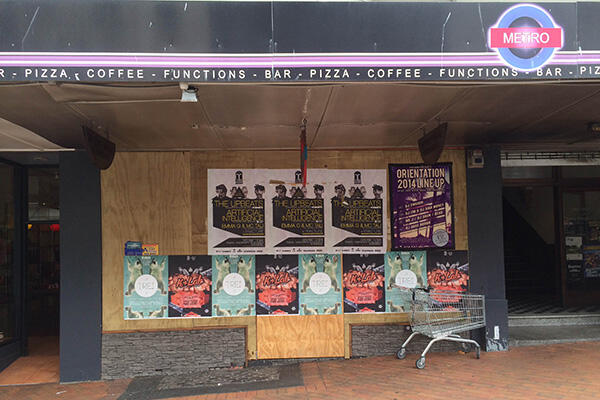
Metro’s fucked, if you haven’t noticed
The owner of a number of Dunedin bars, including student favourites Monkey, Metro and Rumours, has fled the country, leaving a number of outstanding debts. Critic could not get in contact with the owner, Ben Hanssen, but it is understood that he has left behind creditors and employees with no sign of paying them what they are owed. Metro Bar (Dunedin) Ltd, 2 Mooses Tavern Ltd and The Church Nightclub Ltd have all been liquidated following a number of issues with the IRD, leaving business associates and employees financially out of pocket. Sergeant Ian Paulin, of Dunedin Police, told Critic that the non-payment of taxes has resulted in the closure of the local bars. Furthermore, the ODT also outed Hanssen as using gang affiliates to intimidate business rivals, after he was alleged to have knowledge of concrete being poured down the drain of a rival establishment. Several former employees refused to speak of Hanssen’s business deals, however, one former employee told Critic “it’s a serious situation, and I’d rather go to sleep at night knowing I have nothing to do with it.” The liquidated companies were all under the management of Hanssen, who was named as the sole director of each company. In the past, Hanssen has been involved in at least 15 other companies, all of which no longer trade. Prior to owning businesses in Dunedin, Hanssen was known as Charles Benjamin Macadie and was declared bankrupt in 1991. In 2002, Benjamin Charles Hanssen was again declared bankrupt. Critic spoke to Don Millis from Insolvency Management Services who said, “None of the bars are anywhere near reopening in the foreseeable future.” Further, the venues appeared to have no occupying tenants, and the insides of both Monkey and Metro have been “completely gutted” following the recent removal of all chattels. Companies Office records show Mr Hanssen remains a director of various other companies based in Dunedin. Sergeant Paulin told Critic that all liquor licenses under Hanssen’s name have been revoked, including a temporary one held at the Clarendon Hotel. Paulin also told Critic that it is unlikely Monkey will once again become a licensed venue, as the landlords would prefer it was refurbished to become “a high-class establishment.”
-
Columns

Feelgood | Issue 01
A friend of mine was recently employed to be a man in a gorilla suit. He’s supposed to be encouraging the fine people of Dunedin (not to mention the multitude of raving lunatics who wander the streets curiously free of straight jackets) to “Get Active!” with all the irritating enthusiasm of a closeted high-school PE teacher. Now, I have nothing against gorillas, or closeted high-school PE teachers (anyone who wants to suck my one inch diamond cutter is fine by me); but what I do have a problem with is that “a man in a gorilla suit” is the best idea the professional piss-weasels at the DCC could conceive of to combat the epidemic of great-big-fat-people. Worse yet, the Green Party, co-led by great-big-fat-person Metiria Turei, want to ban junk food from schools unconditionally. Now, I may be a syphilitic Turkish humpback, but I know a thing or two about kids: they’re reasonably stupid (not John Banks-stupid – but, hey, who is?) and they like shitty food. Schools sell pastry-covered-heart-attacks because they sell. I question just how “cheap” junk food is. The last time I went to KFC, a quarter-pack was gonna set me back $14 (but then I got asked to leave because I was “naked”). All that’s gonna happen if we ban battered Moro bars and deep-fried dog fetus from schools is that kids will reject the steamed lentils that replaces them, and go hungry. Then the schools will be even shorter of cash-monies and kids will get even stupider because, for some reason, schools need cash to teach well. And I’d rather have a generation of obese geniuses than more of these stupid fat people that you see on Campbell Live. You know the ones I’m talking about. They say they can’t afford to give their kids breakfast even though they themselves look like they’ve eaten Gerry Brownlee. Oh no, folks: we shouldn’t be sending gorillas out to tell people to be less fat – we should be sending them out to tell people to be less fucking retarded. I mean, have you seen Police Ten-7?
-
News
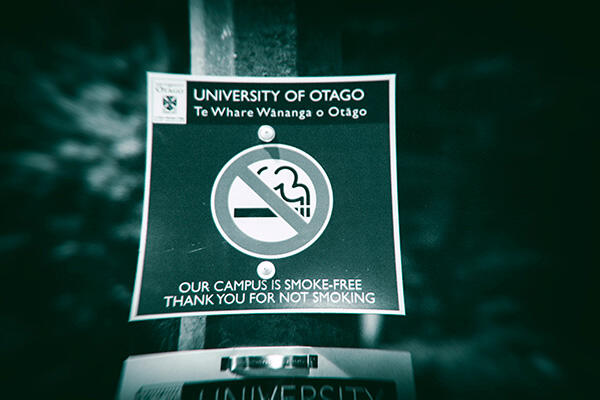
Vaporisers and edibles only on campus
The introduction of a campus-wide smoking ban on 1 January 2014 has harmonised the University with others throughout the country, but many appear to be side-stepping the ban and gutters outside campus have been clogged with cigarette butts. The policy does not outline any smoking-friendly areas in or around the campus, with the removal of public ashtrays aggravating the issue of cigarette littering. In particular, Cumberland Street’s gutters are now swathed with innumerable cigarette butts, while the adjacent Museum Reserve is now comprised of a proprietary blend of cellulose filters, trampled soil, and discarded Student Life brochures. One subset feeling the sting of the University’s attempt at cold turkey is the cannabis-advocacy group NORML. However, members of the group have since adopted non-combustive means of ingestion. Cannnabis advocate Abe Gray believes that vaporisers are the logical future of NORML. “Many of our members weren’t aware of the health benefits of vaporisers until now, so I guess we have the University to thank for that.” Although many at the University believe the policy will bring an end to 145 years of on-site tobacco consumption, patrons of the University’s official nightclub Re:Fuel have been spotted doting the odd honorary cigarette outside Union Hall in the wee hours of the morning. Whether this act of defiance will become commonplace is yet to be seen, but effective late-night monitoring of on-campus smoking appears to be hard to implement en masse. The move to a smoke-free campus follows a nationwide trend prompted by the University of Auckland in 2010, and accompanies steady tax-hikes on tobacco products as well as a total ban on smoking in New Zealand prisons introduced in July 2011. The policy also complements the Maori Party’s Smokefree 2025 initiative which endeavours to all but erradicate smoking in New Zealand by that year. Second-year psychology student and John Player Special-smoker Oliver Gaskell objects to the ban. “People need a place to chug a ciggie – if they really want to minimise harm, smokers should be provided with designated areas to keep them away from the public.” Smoking-related illnesses kill as many as 5000 New Zealanders every year, with roughly 350 of those from second-hand exposure. If you would like to quit smoking, please contact Quitline on 0800 778 778. If you would like to start, please contact British American Tobacco NZ on 0800 113 011.
-
Columns

Science, Bitches! | Issue 01
Have you heard of herd mentality? It can manifest in a few different ways. You may notice some of these as you observe University of Otago students in their natural habitat. (Cue David Attenborough voiceover.) Approaching the St. David’s lecture theatre around half past the hour, you can watch the juvenile Health Science students appearing. They usually travel in packs, for safety, like the great herds of wildebeest that migrate across the plains of Africa. Some may be picked off by older students, and forced to return to their dwellings to remove the egg from their new puffer jackets. Some may have succumbed to the fresher flu already. Some may have wandered off to fertilise the trees with last night’s Riverstone Sav. But, guaranteed, when the lecture is due to start, hundreds will have successfully made it to the door of the theatre. And not one will open that door. But why, I hear you ask, would none of them check whether it’s open? The answer, my friends, is science. Back in the day, it was a pretty good idea to follow the crowd. If everyone in your tribe ran in one direction and you ran in the other, you might be running right into an incoming lion. If no one eats those tasty-looking berries, it might be a good idea to avoid them. If no one opened the door, maybe there was something nasty behind it (physics, perhaps). Peer pressure, for our ancestors, was a matter of life or death. And in the Health Science world, things are not so different. In some cases, however, conformity is less desirable. As much fun as couches are to burn, they’re also heaps of fun to sit on. Yes, crates can be used to create all of your furniture, but no one said it would be comfortable. And a top tip for you first-time flatters: if you run out of couches, plastic chairs are not an appropriate replacement. You know that nasty smell of burning plastic? That’s evolution helping us out again. Sweet. Our senses aren’t just for shits and giggles – everything we detect is telling us information about the world around us. If it’s potentially helpful, we’ll like it. If it’s harmful, we’ll be disgusted by it. Sugar tastes nice because it provides us with energy. Old milk tastes gross because it’s full of bacteria that could infect us. Now, this is no excuse to replace spinach with chocolate in every meal; our diet has changed so much in the last hundred years or so, human evolution just can’t keep up. But that’s another story for another day! The point is, burning plastic smells really bad, right? That’s your nose watching out for you. “Smell” is what happens when tiny molecules get into your nose and bind to the receptors in there. So if you can smell something, it’s releasing something into the atmosphere. Plastics don’t smell of much at all, until you burn them. Sometimes all they release are some harmless hydrocarbons; but if it’s halogenated plastic you’re burning, it’s a whole different story. Unfortunately, when this happens dioxins are released into the air. Now, a quick Google of dioxins should be enough to freak you out, so all I’ll say is that you don’t want them in your nose – or anywhere else. So while conformity may have stopped your ancestors becoming lion tucker, sometimes it’s good to follow your nose, not the herd. That’s science, bitches!
-
News

Uni bank-rolls thugby
OUSA has expressed its support for the University’s sponsorship of the Highlanders rugby union team, despite the University facing backlash from the Tertiary Education Union (TEU) who branded the sponsorship as a “gimmick.” TEU deputy secretary Nanette Cormack elaborated on the Union’s opposition, speaking to Radio New Zealand National. “We see the role of the University of Otago, and of all public education institutions, in New Zealand to be about providing quality public education and research, not about funding private sports teams.” OUSA President Ruby Sycamore-Smith disagrees. “If the University has been honest when they say the sponsorship agreement comes from the existing marketing budget, not an extra allocation of funds, then we’re supportive of the move as it is a new and innovative way of promoting the University both nationally and internationally. We might also say that any money not spent on another year of the ‘Take your Place in the World’ campaign could be seen as a good thing.” Vice Chancellor Harlene Hayne has expressed particular enthusiasm for the opportunities the sponsorship holds in bringing the University closer to the Dunedin community as a whole. Sycamore-Smith agrees. “The University is a big player in the Otago community and this is another way to further establish a bond with, and support for, the local region. No marketing strategy and, in fact, no move the University makes ever pleases everyone, and we’re usually the first to call them out, but in this instance we see the promise of the sponsorship.” The move is not without precedence, with the University of Canberra’s sponsorship of the Brumbies, and Otago Polytechnic’s sponsorship of local cricket team the Otago Volts. However, the TEU have questioned whether the University of Canberra’s sponsorship is a good template to follow. The TEU’s sister Union in Australia, NTEU, have criticised the “progressive imposition” of demands from the rugby franchise which culminated in a five million dollar university-funded training facility for the Brumbies “under the guide of remaking the University of Canberra as a ‘sporting university.’” Despite a lack of support from the TEU, Sycamore-Smith can see a relationship between the University and the Highlanders blossoming. “Students are already big supporters of the Highlanders, and OUSA has been including them in our Super Passes and Orientations for a number of years with great success.” Hayne has refused to disclose the value of the sponsorship, though she remains insistent that she “is pretty convinced it’s a good decision.”
-
Columns
Execrable | Issue 01
The OUSA Executive meeting held last Tuesday 18 February saw President Ruby Sycamore-Smith leading confidently from the front, with Administrative Vice-President Ryan Edgar suspiciously silent and looking much like Critic’s new pet goldfish. The meeting got off to a slow start, however, with Ryan and Finance Officer Nick Tenci both running 15 minutes late. This provided plenty of time for Welfare Officer Nali Lee to enter a highly efficient monologue about what t-shirt size should be ordered for Nick: “If you get him a Medium, he’ll be really cut up that he’s not considered a Large. But Large is still kind of tight, so he’ll like that, too.” Certain character traits in the other latecomer, Ryan, were also revealed after he was asked for an update on how his work was going: “This was supposed to be my day off, so …” Being more than a little petrified of Critic, thanks to a procedural fuck up last year, Ruby was ready to remind everyone to be careful when Critic is in attendance at these meetings. It was even floated that entire meetings should be carried out under “committee of the whole” – which Critic cannot report on. However, Critic reminded the Executive that this is probably not a good idea; both in terms of maintaining public accountability and, more generally, in appearing at all competent. Finally, before any agenda items were discussed, Ruby thanked her Executive for making Orientation Week “much more stressful than it needed to be.” As for the business side of things, well, it was a relatively dull meeting. Recreation Officer Henri Faulkner tabled papers on E Games and a card game called Magic, but it transpired that these did not strictly need approval from the Executive. Nevertheless, the Executive received the papers, with Nick showing attentiveness in requesting to keep an oversight of their budgets. Again coming from Henri’s seat, the Executive then received the University’s ITAC (Information Technology Advisory Committee) report and papers. Points included that: the University was putting together an app, which OUSA could piggy-back on; 90km of fiber-optic cables is currently being laid throughout the University, promising to offer gigabit speeds campus-wide before Chorus’ Gigatown promotion is due to come into effect; the eventual destruction of the proxy that has plagued Otago’s students for years is imminent; and plans for a significantly better lecture recording system are in the works. Discussions then turned to the issue of what charities the OUSA Executive should support. In a rare use of his vocal chords, Ryan came out as the main proponent of only supporting student-related charities. However, Nali pointed out that the wider community should come in at a close second – as a “good-will gesture.” Nick, ever lateral, pointed out that the Executive might finally consider writing a formal charity policy as was briefly considered last year. The meeting then moved into committee of the whole, for reasons of commercial sensitivity, to receive NZUSA conference reports. A significant amount of time later, the meeting was concluded.
-
News
Uni governance and wānanga changes
University Councils throughout the country will undergo major reforms following the Government’s announcement that it plans to reduce their size and remove mandatory staff, student and community membership. Tertiary Education Minister Steven Joyce made the announcement last week, which has since been condemned as an “attack on democracy and on academic freedom.” As the latest in a series of incremental reforms targeting tertiary education, the changes come as part of an Education Amendment Bill, which will soon be introduced to Parliament. The Bill will introduce a number of changes to university and wānanga councils, including reducing the size of councils from between 12 and 20 members to between 8 and 12 members. This would involve removing specific representative requirements to make council membership “more flexible,” and would require the Minister and councils to appoint members with relevant knowledge, skills or experience. Tertiary Education Union (TEU) President Lesley Francey condemned the governance overhaul and said the proposals are unjustified and are “an attack on democracy and on academic freedom.” “[The Minister] is wresting control of universities and wānanga into the hands of his own ministerial appointees and of business supporters.” Francey said the Minister had acknowledged himself that New Zealand’s universities and wānanga are “already financially stable and perform well internationally,” and she saw it as a way to silence local community voices that “do not support the minister’s own economic vision.” While the reforms could be seen to provide a less prescriptive model of membership on councils, Labour’s tertiary education spokesman Grant Roberston said the changes were “simply about silencing the voice of students and staff who have been vocal critics of National’s cuts to tertiary education.” Of major concern is the future of a student voice on councils if student membership is no longer mandatory. OUSA President Ruby Sycamore-Smith said that “student voices on University Councils are a right, not a privilege,” and that it was a “cop out” that student representation on councils may be at the discretion of a university. “That a positive choice has to be made to include students demonstrates that university management and the ministers’ appointees hold more power than ever. Power is much better distributed to those most affected by the institution.” The reforms reflect the needs of a rapidly changing employment market and adapt to changing technology in teaching and learning. “The governance reforms will support universities and wānanga in their drive to be more responsive to the needs of their students,” said Joyce.
-
Columns
David Clark | Issue 01
Welcome to 2014. I love this time of year, with North Dunedin enjoying the surge of energy that accompanies students repopulating the electorate. While this isn’t my first appearance in Critic, for those of you I haven’t yet met: I’m your local electorate MP, David Clark. I have the privilege of representing your aspirations, the aspirations of Dunedin North people, in Parliament. Let me be upfront with Critic readers; my political views don’t (and never have) included banning Facebook. This message is especially directed at the phalanx of cheerleaders who heard my out-of-context comments and rushed to communicate messages of support on talkback, by facsimile, via telegraph and various other “modern” means. Of course I have political views. Having been a student myself for many years, I enjoy debating issues. Don’t be afraid to grab my attention if you pass me in the street and want to bend my ear on an issue. But political discussion is for another day. This first column is focused on practical stuff. If you’re new to campus, you might wonder how on earth your local MP might be any use to you. Here’s how. My Dunedin office and I deal mostly with practical local issues. For starters, we witness and sign many documents, assist with tenancy disputes, do certification of degrees, help with immigration and StudyLink issues, and much more. Some days my office in Albany Street processes more 18+ cards than the Rob Roy dairy makes ice-creams. We also have a good knowledge of where else you can go for assistance. As your MP on campus, an important part of my job is to listen to, and where relevant, to confront, reoccurring problems. For example, I’m currently hearing plenty of frustration about StudyLink waiting-times. I can be contacted at any time via my office in Albany Street next to Why Not Hair (just up from the old Captain Cook. Drop by the office, or pop into one of my regular MP “clinics” on campus.
-
Columns

Hi Dr. Nick | Issue 01
Hi, everybody! Something I’ve noticed in my travels through the healthcare system is that there are certain questions that come up whenever people find out you’re a medical student. If you’re female, you’ll undoubtedly be asked: “Are you going to be a doctor or a nurse?” by your patients. If you’re male, you’ll undoubtedly be asked: “Can you have a look at this weird growth on my junk?” by your friends. If you’re transgender, gender-fluid or gender-queer, you’ll undoubtedly be asked: “How dare you exist in my world and confront my narrow-minded view of a binary-gendered society?” by idiots who deserve a swift kick to their cis-gendered genitals. Irrespective of their crotch’s ability to dangle, however, there is one question that is asked of every medical student: “Are you going to be a specialist, or a GP?” To ask this question suggests, like most New Zealanders, that the speaker doesn’t really understand what a GP is. You see, a General Practitioner is a specialist profession. They go to a specialist school, they get their specialist certificates, and they get to sit at the specialist table in the cafeteria with all the Orthopods and Anaesthesiologists. The thing is, GPs specialise in everything. Now that may sound as antonymous as a St Margaret keg party or as impossible as somebody not from St Margaret’s understanding the word “antonymous,” but it’s true: a GP specialises in knowing everything in medicine. Before you start calling the on-call proctologist to tell them that I’m full of shit, I’ll back up a bit. I’ll admit – that last statement was a bit of a lie. In my defense though, it was like an Englishman’s dick in an African locker room: little and white. GPs don’t know everything in medicine; nobody does. No matter what their GPA, UMAT score or hall of residence, nobody has ever known everything in medicine. A GP’s job isn’t to try and know everything; it’s to know enough about every part of medicine so they can carry out a gatekeeping role. A GP has to be able to see a hundred patients with chest pain and work out which ones need a pat on the head and a push out the door, which ones need panadol, and which ones need to be panicked about. A GP’s broad focus means that a cardiologist will always be more up-to-date with the latest research into the myocardial effects of sildenafil in Behcet’s Disease than them. But it also means they will be more up-to-date with the latest urological research than the cardiologist will ever be. Like a haiku about a group of beautiful idiots, the bottom line is pretty simple, folks. GPs have a specialised role in the healthcare system: to be able to see a wide variety of things and be able to manage them all. Don’t get me wrong – they’ll manage some things better than others. If you show up with conjunctivitis they’ll be more helpful than if you show up with von Hippel-Lindau Disease, but it’s pretty rare to show up to your GP with something they haven’t seen before or cannot help with. After all, they see hundreds of people with chest pain, hundreds of people with depression, and hundreds of people with weird growths on their junk. Throughout its run, this column is going to tackle some of the big issues in health for students. No matter what it covers, though, it’ll never be a substitute for a good GP. So go find one that you can trust and make use of them if you’re concerned about anything health-wise this year.
-
Columns
Queer Eye | Issue 01
Hello lovelies, Welcome to this column, and for those new to town, welcome to Dunnaz. I hope you have a great year at Otago as you load yourself up with a huge student debt and try to get yourself a degree. I also really hope that you get the most out of what you can learn here outside of your official studies as you meet new people, join clubs, and learn more about what makes you unique. This column is all about identity. The identities we are most interested in are sex, sexuality and gender, however, we are fascinated by the diversity of humanity and will endeavour to explore it in all its grisly glory. We will cast our fabulous queer eye around and identify things, people and situations which could do with being looked at from a different perspective. What the Queer Eye for the Straight Guy team did for fashion, we will do for media, culture, religion, politics and society. But why the word “queer,” I hear you ask? Isn’t that, like, offensive or some shit? Well, darlings, I am here to inform you that whilst it has historically been used as a slur against us, we are currently reclaiming it. We are literally transforming the power of it. At the moment it is the only word that can be used inclusively of all forms of sex, sexuality and gender identities. This includes, but is in no way limited to, lesbian, gay, bisexual, transgender, intersex and asexual. The word especially makes sense in a university context, as some subject areas include queer theory, OUSA runs the Queer Support Centre, and UniQ is the University Queer Club on campus. You should check them out. Finally, doesn’t “queer” mean weird or different? Yes it does, and that is part of the appeal. Many people who claim the word want to intentionally disassociate themselves from the heteronormative and patriarchal structures of our society. Who wants to be normal, anyway? We will look at this in more detail later in the series. If you have any questions, feedback or a potential column topic drop me some mail: queer@critic.co.nz Yours Fabulously, Sir Lloyd Queerington
-
News
ECP struggles
Walking into a pharmacy in need of the emergency contraceptive pill (ECP) has left some young Dunedin women feeling inappropriately questioned and judged by a local pharmacy. One woman has made a complaint to the Health and Disability Commissioner (HDC) abut Wilkinson and Son Chemists after her experience ended with her being told that the “best method of contraception was to hold an aspirin pill between my knees,” according to the statement she filed. The ECP, or “morning-after pill,” is available to women at pharmacies and sexual-health clinics nationwide. In New Zealand, the two ECPs on the market are Levonelle-1 and Postinor-1, which cost $35 over the counter if prescribed by a pharmacist, or $6.50 if prescribed by a doctor or sexual health nurse. Women must take the pill within 72 hours of sexual intercourse. However, few clinics are open over the weekend, so many young women have to surrender a visit to an open pharmacy instead. In 2013, over 2,500 ECPs were dispensed from Dunedin Central and Dunedin North pharmacies. Critic spoke with a number of young women who had negative experiences with Wilkinson and Son. The women described their experiences getting the ECP as “judgmental” and “inappropriate.” The industry standards for the Pharmacy Council of NZ indicate that “requests for emergency contraception must be received sensitively, with due regard for the woman’s right to privacy and confidentiality.” With this in mind, I decided to pay a visit to a few local stores to see what response was given to a young woman asking for the ECP. The first pharmacies I visited were Albany, Unichem, and Urgent Doctors – all of which were very professional; taking no more than five minutes to dispense the ECP, including the time it took for them to consult with me. However, my visit to Wilkinson and Son took 10 minutes, including consultation, to receive the pill. During this time, I was asked the standard questions required, including whether it was my first time using the ECP and if I had reacted to it previously. The questions then extended to drinking habits, drug habits and whether my partner was a regular partner. It was explained to me that the reason questions are asked about drugs is that taking cannabis renders the ECP to be completely ineffective. However, according to the Pharmacy Council of NZ, there is no scientific evidence of this, as no studies on the effects of cannabis and the ECP have been carried out. It was further explained to me that a woman had recently got the pharmacy in trouble because she thought they were trying to catch her out in regards to her drug use. Critic had already spoken to the woman in question, who we will call Sarah. In the complaint she filed, Sarah alleges that she was not informed as to why her drug habits were relevant to the pill. Instead, she was asked numerous questions concerning why she took any form of recreational drugs and what effect these had on her. She claims that she was asked “a lot of what I felt were unrelated questions about my sex life and religion, as well as asking me about recreational drug use and what would compel me to take drugs at a party. I felt very uncomfortable, especially as they kept making jokes about the situation.” She says the invasive questioning made her feel “very uncomfortable.” Following the question of whether the incident was with a long-term partner, Sarah says the Pharmacist remarked that her partner was “a lucky guy,” and described Sarah as “pretty and athletic, like his daughters.” The consultation ended with the pharmacist allegedly telling her that the best form of contraception was to keep an aspirin pill between her knees. After making her official complaint to the HDC, she has been informed that they are awaiting comment from the pharmacy. The Food and Drug Administration (FDA) have printed on the pamphlet of Postinor-1, the most commonly prescribed ECP, that the drug works by thinning the uterine lining (which the birth control pill can also do), thereby preventing implantation; or by preventing fertilisation. If taken prior to ovulation, Postinor-1 can inhibit ovulation for 5–7 days, by which time any sperm in the upper reproductive tract loses its fertilising ability. The active ingredient in the ECP, Levonorgestrel, is not effective once the process of implantation begins. Barbara Moore, Professional Standards Advisor for the Pharmacy Council of NZ, clarifies that “taking the morning-after pill whilst pregnant will not harm a foetus” and therefore, by current medical convention, it is not classified as an abortifacient (a drug that induces an abortion). This last point is particularly pertinent, as after being questioned as to whether they are religious or not, and what faith they followed if they did have one, all of the women interviewed who visited Wilkinson and Son said they were asked whether they were “aware that this pill does not prevent pregnancy?” The pharmacist went on to explain that the ECP is a biological abortifacient and that this makes it inappropriate to take for some Catholics. They said that this knowledge sometimes made girls change their minds. Moore says it is essential that, when in doubt, women should challenge the knowledge of their health care professionals and “ask for the clinical evidence.” Being a drug, side effects should be discussed and there is a list of standard questions the pharmacist is supposed to ask in order to ensure the ECP will be effective: why you need it; how long it was since the “incident” happened; whether you have used the ECP before and handled it well enough; and whether you take any drugs or have any medical conditions which may interfere with the ability for the drug to work. Sarah is awaiting a further response from the HDC, but hopes that her complaint will make the pharmacy aware that they are “making women feel uneasy – whether intentionally or unintentionally.” Critic approached the pharmacy, which is aware of the complaint made against them, but they are strictly unable to comment due to following HDC protocols. Whatever the reason, young women should not hold out on getting the ECP because they are afraid of judgment from their health care professionals. According to the Pharmacy Council of NZ, those who are allowed to hand over the ECP have been given that privilege “on the condition they handle it in a sensitive and confidential manner.”
-
Features

Farang Inbox
Every New Year, thousands of youths from around the world flock to Thailand to attend the notorious Full Moon Party. Joining the migration, Max Callister-Baker experienced two weeks of massages, exceptional dart blowing and pissing out the side of tuk-tuks. “Why are there blue stains across the front of your shorts?” is never a question a son wants to hear from his mum as she begins collecting his clothes for the laundry. In fact, when a mum asks a question that combines certain key words like “pants,” “stains” and a particular colour, a son will always feel dread. For me, it was blue stains – although I guess there could be more awkward colours. As I thought about the stains, a collection of words and fragmented flashbacks came to mind and then everything made sense. Well, as much as two weeks in Thailand could make sense, anyway. 27 . 12 . 2013 Max (Email): Everything is going well, miss you. Having breakfast at our hotel then might use the pool then explore around! So so many young white people of different places! What is the name of the shuttle I used BTW? It was a great service. But a “great service” wasn’t the reason I needed the shuttle’s name. The real reason would send Mum panicking. I had already left my phone in the back of the shuttle and, at that point, I had no way to synchronise my travel plans with my mates for the flight the next day. This forced me to give the closest payphone a shot, but holy hell! Trying to operate those bad boys was like trying to perform heart surgery on the Terminator. I was shoving coins in every slot, but it must have thought I was its baby penguin because it just kept regurgitating them back into me. This went on for the next ten minutes. Only then did I notice the line behind me. To save myself embarrassment, I spent the last minute on the payphone faking a conversation to what could have been a Japanese fax machine. Two hours later, the shuttle driver had dropped the phone to reception. 03 . 01 . 2014 Max (Text): Love you guys & miss you. I had a Thai massage - so many funny moments. The food is great and we’re having great times. Going on elephants tomorrow followed by kayaking. Might try eat a fried scorpion. Also ... I watched the Thai ping pong show where women do things - SO many things. It was 11:30 pm when the Thai stripper walked around the edge of the stage holding a board that asked for no photos or videos to be taken. Let the Ping-Pong games begin! Looking around, you would expect that the audience at a notorious Thai Ping-Pong show would be composed of horny, old, bald men, but at least half of the crowd were young tourist women. My two friends, through their aggressive bargaining, had landed us seats directly in front of the stage, which would later backfire on one of them. The first performer came on stage stark naked. She didn’t seem to be holding anything – anything in her hands, that is. To explain what happened next is not easy. If you’ve ever seen or known of that trick where clowns pull out an endless colourful ribbon from their mouths or a hat, it was like that – except out of the performer’s vagina. As she continued pulling she gave the end to one of the male audience members and started a game of tug of war with the ribbon. From that point on, the show only got weirder. The next performer brought out an empty goldfish bowl. Jaws dropped. She had the goldfish all right; it was just in the same area as the previous performer’s ribbon. But as she squatted down to drop (release? shoot? who knows the word) the traumatised creature back into the bowl, it turned out that she wasn’t done with the single one. To put it in terms of a cliché; it wasn’t a small fish in a big bowl, but many, many fish all plopped back into a small bowl. The third performer – again, completely naked – walked around the audience handing (yes, with her hands) balloons out to a dozen or so people, with my friends and I each receiving one. A handful of performers then emerged on stage with a blow dart in each of their hands. Just kidding – the blow darts were in the same place as the goldfish and the ribbon. The performers got down on all fours with their backs to the ground and moved to different edges of the stage. They then proceeded, with admirably good accuracy, to shoot the balloons out of each audience member’s hand. My friends and I tried to make it particularly challenging by holding all three of our balloons behind the others in a line. But their vaginas were steady and there was no disappointment as all three balloons popped in a single firing round. They must be real killers in the bedroom – misbehaving partners wouldn’t last long with these women. For the final (and most memorable) act, a performer brought out frozen beers. She went around the edges of the stage testing to see if there was anyone with the strength to twist open the bottles – which no one could. This was the adult version of pulling King Arthur’s sword out of the rock. The performer got on all fours in front of my friend, put the bottle head up her vagina, and popped the cap open. And when I say popped it open, I mean it sprayed a combination of beer and vaginal fluids all over the face of my friend who sat in front of her. It was the first facial he had ever received. I didn’t rub it in by asking if he spat or swallowed. The rest of the night was a blur of bars, beer, shisha and laughter. It ended with us racing back home in a tuk-tuk as it poured down with rain, my friend holding me in a brace position while I leaned out the side of it to take a very satisfying piss. 05 . 01 . 2014 Max (Email): Hey dad, hypothetically speaking, if you met a girl in another country who you really liked, and she wanted to come back with you, how would that work? Not that I would do anything like that. LOL. But how long could her visit last? Would it be hard for her to get a job? Again, I’m just curious. As my friends were waiting for the toilet at the zoo, I stood outside exchanging funny faces with a cute Thai woman who stood behind one of the zoo’s stalls. Suddenly, she beckoned me over. I wasn’t particularly interested in buying anything, but she had no intention to sell. Instead she began asking me questions – what my name was, where I was from. I soon learned her nickname was Ohh. This was a tad confusing because I have the habit of saying “oh” in the way other people might use “um.” Before my friends returned it was time to say goodbye. Ohh asked for my contact details, namely my Facebook. Later that evening, while chatting to her on Facebook, I discovered Ohh had a peculiar way of exchanging messages. Although she could write in English, most of the time she preferred to express herself through single smiley faces and cat stickers. I’d ask what she’d been up to and she’d reply with a picture of a cat eating McDonald’s. One night my mate and I stayed up drinking. We got into one of those crazy conversations where you make elaborate future plans. This time we decided that I should bring Ohh home. We went on my Facebook to talk to Ohh and make it a reality. In the morning, I read through the messages. The conversation had gotten pretty deep. I’d promised Ohh that she would be in New Zealand by the end of February, she would move into the flat with me, and “of course my flatmates wouldn’t mind!” By the end of the cringe-worthy exchange, I had wooed Ohh. It might sound crazy, but retrospectively I learned how common my experience with Ohh was, except in other cases people actually did marry the women they met in Thailand. Some of these stories end happily. Many Thai women are looking to find a way out of their financial struggle, so having the choice to start a new life with new opportunities by marrying a Westerner is an opportunity many are willing to devote themselves to. However, as expected, there are also those Thai women who are aware of this process and exploit it in an array of economically impressive ways: the women known as “bar girls.” As their name suggests, these women typically hang around bars in Thailand and look out to start relationships with “farangs” (Westerners). Typically in this process, a hooked Western man leaves Thailand convinced he is in love, so he sends his “girlfriend” money to join him in his home country. The girlfriend agrees, but then, at the last moment, something will stop her from leaving Thailand: her mother is sick, or it turns out she is pregnant with their kid. So the bar girl asks for more money. Then, once the bar girl feels she has squeezed as much money as possible from her foreign boyfriend, she will shut down all contact with him in an instant. This scenario sounds obvious and it seems like this type of woman would be easy to distinguish, but it would be a serious mistake to underestimate the level of deceit some of these bar girls are capable of. A blog called Stickman’s Guide to Bangkok has a section where people submit their own experiences. One submission tells the story of how one bar girl faked her job and set up her own fake birthday for her “victim.” When he hacked her email account, he discovered she was playing at least a dozen other guys and half had asked her when their baby was due. 09 . 01 . 2014 Max (Text): Having a great last week in Bangkok, can’t wait to get home! Having just finished a busy day in Bangkok, I felt that a massage was in order but my friends wanted to relax in their room. Up to that point, there was a joke that I had constantly drawn the short straw with always having dudes do my massage, so I made my own plans for the evening along with some people I had met at a bar to find a place – somewhere I was sure the workers would be female. The sign read “Playboy Massages.” I went in. As I clambered up the steep staircase, however, I had the sudden urge to go toilet. After letting out what my mates would describe as a “shit grenade,” I reached for the toilet paper – only to find out there was none there. For a moment I considered remaining there for the next hour, thinking of an elaborate story about how wonderful my massage was, but I knew that was simply not feasible. Furthermore, since the massage workers’ English was at a minimal standard, the only option would be through a game of charades. I wasn’t keen to act out “my asshole.” Then, somehow, the situation further deteriorated when once again I had been given a male masseur. Feeling very alone, things got uncomfortably intimate as I was taken down the end of a dark corridor into a private room. As I lay face down on the mattress, which was as stiff and as uncomfortable as a sandbag, the masseur turned on the air conditioning and had brought incense in – all of which I hoped was part of the routine and not due to any potential lingering smell. As the last moments of the massage were ending, I heard another person’s voice erupt from the next room, repeatedly saying, “No, no, no, thank you!” I hoped, for her sake, it was only an extra towel she was being offered. Vaguely refreshed, I walked down the stairs and noticed two other people in the common room, fervently discussing something in hushed tones. I was struck by the diversity of our facial expressions, and approached them to chat. We decided to head out for dinner together, so hurriedly paid and left to piece together what happened. One of the guys in the group had a male masseur as well, but at the end of his massage, when he thought he was coming back to bring him a towel, the masseur came back needing one himself. He quickly refused and remained somewhat traumatised for the rest of the evening. The other guy, however, had a completely different story. He had received a female masseuse, and at the end of his massage she offered him a “happy ending.” Let’s just say it didn’t involve being read a bedtime story about The Little Mermaid. I realised my “squishy” moment on the toilet had saved me after all; it gave me a natural chastity belt. ~ I slumped over the couch, exhausted and happy to be back home. I was reunited with my family and they had enjoyed my largely edited version of my trip to Thailand (except several awkward photos that had somehow slipped into the slideshow I showed them). About to fall into a comfortable afternoon nap, Mum’s voice boomed throughout the house: “Come here, Max!” What did I forget? I knew that at the very worst I had accidentally gained three towels. I walked to Mum who stood over my suitcase. She held out my trousers. “What?” I asked, confused - and that’s when I saw the blue stains covering them. I laughed when I realised what they were from. The night I got those stains we had spent the evening in the red-light district in Phuket. It had been incredible, but for all the reasons I’m not comfortable telling my mum about – particularly the part where a giggly Thai stripper (with blue makeup over her body) made her way to my lap. I had justified it in my mind that she was coming over to be read a bedtime story and that was all. A good story did happen, just without any book.
-
Features

Yu-Gi-(Makes Me)-Oh
He had straight, shoulder-length blonde hair and iridescent blue eyes. He was tall and slender. His feminine facial features were offset, but also strangely complimented, by his voice (later I learned it was the voice of Christian Bale). His name was Howl and when I saw him for the first time I was wild for him. But how little did my pre-pubescent heart understand. Howl would never love me, or even realise I existed. He was trapped, confined to his own fantasy world – and a limited world at that – with a defined beginning and end. My first encounter with Howl ended almost abruptly. The lights turned on and I left the cinema, trailing behind my parents in secret dismay. There was an ache in my chest and, for a week, I was deeply confounded by the perplexities of loving a Hayao Miyazaki anime character: in essence, a really, really hot cartoon. Almost a decade has past and I think I am over Howl. But, in the recent summer break, I have come to realise that I am not over my obsession for anime and manga – particularly of the shōjo variety. Part of me is, and forever will be, a fourteen-year-old Japanese girl. My next love shared many similarities with Howl. Usui Takumi was blonde, slender and tall, and although he had none of the magical abilities that Howl had, he made up for it with a combination of academic genius, physical strength, and a nonchalant attitude that was fragmented with perfectly timed moments of sensitivity. All the girls “confessed” to him, but he rejected each one with an air of confident disinterest. I liked that about him – he knew what he wanted and he was unfailingly honest to that. He also, somehow, had experience in relationships beyond his years, although his personal background largely remained an alluring mystery. My time with Usui Takumi lasted for 85 comics and while it ended organically, I developed an addiction for his undoubtedly fantastical character type – a personality perfected in countless shōjo manga. And for several weeks I subconsciously trapped myself within the role of the girl who “wasn’t like the other girls” – I was the one who could touch the hearts of Takumi and Howl. I was given an intimate power to put a leash around the cool boys of the manga and anime worlds. Every person should be familiar with the idea of a comic, but the Japanese version – known as manga – is something else completely and holds an overwhelmingly popular status in Japan. Its influence is everywhere. But, while manga passed across those geopolitical boundaries decades ago, it perhaps did so without the full awareness of global consumers. Think, for example, of Astro Boy (or Tetsuwan Atom). This animation featuring a sensitive, crime-fighting robot has been widely viewed (and adored) in the United States since the 1970s, but few completely appreciated that it was made in Japan or based on manga. Decades later, awareness is growing (any child that did not have a Naruto, Yu-Gi-Oh or Dragon Ball Z obsession would be lying ... or very sad), but manga – the base for a majority of anime – is still far from receiving popular status in most Western countries. While the origin of manga is debated, it is generally accepted that it evolved from “Chojyu-giga” (humourous pictures of birds and animals) first depicted by the monk Kakuyu in 1053-1140. However, it was only in the 19th century when the term “manga” was first used by Hokusai Katsushika (1760-1849) in printed illustration books, which showed humourous pictures of everyday life. Jump forward to the 1960s and a variety of manga types for a range of target demographics (usually revolving around age and gender) had developed. Now, manga is still drawn and printed in black and white and this ongoing tradition has resulted in an abundant use of semiotics and semantic connotations unique to these comics. For example, white hair outlined by black lines typically indicates foreigners. ~ The two central protagonists are standing on the school roof, when Usui Takumi (the coolest guy in school) drops a photo of him and Ayuzawa Misaki in her cosplay maid outfit off the edge. Ayuzawa, the Seika High School student council president, is terrified – no one at her school, except Usui, knows of her maid job. Usui, sensing her panic, climbs onto the ledge of the building. “And what do you think you’re doing?” Ayuzawa demands. “This is the shortest way,” Usui replies calmly, almost nonchalant. “Are you kidding? You will die for sure!” “Pres told me to take it back, so that’s what I’ll do.” “What are you talking about? Why would you do it to such extremity?” “Why?? That’s because ... I love you! Ayuzawa!” Usui kisses Ayuzawa, and then dramatically launches himself from the roof’s edge. This scene is from one of my favourite shojo mangas, Kaichōu wa Maid-sama (written and drawn by the renowned Fujiwara Hiro), and it literally made me blush. While I blushed, I questioned many things, in particular my emotional maturity – or lack thereof. I swear I’m normal (blatant lie) but, still, I had to accept that yet again a cartoon made my cheeks go red. Lacking the confidence to accept this and move on I delved into an obsessive quest to understand, first, if there were others who could be emotionally moved by comics and, second, just what it is about shōjo manga that hooks the reader. Shōjo manga is not necessarily a genre or specific drawing style, but rather it is a category that shows the anime or manga target demographic (young women or girls from approximately 7-18-years-old). Popular examples include Cardcaptor Sakura, Fruit Basket, Ouran High School Host Club, Sailor Moon and Skip Beat. However, what is inherent to all shōjo manga is their personal intimacy, from the romantic, teen-angst content to the prolific use of characters with overly large eyes, which (apparently) are meant to act as windows to the soul, suggesting unspoken emotions, allowing readers to identify with the complex inner psychology of the character. Shōjo manga, as well as another variety specifically addressed to boys, first began to appear in the late 19th century during a time in the Meiji era when literacy was encouraged. Importantly (particularly to the background history of shōjo manga), it was also around this time, in 1896, that the Meiji Civil Code in Japan condemned gender ambiguity through the regulation of appearance – the Code was particularly harsh towards women, exercising a fierce control over female bodies and their roles in Japanese society, confining a woman’s status to who she was in relation to a man whether that be as wife, mother, daughter or otherwise. In 1902, Shōjo Kai (Girls’ World) was first published and children’s magazines began to be separated along gender lines. But, over a half a century later in the late 1960s and early 1970s a dynamic youth counterculture influenced manga in Japan, resulting in new, more progressive themes and content in shōjo manga. In 1972, a place was finally made vacant for shōjo manga at the popular comics’ table – largely due to the success of Ikeda Riyoko’s Berusaiyu No Bara (or The Rose of Versailles). Berusaiyu No Bara depicts a woman called Oscar who both behaves and dresses as a man. As a captain in the French army, Oscar also has romantic relationships with a male subordinate and Marie Antoinette (whom Oscar is a bodyguard for). Thus, gender questioning and the huge desire by Japanese readers, especially women, to explore these themes began to be realised. However, comics loosely described as shōjo only brush the surface of what can be found in the manga world. There are many more sadistic, masochistic, pornographic, and gender-bending roller coasters to ride. I have simply been far too sheltered. The first jump from shōjo manga is jôsei and dansei (women’s and men’s) manga, which often features adult themes like drinking, sex and the stress of corporate jobs. Then, somewhere within these more adult comics (but still arguably fitting within the shōjo demographic as a subgenre) fits yaoi, or boys’ love. In no way an understatement, the psychology behind yaoi and its popularity is totally bizarre. Honami Kairi is shy and sweet when he accepts an offer to work as a housekeeper in order to support his sick Aunt. However, unknown to Honami, the job is actually to marry the foreign Royal Prince Shou. Later, on the night after their wedding, the prince is furious at Honami for (innocently) having dinner with another man in their room. “To let a man ... in the room immediately,” Royal Prince Shou growls, eyes cold as ice. “It’s a misunderstanding! Kousuke-san was just here with me for a meal,” Honami replies, scared and wide-eyed. The prince grabs his wrist. “Where are we going?” “At first I thought of holding you gently. But it seems unnecessary now.” Honami is thrown onto the grand bed. “No!” he cries, “please stop this!” “It’s no use shouting. There is no one else left here.” “From today onwards, you’re my wife. I’ll give you money and status. In return, satisfy me.” A terrifying (likely non-consensual) sexual encounter ensues. This is a scene from the yaoi called The Royal Fiancé and provides a flavour for what can be found in yaoi manga. Yaoi is an acronym for the phrase “yama nashi, ochi nashi, imi nashi”, which means “No Climax, No Resolution, No Meaning.” It features romantic and often sexual relationships between male characters; they are typically made by, and for, women. It began as a new genre of amateur manga (originally taking the “yummy,” implied homosexual parts of previously developed stories) and now there are handfuls of serial yaoi with fully developed plots. Furthermore, alternative meanings for yaoi have been suggested as it’s grown, like “Yamete, oshiri ga itai” or, in English, “stop, my ass hurts.” Yaoi goes further than some popular shōjo manga where gender constructs are idly played with – in this way, it has a significant role in challenging the heteronormative gender ideals of sexuality. When I attempted conversation about yaoi in an online anime/manga chat room the responses were mixed: Anon5115: “woah do you guys like yaoi. i don’t. i’m straight.” Netruelism: “I’ve read so much yaoi my opinion of it is now meh.” Anon5115 then asked the obvious: “are you gay?” Netruelism quickly replied: “No, you don’t have to be gay to like yaoi.” So if it’s not about being gay, what is it? The answers aren’t simple. Some argue that yaoi provides a fantasy world for its largely female following where identification, desire and sexuality can be experimented with. Others have interpreted this manga as liberating readers from both the patriarchy and heteronormativity, typically viewing the homosexual relationships depicted as devices (rather than objects) for the freeing of desire. Basically, heterosexual mating is just so mainstream, but in a yaoi the two male protagonists defy norms through the pursuit of their own overwhelming connection with each other. That’s sweet, but why gay men? Ueno Chizuko, a feminist sociologist, believes that “male homosexuality [in shōjo manga] was a safety device that allowed [girls] to operate this dangerous thing called ‘sex’ at a distance from [their] own bodies; it was the wings that enabled girls to fly.” Readers of yaoi can escape the binary gender construction of male and female and submerge themselves within the fluid concepts of sex, gender, and sexuality – something that isn’t so easily done in day-to-day realities, trapped within the social confinements that restrict and subdue women. Furthermore, through the recurring scenes of non-consensual sex in yaoi, as shōjo manga essayist Fujimoto Yukari argues, women gain the perspective of the violator, while simultaneously acquiring a fantastical freedom from the position of being unilaterally violated. It’s somewhat sinister: reading yaoi is not simply about entertainment. A step further takes you into the dark and completely obscure world of hentai, which is typically explored in horny isolation. I turned to the forums to further my understanding. The erratic, juvenile (and maybe enlightening) conversation quickly slipped from a peaceful discussion on manga to the grimy world of hentai, which is a general term most often used outside of Japan to describe anime or manga that features perverse sexual acts: Anon758: “do you look at the incest ones?” Netruelism: “I’ve only read incest a couple of times. Seriously bro, hentai is screwed up. It’s like the bowels of Japan.” Mearick: “Dude, I saw one where they shove a mushroom up a fairy’s meow in order to collect her juice. And the dude covered the mushroom in an aphrodisiac first.” Yobishimuri: “Punishment is the path to order.” Bac0nbitz3: “Hentai is beautiful, it explores the avenues conventional porn cannot. It treads in those uncharted territories that few dare to enter. Also, most hentai is vanilla so don’t hate breh.” A majority of manga (especially amateur manga) has something to do with creating fantasy spaces implicitly or directly presenting questions of gender and sexuality. The practically androgynous Howl was my first encounter, my first step, into this endlessly obscure world of supposed exploration. My binge consumption of shōjo manga was that next step. And, while yaoi doesn’t engage with me like it does with its avid readers, my deeper understanding of shōjo subgenres like yaoi had me fully appreciative of the power of the shōjo manga world – a world where gender and sexual revolution is liberal and eclectic. In this way, I have come to realise that those who openly make and follow this type of manga are admirable – deviating from the mainstream, encouraging a breakdown of social sanctions, in a process which some view as feminist or at least a step towards “true feminism.” While pockets of Japanese culture, like host clubs, cuddle cafes, and vending machines selling used underwear (which many say is now only an underground, illegal business) are hard to understand, an appreciation and following of manga can prove enlightening. The wide following of yaoi, for example, suggests both unhappiness with adherence to general standards of femininity and an environment that does nothing to question or fix this unhappiness. Bac0nbitz3 was right. For many of us, these are “uncharted territories,” but replace a tab of LSD with a good manga and I can guarantee that you’ll open your mind ... in one way or another.
-
Features

Student Jobs Uncovered
I might just become a stripper,” sighs every 19-year-old girl with a student loan and a half-empty bottle of Corbans. She then continues with her life: she dances at 10 Bar, and saves hard for a new MacBook. Her friends tell her she’s hot, and this year she’ll pash at least five people; her ego remains stable. She and her friends talk about stripping as a last resort; it’s said to be sleazy, dangerous, and a sin. Sometimes, though, her dreams are filled with wads of cash, diamonds, a small golden pistol in her waistband, suitors, and her own supple skin glittering in the spotlight; but she’ll never know if this is the life she has missed out on. Stripping could be the fantasy life above, or it could be sleazy darkness and danger; most people will never know, but if you’re interested, the beginning of a new year away from your hometown life is the time to find out. Whatever label you consider stripping to be – anti-feminist, slutty, fun, empowering – it happens, and will continue to happen for as long as arousal is fun. So let’s cast aside moral judgments, both positive and negative, and consider it a job opportunity. Stripping will only ever be part-time, at least in a city like Dunedin. The clubs are only open on Thursdays, Fridays, and Saturdays, but most girls don’t work all three. “The money was full time,” veteran Ashley told me, “[but] the hours certainly weren’t.” She didn’t seem to find this a negative, though: “you’d get bored working ‘full time’ three nights a week, I reckon.” Although stripping is only ever part-time, the money definitely makes up for it: another stripper I spoke with, Lilly, quit studying to work full time, and found that the money she made in the club was worth plenty of hours’ work: she ended up getting another part-time kitchen hand job “for a bit of extra money while I stripped.” As for the money – it’s exactly what movies make it out to be: a lot. Ashley made $1200 on her first weekend at Stilettos, but that, she explains, “was madness … around that time Stilettos hosted a Lisa Lewis show.” Your usual “best night ever” as a stripper is actually closer to $900. Although the money’s good, the one catch is that it isn’t guaranteed; there is no hourly wage, as all the cash comes from tips and lap dances. Dallas, 21, found this to be the main lowlight of the job: “it’s not guaranteed income, and it can be quite frustrating if it’s a slow weekend.” It seems the money is still better than most other part-time jobs, though: Ashley’s slow nights and small crowds could sometimes leave her with a disappointing $200 for a night’s work. “We made good money,” she told me, before re-phrasing it: “well, I made good money.” She explains what made her such a money magnet: the big bucks came from convincing people to buy lap dances. “Most of that was achieved by getting to know a patron; sitting down between sets, having a chat, a drink, or a cigarette, and making them want you as opposed to any of the other girls.” To make money, you not only need to have good chat, you literally need to be able to sell yourself. “I was pretty good at that.” One would think that getting hired as a stripper would be based mostly on one’s physical appearance, but Dallas suggests not. “There are no specific requirements appearance-wise, you just need to be well-presented and outgoing.” Lilly agrees, saying, “There wasn’t a specific body type or fitness level guideline.” All three are sure there’s room for most figures: “there are a variety of body types and that helps to cater to each patron.” So don’t worry, self-conscious ladies; you, too, can be a sexual object! Ashley, though, has some bad news: “if you were super obese you’d have a problem,” but in general you just need to “be confident with your body.” This could be the secret to the body types we see stripping; they’re the ones encouraged to be body-confident. That bombshell being dropped, here’s the good news: there’s no real fitness requirement! “You just prance around stage and use the pole as a prop until you learn to pole dance properly.” Speaking of which, what previous experience is required to be a stripper? Both Dallas and Ashley made their way to the stage via pole-dancing lessons. Having made contact with their inner sex bomb, they both decided to take it to the people. “A friend and I went in one night to watch and thought it looked like mean fun, so asked [the owner] if we could give it a shot for real. She said ‘sure!’ and that was basically it!” So began Ashley’s six-month stint as an adult entertainer. For those who didn’t do lessons before stripping, like Lilly, training can be available; there’s a pole studio downstairs at Stilettos for the girls to use. After her lessons, Dallas says she “seriously considered [stripping],” but didn’t actually apply to a club until after a friend of hers started working there. The feeling of friendship is strong in the club; Ashley feels that “Dunedin girls kind of bond over having worked for [Stilettos].” One can’t help but wonder if this is sisterhood in the face of an oppressive underground hooking ring, but it’s apparently strictly the opposite. Strip club owners, it turns out, are super-strict and no-nonsense; which is absolutely what’s needed. A surprising amount of regulations exist in what you might think would be a dark den of shadiness and illegality: “there are actually quite a lot of rules, but they are all necessary,” Dallas insists. Customer interaction rules appear to just be common sense: no straddling without underwear, no intoxication on duty, and no “favours” for patrons. Despite the smooth running of these establishments apparently requiring the most hawk-eyed of managers, the bosses seem to be lovely. Dallas’ are “very approachable,” and Lilly says, “as soon as you step foot into the establishment they make you feel at home.” Ashley agreed that by-the-book bosses and their rules “definitely kept us safe,” and were more for patrons than workers. Owners “didn’t tolerate sleazy customers or any shit going down.” What kind of shit? “Drugs, hooking … that’d get you out the door in a second.” Shit did not go unnoticed; there are cameras at these establishments, and they’re watched. Surely sleazy customers would be rule-breakers, though, and cause trouble? Apparently not. They reckon the stereotypical seedy, lone, old guy is a myth: “Nobody is a creepy old man … They knew they were paying to have a hot half naked chick make them feel like the centre of the universe, and they knew she wasn’t going home with them later.” The younger guys, on the other hand, were the ones likely to cause trouble; they sometimes didn’t realise that the club they’d entered was just a business, and tried to get off with a stripper, or thought, “that you owe them because you’re just some stripper slut.” Dallas agrees that these were the more troublesome patrons, saying, “The worst tend to be extremely drunk men who come in large groups,” such as blokes on a stag do. “But,” she concedes, “that is a huge generalisation.” Lilly comes across as a bit more of a wallflower – for a performer – and similarly dislikes groups, but this is because approaching them is intimidating. “If you include them all in conversation they become friendly,” she advises, and gives the good news that sleazy customers are “very rare.” When they pop up, they are booted out; a strip club is one place the customer is not always right. If the stories about creepy old men aren’t true, then what kind of patrons can a stripper expect? A strip club, like a coffee shop, has its regulars. They come in male and female varieties, usually come alone, and are “pleasant and respectful.” It’s the rainbow of customers that really makes the job for Ashley: she loves “meeting people from all walks of life – learning things, learning what makes people tick, learning some epic sales skills.” Stripping gave her skills for life, and friends to boot. A life: that’s something we sometimes forget strippers have. Some of us might assume they keep their jobs a secret, lest they bring shame to the family name. Maybe some do, but not these three: all three used the phrase “very open” when discussing the confidentiality of their jobs. Their families and partners all knew what they did, and were supportive. A supportive circle of friends would certainly help anyone, in any line of work, but it could also be that performers – like strippers – gain plenty of confidence from what they do. What about their lovers; are they understanding? Removing your clothes for people other than your significant other(s) could pose a problem for some relationships, but not Dallas’. “My partner is supportive,” she says, and explains his reasons: “he knows that I love my job, and that it’s a safe place to work.” He sounds wonderfully liberal, and Ashley says any partner would probably have to be: “honestly, I wouldn’t want to date someone who took major issue with my having stripped … I’ve done plenty more outrageous shit than that over the years, so we wouldn’t be a great match.” A sour turn in Lilly’s love life, however, is how she got into the biz: “I have always been fascinated with all things sexual,” she tells me, indicating that her partner wasn’t. “Once my relationship of two and half years had ended, I took the opportunity to apply.” She also adds that being single and a stripper can present you with many romantic options: “in the industry, you are wanted by many; men and women.” A stripper has to be able to cope with the mass amounts of lusty suitors, which Dallas is fine with, confiding, “The constant compliments do a lot for my confidence!” She’s more in touch with her sexuality now, which she and her boyfriend reap the benefits of. So the love life can work, but what about family? Becoming a stripper might be daunting; will you lose friends? Will moral crusaders target you? First of all, all the strippers said that their mothers knew and supported them. Lilly, however, did warn that some extended family and friends may not be so into the wacky stories that go hand-in-hand with adult entertainment: “I did have a lot of family members delete me on Facebook due to the vulgarity of my statuses.” It was strangers, though, who shook her up the most; they would ask too many questions, some out of curiosity and some “would just take the piss.” Stripping is one of those jobs, then, that you can be open about and have it go fantastically; but sometimes you’ll be reduced again to “some stripper slut,” or a talking point, and that can be hard. Ashley believes there is a limit to how open you should be about stripping: “I wouldn’t lie about it to others,” she says, but admits that “it sure as shit doesn’t make it onto my CV!” Is stripping worth the questions, the secrecy, or the occasional sleaze? The three of them all agreed that the only lowlights were slow nights and the occasional rude patron, and rambled about the highlights for a long while. For Ashley, one of her favourite things turned into a rule-breaking bonanza: she liked those rare occasions when she got to give a lap dance to “a reeeally hot guy.” Although she once danced on a Highlander, it was a hot blond called Ryan, a regular, who stuck out for her. She actually took his number - against policy - and agreed to go out for a drink with him, potentially ruining his presence at the club. Realising her mistake, and wanting him to “keep throwing money at me while I was on stage,” she had to go the whole night without sleeping with him. Stripping is a hard life, with complicated social rules. Back in the club, when the Highlanders are gone and the regulars are unenticing, it’s the camaraderie with the other girls that’s a stand-out highlight: “they are the most fun, caring, strong, loving, and beautiful characters I have ever met, and I consider them my own family,” gushes Lilly. Dallas is just as soppy, telling us she “really loves all the other girls.” Although Ashley loves her stripper family, the big highlight for her was “getting paid to dance around without many clothes on and have adoring crowds of people throw money at you!” That’s right, Ashley lived the dream. “If I could do it again and nobody would ever know, I would in a heartbeat. Hell, probably for free it was so much fun.” So, stripping: is it glitz and glam, or is the underside not worth it? As a job opportunity, it will only ever be part-time, and likely temporary. Most girls aren’t there longer than half a year, and it can follow you for a while after that. “In hindsight,” confesses Ashley, “I’ve been lucky as hell it hasn’t caught up with me.” Although they worry it could affect future job opportunities, they admit it’s given them sales skills they wouldn’t have got elsewhere. They also get paid - very well - to socialise, exercise, and pick out sweet tunes to blast. There are certainly some personal characteristics you need to work in a strip club - confidence, strong social skills, and rhythm - but if you have those, it could be a hoot. Not to mention, of course, the number one highlight: “your giant envelope of cash every Saturday night absolutely rocks.”
-
Columns

Love Is Blind | Issue 01
Critic’s infamous blind date column brings you weekly shutdowns, hilariously mismatched pairs, and the occasional hookup. Each week, we lure two singletons to Di Lusso, ply them with food and alcohol, then wait for their reports to arrive in our inbox. If this sounds like you, email critic@critic.co.nz or FB message us. But be warned – if you dine on the free food and dash without sending us a writeup, a Critic writer will write one under your name. And that won’t end well for you. OzzyThe day started like any other: my flat mates and I began having a few drinks in the middle of the afternoon. I was looking forward to free food and drinks before hitting town later in the night. After five minutes prep, I was walking to Di Lusso in the pouring rain. My date had arrived just before me and was looking a little bit nervous. We started off with a couple of shots of cock-sucking cowboys and sat down to begin asking questions about the basics: who; what; where; how; and why? She had a fair selection of tats along her arms –13 altogether in total, apparently. A whole 13 more than myself, I might add. She was quite attractive, mind you; she looked good in what she was wearing and had a good figure (she kept saying it took her three hours to get ready and, credit where credit is due, it was three hours well spent). After more light discussion – and drinking, of course – our platter finally showed up. Turns out she lives on my street and is a friend of a friend. (Great match making, Critic! Sort of ruins the total anonymity blind dates are meant to have, doesn’t it?) Soon the discussion turned far more intellectual than what I was expecting. She did look the part. To know what was actually happening in the Middle East, for example, is impressive – most “intellectuals” I know don’t have a clue about what is going on there, let alone anywhere else in the world. After a few more shots and finishing our drinks we started to head home. She pulled a cigarette as soon as we got outside, but I’m not a fan at all of the smell, so that is always a major turn off. I’m going to say she walked me home – being on the same street and all – since we passed my place first. Overall, I’d give the date 5/10 but I did love the setting of Di Lusso and the awesome staff there! Thanks again! SharonNow, my love life has been close to a joke in the last three years. So, naturally, I found myself pretty excited. I spent all day in preparation. After arriving early and having a quick chat to the bartender I admitted to myself that I was actually quite nervous. With the to-be-expected awkward introductions out of the way – and a shot together – we sat down at a table by the window. First impressions are often wrong but I think I was pretty spot-on with this one. I could tell from looking at the kid that he was a bit of a nerd. And I was right. To cut a long story short, he was about as far from my type as possible (and looked freakishly like my brother). Anyway, he told me about his hobbies and interests while I blabbed on about tattoos (because that’s basically all I could think about). I could tell he wasn’t impressed with my stories regarding all my new ink. To add to this, I don’t usually drink, and after a nine-month stint sober, it turns out I don’t handle my alcohol like the champ I once was. I must have spent 90 per cent of the time staring out the window blanking out while he talked and I pretended to listen. Eventually I said I would like to leave because – well, to be brutally honest – I was bored shitless. I gathered my things and we headed on our way. To my delight, it turned out he lived on the same street as me, just a few houses down, so we walked home together in the rain. How romantic. We got to his door and he invited me – like a gentlemen, I might add – to go out drinking in town that night. I said I would get in contact. We shared a hug, a goodbye and then I was on my way. Needless to say, I won’t be seeing him again. I ended up getting a taxi to a “friend’s” house for the night. Sorry, kid. Better luck on your next date.
-
Culture
Hotere Culbert
Ralph Hotere and Bill Culbert Exhibited until 9 March 2014 This whole exhibition could be the result of Dan Flavin meeting Ad Reinhardt in Port Chalmers for a couple of arty hours by the beach. But, in fact, the Hotere and Culbert exhibition, currently at the Dunedin Public Art Gallery, seamlessly brings together the works of two significant New Zealand artists in a retrospective of creative collaboration, revealing the fine fruits of an artistic partnership that lasted more than two decades after the pair met in London, in 1978. The exhibition is an all-encompassing revelation of the pair’s creative relationship, wherein each work reflects the major contribution that both artists have made to both the New Zealand and international art worlds. As individual artists, both Hotere and Culbert have left a permanent mark on the discourse of contemporary – and especially New Zealand – art, through their innovative, emotive and minimalistic use of everyday materials including lights, corrugated iron, and other found objects, which serve to reveal both social and political commentaries close to the artists’ personal thoughts and ideas. The works shown – namely, “Pathway to the Sea – Aramoana” (1991) and “Blackwater” (1999) – unite Culbert’s devotion to fluorescent lights and their energising ability and transcendent clarity, with Hotere’s stark commitment to heavy organic materials, and the colour black. The idea of “Pathway to the Sea – Aramoana” came from a time where Hotere and Culbert were among locals who protested against a proposed aluminium smelter at Aramoana in the late 1970s. They shared a mutual concern that the establishment of the smelter would disturb and upset the local environment. The artists’ working drawings for this installation are shown in the gallery as they lead towards the actual installation. The drawings exhibit instances of wine drinking, and the doodling of pictures of light beams, among other environmentally inspired, nonsensical scribbles. With lines from a poem by John Caselberg (“there is a rock to guard every sacred harbour in New Zealand. It but waits its hour”) printed on the working drawings as well, these pieces are all very nostalgic, atmospheric and eerily close to home (literally – as both men had long lasting associations with the area.) You can almost imagine Culbert pouring a glass of wine as Hotere scribbles down some inspiring Māori words on a piece of wood or something, as they discuss their creative ideas. Once you get to the larger body of work, it becomes obvious that the drawings are very much a delicate visual entree to the buffet of fluorescent light tubes (100 feet of them) laid out in a straight line, with a parallel line of paua shells, all leading to a large rock, that makes up the colossal “Pathway to the Sea – Aramoana.” To put it bluntly, it’s like walking down a beach access in your hometown, then looking over the water at night when you haven’t been there for a few years. The large installations “Pathway to the Sea – Aramoana” and “Blackwater” harmoniously blend Hotere's richly lacquered blacks with Culbert's bright white bulbs and, in doing so, create this prodding yet peaceful reflection of the presence of both the immaterial and material world, as they so naturally impose on one another. The work captures a particular moment in time, and through the innovations of both artists materially and subjectively, visions of these moments have been scaled down to a smaller size, where we can all appreciate and feel that fleeting moment of reflection, in one glance – and all without having to be in the cold at the beach at some ungodly hour of the night. I definitely recommend seeing this exhibition, particularly if you’re into minimalist black-square beauty. And if you’re not into that, it’s worth visiting in celebration of the late, great Ralph Hotere, whose work will again be exhibited, in a significant retrospective, in 2015.
-
Culture

The Immortal Life of Henrietta Lacks
The Immortal Life of Henrietta Lacks is a pertinent, well-constructed slice of the creative non-fiction genre. Written by Rebecca Skloot in 2010, the book takes its readers back to 1951 when a 29-year-old African American housewife and mother died from ovarian cancer. Her death led to an instance of medical-science history. The doctors who treated her at Johns Hopkins University, which is still known for its medical research, were known to use unusual cases for research, without the consent of the patients concerned. Henrietta’s particularly aggressive cancer had caught a doctor’s eye and, subsequently, tissue was collected from a biopsy and kept for further testing. This testing led to the discovery of HeLa cells. For the science students, these cells may not be an unfamiliar topic but for the otherwise uninitiated, HeLa cells are continuously reproducing cancer cells that have been used in medical science labs since 1951. They were initially cultured in biologist George Gey’s lab, which he then passed on to some of his colleagues, establishing Henrietta’s fame. Since then, HeLa cells have been shared between researchers, passing Henrietta’s legacy on through time. Henrietta Lacks gave the world these remarkable cells, and Skloot’s book documents the history of her gift to science, but it also details the effects that the use of the cells had on her family. Today her family is poverty-stricken. Many are uneducated and have genital defects due to family inbreeding. While their matriarch’s cells have become famous, their lives have become shadows in the face of medical progress. They did not know about the HeLa cells and were deeply disturbed to discover their use and, in their opinion, abuse. The interviews in the book have been left in the voice of the speaker, so dialect and personal language quirks give the reader a sense of speaking directly to Henrietta’s remaining family. Skloot wanted to capture the “real people” in Henrietta’s family. This is what cements the book as a jewel in the creative non-fiction crown. The narrative style makes for an easy, yet informative, read. I would recommend this book to both arts and science students. With its anthropological focus on the Lacks family, the text crosses the bridge between the two disciplines with ease. While on one level it is a purely interesting read, this book also poses ethical questions that encourage the reader to see past the science and to consider the human side of our medical discoveries. Skloot asks readers to not only consider Henrietta’s past but all the other unsung contributors to medical knowledge, too. There is a great amount of creative non-fiction around today, and The Immortal Life of Henrietta Lacks is a great example of it; both as an engrossing read to curl up with, but also as an introduction to medical research. The book presents the scientific elements in a non-threatening, exciting way. It is sure to appeal to all readers of an enquiring mind.
-
Culture
Her
Grade: A- Every romantically focused film made has tried desperately to capture the events, thoughts and emotions associated with love. But no film, in my opinion, has ever captured the essence of it quite as poignantly as Spike Jonze’s Her. The film traverses all of the ups and downs of relationships and love, exploring crucial moments from the magic of first connection to the heartbreak of loss. The truth in Jonze’s exploration of love is all the more astounding considering the futuristic context in which his story is based. Her takes place in our not so distant future, when sentient Artificial Intelligences have become part of our everyday lives. The film follows Theodore Twombly, played with spectacular prowess by Joaquin Phoenix, as he gets to know and ultimately begins to love his personal operating system, voiced by Scarlett Johansson. Dealing with such universal themes as love through an unconventional context can be a risky move, however, the astounding performances delivered by Phoenix and Johansson cemented the story in a visceral emotional reality that was hard to look away from. Scenes of intimacy between Theodore and simply the voice of his operating system is a unique acting challenge, but watching Phoenix’s face for minutes on end tells as much of a story as words ever could. Not many romance films have room for much more than emotion; however, Jonze uses the futuristic context of the film to feed in fascinating themes. In particular, the film challenges the way we see technology. It pushes us to consider that though our technologies are currently tools, this perception will soon rapidly change the more complex it becomes. I couldn’t help but look around me after the film and notice how encompassing technology has become in our world, and how different the world will be the moment we admit that technology can think for itself, which we are already starting to see primitive forms of. Her is a must see film for anyone with a heart. It’s a film that will make you feel for two hours, and think for weeks afterwards.
-
Culture

American Hustle
Grade: B Goddamn, did American Hustle have a good trailer! Through a grandiose string of clips, one was treated to dancing, boozing, screaming in toilet cubicles, Jennifer Lawrence in a leotard and the phrase “only in America” punching onto the screen in sassy block letters – all in perfect unison to the beat of Led Zeppelin’s “Good Times, Bad Times.” Needless to say, I was pumped – the WHOLE WORLD was pumped. This was set to be the best hair/70’s/heist/social-commentary film of recent times. Unfortunately, my love affair ended around 20 minutes into actually seeing the movie. American Hustle follows the story of greasy con artists Irving (a chubby, and proud of it, Christian Bale) and Sydney (a tiny, and proud of it, Amy Adams) as they are forced to work for a manic FBI agent (Bradley Cooper) in order to save their skin. Or something. I’m not completely sure. The script was very convoluted – and not because it was too intelligent for the average audience member, but because the plot was messy and the characters’ actions were often unmotivated. People were constantly changing their minds, or swapping allegiances, in a way that didn’t make them look complex, but just confused. It was a waste that O’Russell didn’t employ narration to help clear up the finer points of the heist, but instead used it intermittently to tell the audience things that we should be shown, not told. However, some very skilled and hard-working actors saved this film: most notably Adams, as a deeply unhappy and highly-strung con artist, and Jennifer Lawrence, Irving’s unpredictable and obnoxious wife. In the wrong hands, both characters could have easily turned into two dimensional, typically vain glamour-babes, but Adams and Lawrence give them humanity and humour. And big-ups to O’ Russell for the interesting directorial style, fast-paced editing, badass music and use of slow motion. These things make the film fun to watch, even if you don’t know what you’re watching. American Hustle is a wasted opportunity for something greater, but still worthy of your time. And not just because of the wigs.
-
Culture

Inside Llewyn Davis
Grade: A- Inside Llewyn Davis follows our title character as he desperately attempts to make a name for himself in the Greenwich Village folk scene of 1961. Plagued with a homeless cat, an empty wallet and bad attitude, Llewyn (Oscar Isaac) fumbles through his increasingly disastrous life to what has to be the best movie soundtrack since 1983’s The Big Chill. Bob Dylan, Marcus Mumford, T-Bone Brunett and Tom Paxton all lend their music as either scene enhancers or as covers for the characters to sing in concert as if their own. Thankfully, the Coen Brothers cast actors who were actually comfortable singing, meaning the musical numbers were not excruciating and awkward, as has been the trend of recent Hollywood Musicals (I’m looking at you, Russell Crowe). Carey Mulligan and Justin Timberlake do the best they can as Llewyn’s long-suffering friends/enemies (it was complicated) but are easily eclipsed by the wonderful and almost unknown Oscar Isaac’s effort as Llewyn. The Coens were so supremely lucky to find such a talented guitarist, vocalist, and comedic and dramatic actor all in one person. There’s no denying Llewyn’s a Class-A ass-hole, but through Isaac’s beautiful musical performances, excellent delivery of insults and sad eyes you can’t help but feel for the guy. The major joy for me was that this film feels so un-Hollywood. Instead of following the classic (and tired) “guy-achieves-goal” story, there were numerous narrative threads that interweaved seamlessly, none of which ended the way one would expect or, for that matter, want. Yet it still delivered a fully formed protagonist as more and more of Llewyn’s difficult past is revealed. It also didn’t feel like a Coen Brothers film. That is, apart from John Goodman’s ludicrous stint as a vile Jazz musician, which seemed to serve the basic purpose of saying “chill out, we’re still the Coen Brothers!” I’m sure we’ve all seen John Goodman being John Goodman numerous times before, and I felt Inside Llewyn Davis was no place for John Goodman. Nevertheless, this sepia-soaked bad boy is a must-see and a must-listen, which I recommend you watch alone, and in the dark.
-
Culture
The Wolf of Wall Street
Grade: A+ In recent years, economic disparity has permeated society’s political zeitgeist, questioning whether it is ethical for such a small percentage of the population to control so much wealth and power, while so many struggle on the way side. Wolf of Wall Street gives a face to some of that small per cent, revealing that their wealth comes from systemic predatory exploitation of that larger per cent. Based on the autobiography by Wall Street trader Jordan Belfort, played by Leonardo “I can do comedy, too” Di Caprio and helped along by Jonah “I can do drama, too” Hill, the film takes us through what can only be described as an exuberant fast-paced cartoon of a film that pulls no punches in portraying the lifestyle of these livewire tricksters and raconteurs that man the stock-trading floors of Wall Street. We see it all: Ferraris; mansions; whores; coke; Quaaludes; midget tossing; and anything that Belfort’s band of merry (mostly) men wanted. The idea being such a fast-paced life with unlimited means will lead to desire for unrestrained consumption for these “supermen” of industry. Which leads to what has been a major criticism of the film: glorifying these actions and not depicting the faces of those that were exploited. Warning, here lie spoilers: While there may be no narrative come-uppence for the central character, that’s kind of the bleeding point. Unrestrained capitalism leads to this gross corruption, ruthlessness and excess similar to Belfort’s. However, as a system, it seems impotent in handing out any reasonable penalty to those that exploit it. Belfort served 22 months in prison and now has to pay 50 per cent of his salary to his victims. To this day he still owes his victims over $100 million in restitutions, while he gets to live a life of relative luxury giving public speaking tours about how to sell fucking pens to New Zealanders with horrific accents. End of spoilers. While some reviewers say this film is glorifying the actions of Belfort, I would argue those people also would say the same about a film depicting the final days of Rome. If we argue that this behaviour is unacceptable and disgusting, maybe we should look at the world that we live in.
-
Culture

Fridge Pizza
That O-Week time of the year is a week full of good flat intentions, like doing the first flat shop full of nutritious food, drafting up the cleaning roster and vowing to never screw the crew. But, as we all know, the week’s charming side effect – also known as the week-long bender – renders all of the above little more than well-meant intentions. Many of you will find that the week’s New World budget leaned more towards the wine section than it did the fruit and vege, and now all you have left in your fridge is a limp looking onion, some blackened tomato paste and some rather shiny-looking ham. Never fear, the fridge pizza is here! This pizza base recipe had its humble beginnings as a recipe for hangover-curing focaccia bread, but was quickly converted into a pizza base dough when Visa Debit accounts ran dry. My fridge was looking pretty bare the other night, so when my brother and his girlfriend came over for dinner, they brought the contents of her fridge with them. We then compiled our stocks to create some excellent pizzas. You can throw whatever you want on this pizza; this is just an example from my fridge using in-season ingredients. I make a simple pizza sauce using tomato paste, balsamic vinegar, garlic, a bit of oregano and a sprinkling of chilli. You can use pre-made pizza sauce but making your own, as usual, is cheaper. This dough recipe will make quite a bit, so wrap up any leftover dough in cling wrap and keep it in the fridge for pizza the next day. IngredientsFor the base: 2 cups plain flour 1/2 sachet instant yeast 1 teaspoon sugar 1 teaspoon salt 1/4 cup cooking oil 150ish ml hot water; More flour for bench dusting. Tomato sauce: 1 cup tomato paste 3 cloves of garlic, minced 1 teaspoon oregano 1 teaspoon balsamic vinegar A pinch of salt A pinch of chilli powder Toppings: 1 eggplant, sliced and gently browned in a frying pan with a tiny splash of oil 100g feta, crumbled 1-2 avocados, sliced into small chunks 1 red onion, sliced thinly Edam cheese, grated (use as much or as little as you like) Method1. Preheat the oven to 100°C on bake, and then turn off once it has gotten to temperature. 2. In a large bowl, mix together the flour, salt, sugar and yeast. In a jug, add the oil to the hot water, then gently pour into the flour mix and stir with a knife until the dough comes together. 3. Tip out onto a floured board and knead for five or so minutes until the dough is nice and soft. You may need to wet your hands if the dough is a bit too dry. Oil up a heat-proof bowl and place the dough inside. Pop it in the now-off oven to rise for half an hour. 4. In the meantime, mix together all the pasta sauce ingredients in a small bowl. 5. Once the dough has doubled in size, remove from the oven. Preheat the oven to 200 degrees on bake. Take squash ball-sized clumps of dough and roll out until about 3mm thick. Transfer onto a baking tray, lined with baking paper, and bake for around ten minutes until the base has turned a golden-brown colour. 6. Remove base from the oven and start topping with ingredients. Spread the base with a good dollop of the base sauce. Sprinkle over the onion, eggplant and feta followed by the grated cheese. Pop back in the oven for another 5 to 10 minutes until the cheese has melted and starts to brown. Slice up into pieces and repeat these steps for all the rest of the pizzas until the precious cheese runs out! Makes 7 small to medium-sized pizzas
-
Culture
Broken Age
Grade: A As consumers, we are at the mercy of what sells. When what you like is “what sells,” that’s a wonderful fact. However, when something you like is niche, then it can be the worst. However, the last couple of years have given gamers the opportunity to directly influence what they like as being the thing that sells, all because of the glorious innovation that is Kickstarter. For those of you not in the know, Kickstarter is a website that allows anyone to pitch an idea to which they can ask people to contribute money, essentially making them investors in that product. This service has been a revolution for the gaming industry. Suddenly, games which publishers deemed to be products that wouldn’t sell can bypass these fat cat suits and go straight to the consumers with the question of whether we want it or not. This has allowed gamers to set in motion the development of many games that may not have seen the light of day otherwise. And seeing as the site has been popular for two years, and the average game development cycle is two years, we are finally starting to see the fruits of this endeavor. And, oh, are those fruits sweet. The game that kicked (get it?) this whole gaming revolution off was a proposed project by the legendary team Double Fine Studios, who brought us games such as Monkey Island, Grim Fandango and Psychonauts. They began their Kickstarter asking for $400,000 and, in just under a month, they raised $4,000,000. The game this Kickstarter produced is Broken Age. However, the exponential amount they raised meant they wanted to make a far larger game than anticipated. So the game you buy now is Act One of the game, with Act Two set to come out later this year for no additional fee. Broken Age is a classic point-and-click adventure. Though the genre has seen a resurgence in the last couple of years, with titles such as Telltale Games’ The Walking Dead, these games are evidence of the evolution of point-and-click adventures (Point-and-Click 2.0, if I may). Broken Age, on the other hand, captures the magic of 90’s point-and-click adventures while utilising 21st century technology to make a game that is equal parts nostalgic and refreshingly innovative. Broken Age is the gamer’s version of a coming-of-age tale. It is broken up into two narratives. One story follows Shay, a teenage boy stuck on a spaceship with an overbearing computer, AI, for a mother. Shay is tasked everyday with missions that, as it quickly becomes apparent, are meant as nothing more than distractions for him, as the ship’s main prerogative is to keep him safe. The other story follows Vella, a teenage girl who has been chosen by her village as a sacrifice to the monster that visits every 14 years to eat the offered maidens. Both of the narrative threads share the common theme of reaching a moment where we must question the situation we are in and either accept or rebel against it. The player has the option of swapping out of the narrative they are in and jumping to the other at any time. Both of these stories are superbly constructed, taking the player on two journeys which are absurdly fantastical while never being alienating. Though the stories have real heartfelt sentiments, the game doesn’t lean on emotion to keep the player engaged; its levity and humor keeps you engaged enough as it is. The game is utterly hilarious – when you’re not laughing out loud, no doubt you’ll have a goofy grin plastered on your face. The gameplay is exactly what you’d expect of a classic point-and-click adventure. You will spend almost equal amounts of time exploring, conversing and problem solving. As is customary with this genre, often the problem-solving aspect can lead to some frustrating moments as you search for the object you missed. But hey, it wouldn’t be a point-and-click adventure without those moments. Broken Age is the beginning of gaming revolution: expect a wave of games bought, paid for and developed just for you. For this to be true, of course, you’ll need to keep an eye on Kickstarter and have your wallet ready. But if Double Fine’s fantastic new IP is any indication, it’ll be worth it. I am so excited to play Act Two, and I hope that by the time it launches later this year, you will all be waiting in anticipation with me.
-
Culture

Warpaint - Warpaint
Grade: A- From start to finish, the sophomore effort from this Los Angeles-based four piece emanates a dense atmosphere, each track transitioning beautifully to the next. Soaked in a somewhat ethereal splendor, the record is held together by a subtle, carnal groove which comes across as tribal yet intricate. In a way, the band have crafted a vast, disparate aural landscape, where haunting melodies and gloomy instrumentation beam down like a heavy kind of moonlight, interplaying morose restraint with a starry eyed animal instinct. Produced and mixed by the talented duo of Flood (U2, PJ Harvey) and Nigel Goodrich (Radiohead), the record feels almost nocturnal in nature; each chord balancing on effulgence, every vocal line bellowing like a severed shade of night time. The bass lines are dark and heavy, but luminous. Emily Kokal and Theresa Wayman take turns singing lead vocals and layering waves of lush melody, while the rhythm section of Jenny Lee Lindberg and Stella Mozgawa proves absolutely stellar, drawing influence from genres such as R&B and hip-hop. Spanning approximately 50 minutes, Warpaint is best consumed whole, working well through a sense of synergy. However, there are individual tracks that do demand attention when singled out: “Love Is To Die,” with it’s dark sensuality; and “Disco Very,” which pumps on like a funeral procession. “Teese” is another standout, sounding like a wispy, warm whisper by candlelight. With several traces of banter also included between songs, a live dynamic is also apparent, serving to further magnify the intimacy between band and listener. Lyrically, themes are a little ambiguous and arcane, loosely centered on love and romance, and almost always reaching a gripping mantra: “Love is to die, love is to not die, love is to dance.” The album starts with a short introduction; an instrumental jam highlighted by what sounds like a howling synthesiser. This leads perfectly into “Keep It Healthy,” which greets us with a plethora of descending arpeggios, eventually coming together with doses of haunting backing vocals and off-beat, percussive drumming. These elements become familiar throughout the course of the record as they form the basis of many of the album’s other tracks. Though not all tracks are memorable, none are by any means wasted space. What they all do achieve is the creation of a consistent sense of mood, making this record an overall worthwhile, though sometimes esoteric, experience. A mood record, made for the midnight inside us.
-
Culture

Broken Bells - After The Disco
Grade: B Broken Bells is comprised of James Mercer (The Shins) and Brian Burton (Danger Mouse), who team up again following their 2010 debut. After The Disco is an album of very well crafted songs, merging elements of new-wave and disco with Mercer’s trademark pop sensibilities. The production is rich, clean and lustrous. Congregations of instruments swoop in and out, colourfully centered around ear-worm vocal melodies. Burton again proves himself a master behind the desk, brilliant almost to a fault. Yet, despite having described what should be a perfect pop album, why am I left unmoved and struggling to recall even the most infectious moments? Could it be that James Mercer has become too good at what he does, to the extent that he has lost a certain kind of edge? Not that The Shins were a band who took part in any sort of boundary-breaking. But at one point they felt fresh and new – even if that moment was brief and fleeting. It feels like I have stumbled upon some sort of awkward mystery; when did this sudden blandness descend? Is one of the symptoms of perfection a tendency to appear safe? Is that what I have come to label such consistent songwriting? Maybe some moments of subtle mediocrity are needed to highlight moments of brilliance. All I know is Broken Bells did not make a bad record, but what they did produce is strangely underwhelming. Of course, there are standout tracks. “Perfect World” is melodically instant and boasts a catchy synthesiser motif. “Holding On For Life” succeeds at being a great cross-over disco pop song, hinting at what a contemporary Bee Gees would sound like, though lacking in any instance of danger. These are above-average songs, mind you, but maybe it’s the fact that this collection of songs does not amass to a coherent collection? Yet the songs do have a similar aesthetic; the overall sound is consistent and thematically it all seems quite well tied together. But maybe a collection of good songs does not always make a great album? It does, however, sometimes signal a safe one, an enjoyable one, and definitely not an awful one. After The Disco is just that: a collection of sometimes above average songs, which may actually be quite enjoyable. It’s good, I guess.
-
Culture

Artist Profile: Brown
Brown are a four-piece alternative pop band based in Auckland and Dunedin. From confrontations with boy racers to recording an acapella covers cassette, Michael Cathro, AKA Skinny, talks to Critic’s Adrian Ng about his approach as a songwriter, his memories of Dunedin life, and also gives us an update on Brown’s long awaited debut album. How did Brown come to be? What is your story? I had recorded a couple of bedroom EPs with my solo recording project Baraka and the Finish Hims and decided to transition it into a full band. My brother, Paul, and Ben Sargeant joined as the rhythm section. We were walking home after our first gig when I got bottled by a boy racer and knocked out. They had yelled at us from their car and I had shaken my fist in an attempt at a dad joke. Boy racers really hate dad jokes. We decided on a name change and I’d heard our friend’s band Thundercub describing their music as the colour “orange,” and I’d also had a pet rat called Mr Brown. I liked the idea that we could try to let a colour conjure up our music and in the same stroke honour the memory of Mr Brown. We’ve since added Theo Francis to play more guitars, so we are now a four-piece music group. Your songs seem to come from quite a unique perspective. What kind of topics/subjects intrigue you as a songwriter? Often it can come from something I’ve found really absurd or funny during my day, like, I’m having this issue at the moment where I’m alternating between using the hand dryer and the paper towels at work because I can’t figure out which would be doing less harm to the environment. I quite like to deconstruct things and break them down into their parts so I can see them for what they really are; this can be traumatic but also very funny and I get a lot of material from it. I also find that reading is really important for generating ideas and whatever I read tends to have quite an effect. Or there are these window cleaners that come and clean windows in the CBD, dangling from ropes, and I like to pretend they’re solipsists who live on the rooftops. I wrote one about them. On your Bandcamp page you describe your previous release, Mannequins, as a demo album. For you, when does a song take that leap from demo to final version – is it a fidelity thing? On Mannequins I recorded and played all the instruments myself, so it’s not a real representation of the band. It’s more me just messing around in my bedroom. So I don’t think it’s fidelity; we’ve released some shocking sounding EPs. I really mocked up the album as a way to send tracks down to Dunedin for Paul and Ben to have a better idea of the songs in their entirety. We’ve re-used a few tracks from it on our new album, so it’s probably a demo album in retrospect. Does it feel like a sort of homecoming when you play in Dunedin? When will you be playing here next? Dunedin is still my home and it always feels like coming home, and one day I’ll probably come home for good. When we play Dunedin it’s always a party and easily the most fun gigs to play. We’re playing Queens on the 28 February as part of a tour but I get to spend, like, a week in Dunedin, so I’m pretty excited. Finally, what is the name of your upcoming record and when can we expect it? We’ve named it after a song of ours, “Bacterium, Look at Your Motor Go,” and it is due out about mid-year. We have some more singles we want to release first. browntrout.bandcamp.com facebook.com/brownonbrown twitter.com/brownonbrown browne.tumblr.com
-
Culture

New this week
Welcome to the 2014 Critic music section. I’m Adrian Ng, a songwriter and producer based in Dunedin. What qualifies me to write about music, let alone curate a section around it? Not much, really. I’ve realised that when it comes to music, the person you should pay the most attention to is yourself; find what you love and enjoy it. There is no point listening to something that you hate. My aim is to aid you. You will find that this section has undergone a slight makeover; these pages should now be bursting with new, interesting things to check out. Below are some singles, a playlist of sorts, which will correlate with the Critic Morning Spectrum show on Radio One from 10am – 12pm every Monday. I hope you stumble upon something you like. Cloud Nothings - I’m Not Part Of Me Infectious garage-pop offering, dripping with angst and self-loathing. “I’m not telling you all I’m going through,” Dylan Baldi emotes over a brick wall of dry fuzzed-out guitars. St. Vincent - Digital Witness Retro-fusion, electro-funk madness. “I wanted to make a party record you could play at a funeral,” says songwriter Annie Clark. Which pretty much sums this track up perfectly. CEO - Whorehouse Mystical, melodic electro-pop, brimming with neon and technicolor. Sing-along inducing chorus, “baby I’m so lost inside a whorehouse.” Perhaps a magical whorehouse ... of drugs … Yumi Zouma - The Brae Dreamy track, conjuring visions of streamlined rivers, with masterful use of vocal melody, weaving around layers of rich bass and saccharine guitar lines. Woods - Moving To The Left Sweet, warm, and cradled with a coat of reverb. A cozy Sunday afternoon track which brings to mind the glory days of Elephant 6.
-
Culture
Download of the week: Kane Strang (NZ)
Based in Dunedin, Kane Stang is the city’s resident songwriting genius. When he is not drunkenly stammering in manic rock band Dinosaur Sanctuary, he is writing clever, interestingly crafted, psych-pop songs. Released last year, A Pebble and a Paper Crane is available for free download at kanestrang.bandcamp.com.
-
News

Interview: Ruby Sycamore-Smith, OUSA President 2014
After winning by a significant margin in last year’s election, 2014 sees Ruby Sycamore-Smith going into her second year on the OUSA Executive as President. She caught up with Zane Pocock during a brief lull in a jam-packed Orientation schedule to discuss students, politics, and just a little bit of sex. What are your priorities as President this year? My number one priority is providing the ultimate student experience. I’m focusing this year on trying to communicate with as many students as I can and make sure they know about OUSA, what we can do for them, and how we can help them in their educational career. To that end, how are you different from past Presidents? I’m not Asian or male, and I’m not from the South Island, either. I would like to think that I am different because I want to really uplift and support the clubs; I think that’s a great way for students to get involved in OUSA. University is a really important time for you as a young person to really grow and become the type of adult that you want to be. By providing more leadership, I think we’re equipping students with lifelong skills that they’re going to be using forever. I want to inform the students about the changes that they can make in their New Zealand society, but I’m probably not as invested in politics as Francisco [Hernandez – last year’s President] was, and I’m probably not as grimy as Logan [Edgar – 2012 President]. Well, in terms of politics – even if you’re not as politically invested as Fran – what are the biggest issues currently facing students? Student loans and allowances, and one that I hold quite close to my heart is focusing on internships for students. I think that it’s really important for students to realise that they have different avenues that they can start investigating into. And businesses, too, can give back to the community by providing internships for students; once you get students into the business, they’re going to be loyal and stay there. I think this kind of approach is what New Zealand is missing at the moment. There’s no real loyalty shown towards students. As a society, we’re doing just enough, but I think we could definitely do a lot more. We’re the future leaders. And in a wider political view, how do you envision tackling the upcoming election? Number one is to make sure that students just get out there and vote. I really want to see a huge pull in the numbers; I think we need to focus on how we make elections exciting. At the moment, everyone seems to have the mindset that “because I’m studying right now, what the government is doing doesn’t relate to me; it doesn’t have any importance.” We need to change that mindset. We only get an election every three years; this is our one chance to really make a change, and to really see the New Zealand that we want by making sure that we’re involved. Education is key! Well, education’s what we’re here for. Complete change of tack: what’s been your highlight of Orientation? I met a Highlander. I told him he was really beautiful! Oh, what was his name? He was really cool and we just bonded! He was really excited about Six60 – that’s the highlight of his O-Week – but nah, for me, it’s just really exciting to see the students enjoying it. I think that’s such an amazing foot for OUSA to stand on, just getting the students excited, because it is the students’ association and I just want to make sure that they’re happy all the time. Thinking realistically, how many scandals will there be on your watch? Zero! Realistically! I don’t know. Being part of OUSA is all about having fun! Some people think it’s scandal, some people think it’s fun. It’s all about how you define it! They’re blurred lines. There’s going to be no sex in the President’s office! That’s something that’s also going to be different. That’s not really a change! Anyway, shoot, shag or marry: Ryan, Nali and Nick? [Laughs manically] Oh my God, I don’t want to do this! I’d marry Nali, because that’s legal now. I’d root Ryan because he’s the only straight one, then shoot myself and let Nali and Nick live on! I feel like whatever I pick, they’ll be upset. I’ll fuck them all and then I’ll kill them all! I like that you skipped marriage – I’m not sure if polygamy has technically been legalised. I do like to have a bit of every cake, you know? Maybe I would kill Ryan because he’s been in Thailand all this time … So he’s had plenty enough sex? Yeah! He’s probably married a Taiwanese woman. From Thailand? [Laughs] Alright, and then I think I’d fuck Nick to see if I could change him. The issue is that I’m not star compatible with any of them, which is why I really need to weigh up the pros and cons.
-
Columns

ODT Watch | Issue 01
Suddenly those free O-Week pies seem a bit more sinister: “He had reheated the pie in a 630W microwave at his workplace, as he had many times before,” the article says. The rest was dotted with such gems as “[Otago’s] hot food injury rates begin to boil over,” while “hot food injury rates cooled nationally,” which Critic would like to point out are literally the same joke but reversed. And let’s not forget that “Southland’s statistics simmered” – naturally, the way you’d further this metaphor into stagnation. Cue a very, very slow clap. The context? Braden Currie won back-to-back Longest Day titles during the Coast to Coast race. You’ll learn to pronounce it correctly after five attempts, and you’ll somewhat understand it after ten. The story is actually quite awful – that the practice of clubbing unwanted calves to death is resulting in some arriving at processing plants not quite dead. Perhaps the seemingly nonsensical title is just a very clever form of censorship. Yes, ODT. Your sub editor should probably cast their eyes over your headlines, too. We jumped at this – though, what’s more intriguing than the ODT breaking something as huge as this scoop was the prowess with which the lengthy court case was hidden – but then we realised that we had found ourselves in Florida, thanks to the ODT’s token “World” page. Oh, and it’s “Dunne” with an “e.”


