

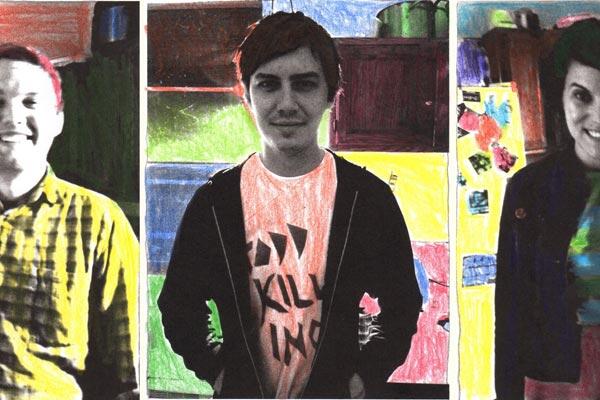
Dinosaur Sanctuary is a Dunedin four- piece made up of Kane Strang, Joshua Hunter, Rassani Tolovaa and Isaac Hickey. Together they make sort of sonic, stoner rock. A kind of Black Sabbath fused with Queens of the Stone Age, plus a dash of Arctic Monkeys.
You can download their album from
dinosaursanctuary.bandcamp.com.

Culture
More Culture from Issue 18
-

New York style soft pretzels
The other Saturday i woke up. Well, i say “woke up” – in reality I was barely conscious and still a bit drunk from the night before. I felt like death. After a few more hours of remaining in the horizontal position, I dragged my tragic ass out of bed, put in my contacts and on some pants and took off to get some food to soak up the previous night’s bad life decisions. (Oh so many bad life decisions.) Now most people seek Maccas in their times of need. Not me – I seek salty and carby goodness in the form of fresh, chewy pretzels. Sitting on the bonnet of my car, in the sunshine with the remnants of last night’s makeup still on my face, munching down on the biggest, saltiest pretzel I can find, can definitely soak up the sins of the night before and wipe my slate clean in time for the afternoon. Making pretzels is so easy. Ok, probably not the easiest when you are finding standing up straight a challenge, but on a normal day-to-day basis, they are a cinch. All you need is simple bread dough ingredients – nothing flash, basically just flour. I recommend you cheat the rising process and warm your oven up to 100 degrees then turn it off, leaving your dough to rise in the residual warm air. Nothing much will happen if you leave your dough to rise on your icy flat kitchen bench. IngredientsMakes 8 pretzels 3 cups plain flour 2 packets of instant yeast 2 teaspoons white sugar 1 teaspoon salt 1 cup warm water 35g softened butter 2 tablespoons baking soda 2 teaspoons sugar a medium sized saucepan with 15cm worth of boiling water in the base 1 egg, beaten rock salt MethodMix together the flour, yeast, sugar and salt. Rub the butter into the dry mix with your fingertips. Pour in the warm water and mix together until it forms dough. Knead on a floured bench for 15 minutes until the dough becomes smooth. Place the dough in a large bowl covered in glad wrap and leave to rise for one to two hours in a warm place until it has doubled in size. Roll the dough into a sausage and slice into eight pieces. Roll each piece into a long sausage about 30cm long. Bring the ends together, twist around each other twice then flip the ends back onto the main loop of the pretzel and secure by pinching the ends with the loop. Preheat the oven to 220 degrees. Dissolve the sugar and baking soda in the boiling water. Boil each pretzel for a minute then leave to drain on a wire rack while you boil the others Once the pretzels are reasonably dry, brush over lightly with the beaten egg and sprinkle with rock salt. Bake for 15 minutes until a golden brown. Enjoy!
-

Michael Parekowhai
Dunedin Public Art Gallery Exhibited until 9 November 2014 Michael Parekowhai (born Porirua, 1968) is one of New Zealand’s most important contemporary artists. Parekowhai acquired his BFA (1990) and his MFA (2000) from Elam School of Fine Arts, University of Auckland. In 2001 Michael was awarded an Arts Foundation of New Zealand Laureate and since then, while still exhibiting, Parekowhai has been an Associate Professor in Fine Arts at the University of Auckland. His exhibition history spans almost two decades. Creating a broad range of work across a range of media, including sculpture, installation and photography, Parekowhai’s work plays with space and theme in a quirky, subtle and humorous, yet still challenging, manner. I have been a fan of Parekowhai’s work since I first saw the images of his two inflatable bunnies (Jim McMurty and Cosmo) in New Zealand art collectors Jim and Mary Barr’s book, Reboot, which is a reflective compilation of their personal collection from a range of renowned contemporary New Zealand artists. I purchased my copy for only $20 at the DPAG, and I really rate it as a simple, but significant, art read. Initially the bunnies were designed for the three- month-long 2002 Scape: Art and Industry Urban Arts Biennial, where Parekowhai suggested that he turn Cathedral Square in Christchurch into a playground for the bunny and its partner (Cosmo) – but the proposal was ill-fated, as was the consent process, so it took a little longer and they never quite made it into Cathedral Square. However, Jim McMurty and Cosmo have been well travelled-since, and now in 2014, the bunnies have been exhibited in places as far as Korea, Canada and Lithuania. Now, finally, Jim McMurty is here at the Dunedin Public Art Gallery – just filling space snoozing and looking cute. I am thrilled to have been able to see Jim McMurty in real life. The inflatable Jim McMurty is characteristically large in scale, and sprawls itself flat on its back across the gallery floor, at 12 metres long and 4.5 metres wide. With limp whiskers and a bushy tail, one eye is closed, and the tongue hangs lifelessly out one side of its mouth, as if stars should be circling the rabbit’s head. Aesthetically, the piece is comical and cartoonish and it reminds me of Bugs Bunny or Peter Rabbit. In a word, it’s quite charming. Even its size isn’t uncomfortably confrontational, demonstrating how Parekowhai cleverly maintains subtlety with what I would call super-scale objects, as a real life bunny would probably be smaller than Jim McMurty tongue. There has been controversy surrounding the significance of the bunny/bunnies, with people questioning: What does it represent? What does it mean? How is it art? But for me, that is the whole point of it. It shows that art cannot be defined by one set of rules or expectations. The bunny for one person is cute and childish and adorable, and for another it is a weird oversize representation of a colossal pest. For some it is a symbol of colonialism, and for others, a mere mascot of popular culture. I was talking to someone who was at the Dunedin Public Art Gallery who shared the same passionate interest in Parekowhai as I do, and they mentioned they had encountered a visitor who had viewed the piece and didn’t “get it” because it “didn’t look like art at all.” The mere fact that the piece exists as an aesthetic object in a gallery I think is what constitutes it as “art” for the general public, but on a more profound artistic level, it is important to understand when looking at art (particularly Jim McMurty), that the object is not confined by any (nonexistent) “rules” or any specific identity, or any specific anything, for that matter – it merely exists as an open possibility of meaning. Walter Pater (my favourite aesthetic theorist) once wrote that what makes it art is that some mood of passion or insight or intellectual excitement becomes irresistibly real and attractive and fun for us for only that moment when we look at the object; and that’s why I like Parekowhai’s bunny so damn much. It brings together memories of childhood, moods of creative impulse, and little moments of intellectual reflection. The second version of the bunny, Cosmo (not on display) is part of the National Gallery of Victoria Collection and that’s my next Parekowhai stop. On loan for an extended duration, the bunny will be resting in the DPAG for a while longer, and it shouldn’t be left unseen.
-
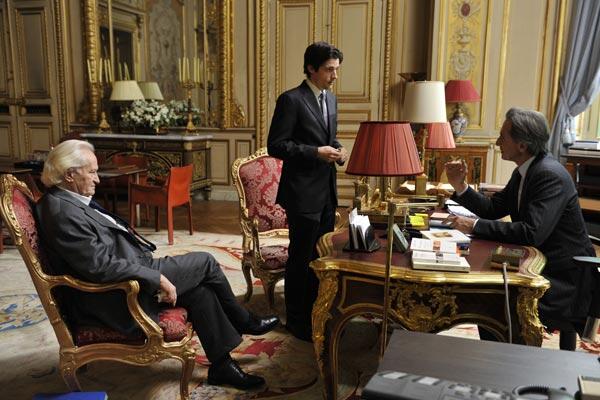
Quai D'Orsay (The French Minister)
Rating: A- The French Minster joins other works such as the US TV show Veep that have clearly taken their inspiration from the popular UKTV series The Thick of It. These shows and films all portray important government figures through a satirical lens, which simultaneously undermines many democratic practices while also highlighting their importance to our modern world. The French Minister follows a young bureaucrat, Arthur, as he becomes the speechwriter for the right wing Foreign Affairs Minister of France. However, very quickly the film becomes less about Arthur and more about the inner workings of this government body and the emergencies that they must deal with. Though this may sound dry, the satirical perspective makes the performances superbly engaging, and often hilarious. Despite The French Minister’s similarities to other works, the French culture keeps the film feeling fresh. The jokes and performances have the arrogant wit and snap that the French are famous for, and the direction has a camp quality that is wholly unique. In almost every way The French Minister is just as successful in its execution as Veep and The Thick of It. The trouble is that the movie is too much like its inspirations, in that it is structured and often feels like three episodes of a satirical TV show put together and published as a film. I found myself wishing that it was a TV show, so that the characters had a whole season to breathe and develop, instead of being jammed into a two-hour film where they could never be as fully realised. The movie also had a structure-less quality, constantly moving from one emergency to another, which would have been far more successful in the TV format. I walked away from The French Minister feeling unsatisfied, not because the film was bad, but on the contrary, because I wanted to spend more time with it. In this generation where TV is quickly becoming as respected as film, creators need to think carefully about what medium their story would do best in. I think Tavernier simply picked wrong.
-
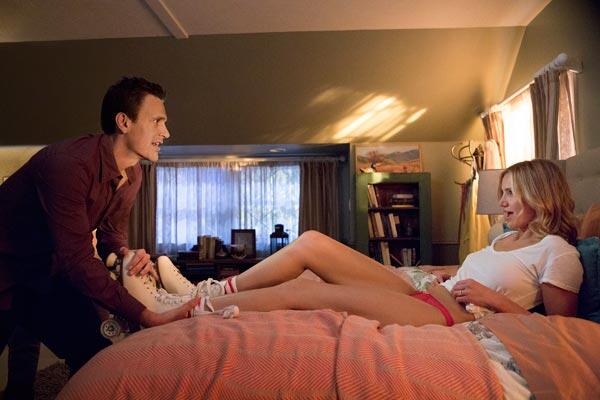
Sex Tape
Rating: C+ I have never come so close to walking out of a movie as I did in Sex Tape. A likable cast and an interesting premise were enticing enough to attend, but after sitting through an hour of the blandest humour imaginable, I just about lost it. Jason Segel and Cameron Diaz play a bored married couple that, in order to rekindle their sex life, decide to get sloshed and make a sex tape which they film on an iPad. They soon realise that their sinful smut has been uploaded onto the cloud that is attached to several other pre-owned iPads they have handed out to their friends and colleagues who can now view the video. And so begins a quest of dumb proportions to retrieve the iPads. Jason Segel, whom I normally love, really did not have enough room to stretch his wings, which I blame on a poorly written script. Almost every joke falls flat, and the few laughs you do get are from a small number of funny scenes that are few and far between. But even those are drawn out and milked dry until you are begging for the story to progress. The most memorable scene was with Jack Black as the owner of YouPorn, but even his unique brand of comedy didn’t bring about much more than a chuckle. Possibly the most impressive thing about this film was Jason Segel’s weight loss; he’s no longer the funny chubby guy from Forgetting Sarah Marshall and he looks not too far from what you could expect the husband of Cameron Diaz to look like. Some may be pleased to know that Cameron Diaz has a decidedly large amount of flesh on display, but side boobs and butts just don’t cut the metaphorical cheese of humour for anyone over the age of 12. Also, at the start of the film they were panicking because the mailman has one of the iPads, but then they never retouched that plot thread. Whoever wrote the film may need a holiday.
-
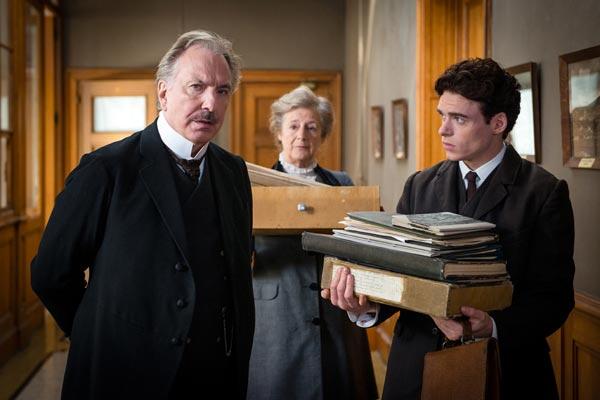
A Promise
Rating: B+ Have you ever had one of those love affairs that was spine-tinglingly perfect in every way – except, perhaps, for that tiny, insignificant detail, that one of you is not technically “available?” Maybe the other person was married to your boss? Then has Patrice Leconte got a film for you! A Promise is a romantic drama based on the novel Journey into the Past by Stefan Zweig. Set in the 1910s, it features a wealthy German industrial tycoon (Alan Rickman, total man-crush, obviously) training his brilliant protégé, Friedrich (Richard Madden; you know him as Robb Stark), without realising that the young lad has been coveting his wife, Charlotte (Rebecca Hall). The film proceeds in the manner of the worst TV soap opera love triangles, with contrived situations partnered with banal dialogue, intended to throw the characters into as many precarious positions as possible in the running time. Frankly, I wished the characters would all, please, shut up. Just shut up. Shut. Up. It was simply awful to listen to. The characters worked in the book, but did not translate well onto screen. The dialogue was also all in British English, which is notably strange as the story takes place entirely in Germany. The price one pays when one uses English-speaking actors, one supposes. With these two distracting dialogue frustrations painfully gnawing at me, I almost missed the absolutely spectacular part of the experience: the images on the screen. If they had made this film differently, as some kind of opera-esque novelty that had no dialogue at all, just letting the evocative score, artistic characterisations of the three leads, and exquisite cinematography carry each story point as slowly, delightfully, artfully, lustfully, and effectively as the memorable few times we explore Charlotte’s delicate neckline through Friedrich’s lingering gaze, thus revealing the boundless inner world of his desire for her, it could have been something really special. So, in the end, I can recommend you at least get the DVD to play on mute the next time you need to set the mood for your couch date with that special someone.
-

Jacob's Ladder
Cult Film To call Jacob’s Ladder a horror movie would be selling it short. It doesn’t only rely on frightening images, it also gets inside your head. Tim Robbins plays Jacob Singer, a soldier who returns from Vietnam and begins to experience terrifying demonic visions. His girlfriend (Elizabeth Peña) believes he is suffering from post-traumatic stress, but Jacob starts to suspect that he died in Vietnam and is now in hell. The grimy concrete jungle that is New York City (subtext alert) suddenly adopts an even more sinister presence. Jacob starts to move between different realities, and his world becomes unnerving in subtle ways. Like him, we are unsure of what is real. Some of what we see may only be the projection of his mind. This was Robbins’ first leading role, and he’s an ideal casting choice, because he just seems like a regular guy. If the film had cast a brooding, swaggering type of actor with movie-star gravi- tas, it would give the audience some distance. As it is, we are kept all the more invested when it’s a relatable character being inexplicably sucked into a maelstrom of hellish insanity. This is one of those films that keeps the viewer strongly drawn in on both an intellectual and an emotional level. For some viewers, the film’s WTF factor might crowd out everything else, but there’s plenty of subtext in there. It’s a film about life and death; it is also full of biblical allusions. But what I found to be the most engaging thread of the movie was its exploration of what happens when your own mind turns on you. It’s established that Jacob is abnormally intelligent, and his mind may have been kicked into overdrive by an external agent. Some reviewers have noted that the film might be an allegory for schizophrenia; I believe it could be an allegory for mental illness in general. Beyond the tangible experiences like hallucinations, the film captures the feeling of becoming afraid of one’s own mind; not knowing what is real or what to trust. Definitely requires multiple viewings.
-

Cap Bocage
New Caledonia is one of the world’s richest sources of the metal nickel, making it a target for mining companies. In the early ‘70s the Ballande mining group procured much of the New Caledonian indigenous land to begin mining the precious metal. In 2008, mismanagement of mining sites and heavy rain caused a large landslide that dumped hundreds of tons of toxic sludge into the fishing waters of the local Kanak tribe. Jim Marbrook’s documentary Cap Bocage follows the Kanak tribe’s fight to have the Ballande group clean up the spill. That description was a tad dry, right? That was just to give you a taste of what Cap Bocage has to offer, because although the source material is interesting, this film is often overwhelmingly informative rather than entertaining. However, for those prepared for something as dry as a Weetbix, there are a lot of fascinating stories and thematic concepts to analyse. The film naturally delivers many perspectives on concepts such as colonisation and capitalism, as the movie develops into the fight of the indigenous people versus the capitalist giants. The incident itself explores concepts of environmentalism, and investigates the idea of environmental responsibility, as Ballande attempts to argue that Mother Nature will remedy their mistakes. The film primarily follows Florent Eurisouké, the president of the Kanak’s environmental society. Florent is an impressively passionate man, who often appears as David did before Goliath. There were many moments that I thought this film was worth watching just for the fascinating character study that is following this man. Cap Bocage is a heavy documentary that often feels more like a chronicle of the events than an investigation of them; however, interesting characters, locations and thematic concepts still make this a movie worth highlighting in your International Film Festival Guide. Cap BocageM/em> is screening at Rialto Cinemas: 6:15pm Friday 8 August and 3:45pm Saturday 9 August
-
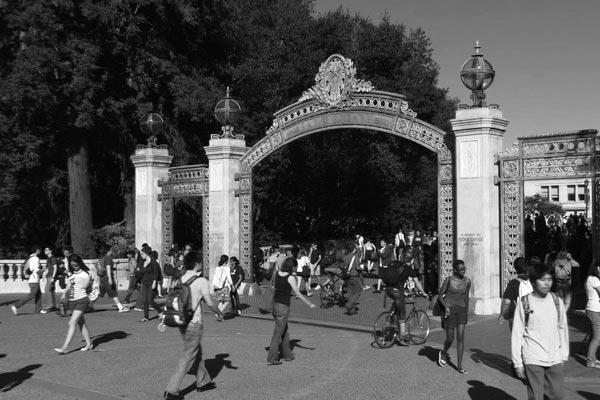
At Berkeley
At Berkeley is an in-depth, atmospheric documentary study of what life is like at the University of California, one of the most prestigious universities in the world today. Any movie that examines a famous academic institution with amazing facilities, scarily intelligent students, and incredible sporting and arts programmes is worth a watch, but At Berkeley adds a new dimension of curiosity by taking place during Berkeley’s financial kerfuffle (to put it lightly). In 2010, the University was hit with a budget crisis that forced them slash job roles and send waves of fear across students already paying monster fees. This is the undercurrent of At Berkeley, but the film is much more than economic panic. At Berkeleytakes on the ambitious task of portraying what life is like not only for students, but for lecturers, academics and administrators. This film is a fascinating watch for us here at Otago because it presents the familiar, but also that which is completely bizarre for our own University. The class discussions are everything from heated, to awkward, to downright offensive, and there’s something painfully familiar about the sympathetic applause given during the amateur theatre performances. Just when you’ve had enough cringing at that which is too close to home, At Berkeley throws something at you that would only happen at one of America’s highest ranking schools: hundred-piece marching bands; footballers running through theatrical smoke to get onto the field; thousands of students protesting, wearing good old-fashioned berets and portable microphones ... It’s all so stereotypical it’s hard to believe it’s real. That’s the beauty of this film: it puts some myths to rest and qualifies others. Frederick Wiseman’s technique to really let the atmosphere of the school sink in is to present very long scenes without narration, giving one the feeling that they are a fly on the wall, or even better, a student in the room. This method is extremely successful but it does come at a price; At Berkeley is over four hours long. So, bring snacks, don’t drink any coffee prior, and sink in to experience what it is truly like At Berkeley. At Berkely is screening at Rialto Cinemas: 1:30pm Thursday 7 August
-

Divinity: Original Sin
Rating: B- There are so many gaming arguments that I am sick to death of hearing about, but more than any other, I am tired of people whining about games not being hard enough anymore. Not because I think it is a completely baseless complaint, but because people don’t understand the difference between something being challenging and difficult. I can absolutely appreciate nostalgia for NES generation games and their challenging platforming, but lo and behold, there are lots of games such as Super Meat Boy being released that satiate that very desire. This means that the people whining are not looking for challenging games, but games that are difficult. My problem with this is that these people, in my experience, are nostalgic for badly designed games, which as kids they trudged through, and now feel like they are “superior” gamers for having managed to complete something not difficult through design, but difficult through poor design. Now, unfortunately due to this perspective, games are being made which have purposefully bad design to attract these nostalgic fools. Divinity: Original Sin is, I’m afraid, one of those games, which is overwhelmingly disappointing to me, considering the potential it has locked behind these faults. The bad design that Divinity emulates, is the directionless story and world design that the market was populated with during the ‘80s and ‘90s. During this time, this was often a ploy implemented to elongate a player’s experience within a world, which was often much smaller than the RPG worlds we enjoy today. Players would aimlessly wander around a world, clicking on every object with the hope of stumbling upon the item or person that would progress the story. Like a terrible blast from the past, this is the way that Divinity plays. The real shame of this is that the story, though in many ways a generic Germanic fantasy RPG, is often unique and engaging in both its story and tone. The game begins with a mundane recycled fantasy trope where there is a magical source and it is your quest to control blah blah blah. However, once you progress through the drudgery, there are quite a few unique quests, including an integral murder mystery in the first town. On top of this, many of the characters have intriguing and engaging personalities and eccentricities that make dialogue fascinating and oftentimes hilarious. Yet, your opportunities to immerse yourself in this world, or enjoy the story, are impeded at every turn by the game’s stubborn insistence of not creating a fluid narrative experience. Now, before you claim that this is just my personal preference, let me illustrate to you why, despite yours or my feelings towards this lack of “hand-holding,” it is inarguably bad design. Take for example an adventure game, where the proffered challenge comes from hunting down clues and items to progress the story. This challenge is contained within an environment, which means that you are always somewhat assured that the answers lay somewhere in front of you. Whereas, in a game such as Divinity, the difficulty comes from dropping clues and progression items throughout a large open world, like dropping a few coins in the ocean during a storm, and expecting gamers to devote disgusting amounts of time trawling just to progress. Then, on top of this, Divinity is purposefully vague and unhelpful in its hints so that you can never feel assured or confident that you are even searching in the right place. This arrogance extends to the combat as well. Divinity boasts one of the most impressive turn-based RPG combat systems that have been created in a long while. Unfortunately, like the story, your ability to enjoy this system is impeded by Larion’s refusal to implement a properly designed progression. The combat combines many factors depending on the class you choose. Fighters obviously use melee weapons, and rangers’ daggers and/or bows. However, it is the magic classes that truly hold the power, due to the impressive and clever elemental design. The elements interact, so that you can cleverly use them to either enhance your previous spell, or disrupt those of your enemy. However, pick the wrong class, or use your skills wrong and several hours in you may find that you have handicapped yourself in the first five minutes due to the developers’ refusal to help you. This is exacerbated further by the fact that the enemies are levelled and it is impossible to know in which direction enemies you will actually have a chance of winning against are in, because the quests do not illustrate levels of difficulty. Divinity could have been an amazing game, but intentionally terrible design choices stopped it from reaching its potential. This stands as a lesson to gamers: think about those things you are nostalgic for and ask yourself if you really want them in your modern games. If you are really honest, 99 per cent of the time the answer should be NO!
-

New this week / Singles in review
Weezer - Back to the Shack Not many bands face such loathing from their own fan base. Since their apparent fall from glory around the new millennium, the group have remained prolific. However, every album seems to breed a sense of, “oh no, you’re just making it worse, guys.” “Back To The Shack” is the first single from the band’s upcoming album, Everything Will Be Alright In The End. It seems to be a trip down nostalgia lane, a band trying to reclaim what they seem to have lost: the magic of their early days, which seems to have slipped away since their initial capture of fame and success. The shack referenced in the title of the song refers to the house where the original members of Weezer once lived and where the band recorded their first demos. “Take me back to the shack, with my Strat with the thunderbolt strap,” Cuomo sings. It’s a good, catchy power-pop track, but trying so hard to be what you used to be is kind of weird. Things change, be the band you are now. But I guess, who am I to say what kind of band they are? Iceage - The Lord's Favorite Iceage is a four-piece punk band from Copenhagen in Denmark. With two full-length records under their belt, including the well received You’re Nothing from 2013, the group return with a new single, “The Lord’s Favorite.” This track, however, is miles away from their visceral, sonically militant sound. It seems the band want to try something new, and have ended up sounding more like The Pogues than The Birthday Party. Taking on issues related to race and gender, Iceage take a long sardonic look at a disturbing part of today’s society, and seem to have a lot of fun doing so. Porches - Townie Blunt Guts Porches are a New York-based project that have been quite prolific over the past few years. “Townie Blunt Guts” is taken from their split with fellow New York band LVL Up, released on cassette by Birdtapes and also available as a name-your-price download on their bandcamp. Combining the swirling, fuzzed out instrumentation of 90’s luminaries such as Built To Spill and the laid back drawl of slacker, alt-country rock. “Townie Blunt Guts” feels like one step in the past and another in a small, quiet, country town. Spoon - Inside Out Britt Daniel and company have been slowly teasing their upcoming album with a slew of singles and videos. They’ve taken their sweet time so far – their previous album Transference having been released four years ago – so I guess it would be hard for them to break the habit now. “Inside Out” is the latest single to be dropped from the Austin, Texas five-piece. It’s a slower paced one, yet the groove is still there. Daniels’ voice is as croony as ever, whining charmingly across a bed of luscious instrumentation. It also includes a sweet harp solo. Avi Buffalo - So What? Avi Buffalo are a group from Long Beach, California, who burst into the hype radar in 2010 with their self-titled debut album back. Predominantly part of the lo-fi, indie-pop trend, which is possibly still happening, the group’s new track “So What?” follows a similar vein, except with a small step up in production. After being silent for almost four years now, the band has announced their sophomore album, At Best Cuckold. “So What?” is a breezy, catchy tune highlighted by a repetitive chorus hook. They are indeed treading familiar ground, but fans should be excited for another great summer record.
-
Radiator Hospital - Torch Song
Rating: A- Radiator hospital is a self-described DIY band based in Philadelphia and centres around the twitchy, heartfelt, pop-punk songwriting of frontman Sam Cook-Parrott. Clocking in at just over 30 minutes, this spry collection of 15 songs is upbeat. Well, you know, as upbeat as any 15 songs about heartbreak and loss could possibly hope to be. At face value it is a joyous record, but it is a joy that stems from the euphoria of acceptance rather than any sort of optimistic upturn in lifestyle. Torch Song often feels like a tired, weary smile, finally beaten out of someone after they’ve spent several months with their soul in a vice. Cook-Parrott, of course, describes it best in a statement released on the band’s website. “This is a record about the relationships you encounter throughout your life. It’s about how sometimes you find the perfect person and the circumstances of your lives keep you apart. It’s about how long and weird and crazy life can be, how sometimes it feels like it never ends and you never learn anything new.” In terms of the overall sound of the record, it has consistent ramshackle aesthetic. Even so, the record is still a warm, effortless listen from start to finish. This is largely due to great sequencing, and a nice variety of blitzkrieg pop-punk, mellow melodic-pop and slower acoustic numbers. The contributions from additional vocalists, Katie and Allison Crutchfield and Maryn Jones from All Dogs, also help keep things from getting too monotonous. Cook-Parrott’s songwriting remains relatively strong throughout. Highlights include: “Cut Your Bangs,” which is an infectious melodic pop tune with a killer chorus; “Fireworks,” which is a heartfelt acoustic tune; and “Honeymoon Phase” is another fast paced, infectious track with great dual vocal work. I’ll finish by telling you one more great thing about Torch Song by Radiator Hospital: it’s available for free download from their Bandcamp page at radiatorhospital.bandcamp.com.
-

Shamir - Northtown EP
Rating: A- Shamir Bailey is a nineteen-year-old musician from Las Vegas, USA. The Northtown EP is his debut release, and it is definitely a promising one. The first thing that becomes immediately apparent is Bailey’s voice. It is silky smooth, and seems to sit at quite a unique register. Almost a falsetto, but not quite. Childlike may be a more apt description. This is combined with an array of almost minimal, lo-fi beats and rough, dirty production. The songs are intrinsically a mixture of soul and pop. One way to describe this record could be a lo-fi Michael Jackson, or a hip-hop Whitney Houston. The EP spans five songs and sits at around 20 minutes. “If It Wasn’t True,” “I Know It’s A Good Thing” and “Sometimes a Man” are the more upbeat, dance floor fillers, with simple but infectious hooks. “I’ll Never Be Able To Love” is a swooping, heartbreaking ballad, which actually kind of steals the show. The final track, “Lived and Died Alone,” takes a detour and features Bailey alone with just an acoustic guitar covering a Lindi Ortega song. Overall, the Northtown EP is as solid an EP as any other. It showcases Bailey’s range, promise and really is just a bunch of good songs.
-

Drowning City
Other reviews i’ve read of Ben Atkins’ first novel Drowning City tended to sound something like: “ZOMG this teenager wrote a book when he was like 17 and then it was published when he was 19 ZOMG and it sounds just like a real person wrote it, this is incredible!” The problem with this is that his age isn’t impressive. At all. Any teenager with a reasonable lack of social life can write a book. And all it takes for a teenager to get a book published is for them to have written an acceptable facsimile of any common genre, since publishers know that they can market it with “ZOMG the infant can spell” and adults will buy it and go, “My word, who knew that teenagers were capable of anything even semi-rational, ZOMG indeed.” And yes, Atkins is a New Zealander, so there seems to be some patriotism going on. But, come on, he lives in Auckland, which we all know is the primary New Zealand way of being a terrible person. Plus his book isn’t set in New Zealand, so his Kiwiosity is all kinds of irrelevant. Drowning City is a hard-boiled noirish crime novel set in LA during prohibition. It’s about, and narrated by, a bootlegger name Fontana. Now, the personality of a first-person narrator can make or break a book. Fontana is a judgemental asshole who thinks he’s better than his fellow criminals, the police, ordinary people, and people who talk. This attitude is unjustified, because Fontana isn’t better than other people; he’s an incredibly self-centred dickhead who can’t shut up. If Fontana is so quiet, (and trust me, he brings up his quietness, and how much he dislikes con- versation, a lot) why the hell is he rabbiting on to me about everything that crosses his mind and every person who crosses his path? There are some qualities a first-person narrator cannot convincingly have. This book is terribly over-written. The first 70 pages are arguably completely unnecessary and seemed to me completely uninteresting. 70 pages in I finally learnt what the conflict was, and about a hundred pages in it got tolerably readable in a “hey, something’s happening I can half-care about” way. That’s a lot of not caring to go through. In the interests of full disclosure and reviewer integrity, I must acknowledge that this book is often praised for its atmospheric atmosphere and evocative setting (the setting evokes where it is set, I assume). I am naturally impervious to both these qualities and have no capacity to evaluate them. I’ll notice if a setting is too wobbly to make the slightest sense, but I don’t care about places or respond to them, and so I’ll only notice a setting if it isn’t doing its job. But apparently Atkins does a fantastic job of making his imaginary LA in the ‘40s seem like a real place, or like the real place, or whatever it is that people who like settings like about settings. Shrug. If you have heard of this mysterious hardboiled genre and want to know what its deal is, then you should pick up some Raymond Chandler. If you want something written by someone genuinely young enough for it to be a talking point, I suggest Axe Cop. If you are already familiar with the hard-boiled genre and/ or crime writing in general, Drowning City is possibly worth a read, or at least an attempt thereof. However, don’t expect to be blown away, unless you’re, like, super awed by the sheer astounding astonishingness of teenagers who can string together whole sentences.


