Greatest Hits / Greatest Shits | Issue 10

from Issue 10 ()
from Issue 10 ()

OUSA’s Dunedin Craft Beer and Food Festival will this year be held on 4 October at Forsyth Barr Stadium and is set “to build on the success of last year’s event,” says OUSA General Manager Darel Hall. However, competing with the event is Matthew Black of Brighton Holdings Ltd, who assisted OUSA in contacting breweries and gaining sponsorship for last year’s festival. Black will be running his own separate event in 2014 after the partnership he believed he had with OUSA came to an end. “The Dunedin Craft Beer Expo” will be held at Dunedin Railway Station on 20 September 2014, two weeks prior to OUSA’s Craft Beer and Food Festival. Falling on the same day as the General Election, Black’s event will also include food, live music and a home-brewing competition. Black says he helped “extensively” to organise OUSA’s entire event last year. “I invested over $50,000 worth of my time towards the event. I worked on it every day for six months.” Hall says Black was primarily responsible for stall sales, where he used his contacts to bring in brewers to the event, whilst OUSA handled production (layout, electrical, sound etc.), communications, marketing, accounting, legal work and health and safety. OUSA put in 1,934 hours of work from the core events and communications team, excluding any hours put towards accounting, legal work and management of the event. 331 volunteer hours were also used and Hall says it is “mathematically impossible [that] Black put in the same hours as OUSA.” In August 2013, Black attempted to trademark the name “The Dunedin Craft Beer and Food Festival”, one month prior to OUSA’s event of the same name. Hall calls this “an ethically curious approach to business.” At the same time, Brighton Holdings Ltd also claimed a half ownership of OUSA’s event “and threatened legal action to that end.” It can be ascertained from their website that the Craft Beer Expo is using an almost identical business model to that used by OUSA’s Craft Beer and Food Festival last year. Similar promotional wording is also being used, with Hall observing, “It appears that Brighton Holdings Ltd is barely changing the OUSA text from our event.” Photos owned by OUSA have also been used on the Expo’s website “without our agreement.” Black claims that the photos were paid for as part of the event’s budget, “so we both share ownership of the content.” Black claims that talks between him and the OUSA Communications and Events manager formed a verbal agreement that there would be “a 50/50 liability between OUSA and me.” Hall claims the agreement was referring to the budget, not to ownership, and that “as the only authority to make that call [subject to Executive authority], no agreement was made over ownership.” The issue here is a “fundamental misunderstanding” of the difference between the ownership of assets and operating costs, Hall says. “In terms of assets, the OUSA owns offices and has reserves, for example, that allow an operation to take place. The cost of the operation or activity was shared … [But] without OUSA’s assets there is no way the Festival could have gone ahead.” “I tried to trademark the event name after OUSA said they were taking full control,” says Black, referring to a meeting with Hall four weeks prior to the 2013 event, where he discovered OUSA would not be wanting future involvement with him. However, Hall denies making any such statement during the meeting. Black claims he was the sole initiator of the event, but Hall insists OUSA had been in talks concerning a beer festival event before Black came along, and that the OUSA events coordinator had even written a paper called “Beertopia” for her degree. Black says he requested a breakdown of what happened to the 510 tickets OUSA did not charge for, but claims that Hall would not reveal the accounts information. Hall counters that Brighton Holdings “has those numbers anyway because it was a planning document they were a party to,” and, furthermore, they “ended the discussion before this could happen.” The tickets were distributed as part of sponsorships, promotions and media passes, which is standard practice for such an event, and Black received 134 promotional tickets himself. They were therefore not budgeted for and were “irrelevant to the discussion,” Hall says. OUSA were also aware of his attempt to trademark the event name by this point. Black complained that he was not given any account information after the event either, despite his involvement. “I’m just as much in the dark about whether [the festival] made any money or not.” However, Hall had in fact provided Brighton Holdings with full summary numbers following the event, after having a “two inch thick” paper trail prepared for all expenses. “Once BHL started disputing simple costs … I decided that the attempt by the OUSA to claim the $2,500 or so BHL owed the OUSA wasn’t worth the effort to make it a priority.” Hall says “there was never going to be money to be made” and that the event made a loss of about $4,000 last year. In January 2014, Black decided to start organising his own event. He says that despite the “unprofessional” experience he claims to have had with OUSA, “I intend on continuing on with the event in the future.” In an email to the breweries, which was leaked to Critic, Black tells potential stallholders, “You know the space well and set up already” and “last year we had 3500 people attend the event, this year I am hoping for the same.” Implying the event is the same one brewers attended last year, Black says, “I can see why OUSA are annoyed.” He believes they resent the fact Black has built a relationship with the brewers and that he is easily signing them up for his 2014 event. He told Critic “any people I attracted to the event last year should be at my event this year.” Hall says, “OUSA is challenging BHL for claiming they managed our event. BHL are free to have any event they like, they just need to give a fair representation about their involvement with the OUSA.”

Popular Dunedin venue Queens Bar has had its application for an on-licence declined following a hearing before the Dunedin District Licencing Committee on 11 April. The decision concerned applicant Ian Robbins, of Dogtown Limited, who sought a licence after letting his expire at the end of the first twelve months, and who was considered unsuitable to hold a licence by Police, the Medical Officer of Health, and Licencing Inspectors. In a report released from the hearing, the Committee Board heard submissions first from Robbins, then from Fishrider Records’ Ian Henderson. Robbins said that Queens is a music and cultural venue with most of the patrons being musicians and artists of various ages. He said he prided himself on a responsible venue that offered good music and a safe environment. He considered the assessment that he is not suitable and lacked understanding of the Sale and Supply of Alcohol Act 2012 to be wholly inaccurate. He believed he is suitable to hold an alcohol licence, he agrees with the object of the Act and to that end he believes Queens is a place for people to drink and socialise in safety, away from the “maddening crowd in the Octagon.” Henderson, in support of Robbins, said that it would not be good for Dunedin if the venue closed. In a submission from the Police, Sgt Ian Paulin revealed Robbins had let the alcohol licence for Chick’s expire, and that letting such a foundational business document expire would have an impact on his suitability in the future. He considered it “careless” and doing so a second time was “irresponsible.” Sgt Paulin recognised that the venue had not attracted any disorder or issues, but based his objection on Mr Robbins’ poor organisation and inefficiencies. Concern was also expressed regarding the lack of staff, Robbins’ lack of knowledge of the legal definition of intoxication and the lack of low strength alcohol available, according to Martine Cashell-Smith, speaking on behalf of the Medical Officer of Health. The report concluded, “It is expected the overall standard of suitability for the holder of an alcohol licence is higher than that of a manager’s certificate. In this case the applicant does not meet the suitability threshold required.” In declining the application, the Committee were still “mindful of the venue’s value to the music community and Mr Robbins’ ability to run events.” The report indicated Robbins has 10 working days from receiving the decision in which to lodge an appeal to the Alcohol Regulatory and Licensing Authority. Critic’s repeated attempts to reach Robbins and to find out his intentions were unsuccessful.

The University of Otago has spent more than $5.5 million on staff redundancies over the past four years, but has still been ranked as the 13th best place to work in the country. Figures released under the Official Information Act by the University show that 121.88 Full-Time Equivalent (FTE) staff were laid off between 2010 and 2013. Between 2011 and 2013 the number of FTE staff also declined overall, from 3759 to 3754. Critic spoke to Kevin Seales, the Human Resources Director for the University, who said that the redundancies would mean “better outcomes for students” because “change processes are often based on improving the quality of service,” although he noted that “there is sometimes disruption while changes are carried out.” In an interview with the ODT, Mr Seales said that over the past four years there have been three main situations where restructuring has been necessary. “Firstly, when there has been a loss of research funding or a need to reduce costs; secondly, to meet changing business needs; and finally to accommodate the [College of Education] merger.” Tertiary Education Union (TEU) University of Otago organiser Shaun Scott told the ODT that the redundancies would have had a “significant impact” on the University. He also pointed out that many of the staff made redundant would’ve been part time, so the 121.88 FTE staff probably equated to “150 or more” people. He also argued that the overall slight decline of FTE staff at the University was a cause for concern for not just the staff and the Union, but also for Dunedin as a city. According to him, these figures show that Dunedin can’t be as reliant on the University for job growth as it has been in the past. He also noted that the redundancies “can impact on morale” within the University. However, a recent survey by global recruitment agency Randstad has ranked the University as the 13th best workplace in the country, coming second in the education category behind Massey University. Mr Seales said that the University is “very pleased” with the rating. “At the University of Otago we strive to provide an environment where people can have fulfilling and successful careers”. He also noted that an area of focus for the University is supporting staff with families, referencing the fact that the University offers “generous paid parental leave conditions” and the development of a new childcare centre opposite Selwyn College on Castle Street, which is due to open this month.

The IT industry’s innovative ways have now extended to their recruitment process with one company offering to pay a flat’s power bill when applying for a role within their company. Datacom Systems Limited has been coming to the University’s career expos for around eight years now, but last year changed the stakes with their “Powered by Datacom,” which pays the winner’s power bill over the three coldest winter months. The “Powered by Datacom” promotion links in with the Company’s recruitment endeavours and requires applicants be in their final year of study, register their interest at the expo with Datacom, and be majoring in one of the disciplines Datacom are interested in, the list of which includes subjects as diverse as Anthropology and Applied Science, to Geography and Music Technology. Critic spoke with Simon Ferrari, General Manager at Datacom Systems Limited, who said their broad range of interested disciplines “reflects our appetite to think differently and look outside the box. [IT] is more than creating software and measuring stuff, it’s much more diverse.” Ferrari continued that “it’s a vital thing finding new grads,” and the company wanted “Powered by Datacom” to be something that would “reflect the culture of the company as a creative and interesting industry.” He said that the prize “needed to be slow release, it needed to be of high value to students, and it had to be something the whole flat could benefit from.” The “brilliant” idea of taking the literal conclusion of the promotion’s namesake was something Ferrari identified with after having lived in Dunedin and experienced the lack of insulation and frugalities among flatmates in regard to heating. The prize is capped at $350 per month, and Ferrari admitted “one of my fears was people passing out high voltage cables from one flat to another.” Last year’s winner Ella Hutching said that even in a flat of eight girls it was “easy to be excessive and max out the monthly allowance.” She said as a Computer Science student, Datacom was an obvious choice when applying for jobs and the competition was “just a bonus.” She said while an iPad or similar was an appealing prize, she probably would have sold it to pay for the bills anyway. Datacom last year hired over 30 graduates from various disciplines, around 10 of which were Otago Graduates. They will be at the Careers Fair on 6 May, along with numerous other recruiters.
The 2014 OUSA Student Satisfaction Survey has revealed the general sentiment towards OUSA and the services they offer, as well as the general student impression regarding the importance and use of those services. With 1,271 student responses, the survey shows that OUSA continues to please students with 81 per cent of students either satisfied or very satisfied with OUSA. Of the services OUSA offers, Events was the highest-rated service. Critic ranked second in the satisfaction stakes, with Student Job Search and the OUSA Recreation Centre only a tiny margin behind. The Student Support Centre and Campaigns by the Executive ranked behind them. All services experienced increases in satisfaction compared with 2013, bar Critic, which experienced no change. Radio One experienced the greatest increase in satisfaction compared to 2013’s results. The increased use of OUSA’s Student Support Service may be explained through students getting better support, or alternatively may reflect a worsening situation for students, something that OUSA keeps a close eye on. Critic’s use reduced, although it still ranked second overall among services used. Critic responded to feedback suggesting there be fewer issues, saying, “we will put you in the ring with our defenders,” referring to equal numbers of similar comments asking for more. The increased use of Student Job Search may reflect the on-going struggle to find jobs, while the increased use of the Executive’s campaigns could reflect better alignment with broad student concerns. Radio One usage saw them rank fourth among the services, with Radio One rationalising to their opponents that they occupy a “unique space” within the media. A growing importance for Radio One, Student Support and Events was also recorded. The importance of the OUSA Recreation Centre, Student Job Search, Critic and Campaigns by the Executive decreased slightly compared with last year’s results. Some feedback suggested Critic should have less sarcastic comments about student behaviour, and fewer misrepresentations of Otago culture as lad culture. Critic responded by encouraging students “to give Critic another try,” saying “[perpetuating and encouraging old cultural myths] is an area we have self-consciously avoided this year.” Radio One said it “will look to proactively promote other service areas through its broadcast to breed awareness of what the OUSA has to offer to its members.” Looking at the variation between sub-populations, there wasn’t a great degree of change between 2013 and 2014. However, there was an increase in the satisfaction of second year students, perhaps due to the Hyde Street Party, and a reduction in the satisfaction of international students, which is harder to diagnose.
The number of international student enrolments at the University has dropped by 3.7 per cent, according to numbers released at the most recent University Council meeting. The figures reveal a drop to 1191 full-time international students enrolled in the University, down from 2011’s peak at 1664, and marks the third year international numbers have declined. Tertiary Education Minister Steven Joyce expressed concern over the declining figures and said, in light of the Government’s hopes of doubling the value of international education to five billion dollars by 2025, the University is “behind the eight ball,” according to the ODT. Labour’s Tertiary Education spokesman, Grant Robertson, labelled the five billion dollar target as “unrealistic,” and an unreachable aspiration that “sets universities up to fail.” Steven Joyce rejected the comments, stating, “[Robertson] doesn’t know what he’s talking about,” and the Government’s plans to double the value of international education was well thought out. Critic spoke to the University’s Pro-Vice Chancellor (International) Helen Nicholson who said the drop in international enrolments “is related to several factors including the strength of the New Zealand dollar, the cessation of various overseas government-sponsored arrangements, and a decline in international enrolments from New Zealand secondary schools.” However, Nicholson said the University has seen an increase in study abroad students from the US and students from China. Numbers of international postgraduate students also recorded an increase, up 181 from 2008. In 2013, Critic’s request for the cost spent on international marketing and advertising under the Official Information Act was declined, with University Registrar Jan Flood stating that breaking down the costs of advertising overseas would be a “monumental task” due to the “indirect” advertising by way of participation in fairs, giving seminars, visits to partner universities, etc. Pro-Vice Chancellor Nicolson has since indicated that the University “regularly reviews its marketing plan to increase enrolments,” and is “working closely with Education New Zealand, a Crown agency with a primary role in international student recruitment, and the Dunedin City Council’s ‘Study Dunedin.’” She also indicated “[The University] has already taken various initiatives such as the development of new taught masters programmes, changes in the way it manages offers to potential students, and working in partnership with Immigration New Zealand under its Priority Visa Process to facilitate visa processing times.”

On Thursday 1 May, environmental organisation Generation Zero released their first of three comprehensive climate change action reports. Comprising more than forty pages of research and suggestions for policy makers, the report marks the beginning of Generation Zero’s campaign for a Clean Energy Plan. The underlying impetus for action is one familiar to those who’ve followed groups focused on climate change: if the “carbon budget” is exceeded, the future New Zealand faces is dangerous. It is not too late to reform, and it’s important that this reform happens on New Zealand’s own terms. Generation Zero’s National Policy Director Alec Dawson adds to this by saying, “the report also shows why people should care about this. It’s not just about the impacts of climate change, but why taking action in terms of energy generation is doing our fair share.” The report comes quickly after a March 2014 American Association for the Advancement of Science (AAAS) paper and the Intergovernmental Panel on Climate Change’s (IPCC) Fifth Assessment Report, both of which confirm to a degree of near-certainty that “human influence has been the dominant cause of the observed warming since the mid-20th Century.” In scientific terms, this degree of certainty is akin to the certainty of smoking leading to cancer, making it considerably more potent than a possible theory. Generation Zero are quick to explain that a two degrees Celsius rise in temperature is the maximum amount the planet can handle, and also make a distinction important for understanding why they consider a Clean Energy Plan fundamental to a safe future; “it doesn’t really matter when a tonne of carbon is released – only whether it is released.” Generation Zero also covers why investing in clean energy (importantly defined as transport and industry as well as electricity) makes economic sense, dismissing the idea that the free market will effectively direct the transition from fossil fuel dependency. The report argues that waiting until this happens will “risk major economic disruption,” an idea that has been the subject of various present-versus-future cost trajectories within the climate science world. Generation Zero explains that it is important to act before the options run out and before the cost of transition rises astronomically. Switching to clean energy also makes real economic sense in terms of building the infrastructure for a forward-thinking industry and job creation. Building on the rhetoric of the 100 per cent Possible campaign that was launched in 2012, this report makes a case study of Denmark’s clean energy transition to show that with the proper political will, it is achievable to institute the changes required to move beyond fossil fuels. Following this, it presents an impressive number of facts, figures, and aesthetically pleasing graphs. It explains that New Zealand, while doing well in some respects (renewable electricity, for example), fundamentally has its “foot on the wrong pedal.” Alec Dawson argues that “at the moment, we have an ineffective carbon price and our transport spending is locking us into fossil-fuel heavy transport in the future.” The final section of the report is a call to policymakers. What makes Generation Zero impressive is its commitment to pushing for good climate policies irrespective of where issues may be politically charged. As New Zealand catapults towards the election, a youth-led organisation with a vested interest in clean energy and the capacity to analyse various policies exclusive of party origins is very welcome. This report does well to explain that a climate-safe future is not a political hoax, but something that must be secured if NZ is to continue as a prosperous country.
The OUSA Executive meeting held on 29 April was attended by the University’s Vice-Chancellor Professor Harlene Hayne, whose presence may have rendered the Executive slightly less audible than in previous meetings. During her visit she said she didn’t “think we should be afraid to knit the relationship [between OUSA and the University],” and suggested the Executive think of other ways the two parties can support each other. She said there should be no concern about subsequent Vice Chancellors not sharing her views on the relationship, and likened the absurdity of being a VC and not identifying with student life to someone “running a toy company and hating children.” She found common ground with OUSA in regard to the submissions on the governance changes to University Councils and gave her congratulations for another successful Hyde St, saying it is clear the party is now “substantially better than before OUSA got involved.” OUSA’s involvement in this year’s general election was heralded as “fantastic” by the VC, who encouraged the Executive “to go hell for leather on this,” saying that it should be very clear on election night that Otago had participated, demonstrating that “there are more students here than people living in Oamaru.” Ruby was equally enthusiastic given that it was one of her campaign objectives. With the VC’s visit drawing to a close, another guest entered with Danny Fridberg from the Centre for Peace and Conflict Studies having his peer mediation programme for students received with general enthusiasm from the executive. A discussion with Student Support was to be organised to see if the programme would complement the current Student Support service. Nali sent her apologies after finally completing her quarterly report, the original of which only covered part one. While it was almost a month late, the report was received and Ruby advised her to make sure this doesn’t happen again because it “gets a bit awkward.” Minutes from multiple committee meetings were received, during which Nali acknowledged the Welfare Committee are still without a men’s or women’s representative, although the vacancies were soon to be filled. Minutes from the Finance and Expenditure Committee (FEC) revealed Kurt was appointed to the Committee “because he knows shit about finance,” according to Nick. The Executive appointed Laura and Kamil to the Robert Burns & Frances Hodgkins Fellowship Selection Committees, respectively. The meeting ended with a soothing rendition of “Kumbaya” floating in from an adjacent room, and reminded everyone that even a two million dollar upgrade of the Recreation Centre won’t give you soundproof rooms.
A financial report released at the University Council meeting on 8 April has shown that the University of Otago held $1.66 billion in assets at the close of the 2013 financial year, an increase from the $1.63 billion in 2012. The greatest asset, recorded at $1.3 billion, was property, plant and equipment, followed by $852.7 million in buildings and $212.9 million in land. The meeting revealed the University Group has set aside $277 million in financial assets, including cash, short-term deposits & shares, to contribute to their upcoming building program. Said to be worth more than $600 million, the project will begin “later this year and in 2015,” the Director of Financial Services Gavin Logie was recorded as saying at the meeting. Most of the buildings, including a new School of Dentistry, are set to be on the University’s Dunedin campus. Chief Operating Officer John Patrick said at the council meeting, “I think over the next 10 years, the face of this campus is going to change quite dramatically.” He further commented that the build-up of extra money had been a “deliberate strategy” in order to attain the funds for the project. David Lont, University of Otago accounting professor told the ODT “it is pretty remarkable that a university of our size has largely almost always been debt free and that we have been able to finance expansion from our operating budgets.” He added, “it’s a wonderful thing for the city to have a financially strong university, which students from outside want to come to.” Lont attributed the outcome to solid management. The report also showed that the total income of the University in 2013 was $635.9 million, $217 million of which came from Government grants, $97 million of which came from domestic tuition fees, and $44 million of which came from international tuition fees. Vote Education mainly funded the Government grants, and includes funding received from the Government by way of the tertiary education student achievement component, which is based on forecast equivalent full-time student numbers and the funding category values of these EFTS. Last year 18,875 students were enrolled full-time at Otago. The University also holds $20 million in investment income, of which $7.3 million came from interest from bank term deposits. Also of interest was the $590 million attributed to expenditure, of which $194 million was spent on academic salaries and $145 million was spent on general salaries. The University employed 3,754 full-time staff members last year.
First this week, let’s go to the tattooed and violent rugby desk, and didn’t those Highlanders do everyone a solid favour by going to Durban and giving the table-topping Sharks a thrashing? Yes they did, because no one likes to see too big a gap at the top. The boys put in a huge shift on defence, restricting the Sharks to scoring from penalty goals, which must have been so boring for their supporters to watch. At least they got to see some decent attack with the ‘Landers scoring four tries for a rare bonus point win. Number 10 Lima Sopoaga has been kicking the goals and has generally improved, which is encouraging to see as we have been struggling in that position for years. This result was a bit of a surprise and most people (myself included) weren’t holding out much hope for a positive result here. The Stormers are up next on their African adventure and they are rooted to the bottom of the table after only two wins in a difficult start to their campaign. The Highlanders have a good chance to come back from their trip with a bigger than expected haul of points. The Chiefs are having a few problems, while the Hurricanes are experiencing a resurgence. Even the Blues, with a win over the Crusaders and ditching Benji, seem to have gotten back on track. The New Zealand conference is looking very competitive and very hard to predict. I have ranted about this before, but compared to the South Africans – who have four of their five teams in the bottom five while the Sharks are in the lead – I think this points to the fact that New Zealand has its resources and best players spread over their five teams, whereas the other unions seem to be putting all their eggs in one or two baskets. And, yet, South Africa is still moaning about “deserving” a sixth team. Bitch, please ... While all the Super Rugby players are focused on their franchise’s season at the moment, in June the season will break for a few weeks so the All Blacks can play three pointless matches against England, not saying no to beersies, in the Steinlager Series. Over in South Africa the Boks host Wales and Scotland for the equally boozy Castle Lager Series, while Australia play a three-game Castrol Edge Tour against France. Really? I suppose the beer sponsorship makes sense, but what the fuck does motor oil have to do with rugby? I don’t think we are going to take a few whiffs of Castrol before a game ... Seeing that we disrupt the Super Rugby season for these pointless (but lucrative) games, indulge me for a while. I have been wondering for quite a bit, ignoring obvious financial motivations, is there any point to these corporate circle-jerk series and one-off reach-around tests? Looking at the bigger picture, is there a more compelling way to do things that would excite fans and help develop the game? A similar question has been asked by football fans, and UEFA, the administrators of European football, have come up with an interesting alternative to their meaningless international friendly matches with the proposed UEFA Nations League, which is set to start after the 2018 World Cup. The plan, which is still being finalised, would see the 54 member countries of UEFA being divided into four divisions and would have relegation and promotion coming in to play between the divisions as the competition progresses. The games would replace most international friendly matches but will not conflict with qualification for the top tier tournaments like the World Cup and the European Championships. However, there is a chance that the Nations League may eventually offer a second chance to qualify for the European Championship, which is being revamped to a multi-country tournament in 2020 after France hosts in 2016, which will be the first running since the expansion to include 24 teams. Some of the eight extra places could be decided via the Nations League, which adds a further incentive to do well. The initial concept of the UEFA Nations League has been very well received by fans, players and pundits and was unanimously adopted by the 54 UEFA member associations at their 38th UEFA Congress held recently in Turkey. Some people are accusing the Europeans of trying to steal the spotlight from the World Cup, as the Cup will be played less in Europe going forward as FIFA is expanding into new territories, with Russia and Qatar lined up as the next hosts. I think the Nations League is a good idea as it will give the less attractive smaller nations a chance to face some of the top ranked teams that would be otherwise unwilling to schedule a friendly match with them. Also the potential to qualify for other tournaments, and the added element of “promotion/relegation,” will give those smaller teams something to fight for, even if it is not the big prize of being champions or qualifying for the Euros. I am not sure how this could be translated over to rugby but the fact that there is a bigger prize at stake than winning just another random game or series gives more meaning to the games. The poorly named and predictable “(insert bullshit sponsor) Rugby Championship” has failed to live up to the hype in my opinion. Ok, it was a little bit exciting last year, but really the All Blacks have been too dominant, Argentina are rubbish and we have seen the All Blacks play Australia and South Africa millions of times already. We should have included Japan and some Pacific Island nations to really promote the game in the Pacific region, like the Nations League will do for football in Europe. I don’t think the “Who can finish second to the All Blacks” Rugby Championship has evolved into something to rival the exciting Six Nations competition, which remains close and unpredictable with four different winners in the last five years. This year’s tournament saw Ireland winning their 12th title and captain Brian O’Driscoll retiring after racking up a world record 141 international caps, including eight on tour with the British and Irish Lions. An amazing achievement in an amazing career but he still never managed to taste a victory over the All Blacks. Somehow I feel we get the last laugh.

This week Critic would like to welcome the leader of New Zealand’s newest political party to take the stage: Kim Dotcom. I first courted him over Twitter before Easter, and have been in touch with an Internet Party representative ever since. Through a few phone calls and emails, I have been given the impression that the Internet Party Headquarters is a flurry of activity and mysterious events; I was told it was “hard to pin the big man down,” and during the final stages of our correspondence I was told that “something has happened,” and that “I’ll find out soon enough.” You heard it here first, Critic readers: something is happening. In the mean time, have a read of what Kim and the Internet Party have to say. Over the past few years, the National Party has instituted a number of reforms designed to increase student loan debt repayment, and I myself have criticised them for treating students as commodities. Do you see debt repayment as an issue? How would you approach this? The student loan system we have in New Zealand is fatally flawed. Once you are done studying, you are indebted for a very long time with a very large amount. Students are essentially starting out in life with a mortgage hanging over them. Students in New Zealand should receive their education – high quality education – for free. Students entering the workforce will contribute for the rest of their working lives, so education is an investment in the future of the country. Today’s students create tomorrow’s opportunities and the Government must support and encourage that. Students aren’t commodities to be used up and thrown away; students are an asset that must be developed, encouraged and provided with an environment that allows them to flourish. Ensuring education is free to all students is the Internet Party’s top education priority. A few weeks ago, Critic covered student loan policy, e.g. which parties support universal allowances and the like. What sort of policies would you advocate? We’re still developing our full education policy and we want students themselves to tell us what they think needs to be done. After all, students know the issues better than anyone. What we do know for certain is that free education for all is non-negotiable. Almost as serious as what happens to students while they’re in university is what happens to students once they’re out. Are there any specific initiatives you would advocate to help bridge the gap between education and actually getting a job? This highlights another major problem with the current student loan regime. Too many students, after they have completed their studies, leave New Zealand because there aren’t the jobs that pay well enough for them to pay their loans back. We are creating an environment where all of our bright minds are being exported to other countries. That’s something the Internet Party will change. We will make sure our best and brightest, the innovators and entrepreneurs, want to stay in this country because there is opportunity and encouragement. We will deliver more innovation, investment and high-tech jobs to New Zealand by fostering homegrown talent. We will double research and development investment and create an economic environment that encourages and rewards those who have great ideas. How would you pay for the amount of money you’re willing to invest in tertiary education? The Government spends huge amounts of money on things that it shouldn’t. For example, this Government’s NSA spy network costs many millions of dollars to run. The joint military action with the U.S. in the Middle East could have paid for a lot of education. By shutting those things down, there’s money we can direct into much more important and beneficial areas such as education. In addition, we are in favour of a luxury tax to pay for free education. That’s how we can make a difference. If you could describe your approach to student policy in three words, what would they be? Free, smart and high-end. What do you think is the biggest barrier to student political involvement, and how would you change that? Too many students have given up, they don’t think they actually have a voice or can make a difference. They can and will. Our approach to politics is about being innovative, challenging the status quo and being different. Most politicians talk “at” students, not “with” them. It’s like the country’s being run by your parents and you’ve been locked out from having a say. We’ll change that by talking with students and young New Zealanders about things that matter to them and in ways that work for them. The Internet Party is all about the youth and how we can take New Zealand into the future with young and fresh ideas. Our University’s Internet is notoriously shit. Could you fix it? Of course. We are the experts and we know how to fix the problems. After all, we’re the Internet Party … Let’s play a game of “reject, (re)elect, realign,” which is Critic’s parliamentary alternative to “shoot, shag, marry,” whereby you choose one of these MPs to boot from Parliament, one to keep (or elect) in, and one who belongs in a different party: Hone Harawira, Clare Curran, Judith Collins. Reject: Judith Collins Re-elect: Hone Harawira Realign: Clare Curran Would you consider doing a concert at Otago? Re-O Week is coming up … We’ve got a lot of very cool things planned and we’ll keep you posted.
My reasons for joining MANA back in 2011, when I was a fresher, were directly related to my involvement in the International Socialist Organisation (ISO). Thus, the main reason for my support for this party at this particular time is the solid activist basis of its leadership and membership, such as we see in Hone Harawera, John Minto and Sue Bradford; fighting the good fight for the rights of the poor and have-nots in this increasingly unequal country of ours. Summarily, MANA policies such as bringing back the right to strike, immediately raising the minimum wage to $15, and replacing GST, which disproportionately affects those on lower incomes, with a “Hone Heke” financial transaction tax, affecting those on higher incomes, puts MANA to the left of most other so-called “left wing” parties in actually addressing the massive inequities within this society in terms of poverty and unequal wealth distribution. At the end of the day, many people like to pigeonhole Hone as a racist and a loose cannon based on the selective coverage he receives by the media, but fail to ignore the good grass roots activism he and other members have done, such as protesting the forced removal of tenants from state housing, and also their involvement with the Occupy movement. Thus, from these credentials, I get the impression that most of the MANA Party are not about compromise but genuinely sticking up those at the bottom of the heap, and this gives me confidence in them as both a party and activist organisation.
Trevor snaps. Clare retweets her 7 Days lover’s achievements. David handled the response to his ridiculously awkward campaign video with much grace. Fake Hekia working hard.
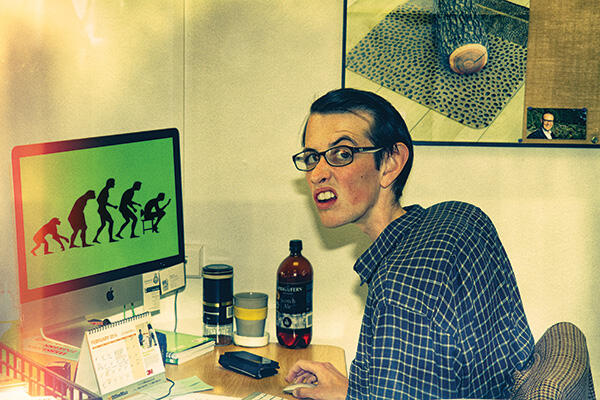
An epidemic is affecting students worldwide; the painful result of our generation being the first to grow up with an endless availability of smart phones, laptops, iPads and gaming consoles. It is the “iHunch.” The iHunch can result in permanent curvature of the spine and is the underlying problem of most neck and back issues and up to 50 per cent of headaches. Critic spoke to Steve August, Physiotherapist and inventor of the Backpod, a tool developed in Otago to help release the frozen hinges of the spine which cause the growing hunch. “We have never had such a group of hunched young people since before people walked out of Africa 60,000 years ago. Not ever.” He explains that the screens of the electronic devices we are consistently using cannot be separated from the keyboard, so students are forced to bend over at the upper back in order to use them, unlike desktop computers which can be set up to be reasonably ergonomically safe. August believes the University of Otago library computers are still not set up correctly for anyone above average height. “The stand-up desks can help but the library computers still aren’t up at eye level.” The screen of your computer should be in front of your eyes and the keyboard should be in front of your forearms, “but there is still going to be a problem if students then go home to play games on the laptop.” Ideally the point of the shoulder should be vertically aligned with the earlobe, but he says students are walking around with the back of their head in front of their chest. The iHunch is known as a Dowager’s Hump in people in their seventies and eighties, but health professionals are now seeing it in students. “They physically can’t straighten themselves upright because the hinges are frozen.” The hump is “not an aging thing” despite the fact it is common at the end of life. Instead, it is a cumulative effect of bending forward for long periods of time without any counter treatment. There are currently 600,000 people with acute pain in the upper back or neck in New Zealand “and tertiary students will be a huge proportion of these.” Although not all students will feel any pain to begin with, if they are already showing symptoms, “it’ll only get worse and it’s not something that goes away on its own.” August explains the reason for the iHunch and how it has developed. The human body is supposed to be upright, however, from school age onwards, we start bending forward from the upper back and when it bends too often “it is strained like a tree in a high wind and will rapidly freeze like that.” The issue often begins during adolescence and has certainly developed by the early twenties. “This is when people start coming to me with problems.” As students get older, the compression will cause additional wear on the joints. Once you have an initial hunch from leaning over too much, it becomes more of an effort to lift your head up straight; you have to overuse the muscles at the back of your head and neck about eight times more than you are supposed to. This means it is a strain against the hunch just to look straight ahead and scar tissue is formed as a result of repairing this strain. As these scarred, shortened and tight muscles get stronger, the muscles around the front of the neck (which hold your chin in) get weaker because the back muscles are now doing all the work. This causes the chin to poke out and the lower neck to be overused resulting in a “swan neck.” By this point, most of the hinges are compressed and will readily jam and freeze. “That’s when people will go to the clinic and can barely move their head along with headaches and sometimes referred pain down the arms.” This is when the hinges have to be cracked free. “The manipulation is like hitting a rusty hinge with a hammer. The cracking breaks the rust sealant and it frees up the hinge.” This is just a temporary result because the collagen, which will still be tight, will just freeze up again and “people end up revisiting the chiropractor every other week.” He says the underlying issue must be addressed and multiple on-going treatment methods are needed, including strength exercises, posture work, massage and stretching of the spine using a form of leverage. He believes most health professionals are so specialised that when a patient mentions the issue, they only address it with one technique, such as massage or strength training or manipulation, “all of which are correct but one method will never be enough.” He says it is essential that students start looking after themselves now rather than wait until the problem becomes irreversible. “Students go by the philosophy that nothing can hurt me until something really does.” Dr Jenny Ogilvie, GP at Student Health, agrees that students are waiting too long to address the problem. “By the time they see us, it has become a chronic condition.” She explains that the students get into a state of constant headaches followed by a cycle of painkillers that evolves into a “snowball of stress, worry and tension and difficulty keeping up with studies.” She says that many students visit Student Health with headaches believing they have migraines, but usually it is a tension headache resulting from incorrect posture. The symptoms of tension headaches vary but are usually felt behind the eyes, feel “tight and intense” and come with a feeling of tightness around the neck. Ogilvie says, “You can see the slouch when they walk in and sometimes the hump in their neck is already visible.” She says it develops from an initial slouch where it becomes uncomfortable to sit up straight and then it gets to the point where you physically can’t sit up straight. Student Health refers these students to the physiotherapy clinic where they are running a headache clinic. Stuart Horton, Physiotherapist at the University of Otago’s School of Physiotherapy, sees “a lot of students a lot of the time” with the problem and believes it comes down to whether students control their posture whilst working with their various devices. Students often have the issue developing for at least a couple of years before they decide to do anything about it. The main method of prevention is that when students are using electronic devices and laptops, they should “just be really aware of your posture” and keep moving regularly. Once the spine is tight enough, an external force has to be used on the spine to give people enough leverage to stretch the tough collagen. August describes the Backpod as a cushioned fulcrum or “high tech version of a tightly packed wheatbag,” which he encourages clients to stretch over most days a week until their spine loosens up. Users can tell how tight their spine is by lying back on the pod or something similar; “if the hinges are free, then it is actually not painful at all.” August believes massage is excellent in loosening up the scarring, but if you have not got the support strength, or the hinges are still jammed, then the problem will not be fixed. He explains that people need enough strength between their shoulder blades so as not to collapse forward. He wants students to be giving their flatmates regular massages using the techniques he has provided on his website. Enhancing flexibility by taking classes such as yoga, for example, is good for you as it stretches the hinges. However, while the loose hinges will move, the tight frozen ones will remain tight. A really tight spine still needs leverage to stretch over. He says the foam rollers used in yoga are the closest thing to Backpod but cannot give the same stability nor do they stretch the ribs, “which are often part of the problem.” August notes that there is a gender difference socially on what they will do to look after themselves. “Guys will generally tend to put up with more, which I think is dumb.” Dr Ogilvie agrees that girls tend to be more proactive with addressing the problem. “I often recommend Pilates classes, but boys just can’t be bothered with it.” Posture has psychological implications, too. “If you see somebody with perfect posture, they stand out these days,” August says. He explains that a perfect posture is attractive but impossible to achieve if you can’t move the hinges properly. A study at Northwestern University, Illinois revealed that posture may in fact have more of an effect than job title on how people perceive themselves and how others treat them. August explains that “the posture implies a psychological attitude which says I count and I am going to go and do things.” On the other hand, “the hunch makes you look smaller and then one reinforces the other.” Those who walk around with their heads held high not only seem to get the respect of others, but they also respect and look after themselves more so, too. If you are experiencing pain from the neck, between the shoulders blades and/or pain tracking around the front of the chest, often along with headaches, then avoid the iHunch by taking action now. Multiple treatments must be used rather than any singular approach, so once you’ve put your shoulders back, check out bodystance.com. It will give you free advice on how to avoid the iHunch and tips on how to give your flatties a great massage.