More Culture from Issue 15
-
Edge of Tomorrow
Rating: A Edge of Tomorrow is one of those films that people will try and describe to you with 100 different similes, and though the film is “like” many different things, the truth is that it combines these factors to create a unique and gripping movie. Edge of Tomorrow, based on the Japanese novel All You Need is Kill, tells the story of a dystopian future in which Europe has been invaded by an alien race. The movie is largely set the night before humankind’s last push against this alien threat on the beaches of Normandy. Major Cage, played by Tom Cruise, is thrown into the battle at the last minute, despite the fact that he has zero combat training. Needless to say, he dies promptly, however his first death triggers an alien event in which every time he dies he wakes up the day before the invasion and must relive the battle. It’s easy to see many of the narratives influences, including WWII itself, and films such as Groundhog Day. I could also see many influences from the gaming industry including strategy platformers such as Super Meat Boy. However, these influences don’t make Edge of Tomorrow feel derivative; in fact the wide variety of these influences make the movie unique in both its narrative and tone. The story is utterly gripping; director Doug Liman did a superb job of avoiding the repetitive nature of the narrative becoming boring by injecting every repeat with a sense of progress and determination. It expertly jumps from emotional, to exhilarating, to hilarious. Edge of Tomorrow was in my opinion a return to form for Tom Cruise. This movie throws away the angsty, brooding Cruise of recent years, and lets him do what he does best: be utterly charming. Forget for a minute that you know how weird he can be in real life, and remember the charming Cruise of Top Gun and Jerry Maguire: that’s the Cruise you are going to get in Edge of Tomorrow. Better yet, Cruise’s aptitude is not only matched but exceeded by Emily Blunt’s performance, who plays one of the most badass female leads since Ripley in Alien.
-
22 Jump Street
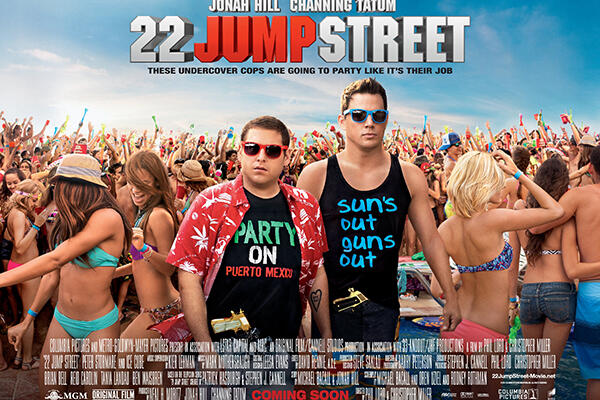
Rating: A Anyone who has ever seen a sequel of almost any comedy movie ever made knows not to expect great things. They are usually a rehash of what worked the first time, though less original and less funny (see The Hangover Part II). What made 22 Jump Street such a great sequel was that directors Phil Lord and Christopher Miller were completely aware they were making a money-grabbing sequel. The story was largely the same as the first film, but a change in setting from high school to college, and a hilariously self-aware script give this film enough originality to be arguably better than the first. Everything I loved about 21 Jump Street is present: the bro-mantic escapades of Jenko and Schmidt (Jonah Hill and Channing Tatum), references, cameos and throwbacks to and from other films, and the hilariously entertaining Captain Dickson (Ice Cube), who has a larger role this time. Jenko and Schmidt are once again sent undercover into a place of education following the arrival of a new drug, “WHYPHY,” and ordered to infiltrate the dealer and find the supplier. Captain Dickson’s advice for the pair is “it’s the same case, do the same thing.” The very clever script comes close to breaking the fourth wall multiple times, especially in the small scene involving Nick Offerman as Deputy Chief Hardy as he explains to the duo that the success of the first undercover operation (film) was a fluke, and now a lot of money has been invested in another attempt at replicating that success in another operation (film). Aside from the heavy self-parodying humour, the film has a lot of heart brought by the real-life/onscreen bro-mance of Tatum and Hill that would make every guy wish they had a bro that tight. Ultimately, this is not only merely a great sequel, but a great movie in its own right. As the directors make evident in the awesome end-credits sequence, the Jump Street gold mine has well and truly been milked dry.
-
What We Do in the Shadows
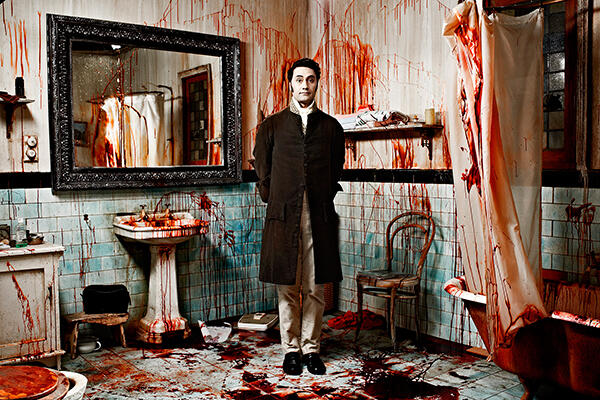
Rating: A It did my heart good to see that Nosferatu hadn’t lost his touch. Vampires have become a staple offering of Hollywood flicks in recent years. I haven’t cared much for the ones that sparkle, the ones that are super-cool and drink blood like they’re shooting heroine, nor for the run-of-the-mill sexy vamp thriller. Luckily, Jemaine Clement and Taika Waititi have seen the tried and tired genre to its logical and hilarious conclusion. Anything that comes after it will (I know, I’m sorry) suck. What We Do in the Shadows follows the lives of four flatmates in a mock-u-mentary style exposé on the secret lives of vampires. Our primary contact is with Viago (Taika Waititi), who is an 18th-Century dandy and the pedantic-but-loving control freak of the flat. Jemaine Clement plays super-sexy Vladislav (I don’t know how to feel about it either), who was known in the Dark Ages as “The Poker.” Deacon (stand-up comedian Jonathan Brugh) is the young rebel, and, of course, Petyr (Ben Fransham), the 8,000-year-old terror in the basement. As it turns out, Petyr is the vampire in almost every early art work that features vampy apparitions. That’s one of the things that these Kiwi directors did to make this film so fantastic: working images of their cast into a wide array of classical art, giving the whole film an air of seamless credibility. The montages are hilarious and convincing. Their use of budget was exceptional; the concepts were wildly entertaining and original, while still managing to poke fun at the genre tropes; and the whole affair is indulgently Kiwi. I laughed hard, and so did everyone else. Bloody good time.
-
Transformers: Age of Extinction
Rating: F Since 2007, the Transformers franchise has gotten progressively more offensive in every way: offensive to your senses, offensive to your sensibilities, and offensive to your intelligence. Transformers: Age of Extinction is the culmination of those cinematic sins; making it one of the worst films I have ever seen. Let’s start with the script. It jumps back and forth between a lazy attempt at a plot, which really just acts as a platform for Bay-style action-carnage, and what I struggle to describe as “dialogue.” Never in all my life have I heard such hackneyed dialogue and character development. Characters constantly spout painfully clichéd exposition and vomit-inducing attempts at playful humour in equal measure. This is made even worse by the fact that there doesn’t exist a likeable character in the whole movie, and when one does start to be vaguely likeable they are quickly killed-off. Although, calling the cardboard cut-out clichés of this movie “characters” is probably a bit of a stretch in itself. To make matters even worse, all of this is coated with an utterly disgusting and totally unabashed level of sexism and racism that sticks to every moment. If you can make it through the sections where characters talk at each other to no effect, then you will be treated to some action that only Bay could think was appropriate in its intensity and scale. To be fair, the first five minutes of this action is certainly entertaining, but it never stops, and after three hours you’ll want to tear your eyes out rather than endure one more barrage of explosions. And that’s all you’ll get. For three hours, like the worst game of ping-pong there’s ever been, the movie volleys from the worst characters and dialogue there has ever been, to the most gratuitous and unnecessary level of action there has ever been allowed. Transformers: Age of Extinction boasts some amazing talent, including Kelsey Grammer, TJ Miller, Stanley Tucci and John Goodman. But even these great actors could not polish the sloppiest turd that Hollywood has ever shat out. I would happily bleach my eyes if it could rid me of my time with this monstrosity. All I can do is warn you not to waste your time, money, and brain cells on what is hopefully the worst movie of this year, and possibly the worst movie ever created.
-
Suji Park - Anu
Brett McDowell Gallery Exhibited until 16 July 2014 My introduction to Suji Park’s work was serendipity, and I’ve been emotionally involved with her sculptures (and photography) ever since. I was in my friend’s apartment and he had his recently purchased Park positioned on a table in the corner. Naturally I had assumed that he had just got inspired one night and decided to elaborately embellish a rock – completely naïve to the fact that the object I had spent the past hour getting lost in, was in fact a Suji Park sculpture. It wasn’t until I picked it up off its perch and waved it round in the air, exclaiming my love for it (in all its cosmic-looking glittery glory), that I was made aware of its actual artistic significance. Shocked and mortified, my friend responded to my intrigue (in hindsight – stupidity): “Hannah, put the $4,000 art work down!” Suji Park is a contemporary artist, of Korean descent, based in Auckland. Since graduating from the Elam School of Fine Arts at the University of Auckland in 2010, her unique practice has quickly gained notable recognition throughout New Zealand. Park is repeatedly concerned with nature and form. Her engagement with her work and material takes an approach that involves the “recovery, analysis and reconstitution” of her own material, allowing for her work to naturally progress both thematically and practically. Anu is Suji Park’s third exhibition at Brett McDowell Gallery, and is a further progression from her previous exhibitions, with the inclusion of disfigured human forms made out of fired-clay and metallic glazing; aluminium powder; pigment; and other reconstituted materials. But, in this exhibition, her characteristically animalistic/figure works are accompanied by simpler, less constructed full vessel forms and abstract pieces. “Vessel” I, II, III and IV, which, although they appear to look like fired clay, are actually beaten bronze, steel, aluminium and brass, give the deceptively similar effect of fired-clay, displaying Park’s clever and effective creative capability. Each of the works are arranged in the gallery in a typically Park exhibition manner – spatially separate from one another, standing singularly on varied, in height and colour, plinths, facilitating an uninterrupted, fully immersive visual deconstruction of each of the nine pieces on display. The first piece in the exhibition is mother of pearl magic; a vessel of white acrylic on fired clay, embellished with clear, clouded quartz crystals standing on a pure white plinth, and it is simply stunning. The piece appropriately sets the viewer up for the progression of the more detailed pieces where Park introduces colour and a wider range of materials, as seen in works such as “Vessel With Eight Rings,” “Yua,” and “Hu,” which are fired-clay constructions, aesthetically enhanced by numerous materials that include graphite, tempera and gold leaf. Also detailed with geometric and pigmented patterns (literally looks like real-life stardust) and finished with metallic glazing, the pieces appear to be a refined amalgamation of her previous, and present ideas. “Yua” and “Hu” in particular, exemplify the artist’s interest in the regeneration and remaking of work, as each piece displays characteristics of both animal and human forms as seen in previous exhibitions, through the rendering of human faces and animal features, which force and stretch themselves out of various parts of each object – creating an almost disturbing, but nonetheless fascinating result. “Anu” is my favourite piece in the exhibition. It radically differs from the others in form, material, and construction. It dramatically combines various medias, including fired and unfired clay that is embellished with gold leaf, tempera, garnet, pigment and mica epoxy and is all embedded in a resin, plastic and Perspex cube, with some obscure cylinder shapes arranged and attached to the top. Confusing and characteristically complex, the piece (in my opinion) is the most enigmatic and interesting to observe. It’s like looking into space from a telescope – there are so many areas of colour, texture and structure, in which the more you look, the more you discover. Each piece seemingly provides refuge from the anxiety and uncertainty of the things we don’t know in the real world; and Park’s exceptionally close attention to detail fosters a sense of nostalgia and wonder, as well as addressing the lingering possibility of something more concrete, such as the satisfying sense of discovery through an inevitably trapped gaze. On show for another week, this exhibition is not to be missed.
-
Sniper Elite 3
Rating: B I’m not a sociopath (I swear) but there is something truly satisfying in games about achieving a stunningly executed headshot. I’m not sure what exactly it is, perhaps the skill involved in lining it up and timing the shot perfectly, or maybe more disturbingly, it’s the clear feedback of that sickening squelch and the consequent rain of blood and viscera that only a headshot can offer. Regardless of the reason, I bloody love a good headshot. So it is unsurprising that given the choice, I tend to lean towards more precision weapons when playing first person shooters. For this reason, I have always loved the idea of a sniper game, where theoretically I could have a whole game of only headshots. It’s a great idea in theory, but I’ve never played a sniper game that has ever lived up to my fantasy. Thankfully, Sniper Elite 3 is the closest a developer has ever come to making my dreams a reality. The three Sniper Elite titles are without a doubt the best sniper-focused games available. All take place within WWII and introduce players to a different front of the war. Sniper Elite 3 takes place in Northern Africa and tells the story of the Allies and Axis struggle for control over the supply routes that run through there. Like all of the instalments in the series, Sniper Elite 3 has a firm grasp on the history of the war and the events that occurred within any given region and focuses on telling a story that outlines the important factors of that struggle. Unfortunately, this gives the games an almost academic feel, like it is letting you play through events just as you would read them from a history book. This means that you are guaranteed to get a better understanding of the events, important figures and locations, but removes any sense of emotion or character from the story. Being an advocate of character and rich story development in games I found this disappointing, however it was a clear design choice made by the developers and I appreciate that they chose an angle and committed to it, instead of creating half-hearted characters and emotions as some games do. Without the pull of an evocative story, the hook of the game relies on its gameplay. Generally, the gameplay of Sniper Elite 3 is very middle-of-the-road third person shooting. Moving around the map often feels clunky and while scoped your character will often inch forward without your direction, occasionally causing you to walk right off of a cliff. However, despite how unpolished the movement and smaller arms weapons can feel, the actual sniping mostly makes up for those failings. This is mainly due to Sniper Elite’s greatest feature: the bullet cam. If you line up a shot right, upon pulling the trigger time slows and the camera begins to follow the bullet from the barrel of your gun and into your target. However, just as your bullet enters, the camera changes to an X-Ray that shows the trajectory of the bullet through them and the subsequent gnarly damage it causes. It is a horrendously macabre feature that is truly addictive. No doubt, it will make you feel uncomfortably exhilarated each time the camera jumps from your scope to the bullet cam. If it were up to me all I would ever do in this game is snipe, hopefully resulting in an infinite number of these bullet cam moments. Unfortunately, the developers seemed to disagree with me by making it particularly hard to actually perform the objective the game promises: sniping. Bad level design, ridiculously stupid A.I and poorly executed mechanics culminate, making it difficult to ever just ease into a spot on the map and pick off your enemies. Granted, this could lead to a very low difficulty, but as the game stands now the trade off between difficulty and frustration is just too high. It seems a little unfair to design a phenomenally awesome gameplay feature like the bullet cam, and then design a million obstacles between you and your ability to enjoy that feature. My dream of playing a truly engaging Sniper game has not been satiated by Sniper Elite 3, but that doesn’t mean that I didn’t enjoy their attempt. If you can overlook the clunky mechanics and the lack of story, those moments situated on a hilltop, picking off Nazis with an X-Ray, are more than worth your time and money.
-
New this week / Singles in review
Spoon - Do You It’s been four years since their last album, Transference, and Spoon are finally making a return. “Do You” is the second single from their upcoming album titled They Want My Soul. An upbeat, summery track, “Do You” finds Spoon retracing familiar ground, but a kind of familiarity we have missed for some time. “Someone get popsicles, someone do something ‘bout this heat.” It’s still freezing, so it may be a few months before we can fully appreciate this track. Ariana Grande - Break Free “Break Free” is the second single from Ariana Grande’s forthcoming album My Everything. The one-time Nickelodeon actress has had a relatively smooth transition into mainstream pop and so far is doing well to cement her place there. Produced by Zedd, who is renowned for his blitzy synth work, this track definitely lives up to that reputation. At its core it’s another song about breaking free and being strong, the kind of song every popstar has to have in their arsenal to captivate the downtrodden youth. Hundred Waters - Murmurs Hundred Waters are a band from Gainesville, Florida and the first to sign to Skrillex’s OWSLA label. “Murmurs” is taken from the band’s second album titled The Moon Rang Like a Bell. The track is immersive, dreamy and subtle. Loops comprised of interesting sounds flowing into, over, one another, creating a ethereal atmosphere. Jessie Ware - Tough Love British musician Jessie Ware made her breakthrough in 2012 with her album Devotion, featuring hit singles such as “Wildest Moments” and “Sweet Talk.” “Tough Love” is her first single of 2014, and a lot of what made her debut so special is back in the mix. Her voice is as soulful as ever, the song is melodic and sweet, yet contemporary. The production is subtle and aromatic, layering soft beats and glowing synths.
-
Artist Profile: Glass Owls
Glass Owls are an alternative pop act from Auckland centered around the songwriting talents of Anthony Metcalf and Tomas Nelson. Having just released their debut album, Out From The Darkness, Adrian Ng caught up with guitarist Anthony Metcalf. Did you come from a musical background? What initially sparked your interest? Not particularly … my grandfather was quite an accomplished musician who wrote and arranged music in a big band type situation in the ‘40s. From memory he played sax and keys. My dad’s favourite bands are Foreigner and The Bee Gees. My first “fuck yes” moment was age 14, hearing Karma Police for the first time. When did you and Tomas meet and decide to form a band together? What kind of sounds did the two of you bond over? Tomas and I have been playing music together for a number of years in various incarnations. We started mainly in competition with our friends Artisan Guns. We bonded over a love for The Doors, Split Enz and the Tin Pan Alley style music of the ‘50s and ‘60s. What inspired the title of your album, Out From The Darkness? Out From The Darkness comes from the title track, which is basically about dying, and everything being okay. Or at least everything you left behind. It’s meant to be an ode to worldly problems, keeping things in perspective when it feels like there’s nowhere else to turn. It’s a theme which permeates a number of the tracks on the record so we decided it was a fitting title. Has there been much of a change between your first EP and your debut album? Quite a bit, yes. Our EP was a collection of our best tracks at the time, pretty standard release for a new band. It was recorded by Dave Parker in his bedroom studio in Oratia. Dave was great for us starting out, as we weren’t really sure what we wanted to do; he essentially gave us a sound. We tried to do something different with the record. We recorded at Revolver Studios in Waiuku with Djeisan Suskov, after a year of demoing and rearranging songs. We definitely had a stronger sense of how we wanted the record to sound and feel. The emphasis of recording was on live performance, so it felt like a band in a room - albeit going through some of the best microphones in the world. What is your songwriting process like? Usually either Tomas or myself will write lyrics and skeleton chords to a song and take it to the other half and/or band practice to flesh out. We don’t really collaborate on lyrics as we like to have different voices coming through on individual tracks. Then, once we’re happy we’ll take it to the demo stage and keep refining the song live. Have you guys played Dunedin before? We haven’t played Dunedin yet but are very keen to come down in the next few months. There’s some amazing stuff coming out of Dunedin at the moment (Males, Trick Mammoth, Kane Strang, Gasp) and we have heard great things about the crowds down there.
-
Parquet Courts - Sunbathing Animal
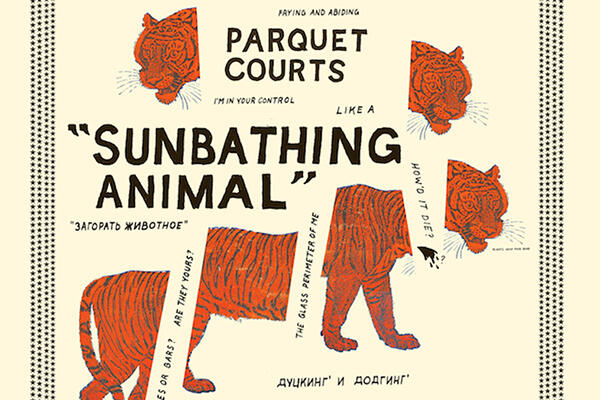
Rating: A Captivated by the wild blur that is Parquet Courts’ second album Light Up Gold, an initial listen of Sunbathing Animal may throw you off guard. While the album’s opening song, “Bodies,” in tone and yelping vocal style, hints at their previous album, preceding songs show definite stylistic shifts. “She’s Rollin’,” for example, descends into chaotic harmonica and “Instant Disassembly” falls into seven minutes of slow, heart-broken delusion. But what further listens reveal is exciting growth. Sunbathing Animal is serious, it’s smart and it endlessly provides. Formed in 2010, Parquet Courts consists of Andrew Savage (vocals, guitar), Austin Brown (vocals, guitar), Sean Yeaton (bass), and Max Savage (drums). The Brooklyn band’s first album, American Specialities, was released in 2011 on a limited cassette run. But it was Light Up Gold, released the following year in 2012, that really got things moving for the band. Recorded over several sessions in 2013 and released this year, Sunbathing Animal is the product of considered and gradual songwriting and producing. My first exposure to Parquet Courts was at Laneway earlier this year. My friend had spent the morning briefing me on them - his enthusiasm was infectious and proved completely valid. Parquet Courts were serious, fast and performed with a cool confidence that grips your attention. The band, barely pausing between each song, created an intense and seamless experience that left me breathless. After, I wanted to know everything about them. While this energy and presence can never be fully emulated when listening through headphones, Parquet Courts’ albums come close to recreating the energy felt when experiencing them live - Sunbathing Animal is no exception. The album’s excellent structure and lyrics give it a powerful glow for any sunbathing animal to bask in. The structure, both within songs and for the album as a whole, deliberately plays with tempos and tone, which serves to clearly distinguish each song from the other (an aspect of the new album that separates it from Light Up Gold). The opening tempo collapses on itself in “Dear Ramona.” Midway through, things are suddenly shaken up again by the urgency of “Sunbathing Animal.” These thoughtful plays with structure also create an interesting musical narrative within each song - reinforcing the roaming, wandering feel of the lyrics - which are arguably the most crucial part of Sunbathing Animal. These lyrics can be anything from anecdotal - to politically and socially critical - to flat-out bizarre. “When we started out to make this record, the focus was – more than ever – on the lyrics,” Austin Brown stated in an interview for The Skinny. “They came first in the process and are meant to be right at the front, so that you’re forced to listen to them. I mean, I don’t know if there’s a hook or chorus on the whole record; but that forces the audience to create their own, depending on which lyric pops out to them – so in its own way it becomes the chorus.” The lyrics in Sunbathing Animal, which were largely written while the band was on tour for Light Up Gold, contain the prevailing themes of freedom of creativity and the countering captivity of difficult creative process and of the industrial models that exist to share the results of this process with the world. In “Ducking and Dodging,” for example, Andrew Savage sings “I cannot be free, the concert stage, the velvet cage, the glass perimeter of me / all my friends are disappearing / all my letters are in codes.” Not to be mistaken as slacker rock interlaced with nostalgia for growing up in the ‘90s, Sunbathing Animal is a crucial cuttingly-smart punk record. It doesn’t slip, it doesn’t slop, but it certainly slaps.
-
Beef and mushroom burgers with homemade buns
Last week a boy who fancied me bought me a cookbook. Not just any cookbook, but the ultimate in burger-making glory cookbook. If the book wasn’t so spectacular I would have taken offence at this blatant attempt to get me to make him the ultimate sandwich. Riding on the current hipster food trend of gourmet burgers wrapped in patterned greaseproof paper I decided to try my hand at making one of these beauties. What I love about these patties is that they have only two ingredients: beef mince and salt. Without the onion and all the rest of the faffing around, these burgers taste true and meaty and the risk of them falling apart is minimal. For the first time since I made baby sliders I made my own burger buns. If you’ve got the time one weekend I would definitely invest the time to make these. Not only are they delicious, but their glossy finish is 100 per cent Instagrammable. This is probably going to be the first of many a column about burgers, so watch this space. Serve these up with a good side of homemade kumara chips and a dollop of mayo and you’ll be laughing your way past our favourite burger-making pals on George Street. IngredientsPatties: 500g beef mince 1 teaspoon salt Mushroom relish: 5 large Portobello mushrooms, sliced 1 onion, sliced into rings splash of olive oil ¼ cup cream a pinch of salt and pepper Buns: 420g high grade flour 1 sachet of instant yeast (8g) 40g white sugar 1 teaspoon salt 170ml milk juice of 1 lemon 1 egg, separated 30g butter, cubed, room temperature an egg white Sesame seeds or salt flakes to garnish Shredded iceberg lettuce A cheeky dollop of mayo MethodTo make the buns, mix together the flour, yeast, sugar and salt. Add the lemon juice to the milk and let it sit for five minutes so it curdles. Mix this into the dry mix followed by the egg white and then the yolk. Stir until the dough comes together. Add the butter in small pieces and knead it into the dough, only adding the next piece when the previous piece has been totally incorporated. Knead for around 15 minutes then leave to rise in a bowl covered in cling film in a warm place for a couple of hours. Once the dough has doubled in size, punch it down then split it into six (you will make more buns than patties). Gently form smooth balls and leave to rise a second time on a baking tray lined with baking paper for another hour. The other alternative is to warm your oven to 50 degrees then turn it off and leaving the buns to rise in the oven’s residual heat. Preheat the oven to 190 degrees, mix the egg white with a splash of water and brush liberally over the buns. Sprinkle the tops with salt flakes or sesame seeds then bake for 15-18 minutes until they are golden and make a hollow sound when tapped. Remove from the oven and leave to cool before slicing open. To make the patties, mix together the beef and the salt, form into four patties then cook in a frying pan over a medium heat for about three minutes either side (longer if you want them well done). Sauté the onion for the mushrooms until translucent then soften the mushrooms until cooked and dark in colour. Add the cream and simmer until the cream has pretty much reduced, then season. Assemble the buns with the mushroom relish on the base followed by the patty followed by the lettuce followed by the crown of the bun smothered in mayo. Use a small skewer to secure the bun if needed. Devour at once.
-
How Should a Person Be?
In 2012, critics praised Sheila Heti’s second novel, How Should a Person Be? The New York Times named it their most notable book of 2012 and magazines such as The New Republic (who once published the works of Virginia Woolf) and the New York Observer placed this novel on their “Best Books of 2012” lists. As well as this, How Should a Person Be? was longlisted for the Women’s Prize for Fiction. To have a novel longlisted for such a prize, a prize once won by Chimamanda Ngozi Adichie, is frankly an insult to Chimamanda Ngozi Adichie. It’s also an insult to Virginia Woolf that magazines she wrote for would enjoy such a terrible novel. In no way does Heti’s novel measure up to the recognition it has received. A part of me wonders why I even put myself through the agony of reading the entire novel. I know the answer though; I hate not finishing a book. My stubbornness led to a week’s worth of misery and a day spent in my favourite place, the library, was a day shamefully wasted. How Should a Person Be? contains 306 pages and each page is pretentious torture. The novel’s blurb describes the story as “a postmodern self-help book” and “an autobiography of the mind.” If I had the same thoughts as the protagonist, who is also the author, and if I, as a reader, willingly chose this book to help me during my quarter-life crisis, I would probably stab myself with a fork. The novel is told from Sheila’s point of view as she begins to go through a period of self-doubt and deals with big, pseudo-intellectual questions concerning morality, art and, of course, how should a person be. Unable to write a play and in search for inspiration, Sheila begins to record her conversations with friend and fellow artist, Margaux, who is based on Margaux Williamson. Margaux never appears to lack creativity and embarks on projects with a seemingly swift ease. However, Sheila’s desire to tackle the question of how a person should be and to rid herself of writer’s block by recording Margaux, eventually causes a rift in their friendship. Alongside this, Sheila enters into a relationship with a man named Israel. This results in several explicit sexual scenes that I wasn’t prepared for. The grand moment of realisation for the protagonist occurs during one of their sexual escapades and that was when I had my own realisation, or in this case, a confirmation: this book is not for me. However, I can’t completely discredit the book. There were some nice one-liners and the occasional paragraph that had me thinking that maybe this book isn’t so bad. I even found myself enjoying some of the things Sheila had come to learn about herself, others and the world around her. However, one-liners and a paragraph or two can’t carry a book to success and I can’t bring myself to write about how great the book is with those sparse but wonderful sentences in mind. While it isn’t the worst book to ever be published, I believe it comes pretty close, despite those moments of redemption. Sheila Heti’s novel, How Should a Person Be? is a true indication that one person’s opinion of a book can be very different to our own. However, I should also point out that even though I wasn’t a fan of this novel, there are people out there who would probably really enjoy it. In particular, I would recommend this to fans of HBO’s Girls as the characters share similar elements and have similar issues to those in How Should a Person Be?