More Culture from Issue 22
-
Pulled Pork Tacos
Summer is coming! (She says as she writes this with torrential rain beating down on her roof.) Warmer weather for me means more al fresco dining and entertaining friends, as well as a more colourful array of vegetables gracing our plates. I am a big fan of feeding large groups with fresh handmade tacos. Unfortunately the weather is still a bit shit and cold so I have decided to blend zesty Mexican food with warming Creole style southern comfort food in the form of pulled pork tacos. I had a bit of a four-day pork bender last week. I wish that was a euphemism but, unfortunately, this pork was paired with buns of the glutinous kind. Poy boys, burgers, tacos. You name it. ALL the pork in and around my mouth. So satisfying. I used the pork recipe from my burgers a few weeks back and I paired them with a cabbage slaw, handfuls of coriander, homemade barbecue sauce and a sloshing of Best Foods mayo all wrapped up in a fresh handmade tortilla. It is now a flat favourite with the girls eyeing up the leftovers I stored in the freezer. Make the barbecue sauce the night before (it makes tonnes so you will have left overs for a couple of weeks afterwards), bung all the pork ingredients in the slow cooker and turn on for eight to ten hours, toss some shredded cabbage and carrot in some mayo and roll out the tortillas and you are good to go. Ingredients Pulled pork: 1 kg pork shoulder chop or steaks, fat trimmed; 2 large onions, sliced; 3 sticks of celery, finely chopped; 6 cloves of garlic, minced; 330ml beer; 2 cups water; 2 tablespoons brown sugar; Bunch of coriander; Spice rub (below); and ½ cup barbecue sauce (below). Spice rub: 2 tablespoons brown sugar; 1 tablespoon each of: ground coriander, ground cumin, paprika; 1 ½ teaspoons each of: oregano, smoked paprika, salt; and ½ teaspoon black pepper. Barbecue sauce: 1 splash olive oil; 4 cloves of garlic, minced; 2 teaspoons crushed chilli; 1 onion, finely diced; 1 tablespoon smoked paprika; ½ teaspoon mustard powder; ¼ cup malt/cider/white or red wine vinegar; ¼ cup tomato paste; 1 cup (or a large tin) of tomato sauce; 2-3 tablespoons of Worcestershire sauce; and Salt to taste. Cabbage slaw: ¼ red cabbage, shredded; ¼ green cabbage, shredded; 2 carrots, julienned with one of those nifty peelers that make carrot ribbons; and 1/3 cup Best Foods Mayonnaise. Fresh flour tortillas: 1 ½ cups plain flour; 1 teaspoon salt; ¼ teaspoon baking powder; ¼ cup + a splash vegetable oil; and ½ cup boiling water. To serve: Handfuls of fresh coriander; and More mayonnaise. Method To make the barbecue sauce, sauté the onion in the olive oil over a medium heat until translucent. Then add the garlic, chilli and spices. Cook for a few minutes before adding the tomato paste, stir then add in the vinegar, tomato sauce and Worcestershire sauce and salt and simmer while stirring for 15 minutes. Leave to cool then refrigerate. Start the pork just over nine hours before you want to serve it. Mix together the rub ingredients and rub into the pork chops. Heat a frying pan to a medium heat with a splash of oil and sear both sides of the meat pieces for about a minute each side. Place the onions, celery and garlic in the bottom of the slow cooker. Place the pork over the top, sprinkle over the salt and sugar and any remaining spice rub. Pour over the beer and water and leave to cook on high for nine hours, stirring every couple if you are around. Once the meat starts falling to pieces, tear it apart with two forks and leave to cook until the sauce has thickened. At this point stir in the barbecue sauce and leave to cook for the remaining time that is left. To make the slaw, toss all the required ingredients in the mayonnaise. To make the tortillas, combine all the ingredients in a large bowl. You may need a bit more water and oil to bring it together into a nice smooth ball. Knead for a few minutes then pop it back in the bowl and cover with glad wrap for 20 minutes to rest it. Heat up a clean, dry frying pan to the highest temp you can get it. Take ping pong ball sized blobs of dough and roll out until they are thin enough to just see the bench colour beneath them. Place them on the hot pan one at a time until each side starts getting those attractive brown spots on it. Leave under a clean tea towel while you cook the rest. This should make around 12 tortillas. Assemble your tacos by smearing the base with a bit of mayo and barbecue sauce. Spoon on the pulled pork followed by a healthy dosing of mayonnaise covered vegetables and a sprinkling of coriander.
-
Keisai Eisen - Shunga
Brett McDowell Gallery Exhibited until 18 September Throughout the 17th, 18th and 19th Centuries, Japanese Ukiyo-e artists, alongside their normal print production, were involved in the creation of erotic prints, which are generally known as “shunga.” Translated literally, the Japanese word “shunga” means “picture of spring;” spring being a popular euphemism for sex. Shunga works express an explicit, but exquisite, world of sexual possibilities in the most idealised and erotisised way possible. And the exhibition of Keisai Eisen’s eleven works at Brett McDowell Gallery is a rare, but exciting, chance to see some of the images that still remain officially prohibited in Japan. Each of the eleven prints are, on average, 240mm x 350mm in size, and show an image of what I would assume medieval soft-core pornography would look like. Keisai Eisen (1790 – 1848) was a Japanese ukiyo-e artist who specialised in Bijinga (“pictures of beautiful women.”) His best works are considered to be masterpieces of the "decadent" Bunsei Era (1818–1830); the majority of the pieces displayed at the Brett McDowell Gallery were completed during this time. In addition to producing a prolific number of prints, Eisen was also a writer, producing biographies of the 47 Ronin and several books, including a book that documented the lives of the ukiyo-e artists. His supplement is known as "Notes of a Nameless Old Man," where he describes himself as “a dissolute hard-drinker” and claims to have been the “owner of a brothel in Nezu in the 1830s which had burned down.” Perhaps this is where he drew some of his rawly erotic inspiration. As a whole, the body of work does not follow any coherent narrative, but rather appears to represent sexual tableaux of Japanese erotic culture during this time – to be less PC, I feel like the body of work could be bound and used as a handbook on “how to have kinky Japanese sex” for Western amateurs. Otherwise, the variety of sexual techniques, situations, positions and possibilities – whether heterosexual or homosexual – that are expressed in the works seem to provide an uncensored glimpse into the sexually explicit everyday life and culture of the Japanese high courtesans in this era. In one image, there is a male lying on top of a female whose genitals are completely exposed – and at a significantly larger size than natural. It is obviously quite pornographic but once you get past the confrontation that comes with images of genital exposure, getting lost in the sophisticated colour patterns, swirling kimonos and silk robes that repeat the curves and undulation of the female’s vagina is inevitable, and, despite the fact that a vagina is literally staring you in the face, the delicacy of detail, the fineness of the ink line, and sensuality of colour palette (subtle shades of red, pink, blue and cream) make the image inherently more tasteful, than what could be otherwise perceived as tacky. The inclusion of traditional Japanese imagery, such calligraphic symbols and Japanese fans, also enriches the image with cultural references, reminding the viewer of the images’ foreign origin, which were separate from the censored conventions of the Western world. Among the other images are scenes where dildos (daggers) and other sexual surrogates are employed, as well as a couple of loaded lesbian scenes where the two females are playing with each other’s vaginas while some boats float by in the indicated outdoor setting. The casual setting depicts the impression of a totally uninhibited sex life that was the reality for the Japanese courtesans during this time. To the modern viewer, each image gives a similar impression to which Klimt’s earlier nude sketches invoke – there is a similar sense of sensuality and softness that undermines any sense of perversion and purely pornographic perception. The way in which some of these scenes are infused with such a passion, suggests the unimaginable lives of Ukiyo-e artists in Japan during this time. Unable to think of a contemporary artist that could equate to such impressions given by Eisen’s images, all that comes to mind are PornHub and Hayao Miyazaki films. How could you not want to go and see it?
-
Lucy
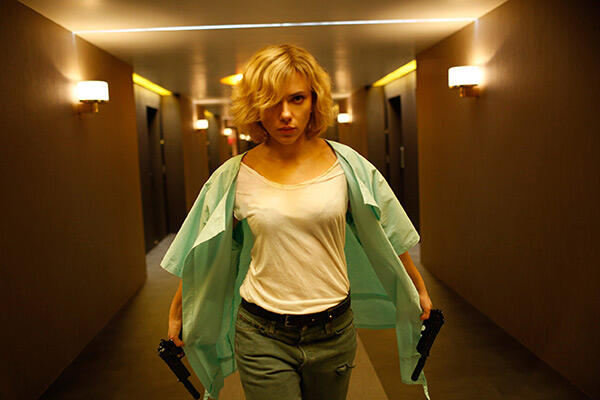
Rating: A - Luc Besson had been directing and writing powerhouse female protagonists since 1990’s La Femme Nikita. Lucy is evidence of 24 years of experience. His French sensibilities with cinema make for an engaging experience. Lucy is a fairly typical student put into the wrong place at the wrong time and then, BAM, she becomes the most intelligent person to ever have lived. As a result of ingesting a large dose of a new drug, she is able to access more of her brain than any person ever has before, and thus gains what are effectively superpowers, because science. We know so because Morgan Freeman tells us in a series of cutaway shots. He plays a leading contemporary neuroscientist lecturing at an unnamed university. Let’s face it: Otago probably couldn’t afford him. My personal brand of feminism was really enthralled by this character. Scarlett Johansson is a phenomenally beautiful woman and yet her character is not based on this, it’s inconsequential, like, you know, real life. ScarJo, as per usual, is a strong, fascinating and totally believable character, even while playing someone that could have walked out of a trashy comic book. There were some excellent uses of film techniques familiar to the action genre, which I think is what makes this film exceptional. It is an action movie, with elements of sci-fi. Yet its take on the genre, in particular the treatment of women and race, was deftly navigated. The “science” felt pretty weak at times and there were some plot hole issues as problematic as Transcendence. More depth into things might have made the overall experience a little more satisfying. But, that said, it’s a short, sharp, sweet flick. Coming in at just under an hour and a half, I think it did exactly what it was meant to. Really, I thought it was just great. I left feeling like a super hero. The ending puts the power into the hands of the viewer, so if you’re willing to invest in this one, you’ll come out feeling like genius.
-
Boyhood
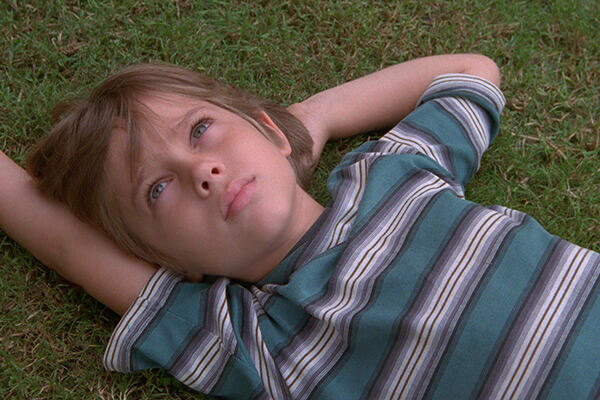
Rating: A Boyhood is Richard Linklater’s ambitious project to film the same cast over a 12-year period to document the journey of fictional child Mason between ages 6 to 18. In true Linklater style, he makes it look easy. The first time the film jumps ahead and I saw a noticeably older Mason, I was taken aback. Despite knowing very well that his development was the entire basis of the film, nothing can prepare you for how unusual and special it is to see a live-action, fictional character grow. After years of enduring the biopic’s tendency to have a 40-year old actor play one character from ages 14 to 90, it is mind-bogglingly luxurious not to have to suspend belief. Linklater always manages to keep the audience well orientated in the time period through diegetic music and references to technology, without any obnoxious sign-posting of the year. It is fantastically refreshing to witness the life of an "ordinary" child, someone whose experiences and accomplishments are comparable to your own. That's not to say Mason doesn't endure traumatic events, but they are handled with the casualness and awkwardness of real life, rather than the melodrama of the typical "broken home" film. Some actors fare better than others with the unique challenges of a 12-year journey. There were some scenes in particular that had to cover a lot of ground, and although many of the actors were able to make the clunky, expository dialogue sound like natural conversation, Patricia Arquette was not one of them. Whenever her character was put in a dramatic situation her performance was beautiful, but place her in an everyday conversation and she sounded like she was reading off a teleprompter. Ethan Hawke picked up her slack and made every scene he was in better with his "lovely but lazy" father act. But the real star is Ellar Coltrane as the boy in question; his sensitive and understated performance made him a kid you wanted to spend 12 years with. Boyhood is an extremely special cinematic experience: unusual, soulful and optimistic. See it on the big screen if you can.
-
The 100-Year-Old Man Who Climbed Out the Window and Disappeared
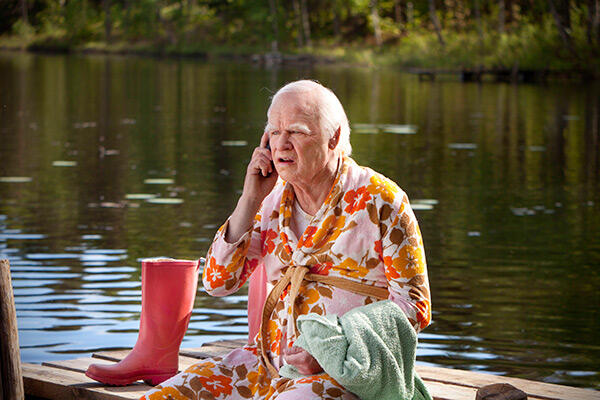
Rating: A This film has an obnoxiously long title, but a story that climbs out the window and into your heart. Getting straight to the point, the title of this Swedish film really says it all. 100-year-old Allan (Robert Gustafsson) decides that it is time for him to up and leave his retirement home, and so simply escapes out the window and walks off. He throws caution to the wind and plans to have no plan, simply content to end up wherever the road and chance lead him. In a hilariously strange turn of events, Allan ends up with a suitcase of cash and a “posse” consisting of another elderly gentleman, a confused and ambitious student, a brave Swede with her rifle and, of course, a circus elephant. While following their crazy antics, the audience is given flashbacks to Allan’s life and the events that shaped him into the “old geezer” the world has labelled him to be. This movie is, at its core, purely random. That really is the only way to put it. People are dying left, right and centre from freezers, elephants and child-made explosives. There are crazy prison escapes, wild parties and downright strange circumstances that lead dazed and confused Allan to become a bomb specialist, a double agent, a crucial part of the Manhattan Project and best mates with Albert Einstein’s brother. Yet, despite all this, Allan is still the kind of bloke that takes time out of his busy schedule to have a wee swim in the lake to celebrate his birthday. Top notch, Allan, top notch. My one and only pet peeve was the prosthetics for the elderly fellow. In an ideal world, I would have preferred a real 100-year-old Swedish man to take the lead; but, alas, they must have all been busy celebrating their birthdays in the safety of their retirement homes and not climbing out of windows. Such is life, I suppose. This light-hearted take on light-heartedness though is a blessing in disguise. The utter stupidity of the storyline and the superb acting of our dumfounded characters make the film a truly engaging, funny and worthwhile adventure.
-
Dead Poets Society
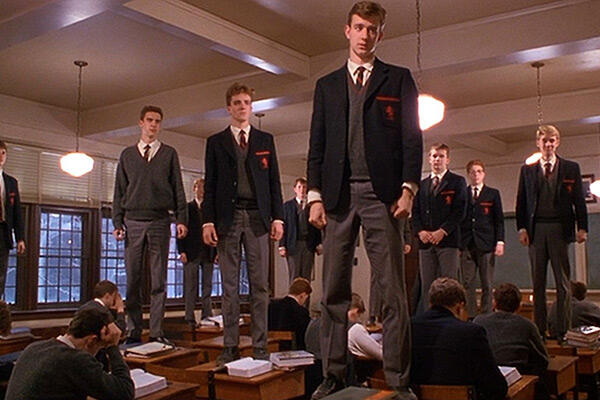
The film that earned Robin Williams his second Oscar nomination and showed the world that he was actually a pretty damn good dramatic actor as well as a talented comedian. Williams plays John Keating, an eccentric and inspirational English teacher at an elite boys prep school in the 50s, whose quirky teaching methods were based on those of real-life teacher Samuel Pickering. The real Pickering was valued by the schools he taught at but, of course, in the movie version the character clashes with his stuffy superiors who will have none of that balderdash and tomfoolery in their institution. When I watched Dead Poets with some friends last week somebody said, “So this is basically Patch Adams in a school instead of a hospital?” That hadn’t occurred to me before but, yeah, it kind of is. But it’s much better than Patch Adams, I promise. The movie really captures the oppressive and stifling nature of 1950s boarding schools, complete with the impersonal lesson delivery and the corporal punishment. We see how Keating would be a ray of light in that environment; he treats his students as fellow human beings. As well as making the subject more engaging, he also helps them to develop some self-confidence. The character will remind you of that one really awesome teacher you had in high school. Possibly the movie undermines some of this by going all Patch Adams on us, as Keating’s unorthodox lessons gradually have less and less to do with English and he thus seems kind of bad at his job, such as when he teaches them how to walk in a non-conformist manner and stand on their desks, because that’ll show The System, or whatever. Here we start to side with the stuffy headmaster. The film also follows several of his students and what they do with their newfound enthusiasm. One decides to go after a girl who has no interest in him, leading to some of the most awkward courtship scenes in the history of cinema. The other student subplots are more effective, and there are very good performances from young Ethan Hawke and Robert Sean Leonard (AKA Wilson from House), who hold their own alongside Williams. All in all, this is a powerful movie that definitely warrants a recommendation. Be warned though: as with Good Will Hunting, it was already a potent tearjerker even when its star was still with us, and it’s doubly so now with the passing of the Captain.
-
New this week / Singles in review
QT – Hey QT QT is a project by a pair of artists known as Sophie and A.G. Cook. I'm not quite sure how to aptly describe this track, except does anyone remember that song “Barbie Girl” by Aqua? Well, if you don't, listen to this track and it might jog your memory. It's not quite as melodically infectious, but it's ear confectionary nonetheless. “Hey QT” manages to be an interesting mix of electro, pop and chip-tune. A quirky breath of fresh air in a sometimes quite uninteresting pop world. Run The Jewels – Blockbuster Night Part One Run The Jewels are comprised of American hip-hop artists El-P and Killer Mike. After releasing their self titled debut last year, the duo return with “Blockbuster Night Part 1,” the single to their upcoming release, aptly titled Run The Jewels 2. The track is a militant stomping ground for beastly verse and boasts a stirring, paranoid synth line. Pretty much the song indicates that Run The Jewels won't put up with shit because they are dope. It's great because they are 100 per cent right. Pallbearer – The Ghost I Used To Be Formed in 2008 in Little Rock, Arkansas, Pallbearer released their first full-length album only two years ago. A gripping, interesting doom metal record. “The Ghost I Used To Be” comes from the group's sophomore album, Foundations of Burden – a massive record with earth shattering guitars. This track in particular draws from classic metal bands such as Black Sabbath, and melds woeful singing and epic instrumentation into an engrossing experience. Wand – Flying Golem Wand is a psychedelic garage band hailing from Los Angeles. “Flying Golem” is a track from the group's debut release, Ganglion Reef. Consisting of howling guitars and nasal, reverb drenched vocals, “Flying Golem” has all the ingredients of a great psychedelic classic, reminiscent of those 60s nuggets from the first psychedelic invasion. Failed Flowers – Summer Vacation Failed Flowers are an indie pop band hailing from Ann Arbor, Michigan. “Summer Vacation” comes from the band’s first release, Demos. Lo-fi as it may be, “Summer Vacation” is a well-needed blast of summer pop. Though some people feel the whole beach pop thing has probably been overdone as of late, I still do enjoy a good song that exudes good vibes and sunshine.
-
Ty Segall – Manipulator
Rating: A - I've been a follower of Ty Segall's work since 2011, which was around the time he released his solo record, Goodbye Bread. It was of course a pleasant surprise to find out he had already released several records before then, and he has released several records since. Known to put out at least two albums a year through various projects and guises, Segall was oddly quiet this year. But as time has taught us, the prolific garage, glam songwriter was due to make an appearance. So of course he goes out and releases a double album. Clocking in at just over 56 minutes in length, Manipulator is Segall's longest record to date. Rumour has it, it also took him 14 months to complete, which is the longest duration of time Segall has spent on any one album. The extra time spent does seem worthwhile, as these songs all feel fleshed out and none appear particularly half-baked. In fact Manipulator feels like a bookend to a chapter – a conglomeration of the past five or six years of Segall's musical output. It has the dusty acoustic guitars, the fuzzed out electric guitars, the psyched out organs, the squealing solos, the glam influences, the 60s garage influences. The record just plays out like a no-nonsense, in your face, nostalgia trip. Segall comes across like a cross between Marc Bolan and David Bowie, as he sneers through the record's seemingly endless number of boogies. If there's one gripe I have with this album, it's that it may actually be too long to survive the lack of variation contained within its 17 tracks. In terms of pace, each track also seems stranded in this mid-paced chug, so when stretched out over 56 minutes, some songs seem to lose their dynamic impact and their ability to stand out from the pack. Apart from that, Manipulator is a great representation of Segall's work over the past few years and contains some of his best songs to date. Highlights include “Tall Man Skinny Lady,” “Susie Thumb,” “Feel,” and the title track “Manipulator.”
-
The New Pornographers – Brill Bruisers
Rating: B + Talented songwriters Dan Bejar (A.K.A Destroyer), Neko Case, A.C. Newman and Katheryn Calder join forces and together The New Pornographers make mature, saccharine, power pop. There isn't much more you need to say about this star-studded Vancouver band. Before even listening to Brill Bruisers, I could hear the polished, well-schooled sound of pure accomplishment the group has come to represent. 14 years ago The New Pornographers were a welcomed breath of fresh air, but familiarity, sadly, sometimes breeds contempt. Just because you're a talented band and make good music doesn't always mean you fit the quota of “what songs people crave right now.” In the early 2000s, bands such as Rilo Kiley, Bright Eyes and Iron & Wine dominated the alternative scene. Embraced for their lyric smart, sensitive pop, and soft, melodic edge, The New Pornographers don't veer far from that description, despite the fact they are a lot less melancholy and instead their music seems to be dripping with joy and cheer. Lead single, title track and opener “Brill Bruisers” is a blast of good vibes, with its “bababas” and “woos.” Their energy is undeniably contagious. Other highlights include, synth ballad “Champions of Red Wine” and the chuggy “Born With a Sound.” Then there are songs like “Marching Orders,” with it's swirling, parade of synths and “Spydr” with it's well thought out structure, that somehow manage to come off as bland and predictable. “Wide Eyes” is the perfect example of the band just going through the motions. The New Pornographers are a good band, and that will probably never change. Their songs are good, and some are great. But it seems they're starting to make albums that are good in the worst way possible. Kind of like how ready salted chips are always sort of good. Brill Bruisers is good, in that kind of way.
-
Endless Night by Agatha Christie
You have of course heard of Agatha Christie, possibly because I just mentioned her, but far more likely because she is incredibly famous. Her patented brand of murder fiction was the cuddly sort. The official genre term is “cosy,” and the notions inherent in the term cosy, are pretty straightforward. The victim is often unpleasant, or at the very least killed off before the reader gets unduly attached. The detective is borderline-omniscient and triumphs, despite people constantly doubting their omniscience, and they drink a lot of tea. A love story, taking place between two young people who fall for each other and decide to get married, threads through the main plot. When the murderer is revealed, there is always the sense that the world has been righted, back to the basically pleasant place it is. A cosy is a genteel book about murder that makes nice bedtime reading for fluffy old ladies, (and in Christie’s case, the whole entirety of the world). This is not to say that Christie's work is the veritable cliché-fest some make it out to be. The reason for her fame is partly due to her ability to shake up and generally subvert the hell out of this formula, book by book by book. But, most unusually, the work I'm actually here to talk about is from a time in the 60s where Christie used this formula to write a story that was distinctly uncomfortable. There is nothing reassuring about Endless Night. It was the first Christie book I ever read, and I don't recommend it as a good way to get a handle on her work. It didn't put me off, but it did make me look askance at the aunt who called Christie her comfort reading, because Endless Night is nothing like Christie's other work. The story is narrated by Mark, a disaffected and alienated young man, who is drifting through life and the plot begins when he meets and falls in love with Ellie, an heiress who has led a sheltered life. They get married with genre-traditional rapidity and proceed to build a house together, in a place called Gypsy's Acre (ah, the 60s). Gypsy's Acre is cursed, of course, and though this plot doesn't sound like much, an atmosphere of underlying tension and nastiness ensues, to the point when the murder comes as something of a relief. Endless Night takes place in a world of discontent and unhappiness, and it is only fair to say the story ends not with a sense of resolution and the world righted, but rather that things have gone terribly, unfairly wrong for everybody. It is very much not a nice book, and if you are like me, that's all the recommendation you need. Of course, Endless Night isn't what you'd call literar-churr, and it goes to pieces a bit towards the end. (Agatha had a tendency to make her killers go a bit too insane when she felt like wrapping things up.) If you're interested in checking out her more usual work, you'd be unlucky to pick up a random and hit a dud, but The Moving Finger is one of my favourites. Though, if you're in the mood for something a little more haunting, try Endless Night.
-
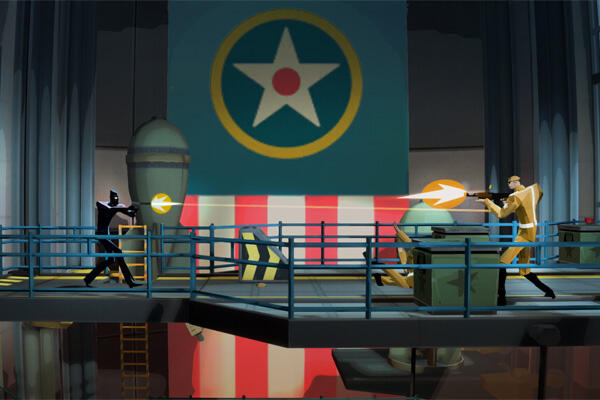
Counterspy
Rating: B + It’s hard for our generation to appreciate how tense the Cold War must have been. Sure, we live in a world with many conflicts, but despite the often horrific and appalling nature of these events, they are all relatively isolated from us. Imagine instead living in constant fear of two of the world’s greatest powers in a persistent stalemate during which both of their fingers hovered over the button, threatening the whole world with nuclear extinction. Dynamighty’s new title CounterSpy deals with this reality, reminding us of the reality of the nuclear threat of a cold war, and the spy warfare involved in keeping those fingers off the button. Fortunately, however, this reality is expressed through a world that makes this reality fun and exciting rather than the hernia-inducing mind fuck that was the actual Cold War. CounterSpy is a side-scrolling stealth game, which sees you playing spies from both sides of a cold war conflict as they infiltrate enemy bases in search of intelligence and attempts to revert the defcon state of the enemy. Dynamighty is an indie studio comprised of some varied and impressive talent, many of the developers having worked on series such as Uncharted, Infamous and Resistance. However, in my opinion, the real coup d’état for the studio was their acquisition of former Pixar artist Mark Cordell. Cordell gave this game the kind of magic that only a Pixar artist can bring, simultaneously grounding the game in the reality of Cold War-era military structures, but also managing to bring a sense of whimsy and mischief to this very serious location through aesthetic alone. The art style is undoubtedly the game’s strongest element, as it has as much effect on the tone of the game as of the visuals. This is really the magic of Pixar artists because, as with many Pixar movies, the content of CounterSpy could easily be disturbing and dark, but thankfully the gorgeous art and aesthetic actually manages to marry the feeling that the game both pays homage to the concepts of espionage and war while also feeling like just a cheeky bit of fun. The gameplay itself is a side scrolling stealth game. You must get from one side of the map to the other while taking down enemies, stealing intel, formulas and money and finally reaching the controls of the base where you subvert the nuclear launch protocol. The interesting thing is that you play as the spies on both sides of the conflict, which makes the overarching goal of the game not to destroy the other enemy first but to stop the nuclear launch of both countries altogether. Though the game is a sidescroller, there is a fantastic cover mechanic that makes the combat far more engaging than any sidescroller I have played before. Upon entering designated cover spots, the camera switches to become a third person shooting mechanic. This makes combat about precision and skill, trying to take down enemies as quickly as possible to either stay in stealth or to stay alive. Though the game labels itself as a stealth game, you are still expected to clean house. This is made clear through not only the design, which does not offer opportunities to proceed without killing the enemy, and also through the score system which is earned through killing but incentivized through larger scores for stealth kills. The wonderful side effect of this cover mechanic is that the change in camera perspective gives a forth wall that is normally missing from sidescrollers. This gives the game a depth and immersion that I didn’t even know I missed until CounterSpy gave it to me. However, despite all of these strong attributes, many of the elements of CounterSpy are not overly polished, culminating in a general feeling of unevenness. These two concepts were constantly at odds with each other during my time with the title, one part of me absolutely enjoying the experience and the other being perturbed by the weakly conceived or executed aspects, such as the AI or occasional technical or graphical hitches. All in all, CounterSpy is the kind of experience that is a pleasure to have, but one that will not be long remembered. Though aspects such as the art and combat were excellent, they were often overwhelmed by the unpolished feel of the game, making this a fun experience but, as I said, not a memorable one.