Countdown Central Declares They Hate Self-Expression
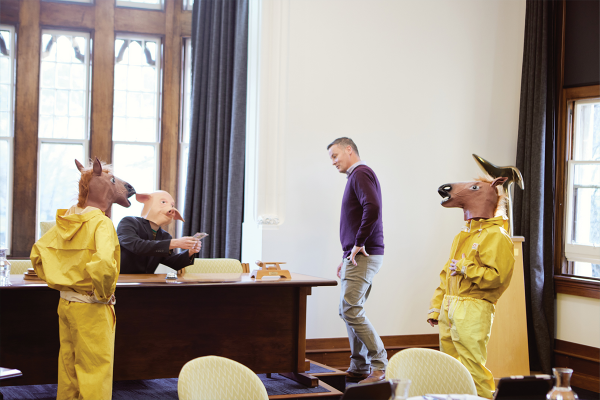
At a packed Uni Council meeting last week, Otago confirmed that it would be going ahead with the million-dollar rebrand. Student protesters - dressed as pigs and horses - refused to leave the chamber after the announcement, protesting staff cuts. It was truly a dog and pony show, but in the end, everyone left peacefully after some words with the Proctor. The meeting covered two significant topics, which we’ll break down here: the design and implementation of a new name and tohu (symbol), and the ongoing debate over cuts and spending. The overlap between the two has been confined mostly to Facebook debates, with people questioning why the Uni is spending more than a million dollars on a project at the apparent expense of staff positions. In the consultation findings, one staff member commented: “On the one hand, there’s never a good time to do this, and the design is very nice, on the other hand, it’s hard to be excited for a redesign when your job is in doubt.” The new name and symbol were a hot debate online, but feedback from people who actually took time to submit to the proposal painted a different picture: out of around 9,000 responses, two thirds were supportive. Some called it tokenism: “The fact that this survey was sent to me only in English shows it is tokenism and woke by a bunch of white privileged people.” Other comments in the consultation findings seemed to think the changes couldn’t come fast enough to incorporate Māori so that it would not be “lost in the Eurocentric foundations of this organization.” While many respondents worried it was merely a “box-ticking exercise”, Chancellor Stephen Higgs said, “I assure you we have listened, and you have been heard.” Thanks, Stephen, for validating me. From next year, the new name will take effect and the new tohu will be seen around campus. The coat of arms will remain (though it’s getting a polish) and will be more visible on the alumni-facing documents and in ceremonial circumstances. The debate about staff cuts was then briefly touched on, with Council noting that they plan to meet with various MP’s and OUSA to hopefully tease out some more emergency funding, or at least lay the groundwork for changes after the election. These meetings will take place with individual MP’s, not as a group. The TEU will also be present. Stephen opened the meeting with the statement that their negotiations with the government have been “successful in a small way”, which is how we’re feeling about the first semester, too. At this point the meeting finished its public segment. When the Council was cleared for a private session, the students along the back row donned their livestock getup and refused to move, flashing wads of printed cash and asking about the democratic process. A third-year amongst the ranks said, “We tried to put on a performance and we got escorted out of the meeting,” making this the first time livestock has ever been trespassed from the Clocktower. The whole ordeal was rather civil, with the Proctor noting, as he escorted them out, that reasonable protest was an important part of the student experience, and that removing them was just due diligence. We did not ask if he had prior experience trespassing pigs or horses. For context, chaos in this room is nothing new. Some years ago, in the late ‘90s, Otago proposed cuts to some languages departments and proposed raising fees. Students occupied the Clocktower, broke down doors, and ultimately forced a counselor to try to escape the meeting room by sneaking out a window. Better luck next time.
Never before have there been so many students claiming to be first year health sci students on Castle St. Why would anyone make such an absurd claim, you ask? It’s likely because they’re not even students. Recently, there has been a significant upturn in the amount of Dunedin highschool students daring to venture out into the wild streets of studentville, emboldened by the anonymity that large street parties provide. Though this phenomenon has a history dating back decades, the process has accelerated recently with more younglings smoking cones, drinking copiously, and even clubbing in Catacombs (seen at one bold formal afterparty). On Saturday June 24, Columba College, a sporting and academic behemoth nestled in Māori hill, hosted their senior formal for Year 12 and 13 students. Notably, the formal afterparty was hosted at an entirely booked out Catacombs where students frothed to the infamous thudding of DnB. Besides the fact that booking out a nightclub is undoubtedly an absolute gun venture, the act perhaps mirrors the efforts of highschool kids getting increasingly involved in student culture. While Critic Te Ārohi has heard rumours of a similar formal afterparty occurring at Suburbia in weeks to come, the primary offender at this stage is the afterparty at Catacombs. But where does this obsession with student culture spawn from? Sure, it does well to draw in the out-of-towners who only see the highlights, but the fact that even locals are being bamboozled makes for an interesting sight. One Year 12 student, Alex*, told Critic Te Ārohi that the primary reason for increased interest was that “student culture is so public in Dunedin.” Still, she did admit that “there’s a certain type” that takes the plunge into the depths of Castle, having never gone in herself. While many would suspect the “certain type” to be the Logan park larakkin located conveniently at the gates of studentville, Fletcher, a second-year student who ventured into Castle as a Year 13, told us that is was mainly those who were “trying to look cool” (AKA posers). Scorning his own youthful folly, Fletcher stated that the experience was “pretty shit, really, as we mainly just hung out together.” Going one step further, Fletcher told Critic Te Ārohi, “If I saw a Year 13 out and about, I would drop them,” justifying his bold claim with the assertion that, “their time will come.” Ben, a student who performed the same crime as Fletcher, shone some light on the benefits of the excursion when he told Critic Te Ārohi that “you had to sell a lie” to get away with it. Ben admitted, “We all knew we didn’t belong and it was kinda fun sneaking around telling people your course that you’d made up.” Based on this testimony, the murky motivations of the intrepid Year 13’s venturing onto Castle became apparent. The “certain type” that Alex* refers to is the dare-devil, inspired by the glitz and the glam of student life, risking a beating or potential embarrassment to get a taste of the thrill that comes with identity fraud. When you frame it like this, the recent spike in the number of Year 13’s wandering Castle Street makes sense. Keep an eye on the streets of studentville for updates on the trajectory of this worrying trend. *Name changed.