

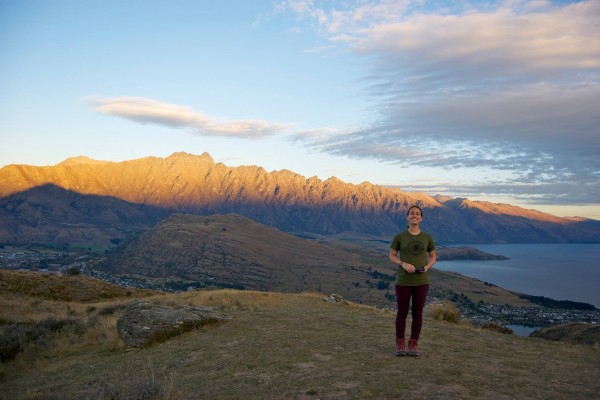
My knees still ache, and I waddle to class with swollen feet. Completing my first Great Walk, the Kepler Track, was as beautiful as it was painful. I came to New Zealand with intentions of answering each invitation with a firm “yes” because I didn’t want to miss out on any adventures during my semester abroad. When Friday afternoon rolled around, I couldn’t have identified the track on a map. Though this was my first tramping trip, I felt a strange amount of confidence about the 60-kilometre, 1,400-metre-high trail that lay ahead. I piled into a rental van with new friends and strangers and was on my way.
We started with a flat 15-kilometre stretch that lured me into a false sense of security. Our second day spanned 23 kilometres, to the highest peak and down again, and in that afternoon I learned more about myself than I thought was possible. While I climbed, my legs burned and my back ached, yet I had to push forward and conquer the desire to quit. I learned that I could quiet the pain, that my mind was stronger than my body. In that moment, I understood that while situations may be beyond our control, we have responsibility in choosing our mindset.
With each new blister, cramp and sore muscle, I was one step closer to completing the Kepler. I had only one chance to soak in the gorgeous views and landscapes. Never again would I be so interconnected with that particular mountain, and I refused to allow pain or a bad attitude to taint my experience.
I survived, and would have kissed the asphalt in the parking lot if not for the strange looks from fellow travellers. Before leaving, I laid in the grass and felt a sort of bliss and pride that I had never before experienced. Kepler taught me that our limits exist only because we create them, and I feel a more genuine sense of confidence about my next Great Walk. I will be equipped with a new type of mental strength I did not know I was capable of.
Columns
A Broad View
-
A Broad View | Issue 13
A Broad View is written by different international students each week who wish to share their impressions of their time here or unique experiences. Email critic@critic.co.nz if you are an international student wanting to tell your tale.
-
A Broad View | Issue 12
A Broad View is written by different international students each week who wish to share their impressions of their time here or unique experiences. Email critic@critic.co.nz if you are an international student wanting to tell your tale.
-
A Broad View | Issue 11
A Broad View is written by different international students each week who wish to share their impressions of their time here or unique experiences. Email critic@critic.co.nz if you are an international student wanting to tell your tale.
-
A Broad View | Issue 10
A Broad View is written by different international students each week who wish to share their impressions of their time here or unique experiences. Email critic@critic.co.nz if you are an international student wanting to tell your tale.
-
A Broad View | Issue 9
A Broad View is written by different international students each week who wish to share their impressions of their time here or unique experiences. Email critic@critic.co.nz if you are an international student wanting to tell your tale.
-
A Broad View | Issue 8
A Broad View is written by different international students each week who wish to share their impressions of their time here or unique experiences. Email critic@critic.co.nz if you are an international student wanting to tell your tale.
-
A Broad View | Issue 7
A Broad View is written by different international students each week who wish to share their impressions of their time here or unique experiences. Email critic@critic.co.nz if you are an international student wanting to tell your tale. I’ve never had much appreciation for the American accent, but that’s probably because I never thought to call it such. When you hear something spoken one way every day, you start to take its idiosyncrasies for granted. In other words, you simply don’t notice them. “Aye, mate, wanna head to Macca’s?” This is how my Kiwihost greeted me on our third afternoon together. “Hey, what?” “Macca’s. Me ’n the boys are goin’ for pies, ’aven’t ya ’eva had one? They’re good on ya.” Only “mate” had nothing to do with chess; “pies” weren’t the ones my Mom makes for Thanksgiving; and “Macca’s” (is that spelling even correct?) is just a Kiwi abbreviation for McDonald’s. The following week there was the pasta/pastor debate … “Do you say pasta or pahster?” my Kiwihost asked. “Like the guy in church? Yeah, I say pastor.” “No, we don’t eat pahster in church.” “Well obviously not, you can’t eat the pastor …” I was beginning to think that Kiwis were a seriously deluded group. It was only after the intervention of a third flatmate (or is it roommate?) that it became clear: he wasn’t talking about church and I wasn’t talking about spaghetti. Although I never considered my American accent, I now recognise that it’s been there all along. Pasta, as I pronounce it; pahster, as the Kiwis pronounce it; and pastor. Will we ever be able to communicate fluidly? Who knows? But, in a way, that’s what’s special: the similarities and differences. The idea that language, dialects and accents are all a part of humanity, all a part of us, and at the end of the day all we really want is the ability to understand one another. That, and McDonald’s.
-
A Broad View | Issue 6
A Broad View is written by different international students each week who wish to share their impressions of their time here or unique experiences. Email critic@critic.co.nz if you are an international student wanting to tell your tale. Well, first things first. What immediately struck me (besides the gorgeous views, herds of sheep and astronomical liquor prices) was the presence of bare feet. Everywhere. But the simple fashion choice of to-shoe-or-not-to-shoe doesn’t even begin to cover the general culture and atmosphere that encompasses Dunedin. And that’s something else I’ve already discovered about this place: there is no “general” culture. Everything has its own aura and everyone their own story. Compared to life back home in the States, people here seem to move slower and time seems less important. What I understand thus far is that the people who find themselves in this city are just here for a good time — to attend class (maybe), but more so to enjoy life. They’re here to explore the scenery and to get to know one another on a deeper level than the typical US-driven conversation of, “What’re you studying? What fraternity/sorority are you in?” In Dunedin, what’s important is who you are and what you bring to the table, and that in itself is amazing. It’s a place where two strangers stumble upon each other at the Saturday Farmers’ Market, discover a common love of bacon butties and soon become fast friends. Maybe it’s tramping to the top of Signal Hill, watching a beautiful sunset together and seeing just how out-of-shape one another is that causes this camaraderie, but I think there is something more to it. Whatever that “something” is, I’m still trying to find out. In the few short weeks I’ve been here, I’ve been to a chaotic-as-it-gets tramping meeting, met some of the most amazing people, both local and foreign, and been met with some beautiful scenes I thought I’d only find in guidebooks. Dunedin already holds a special place in my heart, and I cannot wait to see what the remainder of this crazy adventure has in store.
-
A Broad View | Issue 5
Upon first arriving in Dunedin, I was pretty positive that Kiwis didn’t have feet. Every person that passed my flat was cruising on some form of wheels, whether that be a bike, a longboard or a skateboard. Although this phenomenon lasted for a few hours, a quick walk to the post office proved my theory wrong. I was suddenly very aware of the barefoot nature of Dunedin residents. Bobbing in and out of stores, it became clear to me that leaving your shoes at home was not considered as unsanitary, dangerous or disrespectful as it is back home in the States. By the end of my walk, I had joined the footloose masses and was childishly going in stores just for kicks (or lack thereof). While I have yet to muster up the courage to attend a lecture barefoot, I am already dreading my return to a country that denies my basic human right to publicly free my toes of the oppressive confinement that are shoes. Allowing people to be barefoot may seem like a trivial matter, but from what I have experienced of this country it seems to be fairly representative of the personal responsibility that is allotted to New Zealand citizens. If you choose to go shoeless and end up stubbing your toe, stepping on a shard of glass or contracting a horrifying foot disease, that’s on you. If you visit Rotoroa and get a bit too excited about the gurgling geothermal pools, there won’t be a cast-iron guardrail to catch your fall. If you find a trampoline in the bush and decide to go for a jump, there’s no need call up your friendly neighbourhood lawyer when you break your arm. Unlike America, New Zealand takes advantage of a concept that parents have successfully implemented for centuries. If your kid wants to do something questionable, you don’t stop them. Everyone’s gotta learn from their mistakes and successes — and if things do go awry, there will likely be a band-aid and a glass of milk nearby.
-
A Broad View | Issue 4
A Broad View is written by different international students each week who wish to share their impressions of their time here or unique experiences. Email critic@critic.co.nz if you are an international student wanting to tell your tale. Hours before sitting down to write this column, I was not quite sure of a theme for the piece. But, over dinner, my kiwi host asked me what aspect of New Zealand culture shocked me the most. I had to think for a while — much of how I learned to behave growing up in the United States holds true here in New Zealand. “The bluntness,” I finally told him. The word sounds harsh, but I meant it in an absolutely positive sense. My university experience stateside is, quite possibly, the one true polar opposite of the “Scarfie” experience. I attend a small — 2,000 students — liberal arts school in a vast city — Los Angeles. Of course, the University of Otago is a large school in a small city. More important than the demographics, however, is the attitude of the students. My college prides itself on the progressive nature of its students. And while that is certainly the case — they stage protests, ignore social convention and question authority — there is a strange pressure among the student body to mute yourself as well. On many occasions, people are afraid to speak their mind because they don’t want to be the reason for one of those protests. Therefore, the opinions and, more noticeably, the humour of the student body end up trapped in a paradoxical container labelled “political correctness”. (Or, at least, what the majority deems “political correctness”.) Here, the situation is quite different. Students use cruder language and are less sensitive. When they feel a certain way about something, they let it be heard. This is not to say that bigotry is part of the bluntness that I hear amidst conversations between Kiwis. In fact, I have seen less of it here than anywhere I have lived in the States. Instead, with that bluntness comes a refreshing breath of freedom of opinion. People can develop a dialogue without the fear of having their words woefully misinterpreted because they contradict a certain expectation of appropriateness. When one party is not immediately offended by the differences in opinion of another (or, dare I say it, a joke), real progress and change can happen. So, the first lesson I have learned in my short time here — don’t get so offended, have a laugh, lighten up.
-
A Broad View | Issue 2
I t’s night, the stars are out and a bonfire is burning wildly in the middle of the road. Green shards of glass from smashed bottles are strewn about the flames. I peer closer at the fire, fearing what could be burning in there. Then I see … a ratty old couch. On the street corner, the campus security officer is watching the event with an amused expression. Students running around with beer in their hand. Students running around wasted, barefoot, on the sharp glass shards of beer bottles they’ve just dropped from balconies. Does the officer see what’s happening? At my home school in the US, the officer would be after every one of those kids with a list of 200 convictions, hunting for an excuse to stop a good time. Here, he just seems to want to ensure that everyone’s okay and having fun. Sunday night, I approached an officer for directions to a friend’s flat. He was standing in the street in the midst of couch-burning riot. “I’m looking for 378 Leith Street,” I offered, tentatively. “Oh, I heard there’s a great party there!” he replied. And then — “I’ll walk you over! How do you like Dunedin so far? Hope you’re having fun.” If a campus security officer saw you with a can of beer in your hand in the US, you would be written up, called in for a conduct meeting, forced to attend Alcoholics Anonymous meetings and required to write essays detailing your progress with alcohol abuse. These extreme sanctions often lead to serious binge drinking and multiple transports to hospital during big parties. I’m not sure how much of an issue alcoholism is at the University of Otago, but a policy of drinking in the open and semi-supervised seems much healthier than the situation in the US. Students aren’t forced to take six shots in six minutes hiding in their dorm room before they head out onto the street. Campus safety officers genuinely seem to want to help you stay safe, instead of looking for any excuse to bust your ass. I’m enjoying a break from the uptight campus culture I’m used to at home, and may just get too used to this freedom. Thanks for the burning welcome, Dunedin. emmabilgerlodes.wordpress.com
-
A broad view | Issue 1
I n April of 2010, I sat in my living room in New Jersey and stared at the cover photo of the New York Times. The wings of a New Orleans pelican were drenched with black, sticky oil. On TV, the black, billowing smoke soared in plumes from the Deepwater Horizon rig. 757 million litres of crude oil escaped from the ocean floor and leaked onto beaches, covering wildlife. The country grieved for weeks. Flash forward a few years, and I’ve been in NZ for one week; I already understand that conservation is part of everyday life here. So when I heard NZ has opened its waters to oil companies, my heart sank. 190,000 square kilometres of New Zealand’s waters have been approved for oil exploration. Though oil companies are exploring all around New Zealand, 11 wells exist in the Canterbury Basin, which lies off the coast of Otago. Chatham Rise, New Zealand’s most productive fishing ground, rests 50 kilometres north of a potential drilling site in the Canterbury Basin. In it, nutrient-rich waters from the south converge with warm waters from the north, creating optimal conditions for phytoplankton and zooplankton, which are eaten by other marine life such as fish. The 6,177 tonnes of fish that have been caught commercially in the Canterbury Basin in past years prove its productivity. Surrounding Chatham Rise are migration routes for most large whales in New Zealand, including the Southern Right Whale, which is nationally endangered. A spill at this site could destroy the entire ecosystem. If a spill occurs in the Canterbury Basin, the trajectory of the oil spill reaches the Chatham Islands and significantly affects the shores of the South Island. 76 days would go by before emergency systems could mobilise and drill relief wells. By then, oil would have flowed from the sea floor at a rate of 2,500 barrels a day. The spill would leak about 30 million litres of oil, and all from only one well. In a country that relies on tourism and prides itself on sustainability, an oil spill would be devastating. Drilling for more oil, and in doing so making a move away from alternative energy, would be a mistake for this country and would send the wrong message to the rest of the world.


