Study
14 articles found. Displaying page 1 of 2.
-
Culture
 Issue 14 14/07/2025
I can tell you what you study based off your census answers
I spent the semester break trawling through census data and am confident I can accurately guess what you study based on how you answer the following questions. If I get it wrong, it says more about whether you’re in the right degree than my powers of generalisation.
-
Culture
 Issue 4 19/03/2023
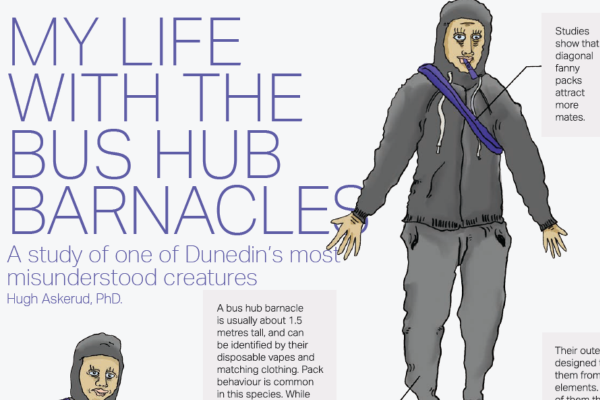
My Life with the Bus Hub Barnacle
A bus hub barnacle is usually about 1.5 metres tall, and can be identified by their disposable vapes and matching clothing. Pack behaviour is common in this species. While they are often regarded as dangerous, like so many other mid-sized mammals, their bark is worse than their bite.
-
News
 Issue 1 26/02/2023
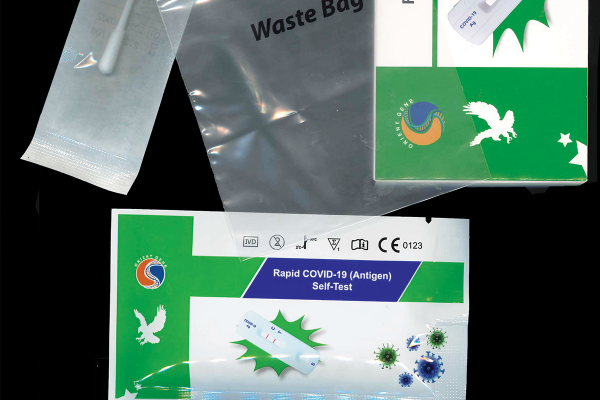
Study: Some Students Intentionally Caught Covid, Didn’t Report Positive Tests
A recent study by a group of sixth-year Otago Med students claims that students significantly under-reported positive Covid-19 RAT tests, both to the Uni and Government. The study was conducted in 2022 between Flo-Week and the end of Semester One. 160 households in North Dunedin were randomly selected using Microsoft Excel – guess it’s handy for more than just commerce students.
-
Culture
 Issue 6 01/04/2022
What’s new? How fields of study have evolved over time
Time moves fast. Sometimes, it’s easy to forget that the stuff you’re being taught at Uni might not be the same stuff that was being taught 20 years ago. Plate tectonics, for example, only became a fully-fledged theory in the ’60s. That means we were on the moon before we formalised the way the Earth’s crust moves. And with the rates of digital communication on the rise, the rate at which university classrooms are adopting and adapting to new discoveries is only increasing. Critic reached out to a selection of academics from all over the University to see how their fields have changed since leaving undergrad. It’s a fast-moving world, after all, and we wanted to know what revelations have occurred in the not-so-distant past. Not everything on your syllabus has been set in stone since the dawn of time. So what’s new? Senior lecturer Dr. Gwynaeth McIntyre completed her undergraduate degree in the 2000s and is always happy to chat about Classics. Although Classics is a bit of a slow moving field (it’s kind of in the name), Gwynaeth said that there have been recent revelations that she does her best to pass on to her students. “We’ve moved past the idea of a canon,” said Gwynaeth, “[previously] all classicists will have read particular texts… We’re looking a lot broader now. For instance, my students know how to read coins in my class, so we have a great collection of coins at the Otago Museum.” Instead of reading the same few-dozen historical staples, Classicists have shifted towards a broader sense of “reading”, trying to glean information from everything from baby rattles to tombstones. “In two to three decades Classics has expanded beyond the written word,” said Gwynaeth. And this is important, because written texts were provided traditionally by a very limited window of the population. This shift in perspective has encouraged the consideration of people who do not fit the criteria of educated white men, such as the “invisible Romans that are clearly the majority”. Gwynaeth said that “women are always going to be half the population, and yet if we just look at written text we don’t know their lived experience because it’s so clouded in what the elite male writers are trying to portray.” Evidence of daily life can tell you a lot about a population, a lot that you might not learn from reading the emperor’s diary. Everyday stories are the real lifeblood of Classics. “We want to hear about how someone’s neighbour stole their chicken, long ago.” The physical sciences have had some major breakthroughs, too. Professor Niels Kjaergaard in the Physics Department described a common theme in what a “discovery” often looks like in the sciences. His particular example was a new state of matter, the Bose–Einstein condensate. This is not “new”, per se, as it was first hypothesised back in the 1920s. But, in sciences like these, it takes a long time to really prove something. After all, even if you’re 99% sure that a new state of matter exists, how do you prove it beyond the chalkboard? Niels said that although the concept has been around since the ’20s, a discovery wasn’t formalised until 1995. A Nobel Prize was awarded in 2001. “It’s kind of rare that there’s a discovery and there's a Nobel Prize for it six years later.” He continued to say that there are more fundamental revolutions in physics outside of his field, like the Higgs-Boson, for example, “but that’s beyond the realm of what I teach and write about.” Dr Jenny Jandt, an entomologist (insect scientist) at the Zoology department, had a different take. “To be honest”, she said, “the thing that has changed the most is an acceptance of the fact that postgrads endure a number of mental health challenges.” This has led to an adjustment of “the support that is - somewhat at least - expected of mentors and supervisors when students are struggling.” Jenny continued to say that the other major change in her field was “about statistics, but to be honest, I don't even understand the new stats that the students are learning, and frankly, I tend to argue that they distract from the point of stats in the first place.” And while she explained that talking about how quickly the statistics have evolved “might not paint me as the best scientist”, her compassionate awareness of the mental workload of post grads certainly paints her as a fantastic human being. And that’s one of the most important parts of being a scientist. Some of these changes are global, but some are more Aotearoa-centric. Paia Taani has been lecturing for 14 years now, initially focusing on early childhood bicultural teaching. She is now the program coordinator at Te Tumu while also teaching te reo. Safe to say, she has plenty of experience and has seen a lot in her time. Recently, the biggest shift she has seen is a surge of people wanting to learn te reo. “It reflects what’s happening at a national level and government level with the big push to promote te reo Māori. Teachers now have to meet the explicit standards of using and showing te reo in the classroom. Thinking back to my undergrad experience as a student in a te reo class, the numbers were much lower. I’m teaching about 80 students this year, and there weren’t that many [back then].” Even last year, class sizes were around 40-50 students. “It’s a big reflection of what’s happening at a national level.” Paia has hopes for future changes, too. Just like everyone else right now, she aims to make online learning more engaging, but the end goal is a bilingual university with te reo “being taught in all areas. Not isolated, but woven in. If we could have more staff coming in, learning te reo, and taking it into whatever they’re teaching, like the sciences, that’d be great.” Dr Sophie Briggs, a Teaching Fellow in the Geology Department, agreed. She said that she “Totally agree[s] with Paia, and we’d love to see more te reo Māori being incorporated into teaching in the sciences too. It’s great to hear that there has been an increase in the number of people wanting to learn te reo Māori!” Sophie explained how important it is to use indigenous languages, and how they really aren’t that difficult to integrate into a science-heavy classroom. “This is something that tangata tiriti staff can do to show our respect and commitment to promoting mātauranga Māori”, said Sophie. Specifically in the Earth sciences, “Little things like using proper Māori placenames [is] super easy to do and especially important [in fields] where we’re referring to specific places a lot.” Using these original names, she said, “always brings extra meaning to what’s being taught.” Sophie is a relative newcomer to the teaching staff cohort at Otago, but she has still seen changes to her field in recent years. “I feel like in the sciences in general, inclusivity is something that has been gradually changing for the better”, said Sophie. “While some NZ scientists still don’t respect mātauranga Māori and Te Ao Māori, or accept that these perspectives make our science better, others do and are just getting on with it. Otago has some fantastic research groups who have developed genuine partnerships with Māori and are doing amazing things.” The ivory tower of academia has not always opened its doors to everyone. And as things are changing, and changing faster than perhaps ever before, it is today’s students that have the opportunity to steer these changes in whatever direction they choose.
-
News
 Issue 5 27/03/2022
Report Highlights Shortfalls For Under-20s Mental Health Care
Demand for mental health care among under-20s has spiked in the last two years, according to a new Government report. They were hopeful, though, that increased Government funding would soon make a bigger impact.
-
Culture
 Issue 1 27/02/2022
Cafe Study Spots
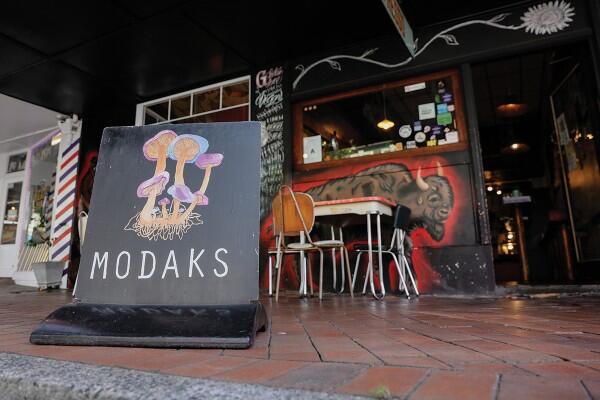
Often, the university libraries can somehow make you feel both agoraphobic and claustrophobic, bored and overwhelmed. More times than not, you’ll find yourself staring at the dull ceilings of Central hating every moment that passes by. With the announcement of online classes, as well as the inevitable reality that soon freshers will fill up every inch of campus, it’s time to branch out and find some new study spots - and where better than a local cafe? Here Critic has compiled an unranked list of Dunedin cafes that are great spots to get your grind on. The factors that were taken into consideration included location, table space (to spread out all your notes) wifi, food and drink quality, as well as the overall atmosphere depending on what kind of studier you are.
-
Culture
 Issue 24 26/09/2021
Outdoor Study Spots: How to make the most of Spring in the exam season
Spring has well and truly sprung, bringing more sunlight and life to campus. With most of us completing the semester online, libraries and flats can become claustrophobic and uncomfortable study spots. Instead of slaving away inside, now is the perfect time of year to grab an outside study spot, and get on the grind.
-
Features
 Issue 23 20/09/2021
Post-glad or Post-sad? What postgrads wish they knew before starting
It’s the second half of semester two and the countdown to graduation for some of you undergrads is well and truly on. You might be thinking, what comes after graduation? Will you go straight into the workforce and hustle your way up capitalist ladders? Maybe you’ll make some serious bank in a summer job, and take a break from the typical trajectory of life after Uni by traveling the North Island in a campervan.
-
Culture
 Issue 18 09/08/2021
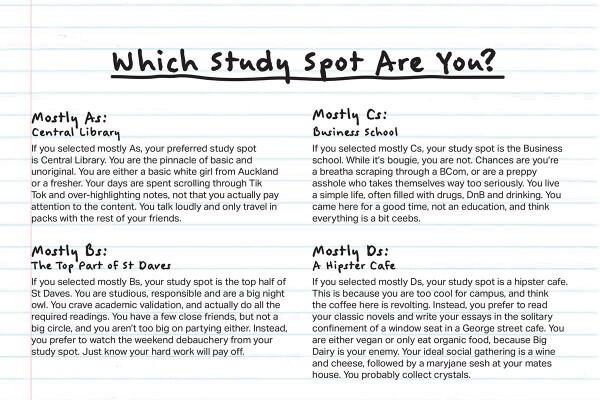
Which Study Spot Are You?
1. It’s a Thursday night. What are you doing?
-
News
 Issue 17 31/07/2021
“No Real Ethical Issues” to Having Jaws Clamped Shut, Said Otago Researchers
The Otago-led research team behind the ‘DentalSlim Diet Control Device’, a magnetised jaw clamp that prevents people from eating solid food, claimed in their ethics committee application that their product would have “no real ethical issues” and presents “no significant risks” — claims accepted by the Ministry of Health’s Health and Disability Ethics Committee (HDEC).
-
News
 Issue 13 30/05/2021
Study SLATED as Bullshit by Demented Grad Students
A study released last week surveyed 4,499 Kiwi students to see if their mental health got worse when they worked on their PhDs. The data said: no, their mental health was not affected.
-
Features
 Issue 5 28/03/2021
Choose Your Own Adventure: The Field Trips of Otago Uni
Critic asked students about the highs and lows of their University field trips over the years. We sorted through the field trips, past and present, and compiled this choose your own adventure, so students with boring degrees that don’t involve field trips can find out what life is like outside of the library.