Poag
2 articles found. Displaying page 1 of 1.
-
Features
 Issue 19 13/08/2023
Humans of the Cuts:
If you don’t care about the cuts you already aren’t reading this page. That’s not who this is for. This page is for people who care about the cuts who are friends with people who don’t care about the cuts - for whatever reason. Maybe their privilege shields them from concern. Maybe they don’t actually want to be at uni. Maybe they just don’t get it yet. Maybe they’re just an asshole. No matter the reason, here are some stories to arm yourself with when this comes up in debate. It shouldn’t be something you let them gloss over. Very rarely do we have the opportunity to really be pissed off about something and know that we’re completely correct in our indignation; this is one of those times. Brandon Johnstone, TEU Otago Co-Branch President In April of this year, the leadership of the University of Otago announced that they would be opening a “voluntary redundancy” process. In short, VR is the university senior management saying “we’ll pay you to end your employment”. University of Otago HR has been pretty clear that this VR process is born of financial desperation, and is not “scientific” in any manner. There’s a bit of a reactionary impulse to point the finger at staff taking up voluntary redundancy, as if those people leaving are the reason for downsizing (or disestablishing) departments. This is not fair, nor is it rational or even correct. When management says “our ship is sinking”, people will inevitably be running for the lifeboats, because the alternative may be forcibly walking the plank. But, critically, the University controls those lifeboats. Senior leadership at the University approves or denies every application for voluntary redundancy. Every one of those 100+ accepted voluntary redundancies exists because the university leadership asked for them, and approved them. University senior leadership would love it if you incorrectly pointed the blame at staff trying to ensure that their career has a future. They don’t deserve this get-out-of-jail-free card. Those senior managers are overseeing cuts to staff, papers, and department, and the accountability should be placed squarely upon them. Another critical point for workers at the University of Otago is the difference between voluntary and non-voluntary redundancy. If a worker is made redundant against their will, the employer must demonstrate that their workload no longer exists. There is no such requirement in the voluntary redundancy process. This creates a risk of growing workloads and the unhealthy workplaces that come with them. If you see such unsustainable practices unfolding, do reach out to us at dunedin@teu.ac.nz or suggest that the staff around you do so. And never let senior management and the government off the hook. Remember, staff and students are in this together. Tū kotahi, tū kaha. Flynn Acworth - Te Ao o Rongomaraeroa - The Centre for Peace and Conflict Studies My name is Flynn, and I’m a postgraduate student at Te Ao o Rongomaraeroa. My research focus is on the intersection between cybersecurity studies and peace and conflict research. I was hoping to pursue my PhD in this topic at Otago starting in 2024, but the proposed changes to the centre (tabled because of the financial crisis) have thrown those plans to the wind. The proposal to ‘align the centre’s costs with its income’ suggests cutting it down to one staff member, who will teach the Master’s course, run the centre, as well as supervise all postgraduate research. This will rob the centre of its doctoral supervisory capacity, essentially killing the PhD program. This is a big deal. The centre is currently the only place in Aotearoa where a PhD in Peace and Conflict Studies can be pursued. The proposed change doesn’t only affect current students and staff - it impacts the entire country. I’m writing this on the 4th of August, and somewhat prophetically, our government has just published its inaugural national security strategy. It paints a rather bleak picture of our potential future. While reading through it I kept asking myself: in a time where our government assesses that strategic competition and contestation is increasing, and that “pressure is likely to grow for countries like New Zealand, whose security and prosperity depend on a cooperative landscape” why the hell are we throttling our national capacity to train the very researchers that might help us address these concerns? The value of Te Ao o Rongomaraeroa can’t be calculated by a cost/income analysis. It is a national resource that only increases in value as our peaceful future is becoming increasingly uncertain. I believe that in our current global landscape, the proposals to change the centre are not just harmful, they are dangerous, and we need to do something about it. Anon (SciCom) Ten months ago I celebrated receiving an offer of place for my dream Master’s program with a glass of wine next to my mum and dad in our family home in Massachusetts. We clinked glasses and smiled at each other, proud of the hard work that went into that moment. Even though this program required moving 9,467 miles away from home, I’d have the opportunity to learn from world-renowned science communicators, collaborate with a network of talented peers, and gain hands-on experience in the field. And even though my mother was still receiving her breast cancer treatments, it felt too important of an opportunity to pass up. I accepted my offer and never looked back. That is until I found out that I would be a member of my program’s final cohort of Master’s students. I never thought that my Science Communication degree would cover management of change processes, voluntary redundancies, and education unions; yet I’ve spent more time in Semester 2 on these topics than science communication theory or application. These cuts have consumed every spare moment and all of my mental capacity. I’ve mobilized my classmates, written demands letters, and negotiated assignment deadlines. I’ve cried in the Pro-Vice Chancellor’s office, in an attempt to make him understand the psychological impact this has had on me and my classmates. I’ve navigated this all, in addition to my coursework, as I’ve grappled with my grandmother’s death and my father’s dementia diagnosis. It’s been an utterly unsupported and overwhelming shit show that I wouldn’t wish upon any other student, let alone my 25 friends and classmates who are experiencing the same exact thing. We’ve already had one member of our cohort drop out and move back home to the US. How many more will decide they’ve had enough and pack up? Sometimes it feels like this is what the Uni would like to see happen, anyway. Jamie Baldwin – Geology The Geology Department is home to many fantastic researchers, lecturers, students, and technicians. It is home to the most extensive fossil collection in Aotearoa, world class research facilities, and me – one of many final-year undergrads. I am proud to call myself a geologist from the University of Otago, but that clearly doesn't mean anything to the University. I wouldn’t be the person or the scientist that I am today without the support of the Geology staff and students – we are a small yet tight-knit community, and I have not found a more welcoming and supportive place than Geology. The announcement of the cuts formed a dark cloud over us that quickly settled into worry for the future. As Fox (ex-Geology student) said in Critic, we stand to lose 30% of our department, and it is depressing to watch what the staff are calling the “hunger games” for their jobs. Ironically, the University has criticized our lack of support staff and lecturers (especially for paleontology) in their proposal yet continues to cull our already understaffed department until we are ground down into the very sediment we study. Our world-class paleontology research program is almost completely gone, and it is a beloved aspect of the Geology Department sorely missed by both students and staff alike. The University froze the hire themselves despite an outpouring of support for the role from hundreds of students, researchers, and enthusiasts – that’s a real twist of the knife in the cuts, and it shows how little the University cares about the quality of our education. The loss of our support staff has also been devastating for the whole department, and the loss of lab managers for our geochemistry labs is felt at every turn. The fountain of knowledge that kept our labs operational has run dry, and research stalls for weeks at a time. It’s funny to think that in a world where understanding the ground beneath our feet is becoming more significant, the University has decided that geoscientists are the first to go extinct instead of preserving the mahi and integrity of their oldest department. Go figure.
-
Columns
 Issue 17 31/07/2023
An Open Letter from the POAG Organising Committee
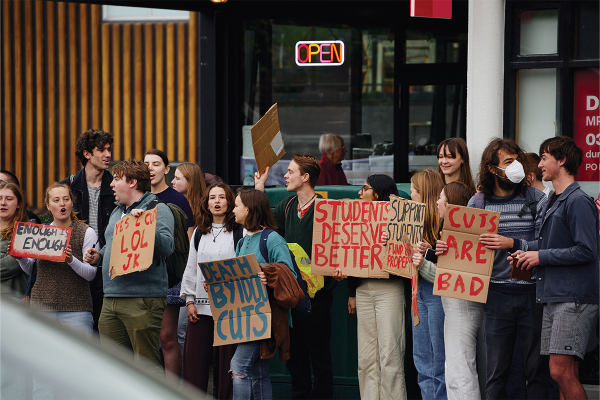
Student life is marked by so many indignities that you’re supposed to accept: the cold, the debt, the lack of nutrition, the shift work for petty tyrants. All the labours that make you question your life choices and whether it’ll be worth it for some shining future. It gets worse, though, when we start to think about the looming cuts. Consecutive governments and the cat’s paw leaders of our unis and polytechs reckon that your efforts to improve yourselves and the world are not terribly valuable. The tertiary education sector is being starved of the funding that it needs to survive. Not even to grow - merely to exist in its current form. While we see massive skills shortages in pretty much every sector across these islands, and problems that demand fresh critical approaches, our universities are facing existential cuts. Jobs, papers, programmes, departments - the works. Students, staff, we’re stressed out. We’re working our asses off. The message being sent to us from the Government (almost explicitly from Education Minister Jan Tinetti and Prime Minister Hipkins) is: “Get bloody used to it, it’s gonna get worse.” Fewer courses, fewer academics, fewer support staff. We’ve been told by this institution’s leadership that they want to “do less, and do it better.” Nah. Even they don’t believe their own PR spin. Doing less is exactly that: doing less. Less of the public good that the University provides. If you see some long faces among your lecturers, this is why. If you see a lecturer scowling, or break into tears as they fear for their career, family and city; this is why. They face the same brutal amputation of our institution as students, and feel it at least as acutely. Over the last ten years they’ve been through several rounds of restructures, redundancies, and financial forecasts of doom. Every time they’ve been assured, “This will protect the University of Otago from future cuts.” This is demonstrably pure bullshit. Many opt out of careers achingly devoted to eccentric obsessions and their students, because, well, this place just isn’t what it used to be. We feel that academics must throw themselves into the arena of a for-profit market and a University Council dominated by local business magnates (and their real estate interests and legal and consultancy firms) in order to justify their contribution to society. The Protect Otago Action Group (POAG) was formed when plans to cut staff and programmes were announced back in April, when we were told that “several hundred job cuts” were on their way (we’re still waiting for the number!). Led by a joint coalition of students, staff, and community members, our message is pretty simple: “We can have nice things if we fight for them!” In a very short period (during which no shortage of consultants and tertiary sector bureaucrats told us we’re wasting our time) we’ve been able to cut through plenty of obfuscation to get our message across. We organised a joyously pissed off 500-strong march on the Clocktower, complete with bagpipes, trombones, and, of course, a unicycling ukulele-toting chimp. We put Chippy and his stooges on blast when they came to campus. In what should have been an easy election campaign photo op in friendly territory, he left town with the image of “Stop Labour’s Cuts to Otago” splashed across national media. We’ve learned pretty quickly that getting righteously mad and focusing that fury through organisation gets results. The Acting Vice Chancellor has shifted into a collaborative stance with the Tertiary Education Union (TEU) and the Otago University Students Association (OUSA). Credit where it’s due to Acting VC Helen Nicholson: she signed on to a strong “Save Our Unis” open letter led by the Victoria and Otago student union leadership, and has urged other Vice Chancellors to put on their big kid pants and join TEU and students associations at the adults table. We forced the Labour Government to give the sector back $128 million. Not only did we prove that there’s blood in the stone, but we’ve been vindicated by Robertson’s admission to what Critic has so deftly pointed out already (notwithstanding the obfuscation of TEC neolibs), that this was money OWED to us. This was not a bailout, but some of what was already allocated to us in the 2022 budget, secreted away through arcane accounting justifications and gesturing at a busted funding process. They even admitted that the current funding mechanisms which produce the Spreadsheets of Doom are not fit-for-purpose. No shit! A late admission, but a welcome one. So, shout out to you. To every student, every worker, every community member who has been refusing to let their anger be only thoughts and words. Words might make you feel better, but action gets the goods. Make no mistake, every dollar is welcome, but this is a bit of a piss take, isn’t it? Not only does this $128 million promised for 2024-2025 not cover what was promised but never delivered - it’s also recovered from university fees-free schemes that were never delivered. The Government is (under)funding our university through the very student debt that they promised to alleviate. To be cynical, it looks like Labour is trying to take student protest off the board for this election season by doing the bare minimum. Prove us wrong, Labour: back up your acknowledgement of a broken tertiary education funding model with the funds needed to save it from immediate cuts. Heal the wound that you’ve let fester. Hell, we’ll even let you call it a bailout if you do. But as we’ve been told, this initial funding boost will not save our universities from irreparable harm, it won’t save us from gutting institutional knowledge, identity, and our people. You can’t just turn the faucet of recruitment back on after dealing this kind of damage to a public research institution of this scale. Academia is infamously difficult to recruit to: if you lose academics, then you’re also educating fewer academics down the line. When you’re in an economically healthier position, those educated researchers don’t exist - or certainly not in the numbers they could have. You’ve tossed your expanding knowledge base in the trash, because a balance sheet told you to do so. On top of this, attracting academics from abroad to New Zealand universities is a bloody nightmare, given that you have to convince them to look the other way and ignore the glaring blemishes of a housing and cost of living crisis that makes the rest of the OECD blush. Which brings us to the current wishcasting by our university’s senior leadership team and University Council, assuring us that we will endure these repeated amputations. But never fear, we will bounce back by attracting more international students. It’s not terribly encouraging, given that this institution has always strategically avoided such a move, and so we’re essentially competing in a global market with institutions far more practised than us. But perhaps we have no cause for worry: surely we’ve paid the external consultants at NOUS many millions of dollars to tell us that this is a smashing plan. This cuts to the heart of our recent pamphlet ‘The Fictitious University’. You may have seen this charming wee manifesto on campus. The core idea is that we are so thoroughly colonised by market logics that our institutions are gambling on imagined future students, and pretending to be gobsmacked when literally anything deviates from their modelling. This paradigm is a continuation of the same neoliberal magical thinking that has stripped our public bare of resources and made us all beholden to consultants. Reactionary pundits may toss their excuses around, but the proof is in the pudding: enrolments at the University of Otago dropped less than one per cent after record-breaking levels of enrolments, and now our institution is on the rocks. Six out of eight universities in the country are facing serious financial hardship. Shit’s fucked. And it’s not going to fix itself. Politicians like to take the credit every time they finally do something. But the truth is: nothing actually gets done without pressure. A lot of the time that’s money-up lobbies working behind the scenes. We don’t have wealthy lobbies, we have something better: people with a shared experience of injustice. The revolutionary potential of students is something rich assholes have always been terrified by. Why do you think the head vampire of neoliberalism was invested in smashing student unions? But numbers and rage don’t coalesce into action spontaneously. We organise ourselves. We put pressure where it will move the needle. We speak, we challenge, we confront, and importantly: we grow. That’s where you come in. That’s where you join us. Every one of you reading this can have an outsized impact on this movement by showing up, bringing your perspective, and growing POAG’s organising capacity. So, let’s stay mad, and let’s get organised. Responses to this open letter can be sent to critic@critic.co.nz.


