Local Produce
116 articles found. Displaying page 6 of 10.
-
Columns
 Issue 22 11/09/2023
Local Produce: Ice Lab
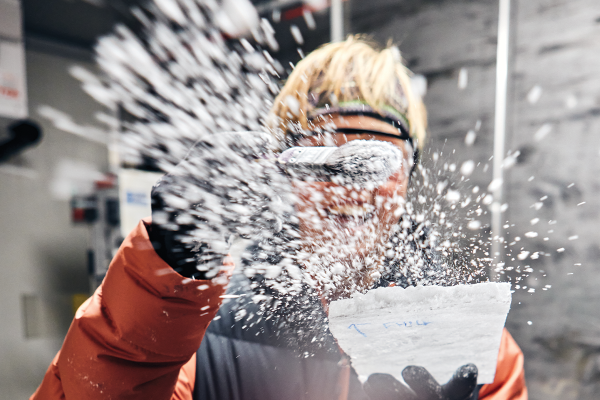
We have an ice lab on campus. If you’re standing on the bridge over the Leith on Clyde St facing toward the harbour, you’ll see it: two blue shipping containers in a parking lot, set to a temperature of minus 8 degrees. The ice lab was set up around two years ago for students who’d previously had to complete a lot of their work bending over deep freezers to stop their subject matter from melting. There are four or five postgraduate students working in the lab, including Zoe MacClure, a Master’s Geology student studying ice. What she does is more complicated than that, of course, but if she were a Ken, her job would be Ice. Zoe said that when she first was offered a postgraduate project working with ice, she was of the opinion that ice was “just all white and boring and there’s nothing going on there.” And we were tempted to end the interview there, but we didn’t. Like the unassuming exterior of the shipping container labs, “actually there’s a lot of really interesting processes going on and a lot of really beautiful things come out. I mean, as you can see,” she said, gesturing at the photos taken from inside the lab. While many of her peers work with ice experimentally, Zoe’s is one of the few whose research is field-based. This, she said, is something she’s had a “bit of a love-hate relationship” with. She’s studying the stresses happening inside ice on the Tasman Glacier, so she can apply those findings to ice in the Antarctic. Obviously, this is a bit harder to access for samples. Ironically, she had the opportunity to spend three and a half weeks in Antarctica for a different project earlier this year to test ice core drilling equipment. It was well into the sub-forties while she was there: “Frostbite was a very real concern,” she said. But it’s nice and toasty in the ice lab’s puffer jackets. Mostly. She’s taken three trips as part of her research to the Tasman Glacier, flying there by helicopter. The five-or-so people who travel there at a time set up camp on the ice with freezers and solar power battery generators: “The kitchen sink, really.” After they finish setting up camp, including a kitchen made out of ice, Zoe said that her supervisor treats them all to a martini on the glacier. “He’s got these plastic martini glasses and he’s taken the bottom of it and we use an ice screw… to make a hole [in the ice kitchen] and then our martini glasses can sit in a hole.” Asked if she thought many students would realise that an ice lab was sitting in the middle of campus, Zoe laughed and said, “Honestly? Probably not. I think a lot of people know there’s work done with ice, but then probably just have not even considered how that would be possible - like collecting it in the field, keeping it in the freezer on the glacier and then the nerve wracking process of like driving home with a freezer going in the car and trying to keep everything cold enough… As soon as you cut the ice out, because it’s so warm in New Zealand” - compared to Antarctica, I guess? - “it’s just gonna melt, and we want to get it back here safely,” said Zoe. She described the paranoia of worrying there might be a power cut, rendering the entire field trip to collect the ice useless. Next comes the analysis: spending long days wrapped up in a thick puffer jacket and gloves, using a band saw to slice the ice thin enough to see individual crystals. Ice crystals within the “S” squiggle shapes you can see pictured contain valuable data. This is where the “love-hate” comes in: “If you have a bunch of cold room days in a row it’s exhausting… you just don’t want to go back in there,” said Zoe. “You just feel drained for the rest of the day.” Next time you complain about how cold your flat is, think of Zoe and her colleagues spending all day in a room colder than your fridge. For science, or something.
-
Columns
 Issue 21 03/09/2023
Local Produce | Imperfect Creatures
Just last week, Dunedin-based fashion brand Imperfect Creatures, designed by Ethan Cruise, was shown on the New Zealand Fashion Week runway. Critic Te Ārohi caught up with Ethan about his latest collection ‘MOTION’ and what else we can expect from Imperfect Creatures. The first item available by Imperfect Creatures was a tote bag. It was designed collaboratively between Ethan and Molly Willis (our talented designer). Ethan reached out to Molly after she posted an illustration on her socials. This face went on to be the logo for Imperfect Creatures and the focal design point of the tote bag. “We both lost our minds a bit,” Ethan said of the reception. Their initial run of twelve bags sold out in 24 minutes. “We put so much work into those tote bags. Every detail that we thought of, we included.” This was back in 2021. At the time, Ethan was halfway through his bachelor of fashion design at Otago Polytechnic. In its initial stages, Ethan had envisioned calling the brand ‘Imperfections.’ It referenced the styles of clothing coming out of brands from the US and Europe, “a really messy raw style” that were inspiring his own sense of style. Unable to access such clothes, due to price or inability to ship to NZ (“most of the time it was both,” Ethan admitted), he emulated their design choices into clothing he made for himself, like leaving exposed seams and choosing fraying over hemlines. The evolution of Ethan’s designs has revolved around how to retain this style while ensuring the quality and long-lastingness of the garment. “The more that I keep designing, the more I refine it.” When we chatted last month, Ethan’s first capsule collection was yet to drop. Titled ‘MOTION,’ the release dropped for pre-order two Fridays ago and features eight pieces including jeans, a singlet a trucker hat, necklaces, a ring and a handbag. It’s the first of three planned drops, with Ethan aiming for three months between each drop. The ethos of quality over quantity is continued in Ethan releasing in capsule collections. Items, such as the jeans and jewellery, are made-to-order, ensuring that there’s no deadstock leftover. Other pieces are made in limited quantities. Each capsule has “a name that will embody my thoughts or my emotions, or whatever I was feeling when I was making this body of work.” Since completing his studies, Ethan’s focus has been on making Imperfect Creatures his full-time gig. The transition period between wrapping up at Polytech and being able to release his first drop has been difficult. “[I’ve been] pretty hard on myself… but I’m really excited to be at the point of getting close to that.” Ethan described being based in Dunedin and sharing a studio with other motivated creatives and mates, as special. “I’m really fortunate for the people that I’m surrounded by.” Aware of the pressure creatives feel that in order to make it, they need to establish themselves in bigger cities or overseas, he’s found Dunedin to not only be apt but has the potential to be a nurturing and unique creative centre. “It's completely dependent on what you make it, and who you keep around you. I'm really excited to be able to do something for Dunedin, and obviously for myself. I really want to put a mark on Dunedin before I leave.” The ‘MOTION’ collection is out now. You can shop it at imperfectcreatures.net/shop. You can also keep up with Ethan upcoming drops on socials (@imperfect___creatures).
-
Columns
 Issue 20 20/08/2023
Local Produce: Keira Wallace
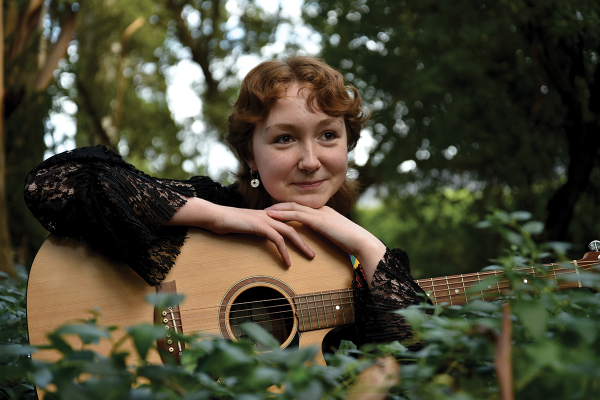
Not many high schoolers can say they’ve performed alongside their musical heroes, but for Ōtepoti singer-songwriter Keira Wallace, this will soon be a reality. Critic Te Ārohi caught up with Keira about their music and exciting upcoming projects. Of creating music, it was the songwriting that Keira was drawn to first. “Growing up, I always loved writing. I started a little writing club in primary school, we’d write every break and have a little prompt.” For Keira’s eleventh birthday, their mum gifted them with a guitar, starting their passion in music. “[They] just went hand in hand…I’d started writing original stuff as soon as I learned enough chords.” This year, Keira also started learning violin, a sound they hope they can bring into their music in the future. Keira describes their sound as what would happen if you gave inanimate objects – like wool blankets, moss and tea cosies – brains and musical instruments, and made them play music. “In a less abstract sense, it’s like indie folk.” Keira’s songs are often woven with imagery of nature. “I like to keep my music quite abstract. I use themes of nature to reflect what's going on in my life and to help me process what's happening around me.” Keira likens their songwriting to therapy, grateful for it as an emotional form of processing, given that they consider themself to be quite logical day-to-day. “I'm quite introverted. I don't really cope by talking to other people about what's going on with me. So it's a great way to have that conversation with myself and actually, to reflect on it rather than putting it aside.” A musician that inspires Keira is Phil Elverum, of American indie projects Mount Eerie and The Microphones fame. “He's so raw and authentic with his work. You can tell that he's not writing music with an audience in mind, it's purely to process his experiences and that really resonates with me.” In an absolute dream-like sequence of events, Mount Eerie is not only playing a show in Ōtepoti, but Keira is also opening. It’s been a fruitful time for Keira. This year, they competed in the duos category of Otago Rockquest alongside a friend. The pair came first place, advancing into the national heats. In June, Keira was in Auckland recording a track at Parachute Studios with producer Abigail Knudson, who performs as MISSY. The song itself came out of Keira’s experience in Song Hubs Ōtepoti, a week of intensive songwriting with fellow artists, where each day sees a different artist lead an original songwriting session. “The day that I was the lead songwriter, we tackled quite a big topic for me. It was really cathartic finishing that day after seven hours straight of songwriting.” The track will be released later this year. Keira is also performing at this year’s Amped, after partaking in the programme last year. They recommend the programme to other youth pursuing music, as well as to “drag your friends into learning instruments.” Though Keira often performs alongside musicians of a different age group, they’ve felt supported in the scene but would love to see more younger performers. “I don't feel hindered by it at all or discouraged, but I think I would feel a lot more safe and understood, if there were more younger artists like me.” You can keep up to date with Keira on socials (@keirawallacemusic). You can catch Keira in a month’s time opening for Mount Eerie and Black Belt Eagle Scout at Dive on 29 September.
-
Columns
 Issue 19 13/08/2023
Local Produce: Small Press Fest
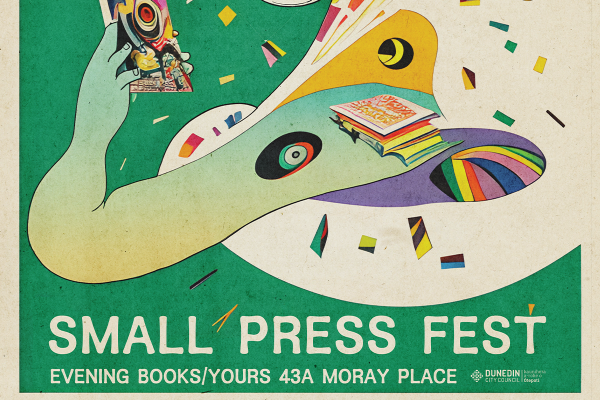
This weekend launches the inaugural Small Press Fest. Critic Te Ārohi caught up with the festival’s creator and curator, Frances Pavletich of Evening Books, on the whats and whys of a dedicated fest to small press. Small Press Fest runs from August 18-20, hosted at Evening Books and Yours café. The festival brings together small-presses, independent publishers and writers from across Aotearoa to host workshops, panels, discussions and readings. GLORIA, Lawrence and Gibson, 5ever Press, Compound Press, Left of the Equator, Gabi Lardies, and magazines, Newzician and Ratworld, will all be present to share their journeys in the world of indie publication. Closer to home, the Dunedin Youth Writers are hosting a reading of their works, and a collaborative discussion-based event between Blue Oyster Project Space and Point Design. Frances’ bookshop, Evening Books, was realised with a dedicated focus to Aotearoa writers and small presses. This kaupapa is extended by Small Press Fest. Small press as an alternative to mainstream publishing has always been of interest to France, especially in its focus on emerging and experimental texts and authors. “A lot of these presses or publications, they're filling a gap in our ecosystem and they are supporting so many of our emerging and experimental texts. Without them there just wouldn't be a place for that.” In creating Small Press Fest, Frances has created a time and place for small presses to be celebrated, and to connect with one another and new audiences. It also validates the form. “It’s supporting the underdog and supporting viable alternatives to mainstream publishing,” shares Frances. “And that not necessarily being just a stepping board into bigger publishing. That that in itself is a valid alternative.” Small Press Fest was fortunate enough to receive DCC funding. This was the first step in allowing Frances the means to put together this festival, ensuring that all the creatives involved are financially compensated for their time, work and travel. Frances also ran a Boosted campaign to make up the final costs and it was met by overwhelming support. “A lot of people coming to talk will be able to talk to that,” shares Frances on the similarities between hosting an independent event and indie press. “I want the public to feel like things are possible. That you can reach out into these things and people will support you… knowing that your communities will rally around you.” As the absolute point of wrap-up of the festival, a book object will be created. It will be an experimental and collaborative account of the event; a coincidence of the kaupapa of the event, the space, and indie presses as an opportunity for collaborative and experimental practice. The collective effort is led and inspired by the visiting 5ever Press and will be printed and distributed to exist as a memento, supported by UNESCO City of Literature. In creating the festival and this particular book object, Frances was inspired by the Wellington indie publishing scene centred around Trades Hall, where much of the presses above exist separately but share the same machinery of Rebel Press. “I really want people down here to see that and to be able to imagine a possibility: if we had the actual press, if we had the machinery, what we could create.” There are multiple workshops across the three days, ‘whatever by 5ever’ in which you can contribute to the object. You can find the Small Press Fest schedule online at spf23.eveningbooks.nz and you can also get updates on Instagram (@smallpressfest23).
-
Columns
 Issue 18 07/08/2023
Local Produce: Fairuza
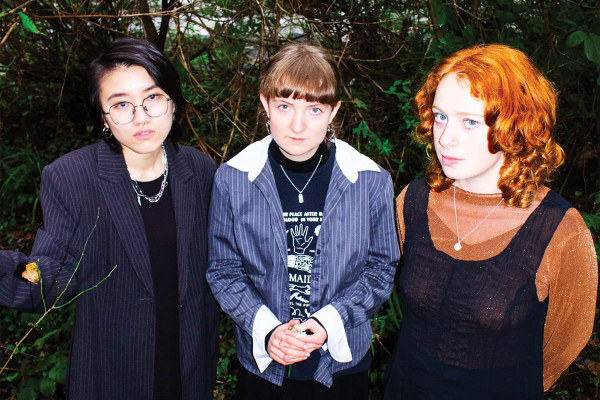
Fairuza is new to the Ōtepoti music scene, but is making a quick and strong presence. As one of the few gender queer bands in Dunedin, Fairuza have established themselves as the band to follow. Only forming this year, members Phaedra (guitar/vocals), Lucy (bass/vocals) and Vzynn (drums/vocals) have managed to open up for Vera Ellen and Soft Plastics. Critic Te Ārohi caught up with Phaedra and Lucy to inquire on the bands quick success. The name Fairuza comes from the 1996 cult classic film The Craft which stars actress Fairuza Balk. “It was my manager’s partner’s idea,” shares Phaedra. “She thought it would be a cool band name and we liked it.” The film itself is about a group of girls who use witchcraft against their enemies which has inspired the tone of the group, even naming a song ‘Fairuza’ and using dialogue from the film as lyrics. “We liked the magic vibe and especially with no men in the group.” Phaedra started playing guitar at ten, while Lucy started piano at eight and has since learnt guitar, clarinet and bass specifically for Fairuza. Their songs consist of themes of magic, independence and heartbreak. Talking about the songwriting process, Lucy shares their “writing is mainly feeling-based. I like words that sound cool together.” For Phaedra, it’s a lot more abstract.“I will write a lyric and then figure out what it might mean and then the song would be about that.” Both Lucy and Phaedra also pull from lyrics they’ve written in the past, with Lucy compiling all their potential lyrics ever in a document and Phaedra even incorporating lyrics she had written when she was 17. “I want to write more narrative based stuff,” Lucy shares. “I’m really into astrology right now.” The band has an equal share in the writing process, both lyrically and musically, and describe the sound as reminiscent of Look Blue Go Purple, The Chills, Warpaint and other Dunedin Sound acts. Phaedra cites Vera Ellen as an influence and was excited that they were able to open for Vera. “I talk about her too much. We actually hugged.” The band may seem limited, only consisting of guitar, bass and drums, but a fresh lyrical perspective, unique vocals that are both confident and vulnerable, and a talent for finding catchy melodies make Fairuza a stand-out in the male dominated scene. “I think it’s cool being a female/gender queer band in Dunedin since there are very few,” shares Phaedra. Lucy is also in Riot Gull, a popular gender queer band in Dunedin, and had Fairuza open for their Goodbye Gull show. Fairuza seems only to improve more and more each gig, becoming more comfortable in themselves and the music they play which is why they are one of the most exciting bands to see in Ōtepoti. You can catch Fairuza at this year’s Dankfest, the iconic annual two-night event at The Crown on the 25-26 August. They’re also part of the upcoming project, Ōtepoti Music Compilation, which brings together a compilation of music by wāhine and gender-diverse musicians of Dunedin. You can follow Fairuza on Instagram at @fairuzaband for updates on upcoming gigs and events.
-
Columns
 Issue 17 31/07/2023
Local Produce: The Audio Visual Dropkicks
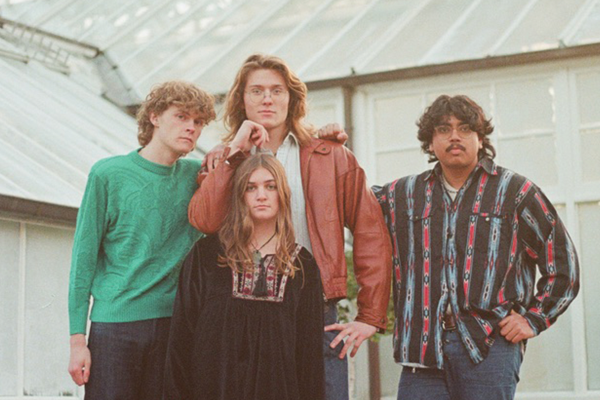
They’re only second-years, but The Audio Visual Dropkicks have dropped in big to the Dunedin Sound, already playing a fair share of ski club parties and even following Hans Pucket on the road for two shows last month. Critic Te Ārohi chatted with the band about their freshly released EP ‘Greenhouse’. The Audio Visual Dropkicks are Kaia (rhythm/vocals), Jeremy (bass/vocals), Shaarav (drums) and George (lead). AVDK’s origins start before any of their time at university. George and Jeremy were first to play in a band together, starting in high school after growing up together as family friends. Both went to Carrington College as first-years where they decided to keep the band going but needed a new drummer post-move. Very keen to kick off uni being in a band, it was Shaarav who answered the call in a group chat. “It all happened fast,” shares Shaarav. “They had a bunch of original songs already written. We were like ‘we could play a gig by Friday’.” And that’s exactly what they did, having their first practice on Sunday to then playing a gig for their entire hall on the following Friday. Kaia joined the band at the start of this year after a unanimous decision in response to a band lineup change. “They wanted a girl. They thought it’d be a point of difference,” Kaia jokes. She received the call on the high of just attending a music festival, recalling her reaction as saying “this is the best day of my life.” The band describes their sounds as maximalist, while also incorporating themselves into the larger streams of surfy-indie-alt rock. “Music that a lot of people can pick up quickly and sing to,” says Jeremy, describing this shared experience as one of his favourite things about making music. They all contribute to the songwriting. “It’s really cool to aim to take our experiences and our feelings, and ones from our friends, and be able to try make songs that feel like that,” says Kaia. AVDK are also inspired by the scene itself. “There’s been a whole lot of really exciting local bands paving the way for us and [who] have been real big inspirations,” shares George. The band agrees they’ve lucked out coming up as a band at this time. Their debut EP ‘Greenhouse’ released last Friday. The five tracks span from older songs to new ones written in their current iteration. Kaia puts it best: “It’s a representation of everything that we have been, and an indication of the different things that we want to be going for.” Their lead-up single ‘Ceviche’ is one of their most enduring tracks from their high school days. It’s a dreamy, longing number that George describes as “school dance meets ‘Under the Sea’.” It’s changed as the band themselves have changed and grown older, but retains emotion that Jeremy describes as “reminiscent of some of the feelings [and] romantic experiences of that period… There’s a song on there for everyone. It’s pretty diverse, but it’s definitely all us.” AVDK celebrates the release of ‘Greenhouse’ with their EP release gig this Thursday, August 3, at U-Bar. They’re opened by The Beatniks and IVY. Over the next month they’ll also be embarking on a South Island release tour with stops in Wanaka, Queenstown and Christchurch. In-house designer Shaarav has designed some merch for the release too that you’ll be able to cop to support them. You can stream ‘Greenhouse’ and keep up with AVDK on socials @audiovisualdropkicks. https://www.instagram.com/audiovisualdropkicks/
-
Columns
 Issue 16 24/07/2023
Local Produce: Paradox Princess
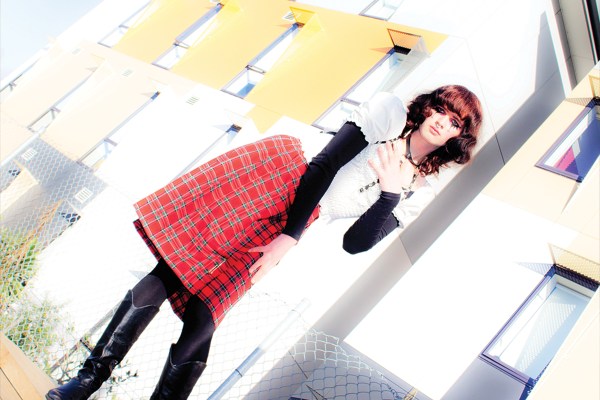
“Quite like Barbara but don’t fuck with cops, I’m coming to Shorty in a crop top,” Paradox Princess spits on her track ‘Utopia For Sale.’ Critic Te Ārohi caught up with Paradox Princess to talk about her upcoming album ‘Creating A Time Paradox.’ Natasha Munro Hurn has been active in the music scene since she was in high school, as a guitarist and vocalist in a punk band. Natasha’s current creative project as Paradox Princess continues her initial beginnings in DIY punk but also pushes into the experimental in its blend with hyperpop and hip-hop. “It’s always been hip-hop and electronic music. I was raised on that as much as punk.” Like punk, things intrinsic to hip-hop such as creating big noise out of little resources and sampling appealed to Natasha. “No one’s gonna tell me off if I decide to cut up a Sailor Moon dub and try to make a beat out of it. It was that freedom, that was the first thing that drew me in.” Inspired by artists like Danny Brown and JPEGMAFIA, Natasha wanted to put her own experience into it. “I really wanted to hear, like, a queer version of that, one that talks about, you know, transness and giving middle fingers to TERFs.” “I would say it’s a mixture of hyperpop, experimentation, hip hop and punk, all mixed together in hopes of some kind of messy version of queer joy,” Natasha says of her upcoming album. It also confronts local homophobia and transphobia. In the process, she also gets “to make silly, stupid, noisy music that scratches an itch in hopefully other peoples’ brains.” Creating the project Paradox Princess occurred at the time when Natasha came out as a non-binary trans-woman. Her songwriting has added to her affirming her trans identity. “It helped me, when you’re dysphoric and stuff, to write, you know? Like ‘I’m a baddie.’ Or express the beauty in myself. It really builds myself up.” The expression of queer joy in this album is an extension of Natasha’s acceptance of her queerness and, in putting it out in the world, she’s hoping to uplift other trans people. “I’ve had a long road to get to this point. I’m finally very comfortable with my transness.” Listening to ‘Creating A Time Paradox,’ you can expect to hear pop culture references in transitions between tracks that rely on samples from blockbuster films to video game sounds. Natasha’s beat-making setup is completely digital and tracks often begin as her emulating the style of an artist that inspires her. “Usually what happens is I’ll have one core idea. As soon as I keep going, it’s transformed into something completely different.” In Paradox Princess, there’s also the meeting of gritty distortion and biting lyricism (check lyric: ‘middle finger to the Hiluxes’) with visual and sonic references to the peak aesthetics of cute core. These reflect Natasha’s interests as well as aesthetics of her background in photography. She studied a Bachelor of Visual Arts that she finished in 2021. “I am, like, obsessed with – at least in my photograph work – over-saturation… It’s always good to have some sort of lightness or saturation. I love very colourful things. I think it does come from a love for anime with how bold and exciting it can all look. ” ‘Creating A Time Paradox’ releases this Friday 28 July and will be available on streaming sites. You can keep up with Paradox Princess on socials (@paradoxprincessxox).
-
Columns
 Issue 15 18/07/2023
Local Produce: Soul Chai
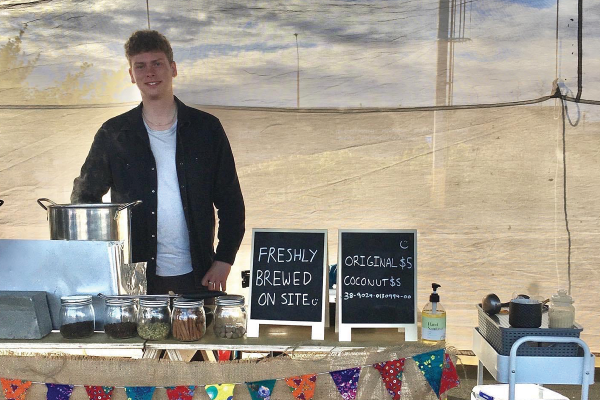
While you’re retiring from kick-ons in the early hours of Saturday, Daniel Fitzpatrick is up and brewing the perfect cure to nurse your hangover and winter blues. Critic Te Ārohi caught up with Daniel to spill the tea on his farmers market venture, Soul Chai. As Soul Chai, Daniel brews fresh, warm chai at the farmers market each Saturday. “Everything is done on the day. Normally, about six o'clock, I'm grinding up spices. Seven o'clock, it's all in the pots and boiling away. Eight thirty, we're ready to serve.” There are two flavours, original and coconut, and we can confirm that they are both delicious. From Monday to Friday, Daniel works as a town planner. He majored in Geography in his undergrad, then completed a postgraduate diploma in Environmental Management. Though the early Saturday starts can be rough, spending his morning serving chais and yarns at the market makes for a good balance after a week in the office. Soul Chai was initially started by his friend, Sophie Richards. She and Daniel began developing the chai stall in the final year of her BCom, after she spent some time travelling in India. Dan and Sophie worked on Soul Chai together for a period before she left Ōtepoti for a job in Auckland. It’s been a year since Daniel took over running the stall. Even before Soul Chai, the weekly farmers market trip was the usual for Daniel. “I was coming to the farmers market for a solid year before I got a stall here. It’s really cool going from being someone who would shop at the stalls, to having your own stall.” Already knowing some of the vendors made Soul Chai’s beginnings at the market easier. There’s also a lot of support between vendors, who are encouraged to use each others’ produce in making their own produce. For Soul Chai, this means using milk from Holy Cow, a small dairy farm out in Port Chalmers. “It’s a really great community. Everyone’s trying to support each other and wants everyone to succeed.” In the future, Daniel plans to roll out his chai in loose leaf bags so people can brew their own at home. He’d also like to add a permanent third flavour, a cacao-infused chai in collaboration with CoKo Lounge. If you’re already a long time enjoyer of Soul Chai, you may remember they’ve collaborated before, last year back when CoKo Lounge were also part of the farmers market. There’ll also be some future fundraising days, the profit from which Daniel plans to donate towards Dog Rescue Dunedin, a local charity that rehomes dogs. “I’ve had a couple of gigs where we’ve put around $300 straight to the puppies,” he says. Soul Chai is also a business sponsor for Dog Rescue. “Aside from using this money to buy beer, I can help out in the community with it. It’s really fun.” There are a lot of reasons why the farmers market is a much more wholesome experience than shopping at some chain supermarket. For Daniel, it’s about “knowing where your food is from and who it’s made by,” a topic he focused on throughout his studies. “You come down here, the food is organic. You know that it's been planted with love and looked after. And it’s cheaper.” Supermarkets really have us believing local, sustainable and cheap is impossible. Be sure to pop down to the Dunedin Farmers Market, every Saturday morning till noon at the Dunedin Railway Station. Pro tip: a cup of Soul Chai is the perfect hand warmer for your wander.
-
Columns
 Issue 14 09/07/2023
Local Produce: 3D Printed Nipples
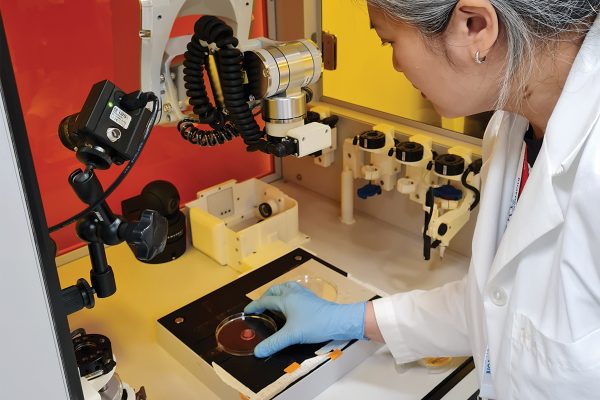
Research Associate Professor Jaydee Cabral is an Otago researcher and lecturer who is taking 3D printing to a whole new level. Her lab is going to be printing nipples. Yes: printing nipples with a 3D printer. Of all things to 3D print, why nipples? Jaydee has a good reason. She is going to be working on making customizable nipple implants for breast cancer patients. The printed nipples are being designed for those who’ve had mastectomies and are getting breast reconstruction. “There is nothing clinically available for mastectomy patients in terms of nipple reconstruction,” says Jaydee. There is only one option (it’s called ‘skin flap suturing’) and it “only creates a semblance of a nipple.” It is not a great option. “There are high rates of infection, multidirectional scarring, and it is often repeated multiple times,” says Jaydee. 3D bioprinting customised nipples is a huge step forwards in providing a safe and reliable option for these patients. Bioprinting is the same as 3D printing but, rather than plastic, the ‘ink’ is a mixture of biomaterials (biologically compatible materials) and living cells. The idea behind 3D bioprinting is that the printed construct is not just an implant, it is a piece of living tissue infused with the patient’s own cells which allows it to be accepted into and become part of the body. Jaydee’s work is a project that goes beyond Aotearoa; she has just received a grant worth $80k to collaborate with the University of Maryland’s (USA) Professor John Fisher who has been leading research surrounding the design and printing of the 3D printed nipples so far. The Fisher lab has developed the process of printing these nipples and customising them. They scan the nipple and get the digital blueprint for the printing from that scan, meaning they can make a replica of the patient’s original nipple. “To link the South Island, New Zealand, with an international leader in bioengineering and access to the latest in cutting-edge next generation healthcare technologies is incredibly exciting,” Jaydee says. Her main focus will be incorporating blood vessels into the 3D printed nipples so they can survive in the body, a process called ‘vascularisation’. The vascularisation process is key, as the remaining hurdle for this project is to keep the cells in the printed nipple alive. In a natural nipple, there are thousands of tiny blood vessels providing the cells with the nutrients and oxygen they need to survive. But in 3D bioprinted nipples, this is pretty hard to do. This is where Jaydee comes in, as vascularising 3D bioprinted tissue is her area of expertise. It is an incredible project which Jaydee could hardly contain her enthusiasm for, especially the opportunity to play with the BioAssemblyBot, a robot that bioprints, transports, and completes experiments on living tissues. Jaydee is currently looking for a Masters student to join her in developing these vascularised nipples: “Any student with a STEM background would suit!” The lucky student would be trained up and get the chance to travel to the University of Maryland to do some work in the Centre of Complex Tissues, the home of the BioAssemblyBot. Jaydee promised that “if you enter this dynamic field, you will never be bored!” It also helps that there is a high demand for bioengineers. Free the 3D-bioprinted nip! If this sounds like a bit of you, get in touch with Jaydee at jaydee.cabral@otago.ac.nz. You can also learn more about Jaydee’s research here:
-
Columns
 Issue 13 29/05/2023
Pōpopo - Jamiema Lorimer | Local Produce
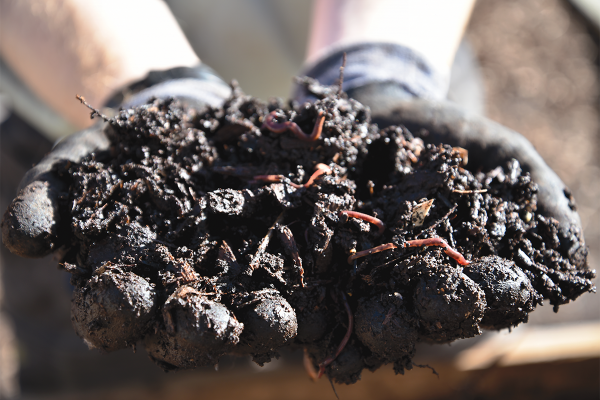
Would you still love me if I was a worm? Pōpopo wormporium, the composting initiative of Otago Polytechnic, definitely would. Critic Te Ārohi caught up with Liam Hoffman and his worms to find out more.
-
Columns
 Issue 12 21/05/2023
Local Produce: Je Pleure
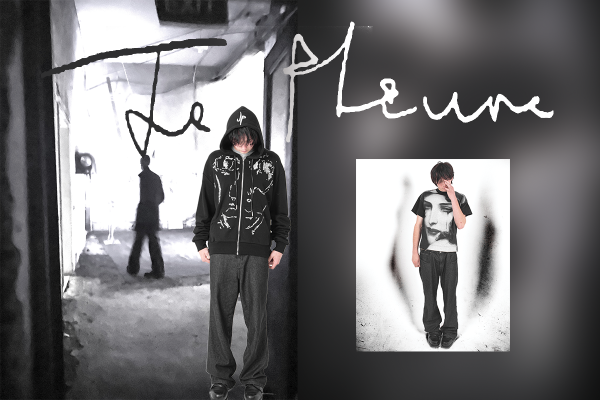
Je Pleure is a fashion brand established by Jack King. Critic Te Ārohi caught up with the young designer from Ōtepoti.
-
Columns
 Issue 11 14/05/2023
Local Produce: The Beatniks
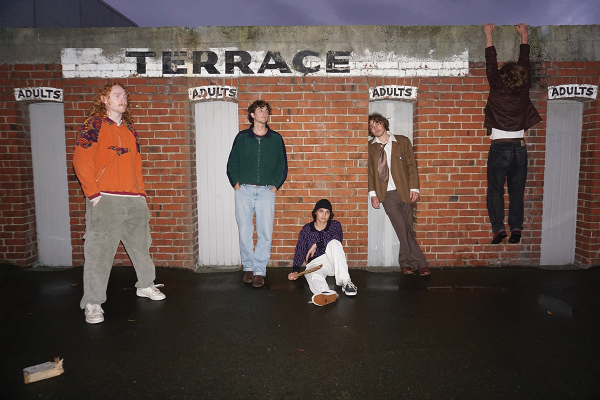
The Beatniks are named after the track ‘Beatnik’ by OG Dunedin Sound band The Clean, which itself makes reference to the Beat Generation subculture of the 60s. Although what The Beatniks do is different to what happened in the 60s, they’re part of a subculture of their own: the Dunedin sound and student scene. Critic Te Ārohi caught up with the band amidst a busy month of shows.


