
Carla Green
Contributor
Articles by Carla Green
4 articles found. Displaying page 1 of 1.
-
News
 Issue 2 01/03/2015
What You Need To Know: The Trans-Pacific Partnership Agreement (TPPA)
I f you type “TPPA” into a search engine, the first result will probably be the website of It’s Our Future NZ, a hub for anti-TPPA activity in New Zealand, decorated with a handy countdown to the next action organised against the agreement. The second will probably be Greenpeace’s webpage viciously condemning the agreement. What you might not find, however, is much information about what you’re actually searching for in the first place. What you’re searching is the acronym for the Trans-Pacific Partnership Agreement, which has been in negotiations since 2005. It is an agreement to set out the terms of the Trans-Pacific Partnership (TPP) between a number of countries on both sides of the Pacific. New Zealand is an original signatory of the partnership. Negotiations over the terms of the TPPA were set to wrap up in 2012. However, they proved to be so contentious that, three years later, they are ongoing — and heated. Here, on this page, we’ll lay out the guts of the Trans-Pacific Partnership Agreement for you, so you can understand what it is and why everyone’s so riled up about it. The Players There are 12 original signatories of the TPPA, including New Zealand and the US, but a number of other countries have declared interest in participating in the negotiations. When the TPPA emerges from negotiations, it may become the world’s largest economic trade agreement to date. The Basics According to a page dedicated to the TPP on the New Zealand Ministry of Foreign Affairs and Trade’s website, “the TPP aims to create a regional free trade agreement … [that] would deepen economic ties between its diverse members by opening up trade in goods and services, boosting investment flows, and promoting closer links across a range of economic policy and regulatory issues.” Nowhere on the page are there details about how, exactly, the TPP will do all of that. That omission isn’t an accident — it’s by design. TPPA negotiations have become famous for their secrecy — almost everything that the public knows about the TPPA has come from a series of high-profile leaks of chapters of the agreement. In the most basic terms, the TPPA is a multilateral trade agreement. It will regulate and favour trade between signing countries. However, it’s become clear from leaked documents that the TPPA is not a “standard” trade agreement. The degree of regulation outlined in the leaked drafts of the agreement goes beyond what could generally be considered normal for a trade agreement. The leaks have shown that the TPPA encompasses a wide range of issues, including, notably, prosecution for digital copyright infringement, enforcement of pharmaceutical copyright and the process by which a corporation might sue a signing country’s government. The Controversy In the context of the secret negotiations and alarming leaked information, a robust movement against the TPPA has formed. Here, It’s Our Future NZ has spearheaded protest efforts. This involved helping to coordinate the New Zealand branch of an international day of action against the agreement this past November, and another one planned for 7 March 2015. While the TPPA has been kept secret from the public, a number of large corporations have been able to see (and likely influence) its contents. Many critics have suggested that the agreement will be more favourable to certain deep-pocketed corporations than to any of the signing countries. In 2013, WikiLeaks published 30,000 words of the TPPA, which comprised the chapter on intellectual property and copyright infringement. The terms laid out in the chapter would likely drive up the price of many medications in New Zealand (and in other signing countries), because they would increase the time that patents last for (thereby limiting the possibility of cheaper, generic brands being on the market). The leak also revealed that the TPPA would probably require much harsher penalties for intellectual property infringement, especially for digital copyright infringement and hacking. There’s another problematic aspect of the TPPA, which the public learned about when the investment chapter of the agreement was leaked in June 2012. Provisions in the chapter would give transnational corporations the right to sue signing governments if they do anything that would deprive those corporations of expected future profits. The lawsuits would be heard by international tribunals, not the country’s domestic courts. New Zealand has signed other treaties with similar provisions, but never with countries like the United States. Many corporations based in the US are big investors in many countries, including New Zealand, and have a reputation for using their power to sue foreign governments. If the government is worried that they will be sued by a big corporation with significant investment in New Zealand, “it will have a chilling effect on the ability of New Zealand and other signatories to pass certain legislation,” Green Party MP James Shaw told Critic. Then there’s the question of negotiating an international trade agreement in total secrecy. Many people say that — no matter the terms — such a monumental trade agreement should not be negotiated in secret. In response to a question about why the TPPA negotiations were being kept so secret, Trade Minister Tim Groser replied that it was to avoid an “ill-informed” public debate about the issue. Of course, there’s no better way of ensuring that a public debate be ill-informed than by deliberately blocking public access to information. In a phone interview with Critic, former CEO of Oxfam New Zealand and 2014 Green Party candidate Barry Coates said, “There are potentially other [problematic portions] as well, but until we get ahold of the text, we don’t know how serious the other considerations are.” Potential Benefits Ever since New Zealand first expressed interest in the TPP, critics have been asking a basic question: why is New Zealand interested? John Key and Tim Groser both argue that the TPPA would be a boon to the New Zealand economy, which is highly oriented towards agricultural exports. A 2011 study found that signing the TPPA could lead to a $5 billion yearly growth in New Zealand exports, among other benefits, according to what was then known about the negotiations. But a later study, in 2014, looked at the analysis used in the 2011 study and concluded that less than a quarter of the potential benefits identified would likely pan out. Groser has said, publically, that New Zealand would walk away from negotiations if the final agreement wouldn’t benefit New Zealand farmers. But Coates expressed deep scepticism about Groser’s claims. “The biggest barrier to New Zealand exports isn’t tariffs, but subsidies, which aren’t up for negotiation,” he said, adding, “And [the final agreement] will be a long way from the full liberalisation that Tim Groser has said would be the only thing that’s acceptable.” In any case, according to Shaw, it’s unlikely that the US market for agricultural goods will open as much as some might hope. “The United States farm lobby is very powerful and very resistant to opening up to foreign imports,” he said. “There might be a partial opening, but it’ll be limited.” The critics of the TPPA are many and varied: from those who think it won’t bring enough benefits to New Zealand to those who think that the cost is too great for any potential gain. And, for now, critics of every variety will continue to gather in the streets and demand change. Saturday 7 March 2015, STOP THE TPPA National Day of Action has a protest march leaving the School of Dentistry, Great King Street, Dunedin at 1pm, heading towards the Octagon.
-
News
Issue 2 01/03/2015
DCC Goes Green
T he Dunedin City Council has presented its Sustainability Audit Subcommittee with a draft proposal to reduce greenhouse gas emissions. The goal is to cut emissions by five per cent of 2013–2014 levels before 2019. The plan comes as the DCC prepares to vote on an ethical investment policy that, if passed, would effectively divest the council from fossil fuels and mark a political shift towards fighting climate change. Jinty MacTavish, DCC councillor and member of the Sustainability Audit Subcommittee, said that the DCC’s plan is still very much a draft. At this stage, the plan doesn’t list the actions that would be taken to achieve the target. Further, the target itself is based on measures that have already been approved by the council under different proposals. “I would be interested to see how ambitious we’re being and which actions would be necessary if we wanted to make more of a hole in emissions,” she said. According to a report on emissions that accompanied the draft plan, 75 per cent of the DCC’s emissions come from its landfills. The DCC has only partial control over the reduction of those emissions, as it depends on how much waste residents bring to the landfills. MacTavish said, “It is difficult to be ambitious” as DCC operations such as landfill “are a direct reflection of the activity of our citizens.” MacTavish said she is optimistic that Dunedin citizens’ activity — like the amount of waste they bring to the city’s landfills — might be shaped by a city-wide environmental strategy that the council is working on. A public consultation on the strategy is expected to be held in August. Colin Campbell-Hunt, Director of the Otago Business School’s Accountancy and Finance Department, said that, given the DCC’s relative lack of control over landfill emissions, it should focus on other measures. “Obviously, a five per cent reduction is nowhere near enough,” he said. “We should focus on [reducing emissions in] areas where relatively good technology does exist, like public transport and electric cars.” Mayor David Cull said there is a possibility that the target could rise above five per cent, but only if the plan proposes actions that haven’t yet been approved by the council. Councillors would then have to vote on any new actions before the plan could proceed. “Without Council’s conscious approval, we could not aim for something that’s higher than [five per cent],” said Cull.
-
News
Issue 1 22/02/2015
Backlash over University Council amendments
A bill amending the 1989 Education Act has come under fire recently from university student associations around New Zealand. In addition to creating a new professional body for teachers — a move that infuriated the Post-Primary Teachers’ Association (PPTA) — the bill aims to decrease the current size of university and wānanga councils. The previous requirement that at least three seats on the councils be reserved for members elected by students and staff will be removed. Councils will decrease from 12–20 members to 8–12, though the number of ministerial appointees required will remain at three to four members. OUSA President Paul Hunt will be negotiating with the council to ensure that at least two student-elected representatives will remain, even if this means one staff position is “sacrificed”. “As Otago students, we’re focused on ensuring that we maintain, or slightly increase, the number of students we have on the council,” said Hunt. Auckland University Students’ Association President Paul Smith said in a press release that it is “extremely disappointing to see the government push the bill through despite its enormous unpopularity.” Education Vice President Jessica Storey said, “[The amendments] will inevitably affect council make-up, because it reduces councils in size, meaning that only some interests will be protected. Ministerial appointees are protected, and there’s not lots of room left for others, which forces councils to make a decision between protecting student- or staff-[elected members], or people with other skills. It puts a lot of pressure on councils to get rid of students and staff.” Wānanga councils will also be affected by the amendments, although it’s not clear exactly how. New Zealand’s oldest wānanga, Te Wānanga o Aotearoa, currently has a thirteen-member council, including one member elected by students and one by staff. The New Zealand Union of Students’ Associations (NZUSA) made a submission to Parliament, calling changes proposed in the bill “wrong-headed and unnecessary”. The submission also pointed out that ministerial appointments have been overwhelmingly male, white and from corporate or legal backgrounds. In a press release following the bill’s passage into law, Education Minister Hekia Parata responded, “The changes will not affect institutional autonomy or academic freedom, which are guaranteed by section 161 of the Education Act 1989, nor will they lead to more Ministerial control over councils.” Parata added that university and wānanga councils will still have the option of maintaining student and staff seats on the council, and student associations have already begun putting pressure on their councils to do just that. Universities and wānanga have until 2016 to rewrite their constitutions in accordance with the amendments.
-
News
 Issue 1 22/02/2015
O Week heats up
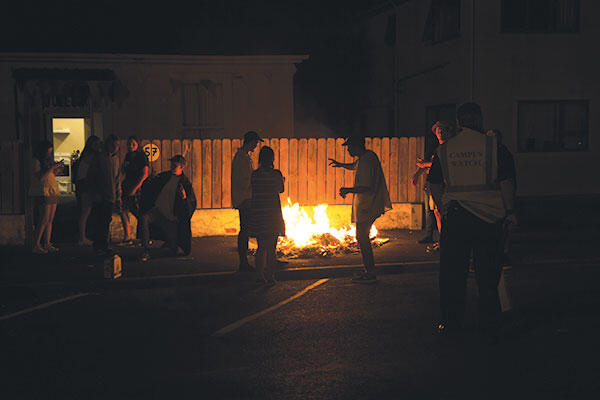
O n Wednesday 18 February 2015, emergency services were called to four separate North Dunedin areas in the early hours of the morning. A house located on Leith Street was left with severe damage to the front porch, as well the front two rooms of the house. The Leith Street residents had not yet set up insurance; however, OUSA has created a Givealittle fundraiser to show support. University of Otago Proctor Simon Thompson said the fire “was started in a chair on the front porch of the property that had been set alight by a passerby.” He noted that the flat was empty at the time. The Southern District Police said in a press release that an ongoing investigation was being conducted on who started the fire, and that it is as yet unclear whether it’s connected with the other fires that night. The release notes that the police are looking into three men who “were seen near the Leith Street address and running away from it towards Frederick Street at about 12.45am this morning.” Lindsay Rae, a Senior Station Officer with the Fire Service, responded to the calls made by residents that night regarding the fires. Rae said the bystander presence on Leith Street was significantly large when they arrived on the scene. “I would presume that the other bystanders were [mostly] students,” he said. Rae seemed resigned to the fact that there would always be arson in Dunedin. “I’d like to think the fires would go away,” he said. “Of course, a person would be naive to think that there would be no deliberately lit fires at all. But the numbers that there are, are out of hand.” Professor Harlene Hayne, Vice-Chancellor at the University of Otago, said in a media release that fires “will not be tolerated” and the university “fully support the Fire Service and Police in their efforts to apprehend offenders who carry out criminal behaviour.” “Our Code of Student Conduct makes it clear that any offence relating to fires and couch burning will result in serious trouble for the perpetrator. We have taken a hard line with students who have been caught lighting fires, and we will continue to do so,” said Hayne. The University Proctor has already issued nearly $4,500 worth of fines for students breaching the Code of Conduct during this Orientation Week, and he said that they will face the “prospect of exclusion from the University as a result of their foolish actions.” Otago Police Coastal Area Commander Inspector Jason Guthrie warned, “if Police catch you or your guests fire lighting this will result in a court appearance but more importantly you do not want a death or serious injury from fire on your conscience.” Given the apparent propensity of North Dunedin residents and/or visitors for setting furniture on fire, the Fire Service has asked residents to keep outside furniture indoors.


