
Sam Fleury
Contributor
Articles by Sam Fleury
12 articles found. Displaying page 1 of 1.
-
Columns
 Issue 27 12/10/2014
Too much screens | Issue 27
Free your mind for a moment of whatever you know of Hannibal Lecter from the cinema. Let go of Anthony Hopkins and fava beans. Don't let go of them completely, because they'll be relevant soon enough, but for now, set them aside. In their place, I want you to picture Mads Mikkelsen in an exquisuitely-tailored and timelessly-stylish suit, as a Hannibal Lecter who, years prior to the events of Silence of the Lambs, has thus far managed to balance his dual lives as both one of the finest forensic psychiatrists in the field, and one of the most successful — and successfully-unsuspected — serial killers around. This feat is made all the more impressive thanks to his new work consulting with the FBI, in particular with highly-strung criminal profiler Will Graham (Hugh Dancy), whose extreme empathy is both the secret to his success and a personal liability. Where other versions of Hannibal Lecter stories are primarily thrillers or procedural horrors, Hannibal the show is first and foremost an account of the intense relationship shared by these two men. The psychological nooks and crannies of Will and Hannibal's relationship — which is in turn intimate, co-dependent, and adversarial — are explored against a backdrop of elaborate, nightmarish murder scenes, rich with metaphor and ripe for psychological interpretation by the FBI's team. The story happens in a hazy, dream-like world where serial killers are common, justice is poetic, and where psychological truth takes precedence over causal realism. While Hannibal might resemble countless case-of-the-week murder dramas, this is no procedural; the clues here are to do with meaning and interpretation, not database searches and guest-star red herrings. Yes, this is a show where people largely stand around and talk about their feelings, but make no mistake, this may very well be the most visually rich and inventive show to ever grace the small screen. Shot in rich blues and deep reds, everything in Hannibal is luxurious and exquisite to behold, even when it's making you squeamish. The food and the murder scenes are both at once beautiful and repulsive. Expertly prepared and tantalisingly presented meals are rendered horrifying in virtue of their ingredients' origins, while the most horrible and twisted crime scenes are made perversely entrancing thanks to the creativity expressed within. In Hannibal, criminals are artists, trying desperately to express themselves through the most profane and extreme medium available. Similarly, the show, through its rich visual style and Brian Reitzell's entrancing and unsettling score, uses the indecipherability and inevitability of death to blow basic human emotions up to the cosmically-important scale that they so often feel. Honestly, I have no idea whether this description is making anyone want to seek this show out, so I should probably emphasise that more than just being psychologically rewarding and intense, Hannibal's operatic nature makes it a heck of a lot of fun. Staying true to the pulpy origins of the books, Hannibal is full of twists and reversals, and anyone familiar with the source material and films will be able to enjoy the way the show plays on the previous versions, re-contextualising lines of dialogue, re-interpreting familiar images, and retelling plot developments from the show's unique perspective. From its beautiful writing to its perfect plotting, sumptuous style and uniformly wonderful cast, Hannibal is an all-around treat. I have never been this excited about every aspect of a show, and assuming you have the stomach for it, it's a show that I unequivocally recommend. That's it from me talking bunk about TV for Critic this year, but thanks for reading, good luck with exams, and keep reading at toomuchscreens. com and on Facebook at Too Much Screens!
-
Columns
 Issue 26 05/10/2014
Too much screens | Issue 26
I'd love to visit New York City. I feel like I know exactly what it would be like. Part of the reason I'm so certain is that there are a bunch of shows I love which largely take place around Brooklyn and Manhattan, which definitely feel like they're happening in the same place. With any luck, that place, that New York, is the real one. The shows I'm thinking of — Louie; Girls; High Maintenance — take place in a city at once bustling and relaxing, grey and colourful, uncaring and highly communal. It's a city where the rent is exorbitant, so everyone's low-key poor, but it's full of places to get great, cheap food, so everyone eats out. It's a city where the unexpected is dependable, and where young adults can find their people, no matter how specific their interests. Broad City is another show that takes places in that same New York. Like those other shows, Broad City is a very loose affair, following the shaggy, slightly surreal adventures of two young women bumbling around in New York. Abbi, an aspiring illustrator but day-time gym cleaner, is the more serious of the two, half-heartedly attempting to control her life, but largely indulging her laziness and desires to buy everything at Bed, Bath and Beyond, while Ilana does exactly what she wants, and is miraculously still employed even though she regularly sleeps in the bathroom stall for most of the day, and leaves whenever she feels like it. If you've seen Peep Show, you can think of them as rough distaff counterparts to Mark and Jez. Unlike the bipolar relationship shared by the El Dude brothers on that show, though, Abbi and Ilana's relationship is remarkable for its strength. Although Ilana's reckless and unpredictable, rather than being a source of conflict, there's a definite sense that's exactly what Abbi values about her. Similarly, Ilana thinks Abbi's the shit, and would do anything for her, including definitely sleeping with her if she was into that. That strong female friendship is important, because as much as the yellow cabs and bodegas, sexual weirdness from gross men is part of the background noise of the New York these girls live in, from the diapered guy who hires them off Craigslist to clean his house for cash, to the greasy, pelvic-thrusting locksmith who shows up when Ilana loses her keys. These guys are so caught up in their sleazy little worlds that they end up implicating anyone they come in contact with, and the girls' response is generally to get to a safe distance, then point and laugh. Looking past the central duo, the rest of the show is filled with hilarious, distinct, secondary characters, in particular Ilana's dentist/sometimes sexual partner Lincoln, played by the inimitable Hannibal Buress. Anyone familiar with Buress knows how particular his brand of comedy is, but it fits in easily here. Even the one-off characters leave an impression, from yoghurt-eating courier depot attendant Garol, to Amy Poehler's martially-challenged chef in the finale, to every one of the girls' previously-unmentioned and probably never-to-be-mentioned-again friends in the episode where they desperately try to get to a wedding. All in all, Broad City is a very accepting show, aware of its protagonists' flaws, but celebratory of the small pleasures they find in each other and the city around them. It doesn't matter if you're terrible at your job, or if the super hot guy you slept with turns out to be terrible at comedy, or if after a day of trying you failed to buy your own weed, like a “real adult;” as long as you have good friends, and live near some of the world's best pizza places, you'll have a good time and things will be fine.
-
Columns
 Issue 25 28/09/2014
Too much screens | Issue 25
An ungodly amalgam of basically the two most disparate genres one could think of — sketch comedy and hospital soap — Green Wing was basically conceived on a dare. A full hour-long in length, each episode of Green Wing is like a little oasis of strange, with comedic scenes of interpersonal drama and intrigue scattered among delightful sketch-like nonsense. The cast is expansive, including people working in many parts of the hospital, from administration to surgery to teaching. However, you're unlikely to get much insight into any of these jobs, as there are few to no plots actually involving medicine. Instead, the hospital largely serves as a serious backdrop to silly shenanigans and soapy relationship drama. Although much of the humour is strongly character-based, it is also consistently surreal, with the characters existing on a spectrum that runs from “fairly out of touch with reality” to “completely bonkers and probably dangerous”. Although all take part in bizarre games and unhinged one-upmanship on a regular basis, some are definitely more out of touch than others: not everyone would try to take out their romantic rivals with a crossbow (the incomparable Sue White) or engage in sapling-and-Puccini fetish play (the always almost-too-much Alan Statham and Joanna Clore). While some surreal shows' weirdness comes at the cost of characterisation, Green Wing's long episodes mean that there is always space for character development as well, and characters' odd behaviour in the more sketch-like scenes can be understood to be an extension of the posturing and uncertainty that underlies their personal interactions. If the show has subtext (and I'm not 100 per cent sure it does), it's that no matter who you are, social life is a performance, and a pretty ridiculous one at that. The seemingly effortless cool of surgeon Mac is contrasted with the try-hard, casual misogyny of anaesthetist Guy, who in turn is mimicked by anxious doctor-in-training Martin. Each of these men's self-image exists in relation to that of the people around them, all in constant competition for the respect and affection of each other and the rest of the hospital staff. Similarly, new hire Caroline is intimidated, and lets herself be walked all over, by confident blonde doctor Angela; and administrator Joanna, who is having a serious age and femininity crisis, often finds herself trying to gain the acceptance and respect of the indifferent young women who work under her in the office. The only person who exists largely above the interpersonal posturing is the puckish head of human resources Sue White, whose odd behaviour is frustrating to the other staff, and hilarious to the audience. Green Wing is a gem. Each episode is stuffed with moments that run the full range from delightful to distressing. First and foremost it's a really fun show, but the way that so many of its characters are horrendously insecure while interacting with everyone around them as if they're the king of cool means that it has some interesting things to say about the fact that, no matter your station, there are going to be people you desperately want to impress, and people you desperately want to leave you alone.
-
Columns
 Issue 24 21/09/2014
Too much screens | Issue 24
Two per cent of the world's population disappears in the blink of an eye. Those who disappeared don't really seem to have anything in common, morally or otherwise, as they were taken equally and at random from all across the globe, and the world is left grasping around in the dark for answers. HBO's The Leftovers is set three years after the mass disappearance, in a world that has failed to reach any kind of consensus about the nature of the event, nor about how to proceed. Government programs set up to investigate the “sudden departure” have come up with nothing, leaving the world's population with a dangerous vacuum at the centre of its understanding of the world. The Leftovers focuses on the remaining residents of small US town, Mapleton, and their efforts to get by in a world that fundamentally doesn't make sense any more. The show is loosely focused on Mapleton Police Chief Kevin Garvey, but regularly shifts focus to peripheral characters, such as members of the many cults/spiritual groups that have sprung up in the wake of the event, and other town residents, each of whom has been affected by the disappearance — and responded to it — in unique and deeply personal ways. With it's shifting perspectives and its bleak subject matter, watching The Leftovers can be a disorientating and mildly alienating experience. But the show is easier to understand, and will endear itself to you more if, rather than approaching it as a mystery to be solved, you see it more as a meditation on loss and depression. The world in the show has come to be defined by an unexplainable void, a niggling sense that when it comes down to it the world can't really be understood in the communal, hopeful ways that society-at-large seems to want us to. The process of grappling with cosmic powerlessness is so different for everyone that, rather than uniting people, it creates rifts between them. It's these tensions that The Leftovers trades in; one person's optimism offends another's more pessimistic attempts to come to terms with the new reality, and vice versa. One big way that the show looks at these tensions is by diving into the inner workings of one of the many “cults” that has sprung up since the event, the Guilty Remnant. The Guilty Remnant wear all white, don't speak, chain smoke, and hang around watching particular people going about their daily lives, in an effort to prevent people from forgetting what happened. Naturally, this pisses off people who attempt to do exactly the opposite of that and move on with their lives, and when the Guilty Remnant stage a demonstration of sorts, tensions in Mapleton quickly boil over. The tensions aren't just between cult-members and non-members though; they hang over every interaction and relationship on the show, from Kevin and his daughter, to the town pastor and the people he's trying to help. At a basic level, people are having trouble relating to one another because there is no longer a commonly accepted world-view. We have cultural narratives to explain most things in our lives, from affection, to death, to heartache. Usually we make sense of trauma by adapting narratives provided for us by the dominant culture. Sometimes, however, we don't have anything to draw on; from the loss of a child to a loss of faith, there are things that can't be satisfactorily explained for us. In the world of The Leftovers, like for many people in times of crisis, the world-views we have in common have vanished, and individuals have been left to fend for themselves, suddenly responsible for making new narratives, and for defending those narratives against any that conflict. At times, it can make for bleak and confronting viewing, but ultimately The Leftovers tackles loss and a depressive world-view head-on.
-
Columns
 Issue 23 14/09/2014
Too much screens | Issue 23
With the rise of home video, streaming, and widespread torrenting of TV shows, it's become clear in recent years that the lines between television and online video content are artificial. TV was once defined by its limits (one new episode of your favourite show a week, lasting half an hour or an hour, including frequent ad breaks), limits which give the audience a very particular experience, one in which everyone watching has seen the same thing, maximising “water-cooler” talk, and keeping them wanting more. Ever since home recording onto VHS became common, however, that centralised entertainment model has been losing its iron grip on the public consciousness. Over the last ten years there has been an explosion in the number of quality shows (many brought about by smaller, previously largely unnoticed cable channels), and in the ways to watch them. This means that TV isn't quite TV in the same way any more. Now, there is certainly a value in the centralised model, as anyone who got as giddy as I did watching and discussing Lost week-to-week as it came out will tell you, but things have fundamentally changed. There is so much good stuff to watch, and so many easy ways to binge-watch whole seasons at a time, that television is necessarily a less communal medium now than it ever was before. There is no longer the expectation that when something new comes out, millions of people are going to see it all at once. Because TV's temporal limits are now largely a non-issue, online video content that resembles traditional television is increasingly viable; where webseries once felt foreign, if you watch all of your TV shows streaming in a browser, there is no leap to make to watch a web-originating series on YouTube. Furthermore, Netflix has decisively proved that web-originals can be as popular and widely-hyped as many TV shows, that means that we're likely to see some real money, not to mention some serious talent, coming into the online video content sphere. If you need any proof that a low-budget webseries can offer as much beauty and humour as any “real” TV show, look no further than High Maintenance, a webseries on Vimeo. Each episode tells the story of a different customer of an affable, unnamed marijuana delivery guy who bikes around New York City, with each episode between five and 15 minutes in length. Ben Sinclair (who also co-created, writes, directs, and edits) recurs as the Guy, the common thread in these varied, but consistently very funny and insightful, short stories about a broad range of people living in and around Brooklyn. Provided you have the skills necessary to do a lot of the work yourself, and talented people willing to help out, the stakes when funding a webseries are significantly lower than in television (unless you're Louis C.K.), and it is clear that the freedom of the format has allowed the creators of High Maintenance to tell exactly the stories they want to. High Maintenance has an extraordinary sense of place and of truth, and this is directly attributable to its webseries status. Free of market testing, advertisers' concerns about content, and questions about how to market it, High Maintenance gets to be a lot of unusual things: a non-stoner show based around pot; a show with a regular cast of one; a show whose tone varies wildly from episode to episode. Most impressive of all, it gets to be a webseries that, without qualification, can sit comfortably alongside the best and most beautiful TV shows. You can watch High Maintenance for free at vimeo.com/channels/highmaintenance and it doesn't really matter what order you watch them in.
-
Columns
 Issue 22 07/09/2014
Too Much Screens | Issue 22
In Treatment's structure was an unusual formal experiment. Each week, five episodes would air on HBO, with each weekday corresponding to a weekly session with one of therapist Paul Weston's patients: On Mondays he sees Laura; Tuesdays, Alex; and so on, until Friday, when he sees his own psychotherapist and supervisor, Gina. Its cable-TV origins afford In Treatment maximum formal flexibility: on one occasion a patient storms out before the session is finished, and the episode simply ends, only some 20 minutes through its usually half-hour timeslot. Similarly, while the first season covers eight weeks of appointments, some of the patients’ narratives are concluded before the eighth week, and rather than filling the space left behind, it simply aired fewer episodes. The economy of the show’s larger structure carries over to the patients’ narratives. Each season’s cast is diverse, in social background and psychology, and while the show consists largely of two people sitting in chairs talking, it is consistently sharply written, with nuanced acting, and efficient direction. Over the course of a season, the audience gets to know the characters, their histories, and their personalities well, and because the episodes are only half an hour, and less than a quarter of the episodes are about any one character, sticking with characters you don’t at first enjoy is relatively painless, and often pays off. Part of the strength of the show is that one single issue generally doesn’t define the characters; they contain multitudes, and their therapy reflects that. They contradict themselves, and hold back in very relatable ways. In season two, a gay teenager played by Dane DeHaan (later of the excellent 2012 found-footage film Chronicle) has lots of issues, many sexual, but never is his sexuality itself called into question. Played by another young rising star, Mia Wasikowska’s gymnast in season one sees Paul after possibly attempting suicide, but her story is more than just a generic “pushy sports parents” story. The show’s older characters provide a window into an age rarely explored, especially on television, in particular John Mahoney’s successful but troubled businessman in season two, and Irrfan Khan’s season three character, an older gentleman who has recently moved to the US from India, and is struggling with aging in such a foreign environment. The show is also very interesting because of the way its format allows it to get at the split between the professional and the personal. Occasionally, Paul has personal issues that spill into his sessions, but the respect he has for that line with his patients is immense. Conversely, he has trouble drawing similar lines with his supervisor, Gina, due to their knotty academic and personal past. So, in addition to being a wonderful insight into how imperfectly but generally well therapy can go for patients, In Treatment is also acutely aware of how artificial and imperfect a lot of the rules around therapy are in practice. After all, any process that centrally involves human interaction is going to have one huge complicating factor. For anyone with even a passing interest in psychology, In Treatment is a wonderful series that can offer an insightful glimpse into the psychotherapy process, and the ways it can alternately fail and help its participants. In Treatment's unique structure keeps it from turning into the boring, possibly stage-y thing it might otherwise have become, and its tautly constructed half-hour episodes giving its excellent cast lots to work with. In Treatment is interesting because human relationships are unavoidably messy. In a lot of cases therapy can help us get by and even make progress, but it isn't a quick fix, and there are no guarantees: sometimes life still gets in the way.
-
Columns
 Issue 21 31/08/2014
Too much screens | Issue 21
It's the 1980s, and prolific (if not actually talented) horror author Garth Marenghi is at the height of his fame. Naturally, he makes the move to the small screen. But his envelope-pushing scares are, for whatever reason, pulled from the schedule before airing. Until now. The network has uncovered these lost episodes of the hospital-set, occult-themed horror/drama series, intercut them with modern-day interviews with the main cast members (except for the mysteriously-unaccounted-for female lead), and is now beaming them into your home. If any of the above yarn was true, it would be right up my alley. The fact that it's actually a metafictional creation of comedian Matthew Holness (who writes and stars, just like his character Garth Marenghi) and director Richard Ayoade (who you may know from The IT Crowd, and who wrote and directed the excellent Submarine) somehow makes it even better. Presented as if it really were a shoddy 80s television series, Garth Marenghi's Darkplace builds a mythos around the cut-rate horror author and the character he plays on television, who is transparently based on how the author sees himself. By alternating between interview segments and the show itself, Garth Marenghi is quickly revealed to be a self-serious egomaniac. He seems to believe that his writing has the same level of cosmic importance as his show's protagonists' combination doctoring/hospital-administration/demon-slaying. As we learn from the excerpts at the beginning of each episode and from his television scripts, however, he's a hack. An excerpt from one of his many novels reads: "Something was pouring from his mouth. Blood? Blood. Crimson, copper-smelling blood, his blood. Blood. Blood. Blood. And bits of sick." His writing's clumsiness extends to his characters; every other character exists to reinforce the awesomeness of the troubled-but-brilliant Rick Dagless, M.D., or to stand in his way before reluctantly acknowledging his genius once he solves this week's nonsense supernatural drama. Where the show-within-a-show is a hodgepodge of "scary" tropes, however, the real Darkplace constructs an elaborate mythology around the fictional series' actors, and sells it all through its note-perfect direction and visual style. The fictional Darkplace is a mess, with boom mics straying into shot, cruddy visual effects, and atrocious line-readings. Every one of those production mistakes builds up the sense that what you're watching really is some delusional artist's labour of love. In one memorable segment, a character explains in an interview that the episodes were running as much as eight minutes short, and that although they tried to keep it away from the dialogue as much as possible, "anything without dialogue was considered for slow-motion." The metafictional gags run just about as deep as you care to follow them; for instance, you may notice that the model of the hospital, used in establishing shots between scenes, is surrounded by a barren wasteland, while the rooftop scenes show the hospital to be surrounded by a bustling city. These touches function as jokes, but also help sell the idea that there really was a half-assed "visionary" in the 80s who went to the trouble of creating a TV show simply as a temple to his own genius. Over the course of its six episodes, Garth Marenghi's Darkplace builds entrancing stories at three levels of fiction. At the bottom is a dingy, ramshackle 80s curio, with an obvious author avatar at its centre. Above lies that show's egomaniac author and a group of actors who wouldn't dream of saying no to him (except for the one who did, and is likely buried somewhere in the eastern bloc because of it). Finally, at the real-world level, we have the group of skilled comics/film-makers who created it all, slavishly recreating the trash of yesterday to make it all plausible and most importantly funny. Darkplace's six episodes pack a hell of a punch.
-
Columns
 Issue 20 18/08/2014
Too much screens | Issue 20
The Larry Sanders Show is set in a very particular time and place, namely the world of US late-night talk shows between 1992 and 1998, when the show was airing. The formula has remained largely unchanged for decades now: a man (it’s always a man) wears a suit, and sits behind a desk for an hour, telling topical jokes, and charming celebrity guests. The order of the segments goes: Monologue (host stands), titles, comedic sketch or segment (host sits), first celebrity interview, comedy sketch, second celebrity interview, musical act (sometimes stand-up), closing credits. Any variation from this formula would be seen to disrespect the format’s rich history. In the world of The Larry Sanders Show, Larry Sanders is one of the big talk-show hosts, airing against Letterman, Leno, and Arsenio Hall, following the formula at 11.30 p.m. each weeknight. The Larry Sanders Show splits its time between behind-the-scenes goings-on of the production of the Larry’s talk show, and the talk show itself. The former are shot on film (the way we're used to seeing fiction shot) and follow Larry, the vain, aging host, and the others who work on the show’s staff. The talk show sections are shot like a real talk show: on videotape and in front of a live audience. The disconnect between what goes on when the cameras are rolling and when they aren’t highlights that the kind of charisma it takes to host television isn't the same as real-life charm. To the audience at home, tired after a long day, Larry is a breezy, funny man, making slightly-hacky, topical jokes and engaging in light banter with famous people. But off-stage, Larry is a neurotic, preening man desperate for validation, friendly only to those he needs to impress, and surrounded by a staff who similarly bow to him or not depending which way his head is turned. Although now commonplace, The Larry Sanders Show was ahead of its time, having fictionalised versions of real-life celebrity guest-stars engage in the same two-facedness as Larry, maintaining a charming persona in front of the audience, but being backstabbing, awkward, or generally rude in-person. Especially impressive was the calibre of celebrity that this small cable sitcom was able to attract over its seven-year run, including Jennifer Anniston, Alec Baldwin, Hugh Hefner, and Sean Penn, and many more names that were surely impressive in the 90s but have since been left behind. The show’s illusion was also upheld in terms of musical guests, featuring performances by Sting, Butthole Surfers, Warren Zevon (who gets forced into playing ‘Werewolves of London’ after initially refusing), and the Wu Tang Clan. As well as being a fascinating (at least, fascinating to freaks like me) time capsule of US celebrity culture in the 90s, and a detailed look at the world of US late night talk shows, The Larry Sanders Show is a hilarious, uncompromising satire of Hollywood and the personalities it both selects for and breeds. Further, it provides an idea of the kind of fireworks that occur when those personalities come into conflict, a display only stifled by the sedative presence of cameras and an audience.
-
Columns
 Issue 19 10/08/2014
Too Much Screens | Issue 19
Review stars Andy Daly as Forrest MacNeil, a man whose job it is to review life experiences. The context (not to mention the reality) of this job is uncertain. We know that he has a production team around him, and that what we are watching is the finished product, but his family and friends from outside of work don’t seem to know what the show is about. This becomes a problem when viewers write in asking him to review experiences like Being Addicted to Drugs, or Making A Sex Tape, each of which he dutifully does for the good of the show, but to the detriment of his personal relationships. It’s that sense of duty that makes Review so enrapturing; Forrest gives everything he has to a task of such uncertain value, with the breezy devotion of a TV host. The space-age studio set and classy graphics have a comforting air of authority, recalling a big-budget current affairs or entertainment news show. But every time Forrest walks off the unreal TV set to embark on his next review, leaving through the unglamorous soundstage door (helpfully held open by the same production assistant each time), he’s met by a chaotic, indifferent world. The reviews are suggested by strangers on the Internet, and regularly involve legal and moral transgressions. But with an unwavering sense of journalistic duty, Forrest sets out to undertake and assign a rating (from one to five stars) to any experience the audience demands. He’s aware of the ethical implications, but resolute in his commitment to the audience’s edification. More than just getting at the simplified world of cultural judgement, Review is a portrait of a man with a purpose, with certainty and –eventually – with nothing. That “eventually” is what pushes Review from just being a funny show into being a terrific, dark, hilarious character study; Forrest MacNeil is not static. The ramifications of each review he undertakes aren’t forgotten at episode’s end. When one stranger tweets Forrest asking him to review “Getting A Divorce,” it sets off a chain of events that calls everything in his life into question over the course of the season. And as Forrest changes, Review changes: getting dark, ecstatic, nihilistic, surreal or hopeful in turn. And at every turn Review is searingly funny, showing us what would happen if a stranger really was as invested in answering our day-dreamt questions, and introducing us to the concepts of a road- rage-inspired “smash-off,” an orgy-inspired “fuck-off” and the perils of space tourism. In the middle of all that craziness lies Forrest MacNeil, a man of certainty, following his truth-seeking journalistic instincts to the ends of the earth. In that way, Review is about how resolutely we can do the unthinkable if we can find just the right reasons. But because it forgoes the end-of-episode reset button on which escalating comedy so often relies, Review also manages to say a lot about how even the most resolute person can only withstand so much. Over the course of its first season’s nine episodes, Review takes a hilarious, and unexpectedly consequential journey through heartbreak, self-realisation, and a disgusting amount of pancakes. To watch the whole season takes around three hours, and this is one comedy that really benefits from being watched in as short a time as possible. Watching Review: The full five stars.
-
Columns
 Issue 18 03/08/2014
Too Much Screens | Issue 18
Before Mystery Incorporated, the Scooby-Doo franchise had the dubious honour of being much loved, but without any real examples of greatness. The previous series had a lot to love about them, but they firmly existed in an episodic world, designed to keep kids entertained on a parent’s bleary Saturday morning. The most recent incarnation, however, takes all the best things about the series — its long history, fun mysteries, cartoon logic, and familiar characters — and roots them in a world you can actually get invested in. Let it be clear, this is the very best version of Scooby- Doo we’re going to get. It’s hilarious, frequently subversive, and uses the world it’s created to its fullest advantage. Building on the franchise’s legacy in satisfying ways while constructing a rich world like a Hanna-Barbera cartoon never could, Scooby-Doo! Mystery Incorporated is very much the Golden Age of Television version of Scooby-Doo. Audiences these days, even (or perhaps, given that we live in a world where Adventure Time is a smash hit, especially) the audiences of children’s shows, expect a degree of serialisation and character development, which Mystery Incorporated delivers surprisingly well. To a degree, the show even presaged live-action drama’s move towards filler-busting limited series with definite end-points like Fargo and True Detective, by signing up to make 52 episodes to be aired over two seasons. This allowed the show runners to tell an overarching story, pace it properly, and not have to tread water too much. The writing of the show is great fun, with smart, silly gags everywhere. But what’s really impressive is the show’s structure, which mixes stand-alone episodes, “myth-arc” episodes, and stand-alone-episodes-which-turn-out- to-be-myth-arc-episodes to great effect. Over the course of the two seasons, the show establishes the personalities and relationships of the main cast (who now have families we get to know, and romantic relationships between them), builds a strong cast of side characters, many of whom have their own well-defined arcs, and establishes the show’s setting (the mystery-filled town of Crystal Cove). It does all this while constructing a fun, surprisingly deep mythology, planting countless hints in early episodes, and eventually paying it all off in a perfectly whacked-out endgame. Basically, whoever decided to instigate this revival loved Lost, and wanted to tell a story as ambitious as that within the Scooby-Doo universe, while trying to avoid the pitfalls that earlier show could occasionally fall prey to. Don’t let my enthusiasm mislead you, Scooby-Doo! Mystery Incorporated is, unsurprisingly, not perfect. The most disappointing thing about the series is that it eventually gives up the idea that everything that happens can be explained by a very liberal idea of what science might be capable of, an idea which really helps ground the show near the beginning, and is a nice reference to the fact that just about every episode of the classic series ends with what seems to be a supernatural beast ending up to be a nefarious guy in a suit.
-
Columns
 Issue 17 27/07/2014
Too much screens | Issue 17
Hijinks ensue when six friends try to navigate the complicated world of relationships ... Happy Endings’ premise is not unique, but its execution is. Beginning with the breaking up of Alex and Dave’s wedding, Happy Endings follows them and their group of friends as they try to figure what comes next when life isn’t going to plan. The cast includes Alex’s sister Jane and her husband Brad, serial dater Penny, and Max, the least stereotypical gay character to ever appear on a sitcom. As shows like this tend to do, Happy Endings took most of the first season to really find its voice, but once it did, it became one of the most consistently funny shows on TV, until its run ended after its third season. Although it has all the trappings of a post-Friends romance-based sitcom, Happy Endings uses subversive details to carve out a niche for itself. The characters regularly delude themselves about where their lives are going, and it plays deliciously against the show’s laugh-a-minute tone. This is an unusually real enough place to take the characters of a breezy, laugh-a-minute sitcom, but it is especially notable for being a corrective to exactly the shows that Happy Endings descended from. But rather than just being all-out cynical, the show also knows how to use the warm, accepting glow of breezy sitcommery for social good. It subtly subverts expectations about gender, race, and sexuality through lived-in representation rather than tokenism, and avoids preachiness by having its characters navigate those areas like people, not symbols. Alex runs a fairly successful business, while Dave struggles to find the business acumen and motivation to get his food business going. Brad, who is black, does white-collar financial work, while his white-as-sour-cream wife Jane eventually becomes a car salesperson. Their marriage is primarily notable for the amount and quality of the sex they have, and their interactions are based around their individual personalities, not generalised social expectations about race, class or gender dynamics. Again, these are people, not just collections of relatable traits. The same cheery attitude towards nuanced identity is applied to Max and his “love life.” Although Max is gay, he’s not “sitcom gay.” Far from the usual shrill, uptight gay characters, Max is a schlubby weirdo. So many shows struggle to find an identity for their gay characters beyond played-out stereotypes, but Happy Endings’ Max is a unique, memorable character, and has more in common with It’s Always Sunny In Philadelphia’s Charlie than any of sitcom history’s (few) earlier gay sitcom characters like Will & Grace’s Jack or Modern Family’s Cameron. Happy Endings treats Max with the same sitcom glow as everyone else; his problems aren’t “gay problems,” they’re Max problems: regular old sitcom problems. He has less trouble finding a date than George Costanza, and it’s heartening to see the endless sitcom dating parade applied across the spectrum. So often on sitcoms, stories that involve characters from marginalised groups (usually guest stars, rather than main cast members) are consistently centred around particular challenges faced by that group, which leaves little space for a larger personal identity. On that score, Happy Endings is a welcome break.
-
Columns
 Issue 16 20/07/2014
Too much screens | Issue 16
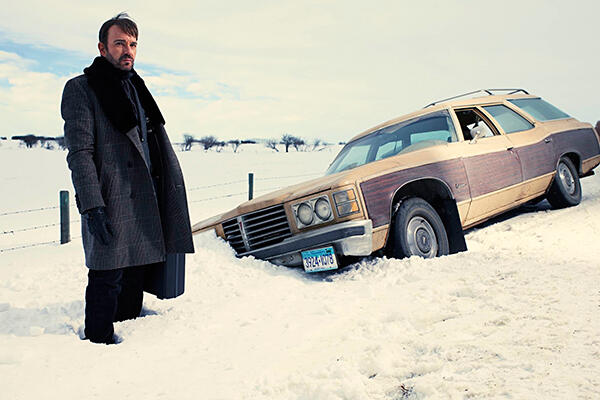
Idiosyncratic shows have to train their viewers how to watch them. But as television seasons get shorter, there is less time to do that. At 10 episodes, this year’s Fargo cuts right to the idiosyncratic chase. So, without giving anything away, here are some things I think you should keep in mind going in to ensure you and the show are really on the same wavelength. The A.V. Club’s Todd VanDerWerff wrote an article late in Breaking Bad>’s run about television and the clockwork universe. The idea is that some stories aim to present us with a complex array of moving parts, all of which serve a particular function within the story as a whole. Part of the thrill of watching Breaking Bad is the way things are set up early in the show’s run that pay off multiple seasons later. This kind of story is increasingly popular on television because it’s never really been possible to tell stories like this in a live-action visual medium before, but in the last decade and a half, largely thanks to the rise of cable, we have seen showrunners (that is, head writers, sometimes also directors) increasingly being treated as auteurs, a position previously reserved for film directors. And as television production has become more about realising one person’s vision, expectations have increased for television series to add up to one grand, coherent statement. Fargo is interesting because it rejects the tidiness of the clockwork universe. Like the 1996 Coen Brothers film, from which the series is loosely adapted, the opening titles of each Fargo episode claim that what we’re seeing is based on a true story. Accordingly, what unfolds across the 10 episodes is the kind of roundabout, plausible-but-unbelievable chain of events you might read a Wikipedia article about 20 years after the fact. Mundane Minnesotan life is suddenly injected with an uncontainable chaos, and the result is explosive and bizarre. For some shows, every element contributes to the over-arching story, but Fargo takes place in a universe full of conflicting stories. Some are routine, some are odd, and some are horrible, and they often cut one another off midway through. Clockwork universe shows have trained us to think that everything that happens which we don’t immediately understand the significance of is a mystery waiting to be solved. But narratives are just things we humans project onto sequences of events to help us make sense of them, and in a chaotic, unpredictable universe, the narratives we use to navigate everyday life are deceptively fragile. As such, Fargo rejects the clockwork universe style of storytelling in which every detail is meaningful in order to examine what we do when our personal narratives start to fall apart. Fargo’s characters make sense of their existences by telling themselves certain stories, and the show is interested in the ways these people behave when confronted with something that doesn’t fit into their world-view; some double down, some switch sides, and if they’re lucky, they manage to adapt, while holding onto their ideals. Fargo subscribes to a kind of “urban legend logic,” in which regular people get caught up in strange, unfathomable things, in order to test its characters. We can never really know if the stories we tell ourselves are true, and we can’t know how much weight to give to the unknown, the unconscionable, and the unthinkable. But by rejecting the clockwork universe and observing how people grapple with those narrative interruptions, Fargo suggests we can learn something about them, and maybe about ourselves.


