
Alex Wilson
Contributor
Articles by Alex Wilson
3 articles found. Displaying page 1 of 1.
-
Culture
 Issue 1 23/02/2014
The Wolf of Wall Street
Grade: A+ In recent years, economic disparity has permeated society’s political zeitgeist, questioning whether it is ethical for such a small percentage of the population to control so much wealth and power, while so many struggle on the way side. Wolf of Wall Street gives a face to some of that small per cent, revealing that their wealth comes from systemic predatory exploitation of that larger per cent. Based on the autobiography by Wall Street trader Jordan Belfort, played by Leonardo “I can do comedy, too” Di Caprio and helped along by Jonah “I can do drama, too” Hill, the film takes us through what can only be described as an exuberant fast-paced cartoon of a film that pulls no punches in portraying the lifestyle of these livewire tricksters and raconteurs that man the stock-trading floors of Wall Street. We see it all: Ferraris; mansions; whores; coke; Quaaludes; midget tossing; and anything that Belfort’s band of merry (mostly) men wanted. The idea being such a fast-paced life with unlimited means will lead to desire for unrestrained consumption for these “supermen” of industry. Which leads to what has been a major criticism of the film: glorifying these actions and not depicting the faces of those that were exploited. Warning, here lie spoilers: While there may be no narrative come-uppence for the central character, that’s kind of the bleeding point. Unrestrained capitalism leads to this gross corruption, ruthlessness and excess similar to Belfort’s. However, as a system, it seems impotent in handing out any reasonable penalty to those that exploit it. Belfort served 22 months in prison and now has to pay 50 per cent of his salary to his victims. To this day he still owes his victims over $100 million in restitutions, while he gets to live a life of relative luxury giving public speaking tours about how to sell fucking pens to New Zealanders with horrific accents. End of spoilers. While some reviewers say this film is glorifying the actions of Belfort, I would argue those people also would say the same about a film depicting the final days of Rome. If we argue that this behaviour is unacceptable and disgusting, maybe we should look at the world that we live in.
-
Culture
 Issue 21 01/09/2013
Pervert’s Guide to Ideology
Rating: 4/5 It’s hard to think of a film at this year’s Festival that is so perfectly equal parts educational and offbeat as this small Irish production about a Slovenian philosopher deconstructing some of the most influential films of the past 50 years. Slavoj Žižek is our phlegmatic guide to the cinema, using it to explore the deep-seated power of ideologies and how they resurface in seemingly unconnected locations such as Nazi propaganda films, the London riots, and Coke commercials from the 1980s. Žižek’s aim is a basic one: to show how film can (often unknowingly) reinforce the beliefs, desires and ideas deemed acceptable for society at large. While Žižek is largely successful in his aim, drawing a few laughs and making very astute observations, at times the whole process is strenuously convoluted. As Žižek jumps from film to film he also jumps from location to location. When discussing (what he refers to as) “The Taxi Driver” we find him delivering his lecture (and it is indeed a lecture) from Travis Bickle’s apartment. His message regarding The Sound of Music and its links to Coca-Cola is stoically delivered in a full-blown nun’s costume. It seems that Sophie Fiennes decided not to reel in her heavily accented pedagogue. If there was a script, it seems to have been discarded early on in the piece: Fiennes is perfectly happy to let Žižek stumble over his words, pause for extended periods and discuss at length ideas that make absolutely no sense to anyone bar possibly Žižek himself. In many ways, this is the film’s purpose. Why would a film funded by the British Film Institute be allowed to deliver its message in a way that invites such obvious barriers to clear communication, if not to deconstruct the film’s own ability to reinforce ideologies? However, while some points may be lost, this is still a great film. Žižek is a brilliant raconteur and theologian who skilfully turns what could be quite a dry subject into a fun-filled romp through the ages. The film is only let down, maybe, by the grandiose scope of his own ideas. The absent-minded professor for the internet age, perhaps?
-
Culture
 Issue 19 11/08/2013
Blackfish
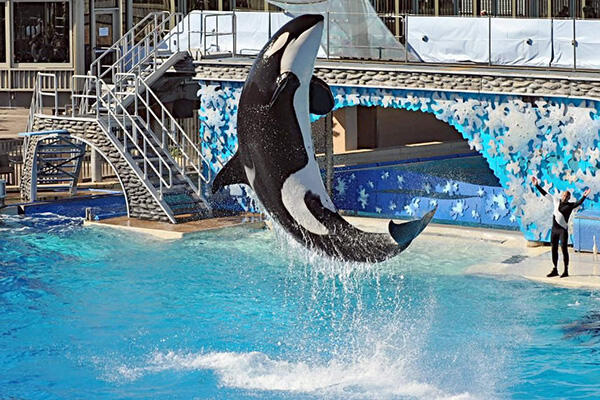
Rating: 3.5/5 The American summer draws to an end, and no doubt millions of Americans have now attended “Shamu Stadium,” SeaWorld, to see Orca whales wave their dorsal fins limply, jump through hoops and engage in bizarre aquatic acrobats with their perpetually smiling trainers. However, what those spectators would not have been aware of is the amount of complete bullshit they have been feed by SeaWorld to ensure that they go home happy, with a stuffed Shamu doll in tow. The biggest of these lies is that the whales are happy, when in reality SeaWorld’s chronic mismanagement has lead to multiple deaths of trainers and whales alike. In Blackfish, our “protagonist” is Tilikum, a young killer whale kidnapped in Icelandic waters and sold to SeaWorld. There, the threatment he recieves at the hands of his human “masters” leads him to fall into a downward spiral that Cowperthwaite argues could be a form of psychosis. Blackfish focuses on how keeping majestic beasts such as Tilikum in captivity is a sign of our cultural hubris. We reduce these animals to court jesters or, in SeaWorld’s case, profit-making slaves. Cowperthwaite is unapologetic in her takedown on of the system that has lead to Tillikum’s Titus Andronicus-like fall into psychosis, documenting over 30 years of abuses of power, sub-circus level living conditions and unreported attacks on trainers. This character study of the whales takes place through interviews with past trainers and “those that knew him best,” which at times makes the film feel like a Crime and Investigation channel special. Every trainer, whale hunter and past SeaWorld employee mentions that they saw the abuses of power that occurred and the slow descent of Tilikum into these dangerous and wild mental states. The moment when an ex-whale-napper breaks down as he recounts how he had to cut open a whale, fill its stomach with rocks and tie an anchor to its tale to avoid a “PR scandal” is particularly disturbing. These interviews are interspersed with amateur footage of whales attacking both humans and one another (something that has never been reported to have occurred in the wild) in front of hundreds of crying families. The central tenement of this mistreatment, the film argues, is that best practice often does not follow objective reality but rather the vested interest of big businesses such as SeaWorld. While the documentary’s anti-SeaWorld bias is unashamedly on display, it is worrying that SeaWorld “repeatedly declined” to be interviewed. The film may be slanted, but it certainly backs up its accusations with historical and scientific evidence that charges SeaWorld with relying on animal abuse to make a profit, putting their employees’ lives at risk, perjury and endorsing the hunting of endangered species. The documentary’s title is a reference to the name given to these animals by the Native Americans due to the majestic authority they assert in the wild. This is ironically contrasted with the way in which they are kept in claustrophobic water filled-sheds, released to a slightly smaller pond for a few hours a day to jump for SeaWorld’s many oblivious guests. Indeed, one of the film’s closing shots reveals that Tilikum is still performing to this day, leaving us to ponder whether this creature will feel the urge to “kill again.” The strength of Cowperthwaite’s film is not in making you feel for the humans who have lost their lives to the orcas, but in making you feel for the whales themselves. Tilikum comes across not as a dangerous animal but as an innocent party who has been abused, demeaned and isolated, making his actions completely understandable. As one of the many marine biologists in the film recounts: “try spending most of your life in a bathtub; see if it doesn’t make you a little psychotic.” Following on from previous festival documentaries Project Nim and Grizzly Man, Blackfish is a damning tale about how we cannot “tame” animals, given our current understanding of how these social and (undeniably) intuitive animals function. It leaves one with the feeling that watching a show at SeaWorld is tantamount to paying to watch torture.


