
Thomas Raethel
News Writer
Articles by Thomas Raethel
28 articles found. Displaying page 2 of 3.
-
Features
 Issue 22 08/09/2013
The Mysterious World of Bronies
In recent years, a bizarre new subculture has sprung up, based on fandom of the television series My Little Pony: Friendship Is Magic. Its predominantly male, adult membership call themselves bronies. But what do we really know about this group? Thomas Raethel investigated the subculture, and found a largely secretive group intent on writing its own story. It was 1982. The Falklands War was beginning, and Michael Jackson’s Thriller was at the top of the charts. American illustrator Bonnie Zacherle began to produce My Little Pony, a range of rubber dolls marketed towards pre-pubescent girls throughout the United States. Little could Zacherle have known that 31 years later, her trademark would spawn a conference in Baltimore that would attract roughly 8,000 attendees – primarily fully-grown men. 2013’s “BronyCon” was the third such annual conference, and is unlikely to be the last. The men and women who attended it identify themselves as “bronies” (a portmanteau of bro and pony), and have come to epitomise the flurry of subcultures that have emerged in recent years thanks to the dynamism of internet forums. The precise origins of My Little Pony fandom remain hazy. It has, however, been noted that increased interest in the brand coincided with Hasbro’s 2010 television revamp My Little Pony: Friendship Is Magic. Like many other subcultures considered perverse by much of the general public, bronydom has its roots in the infamous website 4chan.org. Initial conversations on 4chan in October 2010 largely involved animation enthusiasts watching the show ironically and sharing their thoughts in an objective manner. But objectivity soon gave way to subjectivity as the same critics began to adopt monikers used in the show. Nobody became “nopony,” anybody became “anypony,” and everybody became “everypony.” Bronies were quickly marginalised by other users of 4chan, and were effectively expelled from the community through word-filters and moderators. Independent websites were established for these migratory proto-bronies, facilitating a rapid expansion in numbers. Between May and August 2011, searches for “bronies” on Google exploded. Bronydom transformed from a fringe group on the oft-called “arsehole of the internet” to a fully-fledged subculture virtually overnight. Bronies share their origins with a number of undesirable siblings. A prime example is the “furry fandom.” In what can only be described as gentrified bestiality, “furries” participate in sex acts while garbed in full length plush outfits designed to imitate various members of the animal kingdom. Many early bronies were converts of fringe movements such as furry fandom: they channelled cosplay and My Little Pony into sexual fetishes, which may help to explain the development of practices such as “clopping.” Clopping is a phenomenon seldom reported by the media. It appears to be quietly suppressed by the far more vocal clique of bronies who claim to not participate in such activities. In simple terms, clopping involves masturbating to unofficial, sexualised images of the show’s characters. According to an internal study undertaken by bronies themselves, 19.05 per cent of respondents engaged in clopping. Considering that a significant percentage of bronies are closeted, and taking into account the stigma attached to such practices, it is fair to assume that the real “clopper” population is likely far larger. Most bronies, when asked, will identify with one of the main characters from the show on a deeply personal level. The main characters include Twilight Sparkle, Rainbow Dash, Rarity, Fluttershy, Pinkie Pie and Applejack, all of whose names suggest the mental age of the intended audience (with the possible exception of Applejack, who shares her name with a potent alcoholic beverage). An interesting development in the My Little Pony canon was the June 2013 release of a feature length film, Equestria Girls, in which the ponies introduced in the television series are transported to a different world, manifesting as (female) teenage humans. This rather extreme anthropomorphism echoes what has become a widespread practice in brony forums: humanising the My Little Pony characters. As such, some media outlets, including Slate magazine, have accused the film’s creators of pandering to a brony desire for sexualised My Little Pony media. According to statistics on Google, a rapid internationalisation of interest in bronydom is apparent. In a unpredictable twist, searches relating to bronies are rapidly gaining traction in Indonesia, a country that is 87.2 per cent Muslim. It appears, therefore, that bronydom may transcend religion (although a 2012 study revealed that 59.81 per cent of brony respondents in the United States consider themselves either atheist or agnostic). New Zealand has not escaped the brony phenomenon. No research has been done into the subculture’s development here, but an indication of its following can be gathered from the largest New Zealand brony Facebook group, NeighZealand. With 479 fans, the group is the largest of a considerable cluster of similar pages, which total roughly 1,000 members. Many more closeted brony New Zealanders probably exist, and it is possible that a sizeable minority choose to not use Facebook. A critical appointment in the show’s development was that of developer Lauren Faust, who had previously worked on the Cartoon Network’s The Powerpuff Girls and Foster’s Home for Imaginary Friends and had played an integral role 1990s “Disney Renaissance,” responsible for films such as Hercules and The Little Mermaid. In each of these offerings, adult themes and humour were subtly paired with animation to make the content easily accessible to children. However, unlike in the case of My Little Pony: Friendship is Magic, the majority of adult viewers were parents watching the films with their children. The average modern brony, it should be noted, is a single, heterosexual Caucasian man in his early twenties. In internal studies, bronies often cite the show’s artistic direction as the factor that draws them into bronydom. This differentiates My Little Pony from the older animations that attracted adult viewers. Whereas the older Disney films (and even the original 1980s series of My Little Pony) were nuanced and subtle, the garish colours of My Little Pony: Friendship is Magic are largely the result of the show’s digital origins in Adobe Flash. This could help explain the show’s appeal: adults on internet forums who have existing relationships with amateur, Flash-animated productions are more likely to be bronies than those who don’t. A surprising but inevitable development of the brony culture is the ever-increasing number of “pegasisters” (yet another portmanteau, this time of Pegasus and sister). Totalling 11 per cent of the brony population, these female fans remain a small minority. One explanation for this may be that female fans do not experience the feeling of social irreverence in which many male fans take pride; male bronies often derive a sense of satisfaction from their subversion of deeply rooted gender norms. Celebrities accused on brony forums of closeted bronydom include wrestler John Cena, celebrity chef Anthony Bourdain, musician Weird al Yankovich, and even President Bill Clinton. Whilst it is more likely that none of these men are participants in the brony subculture, less prominent celebrities have been seen donning Pony regalia openly in public, including music producer deadmau5. Bronies have justified their fixation by highlighting several key aspects of My Little Pony. The oft-quoted slogan “Love and Tolerance” is one of many attempts to attach greater meaning to what is essentially still a children’s television show. Unfortunately for bronies, the word “tolerance” has never once been uttered by any of the characters. The slogan appears to be the creation of adult fans who wish to impose their social disenfranchisement onto the ethos of My Little Pony. In an age where any group of people from virtually any corner of the globe can converge in a digital medium, increasingly unlikely subcultures are beginning to emerge. Bronies are one of many, but stand out in both number and perplexity. It remains to be seen how long the culture’s popularity will last. Bronydom will likely be seen in the future as an extreme example of the power of internet forums to facilitate nascent subcultures. EndnoteIt should be noted that in the process of writing this article, I found it difficult to locate studies relating to My Little Pony: Friendship is Magic fandom that weren’t conducted by bronies themselves. While it is reasonable that bronies show interest in the demography and characteristics of their own subculture, accepting many claims made by brony researchers requires a certain suspension of disbelief. For example, herdcensus.com has deduced that 4.0 to 6.8 per cent of the Internet-using US population “strongly identify” as bronies. This amounts to a population of between seven and 12.4 million. While the brony subculture has grown rapidly in the three years since its inception, an American followership two to three times that of New Zealand’s entire populace is clearly exaggerated, undermining the credibility of websites like HerdCensus. A documentary titled Bronies: The Extremely Unexpected Adult Fans of My Little Pony premiered on 4 November 2012 in Anaheim, California. I watched the film hoping to gather some unbiased information, but from the outset it was clear that the film is poorly shrouded propaganda. Criticism of the sexualisation of the show is quickly written off as right-wing sensationalism supported by media outlets such as Fox News. That aspect is thus largely ignored, and the majority of the documentary focuses on socially inept individuals who perceive their bronydom to be a vital social lubricant. The film explores the international popularity of bronydom, interviewing bronies from locations as diverse as Manchester and Tel Aviv. One of the principal researchers of bronydom is Dr. Patrick Edwards. His website bronystudy.com, formed with Dr Marsha H. Redden, serves as one of the more prominent outlets of brony academia. Studies relating to both bronies and non-bronies have been explored by Edwards. It appears that few of his findings, however, have been peer-reviewed by other psychologists. Vitally, Edwards’ son is a brony, and on the website’s Frequently Asked Questions page Redden admits that Edwards is “involved in other aspects of the fandom.” Whether due to a widespread ambivalence towards My Little Pony fans or an intellectual whitewash by determined bronies, conflicts of interest have led to an ill-researched and yet rapidly growing subculture.
-
News
 Issue 21 01/09/2013
Mosgiel Chainsaw Canister
A six-hour standoff took place in Mosgiel between police and a man who had locked himself in his garage with a running chainsaw. Critic is astounded at how long it took for the chainsaw to run out of fuel. After being called to a domestic incident on Murray St at 8pm on 22 August, police were forced to negotiate with the 30-year-old man, who had argued with neighbours prior to barricading himself in his house. The man appeared in the Dunedin District Court the following day, charged with assault. In an unexpected turn of events, as of 29 August the Armed Offenders Squad has failed to locate a bag containing tear gas and spare canisters that were taken to the scene. A police spokesperson said that “the bag [fell] from a vehicle in the vicinity of Street Andrew St and the Southern Motorway during an AOS callout to a domestic incident.” According to Inspector Greg Sparrow, the canisters – labelled “FLAMELESS TRI-CHAMBER CS” – pose no threat to the public if not tampered with. The cartridges resemble large shotgun shells, with distinctive blue text printed on a shiny aluminium exterior. Inspector Sparrow has urged anyone who finds the canisters to return them to Dunedin Central Police Station on Great King Street with “no questions asked.” As extensive inquiries into the disappearance have proven fruitless, an enquiry into what happened is now taking place. “An internal investigation is under way to determine exactly how the error occurred and to ensure it does not happen again,” confirmed Sparrow. CS gas has recently been utilised by the Turkish police in efforts to disperse protestors in Istanbul. Its effects can range from a mild watering of the eyes to vomiting, immobilisation and temporary blindness.
-
News
 Issue 21 01/09/2013
Shit System to Be Made Less Shit
The Performance-Based Research Fund is set to undergo changes in an effort to save time and reduce compliance costs for researchers. In a 26 August press release, Minister for Tertiary Education, Skills and Employment, Steven Joyce, confirmed that a review is underway. The Government plans to increase investment in the PBRF scheme from $250 million to $300 million per annum by 2016 or 2017. To make sure that the Government gets “the best value possible for this investment,” several objectives have been outlined. The research assessment process is to be simplified, reducing costs and saving time. Universities will be encouraged to employ and invest in new researchers. Particular emphasis will be placed on universities that attract research income from non-government investors. According to Joyce, the PBRF’s purpose is to “reward and encourage excellent tertiary education research by assessing research quality, allocating funding based on results, and publishing information on research performance.” He added that the fund “supports the Government’s wider science and innovation objectives by supporting research that provides and develops new talent.” The PBRF awarded the University of Otago $53 million for 2013. This amounted to 20.34 per cent of total PBRF funding, 10.32 per cent less than was awarded to the University of Auckland. The fund has been accused of facilitating an academic culture that encourages research at the expense of teaching. Among its critics is Associate Professor Gordon Sanderson, the recipient of John Key’s $30,000 Supreme Tertiary Teaching Award. After receiving his award earlier this year, he told lecturers that “[Otago] University is not very enthusiastic about teaching.” The PBRF has also been accused of incentivising creative accounting on the part of universities, who in the past have often drawn up contracts in order to maximise the amount of research occurring during the PBRF review period. Victoria University of Wellington took this approach in the latest round of PBRF, and ended up topping two of the four measures of research quality. Otago’s Deputy Vice-Chancellor of Research and Enterprise, Richard Blaikie, agrees that adjustments to the PBRF may be necessary. “The PBRF has been in place for a decade now, so a review is timely.” Regarding the University’s participation in the review, Blaikie added that “students and the OUSA should also be encouraged to consider submitting their views into the process either formally or informally by talking to the staff members,” as “one of the purposes of the PBRF is to support world-leading research-led teaching and learning at degree and postgraduate levels.” Blaikie addressed the issue of compliance costs associated with the PBRF in particular. “Compliance costs are high for the six-yearly quality evaluation component of the PBRF, which accounts for 60 per cent of the funding. However, the research degree completion and external research income components, which are evaluated annually through institutional returns, have very low compliance costs.” Blaikie acknowledged the time-consuming nature of PBRF rounds. “For the quality evaluation, the time required for academic and general staff to prepare evidence portfolios, enter and verify research publication data and meet other submission requirements has also grown in recent rounds, so we support the principle of the current review to seek ways to reduce both the financial costs and time-consuming nature of the exercise.” Addressing Otago University’s probable participation in the review process, Blaikie stated that “views from the University community” would be consulted. This would include “individuals, academic departments and schools, and service divisions.” Blaikie criticised the PBRF’s efforts in 2012, admitting that the process was “more time-consuming and cumbersome than it should have been. “Other flaws or potential improvements, which may be related to specific technical aspects of the process or discipline-specific issues, will be raised through the internal discussions that are currently being held in response to this consultation document.” OUSA President Francisco Hernandez supports the move, but has called for a similar fund to encourage excellence in teaching. “Funding for research is always good, but we think there should be a PBTF; some sort of performance based teaching fund that incentivises, encourages and rewards good teaching. “Good teachers lead to good research, as they inspire and encourage people to go on to postgraduate work. The link between them is quite clear. We don’t know why the government isn’t doing more to incentivise good teaching.”
-
News
 Issue 20 18/08/2013
“Sit Back Down,” Says Joyce
In response to the Otago Daily Times’ call to “Stand Up Otago,” Economic Development Minister Steven Joyce provided a rebuttal that was published by the newspaper on 10 August. In the rebuttal, entitled “Government Assisting Otago in Multiple Ways,” Joyce cited a $15 million contribution to the development of the Forsyth Barr Stadium, the $277 million devoted to the University of Otago throughout 2013, and, perhaps controversially, “encouraging petroleum exploration around the region.” Joyce went on to admit that “in Otago’s case, one of the real competitive strengths is tertiary education.” According to the government’s first official measurement of regional economic performance, Otago grew 16 per cent in the four years from 2007-2010. Among the other ways in which Joyce believed the government was assisting Otago were “encouraging the development of irrigation projects in the region,” the construction of an ultra-fast broadband upgrade throughout Otago, and a bypass on State Highway 88. Two days earlier, Labour’s Spokesman on Economic Development Dr David Clark labelled Joyce “wilfully or blissfully ignorant” after Joyce posted on Twitter that “Dunedin is growing with lots of companies adding jobs.” In an article on the Labour Party’s official website, Clark goaded Joyce to “get out of his Beehive office and get to Otago.” This came after Clark’s assertion that, at 7,800, Otago had reached its highest absolute unemployment figure since 1991. The job cuts at Invermay in particular have spurred the creation of a delegation that includes Dunedin Mayor Dave Cull. The delegation plans to travel to Wellington in the next few days to present the case for greater government interests in Otago. At a press conference on 14 August, Cull emphasised that boosting Invermay rather than destroying it would benefit the country as a whole. Environment Southland chairwoman Ali Timms added that Southland offers a different environment to Canterbury, where much of the Invermay workforce is set to be relocated. Cull called the delegation “probably a first” and “quite exceptional.” Deputy Mayor Chris Staynes added that “perhaps we haven’t been doing that as well as we could. I think today was a very positive step in that direction.” In related news, New Zealand First Leader Winston Peters has called for members of Age Concern Otago to “revolt” against the “dumb people in Wellington” who he alleges are responsible for Otago’s economic plight. Addressing the crowd of approximately 60 pensioners, Mr Peters highlighted Dunedin’s faltering economy. “This is more than just a university town. Dunedin should still be considered a major economic hub,” Peters said. According to Peters, the wealth from Otago’s export industries was being effectively “relocated.” He further cited National’s subsidising of developments of Tiwai Point in Southland. “How about an enduring, lasting hand-up for local industry here?” he asked. To Peters, regional New Zealand is being abandoned in favour of Auckland, which contains only a third of the country’s population. Peters encouraged the crowd of retirees to draw on their Scottish heritage as inspiration for the revolt. In a press release, OUSA President Francisco Hernandez agreed with Joyce’s detractors, stating that OUSA is “passionate about keeping and creating jobs in Dunedin.” Hernandez is concerned that there are insufficient local job opportunities for former students. “For students, Dunedin doesn’t need to be a part-time home. There should be more incentives and opportunities to stay and make Dunedin home,” said Hernandez. “Invermay is a significant part of the local knowledge economy, providing a place for students to study and work with top researchers in their industry. … With 60 joint research projects in the last five years, it’s clear that there’s significant knowledge transfer between the blue skies university and the applied sciences institute that is Invermay.” Hernandez concluded that “this is just another chunk chipped away [from] Dunedin’s knowledge economy.”
-
News
 Issue 19 11/08/2013
Provincials Reach For Their Pitchforks
A former presenter of New Zealand’s Funniest Home Videos has called for the formation of a political party devoted to the South of New Zealand. Dunedin businessman Ian Taylor formulated the idea in conjunction with the Otago Daily Times’ “Stand Up, Otago” front-page editorial of 3 August. The piece was aimed at mobilising people to fight for South Island jobs. Taylor spearheaded the movement in response to high-profile job cuts on the outskirts of Dunedin, and believed that a political party would “bowl in” to Parliament if it won seats in Dunedin, Southland and Waitaki. “Now is the time to take our future in our own hands and do something about it ... [to] come together and force the politicians to take notice. No-one else will. It is up to us to stand up and be counted and the best way to do that is from the inside,” he told the ODT. Located between Dunedin and Mosgiel, Invermay Agricultural Centre is set to lose 85 highly skilled jobs to either Lincoln or Palmerston North in 2016. This amounts to three-quarters of the current jobs at the research centre. Otago Chamber of Commerce President Peter McIntyre says he has heard rumours of “empire-building within Lincoln University,” suggesting deliberate poaching of Otago-based researchers. Taylor believes that more regional-based political movements will evolve with time, following similar lines to the party he has envisioned. He is particularly concerned with nationwide prioritising of major centres, stating that “we’re being left on the peripheries of this mad dash to rebuild Christchurch and keep making Auckland bigger.” Calls for an increasingly autonomous South Island echo previous movements in the 19th century, along with some more recent political activities. In the 1860s many of Otago’s more prominent residents called for secession from the North Island after the 1861 gold rush resulted in newfound prosperity. Premier Julius Vogel himself was well known for nursing secessionist tendencies in his early years. He was dismissed from his editorship of the Otago Daily Times in 1868 for encouraging an independent South Island. More recently, two political movements (each named the South Island Party) have attempted to enter New Zealand’s Parliament, one in 1999 and the other in 2008. The 1999 iteration secured 0.14 per cent of the total vote, and Richard Prosser’s 2008 attempt failed to register as a party. Prosser instead chose to merge with South Island First, a non-partisan pressure group whose website operates on the back of Amber House, a Nelson-based bed & breakfast. (amberhouse.co.nz/south-island-first.html) Meanwhile, 180 jobs are to be axed from Ruakura in Hamilton, the current base of Invermay’s parent company AgResearch. No plans for a seperatist Waikato political movement have emerged as of yet.
-
News
 Issue 18 04/08/2013
Waterway Revamp Minimises Leithal Floods
Otago University has agreed to commit $204,000 towards the development of a beautified Water of Leith, adjacent to the Clocktower. This sum is only a fraction of the $5.4 million that the Otago Regional Council expects to spend on the project over the summer. The funds have been sourced from local ratepayers. The University’s contribution is likely due to its status as a non-rateable property owner. Possibly the most striking feature of the development is a shallower right bank (opposite to the Clocktower), which will bring pedestrians virtually within paddling distance of the Leith. This development will feature a grassed flat area, with a floodwall expected to be approximately 0.8 metres higher than it was previously. Much of the work on the project has been planned to coincide with the summer holidays in order to minimise disruption to students. The key function of the landscaping is flood prevention, with Otago University’s share amounting to only half the superficial aesthetic costs. Plans for the revamp have been in place since 2004, when the Otago Regional Council first pitched the idea to Dunedin residents. The Water of Leith has endured many spectacular floods throughout Dunedin’s history. The current record for flow rate occurred in March 1929, with an estimated flow rate of 220 cubic metres per second. Floodwaters reportedly travelled as far as Dunedin Railway Station, and over 500 properties were damaged extensively. According to the Otago Regional Council’s official 2006 Flood Protection Scheme, the project aims to “enhance the recreational values of these waterways.”
-
News
 Issue 16 21/07/2013
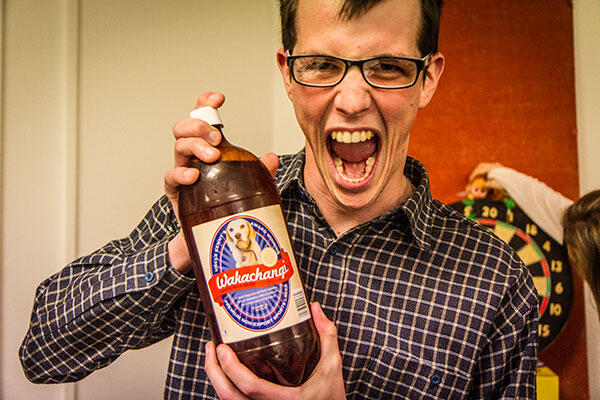
Wakachangi Beer Launch
Comedian Leigh Hart visited Leith Street Liquorland on 13 July to promote his new beer’s launch in Dunedin. Wakachangi Lager is to be primarily marketed toward New Zealand students. Hart told Critic that he considers the lager to be an alternative to brands like Speight’s. He admitted that the process of creating and marketing a new beer was a “steep learning curve,” only fully envisioning the beer “a couple of weeks ago.” “I’d been talking about it with my mates for a while, then we realised that Re O-Week was the last chance we had to roll it out to students properly before O-Week next year,” added Hart. Hart and his crew of promoters had previously visited Hamilton and Christchurch to launch the beer. “We sold out in 18 minutes in Hamilton.” In keeping with Otago students’ reputation as lovers of beer, three times the quantity of lager was needed at Leith Street Liquorland than the two other locations. The beer took only half an hour to sell out. Wakachangi Lager’s online advertising campaign, distributed via the Moon TV YouTube channel, has already garnered a cult following among students. One of the advertisements has had over 10,000 views in the eight days since it was uploaded. Hart believes the quirky humour utilised in the videos, as well as the bottle’s distinctive label, have widespread appeal, adding that “humour is non-geographic in New Zealand.” He deliberately chose to produce a “middle of the road” beer, noting that many of the new beers on the market are craft beers. “Beers like Tuatara are often a bit hoppy, and cost about 30 dollars for a 12 pack” – a price not suited to students. Hart said that the recipe they chose was the last one they tried, and is specially designed for the student palette. While Wakachangi’s range is currently limited to 2L bottles, Hart intends to roll out more conventional glass stubbie bottles in the near future. Wakachangi’s 2L bottles of lager cost $12.90, and contain 7.9 standard drinks.
-
News
 Issue 15 14/07/2013
Re-Orientation Week Happened | Opinion
As quite possibly Dunedin’s nonevent of 2013, Re-O-Week has been a constant disappointment for anyone with a brain stem. Only through a haze of excess alcohol consumption and synthetic cannabinoid smoke will people be led to believe they had a mean time. Too bad most of North Dunedin’s dairies agreed to cease selling legal highs during the inter-semester break. The week is not quite over as Critic goes to press. But one can presume that the Carnivàle of mediocrity that is Re-Orientation won’t be able to redeem itself in two meager nights. The flaccid music of a Shapeshifter concert on Saturday will do little to help. The most enduring of the week’s events will undeniably be the Illuminate Paint Party. Despite the party’s close phonetic resemblance to the dreaded Illuminati, it appears that paranoid bogans from every nook and cranny of the university swallowed their pride and took part in the world record attempt. Enthusiastically ignored was the lack of precedence for the record; nobody has before bothered to pretend that a paint rave is a feat worthy of a Guinness World Record. A smaller scale mini paint party was held on Wednesday afternoon outside Union Hall. A somewhat disturbing spectacle, the victims exchanged their presumably wounded dignity for a free ticket to the self-described “mind boggling” main event. A sort of fluoro-bukkake scene ensued, with the very last free ticket giveaway encapsulating everything that was wrong with Illuminate’s marketing. A girl, obviously a fresher, was subjected to a humiliating scenario that even the most hardened Japanese pervert would consider depraved. Whimpering as the cold, toxic sludge was squeezed over her, she did not look in the least bit enthused by the situation. In contrast, her tormenters were enjoying the shit out of it and pulling thumbs up to the camera, with nauseating grins all round. Such borderline sexual humiliation signaled a trend that has persisted throughout the week, beginning with a wet t-shirt contest that took place at Starters Bar on Monday night. The bar actually closed its doors prematurely in anticipation of the inevitable wave of cantankerous first year males, in the process making the contest a pseudo-VIP event. Predictably the Undie-Run 500 did not go ahead, but whether its cancellation was OUSA’s doing is still unclear. The looming spectre of The Cook still haunts the streets of Dunedin during Re-Orientation, though Starters Bar has largely absorbed the Cook’s fresher clientele. The Cook’s absence is at least partially responsible for Re-Orientation’s somewhat muted reception; the diseased aorta of Dunedin’s nightlife has finally been surgically removed with a rusty scalpel.
-
News
 Issue 13 26/05/2013
Busin’ like a bus
The Otago Regional Council (ORC) has been lobbied by several student bodies to discount Dunedin’s bus fares for both University and Polytechnic students. OUSA, OPSA and Generation Zero all submitted material supporting Dunedin bus reforms at a Council meeting held on 15 May. OPSA spokesman Mark Baxter predominantly cited the financial strain that catching a bus to and from Polytech inflicts on students, claiming that for a low-income student, a bus fare can represent as much as 20% of expenses. He then expressed his belief that “a lot more [students] would use it if they could afford to.” NZ Bus services in Auckland have introduced a tertiary discount, exclusively supported by Auckland Transport “Hop” Cards. With the card, verified students can save 38-42% on bus fares, depending on the distance travelled. In contrast, the Otago Regional Council’s current “GoCard” saves roughly 10% per trip, an obviously insufficient reduction for lobbyists. Generation Zero’s submission for reform largely focused on increased patronage. Harriet Leadbetter of Generation Zero told Critic, “the ORC should be encouraging patronage numbers through a number of measures, such as increased services on the weekends and more accessible timetables.” Generation Zero is also supportive of reduced fares, with Leadbetter stating that reductions are “a good way to encourage increased public transport use, which in turn helps to lower New Zealand’s transport emissions.”
-
News
 Issue 12 19/05/2013
Israelient
Last Tuesday afternoon, Otago University hosted Shalom Cohen, the former Israeli Ambassador to Egypt, for a discussion with students and staff. Cohen is currently the acting Israeli Ambassador to New Zealand. Mr Cohen spent much of the heated discussion addressing the recent “Arab Spring”; or in his words, the “Islamic Winter.” Cohen expressed a unique Israeli diplomatic perspective on the Arab Spring, an interesting opportunity for those in attendace, since Israel’s critical viewpoint is often overlooked by the press. When questioned about the Israeli bombings of Syria’s chemical weapons research facilities earlier this month, Mr Cohen was reluctant to comment. He later maintained that Israel does not want to intervene with Syria’s domestic affairs, calling the Assad regime’s atrocities “Syria’s internal business.” Mr Cohen did however express personal regret at the situation, with one of the audience members reminding him of the extreme hardships the Jewish people have suffered in living memory. As the ambassador to Egypt from 2005-2010, Mr Cohen oversaw diplomatic relations with Hosni Mubarak’s regime, which crumbled in February 2011. Mr Cohen observed that when first appointed as ambassador, Mubarak was a “very popular leader.” According to Mr Cohen, when protesters first appeared on the streets, they called for the downfall of Mubarak’s regime, with no immediate plans for the future made clear. “They just wanted Mubarak out.” Mr Cohen believes the “beautiful” Arab Spring has been “kidnapped” by groups such as the Muslim Brotherhood in Egypt. Egypt is one of only a few predominantly Muslim states to share full diplomatic relations with Israel, an upshot of the Camp David Accords in 1978. The Muslim Brotherhood, now the largest and best-organised Egyptian political force, suggested that a referendum may be held regarding the 1979 Egypt-Israel peace treaty only last year. Mr Cohen described observing the unique emotions amongst Egyptians in the aftermath of the 2011 revolution: “It is a beautiful thing to feel free, after decades of totalitarian oppression.”
-
Columns
 Issue 12 19/05/2013
Bouncing off the Halls | Issue 12
Our column this week begins with the tale of a young lady of Cumberland Courts. She challenged herself to engage in what Critic will describe as “French kissing” and “heavy petting” while on a night on the town. This, of course, is a game plan to which a sizeable chunk of Otago University’s clutch subscribes whilst indulging themselves in or around the inner city. What makes this girl’s actions sufficiently hedonistic to appear in Critic’s noble pages was her pledge to engage in such acts with no less than five unknowing young men in the course of one night. An outrageous number in itself, the girl beat her own goal by a total of 24 individuals. The 29 victims of her obviously intoxicating charms spanned social strata, with at least three hailing from the elite Knox College. These young men were joined by at least one City College student, proving that one affliction strikes all sectors of society alike: that of a harlot’s charm. We’ll now revisit Salmond College, which by all accounts is a goldmine of weird and wonderful tales of fresher romance. It is well known that at every hall, a small, exclusive group of students arrives well before O-Week. These students often form tight-knit friendships in this fleeting moment of calm and clarity before the degrading spectacle of Orientation. At Salmond, one of these friendships was soon taken to the next level, with a covenant established between two members of the college – a health science student with a knack for study, and a voluptuous young lady. In exchange for regular intercourse with the girl in question, the young man has promised to supply her with study notes, as well as to purchase and deliver whatever consumables she pleases from Gardens New World. The most compelling condition of this agreement, however, is the young woman’s main condition that the other party satisfies whatever depraved sexual urges she has in exchange for her full cooperation with the contract. As far as Critic is aware, this agreement is still in effect.
-
News
 Issue 12 19/05/2013
Ghosts write essays for cash
A nationwide made-to-order web-based essay service marketed primarily towards Chinese students has been uncovered. Assignment4U is registered with a New Zealand domain name, and markets itself as an “academic advisory” service. A 1,500-word essay ordered by Fairfax Media last week cost $270, gaining the fictitious student a B+ mark in a COMS101 paper. The essay was emailed to Fairfax only three hours before its deadline, suggesting that the essay was intended not as a study aide, but rather as a finished product for a student to hand in. Professor Vernon Squire, Otago University’s Deputy Vice Chancellor regarding Academic and International Affairs, reassured Critic that “the University has strong policies and procedures in place to deal with dishonest practices, including that of students passing off the work of others as their own.” When questioned about the University’s awareness of sites such as Assignment4U, Squire said he was aware of another site called NoteBoat. NoteBoat does not offer customised essays to order, but instead offers notes and essay examples from previous years. These would be detected by the University’s anti-plagiarism software if submitted. Squire added that “there have been no instances of students being caught using bought assignments that have been customised for particular courses.” However, the University has “disciplined” students who have “plagiarised material from online sites that offer prewritten essays.” Squire added that even if anti-plagiarism software were thwarted, “irregularities in regard to the performance of an individual student would be detected by lecturers or tutors.” A law change in August 2011 allows NZQA to prosecute owners of websites that advertise cheating services. These laws have not yet been used, but sites such as Assignment4U could serve as excellent test cases if sufficient evidence to warrant prosecution were discovered.


